










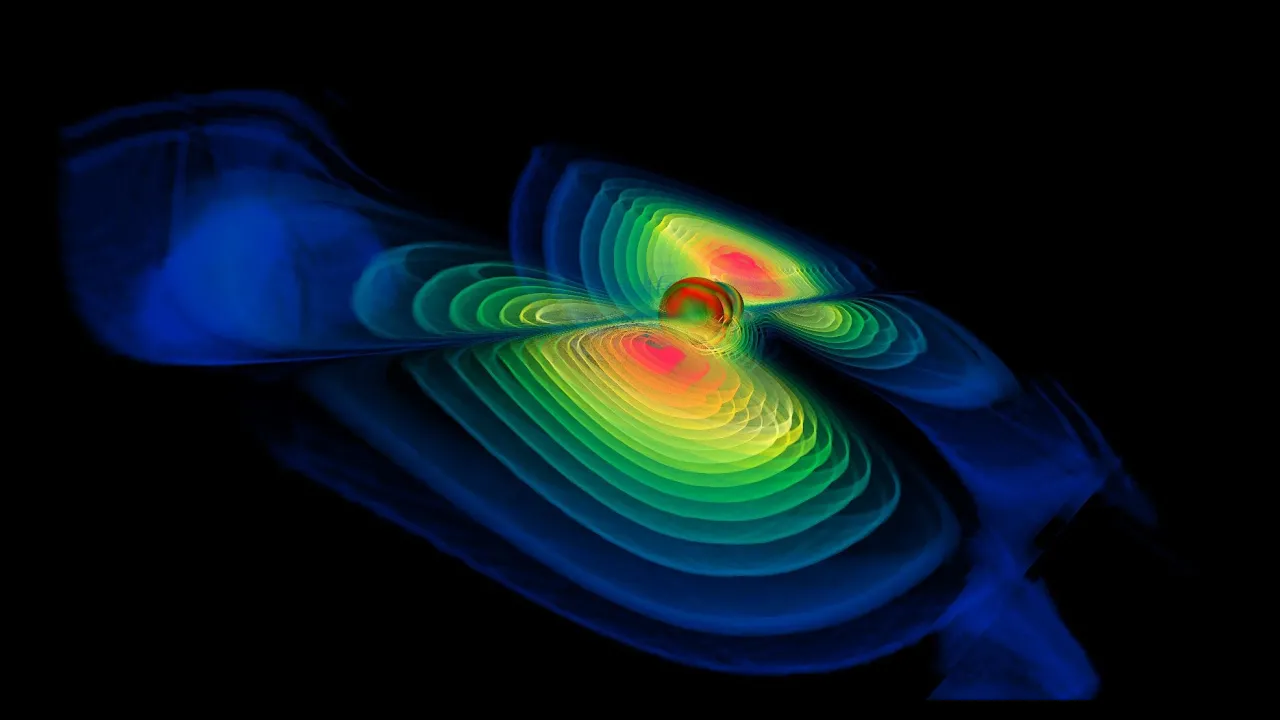




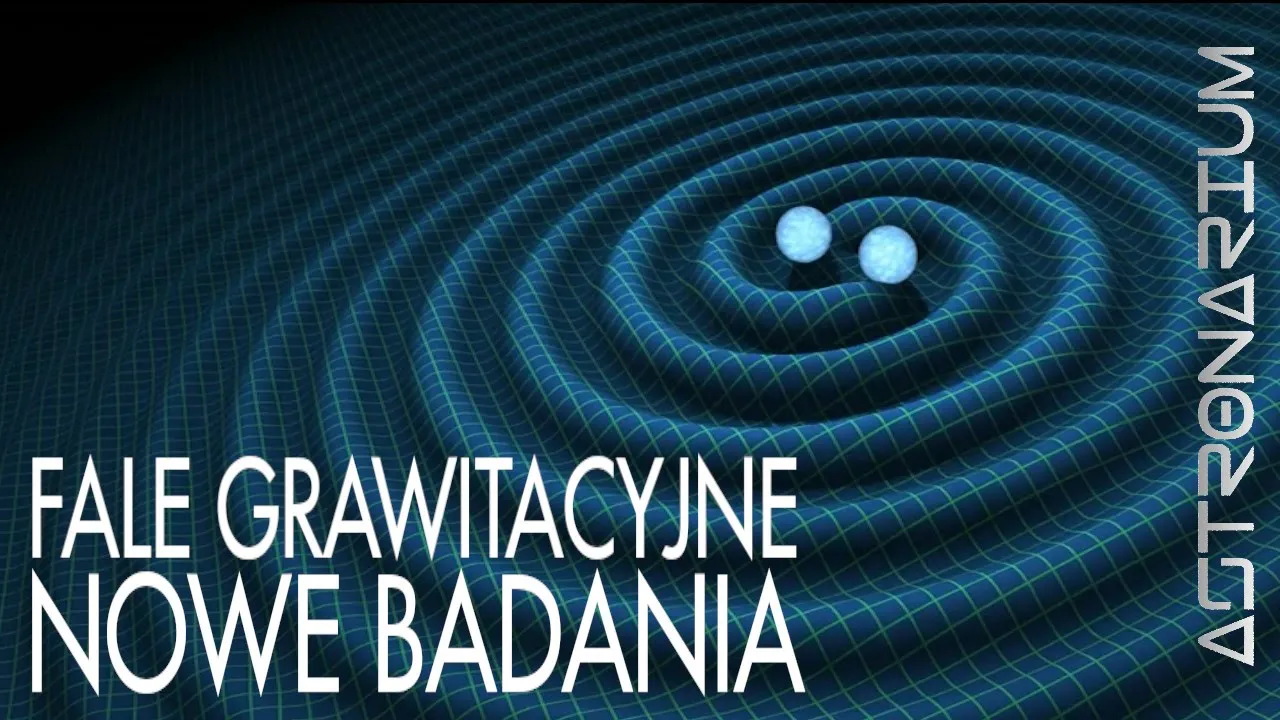
The motivation for building gravitational wave detectors was to create a new astronomical window, similar to Galileo's telescope revolution. Only gravitational waves and electromagnetic waves can carry information from distant cosmic events. This vision drove decades of effort to build instruments sensitive enough to detect these elusive signals, representing a fundamental expansion of humanity's observational capabilities beyond traditional electromagnetic astronomy.
Black Holes, Gravitational Waves, & Interstellar: Kip Thorne & Brian Greene in Conversation
Added:Einstein's General Theory of Relativity, specifically how mass and energy warp the fabric of spacetime.
The fundamental properties of black holes, including the concepts of the event horizon, singularity, and escape velocity.
The basics of wave mechanics, to understand how disturbances can propagate as waves through spacetime.
The concept of gravitational time dilation, where gravity affects the passage of time, which is crucial for understanding the physics of the movie 'Interstellar'.
The engineering and physics of LIGO (Laser Interferometer Gravitational-Wave Observatory) and how it detects subatomic-scale changes in distance.
The theoretical physics of wormholes, Einstein-Rosen bridges, and the energy requirements needed to keep them open.
The paradoxes of black holes, such as the Information Paradox, and how quantum mechanics attempts to resolve them through Hawking Radiation.
Multi-messenger astronomy, which combines gravitational wave detections with traditional electromagnetic (light-based) observations to study astronomical events.
262.1K views4.6Klikes3:45Original Release: 2025-12-05
Kip: My collaboration with Christopher Nolan is just a wonderful collaboration, a wonderful experience. He is a highly creative man, very different background from me, and he could ask questions of me that I would never have asked myself.
Brian: Hey, everyone. Thanks for joining us. Today we are going to be talking about gravitational physics, black holes, wormholes, gravitational waves, both from the science, of course, but also from the artistic and filmic perspectives. And I'm so pleased that we're being joined by someone who, for more than half a century, has been a pioneer behind our understanding of gravitational physics. He was the leading force behind the LIGO experiment, the Laser Interferometer Gravitational-Wave Observatory, that first detected gravitational waves back in 2015, for which he shared the 2017 Nobel Prize in physics. You've guessed who that is, no doubt, by this point. Kip Thorne, thank you- Kip: Thank you, Brian.
Brian:... so much for joining us.
Kip: It's a pleasure to be here.
Brian: Thank you.
Kip: You exaggerate, but thank you.
Brian: Not at all, not at all. So I thought we would begin with black holes, a subject near and dear to your heart. And if it's not asking too much, can we go just, for a moment, all the way back to John Michell and Laplace, the folks who even long before the general theory of relativity intuited the possibility of things like black holes?
Kip: Yeah. And so back in that era, the understanding of gravity was that of Newton. And nobody knew anything about the speed of light limit, but you could imagine an object that was so strong that whatever the speed of light was, that light couldn't escape it. And that's what John Michell did. And it was just very plausible that he was right, but they didn't know enough about the laws of physics to really be able to determine whether he was right.
Brian: Was there a reaction in those days to that possibility?
Kip: I don't know. I haven't looked into it deeply enough. Certainly, the real embrace of these ideas didn't come until awfully recently. And I presume that there was a lot of skepticism then, as there was in the 1920s and even into the 1930s and '40s and '50s and '60s.
Brian: For sure, for sure. So let's get into the more modern version, which takes us really to the trenches in World War I, Karl Schwarzschild.
Kip: Amazing man. Karl Schwarzschild was a great astronomer, astrophysicist. He's sitting in the trenches in World War I, and Einstein has just formulated his general relativity laws. And Schwarzschild reads about this, and he does a little calculation, and he sends Einstein a letter and says, "I found an exact solution of your equations." It quickly became named the Schwarzschild Solution, but it was a great mystery as to what it really described. It was perhaps the external gravitational field of the Earth, but I suppose you take the Earth away and you still have a solution, and suppose you go down toward the center, what's going on? And that's what it took decades to really sort out. It did turn out to be the gravitational field of a compact star, the gravitational field of a black hole, the gravitational field of a wormhole. It turned out to be all these things depending on just how you manipulated it.
Brian: And this was the first exact solution to Einstein's- Kip: It was the first, exactly.
Brian: Einstein himself didn't have an exact solution of his own equations, right?
Kip: Precisely, precisely. So it was rather momentous.
Brian: I mean, when you look in the textbooks, it can be very misleading because we clean up the history and make it all very logical and straightforward. But at least when you read Schwarzschild's textbook solution, it doesn't take that much. You makes some assumptions, spherical symmetry, aesthetics. So why didn't Einstein find that solution?
Kip: I don't know. I think his attention was mostly focused in other directions is primarily the case. I mean, he had so much going on intellectually in his life. He wasn't just doing general relativity at this time. He was doing other things in statistical physics. He was doing early thinking about quantum theory. It was amazing how many different irons he had in the fire in that period.
Brian: Now, he was a champion of this solution. It's not like you can imagine- Kip: Oh, yes. Absolutely.
Brian:...the letter shows up and he's, conveniently puts it into the waistband and does his own version of it or something like that. So he was very open and- Kip: He was very open to it, but it did have this very puzzling property that when you went down to a certain distance away from the center, called the Schwarzschild radius, not surprisingly, or the gravitational radius now, the mathematics goes singular. So one thing blows up, becomes infinite, another thing goes to zero, and it looks like time and space reverse rolls. It just looks crazy when you go to that location. So that came to be called the Schwarzschild singularity, and it was called that for decades. It turned out not to really be a physical singularity, but it was a singularity of the mathematics in the actual form that Schwarzschild wrote down the mathematics.
Brian: And so that was a puzzle for a long time. And it wasn't the only reason, but it was part of the reason why people, like Einstein, resisted taking this solution as seriously as, for instance, we take it today.
Kip: Yeah. So Einstein, trying to sort this out, imagine taking a star and shrinking it down to a very small size, and he couldn't shrink it down all the way to that radius. And he began to believe that maybe everything below there was in some sense fictitious. He just couldn't understand what was going on. It's not that Einstein was dumb. It was a real, real hard thing that did subsequently take decades to sort out.
Brian: And so as I recall, I think in the late 30s, Einstein even wrote a paper where he tried to specifically model a bunch of masses that would be in some spherical configuration. They were moving, and he tried to model them collapsing inward.
Kip: Well, he moved them in slowly. He didn't have the wherewithal, he hadn't even asked the question about a dynamical collapse. He said, let me shrink it smaller and smaller. And once it got down to something a little bit larger than this Schwarzschild radius, he couldn't shrink it any farther, and that was one of the key reasons that he was skeptical about what was going on below there. And it then required Robert Oppenheimer and his student Hartland Snyder to actually, for the first time, do a dynamical collapse of a ball of dust down through that radius and down to the Schwarzschild radius and then change coordinate systems, change the actual way the mathematics was being done and carry it all the way down inside there and discover, in Oppenheimer's own words, "We see that the star shuts itself off from the rest of the universe."
Brian: Cuts itself off.
Kip: Cuts off. It cuts itself off from the rest of the universe, which we, in the modern time, we recognize it has gone through the horizon of a black hole. It's left behind the horizon of the black hole, but that aspect of it wasn't understood until the 1960s.
Brian: Sure. Now in the Oppenheimer and Snyder work, if I remember correctly, part of the way they made a breakthrough was much like Schwarzschild, making simplifying assumptions that somehow still capture enough of the physics to give you real insight.
Kip: This is really one of the... I learned over the years the greatest minds of, the physicists with the greatest minds that I have met, and this included Oppenheimer, it included Yakov Borisovich Zeldovich in Moscow, they could somehow understand what simplifications capture the correct physics without losing the essential physics. Because most simplifications, you may throw away the essential physics, or you may not even be capturing correct physics, but Oppenheimer and Snyder succeeded in this.
Brian: And I guess part of their- Kip: In retrospect.
Brian: Right. And part of their assumption, I guess, was they assumed there wasn't undue pressure within- Kip: Yes. So for simplicity, they just assumed this was dust, so there's no pressure at all. And of course, skeptics then immediately said, well, that's not how things work in the real world. You put pressure in and it's not going to keep shrinking.
Brian: Right. They could say that the very reason it's shrinking is because you neglected the very thing that could push outward.
Kip: That's right. But in fact, it turned out that that's not the case. That once you put the pressure in, this still happens. But Oppenheimer and Snyder did not have the technical know-how to put the pressure in and keep going.
Brian: So what did it require for people to get to that point?
Kip: Well, I think what required, the key thing that happened, I think, was the insights of Roger Penrose for which he actually got the Nobel Prize a few years ago, a half a century after he did the work, more than half a century, in which he introduced, he brought into physics a branch of mathematics called differential topology, which had the capability to prove theorems that were so powerful that the theorems were correct whether you had dust or whether you had pressure. And he was able to prove that indeed you really, even with pressure, that there would be circumstances in which you would still form this horizon.
Brian: And did that convince the community at that point, or was it still- Kip: Well, it was really quite interesting that it ultimately convinced the community, but his techniques were sufficiently alien to physicists. They were familiar to some mathematicians, but sufficiently alien to physicists that it took a few years for the community to come around, particularly the community in Moscow. I had very close relationships with the Russian physicists early in my career and was commuting back and forth. So I knew these people. I discussed that this happened before I came on the scene. So what Yevgeny Lifshitz, one of the great physicists of that era, said to me is, "Kip, you cannot understand how alien to the human mind this business of what Oppenheimer and Snyder saw was, nor how alien to our minds the mathematics that Roger Penrose was introducing because it was just so different from what we were doing, what we had ever done." And he basically said, "It took us a while to really come around and understand." A while meant three, four years.
Brian: Right. But it is funny how what's alien to one generation just becomes the vernacular of the next.
Kip: It's just common sense.
Brian: But part of what was alien too, I presume, was there are two different narratives, two different stories that you need to tell if you're watching something fall to a black hole versus the story that will be told by the individual, unfortunately, who is passing into the black hole. Can you just take us through that because that's also deeply unfamiliar?
Kip: Yeah. So I'll be the one that goes through it.
Brian: Thank you.
Kip: But if I fall into the black hole or I ride on the surface of a star that's shrinking to form a black hole and you're outside, time for me, as you see time, my time slowing to a halt, so you see me going to slow motion then freeze right at the horizon because my time is halted compared to the rate of flow of your time. On the other hand from my point of view, time just flows willy-nilly forward, and I go through the horizon, and I keep on going. But once I'm inside the horizon, time flows in what you would have thought was a spatial direction toward the center, which is why one reason I can't go back, and I can't send signals back because nothing can move backward against the local forward flow of time. Now time travel might be possible, but only by going out in space and coming back before you started. You can't go backward against the local flow of time. You just can't. And so I go in, and I like to say inside the black hole, there's a down cascading time. Time is flowing inward. The technical phrase is that the light cone is pointing inward. But this is all invisible to you because you've seen me go down. And as far as you're concerned, I'm plastered on the horizon and frozen there, except that the last photon I emitted to tell you what was going on has long since reached you, and there are no more photons because photons are discreet. No more photons left to communicate to you what happened to me.
Brian: So there's two things worthy of emphasis there. One, your motion, as you described, once you pass the edge, the horizon toward the center of the black hole, locally is motion through time, so it is as inevitable that you're going to go toward the center as tomorrow becomes today.
Kip: Absolutely.
Brian: I mean, that's hard to grasp in its own right. But the second thing is how long or how do people reconcile these two radically different pictures? I mean, we used to say from special relativity, your clock is going slow. My clock, we can get our minds around. This one just seems so radically bizarre.
Kip: Well, I think we generally do it by finding a third point of view where everything fits together in a beautifully elegant way.
Brian: Like Finkelstein.
Kip: Yeah, so called Eddington-Finkelstein coordinate system. And so you basically, if you adopt this idea that space and time are unified, and you think in terms of four dimensional space-time and its properties, instead of thinking in terms of space and time individually, then everything, if you think about it for a little while and go read some decent textbooks, modern textbooks, it just becomes natural. It's obvious. It's beautiful. It's elegant, and it's a marvel to behold and fits beautifully. There's no paradoxes, no problem at all.
Brian: Right, with the two stories.
Kip: With the two stories.
Brian: But there is still a problem that remains about what actually happens right at that center point, that end of the time journey.
Kip: Down in the center there is a singularity, again, in the Schwarzschild solution, where we say the curvature of space-time goes to infinity, that the strength of gravity truly goes to infinity in any kind of a measure that you might try to introduce to measure the strength of gravity. And this is also something that Roger Penrose basically predicted. His theorem said something goes wrong because anything that falls in there can no longer exist. It basically proves using his topological techniques. But again, it then took quite a while after that to really sort out what was going on. And it turns out that that singularity in there is unstable, and that's not really what you wind up with. That when stuff falls into it, it changes its whole character. So by contrast with the horizon of a black hole, which is highly stable, you perturb it and it vibrates a bit and then settles back down. It's just so stable. You can't blast it apart. By the contrast, what's going on down beneath there is highly unstable. And when stuff falls in, the gravity of the stuff that falls in completely changes what's going on down inside the black hole. So as best we understand it today, and this is part of the backstory of the movie Interstellar, I know you don't want to talk about that yet.
Brian: But we will get there, for sure.
Kip: But there are three singularities in there, as far as we can best tell. Three regions with three different characters where Einstein's general relativity theory completely fails and you've got to replace it with a... And it completely fails in a way that isn't intimately entwined with the laws of quantum gravity, and the loss of quantum gravity take over and govern whatever happens in there. But so three regions with a weird breakdown in the loss of physics as we know them. So it was a much richer interior to a black hole than we ever knew a few decades ago.
Brian: And so if you go back to Einstein's hesitation, and this may not be historically accurate, but if you imagine that part of the dominant hesitation was the fact that the curvature goes haywire at the true center of the black hole, you can't fault him for- Kip: Oh no, not at all. And this is also a very interesting story between two of my Princeton colleagues, Robert Oppenheimer and John Wheeler. John Wheeler looks at the Oppenheimer-Snyder analysis and says, "You've got a singularity at the center. There's something wrong with your analysis. And when there's a singularity, all bets are off. I don't believe your analysis because that singularity is a signal that we've got to rethink the whole thing."
Brian: Right.
Kip: And Oppenheimer says, and there's a big confrontation between the two of them, at what's called a Solvay Congress in '56 or '57, in which Oppenheimer says, "Well, it's very simple. It just cuts us off from... The collapsing star cuts itself off from the rest of the universe and what happens down inside there has no influence on the external universe, so why worry?" And so they have this radically different viewpoint. And in fact, sorting out what happens with the singularity turns out to be absolutely crucial for modern physics.
Brian: Sure.
Kip: And John Wheeler is quite correct. And Oppenheimer is also quite correct that it has no influence on what's going on on the outside.
Brian: Right. Now, John Wheeler, if I, again please correct me, but he posited the possibility that there would be quantum processes at the center that would generate outward streaming radiation carrying away enough mass and energy to avoid the formation of the black hole itself. Wasn't that his vision?
Kip: Yeah, that was his vision, and that was what he was pushing when I was his graduate student. That's what he was pushing when we were writing a book together called Gravitation Theory and Gravitational Collapse. And that's where I told him, "We can't put this in there."
Brian: Oh, really?
Kip: "We can't put this in our book. It can't be right." And- Brian: And what did he say?
Kip: Well, he argued with me. And so I went and got all the big guns that I could find among his former students and postdocs and colleagues to lean on him. And finally, he gave in, and it does not appear in there. It appears in his other writings, but in our little book that we did together, it's not in there. And I forever regret this because- Brian: Radiation, yeah.
Kip:...John Wheeler had tremendous physical insight, and he didn't have the whole story correct, but he was basically intuiting Hawking radiation, which as we now understand it comes... And one of the deepest way to understand Hawking radiation was one that Steven Hawking and his colleague, James Hartle, worked out in which there actually is a connection to the singularity inside that gives rise to the Hawking radiation.
Brian: But that's interesting because the Hawking radiation as I... And maybe you're going to enlighten me in ways that... Usually we describe it as pair production, the event horizon of a black hole, one particle falls in, the other strings away and so forth. And it's the disconnection between that process and the center that sets up the so-called information problem. They were describing more of a link?
Kip: If you want to really prove that you're right on Hawking radiation, you got a problem because the Hawking radiation is basically triggered by, in Hawking's original calculation, vacuum fluctuations, just fluctuations of electron positron pairs fluctuating in and out of existence of photons. They flow onto the star, onto the black hole when the black hole is being born, and they suck energy out of the expanding space as the black hole is born. And all that radiation is created just above the horizon as the black hole is born, and then it takes millions of years to leak out. But there's a real problem that the stuff that leaks out a million years later. It has humongously high energy at the beginning, far, far beyond where the laws of quantum gravity have any right to. And so it was Hartle and Hawking that went in, and they did a very different calculation in which they basically turned time into imaginary time.
Brian: Sure.
Kip: And then so they were setting up a different way of thinking about it. But in this different way of thinking about it, a key role is played by the singularity at the center. They're basically having virtual particles that go in and out of the singularity at the center. Virtual particle can go faster than the speed of light. There's no information flow. But that analysis was the thing that finally I think got people who were highly skeptical to throw in the towel and say, okay, you don't have to pause it, pretend to think that this Hawking radiation forms with humongously high energies and then waits a million years trying to climb out with its energy decaying lower and lower and lower until it finally comes out, which feels like nonsense. So there was this period that was in the '70s, when this was all being sorted out, that when the tools that were used to sort it out were closely related to John Wheeler's in 1950s and '60s viewpoint on Oppenheimer that I did everything I could to prevent John from publicizing it.
Brian: And so did John ever say, "Hey, Kip. I wish we would've included that?"
Kip: No, no, no. No, but by contrast, because of this idea, he was totally skeptical about black holes. He was totally skeptical about Oppenheimer and Snyder until work by a student of Charlie Misner, by Beckedorff, who did a different way of analyzing Oppenheimer and Snyder's work that suddenly made it obvious that this made sense. And this was 1962. Quasars are discovered in '63. There's a big Texas symposium on relativistic astrophysics in '63 where people are struggling to understand quasars. And John Wheeler gives a talk about gravitational collapse, and that and the formation of a black hole as being what really is ultimately behind powering quasars. And John views this as his public apology to Oppenheimer because he's now saying Oppenheimer is right, and you really do form a black hole. He's not using the word black hole yet. But Oppenheimer sits out in the hall at that meeting. He doesn't deign to go into Wheeler's. There's been enough bad blood over the years between the two of them.
Brian: Oh, he skipped the talk.
Kip: He skipped the talk.
Brian: Really?
Kip: And Wheeler comes in. I was there. I was with Wheeler. Wheeler comes out and sees that Oppenheimer's out in the hall and he wilts.
Brian: Yeah, I can imagine.
Kip: His apology and Oppenheimer didn't... And so it was a momentous moment in the history of science that, of miscommunication between these two great men.
Brian: And was it an arrogance on Oppenheimer's or just a- Kip: No, no.
Brian:...feeling bad?
Kip: I don't think so.
Brian: Or what do you think the emotion was?
Kip: I think he was just... I don't know. I didn't know. I knew Wheeler better than I knew Oppenheimer. Certainly Oppenheimer is capable of arrogance, but I don't think so. It's more my impression that it's just that he had had it with these arguments with Wheeler, but I don't know.
Brian: Right, right. Just fed up a little bit.
Kip: Yeah.
Brian: Now you said that, excuse me, Wheeler wasn't yet using the term black hole. Ultimately, he does. He's actually credited in some stories as having named them. Is that correct?
Kip: Well, the phrase black hole was used by others earlier in this context, but Wheeler was unaware of it, and it didn't catch on. And Wheeler introduced it in 1968, as I recall, in an article that he wrote. And he doesn't say, "Let's call it a black hole." It's vintage Wheeler. He just writes it as though we had always called it a black hole, and suddenly people, everybody does.
Brian: Now, I heard a story that there was a conference on 112th Street and Broadway at the Goddard Institute for Space- Kip: Well, I was there.
Brian: Oh, you were there?
Kip: I was there, yeah.
Brian: And the story that I heard was that somebody in the audience, as John Wheeler's talking about these objects says, "Oh, that's like a black hole."
Kip: So I don't remember that. I was there.
Brian: Ah.
Kip: I've heard the story, and that may be, but certainly it didn't stick at that time. And I don't think it probably had any influence on Wheeler at that time.
Brian: I see. I see.
Kip: This is- Kip: The influence on Wheeler at that time.
Brian: I see. I see.
Kip: This was probably '67, I think. I think it was a year before John started using the phrase. John understood the power of words. He spent a lot of time crafting phrases and words to describe things. As he described it to me, he liked to lie in a warm bathtub, and just think about what is the right phrase to use. Now, it could be that he was triggered by that a year or so earlier, and didn't remember it at all, but in the back of his subconscious, remembered it.
Brian: What was it like then working with John Wheeler who cares so much about language and words on a book that winds up being, I don't know, 1,200 pages dense with words, pictures, equations, and so forth.
Kip: The second thickest books I ever wrote.
Brian: Yes.
Kip: No, that was a real pleasure. That was an enormous pleasure. This book, Gravitation, was a textbook on relativity. We finished it in 1973, and published it in '73. We began at about '68. It took about five years. When we began it, general relativity was truly and had been for the preceding several decades, more a province of mathematicians than a physicist. John felt, and I certainly agreed, as did Charlie Misner, that there was an issue that mathematicians is great and the mathematics is crucial, but that you really need physical intuition as a tool, if you're going to make rapid progress. Calculations can be slow, tedious, and complicated. You've got to be able to decide what's worth calculating. You develop physical intuition as a tool for making those decisions of what's worth calculating. Then you intuit something, then you go in and do a calculation, you see whether you're right or not, and you get the details right. The foundation for physical intuition, for John, for me, and for Stephen Hawking, was pictures, mental pictures or diagrams that you draw, as well as words that go along with those pictures. The ratio of words and pictures to equations in that book has absolutely never been seen before in any relativity textbooks. It's a book that is designed to try to teach physical intuition to a new generation of physicists who are just beginning to get interested in relativity because quasars and pulsars have recently been discovered in the cosmic microwave background. Suddenly, it's relevant to the astronomical world. We need to build a generation that thinks physically. That's what the purpose of the book was. Bill Press, who was a student of mine at the time... Brian: He was my advisor when I was an undergraduate at Harvard.
Kip: Okay.
Brian: Look at that.
Kip: You're my grandson.
Brian: Grandpa!
Kip: Bill comes in. We've just distributed to the people in my research group a draft of a chapter from this book. The chapter has a dialogue between [inaudible 00:35:16] and Segridas about what is a black hole. It is very much a Wheelarian thing. Bill slaps that down on my desk and says, "Why the hell did you let John Wheeler write something like this in your book?" I said, "With great pride, I wrote that. I'm capable of writing in Wheelerian style."
Brian: Fantastic.
Kip: I agree with John. That we need to be building up physical intuition, and this is part of it.
Brian: Absolutely.
Kip: That was one of the joys of working with John Wheeler.
Brian: Now, one thing in that book, which is interesting to me is that when physicists typically learn the mathematical methods of general relativity, differential geometry to be concrete, most physicists learn it in a so called coordinate form, which is the more nuts and bolts ingredients necessary to really carry out certain kinds of calculations. You're at great pains in that book to do both the coordinate version, and the coordinate-free version, which is perhaps maybe the way more mathematicians think about things in a more global perspective. It's powerful to have both. But was this your bread and butter or did you and John, did you need to study to learn that stuff or was it already how you were thinking about this?
Kip: That was the way Charlie Misner was thinking. Charlie was very, very deep in the mathematics. John was an enthusiast for mathematics. He was capable of doing deep mathematics. Let me just tell you a little side story.
Brian: Please.
Kip: One day, John had a reputation in my era, and going back a decade or two, for not doing much mathematics, for a reputation for functioning on physical intuition. One day, I was sitting at Caltech in a party with Richard Feynman who had been John's student several decades before me. We were both a little inebriated. He was reminiscing. He said, "Yes, I remember when Professor Wheeler," he always called him Professor Wheeler. I called him Johnny. Feynman says, "I remember one day Professor Wheeler and I were doing a calculation together. Professor Wheeler went from this step to that step. I didn't see how he got there. He showed me. As he'd showed me, he said, 'Little steps for little people.'" Now, John Wheeler was the most polite person I ever knew. I never saw him do anything impolite like that. Now, it's clear that Feynman was full of himself as a graduate student. Wheeler felt that he needed to be taken down a notch or two.
Brian: Wow.
Kip: Wheeler did. But the fact that he could was an indication that he really himself was quite deep in the mathematics.
Brian: That is so interesting.
Kip: He could outthink Feynman. Of course, he had more a number of years behind him. Feynman was just getting started. But still... Brian: But Feynman is... Kip: Feynman is phenomenal.
Brian: If I can just give one story that you may be familiar with too. I was taking quantum field theory with Sidney Coleman. Sidney Coleman, I think this was an act that he did every year that he talked quantum field through. I don't think it was spontaneous. But he put up some problem on the board. He said, "Let me first show you how Feynman would solve it." He turns dramatically to the board, puts his hand on his head, and then writes down the answer. He said, "Feynman, he can just do all those calculations in his head. We, little people, have to do step by step." For Wheeler to play the same on Feynman is sort of astounding.
Kip: It is astounding. But it really showed. Feynman still remembered this with chagrin.
Brian: Wow.
Kip: It showed what he was capable of. Back when we were writing the book together, he was embracing what for physicists was new mathematics. But coordinate-free notations, thinking about things without coordinate systems, which is part and parcel of the unification of space and time that was central to really understanding what goes on inside black holes. Wheeler was enthusiastic about it. He was embracing it. Charlie Misner was much deeper than either of the two of us in the mathematics. I was learning it from the two of them. I brought to this an understanding of the astrophysics, but not the kind of depth in mathematics that the other two.
Brian: Yeah, what a wonderful experience though to be learning, contributing, and creating something timeless as that book. Now, one of the other things that I deeply appreciated about that book is you had track one and track two. Track one was for maybe the beginner. Track two, the person wants to go more deeply, which is a great structure. From that point on, when I read your book, for years when I would give a technical lecture, I would do, here are the track one slides, here are the track two slides, and try to appeal to a broader group of individuals who could follow the ideas. But perhaps maybe not the mathematics, which I think is a powerful way of going about it. But back to black holes then. By what era would you say the community had pretty much been convinced, through all of the things that we've discussed historically, that these things should be real?
Kip: I think depends on which community. There were people like Phil Morrison at MIT, very highly respected, a superb astrophysicist who never, ever embraced black holes. After they died, the community was convinced.
Brian: Is that the famous adage that physics progresses one funeral at a time kind of thing?
Kip: I hadn't heard that one, but yes. But certainly the younger generation, the people who were learning stuff and thinking stuff through, my generation had all embraced this, and had, I think, a very clear understanding by the early to mid 1970s. It took some of the older generation another few years beyond that. But certainly by the 1980s, it was pretty universal except for a very small number of people who hung off on till death.
Brian: Psychologically, for those who were convinced, were they waiting for observational confirmation or it was just a foregone conclusion?
Kip: The observations were coming in on things related to black holes. There were a number of black hole candidates in the sky. The gravitational waves didn't come along until decades later. But electromagnetic observations, we were learning about the cosmic microwave background, and we were learning about black holes through quasars, pulsars, and jets sticking out of galactic nuclei, and so forth. That the theories that were being developed and the models that were being developed were by 1980s were pretty much right on.
Brian: For instance, additional data that ultimately was awarded the Nobel Prize, observations of stellar trajectories in the center of our galaxy, was that viewed as just adding to the mountain of evidence?
Kip: I think there was always a worry, I would say, a worry of hope that there was something wrong. I saw over my career some huge surprises where we were wrong. For example, the acceleration of the universe, which I didn't believe until there were several very different pieces of data that insisted the universe was accelerating its expansion. I saw things like that, that were sacred to me. It was just obvious that there was no acceleration of the universe. We really did understand that the cosmology of the early universe, and my nose was rubbed in it. That has associated with it, huge potential surprises that we still haven't sorted out. I'm always hoping that something will similarly be wrong with black holes. There's something going on at the horizon. We've got it wrong. Going all the way up to the present time, I'm certainly a strong advocate of going in and really pushing the observation really hard to be sure that we're right, and hope that we're wrong because it'll lead to a revolution.
Brian: The Event Horizon Telescope, the images when you first saw those, what was that?
Kip: They were fabulous, just to see it, just to see it. But for me, the key thing there is to see movies. There has been various skepticism and complicated plasma physics arguments over how the jets are launched from the vicinity of a black hole, as we see jets sticking out of black holes. How are they launched? There are very interesting and probably correct theories and models related to it. I began with the so called Blandford-Znajek effect. But there are skeptics in the plasma physics community. I can't be absolutely sure that skeptics are wrong. I want to see a movie of the launching of these jets. That's what I think we will ultimately get from the Event Horizon Telescope. I'm just waiting for them to come out with movies now, not of the black hole in M87. Because that's such a humongously big black hole.
Brian: Timescales.
Kip: Movie's just too long a timescale. But the black hole in the center of our galaxy. That is technically very, very difficult. But that's where the really exciting payoff from the Event Horizon Telescope is going to come. It could come most anytime. I don't know precisely where they stand.
Brian: Yeah. I've had conversations on occasion with Shep Doeleman. Movies has certainly been the top next step. But timescale, I don't know. But it's interesting that you're still open to the possibility that our understanding may need to be fine-tuned or changed in some way.
Kip: It may be much more than fine-tuned. As I say, I've seen several huge surprises. I have come to believe that there are situations where we're not as smart as we think we are, and where we're quite sure of things that will turn out to be wrong. You take any given thing. I look at it, and say the odds that were wrong there are pretty damn small, but we're going to be wrong somewhere among things that we hold near and dear to ourselves. We should work very hard to search for a failure.
Brian: By any chance, there is a proposal in string theory. I don't know if you're familiar with the Fuzzball proposal, Samir Mathur, Ohio State University. This idea that maybe black holes are not the thing that we've long thought there. Maybe they're closer to an entity. It could be a agglomeration of strings and other membrane-like objects within string theory. He finds it can mimic the features of a black hole, but if you really got in, and looked at it with adequate resolution, it wouldn't be what Schwarzschild wrote down per se. Is that a thing that you can imagine?
Kip: Now, I don't know much about that. I do know other speculations about what goes on at the horizon. Let me just make a remark about string theory.
Brian: Uh-oh.
Kip: No, I think that string theory and the laws of quantum gravity are the most important and the most interesting area of physics. They have been for several decades. They will be for a few more decades. I haven't touched them with a 10-foot pole because I need elbow room. I'm not happy if I'm working in a community where there are huge numbers of people working. They're all really smart. My mind works slower than any of theirs do. I need elbow room. I've stayed clear of that. But I admire you and your colleagues who do this. I follow what goes on at sort of a semi-popular level, and keep hoping for big surprises.
Brian: Sure. Yeah. No, we are hoping too. Yeah, it goes both ways. When you do have a lot of people working so closely, we find that things do go in fads. An idea catches on. It spreads through the community through no other reason than excitement and wanting to make progress, which weirdly online you do have these people having conspiracy theories about how we're trying to shut out every... It's not. It's excitement. It is a group of individuals that do work closely. The elbows are touching, as you're saying. That's sort of a good thing and a bad thing about it all. But with that, maybe we could turn to the next arena in which you've had a tremendous impact, which is gravitational wave physics. We can't go as far back, I don't think, as John Mitchell or Laplace or anybody here. But we can go back to Einstein in 1916, 1918. He writes a couple of papers that suggest this possibility, but he himself, I don't know, is a little confused. It goes back to coordinates, and how to really determine what's real in your mathematics. Maybe you can just give us a sense of what that story is.
Kip: Yeah. Yeah. Einstein, 1916, he formulates his general relativity theory in 1915. He writes his first paper on gravitational waves in 1916. He's pretty confused in that paper. He recognizes it rather quickly. Basically, in some sense retracts it, does it write aside from maybe a factor to run formula in 1918. But at that point, I think it's my impression that he really believes in these as physical gravitational waves. But there is a lot of confusion over that. He has moments later on when he has misgivings, but I think they're only moments.
Brian: Oh, really?
Kip: That's certainly my impression.
Brian: Yeah. I got the impression that he was a little more skeptical, but I haven't really delved into it in detail.
Kip: Certainly, that's my impression that there are moment, a month or two, when he's having some cold feet. The central thing was how do you describe the gravitational waves in a way that is absolutely clear physically, that it has a physical reality. This ultimately comes from something called the equation of geodesic deviation that is formulated around 1956, '57, '58, by Felix Pirani in London. He identifies something called the Riemann curvature tensor as the thing that stretches and squeezes. He says, "If you begin with two particles, and they're running alongside by side with a fixed distance between them, then this Riemann curvature tensor," which has nothing to do with coordinates, it is a true geometric object, and everybody agrees on that, "That it actually squeezes and stretches the space between the particles. They move back and forth relative to each other." But it's only then. I think he publishes it in '58. He has it in '57 or '56. He talks about it at a famous conference on general relativity in Chapel Hill, North Carolina in '57, and then publishes it the year later. But it then becomes the foundation for Feynman, Herman Bondi, and others to start thinking about this in a totally physical sort of a way.
Brian: Then people, at least one person starts to think seriously in those older times about detecting these, way before LIGO.
Kip: This is Joseph Weber. Weber, he has already just before this, he in some ways is a disciple of John Wheeler. He is a professor of electrical engineering at the University of Maryland. But he's interested in gravity and gravitational waves. He goes with Wheeler to Leiden when Wheeler has a sabbatical in Leiden, Netherlands. They're there, so is Charlie Misner, and a few other people around Wheeler. They're thinking about gravitational waves together. We have no evidence that he's thinking about any detection methods in Leiden yet, though he might have been. But there's no evidence of it. A few months after Leiden, is this conference in Chapel Hill where Wheeler and Weber together present the analysis of gravitational waves, but not with of an experiment, but a mathematical analysis that emphasizes the physical reality of the waves. Then it's immediately after that, that he is thinking about gravity wave detection. That we have evidence he's thinking about it. '57, '58, he's beginning. He even writes a little textbook of his own on general relativity.
Brian: Really?
Kip: That is a nice little textbook, unconventional approach, but one in which it's clear that he's thinking about it from a point of view of experiment, and building things that will measure the stretch and squeeze of space. He then actually starts to put together an instrument in gravitational waves, and works on this until '69. In spring of 1969, there's a conference in Cincinnati, Ohio, at which he announces evidence for having seeing gravitational waves with his instrument, which is a large cylinder. The equator of the cylinder is amounted crystals called piezoelectric transducers, which when they're squeezed ever so slightly, they develop a voltage across them. Then he's instrumented to see this voltage as this twistal squeezed back and forth by a gravitational wave.
Brian: It's very clever.
Kip: It's a very clever. It's clever to the point that other people keep pushing on that particular technology until we and LIGO have better sensitivity than they do. But that's not until about 2006, 2007. This technology that he invents, that he conceives, keeps getting pushed by some very good experimental physicists from then in the '60s all the way up to 2006. 40 years, basically.
Brian: Wow. Just to give people a sense of the challenge, what sort of squeezing and stretching would they need to be able to detect that?
Kip: They were hoping that if they stretched and squeezed a bar that's a meter long, that by an amount that is, say, a sizeable fraction of the nucleus of an atom, that that would be enough. We know today, it was not enough. That you need something that is quite a bit smaller than that. But that was where he was headed. It was astounding that he could do, as well, as he actually did. But it wasn't nearly enough. In retrospect, we know it wasn't nearly enough.
Brian: Was he ever convinced that he had not detected gravitational waves?
Kip: No, I think he wasn't in the end up until his death. He believed, after Charlie's death, "Nobody has precisely replicated my experiment. I'm seeing something. I don't know for sure it's gravitational waves, but I'm seeing something. Nobody has precisely replicated what I've done. We really need to sort out what it is I'm seeing."
Brian: You're convinced though that he was not in no way... Kip: Yeah.
Brian: Yeah. When was... Kip: It took a few years to get to the point where I was convinced that he wasn't seeing them. Negative experiments by a number of different groups, I was hopeful that it was fairly quick that I began to think he probably wasn't.
Brian: Were you rooting for him or did you want it not to be so the field would still be... Kip: I was absolutely rooting for him, absolutely rooting for him.
Brian: Okay. Then where did the idea of a new technology that ultimately succeed it come from?
Kip: The new technology was that you have mirrors that hang from overhead supports. You have laser beam bouncing back and forth between the mirrors. You use a technique called laser interferometry to monitor the motion of the mirrors. That idea was first conceived by Mikhail Gertzenstein and Vladislav Pustovoit in Moscow just a few years before I started developing my close collaboration with the physicists in Moscow. I knew them well. They were theorists. They didn't really understand the noise sources that this instrument would face. They just had the idea. They had the idea clearly before anyone else did. The idea was fairly obvious once you began to think about it. It was in the air. But it was Ray Weiss at MIT who had the idea completely independently in the mid to late '60s, who then carried out, after doing some experimental work to see various things like whether he could get a laser down to its so called shot noise level and some things that would be required. He wrote a technical paper in 1972 in which he described this radio detector. He analyzed, he identified all the major sources of noise that it would face. For each major source of noise, he conceived a way to deal with it. He then analyzed how far down he could push that noise source by the method he conceived of doing it. He concluded then that if he were to make this instrument a few kilometers long, he might have a shot at seeing gravitational waves. This paper, interestingly, it's an absolutely classic paper. It's the most prescient paper in this field that was ever written as far as I can see in... Kip:... field that was ever written as far as I can see, the most important paper really. He didn't publish it in a journal. He published it in an internal progress report series at MIT 'cause he thought you shouldn't publish it until you've actually built the detector, maybe seen gravitational waves. This is Ray.
Brian: Right. Yeah, yeah, yeah.
Kip: Who became one of my dearest friends. But he sent this out to colleagues. And so I got a copy, he sent it to me. It was [inaudible 01:02:35] at the time that I was... I had been thinking about gravitational waves and their detection, and what you could do with gravitational waves for astronomy for a few years. And Bill Preston and I had just written, or were just finishing our first paper on a vision for gravitational wave astronomy. And so this thing comes in from Ray Weiss, and I look at it cursorily, quickly. And I am at the same time, we are about to send to the publisher the manuscript of our book, Gravitation, with Charlie Misner and John Wheeler. I look at it and it just seems to me crazy to think that it could succeed. And so in this manuscript that's about to go to press, I write a brief description of this technique. And then it's an exercise for the reader to explain why it's not very promising. Our book goes off to press. And then on and off over a period of about three or four years, I keep thinking about this. I have long conversations with Ray Weiss. I have long conversations with Vladimir Braginsky in Moscow, and I gradually become convinced that it has a shot at succeeding.
Brian: But a shot at succeeding, it's still audacious.
Kip: Well, it's going to be very difficult. But by 1976, I guess it is, by autumn of '76, I think November of '76, I'm convinced it has a good enough possibility of success that because the payoff would be so enormous if it does succeed, that I decide Caltech ought to get into this business.
Brian: Now when you say the payoff, I guess there's two ways to look at it. One is you're confirming a prediction of general relativity- Kip: Big deal.
Brian: Or you're opening a new... That's what I'm wondering. Was that the driver or was it opening a new window of astronomy?
Kip: Totally opening a new window of astronomy.
Brian: Okay.
Kip: It was to just confirm the existence of gravitational waves, what was going to be several decades of work and enormous effort. I was going to spend most of my career and that of my students.
Brian: But what about Ray Weiss? Was it similar vision to yours?
Kip: It was a similar vision. Similar vision. The driving issue was to create gravitational astronomy. The issue was that Galileo, 400 years earlier, had built a little optical telescope, pointed it at Jupiter, seen Jupiter's four largest moons, and initiated instrument-based electromagnetic astronomy. Which blossomed and revolutionized our understanding of the universe. There's only one other kind of wave that we knew about at the time and that we know about today that could be created in the distant universe and bring us information about what's far away, and that's gravitational wave. And so, the vision was to do for gravitational waves what Galileo did. And over periods of decades to centuries, that will revolutionize our understanding of the universe.
Brian: That certainly is motivation, framing it that way.
Kip: And so that was truly the motivation, but it was going to be very difficult. And so, when I could see that we had a reasonable shot at success, better than a 50/50 chance, I then wrote a document proposing that Caltech get into this game. Gave it to the chair of Physics, Math and Astronomy at Caltech. At the time it was Martin Schmidt, who was the discoverer of Quasars. And Martin and I had discussed it before, he said, "You write it up." I wrote it up. And he appointed a committee of Caltech physicists, and one radio astronomer who were deep in the relevant physics of these instruments, to look at this proposal in depth and make a recommendation.
Brian: And there were some skeptics.
Kip: Oh, yeah. There were skeptics on the committee.
Brian: Was Dick Garwin part of that?
Kip: This a later thing. This is '68 at NSF. I mean, that was '76 at NSF. This is 60s... Just a minute. I confused my decades. This is '76, and that is '86, Garwin. And so this is at Caltech. And this is at a time when NSF is invested in Ray Weiss, I think $56,000. That's the total amount of money he's gotten from NSF, and total amount of money he will get in the 1970s. And when MIT won't give him the time of day. And so there's just, everywhere there's skepticism. And I couldn't fault the skeptics because I had been skeptical for four years. But, I had come around. And so this committee is appointed. We as a committee, it includes Barry Barish who becomes the key director [inaudible 01:08:47]. But, the committee then talks to everybody who's working in this field, and a lot of other people who have knowledge about the technology. And, after a year decides we should go into the field. Spends a year trying to identify who we might bring to Caltech to help start it, identifies Ronald Drever in Glasgow, Scotland. And our recommendation gets enthusiastically endorsed by the Physics, Math, and Astronomy faculty and by the Caltech administration. I even do presentations of the board of trustees, though they don't have to embrace it. They don't make a decision. And so, it's embraced at Caltech. And Murph Goldberger, who's the new president of Caltech, he phones up Bob Dickey back at Princeton and says... That's where Murph comes from. He says, "What do you think of this?" Well, Ray Weiss had been Dickey's postdoc, and I had been a graduate student in Dickey's group, although I did my thesis with John Wheeler. Dickey is the great experimental physicist in relativity of that era. And he gives it his enthusiastic blessing. He knows Ray, he knows me, and he knows the field. As a result, Goldberger says, "Okay, we will invest what we need to get this started." And that turns out to be that he forks over $2 million of Caltech money, which inflates to $14 million today.
Brian: $14 million in today's dollars. Wow.
Kip: To get it started. At a time when NSF has invested 56,000, and MIT has invested zero.
Brian: So that's a bold, bold... Kip: It's a very bold move, but Caltech's a unique institution. It's small, it's intimate, and it's a place where you can make things happen. The relationship between the trustees and the faculty and the administration is very strong, and the trustees are the sources of startup money like this.
Brian: Was there any outcry? "How can you put that much money into this?" No.
Kip: No, this had been embraced by the PMA faculty.
Brian: Yeah.
Kip: And Murph Goldberger is a physicist. He got the blessing from Bob Dickey. No.
Brian: And so, off you go.
Kip: Off, we're- Brian: Running there.
Kip: NSF sees this and says, "Well, we'll do our own study." And they do their own study, quickly over a period of about four months. And come up with the same conclusion. They start investing money both in Caltech and in MIT. And we're off and running.
Brian: And so what's the first thing you do when you... Kip: Well, so Caltech starts building with Ron Drever, whom we have hired, brings Stan Whitcomb from Chicago. Ron is commuting back and forth between Caltech and MIT. Stan is a superb experimental physicist who becomes ultimately, effectively the chief scientist, although he didn't carry that time, he was at various times, deputy director, acting director of LIGO. But he's just absolutely superb, and he really makes things happen in the laboratory.
Brian: And is MIT and Caltech sort of in partnership now in this?
Kip: Well, not yet. But R&D is now underway vigorously at MIT with a 1.5 meter prototype, at Caltech with a 40 meter prototype. In Glasgow, Scotland, a 10 meter prototype. That's Ron Drever's group, and he's commuting back and forth. And in the Max Planck Institutes originally in Munich and then in Garking, they moved to Garking, they built a three meter prototype, then a 30 meter prototype. And these four groups interacting with each other are pushing hard to... And what we know is we have to... I know approximately how strong the waves are. And it's clear to me already by 1978, and I was trying- Brian: Well, what were you assuming the source at that... Did it matter, or you're just saying [inaudible 01:13:17].
Kip: No. Well, by '78, it was black holes and neutron stars.
Brian: You've already concluded that that's [inaudible 01:13:26].
Kip: That's right. And I had zeroed in. I knew, my best guess was right on, 10 to the minus 21 strain. With an uncertainty that was pretty clear by 1992, about a factor of 100, between 10 to minus 20, 10 to minus 22, which becomes important later.
Brian: Sure.
Kip: And so, we know where we're going. And we know where we're beginning. And we have to improve our displacement noise on the mirrors by a factor of a million. And the team by 1986, after about 10 years of effort, has gotten a factor of a thousand. So in logarithmic scale, they're about halfway there. So the prototype work is going pretty well. Our colleagues have- Brian: Is logarithmic the way to think about it psychologically?
Kip: Yeah, yeah.
Brian: You think so?
Kip: Yeah. Yeah. It was in that era, in that era.
Brian: Because obviously you hear a thousand to a million, it's like, "Ooh, you got a ways to go." But, yeah.
Kip: And no wonder I was skeptical.
Brian: Right.
Kip: I mean, that's why I was skeptical, a factor of a million. You're going to do that?
Brian: Yeah.
Kip: But as I say, I came around. And so the folks at NSF, the key people, Marcel Bardon, who's head of physics. And Richard Isaacson, who's head of gravitational physics, reports to Marcel. They understand two things. One, that there's no way that Caltech and MIT separately can build up enough manpower, enough technical strength to pull this off. They've got to collaborate. And two, there's no way Congress is going to give money to a field of- Brian: To multiple groups competing.
Kip:... where there are two different groups competing.
Brian: Right, right, right.
Kip: And so they tell us, "You've got to build a collaboration." And Ed Stone, who's now the head of Physics, Math and Astronomy, says, "Absolutely yes, we've got to collaborate." John Deutsch, who's the Dean of Science and becoming the provost at MIT says, "No way. We have no interest in this. This project's going to fail. We have no interest in supporting this." So MIT administration has no interest. Caltech is enthusiastic. There's a troika of leadership, Ray Wiess, Ron Drever, and me. Ray and I say, "Of course we collaborate." Ron Drever says, "No, I can't collaborate." Ron is a very interesting guy. He's highly creative. He invents a set of things that are in the final interferometers that are really crucial for ultimate success, that are improvements on what Ray began with. So he's made some substantial improvements. But he cannot psychologically somehow, function efficiently and enthusiastically unless he's in complete control over everything that that he's involved in. But he's also the most disorganized physicist I ever met. There's no way he can be the head of this project. Just no way. And so, this is a whole recipe for dysfunction. Somehow, however, we do build a collaboration. We define it. I head a steering committee of the three of us, a troika we were called. And we get a lot done over that period then from '84 to '86. In 1986, we've got this factor thousand improvement in sensitivity, not just us, but the four research groups that are doing this. And it's 1986 that we're beginning to talk with NSF about going big, going up to kilometer scale. Richard Garwin, the most politically influential physicist of that era.
Brian: Who was at IBM?
Kip: He was at IBM.
Brian: I used to be a summer student, so I knew him from my days as a summer kid at IBM.
Kip: Yeah. No, he'd played a huge role in the hydrogen bomb development project, but he had also built one of the detectors to check Weber, a bar detector in that era. So he had credibility from that point of view. And had very quickly built a very good, but very rapidly built experiment, and not seen gravity waves. He writes a letter to NSF, to Marcel Bardon. And he says basically that, "If you're really thinking about spending 40 or $100 million on this, I advise against it. And if you're going to do that, you should appoint a summer study committee to look at this in depth of people who are from outside the field and give advice." And so, Bardon does the best he can. He can't get it together for a summer study. He does it in the autumn, and appoints a committee that Garwin is on. He puts Garwin on, because Garwin goes in as a total skeptic. And the other committee members are highly respected experts in the technology, plus one person from the gravitational community, which is Saltakolski who at the... Brian: At Cornell, yeah.
Kip: Is at Cornell at the time, a theorist.
Brian: Yes.
Kip: A superb physicist, just a theorist, but who could provide understanding for the committee about the thinking of the gravi-wave community in the committee's deliberations. But, the real heart of the committee is this whole set of something like eight other experimenters. And so, the committee does a one week long study. Brings in all the people from around the world who are working on this, grills them, looks in depth at the technology. And comes out with a report that says, "This is likely to succeed. It is likely to revolutionize our understanding of gravity and of astrophysics. You should move forward now. You should build two instruments, separated by at least a thousand kilometers." Even though the Europeans are thinking of building several instruments because a network of the European instruments and the US instruments is going to be crucial for getting all the science out that can be gotten out. And as I said, "You move forward now."
Brian: Were you surprised by their report? Relieved by it?
Kip: Well, certainly relieved. I was surprised that it was so strong and so specific, and particularly with regard to build two, even though the Europeans are aiming to build. But it was in fact a blueprint for what actually happened over the subsequent decades. It just foresaw this. And... Brian: So sometimes, committees work.
Kip: Well, these committees worked. And this was the secret to our success with funding in subsequent years, was these kinds of committees that were experts in the technology. And so I'm told that Richard Garwin, when LIGO actually discovered gravitational waves, that he... Well, I know he was very enthusiastic. Barry Barish saw him shortly thereafter, and he was euphoric, Garwin. But I'm told he also took great pride in having triggered this 1986 study that enabled it to go forward. And so, over the subsequent few years, as we submitted a proposal and the proposal got funded, it was crucial time and again that we have this kind of review committee. Because, we had eminent astronomers who were fighting us tooth and nail in Congress, totally skeptical. And I couldn't fault them because I was so skeptical initially, but totally skeptical about this and thinking that this money should go for conventionalist astronomical telescopes, not for LIGO.
Brian: And so you get the go ahead there, and you settle on two locations in the United States, Washington and Louisiana. You go forward, but there's still enormous challenges to overcome.
Kip: Oh, yeah.
Brian: So you're building the plane kind of while you're flying it, does that make sense?
Kip: Yeah, that's right. And so, we also have a sequence of several directors who come... This committee had also said as part of their report, "Get rid of this troika, this semi-dysfunctional troika leadership, and get a single director." So they bring in Robbie Vogt, who had been the Caltech provost. He'd been the first chief scientist at the jet propulsion laboratory and defined the job of chief scientist. He was tough. Tough, charismatic. And he forced the Caltech and MIT to start collaborating. And he was central to getting Congress to provide the funds, central to winning the battle against the astronomers who were trying to prevent us from getting the funding. But, due to some misunderstanding between him and NSF, he wound up with a budget that was not adequate to have a robust management. And so he was running a lien management, because there had been some misunderstanding and he was stuck with... I think lien management was also probably his preference, but I know that he recognized that it would be safer to have a robust management.
Brian: Right.
Kip: The difference between lien management and robust management in this case was several tens of millions of dollars in costs, just to have a robust management structure.
Brian: And robust, just more people.
Kip: More people.
Brian: More layers.
Kip: More layers, more documentation, more continuing response to queries that come from NSF and elsewhere. So, NSF gets cold feet once we're ready to start construction. And when they get cold feet, then Congress gets cold feet. And they come back and they say, "You've got to have a robust management." Robbie says, "I don't have the money for robust management." They won't give him more money. Because they don't really trust him to do a robust management, although he's done a superb job up to this point.
Brian: Right.
Kip: And so the president of Caltech, who has the authority to change the director, he fires Robbie basically, and brings in Barry Barish to take over the leadership. And Barry asks for an additional, something like $30 million for the robust management, which NSF will give to him. But then the really interesting thing, Robbie Vogt, who has never functioned very effectively under somebody else, he and Barry make an agreement that he will take over, at Barry's request, to be in charge of the design of the first gravity wave detectors and leading into their construction. Working under Barry Barish as director. And there's a huge respect between these two people, and Robbie does that for two years of transition. You have this team that is very loyal to Robbie, and he's just been fired, but he stays on in this capacity. And then with Barry, he smooths everything out.
Brian: So, strategically, this is a great move.
Kip: It's a great move, and it's something that I would not have believed that Robbie was capable of, but he did for two years. And then when things were really solidly in place, Robbie left the project and moved off and started doing other things. And Barry was solidly in place, and Barry carried it forward through the absolutely crucial period of... We knew that... So Barry identifies... Robbie had not thought much about advanced detectors. We knew that the initial detectors, as we were planning to design them, would probably not see gravitational waves, and we would have to go beyond that. And we knew that with Robbie, and that was part of our... When we submitted a construction proposal, we said that.
Brian: And people bought into this idea of building a machine that you think is likely not to succeed as a stepping stone.
Kip: They bought in. That's right.
Brian: Okay.
Kip: But, this was also part of the problem with NSF and the robust management business was that they didn't see adequate planning for the advanced detectors, while the initial detectors were still under design, much less under construction. But Robbie didn't have sufficient budget to be doing much on the advanced detectors. So, when Barry comes on board, he analyzes the whole thing and he says, "Look, there's no way that if the advanced detectors see nothing and the first detectors see nothing, we're dead in the water." And so the advanced detectors have to have a very high probability of success.
Brian: Because you can't fail twice, I guess.
Kip: No. And so, the initial interferometers become a precursor, a test bed, someplace where you can find out what the problems are going to be in order to design the advanced interferometers to deal with that. And so you don't expect the first interferometer to see anything, but the advanced interferometers, they've got to see something.
Brian: And did you clue Congress in enough, I mean to say, "We're going to come back to you and say this is going to fail first time."
Kip: Yes, yes, yes, absolutely. And so, when Barry then formally came on and took over the project, and he had gone through and redone the budget and seen how much more he needed, he needed to get buy-in from NSF and then from Congress to restart the project. And he did so in the context of this two interferometer strategy. So, Barry and I met with the National Science Board that oversees NSF and then they would make a report that Congress would see. And when we met with the National Science Board, folks at NSF were really quite nervous. And I was supposed to be sort of the guru on where the gravity waves were, how strong they were going to be. And I was very blunt and said, "The odds are the first interferometers will not see anything, but the advanced interferometers will have a high probability of success, and we have to be prepared for that." And we had a detailed discussion with the National Science Board over this. And in the end, the National Science Board bought into it and then Congress bought into it. And part of that then was that Barry went in and started asking for funds for the R&D and the construction for components of the advanced interferometers, several years before the initial interferometers reached their design sensitivity. And so, you're not even doing [inaudible 01:30:59].
Brian: You're not doing stage one and stage two, you're doing stage two while stage one is... Kip: That's right.
Brian: Yeah.
Kip: So it was a very bold move, but it was essential because it would have driven the cost way up, because of the stretch out time if you were not ready with the advanced interferometers just as soon as you had done a search with the initial interferometers.
Brian: And was Barry... Of course, particle physics, he had already managed big... Was this part of his own experience in the past?
Kip: Well, this was quite different in some respects, but Barry was a superb strategist, and the designer and manager of big projects. Look, I'm not an expert in this, but it's certainly my impression that he was the best we've ever seen. And he was dealing with a situation where you were doing technology development hand in hand with then designing and building instruments in two generations. You don't do that in particle physics. It's just not done. So, it was a unique situation.
Brian: Yeah.
Kip: Similarly, it was very interesting. With the first interferometers, he was building the facilities to house the interferometers, big vacuum systems and so forth. And then he was going to start installing the interferometers in them as soon as they were ready. And the preparation for the installation of the first interferometers was all going on. And so, he ran two organizational structures in parallel. And if you were working on facilities, you were in one organizational structure, which was very pyramidal. There was a boss, like you do on a big construction project. But if you were working on the interferometers in preparation for beginning installation of components, you were in a very flat- Kip: Installation of components, you're in a very flat organizational structure. And he successfully ran the two simultaneously for a couple of years.
Brian: It's amazing.
Kip: It was quite amazing. That's the first thing I saw. That was in the 1990s and on into the early 2000s. And then this business of initial inventor ferometers and advanced interferometers running along with only a time lag between them. But the advanced was very far developed before the initial interferometers even reached design sensitivity.
Brian: Now when we left the numerical sensitivity a little while ago in our conversation, we were at a thousand versus a million, effective a thousand to go. How is that gap closing through all this?
Kip: That gap is closing through continuing R&D in the four kilometer long arms. And so, the initial interferometers are installed and they are being driven down over a period of about four or five years, being driven down to their design sensitivity. And that's picking up this next factor of a thousand.
Brian: So you see the gap closing?
Kip: You see the gap closing. And that was the plan. That's basically what we said in 1986 is how you would do it.
Brian: So when does the first LIGO actually turn on?
Kip: So the first interferometers, they begin installation around 2000, 2001. They get close enough to design sensitivity to start doing very serious gravitational wave searches around 2005, 2006. We have a delay, because of a no new start policy in the George W. Bush administration. So we have a several year delay. And so, by 2006, 2007, we're at design sensitivity. And the advanced interferometers can't be installed with a new start until 2010. So what do you do? Well, there's this graduate student of Ray Weiss named Rana Adhikari who proposes a detailed plan to get another factor two of sensitivity beyond the original design sensitivity and then do another run. And that plan is accepted and they do get this other factor two at frequencies above about 150 hertz, something like that, or 200 hertz, a little less improvement at the lower frequencies. But I mean, it's quite remarkable. That means you're saying twice as far into the universe, eight times as big a volume, eight times bigger event rates for things in the higher frequency band than the original interferometry even designed to have.
Brian: Right.
Kip: And we picked that up during this delay period.
Brian: This period. But you mentioned graduate students, and I'm just wondering, so in this whole period, there are graduate students involved. Their careers in some sense are hanging on this idea. What sort of pressure to say you or does Ray feel that you've brought these young researchers into a field? And obviously it's their choice to take this chance, but it's a big chance, right?
Kip: Yeah. Well, so when gravitational waves are finally discovered in 2015, this shows up in our reactions, our emotional reactions. And Ray and I have long since become very close buddies. I called him my transcontinental soulmate. And when it's finally clear, we've seen gravitational waves. My reaction is profound satisfaction that we had made wise choices in a number of places along the way. Ray's reaction is profound relief, because of just this, that he had convinced hundreds of students and postdocs, not just at Caltech and MIT, but around the world, because Barry had expanded LIGO in order to have this succeed, to what in the end became 15 countries, 80 institutions, a thousand people in order to succeed. And by the way, and Barry had actually left the leadership of LIGO at about 2006 when the first detectors were reaching design sensitivity, because the high energy physicists needed him back to lead the biggest international collaboration that they had ever conceived. And he was told, "This won't go forward unless you come lead it." The so, called design of the international linear collider. And so he leaves LIGO, but he leaves it in the superb hands of Jay Marks who we bring down from Berkeley to do that. And then Dave Reitze, who comes in from Florida to take over after that. So we have a series of superb subsequent directors with Barry down to 20% time on the project while he does hydrogen physics. But anyway, so there's all this goes on, but by the time we finally see the gravitational waves, as I say, Ray's reaction is profound relief. And the younger generation, it's just euphoria.
Brian: And so, take us through the period of September 2015 to February 2016. So you get a signal, I forget the exact date, September 14th or something of 2015 at like 5:21 in the morning, or you know the details better than I do. Yeah, you're not convinced immediately that this is a real signal.
Kip: I have an email from Christian Ott, a young colleague of mine, who says, "Go to such and such an internal website. We may have a detection." And the signal has come in. It's been entirely processed by an automated system, untouched by human hands. And this automated system has laid out what the data are and is basically announced to everybody that this is a likely detection. It seemed too good to be true. And during the initial, and this has come in three or four days before we're going to do our first serious gravity wave search with the advanced interferometers. The advanced interferometers have been installed. They have been brought down to a good sensitivity, good enough to do a search. They have a sensitivity, but that by then is, I've forgotten, something like five times better than the initial interferometers ever were. So a substantial improvement beyond the initial interferometers and they're just being tuned and the signal comes in. So Dave Reitze announces, "Our first search has just started, freeze the interferometers and the signal." But for the international interferometers, the team had done blind injections in which they went in and they applied electrostatic or magnetic forces to wiggle the mirrors back and forth in both sites, in Louisiana and in Washington state, in a pattern that corresponds to a particular source, say a binary black hole merger, particular location on the sky.
Brian: Just mocking it up.
Kip: Mocking it up.
Brian: Yeah.
Kip: And then you see whether or not the team can find the signal and analyze the data, and then you- Brian: Keep everybody on their toes sharpened.
Kip: That's right. So I said, I responded to Christian, I sent him an email back and I said, "This is obviously a blind injection." And Christian responds, "No, I'm on the team that does blind injections and we didn't do it." And so, then I began to wonder if this is really true, but there is then a big issue of being absolutely sure that this is the real thing.
Brian: Were you afraid of like hackers or anything?
Kip: Yes. And so, that was the big worry is hackers. When it was pretty clear that this was a very, appeared to be a quite a clean signal, but the instrument had been designed so that every component in the instrument, you could probe that component, ask what was it doing at that time. So there are 100,000 data channels you could get out if you wanted, because there were 100,000 critical components inside, but also in the environment. Much fewer than that, say a thousand or so that are really interesting. But I mean, when I was told there are 100,000 data channels, I said, "How's that possible?" The answer is every component was built with a data channel coming out of it. But that was crucial, because you could then go in and query everything. And the very best experts, hands-on experts of this younger generation, among the experimenters, I'm not involved in this at this point, but they cannot conceive how to hack the system without leaving fingerprints in a number of different data channels. They just don't see any way you could do that, and there are no fingerprints anywhere. And if they can't do it, then if there's a hacker that did it, this hacker is super- Brian: Be smarter than everybody. Right. Yeah, right, right.
Kip: And so, that's the point at which we're really convinced. And the committee that investigates this spends about six weeks doing all this probing, pushing and probing, but then a bit after that, another signal comes in the day after Christmas. It's not a big, strong signal, but it's another signal. And that for anybody who had any questions, that was the clincher, but we don't announce, the team does not announce that signal until sometime later that year. It's just an internal thing that gives confidence. So then we go into mode of preparing for a press conference, an announcement, which ultimately then happens in February.
Brian: And the world takes notice.
Kip: And the world takes notice, yeah.
Brian: Now, one final thing that I want to talk about in this story is, there's a whole computational side to this story, where you've got to reverse engineer signals to figure out what source created this particular wiggle in Washington state and Louisiana. My understanding of that is that was also a bit of flying the plane while building it too, right?
Kip: Yes. Well, let me tell you again from a personal perspective.
Brian: Yeah, please.
Kip: So about 1992, I am really thinking very hard. I've been thinking through this whole thing. I sit on the sidelines as a theorist who, however, is very close to the experiment. I've done some design of some pieces of the apparatus. For example, baffles of controlled scattered light and beam tubes together with Ana Flanagan. So I'm pretty knowledgeable about the experiment, but not a real experimenter, but I have enough understanding of the astrophysics, of the theory of gravitational waves, and of the experiment that I can think about the whole picture. And I've become concerned about two things. The first thing I'm concerned about is that I am already by then can think it's likely the first thing we'll see is two black holes merge. This is not a popular viewpoint, because we didn't have a nearly as good a handle on the event rate for binary black hole mergers as we did for neutron star mergers, because the neutron stars show up, many of them as pulsars and the black holes don't show up as anything you can observe. And so, you have to get a handle on this through more indirect means. But I have this view that the black holes binaries are going to be roughly 10 times heavier than the neutron star binaries, which means you will see them 10 times farther away, which means you'll see them over a volume of the universe that is 10 cubed, so a million times bigger volume of the universe. And it seemed to me just very likely that that factor of a million It would outweigh the greater rarity of black hole mergers than neutron star mergers. And so, it seemed to me very likely that the first thing we would see binary black holes. It also seemed pretty clear to me that if we were going to really understand the waves when we see waves from a binary black hole, we would have to have computer simulations of the black hole mergers, because the details of the waves from the merger phase could only be understood with numerical relativity simulations, all Einstein's equation on a computer. So I start pushing very, very hard in 92, as does Richard Isaacson who has a similar view at NSF on the computer simulations. Then there's a second thing at about the same time that concerns me. That is, I have based on all we know about the sources, I have this range from 10 to the minus 20 to 10 to the minus 22, this sensitivity for the first detections with 10 to minus 21, which is where it actually was in the end, is best guess. But in the vicinity of 10 to the minus 22, if it's two 10 of the minus 22, maybe even three 10 of the minus 22, quantum noise in these gravity wave detectors is going to kill us. Each mirror, these detectors are designed to monitor the center of mass motion of mirrors. And we spent a hundred million dollars or more to guarantee that you see only the motion of the center of mass. So each mirror is like a 40 kilogram particle.
Brian: You've got the uncertainty principle.
Kip: And you've got the uncertainty principle, not the uncertainty principle for an atom or electron, but for a 40 kilogram particle. And that uncertainty principle says that there will be fluctuations at the level of 10 to the minus 18 meters, a few 10 to the minus 19 meters that will hide the gravity waves. And to get down to this level of few 10 to the minus 22 sensitivity, you can't. It's going to hide the signal. And so, we have to invent and build and make robust technology to circumvent Eisenberg's uncertainty principle. Quantum technology, quantum measurement technology. It's now called quantum precision measurement technology. It was Vladimir Burginski in Moscow, whom I mentioned before, who first pointed out this was going to be a problem. He points it out in 1968, before Weber sees his first gravity wave. He says, "Whatever kind of instrument you build, you're going to have to face this." And by this, fortunately, the fundamental idea for how to do this technology that you needed has been conceived in 1981, about 11 years earlier by a student of mine.
Brian: This is the quantum non-demolition- Kip: This is the quantum non-demolition technique. It's a technique called squeezing or frequency dependence squeezing. Carlton Caves has conceived this of what's required. And Jeff Kimball is a perfect experimenter down the hall from Carl has invented the necessary technology by something called degenerate parametric down conversion in a non-linear crystal, if you want to be fancy. He's invented it. '92, the ideas are basically there and the issue is to bring it into the LIGO frequency band, and make it robust and implement it. And you've got to do that before it's needed. And so, that's when I started pushing very hard in LIGO that we need a parallel effort and in this quantum non-demolition to get there, because if nature is unkind, we will have to have this to see the first waves. And at the same time, I push very hard that we need the computer simulations, as is Richard Isaacson.
Brian: See, these are two ways that you could fail.
Kip: Two ways that you could fail. Well, we would still see the gravitational waves- Brian: You just wouldn't know what to do with it, right?
Kip: Yeah. You wouldn't know what to say.
Brian: In fact, I'm wondering about that. If you didn't have the numerical simulations, let's say everything else work, quantum and non-demolition, and you see the signal, would you be convinced that it was a gravitational wave signal?
Kip: I think we would have been convinced, and I think we would have been convinced it was black holes merging. We would not have had a good handle at all on the masses of the black holes or the spins of the black holes, but we knew enough about signals that I think we would- Brian: Have had confidence.
Kip:... have confidence of what it was as a type of source that is binary black holes.
Brian: And so where are we today then? So this very clean signal that comes in September 2015.
Kip: So the community that's working computer simulations, those simulations, the foundations for them start being laid in John Wheeler's group in the 1950s, before I'm even on the scene. And they've been carried up through and they're not going well in the '90s. And so, I leave the day to day involvement with LIGO in the early 2000s. I'm no longer needed. I've trained several generations of young theorists who can work close to experiment and play the roles I was playing. And so, I turned my attention to the simulations. I'm not an expert on simulations, but I know what's needed and I know what science we need to get out. And so, we build a collaboration between Caltech and Cornell, Saul Teukolsky's group at Cornell, and I mentioned Teukolsky before.
Brian: Yeah, my first job was at Cornell, so I knew Saul very well.
Kip: So we build what's called the SXS collaborations, simulate extreme space times with Lee Lindbloom at Caltech, who's on the research faculty playing key role in getting it started at Caltech. And so, we build this collaboration and we, Saul and I together and also in consultation with others, becomes clear to us that in order to be confident that we're going to have the simulations in hand before the gravitational waves come in, we need an intermediate scale effort, an effort of a roughly 15 computational physicists at Cornell and roughly 15 at Caltech. There was only one group of that kind of a scale that had been built, a group of 15, roughly at one institution that's in Ed Seidel's group at the Albert Einstein Institute in Germany. That's the only one. There's no way NSF politically can provide the funds for this. And so again, I go to Caltech and Caltech provides the seed funds to get started, and then helps me find permanent funding of about a million dollars a year from the Sherman Fairchild Foundation, which then we can combine with funding we have from NSF and NASA and other sources to pull this off. And that's still what we have. The Fairchild Foundation has been crucial for us to pull it off the private funds. And so, the SXS team is put together and the goal is to have the... The first successful simulations are by a postdoc in my group at Caltech, who however is really working on his own. And he's a prize postdoc. He adds the freedom to do whatever he wants with prize money. And he conceives of a combination of techniques, where everybody else had failed and wasn't able to get mergers to go. He makes the first merger breakthrough, Frans Pretorius, Frans make enough deal that he wound up as a professor at Princeton very quickly. And Frans was just wonderful, but to get something that was robust where you could do hundreds of simulations over a period of a few months with different parameters for the masses and the spins of the black holes, this really required this team of 30 people under Saul Teukolsky's leadership. And that team had that in hand, had what we needed by about 2013. The signal came in 2015.
Brian: So just under the wire, so to speak.
Kip: Under the wire. And then the quantum precision measurement, the quantum non-demolition, this turned out wasn't needed.
Brian: In the initial.
Kip: In the initial. It's needed today. It was needed as of about four years ago or so. The first piece of it was needed quite early in advanced LIGO, squeezing, but not so called frequency-dependent squeezing. But the LIGO team had worked hard to bring the technology to the point where it could do the job and had it in place when needed. It just worked beautifully, thanks largely to the group of Nergis Mavalvala at MIT and Roman Schnabel in Germany and David McClellan in Australia, so three group collaboration.
Brian: And so, where do you think we stand now on the original vision that pushed you forward of really having gravitational wave astronomy?
Kip: Well, we are there. It's the beginning. I believed from the beginning that the real payoffs, the huge payoffs will come over the following decades and centuries, and I still believe that. Now we have this quantum precision measurement in place. It's responsible for the fact that LIGO is able to see several black hole collisions every week, whereas when we first turned on, we were seeing about one every six weeks. And with this, that means we have much lower noise. That means we're seeing details of the waves that we couldn't see before. And that has led us to the domain, where the team is really testing the laws of black hole mechanics that were devised by, discovered by Steven Hawking and colleagues in the 1970s, detailed tests. Tests, for example, at the five sigma level, which is the standard of physicists to say it's absolutely true, for proof that the surface area of the final black hole is bigger than the sum of the surface areas of the initial black hole. Those tests have been published within the last few weeks. So it's really an exciting period, but it's just the beginning.
Brian: Do you see one of the big prizes, presumably, to finally hear gravitational waves from the beginning, from the Big Bang? Is that- Kip: That's to me, that's the biggest prize, the biggest prize of all, because the primordial graph... Well, then I'm going to ask you a question. I have the view that there was a plank era in which space and time came into existence, and the conventional wisdom is that when they came into existence, that the only thing that was present in terms of fluctuations were vacuum fluctuations, the smallest, weakest fluctuation that could possibly exist of everything, of electrons, protons, photons, gravitational waves. And that those fluctuations sucked energy out of the early inflationary phase of expansion of the universe and created all the matter and radiation we see in the universe today, and created them with just the fluctuations of density and temperature that were required to make galaxies. So it's a beautiful, beautiful picture. Do you believe that picture?
Brian: Well, I believe it has an effective picture in the language that we commonly use. I think it's a good model for what happened after some kind of primordial stage, but I wouldn't take it as the guide to that primordial stage. I think it is based upon conventional ideas of space and time, for instance, and I think like many of us have become fairly convinced that space and time are emerging quantities. And that there is some more fundamental description. String theory is hinting at it from various directions today, but I don't think we have it yet. So from a certain point on, I think that is a really good model, but I don't take it as the truth of what's really going on. I mean, how about you?
Kip: All I have is hopes.
Brian: Yes.
Kip: As I think I mentioned to you, I've forgotten whether I mentioned this. I think this area of understanding quantum gravity, understanding the details of the birth of the universe, this is the most interesting and important area of all of physics and has been for several decades, and will be for a few more decades. And I've avoided like the plague, because I want elbow room. And so, I then ask you and your colleagues for what really goes on, what you think goes on. My hope is that... Kip:... goes on, what you think goes on. My hope is that something along these lines is correct, but that what came off of that early era, because we don't understand it properly yet, is somewhat different from just vacuum fluctuations.
Brian: Well, that would be astounding.
Kip: And that if that turns out to be the case, we will have by roughly the middle of this century, gravitational wave data about this in two widely separated frequency bands from the polarization of the cosmic microwave background, a polarization, a component of polarization produced by the primordial gravitational waves.
Brian: And Lisa, I guess? No.
Kip: We will be seeing the indirectly gravitational waves with periods of hundreds of millions of years, and then a follow on mission to Lisa. Lisa's not going to do it itself, but a follow on mission to Lisa. There's a study for one by Sterl Phinney and the team a few years ago called the Big Bang Observer, which is a plausible follow on direct observation of gravitational waves with the periods of seconds to minutes. You've got these hundreds of millions of years, seconds to minutes. You've got data in those two frequency bands. If there's some huge incompatibility between those data or between those data and people's best theories, I just have this dream that it all blows up in our faces, that there's a huge mystery to be solved and that somehow these gravity of observations together with the struggles of brilliant theorists like you, that this will lead to a true deep understanding of quantum gravity and the birth of the universe.
Brian: Yeah. No, I share that dream. It's a tall order, but if we actually had some real data and if that data pointed toward things that were not quite the vanilla model that we sort of all focus on, that would be astounding. I want to turn in just a final few minutes to a related era. You described the importance of simulations to being able to interpret data from LIGO, for instance. You have used simulations in another domain, a sort of new chapter of your career where you've collaborated with people like Christopher Nolan and making Interstellar. And just tell us a bit about that, because my understanding there is you actually did real simulations that pushed the boundaries of visualization there, right?
Kip: Well, sort of. So my collaboration with Christopher Nolan is just a wonderful collaboration, wonderful experience. He is a highly creative man, very deep, very different background from me, has enormous intuition about physics in the universe, built up almost entirely by browsing the web.
Brian: Really?
Kip: Yeah.
Brian: It can be good or bad.
Kip: Well, in his case, it's good because he understands the limitations, but his creativity, you combine him with me with my knowledge, but with coming in from almost orthogonal direction in terms of knowledge, it just turned into a fabulous collaboration. But you asked about one aspect of it, and that is that we agreed that we would base everything involving the visualization of black holes and wormholes on computer simulations based on Einstein general relativity theory in a universe where wormholes can exist. So there's aspects of the laws of physics that we don't understand very well. And so we pick a particular choice for those aspects of the laws of physics in which a very advanced civilization can build a wormhole and provide it to the humans. And similarly, well, then you have the physics of black holes. So the question then is to do computer simulations to visualize what goes on around a black hole. And so he puts me in touch with the team at what was at the time called the Double Negative Visual Effects Company based in London where Paul Franklin, who is the co-founder of that company, is the Head of Visual Effects for the movie Interstellar. His young collaborator, Oliver James, is the Chief Scientist, and he has a Master's degree in optics, in physics.
Brian: I see.
Kip: He's very deep and he's a superb physicist in all aspects of optics, ever so much more than I know. And so I provide the equation that we need to do a propagation of light, say from the accretion disc hot gas going around a black hole, propagation of light around a black hole and down to an IMAX camera. And it doesn't work because he analyzes it, and he figures out the problem is that if you have two adjacent pixels on the camera and these light rays go out from those adjacent pixels almost precisely parallel, and they go over the black hole and down to the disc, the tidal forces of gravity, the difference in the strength of gravity along this ray and along that ray is so great because you're near the horizon of a black hole that these light rays get pried apart. So they land very far apart.
Brian: So one misses the camera.
Kip: Well, you begin on the camera.
Brian: Oh, he's going backwards. Yeah, sure. Sure, yeah, yeah.
Kip: He says, "We've got to have another method. We've got to invent a new method." And he says, "I have an idea. We want to propagate not light rays, but light beams, and they're going to begin as circular."
Brian: They have some size to them.
Kip: They have size to them. They begin overlapping.
Brian: Got it.
Kip: And then they go over the camera and they get spread, but they still overlap and they collect their data from the other side overlapping.
Brian: Wow. Okay.
Kip: And he says, "But I need the equations for this." And so I work out the equations in general relativity. It's much more complicated than just propagating light rays. And I test the equations out on Mathematica. That's my level of computing, but Mathematica is capable of doing that, to get stills, not movies. And I get it debugged, give it to him. He does this in C++, and it works. It works. And so he makes the visuals for Interstellar this way. But then we say to each other, "Well, let's just see what we can learn about gravitational lensing." And so we take our black hole now, our mathematical model for the black old gargantua, and we surround it by a star field, and the light comes in from the stars and it goes in and it is lensed by the black hole. We see all these wonderful things that I've been told about caustics in the past light cone structure of a pixel on the camera and how the caustics lead to multiple images. And we watch multiple images be created in pairs out of nothing on the screen. We watch these pair go out and this one annihilates against some other image and that one goes out and annihilates against some other image. We see these rather remarkable things that I've heard about, but for the first time we have the resolution to really be able to observe some remarkable things about optics that we've not had before.
Brian: And beautiful images.
Kip: Beautiful images. And so we publish a paper together also with other colleagues from the team at Double Negative, Paul Franklin and Von Tunzelmann. We publish a paper in Classical and Quantum Gravity describing the details of our method and then applications both to the movie and to just star fields. That paper, by a huge margin, is the most downloaded paper in the history of this journal.
Brian: So Kip, in Interstellar and also in various other science fiction stories, wormholes play a key role. Where do you stand? I mean, do you think they're real? Are they a bonafide solution of Einstein's equations? Where do you think about them?
Kip: Well, I think the first thing that I have to say is if they're going to be real, then they have to be compatible both with Einstein's classical general relativity equations and the laws of quantum physics. And wormholes certainly are compatible with Einstein's equations. They arise naturally from Einstein's equations, but there are reasons to suspect that quantum physics then combined with general relativity prevent them from existing or at least existing naturally in our universe. So my best guess is that there are wormholes in a quantum foam at the Planck scale, at very small scales, that there are fluctuations in the topology of space at very small scales, John Wheeler postulated this as quantum foam, but that you cannot have macroscopic wormholes that live long enough for people to travel through.
Brian: Even with some kind of exotic matter?
Kip: Well, that's my best guess. However, I can't prove it. And we know a lot more about this question than we did when I first started thinking about it, triggered by Carl Sagan back in the mid-1980s. And we do know that in order to hold a wormhole open, you have to have something that repels gravitationally, basically push the walls of the wormhole apart. And I call it that exotic matter. We know that with pretty high confidence that you can make exotic matter by rearranging vacuum fluctuations, and we have a very simple example that I think is very compelling that if you take two electrical plates, I'm sorry, two conducting plates, let's make them superconductors for simplicity, and I put handles on them, and so I'm holding them apart, that as they get closer and closer together, the electric field parallel to the plates basically gets annihilated because current flows in the plates to annihilate it. And so you have reduced fluctuations of the component of the electric field that's parallel to the plates. And the closer the plates get together, the more reduction of fluctuations there is. And there's a resulting attractive force between the plates. And this attractive force has been measured. It's called the Casimir force. And this is the Casimir vacuum between the plates. And you could feel this with your hands, and the plates are being pulled together and they're doing work on your hands. Your hands are extracting energy from the vacuum between the plates.
Brian: It's a purely quantum effect.
Kip: It's a purely quantum effect, but you're actually getting work out, and you're getting it out of the vacuum. And so if the vacuum began with zero energy, energy in the sense of what produces gravity, then it has negative energy and that you have exotic matter in there that repels gravitationally. I think it's pretty convincing, I don't know that it's 100% sure, but pretty convincing that thereby you get exotic matter between the plates. The question is, can you make enough exotic matter and put it inside a wormhole to hold the wormhole open because without it the wormhole will implode so fast that nothing can travel through. And that's where people have done a number of calculations trying to answer that question without a definitive answer. My impression is that the odds are against holding wormhole open, but that's just the odds. And as I like to say, I've been proved wrong often enough in areas where I think I know the answer that you shouldn't take my pronouncement seriously.
Brian: Well, one final gut check though. Imagine that you were able to keep the walls of a wormhole open using Casimir energy or some kind of like-minded exotic matter, do you think we'd ever be able to use these for time travel and by towing the opening to a black hole and having a time warp set in between it and the other opening?
Kip: I don't know. But this intimately ties into a related issue and that is whether or not time travel is possible at all on either macroscopic or microscopic scales. And so there is very interesting calculations done by two different groups. One is Jim Hartle and Murray Gell-Mann have developed a variant of Feynman's so called path integral approach to quantum mechanics, that is capable of dealing with regimes that normal quantum mechanics cannot deal with. And in normal regimes, this path integral approach is absolutely equivalent to the standard approach of quantum mechanics. But if you have time travel, then ordinary quantum mechanics can't deal with it. Feynman approach, Gell-Mann/Hartle approach can. And so Jim Hartle did an analysis and a similar analysis with a different but still Feynman-based approach done by John Friedman and colleagues at the University of Wisconsin at Milwaukee. In both these calculations, they imagined that you have some region, and if I run time up in space horizontally, you have some region where there's backward time travel. There's no backward time travel allowed down here. There's none up there, but there's a compact region in space-time where it's allowed. Using the Feynman approach, they could evolve quantum fields from initial state down here to a final state up there. They compute probabilities. Probabilities are preserved. There's no problem whatsoever, but information is lost. Or more precisely, the evolution from here to there is non-unitarian.
Brian: Non-unitarian. So you can't go back.
Kip: So you can't go back.
Brian: Yeah.
Kip: And this is irrelevant because there is the mystery, the paradox, the question of whether information is lost. If a black hole is created through implosion of some matter, and then the black hole evaporates, is information lost? And Stephen Hawking insisted at one time that information gets lost. And we even had a bet where he and I bet that it does get lost. And John Preskill, our colleague at Caltech, bet it doesn't get lost. And Stephen threw in the towel. I have not thrown in the towel. I've not thrown in the towel. I still think that it's an open question because I think there's a real possibility that backward time travel is allowed, is required on microscopic scales, at least, that when you do a path integral approach to the quantum gravity of some of our histories, that you have to have finite probability amplitudes for backward time travel on microscopic scales. And that's what eats the information. That's what prevents the unitarian evolution. And this is just saying that the true approach and the real universe to quantum gravity is a path integral approach and that the standard approach is just not broad-minded enough to deal with these bizarre kinds of situations. And I think that's a very, very important open question.
Brian: So you think Hawking bought Preskill the Encyclopedia of Baseball too soon?
Kip: I do think that.
Brian: Interesting.
Kip: But on the macroscopic scale, I think it is also an interesting question, can the laws of physics accommodate themselves to backward time travel? That is a kind of question that I spent some fair amount of effort trying to understand. And it appears to me the answer is probably yes, they can accommodate.
Brian: Some sort of self-consistent.
Kip: You can build self-consistent solutions always, though there'll be some circumstances where these self-consistent solutions cannot have a quasi classical approximation. Some situations where you give initial data and the probability gets all spread out all over the place because you can't have classical health consistency.
Brian: So it gets sort of hidden in the quantum diffusion, but you can't go back and kill your grandparents.
Kip: Yes. Yeah.
Brian: Right. Excellent.
Kip: So anyway, that's my view. But what happened was I was really digging deep, as deep as I could on these kinds of issues in the 1980s and the early 1990s, and then LIGO got funded.
Brian: So off and running.
Kip: I shut down all that research in my own research group, and we had some non-trivial amount of research on that, to focus on LIGO, and I've never turned back.
Brian: Right. Well, maybe that's the fourth act.
Kip: Maybe.
Brian: Unfortunately, we're running a bit out of time. I could keep on going for another few hours, but I just want to close with one question. So you are now focused more on trying to create experiences for people. You're involved in live events on Zimmer and visuals and stars and music and so forth, Interstellar, and other projects of that sort. What do you hope to bring? What do you hope the experience of the public would be and why is it important to you that they have that experience?
Kip: Well, let me say my motivations are several fold. One is I was a conventional professor for almost 50 years, been there, done that. I want to do other things that are really interesting, and they're fun. So one of my motivations is have fun.
Brian: Yeah.
Kip: That was also my motivation as a conventional professor too, and I had fun. But I also see this as a means to communicate and inspire people about science through these collaborations between scientists and artists. And I think I was particularly inspired by my collaboration with Christopher Nolan. So we had in depth discussion of his movie Tenet before he ever started any filming when he was just beginning to conceive it. What happens if you have a person whose direction of flow of time is opposite the rest of the universe? Entropy inside me increases in the wrong direction relatively.
Brian: From my perspective.
Kip: Yeah. What happens at the interface between those? As a physicist, if I try to do statistical physics in that kind of a universe, that's just an intellectually fascinating question, but it also led me to give him some advice for that movie. But I would never have asked that question, but he did. And it was just so stimulating. So I get enormous amount of joy out of collaborating with people like that, with Lia Halloran, the painter, that I have done this book.
Brian: That book, beautiful book.
Kip: The Warped Side of Our Universe, her painting is my verse and conceiving this new genre of tightly integrated paintings and verse is a mechanism to try to convey the essence of some pieces of science, in this case, the Warped Side of Our Universe, to a different kind of an audience than I've ever tried to reach before. Really enjoyable, and I know that we have some success in inspiring people about science at the same time. And so I'm just in a phase in life where I'm getting a lot of joy out of that kind of collaboration.
Brian: Well, look, it is a very rich realization when people can see science, not just as something that scientists and laboratories or universities do, but it's something that seeks truth in a pathway that's resonant with a pathway that artists and poets and writers can follow. So it's a wonderful way of really bringing science into the cultural center, which is vital. So Kip Thorne, thank you so much for this conversation.
Kip: Thank you. Its' been wonderful, Brian. Thank you.
Up Next

76:36
Gravitational Waves from Coalescing Binary Black Holes: Theory and Detection
@DebatesAndLectures
1.7K views•2013-03-12

12:53
21cm Hyperfine Transition in Neutral Hydrogen: Radio Astronomy Basics
@AaronRobertParsons
12.4K views•2011-10-13

18:35
Relativity of Simultaneity: Deriving the Time Discrepancy
@WorldScienceFestival
70.5K views•2020-03-31

27:14
Entropy and the Second Law of Thermodynamics Explained
@veritasium
27.5M views•2023-07-01
Related Study Plans & Knowledge Roadmaps
Structured learning paths in Physics
physics
Nuclear Physics (Decay, Fission & Reactors)
01Atomic Structure and the Binding Force
02Radioactive Decay and Half-Life
03Nuclear Fission Mechanics and Chain Reactions
+ 2 more learning modules
12h5 modules
Explore Roadmap
physics
Soft Matter (Polymers, Colloids & Rheology)
01Foundations of Soft Matter & Thermal Forces
02Polymer Physics and Macromolecules
03Colloids, Surfactants, and Self-Assembly
+ 2 more learning modules
38h5 modules
Explore Roadmap
physics
Analytical Mechanics: Lagrangian & Hamiltonian
01Mathematical Foundations: Calculus of Variations
02From Newtonian Mechanics to Constraint Dynamics
03The Principle of Least Action & Lagrangian Mechanics
+ 3 more learning modules
28h6 modules
Explore Roadmap
physics
General Relativity (Spacetime & Cosmology)
01Foundations of Relativity: Special Relativity
02The Geometry of Spacetime: Equivalence Principle & Curvature
03Einstein's Field Equations: The Mathematics of Gravity
+ 2 more learning modules
55h5 modules
Explore Roadmap