














![[1/4] Thibault Damour (2018) From Classical Gravity to Quantum Amplitudes](https://i.ytimg.com/vi_webp/nf1FnS9Vvb0/maxresdefault.webp)


![Geometrodynamics: The Nonlinear Dynamics of Curved Spacetime - Kip Thorne [2018]](https://i.ytimg.com/vi/XD2HVoAK7es/hqdefault.jpg)





The Effective One Body (EOB) method is an analytical approach that combines post-Newtonian perturbation theory with numerical relativity results to compute gravitational waveforms from coalescing binary black holes. This method maps the complex two-body problem to an equivalent one-body problem in an effective curved spacetime, allowing efficient computation of waveforms needed for gravitational wave detection. The EOB method has been shown to agree remarkably well with numerical relativity simulations, making it essential for the data analysis of detectors like LIGO and Virgo, which require thousands of waveform templates to identify signals buried in noise.
Gravitational Waves from Coalescing Binary Black Holes: Theory and Detection
Added:Foundations of General Relativity, including Einstein's field equations and the concept of spacetime curvature.
Basic black hole physics, specifically the properties of Schwarzschild and Kerr black holes.
Classical mechanics and Newtonian gravity, particularly binary orbit dynamics and Kepler's laws.
Fundamentals of wave physics and basic signal processing concepts like Fourier transforms and noise filtering.
The Effective One-Body (EOB) formalism, pioneered by Thibault Damour, which analytically maps the two-body problem in GR.
Numerical Relativity techniques used to simulate the highly non-linear merger and ringdown phases of binary black holes.
Advanced gravitational wave data analysis, including matched filtering techniques and Bayesian inference for parameter estimation.
Multi-messenger astrophysics, exploring how gravitational wave observations integrate with electromagnetic and neutrino astronomy.
1.7K views18likes1:16:36Original Release: 2013-03-12
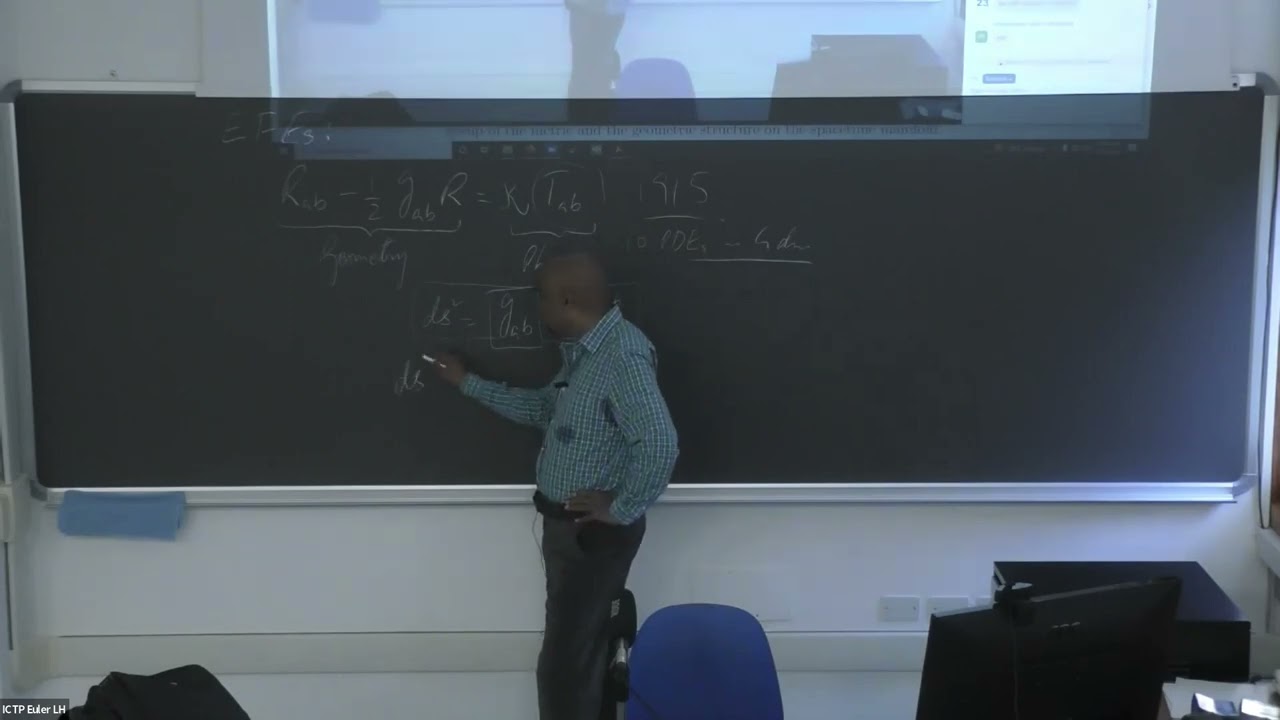
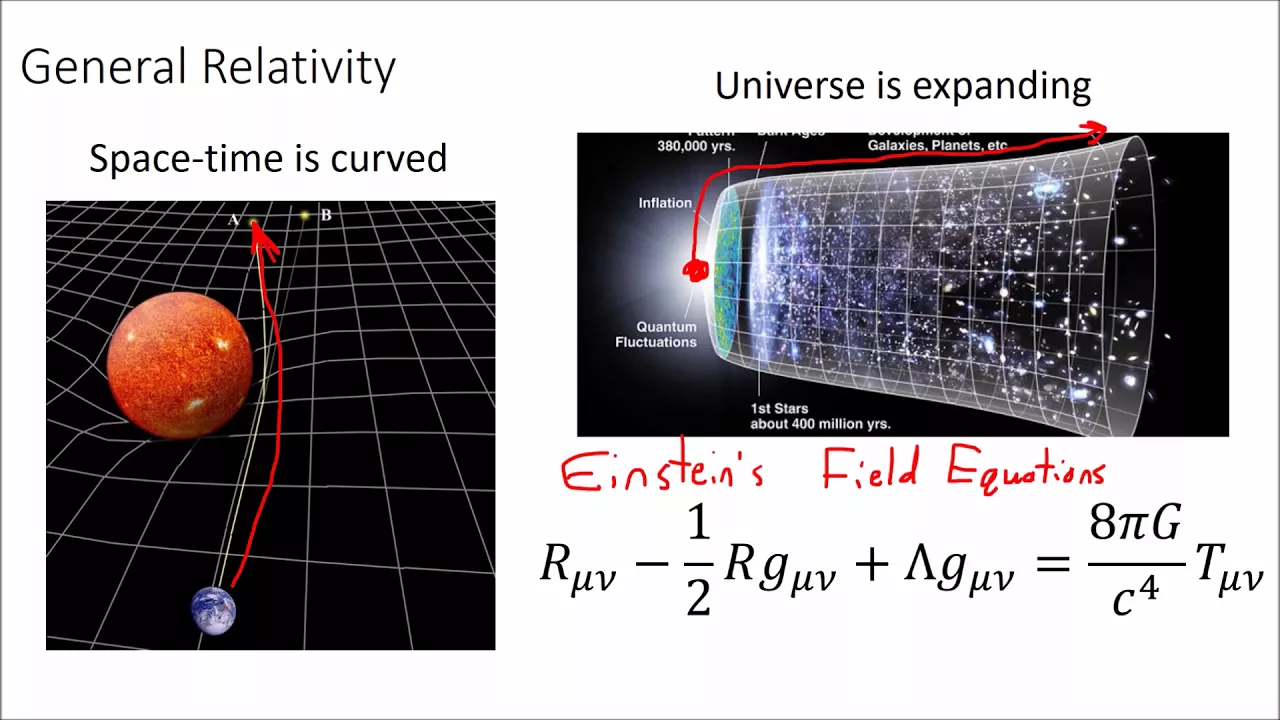
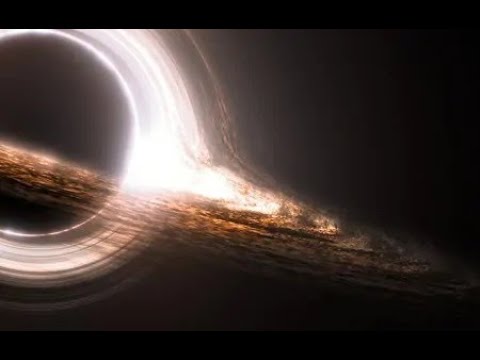
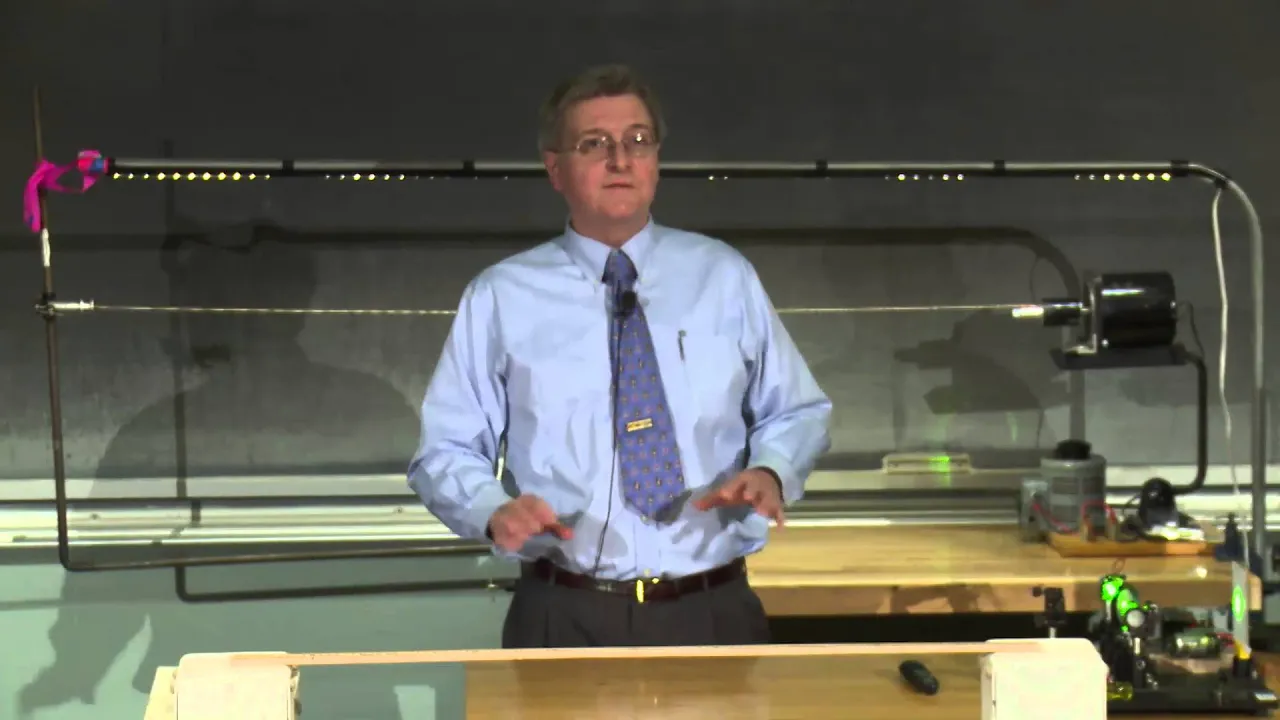
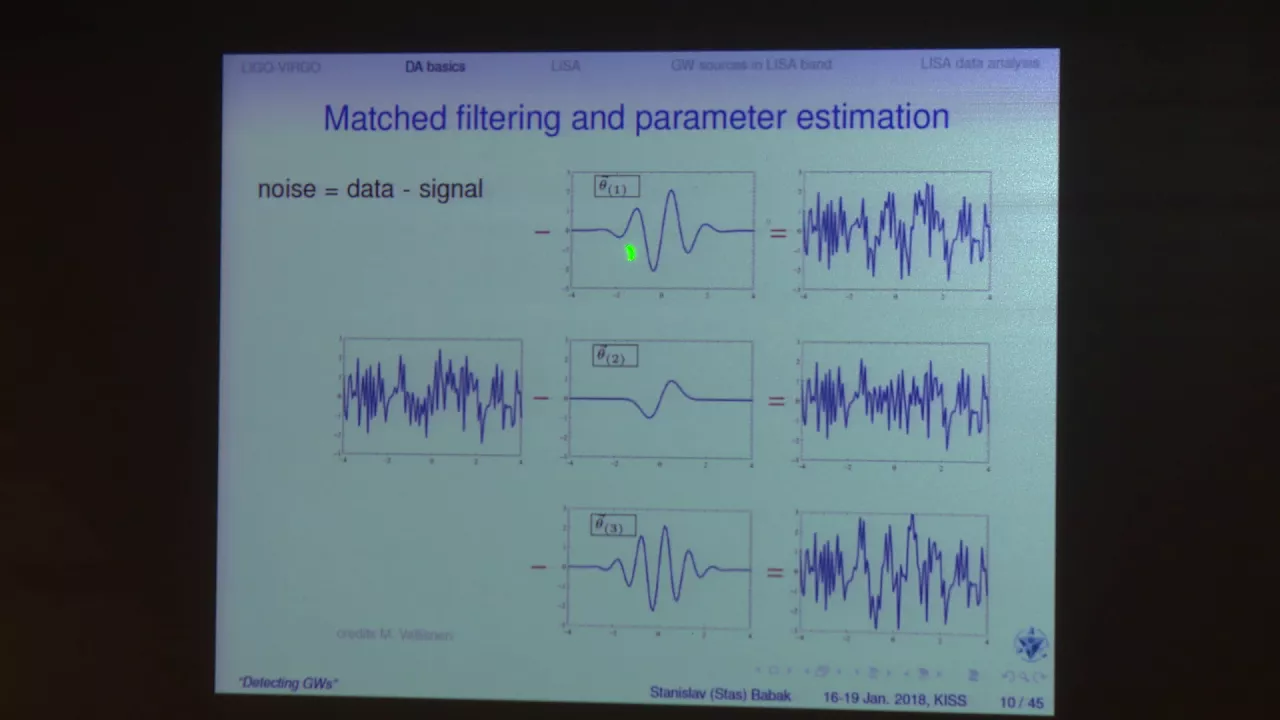
it is a very special pleasure for me to introduce today's speaker of the physics colloquium tib from The Institute the scientific in near Paris tiur is known for a variety of contributions ranging from general relativity to super gravity and to string theory and also ranging from the rather concrete and closed observation to the more speculative for instance in general relativity let me mention his work on binary pulsers which was crucial in making contact between the Nobel prize winning observation by hollon Taylor and on one hand and Einstein theory on the other hand and for that purpose debore had to develop novel expansion schemes valid in strong gravitational field that is well beyond the usual post neonian approximations and another topic is about inspiraling binaries and the uh gravitational field patterns which are associated with them and about that we will hear today on the more speculative side perhaps uh he's known for studying alternative theories to gravity as for instance proposed by string theory and the question of his is also what might ultimately replace the notion of space in quantum gravity and the proposal of his and Herman Nikolai is that it might be a coet space of some exceptional Lee algebra now let me not dwell too much in the many prizes Debo has received let me just mention one because it's a Swiss prize it's the Einstein medal which he was awarded in burn in 1996 so before giving the word to tibo let me say just one more thing so tibo is among those quite rare people who is able to convey the grand picture who is able to answer the question what does it all mean and to relate the questions of physics nowadays to the questions which have been of the questions of physics at all times and with that I would like you to welcome tibo Damu to the [Applause] [Music] colloquium oops so after these very kind words let me start so I want to it's a great pleasure to be here in zurk the town where Einstein contributed so much so I want to talk about gravitational waves from quing binary black holes and I want to make the connection between uh the analytical calculation and analytical method to compute the gravitational waves emitted by binary system and uh existing um numerical calculations of binary black holes and all these are two approximation schemes for solving Einstein's equation in view of detecting gravitational waves in a few years so first let's remind ourselves that uh Einstein uh introduced the notion of gravitational waves in basic papers of 1916 and 1918 so here you have Uber gravitational Von uh where he was solving Einstein's equations here written in full uh bi a perturbation method so essentially you look for solution of equations where the special metric is a small deviation from the idian metric and you find that there are plain wave solutions that uh propagate at the velocity of light in vacuum and which are uh all their physical effects are transverse to the direction of propagation and actually in the transverse plane they contain only two degrees of freedom because they're also traceless and transverse so like electromagnetic waves Wes they are transverse and they have only two degrees of freedom but these are gravitational waves the first person who really pioneered the idea that gravitational waves could be detected that who really thought about experiments that could see something was Joe Weber uh who at the end of the 50s and the early 60s first he wrote a theoretical book so he understood the theory by discussing with mathematicians actually he told me and and but it was the first one to to think that when a gravitational wave emitted by a binary system very far in the universe comes on the earth then what happens is that this wave changes the distance among uh any pairs of bodies so if you have two bodies and the wave is coming like that the distance between the two bodies will change in time and actually the fractional change in the the distance Delta L over L the fractional relative change of distance is given by the same quantity which appeared in the previous transparency which is the modification of the metric of space time uh projected in the direction of the distance between the two objects and Joe Weber thought about detecting it by using a massive cylinder waiting for gravitational wave to pass and to excite the longitudinal oscillation move of the cylinder um so yeah essentially uh the the theory of linearized gravitational waves is telling us that gravitation waves as two elicity States as I said they act only in the plane transverse to the propagation Direction so if for instance the wave propagate in The Zed along the Zed axis you have components of the gravitational waves only in the XY uh plane and they have two independent components uh in this plane and the physical effects of the physical component is to stretch and squeeze objects in the transverse plane like you have a ring of particle it can be stretched and squeezed like that transversally to the propagating gravitational wave now uh we have not yet detected the arrival of gravitational waves on Earth but uh what John Mikel alluded to which is the comparison between observations of binary Pulsar data which is the timing of binary Pulsar in our galaxy as seen on the earth and the theory of Einstein which predicts that the that gravitational radiation damping is actually changing the orbital dynamics of these binary Pulsar uh the comparison therefore between binary Pulsar data and general relativity gives a certain number of tests sorry and this test I will not describe them in detail but in in a plane which is the plane of the two unknown masses of the pulsars M1 let's say ma the pulsar and the mass MB of the companion you make several measurements and that gives rise to several curves and if these curves meet at one point then this is a confirmation that general relativity is correct and all the curves here they all meet at one point like for instance this point this point this point and if these curves here contain the P dot curve this is an effect of gravitational radiation damping so all those binary pulsars they already Pro that gravitational waves exist in our universe and they not only that they exist but that General activity is valid for the description of a strongly self gravitating object like a neutron star so this gives us confidence to use gener activity to describe gravitational waves now what is the experimental effort towards the detection of gravitational waves the experimental effort uh currently is that in the world you have several um kilometer size detectors that exist there are two detectors that exist in America called ligo and in Europe there exist a three kilm detector French Italian uh detector which is in in Italy in Pisa which is Virgo and there is a smaller uh detector in in Germany what is the principle of these big uh detectors these are uh interferometers where essentially you let uh very powerful laser light circulate in uh in the two arms of kilom size interferometer so there is like 3 km distance between this this mirror and this mirror and the light circulates between these two things and also between these two mirrors and then you recombine the light coming from these two uh arms so you make interferometry and if a gravitational wave passes by like that it will like stretch one arm of the interferometer and squeeze the other one and then change the interference pattern so when you look here if a gravitational W passes you see a change in the fringes okay this is the the basic ID what is the current experiment Al status of of these detectors is they have now reached their design sensitivity which is the sensitivity for which they were designed for the first generation of detectors which is a sensitivity where they can detect a gravitational wave which means a fractional modification in the distance between this mirror 3 km away and this mirror here of the order of 10 minus 22 okay and this is so it's a very small number this means by the way that the physical change uh displacement is is a thousand times smaller than a firm than the size of a proton okay so we are talking about very small displacements uh but at this level nothing has been seen in the last several years these dictators have been detecting uh I mean trying to detect gravitational waves I've been measuring data for a few years but they have not yet seen any waves but this is normal when we when you try to think about the sources that exist how far they can be how many sources this is at this stage no problem that nothing has been detected but because what is what are the sources of gravitational waves so I said before that the gravitational wave itself has the structure of uh it's an object with two indices instead of being a electromagnetic wave which is a vector which is transverse to the propagation plane this is an object with two IND thises a tensor which has a quadrupole structure in the plane transverse to the propagation of the wave and uh the wave at this quadrupole structure but as a consequence it's uh it is emitted also by a quadrupole okay it's a quadrupolar type wave and it is emitted by any moving quadrupole so if you have any system in nature which is a Time dependent quadropole so we have an assembly of masses and uh and its quadruple moment changes in time so if Qi is the quadruple moment dot dot is the second time derivative of the quadropole moment TT is a transverse traceless projection so it projects in the orthogonal plane of propagation then this formula give to lowest approximation what is the gravitational waves emitted by this system when you look at it very far in the wave zone so you see any time dependent quadal moment emits a one/ r wave okay and what are the gravitational waves we are talking about by uh ligo Virgo and their Advanced versions these are essentially binary systems okay there can be stochastic sources coming from The Big Bang they can be uh Supernova explosion I mean the implosion of a star but the problem for instance of the implosion of a star is mostly the implosion of a star is spherically symmetric you have the star falling down on itself with spherical Symmetry and therefore there is no quadrupole moment and no time depend on quadruple moment or a small bit only why if you have a binary system of two black holes or two neutron stars going around and merging then this has a quadropole moment and this is why here you see among sources no these are rotating neutrons which is something else but here you have the coalesence which means the the fusion together at the end of the evolution of a binary system made of neutron stars or black holes okay and as you see this amplitude of these waves at a level which is not indicated here but which is above the level of advanced detectors because what I'm going to say is the present generation of detectors is just a little bit too insensitive to see anything but in the coming years we are going to have advanced detectors these are gravitational waves with typical frequency of the oor of 100 HZ 1,000 htz this is the type of frequencies we talk about because the last orbits they last like of a seconds okay so it's the typical frequency for 10 solar mass type black holes binary black holes one is also for the future hoping that one day there will be a detector of lower frequency gravitational waves like 10 - 3 Herz 10 - 2 Herz due to massive black holes or small black holes falling into a big black hole but this is more for the future today we are talking about Lio Virgo type uh detection now what is the basic principle of detecting gravitational waves the basic principle is you have this interferometer and the interferometer which is measuring the fractional uh Fringe uh change and therefore the fractional length difference is is affected all the time by noise because uh you put long arms and then you have vibrations in the earth you have vibration in the Optics you have a frequency change in your laser you have I mean uh you have the the the the the mirrors that have pendulum excitations I mean you have an inable number of source of noise and actually as you have seen the the amplitude of the gravitational waves is so small 10us 2 10us 23 I mean a change in the position of a mirror of one part in thousand of for me okay something so small that evidently the Broadband noise is is larger than what you you hope to detect so the only way you can see a gravitational waves is by knowing in advance what is the shape of the signal you expect like the signal which was shown on the first transparency and you will see again a certain signal like a sine wave emitted by the source and then this signal you you make a correlation with the noise for instance here in the frequency domain what you do is you take what is called the template which is the expected signal what you what you hope is existing as a source in in your output of your detector and then you make a convolution between the two here in the frequency domain weighted by the inverse noise because this is the optimal filter okay this is the best way to extract from a noisy output the fact that there is hidden in the noise a wave of a certain shape okay but in order to do that you need to know in advance the the the shape of the gravitational waves you detect it's like if you are looking in a Broadband noise for a certain frequency okay you do a 4E transform but but you you are looking for a certain frequency okay and you need to try several frequencies by doing a frequency transform and then you see uh if it is present or not so so the question that I'm going now mainly to address is uh in order to detect gravitational waves you need to know in advance uh what is the precise shape of this gravitational waves so how do you compute the shape of a gravitational waves uh we are talking here about the gravitational waves emitted by binary systems so this is a space-time diagram in in SpaceTime a binary system means elix you have two two stars moving around each other and as you know if you represent the motion of two stars with time as a vertical Direction it makes an elix This Is A Spacetime diagram and then this thing will be emitting gravitational waves how do you compute the emitted gravitational waves for this you have to solve Einstein's equations which are nonlinear equations where am muu is the rich tensor of the SpaceTime metric G muu and T muu is the source so there exists a source if you have for instance two neutron stars if you have two neutron stars you have two blobs of matter that go around and they Source the gravitational wave now if you have two black holes actually the situation is more subtle because you have no matter okay black hole there existed matter before but the matter has disappeared and you have only two Horizons this is a purely vacuum SpaceTime with just the knowledge that you have some uh that there was matter here in the past now how do you do that this is the question of solving the the motion of two bodies in general relativity this is a problem which has a very long history it's uh the first the first methods in fact the okay we don't know yes one should say that you know that in Newtonian Theory uh you know how to solve exactly the two body problem okay not only you solve the problem the cap problem of one small planet around a big star but you can solve two comparable masses going around in elliptic orbit you can solve it explicitly okay in Einstein theory you can solve exactly the problem the one body problem which is a small particle moving around one big star like the sun okay because you can find the exact solution for one body which is one spherically SYM body but you cannot solve exactly the two body problem where you have of comparable mass that go around you need approximation methods to do that and what are the approximation methods you can use the first one which is now called post Mosin was invented by Einstein in 1916 but this is the natural method where you say the SpaceTime metric is flat the minkovski space time plus a first order perturbation and then you can add second order perturbation so you make an expansion in deviation from Flat SpaceTime okay but at at the same moment uh a young Dutch physicist the student of Laurence invented u a new approximation method which is called Post neonian in which not only you assume that the uh you are talking about the small deviation from Flat space time but in which you use also the fact that the time derivative of this uh perturbation is small compared to the space derivative because the idea is that the time derivative at least in the near zone is linked to the velocity with which these two two object move and if the velocities are smaller compared to the velocity of light you have a second small parameter so when you do this you can use a second small parameter which is V Square over C Square okay and it helps to solve the thing then as John mik alluded to when you have to talk about the motion of two black holes in fact these methods are not sufficient by themselves because you need to say ah but somewhere I have very strong field so I need to combine combine weak field strong field okay and recently a new method of approximation came along the line which is numerical relativity that uh it's only like 5 years ago that after 30 years of effort PE people could use stable codes to compute the motion of two black holes and what are the gravitational waves that they emit so I'm not going to describe in detail how you you do the technical calculations of solving the two body problem with sufficient approximation because I will mention later the explicit result but let me just say that the key word is that you use a cocktail of various method that is to say you use some of usual nonlinearity expansion post mosan some post neonian then you combine them with a multi-chart approach with uh match asymptotic expansion effective fil Theory expansion and you use all the tools that you find also in Quantum field Theory I will explain why like dimensional regular a and it's a complicated problem so you use everything you can and and it works so for instance you you uh you can U one way to explain uh how you do the computations of a two body interaction is to say you solve Einstein's equation by successive approximation where between two bodies you exchange one graviton that you could describe by this diagram and then you uh you have more like nonlinear vertices uh so nonlinear effects where you have several gravitons that interact and things like that so so you compute the effective action by some diagrammatic uh representations although when you do the calculations you don't need to use explicity diagram so this is one uh of the techniques just to explain now what is the result of that what can you can you really hope to compute something useful for experiment this is the question so for years the question was debated because for instance people in the group of keep thorn in America where have been saying for years that if you use usual approximation methods like post neonian methods you will be able to describe the motion of two black holes but only up to a point because when the two black holes will get too near each other and this is the most important moment because this is when they meit the strong gravitational waves you want to detect the post neutral methods becomes bad because the velocity become comparable to the velocity of light in fact what happens is when the two black holes go around each other when they merge their velocity is essentially like one half the velocity of light okay so you need to go the the small parameter that you had disappeared and then keep Thor and his group said you you don't have an approximation method for the most important moment which is the coalesence of the two black holes and therefore the only way to do that is to use numerical relativity at the same time when working with a post do Alexandra bonano we claim we made a different claim we said let's invent a new method and with this new method we are going to we we're claiming that we are going to be able to describe by approximation methods but with special techniques to improve the approximation method the the inspiring motion of the two black holes up to the moment where they merge and then when they merge we know a second approximation method to describe what is happening after the merger I will describe what it so we made this claim in 2000 uh and at the time uh and and we made the first calculation of a complete waveform so we said this is the gravitational wave emitted by a binary system uh and it's only in 2005 that numerical relativity succeeded in Computing the first waveforms and as you can see these waveforms are are close to what we were uh claiming and I'm going to describe now how close they are actually but let me explain why the gravitational wave has has this structure so this structure is due to what you have two black holes that go around each other for a long time the black holes are far from each other so they go slowly around each other and therefore the gravitational wave it emits is like a sine wave because it goes around periodically okay but because the system is losing angular momentum and energy to Infinity actually the system is speeding up because it loses energy so it gets closer and closer and when the two objects are closer they go faster and faster so you should see a sine wave where the frequency increases so the you see this is what you see the the The Things become smaller and smaller frequency and the amplitude increases because it goes closer and closer and faster and faster so this explains why during the inspiraling motion you have a wave which is like that and then at some moment the two black holes really plunge towards each other although it does not really happen this way we will see and they coales and then they merge and then there is a ring down waveform which means you have a maximum intensity and then the thing decays okay you see it better here we will describe now in more details uh how it worked ah yes so now I need to uh so how do I take away this to show the movie uh because I have a short movie of numerical calculations that last only 10 seconds or so to so it's a movie which has been done by the Albert anshin Institute group of luchano redola in in Potsdam in G okay so you're going to see two black holes these are the last orbits of two black holes going around each other yes let's start and so initially they go slowly around each other and then the system will accelerate and then be careful you see so very fast at some moment they have merged and this was extremely fast and instead of two separated black holes you have like an oblate black hole because what happens is the two black hole merge and then you have a rotating black hole which is deformed because but it rotates so uh yes maybe we can see it again because it's so short so that uh so this is the inspiring motion during this motion it emits gravitational waves like that a sine wave and then the sine wave accelerates so here it goes although it's not so evident it goes faster and faster so in real time for black holes of 10 solar mass the last orbit ISRO of a second it's a very short thing yes if you can help me again with this now this is numerical relativity result which shows the SpaceTime itself but out of the space time you also extract what is the gravitational waves at Infinity that we are going to show now so this this is the type of waveform computed by numerical relativity you see during the inspiral you have this sine wave the amplitude increases the frequency increases and then you have the merger of the two black holes and now the new groups after a breakthrough due to pretorius uh the new groups especially the Caltech Cornell SATA group using a spectral Cobe is able to compute this waveform with very high accuracy now so you could say at this level okay so now numerical relativity exist it can compute this very precise waveform why do we care about having an analytical method to compute the less thing with less accuracy there are many reasons why you want an analytical method first it's useful to have a theoretical understanding of what happens especially in the case of spinning black holes okay because when you will have two black holes with spin you will have more complicated things with precession of the spin and the physics gets so complicated that you want an analytical formalism to understand what is going on but what is even more important is that if you ask numerical people okay can you compute this waveform they say yes but how long will it take for you to compute it the answer is at least 2 months and now how many waveforms do you need you need 10,000 or 100,000 waveforms because as I said before in order to detect gravitational waves you need to know the possible wave form in advance in order to correlate them with the noise but for this as you don't know the parameters of the source like the two masses the spins this means uh this meets many parameters that you have to scan you have to uh you have a multi-dimensional space like a space of seven dimensions and for each point in this space you need to compute in advance a waveform to stock it somewhere or compute it in real time and then compute your correlation with the output of your detector and if it takes two months to compute one waveform evidently you won't be able to do anything okay that's why you really need an analytical method and what I will now present is that the the present method that we have developed started with Alexandra bonano is called this effective onebody method I will explain why and this is an analytical method but which uses information both from perturbation Theory so you use results from post neonian and other perturbation Theory but you use crucially also information from numerical relativity like because this method cannot really describe what happens in the fully strong field you use some information from numerical relativity you use information from analytical relativity and you combine the two things so how do you do that so this method okay I just said its name effective one body was introduced by us and then developed over the years okay and it's still under development but I will describe what exists today so let me uh first describe the the essence of the method so the essence of the method and uh is the following first this method describes the full uh the full waveform from minus infinity when you have two objects going around each other slowly up to the moment where they merge and at the end as you have seen in the movie there is one black hole which is the final Black Hole uh and to do it you do it by saying by saying there are two phases there is the phase which is the in spiral when the two objects are separated and when you do that you treat the two black holes as two point masses so there is the first first first part of the method where you say I have two black holes described by really Point masses and then at some moment when these two point masses are so near that they are no longer Point masses you you jump and you say at this point I say the two black holes merge very fast and then I can describe the rest of the signal by saying I have one black hole but this black hole is ringing because if you imagine that you have two black holes like two spheres that touch each other and then they they they use the coals to make one thing you say this is like a ringing black hole a black hole can move and and ring like a bell okay so you make this course approximation by saying there is one moment where you match the two point masses to a ringing black hole and we are going to see it works beautifully at the time when we made this conjecture it was not clear why it should work but you have seen on the movie actually that the coalesence is very very fast okay so there is nearly like no real transition NO phase transition between the two uh and by the way as here we see on this plot what you have is the superposition of two waveforms there is the analytical waveform I don't I think it is the red one and then there's there is the numerical one which is the black but as you can see they are totally superposed from in fact minus infinity here and the only place where you can see a small difference is here that there is a a tiny difference so this is an example of how the effective one body analytical method can agree with numerical relativity okay uh and I will describe how this agreement is obtained but first let me go back to so what do you do technically to compute first the perturbation theory of the motion of two masses so technically I said you describe the two black holes as being two point masses but now I don't know if there are mathematicians in the audience maybe not but for a mathematici it is absurd to assume that Einstein's theory can admit Solutions which are Point masses because the theory of Delta functions Point masses is valid only for linear theories you know in Maxwell equations you can put Delta function Source if you don't treat self effects okay why in Einstein the which is highly nonlinear you cannot put a Delta function okay also because physically these objects are not Point masses they are black holes they are extended objects but you do it and and you use quantum field Theory techniques which is you use perturbation Theory but you work in a space-time Dimension which is not four but for plus Epsilon where Epsilon is a complex parameter and you make analytical continuation in epsilon you know this is called dimensional continuation and this this avoids and treats very nicely for you all the Infinities uh and regularization effects that you would need to work with if you had Point particles and but then you need to do calculations both at the level of the Dynamics and this has been done over the years by a group of people uh at the level which can be described as being three Loops in the sense that the type of calculation you do is you have the two word lines of the two bod and then you compute the interaction by gravitational interaction so for instance this diagram means you take into account only the linearize uh gravity between two objects okay this is saying this this world lines emit a gravitational field which is absorbed by the other one which it's the one / R Newtonian interaction okay while here it means you more complicated things where each body creates a gravitational fields and the energy in the gravitational fields is creating a secondary gravitational field which then interacts with itself and then with the other body so these are nonlinear interaction between the two body so you compute this up to uh diagrams which are three Loops 3 PN and you do the same thing for the waves emitted at Infinity so you just do that I mean you just do that it took many years to to do that okay and here is the result for instance for the interacting aonian as computed by yanoski schaer and then I help them to finish the calculation completely in two 2000 so this is the interaction aonian at the highest level where you can compute everything at this the first line here you can recognize it's the Newtonian interaction you see p sare over 2 m and then the one / R interaction okay then you have the so-called first post neonian correction which are V Square over C Square correction and this correction have been first computed by Lawrence and Rost in 1917 and by Einstein in 1938 then the 2pn calculation was completed at the time of the binary Pulsa calculation in 1982 by myself and then the 3pn was computed only in 2000 okay so you see it gets quite complicated uh you do the same thing for the waveform which is the wave emitted at Infinity so I said before that the waveform is essentially a quad formula okay if you have a quadrupole moment of the source you just take two derivative of the quadrio moment and this is the wave actually this is more complicated than this because you have corrections to this and this is for instance the quadripolar wave so it needed the work of Luke Blan and many others over many years to compute this so the quadruple formula is the first term here it's this one okay this is the leading order quadruple formula but then you have Corrections one PN uh half PN 2 PN and up to 3 PN and 3.5 p.n okay uh and you see complicated coefficients and logarithm appearing by the way for the following formulas it's useful to know that we talk about the binary systems with masses M1 and M2 and we denote the total mass by capital M M1 plus M2 and there is a very important parameter which is called the symmetric Mass ratio it is the product of the two masses divide by the square of the sum of the two masses this this quantity is dimensionless because it's the ratio of square mass divid by square mass and this quantity when one mass is much larger than the other one is a small parameter this is the test Mass limit where have a small particle going around the big one but when this parameter when the two masses are equal this parameter is equal to 1/4 and this is the case where you have no perturbation Theory okay but still you are going to use this parameter as a kind of information parameter to check that when it is very small you know the exact answer and when it is 1/4 you hope that this answer will not be too different from the thing so I will not don't be afraid of this the the basic Point uh so this is the full uh structure of this effective one body formalism but the key word is that for each each thing you do you are going to use resummation methods resummation methods means instead of using the result of perturbation Theory as they are so so for instance as they are means you have a formula of this type where you have 1 + x plus X squ so it's like a power expansions in power of x x means by the way V Square over C Square essentially so instead of using the result as a power series expansion one plus X Plus x square you you replace it by something else which is a function of X which is a better representation of this up to the same level you know okay and I will give examples on how you do that so let's start with the Dynamics so the Dynamics means the part of the interaction between the two object that describes the the the equations of motion and how they go around even in absence of gravitational radiation back reaction so I I said before that you you describe the interacting aonian by expanding it by some calculations like that and this means you have the aonian I have shown which was this complicated formula which starts with the Newtonian amoni and then you have V Square over C Square correction V4 over C4 correction V6 over C6 Corrections so it's a long and complicated result and the basic idea of the effective one body problem is to say this is really the aonian for the two- body problem but I'm going to represent it by a different problem which is one particle of mass mu where mu is the usual you know effective Mass M1 M2 divided by the sum of the two masses I want to say that the particle of mass mu moving in some unknown SpaceTime in some effective curve background has a Dynamics which is equivalent to this complicated two body Dynamics so the problem you pose is can there exist an effective metric and because this is the effective metric which describes the Dynamics of a two body system in a two body system in absence of spin this uh this Dynamics is is is isotropic it does not select special Direction in space so it should be invariant under the group of rotations the rotations of the relative distance between the two bodies which means that if this effective metric exist it should be spherically symmetric and therefore uh it means there should exist two functions of the radial distance a function a and a function B such that this effective metric has this form so already you have reduced your problem to the following one can I find two function A and B such that this effective amilton the geodesic motion of one particle in this effective metric is equivalent to this complicated aonian how how do you pose this problem because what does it mean to say that a one body problem is equivalent to a two body problem to do that you use an ID that I learned long ago from John Wheeler in Princeton and reading his Works wheeler always said that classical mechanics can be uh clarified if you think Quantum mechanically because the problem I'm talking about is a purely classical problem these are enormous classical object and I'm talking about their classical Dynamics but let us think Quantum mechanically instead of saying I have a a two body classical system I say I have a two body Quantum systems and then this means this is a certain level Spectrum I have energy levels and I know by opening a book of quantum mechanics that these energy levels will be classified by the quantum number numbers appropriate for a spherical as symmetric problem which is the like spdf States Etc I have the quantum number L I have also the magnetic quantum number M which is the Z component of angular momentum that does not show because I have a de genery with respect to M and then I should have a radial quantum number n and I know that in the Kon problem I have a degeneracy between n and L but not in a relativistic problem so I know that I would have real Quantum States like that bound States so this are the bound states of a two body system viewed Quantum mechanically if I treat now one effective particle in an external spherically symmetric field I will have also bound States so something like that that I can compute from the function A and B and now what you ask is that there is a map which makes is one to one between these two energy levels okay and although it seems to say nearly nothing it says a lot because it says that each Quantum State here is mapped to one Quantum State each Quantum state is to one Quantum State and when we you convert this diagram in in equations what you find is using the old summerill quantization of quantum mechanics which is that what determines the quantum numbers are the adiabetic invariance the integral PDQ over the degrees of freedom you know the bomal thing what what this diagram is saying is that the finally the classical aonian if you reexpress the classical amoni in terms of the uh of the integrals how they called the action integrals integral of PDQ and In classical mechanics this is called the Doon aonian okay so you compute the Doon aonian of the real problem two body problem the do amoni of the effective problem and you say the two amoni are the same modulo certain function that transform them okay it looks like nothing but it is actually a very strong requirement and when you require this you find there is a unique solution essentially and not only that but first you find that uh the energy state are changed because I said before that I am not requiring that the energy in the two body rest frame is equal to the energy of the effective problem because you realize the effective problem is like in a moving frame in some sense so there is some transformation that you don't know in advance but when you do the computation you find a very simple answer which is that the effective energy is simply equal to the square of the uh real two Body Energy so it's the mandal St invariant s and you have this exact formula that you find okay out of the compis so but but when you pursue it and then you say the next step is I compute what are the coefficients of the effective metric the A and B coefficient where I remind you that a is the is the coefficient of the DT Square so uh as you know probably uh um in general relativity the coefficient of DT squ the the the curvature of space time Associated to the measurement of clocks of of time is linked to the gravitational potential the Newtonian potential and for uh for usual isolated body like uh let's say the sun uh g0 this component a is equal to 1 - 2 gm/ c² R this is one of the basic formulas the potential around the Sun is 1 - 2 gm/ c² R for this a component but what you find when you do now not a onebody problem but a two body problem is if I denote the the combination gm/ c² R simply by U to simplify uh I know that in the limit where one body is much smaller than the other one I should get 1 minus 2 U which is The schwar Shield solution 1 - 2 GM over C squ I get extra Corrections which starts at U Cube and and then at u4 but what is what I find really remarkable is that you see I was solving only for two functions C A and B and the result is very simple for instance the most important function is this thing because it's like the interaction potential between the two bodies it's what replaces the usual one / R potential but the answer is 1 minus 2 U is is fully contained here but this answer is equivalent to this complicated thing so you see here I have 100 terms and I don't know what to do with them because when when the next term becomes large uh it messes up the full thing it means the the theory I cannot use the Simoni why here when uh sorry I have to go back here I have this very simple formula and uh for instance at 2 p.n at at 1 p.n I have no Corrections so the answer is zero at 2 PN I have only a coefficient two to compute and I mean you need to compute the 100 coefficients before in order to find it is2 the final answer and at the next level all the complication is contained in this number which is this 94 3 - 41 32 Pi s okay this is the final uh important number you get and then this gives an aonian which describes the two motion system instead of this so this aonian I've just described which is quite simple so which compactify the very complicated information about the two body interaction in one simple thing uh describes the the the orbits between the two objects but it describes the orbits when I neglect gravitational radiation damping okay so for instance it uh it is like it it defines an effective potential which is the amoni for a given angular momentum as a function of the radial distance and when this effective potential has this shape this is saying that I can have elliptic orbits you see if I have a fixed energy let's say at the level little bit below one which means bound system I will have the particle which goes from radius here to this radius and then back here that will be an elliptic orbit okay if I sit for One angular momentum here at the minimum of this effective potential then I have a circular orbit so the Amon I describe describes the the conservative dynamics of the system and then at some level when the angular momentum gets too small you see that you don't have a centrifugal barrier because yeah I should say that in the Newtonian approximation this curve is simply you know l s over 2 R square the centrifugal barrier and then minus 1 / R which is the gravitational potential and as we know it is the competition between the centrifugal barrier and the 1 / R attraction which makes the existence of capan orbits okay so we have a modification of this with the fact that the centrifugal barrier goes to zero at some radius which correspond to the Horizon okay in the usual schield case so this amoni describes the conservative Dynamics but now you need to describe the fact that the system is losing energy in angular momentum so you need to add something to the formalism the way you add it is you write amilton equations so these are amilton equation but you add on the right hand side of some of them an extra Force which is a damping force in particular the usual amilton equation would say that pii which is the angular momentum is conserved okay under a conservative Evolution but here you want to say angular momentum is lost to gravitational waves so on the right hand side you put a certain object F ofi which expresses the loss of angular momentum but how do you compute this loss before I said you have a formula for this loss which is a certain expanded uh tailor expanded formula you replace this by a resummed expression so I won't describe go into the detail but here you use also new techniques like you resum an infinite number of leading logarithm you solve auxiliary problems you think about the problem for a while and then you come up with some explicit formulas and these explicit formulas then give you a resum formula for the the radiation the radiation reaction force that you put on the right hand side which still contains things which are not resummed but because you find that they are good enough now in order that you don't need to resum them you do some studies of this so it gives uh an explicit analytical representation and then you test this analytic representation against some numerical calculation I will not spend too much time on this but this is if you were using a tailor expanded represent a of gravitational radiation reaction you would get something that at 1 PN is here at 2 PN is here and you need to go to very high orders to get close to the good answer which is the solid line why if you use the new method you are exactly on top of the numerical answer without doing anything okay and the same thing is true when you compare to numerical relativity for the for the two black hole problem but I will enter so these methods they started from uh perturbation Theory and then they use some new IDs and new resummation method but still by themsel they would not have a perfect agreement with numerical relativity because what you have used in the antical calculation is calculations up to the third approximation order but you know there are Corrections beyond the third approximation order and how are you going to to get some information about it the way you do now is you say for instance I've computed the the the function a which is really the gravitational potential of attraction between two object to some order of approximation in U it was 1 - 2 U plus 2 new U Cube plus A4 u4 but you know there are terms beyond that terms of order u5 of order U6 Etc you don't know them it's too difficult now to compute them although a big effort in principle could allow to compute them but what you do is you say okay let's assume they exist I don't know them I put them as three parameters let me resum this thing because this is an expansion 1 - 2 U plus which is not good to use as a tailor expansion so I transform it in a pad approximate which means I write it as the ratio of two pols and then what you do is you you you look for values of these parameters that agree well with numerical relativity so at this stage you use numerical relativity results and you try to find what are the good values of these uncalculated parameters so you have a good agreement with numerical relativity so here you have a complementarity between numerical relativity and analytical relativity and this is this is when you do that that you have the beautiful results I was mentioning before because on this plot you have the superposition as I said of a numerical relativity waveform and the effective one body waveform but for values of these parameters that you have tuned in order to agree with the result so here you use numerical relativity but look that the tuning is not you know very sharp for instance these numbers are 0 and minus 20 they are not- 19.25 34 and thing like that I mean you don't need to tune many numbers you find things and then it works okay and as I said before the agreement is so good that during all the time you see no difference except here where there is a small difference okay here I've been talking mainly about the the work we have done at IH with recently uh my uh postdoctoral student Alexandro nagar I should say that parall to what we were doing in France my former postu Alexandra bonano who is now in America has been working also independently and parall with first students on and has developed also the effective one body and obtained results comparable in quality uh these are specific result that she obtained for several Mass ratios you know so this shows that effective one body can beautifully agree with numerical relativity let me by the way give you an explicit result so this is the function a that I mentioned this is this function that uh in lowest approximation this function should be the SCH Shield value 1 - 2 m / r that is to say as a function of U which is m / R should be the straight line 1us 2 U which is this straight line and if you do analytical calculation of this function you get at uh at the 1 PN approximation you get 1 minus 2 U which is this straight line if you use the 2 PN approximation you get this curve here which is a little bit above uh 1 PN and this is what we knew in 1999 okay then in 200000 we could compute the 3pn approximation and then you get this thing but you see that the 3pn approximation is so different from the 2pn approximation in the strong field regime because this value u means 0.5 but 0.5 is the value which is the Horizon for shield black hole so it means the two black holes touch each other you know really okay so it's normal that in the strong field you have the next order is different from the previous order but still this difference is so large that you don't like this so at the time we said let's use the pad resummation of the 3pn and this gave this black curve here and now after years of using numerical relativity to improve effective one body the Curve you get the best curve you get is the red curve this is the latest curve we obtained like last month with Alexandro Naga using the best numerical activity and you see that so you have learned numerical relativity is telling you the truth is around this thing but the analytical guess we had made before was not very far from it okay so this is why analytical methods can by themselves be useful let me also mention here I was talking about the gravitational wave emitted by uh binary black hole but one could do other comparisons like for instance uh last year with uh numerical people we we did the following thing we we took a binary system of two black holes computed in numerical activity and this binary system is emitting energy and angular momentum to Infinity but what you do is before the system starts emitting you know what is the initial energy and the initial angular momentum of the binary system you take away you subtract the emitted energy and angular momentum and this gives you the relation between the energy and the angular momentum for a binary system which is along a circular I mean a sequence of circular orbit it is INSP inspiraling but essentially along circular orbit and numerically you get this black curve okay this curve which is here but when you ask what is the prediction from effective one body even the effective one body method of 2000 not knowing anything about activity you get the blue the red curve and you see that the red curve is extremely close to the numerical one and and stay close to it up to the end why if you use perturbation theory in in this form you you add the dash curve which is visibly different from that so it's one example where analytical methods really can describe there is also work of Lal where they did a comparison between effective one body and the precession of the you know like the Mercury precession but for binary black holes and they got also I don't want to describe that the effective one body is very close to numerical relativity I should say that one of the big motivations for this work is to go beyond what I have described up to now which is the motion of non-spinning binary black holes two black holes which are not spinning but to go to the full system of spinning black but this is something which is now being developed the theory has been developed for years uh and uh in America the first comparison have been done by uh Alexandra buano and her group and then the preliminary results they they got using uh too much tuning for my taste but still it works that you can using the effective one body and spin effects a good agreement with some numerical relativity things but probably not with all existing numerical relativity waveform so this is preliminary but promising uh I don't have the time to mention that there is also the question of new neutron stars because binary black holes we are not absolutely sure that they exist in nature I mean we think they exist but you have not observed binary black holes of two 10 solar mass each why you are sure there exists binary system of neutron STS because these are binary pulsars for instance and it's very important to extend the effective one body to the case of U binary neutron stars and you can you use the same formalism but you need to take into account that neutron stars can be tily deformed when two neutron star are close to each other there are tidal interactions that you can describe by adding new non-minimal word line couplings to the aonian okay so and then you use numerical relativity to uh determine some I mean this title coefficients because you can compute them actually but you need some corrections to them and it seems to work to a good extent so let me conclude because my time is up so I forgot to say yes but now let me say it that experimentally what I said at the beginning ligo Virgo is uh the detectors exist today okay but now they are being upgraded that is to say the detectors actually are stopped and they are improving the the detection system to gain a factor 10 and in a few years which means in 2 3 years in 2015 2016 the detectors will have been upgraded and we have a factor 10 Improvement in sensitivity but the factor 10 Improvement in amplitude sensitivity means you can see sources 10 times farther in the universe which means you have a volume 1,000 times bigger which means you should see 1,000 more sources and at this level you should see like every month coaling binary neutron stars or coaling binary black holes okay so this is really in 2016 that you should hear about the detection of gravitational waves and then there are also other groups in the world in Japan and in India that will are now creating new gravitational wave detectors I said that the the Breakthrough in numerical relativity have been very important in giving us information about really what happens at the coalesence of two black holes but I also said that by themselves although they bring us essential non nonperturbative information you still need to have a method based on analytical methods like the effective one body because this allows with the special Improvement I I mentioned to describe the full coalesence process including when the two black holes coales and one should not say that there is a competition between numerical relativity and analytical relativity but on the contrary there exists a complementarity that is to say the people work together or at least it took some years that they gave us access to their data but now we have access to their data so there is now a good complementarity the numerical people give their waveforms to analytical people and then you can improve uh the new the analytical methods by using the by tuning essentially some parameters that you cannot compute because it's too complicated to compute and you you find a value that works well in a few cases and then you hope that your analytical improve NR improve analytical formalism will describe all possible waveforms which is still to be proven in the sense that analytical methods can predict things but until we have detected them all we are not sure that they are the the good waveforms okay thank you for your attention thank you very much for your talk are there questions uh but here you have to you have to think in in frequency space you know the coalesence takes a 100th of a second so if you have perturbation which have the same frequency you need to worry about them this if this is a slow change due to some environment environmental change you don't care in the frequency band of 100 HZ you will see nothing but here okay if you not close to merger you won't see anything yeah I should say the orders of magnitude is that in order to see even 10 solar mass black hole around each other they need to go to a fraction to the velocity of light if they are uh farther apart the signal is so weak you don't see anything so you see only like the last three minutes you know in the last three minutes they go through 1,000 orbits or whatever and then the frequency increases from 10 Herz to 100 Herz all that is 3 minutes and that's it what happens when they're very far apart you don't see them here maybe in Lia type detectors you you want to worry about what happens you know with long eccentric orbits and things like that here I'm talking about Lego Virgo it's it's a simple problem in the sense yes yes first the the you did not know the statistics so from the beginning they have been honest in saying they always said that initial Lio was not supposed to see something for sure okay if you they have been very honest in saying there is no guarantee that at the level of uh H equal 10us 22 which is very impressive first they had to show you can reach with a stable laser system interferometric thing 3 kilm this sensitivity okay but they always said at this level if they exist more binary black holes of tens solar mass than we can estimate then we should see something but if they are not so numerous we won't see okay so the only thing they could say is that if there is a source within like 200 Mega Parx of a binary black h of 10 they should have seen it they did not see any but it's not a big problem because we are not sure in fact we are not even sure that with a factor 1,000 you will see binary black holes because it's very difficult to estimate how many B binary black holes exist what is more sure is for neutron stars because you know how many binal stars exist so you can make although it's a small number of Statistics you can make an estimate in this volume of how many binary neutron stars coaling you should see and in that case you should see between like 1 and 300 events per year but there is a big uncertainty even for binary Neutron STS but 30 per year is like a medium number okay there yes no no it's a it's a good question so there are several measurements of the of the level of agreement between an itical waveform and a numerical waveform so uh there are several measurements one of them is the maximum overlap and then it has to be and now what is how many digits uh you need in this thing first I should say that the type of results we have are already too good in the sense that uh they are better than what you need but for when the signal to noise ratio the first detection will have a signal to noise ratio of seven or maybe 8 10 something like that at this level they are too good okay but later when the signal to noise ratio gets better you want waveform as accurate as what I said anyway there exists a precise answer and one can ask for each frequency band and each Mass what is the accuracy of the waveforms that you need okay and and we are there so class yes okay yes so the physical reason first the the I did not have the time to explain the the rig down is due to the fact that when the two black holes seless very quickly they instead of two black holes like that they form one de black hole and you know from the theory that when you start from one de black hole it will oscillate and radiate a lot of energy and go to a cur black hole you this and this is very fast much faster than before and this explains why the last signal decs exponentially and you can compute this exponential decay now but but the reason also why the waveform I showed are particularly simple these are without spins okay so you have the two objects going around although there is the the full merger in the merger not much happen it's a very fast process we conjecture it and it is true now with spin things are more complicated because the spin process so the waveform has more complicated things but even in this case for most case the coalesence is also like as simple as that because at the last moment although I have two spinning black holes and what happens is a very complicated you know world pool and thing like that when they merge not merch happen and you have the ring down waveforms due to a cur black hole which is near extreme spin but finally the people that were afraid saying we will get very complicated you know nonlinear Dynamics Einstein chaos or whatever this did not happen maybe there is a corner of parameters where you you will have more strong field Dynamics but it seems the Horizon uh because what happens is when the two black holes nearly touch each other they appear in the Horizon around them which then screens all the complicated physics there and then all that is uh and you just have like a a myopic view of what happens at Infinity okay if you were looking locally at the curvature in between the two black holes you would see more chaotic and complicated things but not in the way format Infinity sorry about in fact there is a lot because even for the uh for the nonspinning case the total energy you emit in the entire process is 5% of the total mass so although it does not look like 90% this is still a lot and in the case of Maximum spin when people numerical calculation of extreme spins parallel spins then they found you get 10% but never more than that okay uh I don't know indeed uh from the analytical point of view you jump from uh one description to another very discret so when you join them I said phase transition I should maybe not have said phase transition but it's something the matching between the two is very fast it's like also you know these things that happen in uh in uh in string theory and super young males where you have a perturbative description in the in the weak uh G regime and in the strong coupling regime and finally uh you have a factor 3/ quter of change of the entropy between the two and if you use perturbation theory in one side and perturbation theory on the other side they join uh thing so though there is a lot of complicated physics to join the two perturbation theory on both sides said that nothing happens at the transition this is so it's not really indeed indeed a transition where a lot of things happens it's matching uh but here yes also you don't have the time I mean what it's not that you are going to have like a glue ball that exists for an infinite time I mean gravitational type globall uh uh the thing is emitting is losing so much energy also that uh and and when you have when you you coales you you you go to the equilibrium State very fast you have a ringing modes which means you have decaying modes uh so from the analytical point of view you don't have the time to to stop on the transition and see some complicated physics maybe it's not a good answer um maybe okay as I said if you if you maybe you sit before in the movie you saw that at some moment the two Horizon merge okay so maybe if you look at the SpaceTime geometry locally in the middle of this thing maybe here you have chaotic things that take place on short time scale and which are very uh important okay but you have to remember that the wavelength the gravitational wavelength is always is bigger than the system okay these are long gravitational waves so you have a myopic view you don't see the waveform the wave itself sorry has a wavelength bigger than the size of the system so you don't see details so even if you have comp complicated M microscopic phenomena they are smoothed out in the waveform at Infinity so it's another reason why from the waveform point of view you don't see the complicated physics okay maybe question let me just add add one very short in this comparison of the template to the observational data can this comparison not yet observational data yes can it be done on store data or does it have to be done in on real time that's a good question and it's it's not clear what the uh I mean they want to do it in real time and also it seems that one is reaching the limit uh of the the Computing capabilities because because I thought for instance that our analytical waveforms they can be computed now it takes one second to compute one waveform so you can do 10,000 waveforms in 10,000 seconds but they seem to want to compute them in real time and then in real time it takes too much time one second so they want it's not clear how they are going to do the data analysis I did not work those times on the data analysis I know they have computer facility problems that I mean they are they are exceeding the limits of what you can do in real time to analyze the data online you know and know whether there's a a signal there or not but I don't know the precise answer there is one more question that there is some what sorry uh they want to do it also in real time to have an alert towards astrophysics because for instance you know they want if there is a gamma array which is observed first to look specially and if they see a gravitational waves to tell the gamar gamma people to look for so they want not only to wait one year to say ah we are the source that day and then nobody looked at that but but I'm not sure because they look at many sources at the same time uh so yes curves yes it's a fine detail it's linked to the the question of the young lady that you need uh the yes so but let me explain the the big reason the big reason is in the number of it goes is for instance one one of these waveforms uh yes is the reason why you can see something is because you are going to overlap so you have to imagine that your detector output is is Noise Okay and in order to extract the signal from the noise you need to keep to be in phase for four 100 Cycles more than this okay because if you are out of phase then you don't accumulate things because when you do the correlation you have zero instead of being always plus one you need and because of this you need that the although it looks like very simple it say it's a sine wave which is chirping a little bit but the the acceleration the the way the the frequency increases with the number of Cycles has to be correctly described to a very small fraction of a radian like you need to not lose a tenth of a Rion over 1,000 Cycles okay so it is an accuracy of 10 - 3 timeus 4 on the parameters of the signal and like that and because of this when you change the mass ratio you change this proportionally to the change in the mass ratio you need like 1,000 templates for different Mass ratio and then 100 templates where you put the spin with this value and this value and then when you multiply 1,000 by 100 you end up with 10,000 templates although I agree with you looks a bit stupid to say that but still and except if you can represent this by better formula here the this formalism work well but it gives you OD that you still have to integrate because it gives you equ amilton equations so that's why it takes one second to compute 1,000 orbits okay if you could represent it by just an analytical formula by putting maybe many parameters and like that that you could analytically compute then it would be much faster but it's like a second stage Maybe okay so finally we come to a close and let's thank Deo once more [Applause]
Up Next
88:45
Gravitational Wave Data Analysis: Gaussian Noise, PSDs, and SNR
@iiptv
126 views•2019-06-27

12:53
21cm Hyperfine Transition in Neutral Hydrogen: Radio Astronomy Basics
@AaronRobertParsons
12.4K views•2011-10-13

32:32
NMR Spin Physics I: Zeeman Effect, Resonance Condition & Larmor Frequency
@nptel-indianinstituteofsci8064
2.3K views•2024-01-17

27:14
Entropy and the Second Law of Thermodynamics Explained
@veritasium
27.5M views•2023-07-01
Related Study Plans & Knowledge Roadmaps
Structured learning paths in Physics
physics
Nuclear Physics (Decay, Fission & Reactors)
01Atomic Structure and the Binding Force
02Radioactive Decay and Half-Life
03Nuclear Fission Mechanics and Chain Reactions
+ 2 more learning modules
12h5 modules
Explore Roadmap
physics
Soft Matter (Polymers, Colloids & Rheology)
01Foundations of Soft Matter & Thermal Forces
02Polymer Physics and Macromolecules
03Colloids, Surfactants, and Self-Assembly
+ 2 more learning modules
38h5 modules
Explore Roadmap
physics
Analytical Mechanics: Lagrangian & Hamiltonian
01Mathematical Foundations: Calculus of Variations
02From Newtonian Mechanics to Constraint Dynamics
03The Principle of Least Action & Lagrangian Mechanics
+ 3 more learning modules
28h6 modules
Explore Roadmap
physics
General Relativity (Spacetime & Cosmology)
01Foundations of Relativity: Special Relativity
02The Geometry of Spacetime: Equivalence Principle & Curvature
03Einstein's Field Equations: The Mathematics of Gravity
+ 2 more learning modules
55h5 modules
Explore Roadmap