Design for Disassembly is an engineering concept that develops products, multi-material compounds, or composites which can be easily separated or recycled at their end of life, while also facilitating repair of damaged or broken products; TU Wien is researching this approach by integrating Additive Manufacturing (3D printing) with innovative physical and chemical compounds.
Design for Disassembly: Sustainable Product Lifecycle & 3D Printing
Added:Deep Dive
Fundamental concepts of Additive Manufacturing (3D Printing), including layer-by-layer fabrication and common material types like thermoplastics.
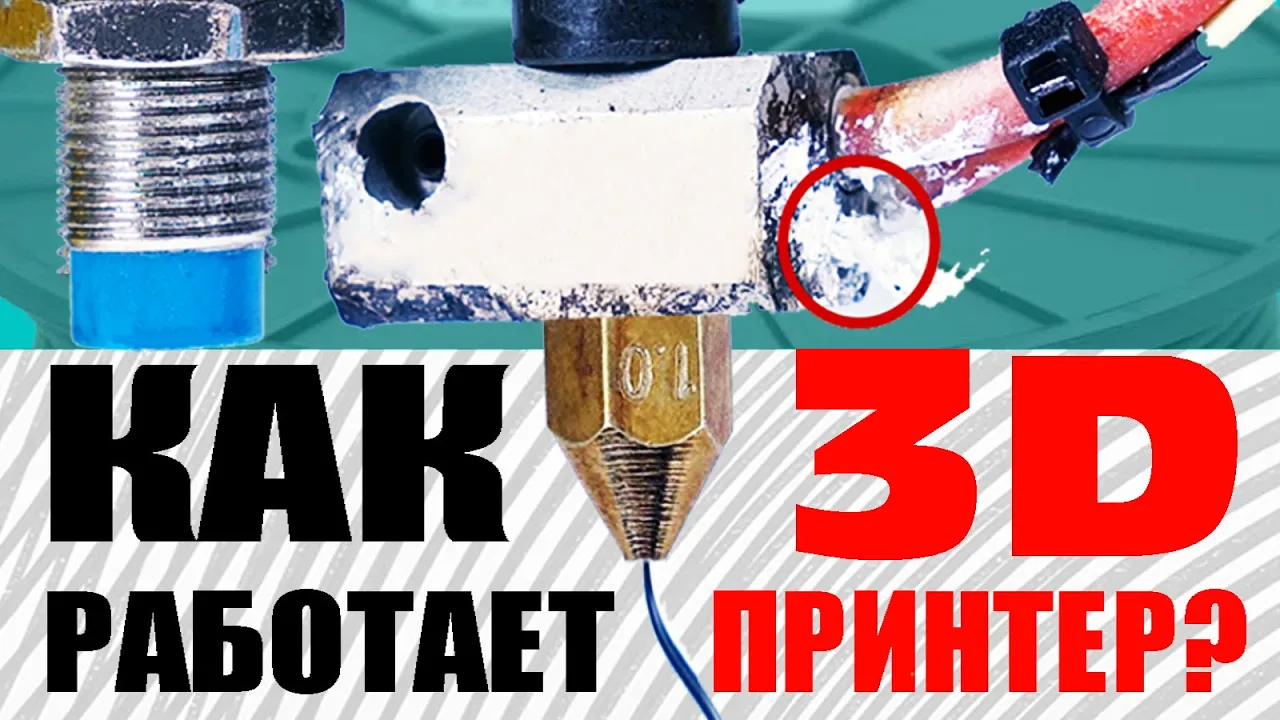
Как работает 3D-принтер? Просто и в деталях.
101.7K
3D printing emerged from science fiction in 1945 when Murray Leinster described a device that would build objects layer by layer. The core principle remains: additive manufacturing through layer-by-layer accumulation. Modern 3D printing encompasses over a dozen technologies, but FDM (Fused Deposition Modeling) and SLA (Stereolithography) dominate home use. FDM uses thermoplastics like ABS (acrylonitrile butadiene styrene) and PLA (polylactic acid). ABS, used in LEGO and remote controls, melts at 220°C and offers strength and durability. PLA, derived from corn and sugarcane, is biodegradable but brittle and unsuitable for functional parts. The choice between materials depends on application requirements and desired mechanical properties.
Click to watch →
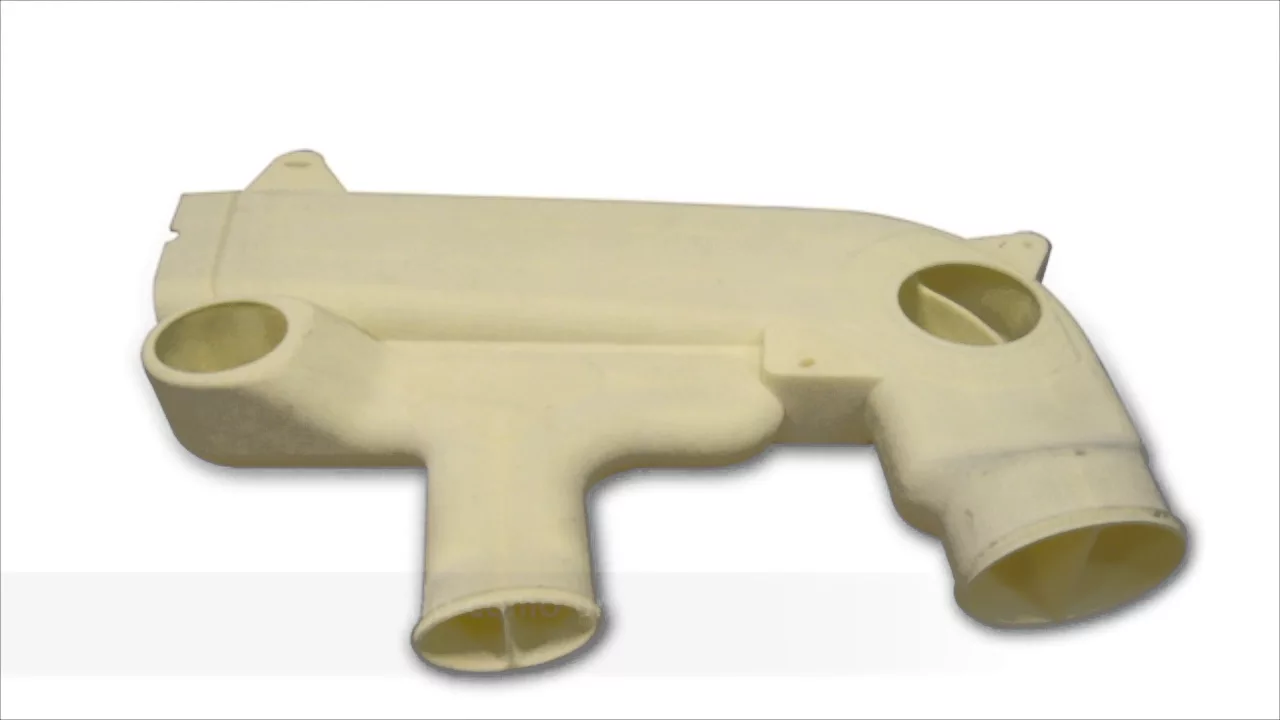
Conceptos básicos de manufactura aditiva
7.5K
Additive manufacturing (3D printing) is a production method that builds parts layer by layer by fusing material, enabling the creation of complex geometries like internal channels and lattice structures that traditional manufacturing cannot achieve, while also allowing customization without dedicated tooling and reducing assembly requirements; it serves as a complementary process to machining and molding rather than a replacement, with applications spanning aerospace, medical devices, and mold components.
Click to watch →
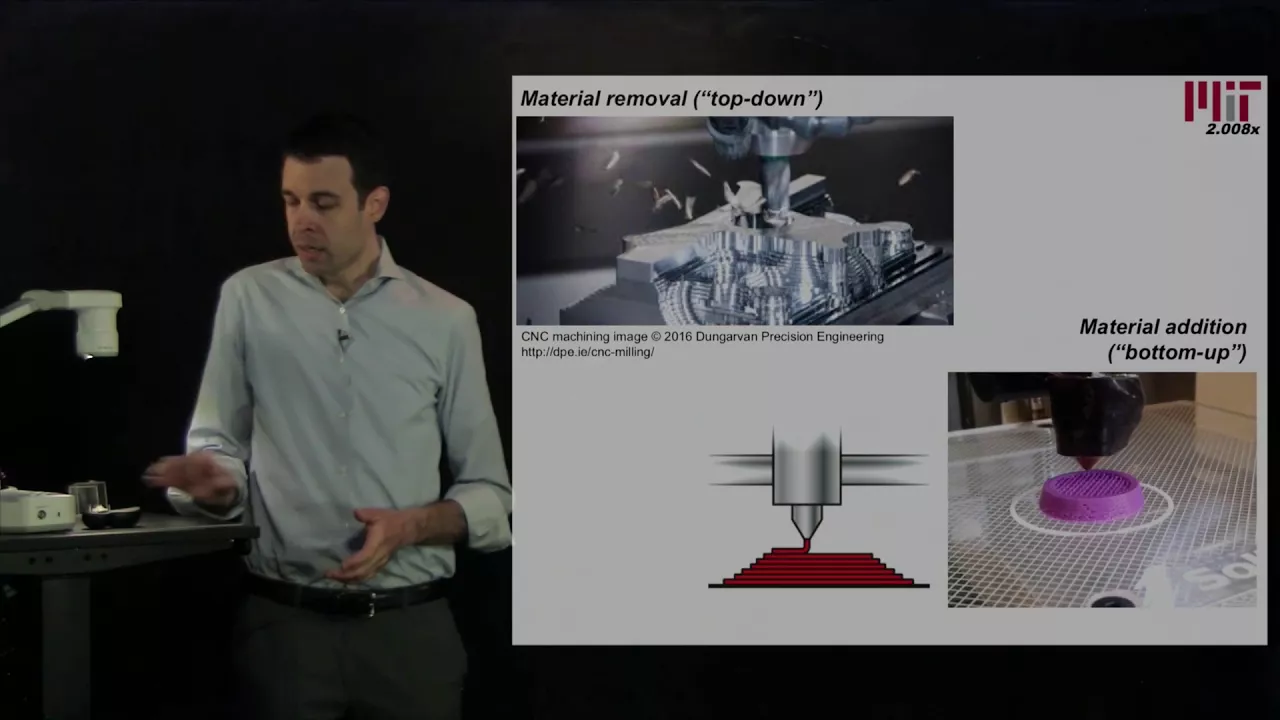
An Introduction to Additive Manufacturing (Prof. John Hart, MIT)
436K
Fused Deposition Modeling (FDM) is the most accessible and widely used additive manufacturing process, spanning from $500 desktop systems to $100,000+ industrial machines used by Boeing and Airbus for aircraft duct components. The process involves extruding thermoplastic filament through a heated nozzle moving in three orthogonal axes (X, Y, Z) to build parts layer-by-layer from the bottom up. Key considerations include: polymer physics (heating past glass transition temperature to achieve workable viscosity), anisotropic mechanical properties (20-30% weaker perpendicular to filament direction), heat transfer limitations constraining extrusion rates, and trade-offs between accuracy, strength, and print speed. Large-scale extrusion systems like BAAM sacrifice resolution (several millimeters vs. 100 microns) for dramatically increased throughput, enabling applications from composite tooling to complete vehicle structures.
Click to watch →

Capacitaciones Aulas STEAM-Sesión No1: Profundización en proyectos basados en tecnologías emergentes
1.5K
Additive manufacturing, commonly known as 3D printing, is a fabrication process that constructs objects layer by layer from digital 3D models. Unlike traditional subtractive manufacturing that removes material, additive manufacturing adds material to build physical objects. The process begins with digital designs that are sliced into layers, which are then deposited or fused together to create the final product. Fused Deposition Modeling (FDM) is the most common 3D printing technology, using thermoplastic materials that are melted and deposited layer by layer. Common materials include PLA (polylactic acid, derived from corn starch and sugarcane, recyclable up to 5 times), ABS, PET, and PETG (from recycled plastic bottles).
Click to watch →

Conferencia: Fundamentos de la Manufactura Aditiva, LDI. Juan Pablo González Berjón
285
Additive manufacturing (AM) is the process of joining materials to fabricate parts from a 3D model, typically layer by layer, as defined by ISO 52900. 3D printing is a specific type of additive manufacturing that involves material deposition using a nozzle or other printing methods. The three main families of 3D printing technologies are: FDM (Fused Deposition Modeling) which uses melted filament deposited layer by layer, SLA (Stereolithography) which uses UV light to solidify liquid resin, and SLS (Selective Laser Sintering) which uses a laser to fuse powder materials. Common materials include PLA (biodegradable plastic), ABS, nylon, and various resins. Key considerations for successful 3D printing include proper infill density (20% recommended for most applications), wall thickness (0.3-0.4mm minimum), and design tolerances (0.1mm for assembly).
Click to watch →
Deep Dive
Basic principles of the Circular Economy, specifically the concepts of reducing waste, recycling, and extending product lifespans.

Conferencia: Economía Circular
1.8K
Circular economy extends product lifecycles, reducing waste accumulation. Zero waste means preventing materials from reaching landfills by reusing, recycling, and recovering them. The three basic principles are: (1) Ecodesign with environmentally friendly, biodegradable, reproducible materials; (2) Technical adequacy for easy assembly/disassembly and component replacement; (3) Proper use and disposal systems. Products designed for circular economy can be repaired by users or third parties, reducing replacement costs. Components can be upgraded rather than entire products replaced, addressing rapidly evolving technology needs.
Click to watch →

A IMPORTÂNCIA DA SUSTENTABILIDADE (com Andrea, Bruno Capobianco e João Zeni | MentorEX Cast #11
264
The circular economy operates on three principles: (1) Reduce - minimize raw material consumption; (2) Reuse - extend product lifespan and use materials for longer periods; (3) Recycle - return materials to the production cycle. These principles aim to eliminate waste and continuously keep resources in productive use, moving away from the traditional linear economy model of take-make-dispose.
Click to watch →

95% Economics Questions Repeated in UPSC CAPF/CDS/CSE? | FULL PYQ Breakdown!
1.1K
Circular economy is an economic system that reduces waste and resource consumption through three key principles: (1) Reduce - minimizing resource use and waste generation, (2) Reuse - extending product lifespans through multiple uses, (3) Recycle - converting waste materials into new products. This approach reduces greenhouse gas emissions and decreases the use of raw materials as inputs in production processes.
Click to watch →

ACE Hub Webinar: What is the Circular Economy?
1K
The circular economy is based on three principles: (1) Design out waste and pollution - waste indicates system failure; (2) Keep products and materials in use - extending value throughout lifecycle; (3) Regenerate natural systems - enabling rather than depleting resources. The approach aims to slow, narrow, and close resource loops: slow loops keep materials at high value; narrow loops improve efficiency; close loops ensure materials re-enter production cycles. This contrasts with the linear 'take-make-waste' economy where products are used briefly and discarded.
Click to watch →

Circular economy||uppsc mains 2022|| UPSC mains topics in hindi
665
The five principles of circular economy are: (1) Reduce - minimize input usage, (2) Reuse - use products multiple times, (3) Repair - fix items when they break, (4) Remanufacture - rebuild products to like-new condition, and (5) Recycle - convert waste into new materials. These principles work together to extend product lifecycles and minimize waste.
Click to watch →
Deep Dive
Introduction to Product Lifecycle Management (PLM), understanding how products transition from design to manufacturing, usage, and end-of-life.
PLM Explained: Understanding Product Lifecycle Management + Example
19.4K
Product Lifecycle Management (PLM) is a strategic process that manages the entire life cycle of a product from inception through design, manufacturing, to service and disposal. It involves managing complex product information, engineering workflows, and collaboration by connecting people, processes, and data to a central repository. The six phases include conceptualization (generating ideas and conducting market analysis), design (creating detailed specifications, prototypes, and performing engineering analysis using CAD tools), manufacturing (sourcing materials, production planning, and quality control), distribution, usage and maintenance (collecting customer feedback), and end of life (retiring the product). PLM software integrates these functions by bringing CAD files and design information into a unified system, enabling efficient workflow tracking, milestone management, and cross-departmental collaboration throughout the product development journey.
Click to watch →

Product Lifecycle Management | Four stages of PLM | Great Learning
117.7K
Product Lifecycle Management (PLM) is a comprehensive process that integrates all aspects of a product from its initial concept through development, manufacturing, market introduction, customer support, and eventual retirement or decline. Unlike Product Data Management (PDM), which focuses solely on managing product data during its useful life, PLM encompasses the entire product journey including the decline phase. The PLM framework consists of five development phases—concept/design, development, production/launch, service/support, and retirement—and four lifecycle stages: introduction (research and market entry), growth (increasing competition and distribution), maturity (widespread availability), and decline (reduced demand requiring innovation). PLM helps organizations streamline processes, reduce time-to-market, eliminate errors, improve product quality, and maximize product value while supporting sustainable practices through closed-loop manufacturing cycles that recycle materials from declined products back into new production.
Click to watch →

Industrie 4.0 : Product lifecycle Management (session 2)
2.6K
Product Lifecycle Management (PLM) is a management science that governs the entire lifecycle of a product from its initial conception idea through to its eventual destruction or end-of-use. Unlike traditional supply chain management which focuses on geographical relationships between suppliers and customers, PLM operates along a temporal axis, tracking the product's journey from design through market launch, usage, maintenance, and final disposal.
Click to watch →

Product lifecycle management
5.5K
Product Lifecycle Management (PLM) is the process of managing a product's entire lifecycle from inception through engineering design, manufacture, service, and disposal. It integrates people, data, processes, and business systems to provide a product information backbone for companies. The concept originated from American Motors Corporation in the 1980s, who implemented computer-aided design and communication systems to accelerate product development. Chrysler later expanded this system enterprise-wide, achieving development costs half the industry average. PLM differs from commercial lifecycle management (PLM), which focuses on market aspects like costs and sales. PLM serves as a cornerstone of manufacturing IT structure, enabling organizations to cope with increasing complexity in global competitive markets.
Click to watch →
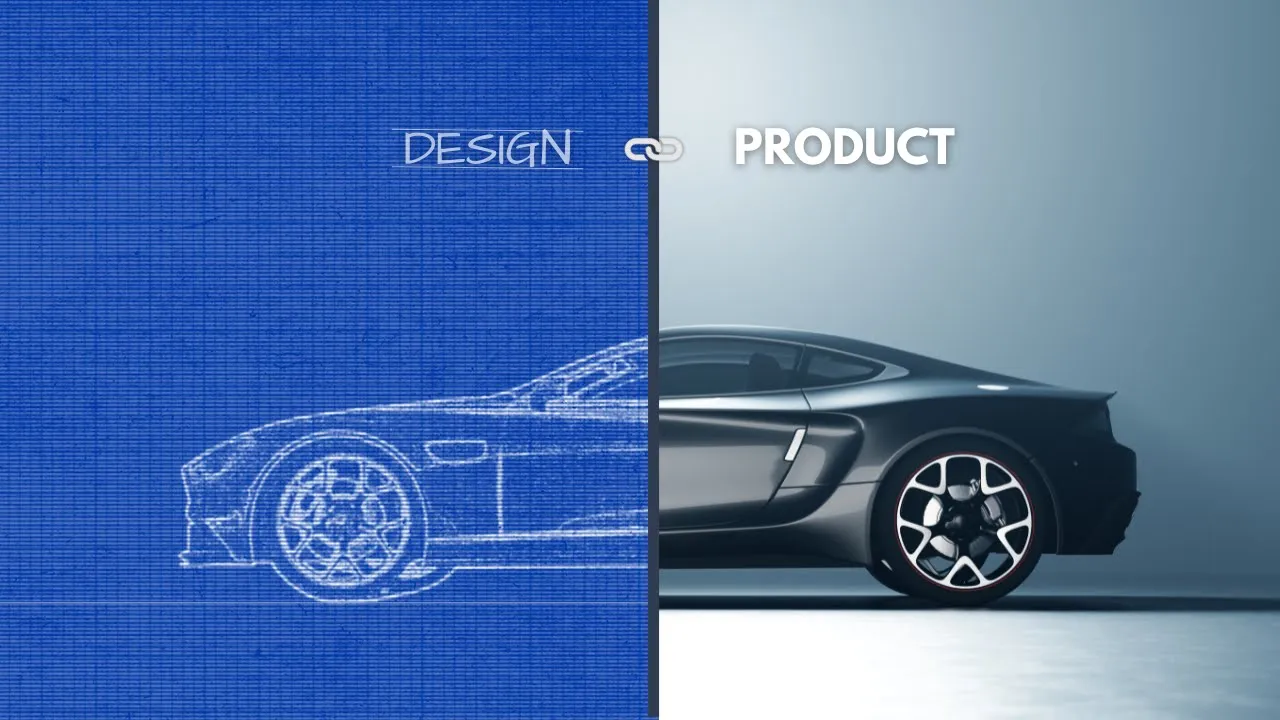
What is Product Lifecycle Management | In 2 Minutes
241
Product Lifecycle Management (PLM) is a comprehensive framework that manages products—from components to assemblies—through their entire lifecycle from concept to obsolescence, serving as a centralized system of record that maintains controlled, consistent data through change processes, manages intellectual property like designs and specifications, controls access for internal teams and external partners such as suppliers, and ensures compliance with both internal business procedures and external regulations by delivering the right information to the right people at the right time.
Click to watch →
Deep Dive
Standard mechanical joining and fastening methods (e.g., adhesives, snap-fits, threaded fasteners) and their impact on assembly complexity.

Wheel Barrow | S4 E9
78.7K
Frame assembly uses construction adhesive at all joints for additional strength. Square drive screws, particularly stainless steel, are used because they pull the assembly together tightly and will never rust. The threaded rod helps hold the entire assembly together, providing structural integrity throughout the wheelbarrow.
Click to watch →
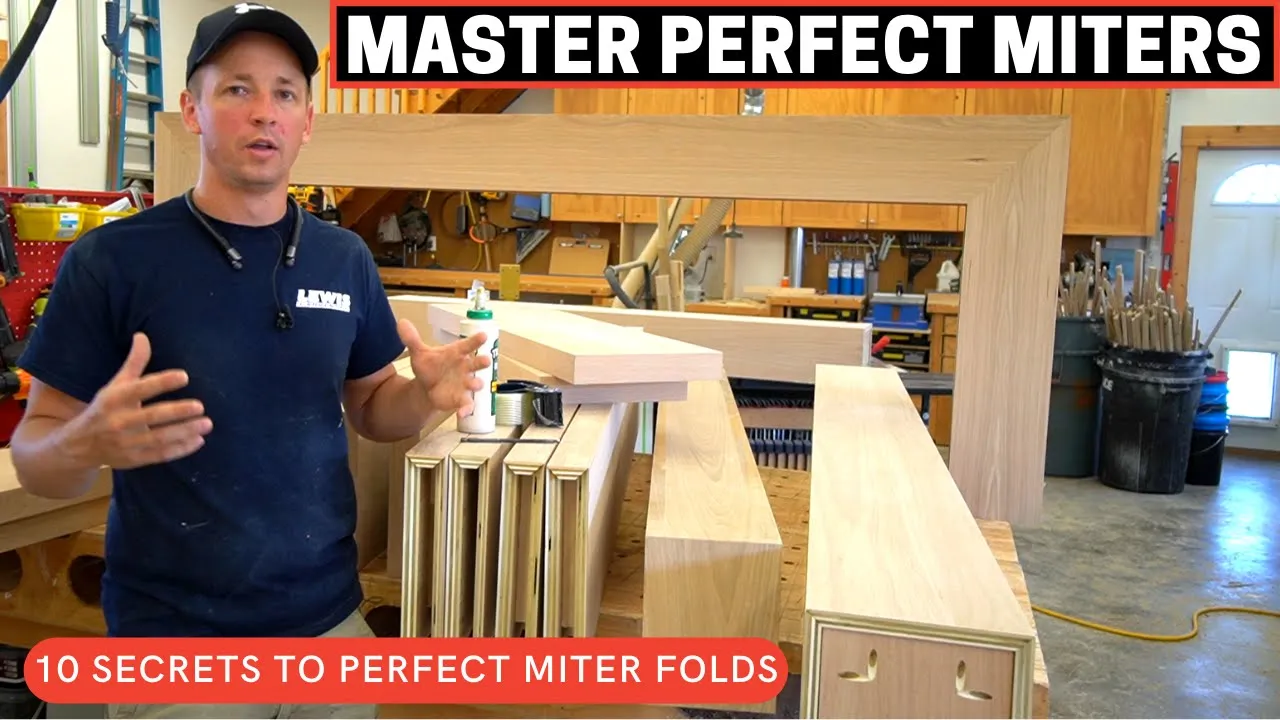
MASTER PERFECT MITERS!!! | 10 Secrets to Miter Folding
1.2M
Final assembly techniques ensure professional results: Apply glue liberally but avoid over-gluing as excess will seep through tape. Pop pieces up to naturally spread glue around. Add glue to interior blocking partitions for added stiffness. Use tape on the back side as a clamp to hold everything tight while glue sets. For end caps, 23-gauge pin nails are acceptable on stain-grade material as they disappear under paint or stain. Apply tape to one side, fold the end cap, align everything simultaneously, then shoot pins through the folded joint. Collins clamps provide alternative clamping pressure.
Click to watch →
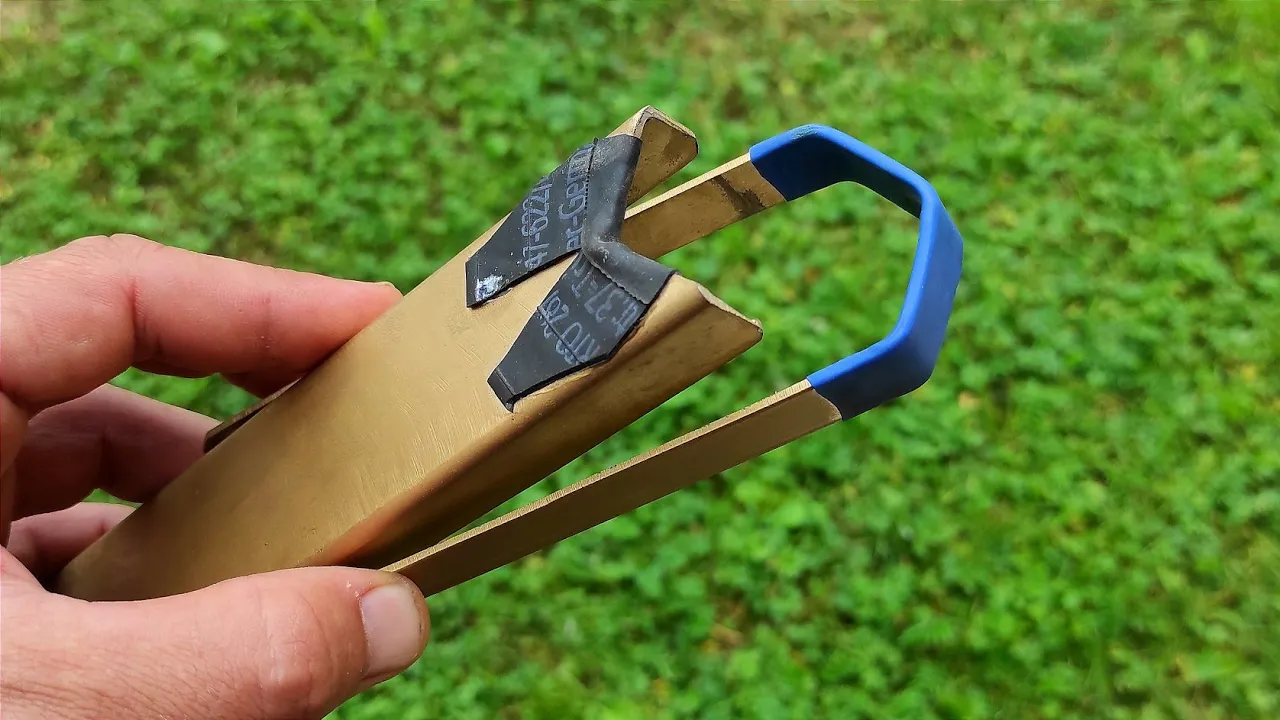
Китай точно поставит это на поток! Отличная идея своими руками из профильной трубы!
291K
This segment demonstrates practical assembly methods for metal components. The process includes: applying two-component adhesive to both surfaces for bonding, using screws with washers for mechanical fastening, securing fasteners with adhesive to prevent loosening, and wrapping joints with electrical tape for protection. The technique shows how to combine mechanical fasteners with adhesive bonding for permanent connections, particularly useful when self-locking hardware is unavailable. The assembly creates a durable fishing rod holder that can withstand the weight of rods and reels.
Click to watch →

Lalka Niemowlę | Kreskówki i filmy edukacyjne dla dzieci | Fiksiki
1.5M
Common fasteners include screws, nails, and bolts. Nails are driven with hammers for wood. Screws are used for metal and brick, often requiring pre-drilled holes. Wall anchors are inserted into holes before screws are driven in. Screws have different designs: wood screws have pointed ends, while regular screws are driven into pre-drilled holes or onto nuts. The screw was invented in ancient times and became essential in almost all devices.
Click to watch →

El nuevo bebé 👶 | Los Fixis | Dibujos animados para niños
3.1M
All parts of an apparatus must be properly adjusted. For fastening pieces of wood or plastic, nails can be used. Nails are hammered with a hammer. For metal or stone, holes must first be drilled for screws to help them hold better. To help screws hold better, they can be inserted into special fasteners called anchors or wall plugs. The difference between machine screws and wood screws is that wood screws have pointed ends, while machine screws fit into holes that already have a thread or into a nut.
Click to watch →
Prerequisite Knowledge
- Concept 01Fundamental concepts of Additive Manufacturing (3D Printing), including layer-by-layer fabrication and common material types like thermoplastics.
- Concept 02Basic principles of the Circular Economy, specifically the concepts of reducing waste, recycling, and extending product lifespans.
- Concept 03Introduction to Product Lifecycle Management (PLM), understanding how products transition from design to manufacturing, usage, and end-of-life.
- Concept 04Standard mechanical joining and fastening methods (e.g., adhesives, snap-fits, threaded fasteners) and their impact on assembly complexity.
Subsequent Learning
- Step 01Advanced Design for Disassembly (DfD) guidelines, including quantitative metrics for evaluating ease of disassembly.
- Step 02The application of Life Cycle Assessment (LCA) software to measure and compare the environmental benefits of DfD strategies.
- Step 03Smart materials and 4D printing technologies that enable self-disassembly triggered by external stimuli such as temperature or moisture.
- Step 04Circular business models, such as Product-as-a-Service (PaaS) and Extended Producer Responsibility (EPR), which leverage DfD.
- Step 05Design for Remanufacturing (DfR) and reverse logistics network design to scale up product return and recovery systems.
Talk Start
Talk Start
3:49Playing Section
- 1
Speech begins after initial music and applause.
- 2
No substantive content has been presented yet.
The Multi-Material and Energy Paradox of Additive Manufacturing
While designing 3D-printed products for disassembly aims to promote sustainability, this approach faces significant material and thermodynamic limitations. First, to create functional assemblies that can be easily taken apart, designers often utilize multi-material 3D printing or specialized polymer blends. These composite structures are incredibly difficult to separate and recycle in real-world facilities, frequently resulting in downcycling or landfilling. Second, 3D printing is highly energy-intensive compared to traditional mass-production methods like injection molding. If components must be frequently printed, disassembled, and reprinted to replace worn parts, the cumulative energy footprint can surpass those of a single, highly durable, non-disassemblable product. Furthermore, the inherent mechanical weakness of 3D-printed parts (anisotropy) means that joint interfaces designed for disassembly often wear out prematurely under stress. Consequently, the focus on disassembly can inadvertently shorten product lifespans and increase total environmental impact, challenging the assumption that additive manufacturing inherently fosters a sustainable lifecycle.
Deep Dive
Advanced Design for Disassembly (DfD) guidelines, including quantitative metrics for evaluating ease of disassembly.

2024-04-02 JMD-JMSE Joint Special Issues Advances in Design and Manufacturing for Sustainability
140
The disassemblability index calculation compares each parameter against a reference value derived from benchmark analysis or technoeconomic analysis. For disassembly steps and time, scores equal or exceeding the reference value receive a score of 1 (optimal), while lower values receive proportionally lower scores. Fastener analysis categorizes connectors as reusable, removable but not reusable, or non-removable. Tool requirements are similarly categorized. Thresholds are established based on product characteristics, component value, company knowledge, and cost-benefit analysis. Individual thresholds for each parameter enable identification of main causes of criticality.
Click to watch →

Further development of the Disassembly Map, a method to guide product design for disassembly
617
This section establishes the theoretical foundation for design for disassembly in the context of circular economy transitions. It explains why design for disassembly has become increasingly relevant due to consumer demand for sustainability, European Union policies like the Green Deal and Circular Economy Action Plan, and emerging circular business models. The Disassembly Map is introduced as a methodology for product designers and mechanical engineers to assess and improve product designs for repairability, reusability, and recyclability. The methodology is grounded in European Commission standards (EN 45554) and Joint Research Center scoring systems. Four core assessment parameters are defined: disassembly depth (number of steps to remove parts non-destructively), fasteners reusability/reversibility, tool requirements, and disassembly time measured using the IDIM metric based on MOST technique. Priority parts are identified through likelihood of replacement, suitability, and functionality. The section concludes by addressing the challenge of translating numerical assessments into actionable redesign solutions, leading to the development of visual representation systems.
Click to watch →
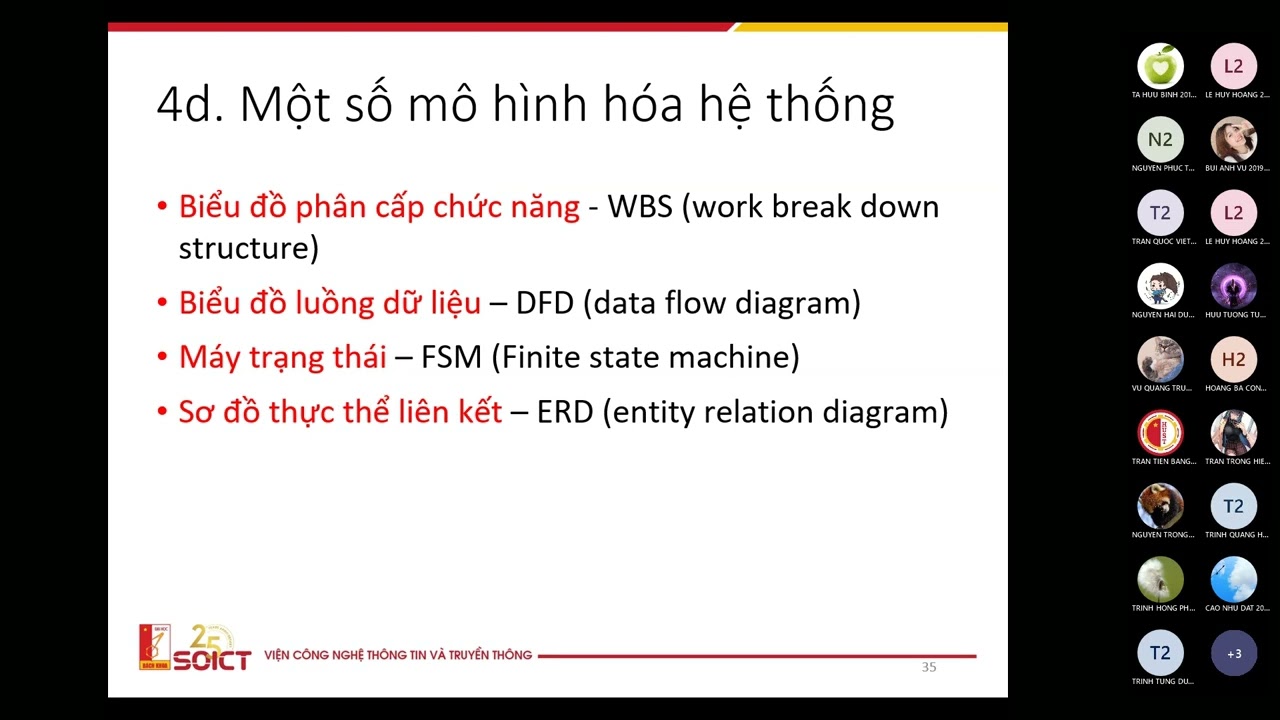
Nhập Môn Công Nghệ Phần Mềm - Buổi 7
1.3K
When decomposing DFDs: (1) Maintain consistency of external entities and data flows across levels; (2) Each process should handle a specific input-output transformation; (3) Typical decomposition creates 3-7 sub-processes per level; (4) Number processes systematically (e.g., 1.1, 1.2) for traceability; (5) Stop decomposing when processes are detailed enough for implementation.
Click to watch →

Expert Cafe: Design for Disassembly
296
Design for disassembly is a circular design approach that enables products to be easily taken apart for repair, reuse, refurbishment, or recycling. TU Delft developed two key tools: Hotspot Mapping, which systematically evaluates product architecture by logging disassembly operations and identifying critical parts based on time, access difficulty, failure rate, economic value, and environmental impact; and Disassembly Mapping, which visualizes the teardown sequence to locate hotspots within the product structure. Three redesign strategies improve ease of disassembly: surfacing (raising critical parts higher in the disassembly tree), clumping (grouping parts into sub-assemblies for easier removal), and trimming (reducing the number and time needed for critical activities). Philips' experience reveals key challenges including reliability impacts, cost implications, service costs, and consumer willingness, emphasizing that disassembly serves as a design enabler rather than an end goal, requiring alignment with circular business models and clear value drivers.
Click to watch →

Analysis Modeling-I ERD DFD Software Engineering Computer Education for All Unit No.6
17.4K
Successful DFD creation follows key guidelines: use meaningful names avoiding domain abbreviations and programming terms; number processes consistently; avoid overly complex diagrams; redraw as needed; and ensure internal consistency. Critical consistency rules prevent modeling errors: avoid 'black holes' (infinite sinks with inputs but no outputs) and 'output-only bubbles' (generally incorrect except for special cases). Behavioral modeling captures event-driven state changes using State Transition Diagrams (STDs). The creation process involves listing all system states, defining behavior in each state, identifying transition paths, specifying triggering events, and documenting associated actions. A photocopier example demonstrates this: states include reading command, making copies, reloading paper, and diagnosing problems. Events like user commands, paper finish, reload completion, and jams trigger transitions between states, enabling clear visualization of dynamic system behavior.
Click to watch →
Deep Dive
The application of Life Cycle Assessment (LCA) software to measure and compare the environmental benefits of DfD strategies.

Tools to Measure Sustainability: Life Cycle Assessment Webinar
3.5K
LCA software (SimaPro, GaBi, openLCA) automates complex calculations and provides embedded databases with pre-populated material/process data, enabling quick comparisons between alternatives. Case studies demonstrate practical applications: Welch Allen's blood pressure cuff analysis validated design decisions, identified packaging and materials as primary improvement areas, and supported environmental marketing claims. Results also revealed supplier engagement differences and informed employee training. Applications extend beyond products to building design and material selection comparisons. However, challenges persist including data collection difficulties across complex supply chains, time-intensive processes (6-12 months typical), and limitations in representing entire product categories from single-case studies.
Click to watch →

Análisis del ciclo de vida y declaraciones ambientales de producto. Curso de Economía Circular (x2)
563
Major LCA software includes SimaPro (comprehensive, expensive), Gabi, OpenLCA (free, growing), and One Click LCA (free, good for construction). Organizational LCA (ISO 14067) assesses the entire organization's environmental footprint, while product LCA focuses on specific products. Life Cycle Impact Assessment (LCIA) converts inventory data into environmental impacts through classification, characterization, normalization, and weighting. Classification and Characterization are mandatory; Normalization and Weighting are optional.
Click to watch →
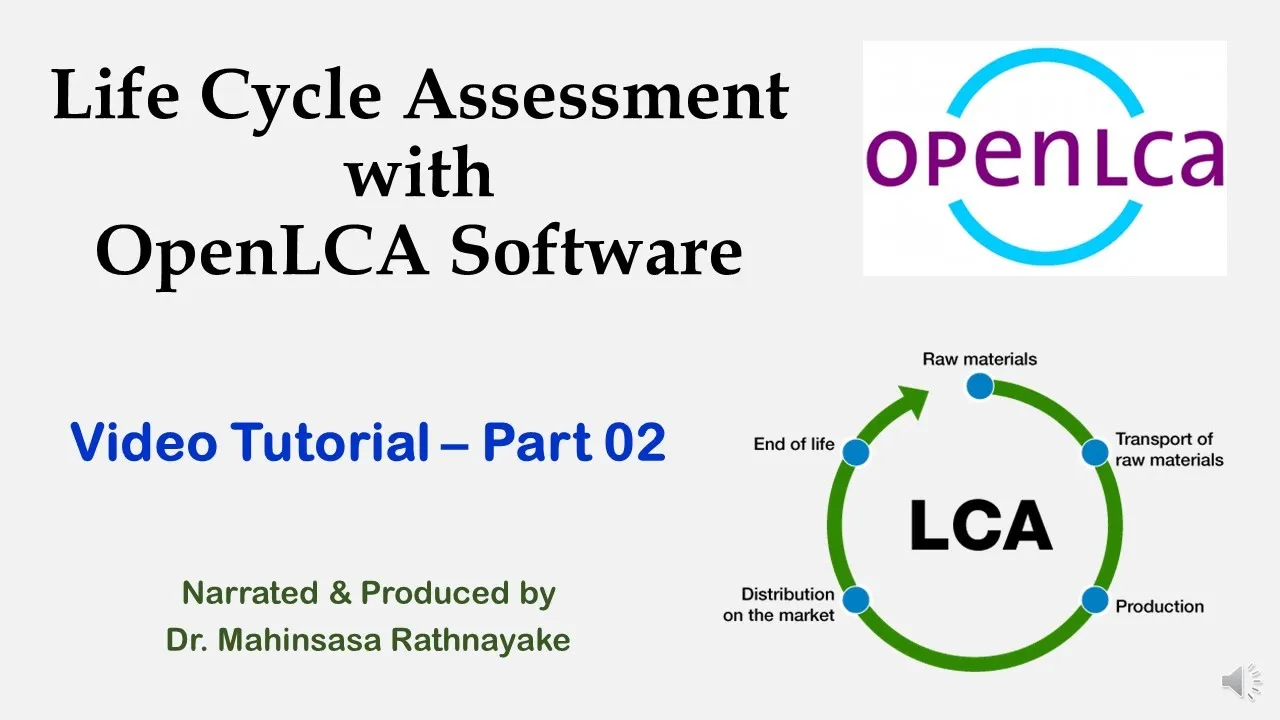
OpenLCA Software Tutorial - Part 02
72.2K
This section demonstrates practical LCA modeling using OpenLCA software through a coal power generation case study. The example covers three processes: coal mining, coal transportation, and coal combustion. Key concepts include: (1) System boundary definition using cradle-to-gate approach; (2) Understanding the four hierarchical elements in OpenLCA: flows (individual mass/emission flows), processes (activities transforming inputs to outputs), product systems (collections of related processes), and projects (for multi-system comparisons); (3) Data entry methodology for inputs and outputs including emission factors; (4) The importance of functional unit consistency when comparing alternatives. This hands-on demonstration illustrates how theoretical LCA principles translate into practical software implementation.
Click to watch →

Lec 33: Life Cycle Assessment (LCA): An Introduction
11.6K
LCA serves multiple purposes including: (1) Product improvement by identifying how changes in raw materials or fuels affect overall environmental impact; (2) Decision-making support for comparing alternatives like battery vs. petroleum vehicles; (3) Policy evaluation for standards like BS6 vehicle emissions; (4) Environmental planning using relevant performance indicators; (5) Marketing strategy development by demonstrating environmentally superior products. Case studies show LCA helped Delhi reduce pollution by comparing diesel versus CNG vehicle emissions, enabling informed decisions about fuel transitions and public health benefits.
Click to watch →

LCA for 3DEXPERIENCE SOLIDWORKS – Part 1 – Introduction to LCA
224
Life Cycle Assessment serves two primary applications in sustainable decision-making. First, hotspot identification uses LCA to pinpoint the largest sources of environmental impacts within a product, process, or service, guiding improvement decisions. A case study demonstrated this with a US leather company analyzing domestic versus Spanish production: LCA revealed that cattle farming impacts far exceeded shipping and processing impacts, showing that upstream raw material production often dominates environmental footprint. Second, comparative LCA enables evaluation of alternatives by establishing a functional unit that defines equivalence. For example, comparing cups for carrying 12 oz of hot fluid for 500 uses revealed that ceramic mugs outperformed disposable options even when accounting for washing requirements. These applications demonstrate how LCA supports both internal improvement decisions and competitive differentiation strategies.
Click to watch →
Deep Dive
Smart materials and 4D printing technologies that enable self-disassembly triggered by external stimuli such as temperature or moisture.

El poder de la manufactura aditiva y digital: Creando un mundo sostenible
298
4D printing extends additive manufacturing by incorporating time as the fourth dimension, using materials that change shape or properties in response to external stimuli like temperature, humidity, electrical fields, or mechanical stress. These smart materials can self-assemble, deform programmatically, or respond to their environment. For example, materials reacting to temperature (Peltier effect) can change shape when heated or cooled, enabling grippers or adaptive structures. This technology enables objects that detect and respond to their environment, opening possibilities for self-repairing structures, adaptive devices, and responsive systems. The ability to program material behavior transforms manufacturing from creating static objects to producing dynamic, responsive systems.
Click to watch →

10 Incredible Recent Engineering Achievements
53.3K
4D printing builds upon 3D printing by creating objects that can react to different conditions in real time. Several smart materials have been developed, including self-healing plastics that eliminate wear and tear and make items infinitely reusable, fabrics that rearrange their molecular structure in response to weather changes, and shoes that can fully repair themselves when treated with an additional gel. These materials represent the evolution from static manufactured objects to dynamic, adaptive materials that respond to environmental stimuli.
Click to watch →

Кружка может склеить сама себя! За какими материалами будущее? | Метод Сократа
859K
Smart materials are materials that can change their properties in response to external stimuli such as heat, light, or moisture, enabling applications like self-healing surfaces, shape-memory alloys, and responsive medical implants. Biomimetic materials replicate natural structures and properties, while 4D printing extends 3D printing by creating objects that can change shape over time through programmed responses to environmental conditions.
Click to watch →

4D Printing: Shaping Tomorrow's Realities | Ir. Ts. Dr. Ahmad Jazlan Haja Mohideen | TEDxIIUM
928
4D printing extends 3D printing by incorporating smart materials that enable printed objects to respond dynamically to environmental stimuli such as temperature, moisture, pressure, and pH changes, allowing them to change shape or properties over time; this technology has significant potential in medical applications like personalized heart stents that can adapt to patient-specific conditions, grow with children, and minimize complications such as restenosis and thrombosis.
Click to watch →

상상, 현실이 되다 - 4차 산업혁명 2부 / YTN 사이언스
62.9K
4D printing extends 3D printing by adding the dimension of time, creating objects that change shape over time when exposed to environmental stimuli. This technology uses smart materials like shape memory polymers that can remember and return to their original form. The concept was introduced by MIT in 2013 and represents an evolution from static 3D printing to dynamic, self-assembling structures. These materials respond to temperature, moisture, and other conditions, enabling applications in medicine, manufacturing, and adaptive structures.
Click to watch →
Deep Dive
Circular business models, such as Product-as-a-Service (PaaS) and Extended Producer Responsibility (EPR), which leverage DfD.
Les nouveaux modèles d'affaires durables générateurs de valeurs
305
Four circular business models can be implemented: (1) Product-as-a-Service (PaaS) - selling access rather than ownership, with options for daily/weekly rental or subscription; (2) Repair services - offering repair workshops, DIY training, or on-site repair services to extend product life; (3) Second-life products - reselling refurbished products to original or new customers; (4) Recycling - recovering materials from end-of-life products to reduce raw material purchases and generate new revenue streams. Quantitative analysis shows PaaS can generate 5-6 times more value than traditional production models while reducing carbon intensity.
Click to watch →

Week van de Circulaire Economie - Circulair Ondernemen | De belofte van PaaS
151
Product-as-a-Service (PaaS) represents the pinnacle of circular business models, where companies sell product functions rather than physical items. This model creates natural incentives for sustainability because providers retain ownership and earn revenue as long as products function. Key elements include dematerialization (reducing total materials needed), life extension through maintenance, and continuous product improvement. Companies like Slof Fiets have demonstrated success with 260,000 members, improving quality while reducing total cost of ownership. The model requires different financial approaches than traditional sales, with longer payback periods and ongoing service relationships.
Click to watch →

Closing Workshop of the Plastics Awareness Project
244
This section explains Extended Producer Responsibility (EPR) and circular economy principles: (1) EPR is a policy mechanism where producers are responsible for the entire lifecycle of their products, including post-consumer packaging. (2) In Nigeria, the industry-led model requires manufacturers to form Producer Responsibility Organizations (PROs) to manage waste. (3) FIBRA (Food and Beverage Recycling Alliance) manages packaging waste for the food and beverage sector, with 49 member companies. (4) The circular economy aims to eliminate waste by creating a loop where materials are continuously reused, contrasting with the linear economy (production → use → disposal). (5) The section demonstrates circular economy in practice through PET bottle recycling: consumers use bottles, waste pickers collect them, recyclers process them into raw materials, and manufacturers use recycled materials to produce new bottles. Companies like Nestle now use 50% recycled content, with regulations requiring 25% by 2028.
Click to watch →
A circular economy for packaging: Extended Producer Responsibility
9.2K
Extended Producer Responsibility (EPR) is a policy mechanism where companies that introduce packaging into the market are legally required to pay for its collection, sorting, and recycling after use, providing dedicated, ongoing, and sufficient funding that addresses the economic gap where current recycling costs exceed revenues; this mandatory approach creates a level playing field among all stakeholders, incentivizes better packaging design, and serves as a structural foundation for building circular economy systems, as evidenced by the recent alignment of over 150 organizations including major FMCG companies, retailers, and governments behind EPR as essential for solving packaging waste and pollution.
Click to watch →
5 Geschäftsideen für Anfänger, die du mit weniger als 500€ umsetzen kannst!
90.9K
The product-as-a-service model involves packaging standard services as standardized products that customers can purchase directly. The speaker explains that this model transforms traditionally custom services (like graphic design or consulting) into repeatable, scalable products. The speaker uses the example of podcast cover design, where a service that would normally require a custom consultation and design process is packaged as a standardized product that customers can purchase and receive without direct interaction with the service provider.
Click to watch →
Deep Dive
Design for Remanufacturing (DfR) and reverse logistics network design to scale up product return and recovery systems.

Circular Economy Masterclasses - Lecture 5
136
Remanufacturing and reverse logistics are essential components of circular economy implementation: (1) Products should be designed for easy disassembly and component recovery, (2) Sales packaging should facilitate return and recycling, (3) Products should be designed to be dropped into return systems for processing, (4) Reverse logistics infrastructure must be established to collect and process returned products, and (5) Components should be designed for reuse in new products. The challenge is creating systems where products can be returned, processed, and components recovered efficiently. This requires both product design considerations and infrastructure investments.
Click to watch →

MIT Student Lightning Talks - for the City Science Network
275
Current product design typically optimizes for scale manufacturing but not for scale remanufacturing or repurposing. To improve sustainability, products should be designed with remanufacturing in mind, enabling components to be reused for multiple purposes. Pilot projects are exploring educational incentives that connect informal economy participants with efficient networks, providing training on safe e-waste repurposing and connecting scrap dealers with recyclers throughout cities to create more efficient circular economy systems.
Click to watch →
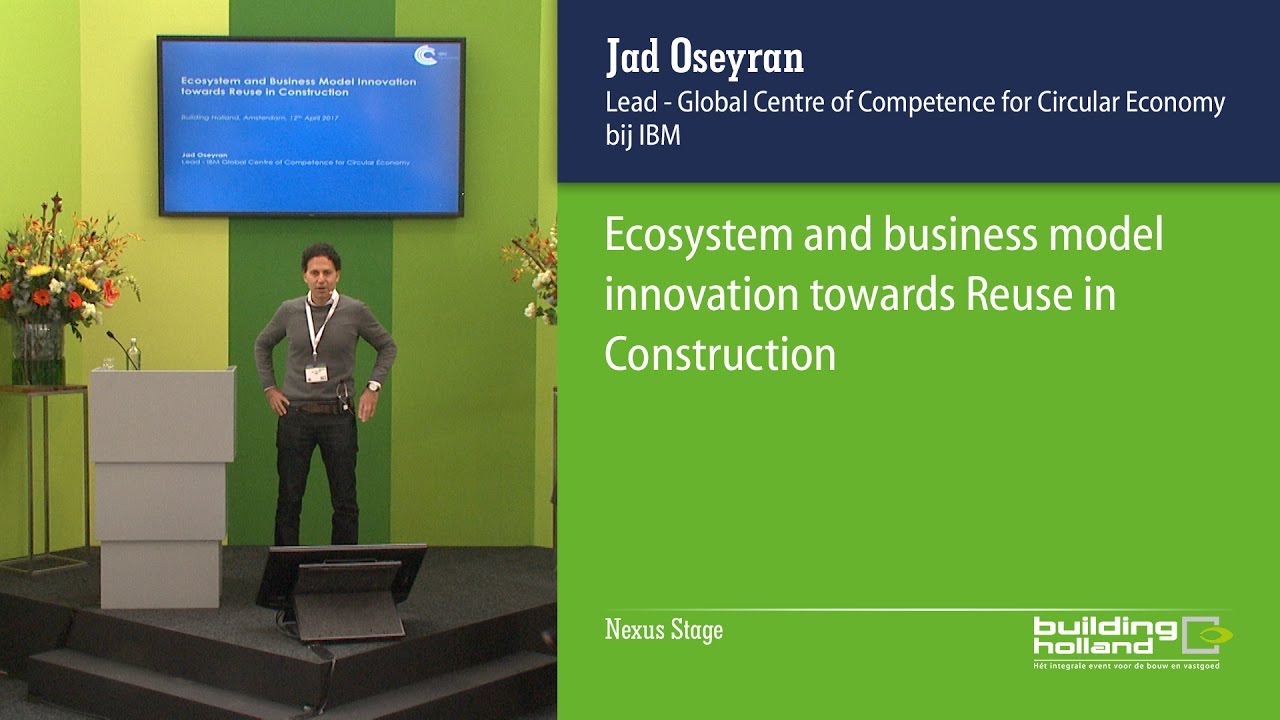
Ecosystem and business model innovation towards Reuse in Construction - Jad Oseyran
246
Reverse management requires setting up complete reverse logistics networks, not just execution. IBM operates 12 centers worldwide to recover products. Remanufacturing value is increasing because smart design can boost value propositions. Specialized recycling technologies are advancing, particularly for extracting precious metals from electronics, while remanufacturing gains prominence in the circular economy.
Click to watch →

CSCP Exam Practice Question Test 4
10.4K
Design for reverse logistics is a product design strategy where products are designed to be returned to the manufacturer for proper disposal or recycling. This is particularly important for products containing hazardous materials, as it prevents customers from having to dispose of dangerous items themselves. The company invests in packaging and reverse logistics functions as part of customer service to ensure safe and proper product return.
Click to watch →

II Jornada Logística Inversa - Ricardo Catelli
7.8K
To obtain value from reverse logistics, companies must analyze received items and decide on final destinations. Efficiency requires sectoral specialization. The future lies in operators adding 'R' services to their classification (e.g., 3PL + 3R). Companies should seek volumes both upstream and downstream to generate economies of scale, transforming reverse logistics from a cost center into a profit center. Implementation requires analyzing entry barriers, defining product scope, designing collection mechanisms, and establishing quality standards. Technical challenges include establishing demand, recovery delays, supply-demand imbalance, disassembly design, remanufacturing programming, and recovery network design.
Click to watch →
Talk Start
Talk Start
3:49- 1
Speech begins after initial music and applause.
- 2
No substantive content has been presented yet.
The Multi-Material and Energy Paradox of Additive Manufacturing
While designing 3D-printed products for disassembly aims to promote sustainability, this approach faces significant material and thermodynamic limitations. First, to create functional assemblies that can be easily taken apart, designers often utilize multi-material 3D printing or specialized polymer blends. These composite structures are incredibly difficult to separate and recycle in real-world facilities, frequently resulting in downcycling or landfilling. Second, 3D printing is highly energy-intensive compared to traditional mass-production methods like injection molding. If components must be frequently printed, disassembled, and reprinted to replace worn parts, the cumulative energy footprint can surpass those of a single, highly durable, non-disassemblable product. Furthermore, the inherent mechanical weakness of 3D-printed parts (anisotropy) means that joint interfaces designed for disassembly often wear out prematurely under stress. Consequently, the focus on disassembly can inadvertently shorten product lifespans and increase total environmental impact, challenging the assumption that additive manufacturing inherently fosters a sustainable lifecycle.
Fundamental concepts of Additive Manufacturing (3D Printing), including layer-by-layer fabrication and common material types like thermoplastics.
Basic principles of the Circular Economy, specifically the concepts of reducing waste, recycling, and extending product lifespans.
Introduction to Product Lifecycle Management (PLM), understanding how products transition from design to manufacturing, usage, and end-of-life.
Standard mechanical joining and fastening methods (e.g., adhesives, snap-fits, threaded fasteners) and their impact on assembly complexity.
Advanced Design for Disassembly (DfD) guidelines, including quantitative metrics for evaluating ease of disassembly.
The application of Life Cycle Assessment (LCA) software to measure and compare the environmental benefits of DfD strategies.
Smart materials and 4D printing technologies that enable self-disassembly triggered by external stimuli such as temperature or moisture.
Circular business models, such as Product-as-a-Service (PaaS) and Extended Producer Responsibility (EPR), which leverage DfD.
Design for Remanufacturing (DfR) and reverse logistics network design to scale up product return and recovery systems.
560 views7likes3:50@tuwien-e3089Original Release: 2022-08-24
[Music] [Applause] [Music] [Applause] [Music] you
Up Next

30:43
8259 Programmable Interrupt Controller | Features & Applications
@Ekeeda
29.4K views•2018-08-11

30:32
Ultrasonic Transducers: Resonant Frequency Measurement and Horn Design
@imajeenyus42
229.9K views•2017-02-22
54:16
Polymer Environmental Degradation: Mechanisms & Stabilization
@iit
1.8K views•2012-07-10
33:39
How a Student's Question Saved a NYC Skyscraper from Collapse
@veritasium
22.8M views•2025-04-26
Related Study Plans & Knowledge Roadmaps
Structured learning paths in Engineering
engineering
Building Acoustic Levitators: Physics & Arduino
01The Physics of Sound and Standing Waves
02Piezoelectric Transducers and H-Bridge Drivers
03Arduino Programming: Generating 40 kHz Signals
+ 2 more learning modules
14h5 modules
Explore Roadmap
engineering
Building Peltier Cloud Chambers: Particle Tracks
01Cosmic Rays & Cloud Chamber Physics
02Thermoelectric Cooling (TEC) Fundamentals
03Custom Liquid-Cooling Loop Design
+ 2 more learning modules
18h5 modules
Explore Roadmap
engineering
Yagi-Uda Antennas: Modeling, Build & VNA Test
01Introduction to RF and Antenna Fundamentals
02Yagi-Uda Antenna Design Principles
03Antenna Modeling and Simulation in 4NEC2
+ 2 more learning modules
18h5 modules
Explore Roadmap
engineering
ECG Monitor Design: Op-Amps, Filters & Noise
01Electronics & Breadboard Basics
02Op-Amps and Instrumentation Amplifiers
03Bioelectricity and ECG Fundamentals
+ 2 more learning modules
18h5 modules
Explore Roadmap