






















Eigenvectors are special vectors that, when transformed by a linear transformation, are only scaled by a constant factor (the eigenvalue) without changing their direction; these vectors are particularly useful because they form natural basis systems that simplify the computation of transformation matrices.
Eigenvectors and Eigenvalues Explained | Linear Algebra
Added:Understanding of matrices and matrix-vector multiplication as linear transformations.
The concept of determinants and how they measure the scaling of area or volume.
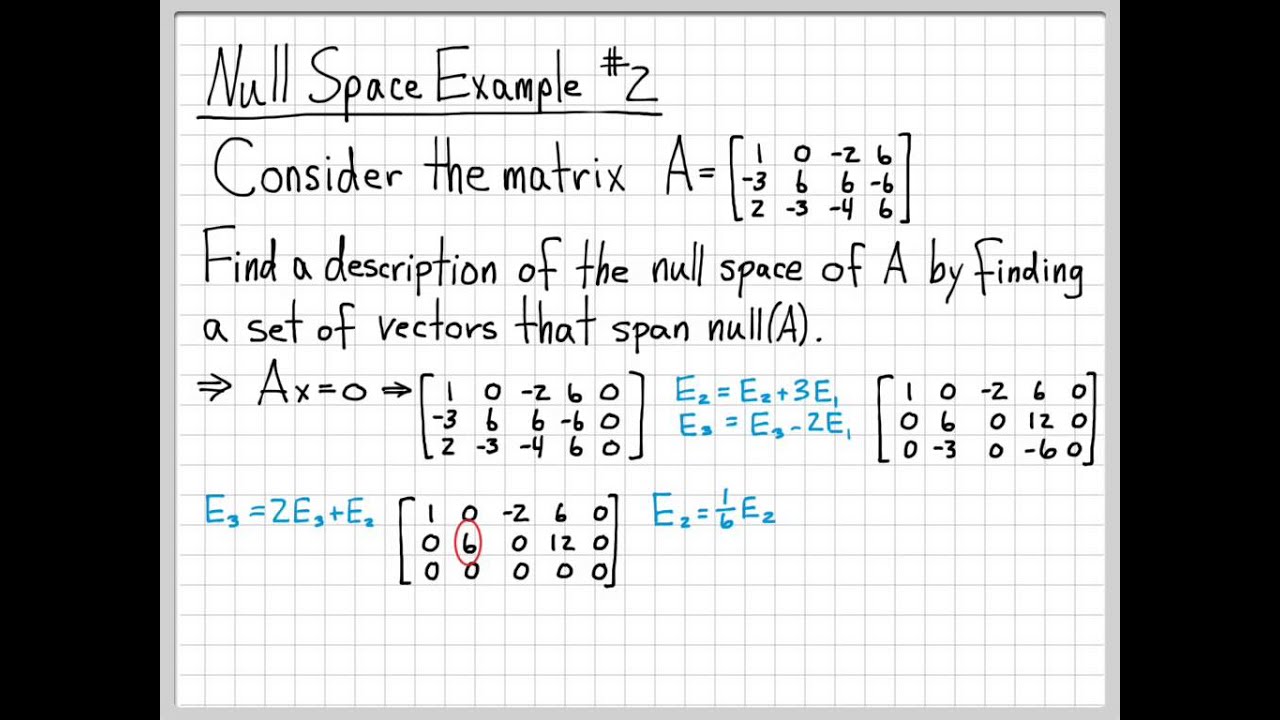
How to solve systems of linear equations and find the null space of a matrix.
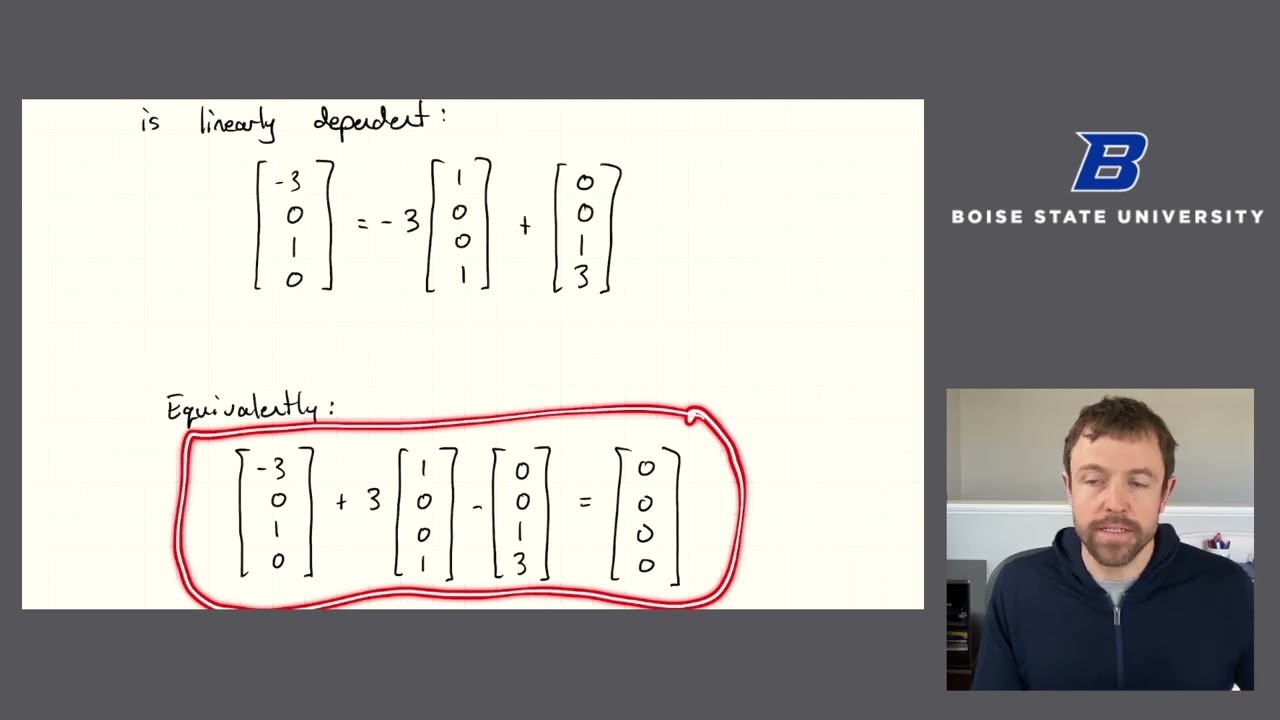
The foundational concepts of vector spaces, linear independence, basis, and span.
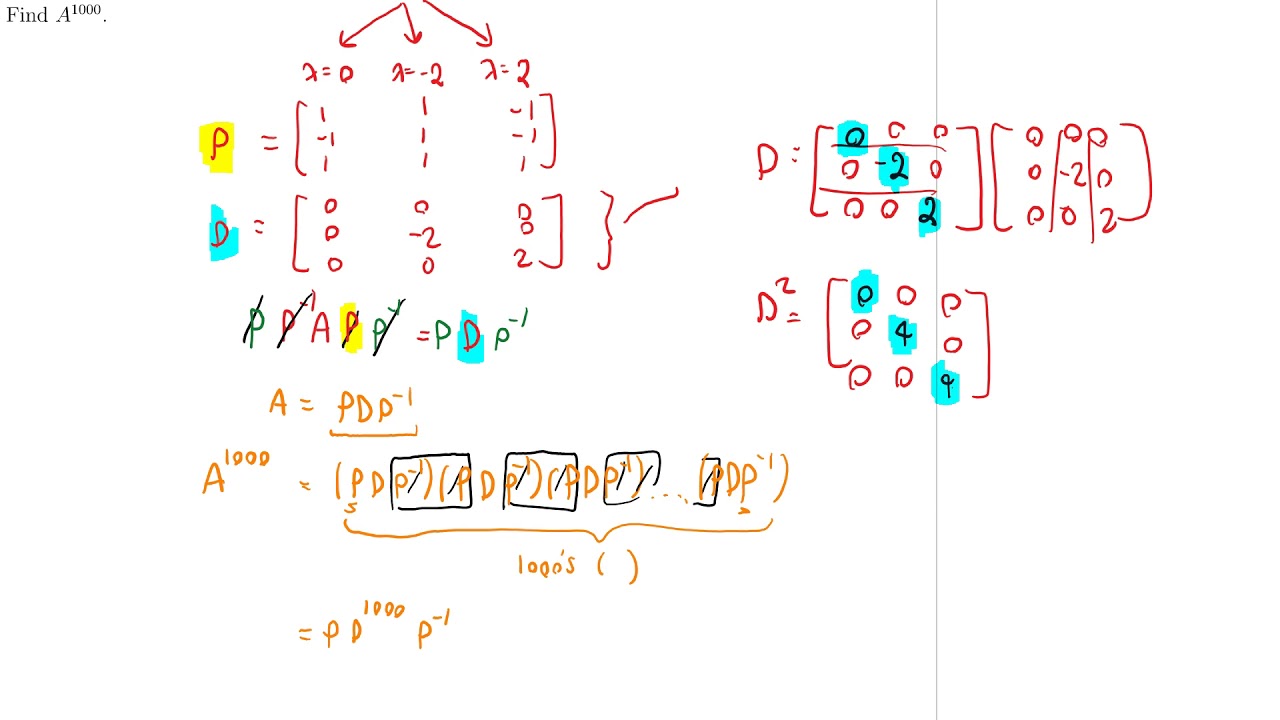
Matrix Diagonalization and how it simplifies computing high powers of matrices.
Principal Component Analysis (PCA) for dimensionality reduction in data science.
The Spectral Theorem and the unique properties of symmetric matrices.
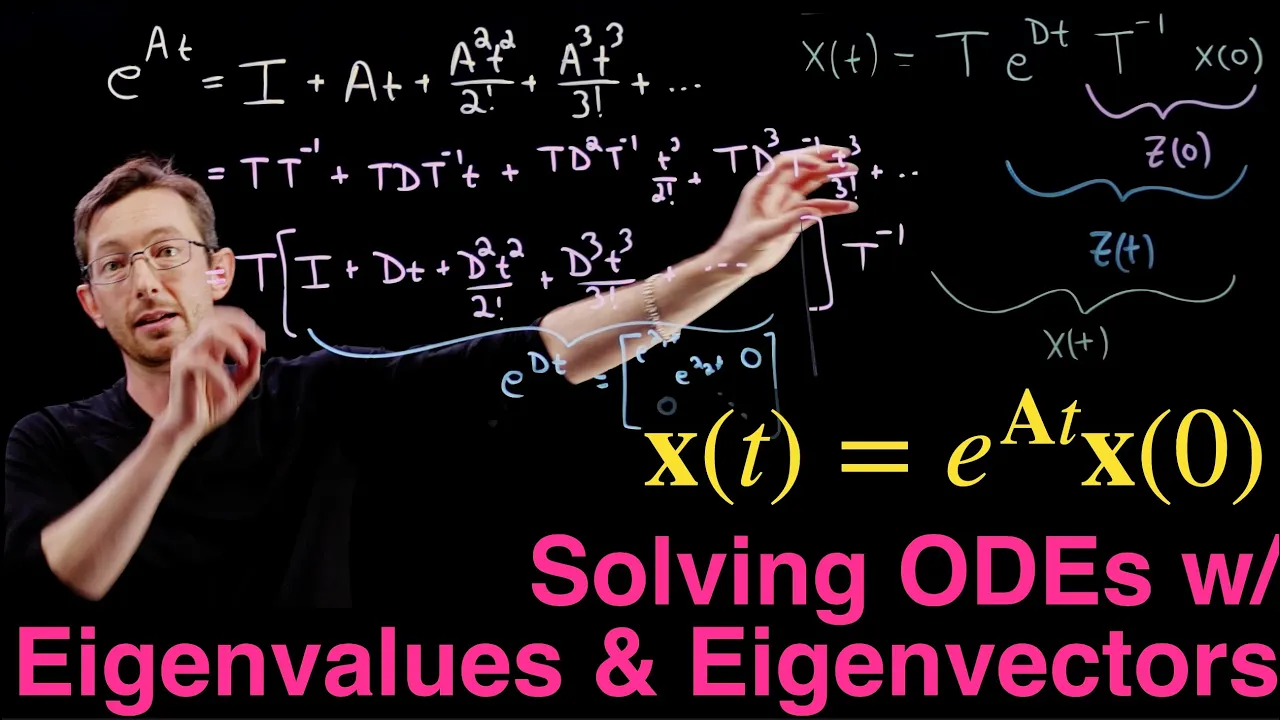
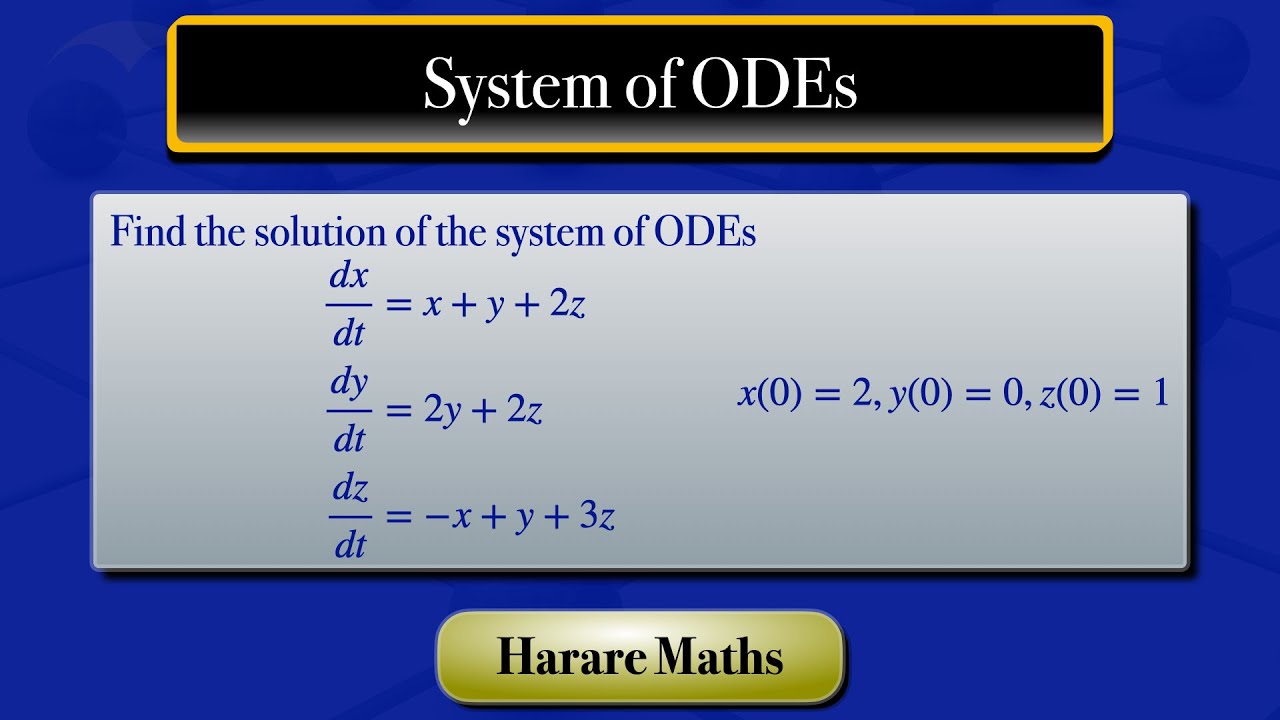
Using eigenvalues and eigenvectors to solve systems of ordinary differential equations.
PageRank and Markov Chains, which utilize dominant eigenvectors to determine importance in networks.
1.3M views3.5Klikes7:42Original Release: 2009-11-13
For any transformation that maps from Rn to Rn, we've done it implicitly, but it's been interesting for us to find the vectors that essentially just get scaled up by the transformations.
So the vectors that have the form-- the transformation of my vector is just equal to some scaled-up version of a vector.
And if this doesn't look familiar, I can jog your memory a little bit.
When we were looking for basis vectors for the transformation-- let me draw it.
This was from R2 to R2.
So let me draw R2 right here.
And let's say I had the vector v1 was equal to the vector 1, 2.
And we had the lines spanned by that vector.
We did this problem several videos ago.
And I had the transformation that flipped across this line.
So if we call that line l, T was the transformation from R2 to R2 that flipped vectors across this line.
So it flipped vectors across l.
So if you remember that transformation, if I had some random vector that looked like that, let's say that's x, that's vector x, then the transformation of x looks something like this.
It's just flipped across that line.
That was the transformation of x.
And if you remember that video, we were looking for a change of basis that would allow us to at least figure out the matrix for the transformation, at least in an alternate basis.
And then we could figure out the matrix for the transformation in the standard basis.
And the basis we picked were basis vectors that didn't get changed much by the transformation, or ones that only got scaled by the transformation.
For example, when I took the transformation of v1, it just equaled v1.
Or we could say that the transformation of v1 just equaled 1 times v1.
So if you just follow this little format that I set up here, lambda, in this case, would be 1.
And of course, the vector in this case is v1.
The transformation just scaled up v1 by 1.
In that same problem, we had the other vector that we also looked at.
It was the vector minus-- let's say it's the vector v2, which is-- let's say it's 2, minus 1.
And then if you take the transformation of it, since it was orthogonal to the line, it just got flipped over like that.
And that was a pretty interesting vector force as well, because the transformation of v2 in this situation is equal to what?
Just minus v2.
It's equal to minus v2.
Or you could say that the transformation of v2 is equal to minus 1 times v2.
And these were interesting vectors for us because when we defined a new basis with these guys as the basis vector, it was very easy to figure out our transformation matrix.
And actually, that basis was very easy to compute with.
And we'll explore that a little bit more in the future.
But hopefully you realize that these are interesting vectors.
There was also the cases where we had the planes spanned by some vectors.
And then we had another vector that was popping out of the plane like that.
And we were transforming things by taking the mirror image across this and we're like, well in that transformation, these red vectors don't change at all and this guy gets flipped over.
So maybe those would make for good bases.
Or those would make for good basis vectors.
And they did.
So in general, we're always interested with the vectors that just get scaled up by a transformation.
It's not going to be all vectors, right?
This vector that I drew here, this vector x, it doesn't just get scaled up, it actually gets changed, this direction gets changed.
The vectors that get scaled up might switch direct-- might go from this direction to that direction, or maybe they go from that.
Maybe that's x and then the transformation of x might be a scaled up version of x.
Maybe it's that.
The actual, I guess, line that they span will not change.
And so that's what we're going to concern ourselves with.
These have a special name.
And they have a special name and I want to make this very clear because they're useful.
It's not just some mathematical game we're playing, although sometimes we do fall into that trap.
But they're actually useful.
They're useful for defining bases because in those bases it's easier to find transformation matrices.
They're more natural coordinate systems. And oftentimes, the transformation matrices in those bases are easier to compute with.
And so these have special names.
Any vector that satisfies this right here is called an eigenvector for the transformation T.
And the lambda, the multiple that it becomes-- this is the eigenvalue associated with that eigenvector.
So in the example I just gave where the transformation is flipping around this line, v1, the vector 1, 2 is an eigenvector of our transformation.
So 1, 2 is an eigenvector.
And it's corresponding eigenvalue is 1.
This guy is also an eigenvector-- the vector 2, minus 1.
He's also an eigenvector.
A very fancy word, but all it means is a vector that's just scaled up by a transformation.
It doesn't get changed in any more meaningful way than just the scaling factor.
And it's corresponding eigenvalue is minus 1.
If this transformation-- I don't know what its transformation matrix is.
I forgot what it was.
We actually figured it out a while ago.
If this transformation matrix can be represented as a matrix vector product-- and it should be; it's a linear transformation-- then any v that satisfies the transformation of-- I'll say transformation of v is equal to lambda v, which also would be-- you know, the transformation of [? v?]
would just be A times v.
These are also called eigenvectors of A, because A is just really the matrix representation of the transformation.
So in this case, this would be an eigenvector of A, and this would be the eigenvalue associated with the eigenvector.
So if you give me a matrix that represents some linear transformation.
You can also figure these things out.
Now the next video we're actually going to figure out a way to figure these things out.
But what I want you to appreciate in this video is that it's easy to say, oh, the vectors that don't get changed much.
But I want you to understand what that means.
It literally just gets scaled up or maybe they get reversed.
Their direction or the lines they span fundamentally don't change.
And the reason why they're interesting for us is, well, one of the reasons why they're interesting for us is that they make for interesting basis vectors-- basis vectors whose transformation matrices are maybe computationally more simpler, or ones that make for better coordinate systems.
Up Next

28:16
Spectral Graph Theory Explained: Laplacian, Eigenvalues, and Clustering
@ron-math
87.9K views•2024-05-16

8:17
JEE Maths | Circles: Pole & Polar Explained with Equations
@TargetPublications
14.4K views•2019-02-23
6:22
Jacobian Matrix Explained | Local Linearity & Transformations
@khanacademy
580.9K views•2017-01-10

6:00
The Mathematical Impossibility of Accurate World Maps
@Vox
23.3M views•2016-12-02
Related Study Plans & Knowledge Roadmaps
Structured learning paths in Mathematics
mathematics
Projective Geometry: Coordinates & Conics
01From Euclidean to Projective Space
02Homogeneous Coordinates
03Duality and Projective Transformations
+ 2 more learning modules
14h5 modules
Explore Roadmap
mathematics
Tensor Calculus: Vectors to Riemann Curvature
01Mathematical Foundations: Linear Algebra & Calculus
02Covectors, Dual Spaces, and Tensor Basics
03The Metric Tensor and Index Gymnastics
+ 2 more learning modules
40h5 modules
Explore Roadmap
mathematics
Gödel's Incompleteness: Logic, Proofs & Limits
01Introduction to Formal Systems & Hilbert's Dream
02Set Theory, Cardinality, and Cantor's Diagonal Argument
03Arithmetization and Gödel Numbering
+ 2 more learning modules
14h5 modules
Explore Roadmap
mathematics
Galois Theory: Fields, Groups & Solvability
01Foundations of Abstract Algebra: Groups & Fields
02Polynomials & Field Extensions
03Splitting Fields & Symmetries
+ 2 more learning modules
24h5 modules
Explore Roadmap