




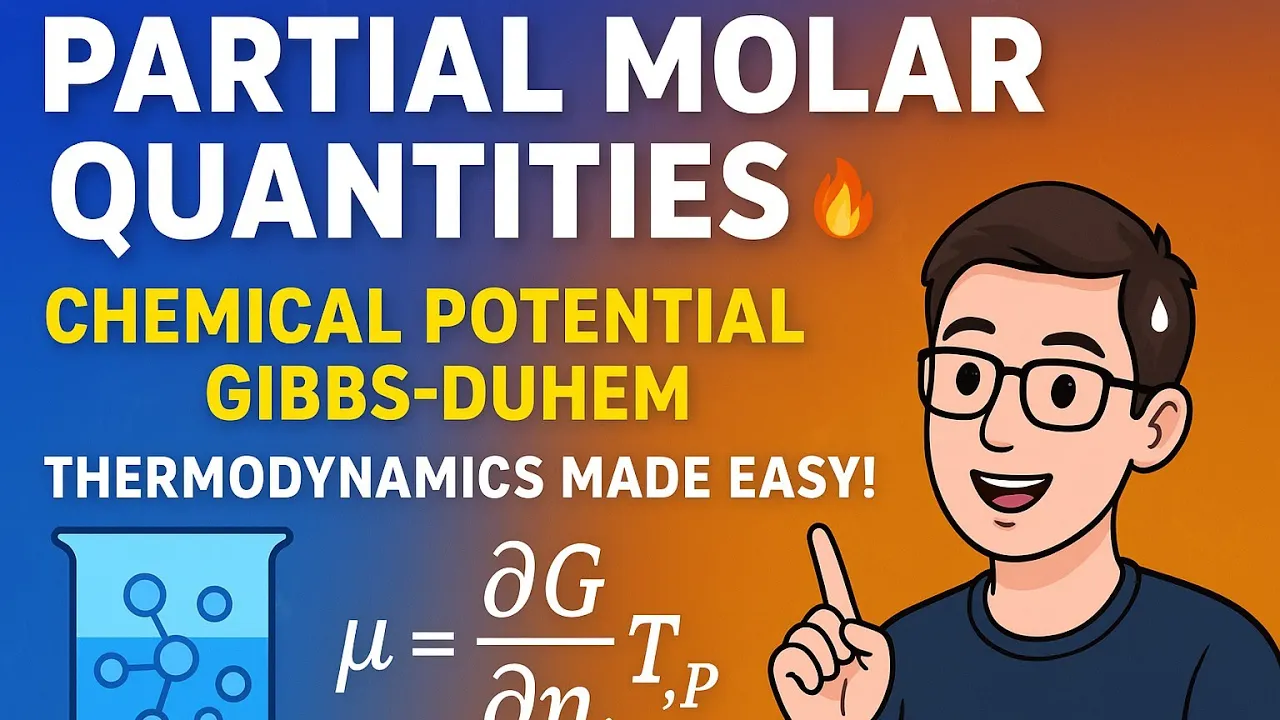



















Chemical potential (μ) is defined as the partial derivative of Gibbs free energy with respect to the number of moles of a component, holding temperature, pressure, and the amounts of all other components constant. It serves as an intensive property that drives matter transfer from regions of high chemical potential to regions of low chemical potential, analogous to water flowing from high to low levels. At equilibrium, the chemical potential of each component must be equal across all phases in a system. The Gibbs phase rule (F + P = C + 2) describes the relationship between degrees of freedom (F), number of phases (P), and number of components (C) in a system at equilibrium. For ideal gases, the chemical potential is given by μ = μ° + RT ln(P), while for ideal solutions, it is μ = μ° + RT ln(x), where x is the mole fraction.
Chemical Potential & Introduction to Phase Equilibria | Thermodynamics
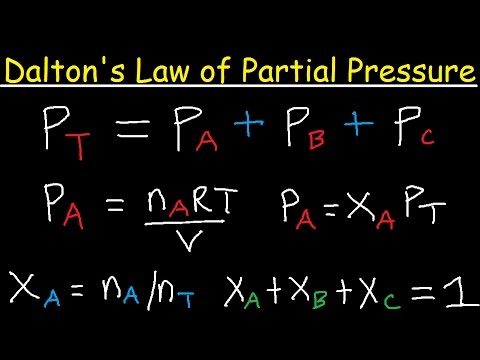
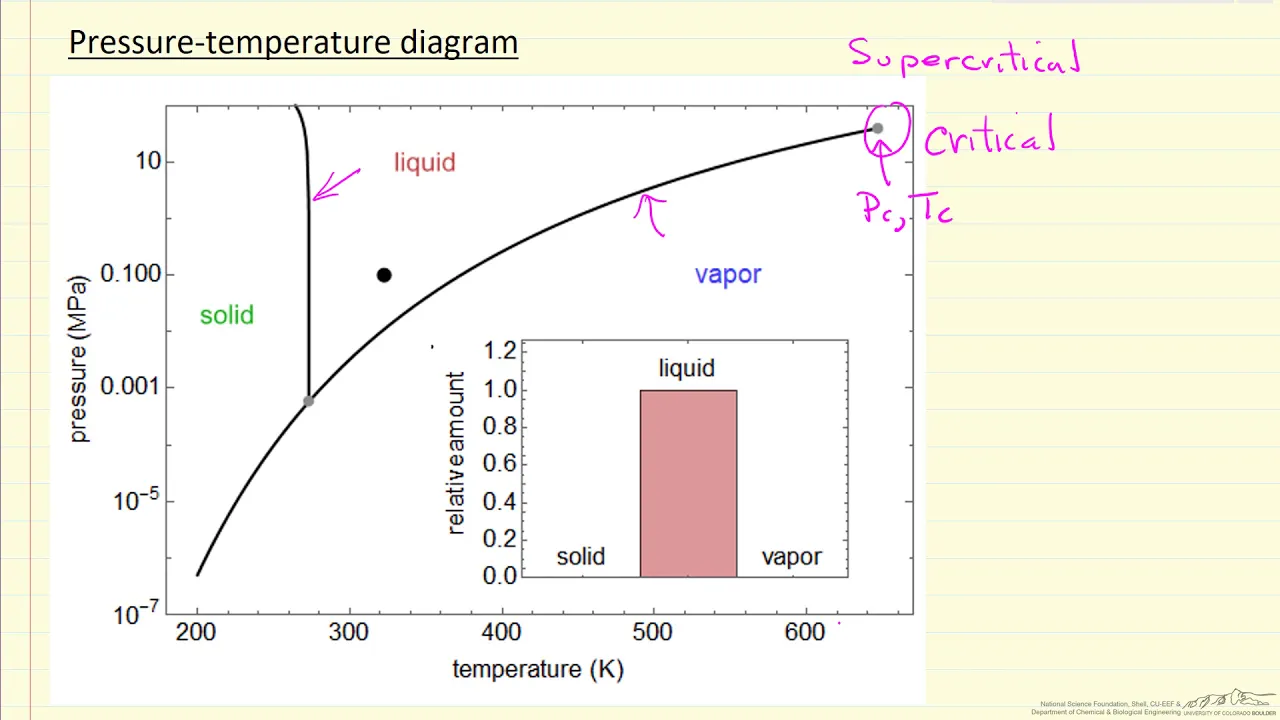
Added:so I want us I want to introduce um a new excuse me excuse me which which site are we going to to get the the recordings that you have recorded so there's a recording I have sent to you which is on uh on email I hope you have received it okay let me check yes just just check your emails it's it's recorded on Google meter so you have to to log in to your you have to log in to your to your email of course usually I have that class with another group so I use I always record it on uh Google meet this one it's always recorded on yes this one is always recorded on on this platform Ms teams so if you go to m teams did you did you see the other have you ever seen the previous recordings no I've just checked the one you have sent yesterday like I have seen it yes for for the others I think I told you that it's on uh you can find it on uh Ms teams or you can find them because we have a number of them so if you go go to Ms teams let me see if I can demonstrate that again when you go to to your team there is this tab here for files when you click files it gives you all the files that have been um uploaded on this3 or3 so we have class materials I have not uploaded anything there or apart from the exercise but I stopped uploading here because the rest is uploaded on uh SAS and then we have the slides and then we also have the recordings for the previous classes last last week we didn't record because of the power problems so I just chose to that's why that's why I have I had to send you the other recording I think there's there's one here for this one where you have [Music] two excuse me you should identify I think one of them is faulty but one of them is okay so you can be able to identify which one is uh is okay okay um so I want us to talk about chemical potential um so far we have looked at uh in our discussion on thermodynamics we have looked at systems that contain only one chemical component but you usually have you can have uh systems that have many components especially those that involve chemical reactions and you have transport of matter so what chemical reactions and transport of matter does is that there are some changes in the composition of those systems since they have many components so if you have a plus b giving us C plus d for that reaction there are changes in the concentrations of all those species in that reaction so therefore for that system you have [Music] to um make some ch changes to the thermodynamic Expressions that we have come up with so for a p substance and a system that that has a constant chemical composition this is the expression that we have for change in gives free energy say given by VDP minus sdt now in systems that have many components where the number of moles of the various components are say N1 N2 and so on up to NN just an example where these uh vary further terms have to be added to the fundamental equation of free energy so this equation has to be modified to uh take into consider ation the number of moles of the various components so we consider for example to do that we consider G that is gives free energy being a function of temperature pressure and then also a function of the number of moles of the various components one two all the way to n okay the for this uh Gibbs free energy as a function of all this the differential is going to be given by this so it's quite a lengthy one but if you look at it you see that it's simply uh change in Gibs free energy is given by Delta G with temperature so you have to differentiate it with respect to all the variables okay and in this case we have this number of variables here TP N1 N2 all the way to NN so excuse me first of all you differentiate it with respect to temperature keeping all the other variables constant so NJ here represents the quantities of all components except one in the derivative so in this case you don't have one in the derivative um and then here you differentiate it with respect to pressure keeping temperature and the number of components uh or the quantity of the components constant then you differentiate with respect to uh the the quantity of uh the first component keeping the all the other components constant and temperature and pressure and then of course you also differentiate with respect to uh with uh component two keeping all the others or the other variables constant all the way to different um differentiate with respect to n a component n keeping all the other components constant and temperature and pressure also constant so if uh the system does not undergo any change in composition so that means the composition of each component is not changing so what that means is that this uh dn1 or this is change essentially changing a component one is change in component 2 all the way to change in component n all these are going to be equals to zero because if this composition is not changing then the amount of a particular component the change in in a in the composition is going to be equals to zero okay so if you do that then this uh equation e68 is is uh simplified in that if dn1 = to 0 dn2 = to 0 all the way to d and n all these terms are going to be equals to zero so therefore they're eliminated from this expression so then this expression becomes DG equals to Delta G uh delta T at constant p n J DT that was this first term plus Delta G over Delta P at constant T and NJ Delta P so now this one is simplified just give me a second e now if you compare this expression with uh this expression that we had come up with for a one component system notice that there's some similarities so like we have DT we have a term time DT plus another term times DP so essentially [Music] essentially when you look at these uh we can equate the terms in that particular expression so that is this particular term and this uh term or this that that coefficient of that term we can equate them so this one this would be equals to minus s and this one will be equals to to V okay so we are just looking at the fact that they multiplied to DT and uh VDP then we look at this part of the Expressions so we say then these ones would be equals to the other coefficient of the original expression for change in uh G okay so from these equations that is uh these two equations up here the total differential G in equations e68 can change so this was e68 so we have changed this coefficient we have equated it to something and we have also equated this one to um to something so now when we replace them this expression becomes DG equals to VDP minus sdt plus changing G with respect to um component one keeping all the other constants dn1 plus DG over Delta N2 with TP and NJ constant all the way up to change in G with respect to a the composition of component n keeping all the other TP and MJ constant okay now the coefficient dn1 in this equation is called the coefficient of dn1 is called the chemical potential and it's given the it's given the symbol mu uh so mu one of the component the first component so this particular coefficient here is called mu1 and then this one is going to be called uh mu2 and so on and so forth so this is called the chemical potential for that particular component so in general for our component for an i component mu I is going to be given by this expression here so change in the Gibs free energy with respect to the composition of that component keeping temperature pressure and um all other compositions constant Okay so if we consider this as the definition for for chemical potential the expression this e70 can be simplified further okay essentially it becomes change in uh Gibs free energy equals to VDP minus sdt plus the sum of all uh mu * DN for all the components okay so the sum in this case in this expression the sum includes all constituencies of the mixture so this equation is very important sometimes it is referred to as the fundamental equation of chemical thermodynamics so from the equation on the of chemical potential of a substance so from this expression we can say that the chemical potential of uh a substance is given by the change in Gibs free energy with respect to the change in the in that part in the composition of that component or the number of moles so it's equal to the rate of change of gives free energy of the system with the number of moles n i of this particular component when the number of moles of all other components are held constant okay so that is the definition according to this equation E71 so chemical potential is a is an intensive property and it may be regarded as a force which drives the chemical systems to equilibrium now the fact that chemical potential of any substance in the system must have the same value throughout the system is an important is an important uh equilibrium condition so there's always a spontaneous flow of matter from one region of high ch chemical potential to a region of low chemical potential just like the case of spontaneous flow of water from a high level to a low to a low level or spontaneous flow of electric current from a region of high chemical potential to a region of low chemical potential Okay so so this particular um situation is what now would drive a chemical reaction towards equilibrium so the chemical potential may also be referred to as the escaping tendency of that substance and the higher the chemical potential of a substance in a system the greater will be the SC tendency of the substance and the opposite is also is also true okay so we have established that DG is equals to uh VDP minus sdt plus the sum of all mu I dni okay in that particular system at constant when when you consider this particular expression at constant temperature and pressure something happens change in if you have it if it is constant pressure then change in pressure is zero because it's not changing and change in uh temperature is also zero so essentially DG we are eliminating the two terms or DG equals to the sum of all mu i d and I when you integrate this uh expression it becomes g equals to the sum of all mu i n i okay when you differentiate now this uh e73 not notice that now we have two [Music] variables mui and n i so of course the differential for G in this case is going to be the sum of uh differentiating one and keeping the other constant and then interchanging so DG is going to be given by the sum of mu I dni I so in this case you have different differentiated n i and the mui is constant plus ni i d mui where mu has been differentiated mu I and N I has been kept constant so subtract subtracting question uh E74 from e72 you get this expression here the sum of N I D mu I equals to VDP minus sdt so this expression is referred to as the Gibs doem equation okay at constant uh temperature and pressure If Only variation in composition is taking place yeah this equation is going to change so constant temperature and pressure remember these ones are going to be equals to zero so essentially we are equating the sum of Ni D mui equals to zero at constant temperature and pressure now this equation it shows that with variations in uh compositions the chemical potentials do not change independently but in a related way okay now when you consider for example A system that has two constituents of of compositions N1 and and N2 this expression is going to become N1 D mu1 plus N2 D mu2 = to 0 where T and P are constant now if you rearrange this expression you get D mu2 = to N1 / N2 d mu1 so with this equation here it is possible to find the change in chemical potential D mu2 of the second constituent by knowing a change in the chemical potential dmu one of the first constituent that results due to the variation in the composition so you see that the change in the chemical potentials are are related so they are not independent of each other and this is should be understandable when you consider that uh a particular reaction is taking place of course if the the the varation of a reactant's concentration of a reactant's chemical potential definitely would also affect the um chemical potential of the of the other reactant now in in summary so far we have defined a number of uh thermodynamic functions this is just a recap of all that we have covered um we have covered CH uh U that is internal internal energy and for that we have this expression from the laws of thermodynamics say du = to DQ minus DW and then we have an expression for ENT Y where entropy is symbolized by S DS = DQ reversible over T we also looked at defined enthalpy H given by u+ PV we have also defined gies free energy is G is given by h H minus TS and then we have hem holds free energy which is also referred to as the work function that is a it's given by U minus TS and then we have just defined chemical potential that is mui and it's given by the this expression the rate of change of G with the composition ni I when t p and the NJ composition of all other components has been kept constant we have we also defined uh heat capacity at constant pressure that is CP and is given by the change in enthalpy with respect to temperature at constant pressure we have also defined heat capacity at constant volume is CV it's given by the change in uh internal energy with respect to temperature or with temperature at constant volume this is just a summary of the functions that we have looked looked at so far now we can think about the applications of chemical potential just a second e now um applications of uh chemical potential you can find the chemical potential of pure substance so the chemical potential of a pure substance is given by this expression and it can be symbolized by GI you have this uh symbol on top now this is defined as the mol free energy of the component I in the system the other partial mol quantities are going to be defined as uh we can have the partial mol volume to be defined by this Delta V over Delta n i and the partial mol entropy is given by Delta s over Delta n i now from this expression here from the expression DG = to V DP minus sdt you can have DG with with respect over D Delta P Delta G over Delta P at constant T equals to V okay so here notice at constant T this one is going to change this term is going to be equals to to zero so then Delta G no I think I'm messing up no I'm not messing up so this one becomes zero so the whole term is zero so from this expression is at constant temperature we say the change in G with respect to pressure constant tals to V and you can see how we end up to that expression from the rearrangement of this expression now when you substitute the value of V that we have here this one here to this expression for the change in uh G with respect to pressure so we can say this becomes Delta Delta n i so notice this one here change in V with respect to ni I so this is Delta Delta n i um of Delta G over Delta P at constant T equals to the the partial volume for that particular component I or we can say d mu I over DP at constant T equals to um VI so notice that we are saying uh this we had said that this expression is is what is the expression for mui that's why we are saying this expression is the same as the change in mui with respect to to pressure at constant t equals to the partial mol volume so using the similar argument we can also end up with a um change in mui with respect to temperature at constant P equals to negative paral mol entropy for that component I so these uh partial mol quantities they play an important role in the study of non ideal mixtures with the help of uh equation e81 for example this one here one can calculate the chemical potential of gases liquids and solids provided the pressure dependence of volume is is known now another application of chemical potential is in the study of uh of phase equilibrium if you have two phases that is uh one phase phase beta and phase Alpha and then there is a component I that is being distributed between the two faces that is Alpha and beta so that means if component I is being distributed in the two phases then you're going to have a change in the composition of of that component I from one phase to another so you can have D and I so when you consider this substance I distributed between the two phases as shown you can let mui Alpha and mui beta be the chemical potential of the substance in the two phases and DN I can be the number of moles of I transferred from phase Alpha to the phase beta at constant temperature and uh pressure now equation 7 e72 that was uh for DG when you consider this uh what is happening in the two phases then DG is going to be given by at constant uh remember we had this DG um VDP minus sdt and then plus um the sum of all mu I dni I so of course at constant temperature and pressure all these two terms are going to be equals to zero so DG is the sum of of all mu I dni so in this case we have said uh this is the case uh DG is going to be given by mui beta minus mu I um Alpha D and I so here we have a minus because uh when this dni when there's a change there's a the component is being distributed from for example phase Alpha to phase beta what is happening is that here you're going to have plus dni because it is increasing and here you're going to have minus dni so the sum of the two of course you're going to have uh you're going to have uh positive mu I beta dni and then plus negative mu I Alpha dni I so therefore it becomes mu I beta minus mu I Alpha dni so at equilibrium DG equals to to Z and for a small finite change in the number of moles of I dni I will be a nonzero value okay so therefore if DG equals to Z that equation we equate this right hand side of that expression to zero it becomes mu I beta minus mu I Alpha = to0 essentially here this is the it's the same as equating mui beta being equals to mui Alpha so at equilibrium at constant temperature and pressure the chemical potential of each component must be equal in all parts of the system so in the two phases here now at equilibrium what has happened is that now the component has been distributed in the two phases so now there's no more distribution taking place now it is at equilibrium so at that point then the chemical potential of U that component would be equal in all parts of the two of the system and this is a system that has two phases okay so that's why we are saying mu I equals to Mu I betaal to Mu I Alpha we can also use uh chemical potential you can find the chemical potential for for an ideal gas now from um equation e42 you can this is way back you can refer to this when you get the notes the free energy of one mole of an ideal gas at one atmospheric pressure is given by this Okay g = to g plus RT Ln of of P so if there are n moles of the of the gas the above equation is going to take this form gal to g g g um G not plus nrt Ln of P so remember this I think this expression was uh G = to G not plus nrt l n of P2 I stand corrected you can confirm this P1 so if this one was one mole the pressure not one Mo but one atmosphere the initial pressure so at pressure P2 then this would be the expression for for G when you're having one mole but when you have n moles then this would be the expression for for G so then for n moles you can divide throughout by n so it becomes G / n = g / n plus RT Ln of of P so therefore the mol free energy uh or the chemical potential of an ideal gas is given by so from this expression you know that g essentially change in D in G with respect to to n is the expression for chemical potential so of course you can see where this is coming in this is Mu = to G Over N so this expression we can say mu = to Mu not plus RT Ln of of P we can find the chemical potential for this applies for an IDE gas uh we can also find the chemical potential in an ideal mixture just a second e e so if you consider an ideal mixture and an ideal gas mixture um you have a system that contains yes yes yes on chemical potential for an ideal gas MH I've seen you saying that g is equal to G note plus RT Ln of p uh what is the what is the difference between G and G not so so G not now would be the um at standard at standard conditions we talking at one atmosphere and and 25° C okay okay fine so foral mixture Suppose there is a system that contains uh these number of components N1 plus N2 plus N3 and so on moles of various ideal gases at any constant temperature t you can let P1 P2 and P3 and so on Etc be the paral pressures of gases in the mixture so we are saying you have uh an undefined number you can have up to 10 or even up to five or even just three so then for such a system n that is the total number of moles is going to be given by N1 plus N2 plus N3 plus um and so on then the pressure or the total pressure of that particular mixture is going to be given by uh P1 um I think this is plus plus P2 plus P3 and so on and so forth yeah now from the ideal gas law V that is the total volume of that this particular mixture is going to be given by N1 + N2 + N3 and so on times RT over P where p is the total pressure okay so when you differentiate the volume with the respect to the number of moles of any component keeping temperature pressure and the number of moles of all other gases constant we find this with respect to component one V1 equals to Delta v/ Delta N1 um with temperature pressure and NJ constant is going to be equal to RT over over P um with respect to component two Delta V with the respect to N2 with with t p and NJ constant going also is also going to be equals to RT over P so essentially we can write a general expression it is VI equals to Delta V with respect to n i with TP and NJ constant is going to be equals to RT over over P okay so this implies that partial mol volume of any component in a mixture of Ideal gases is given by RT over P so therefore uh equation e81 can become just looking for equation e81 this is equation e81 so it becomes D mui over DP Delta Delta mui over Delta P at constant T and NJ equals to rt/ P okay because for for equation 81 VI was equated to Delta Mu I over Delta P at constant t and n and NJ so therefore we equating this to be equals to rt/ p so when we rearrange this it becomes Delta D mui equals to RT you have taken DP to the other side DP over P so of course this one um when you differentiate becomes RT D Ln of of P but then the partial pressure of a component I is given by the number of moles of that component divide by the total number of moles times the total pressure so n i/ n * P so for for a given system uh as uh n i and N are constant these are constants for that particular system D Ln of Pi I equals to DN of of P so that we can say d mui equals to RT tln of excuse me so when you integrate this equation here we have mui equals to Mu I prime plus RT Ln of of Pi so where mu I prime is the is an integration Conant so for that particular um for that particular component I this chemical potential at particular set standard conditions is is a constant yeah that is mui Prime so this equation suggests that uh the chemical potential of any component in a mixture of Ideal gases can be calculated from the partial pressure in the mixture this is what we we seeing here equation e84 can also be um written as so this equation here can be written as Pi IAL to c i RT where CI is the concentration per mole of the component I okay so here uh mui is going to be given by mu I not plus RT Ln of RT okay plus c i so we are we are replacing uh Pi into that expression here this expression here e84 so now the natural log of C I T is the same as natural log of CI plus the natural log of RT that's why we have them separate here okay so mu ials to mui uh C prime plus R tln of of CI this particular component here comes from a combination of these two terms okay so that's why we saying mu I C equals to Mu I not plus RT Ln of RT now from uh Dalton's law of partial pressures in terms of mole fraction we have that is the partial pressure equals to P * x i that is the total pressure times the mole fraction of that component so X this x i is the mole fraction of component I and P is the total pressure and therefore this um e84 becomes this one here it becomes mu I = to Mu I plus so now we are replacing pi with uh P times x i so Ln of PX I is the same as Ln of p plus Ln of x i that's why we have here them being separated mu I equals to Mu I not plus RT Ln of p plus RT Ln of x i so now when you combine these first two terms this is mui for the pure uh Pure Gas Plus RT Ln of uh XI where this uh is given is a combination of the first two terms this is the chemical potential of pure component I under the pressure p okay this might might seem a seem a bit stretched but you when you get time and look at it you'll be able to follow how we have arrived at all these uh these all these Expressions so since x i is always less than one or the mole fraction of of a component in a mixture of gases then it's logarithm is negative okay that is in this case here x i is always less than one so natural natural log of x i is going to be negative it follows that this particular expression from that expression that the chemical potential of any gas in a mixture is always less than the chemical potential of the Pure Gas under the same total pressure so for that case since this x i is always less than one Ln of x i is going to be negative so essentially we are saying that mu I equals uh just pardon my handwriting mui for a pure minus a quantity let's call it uh I don't know C so this is the expression General expression from our understanding of the L of XI so therefore the that's what the meaning of this statement the chemical potential of any gas in a mixture is always less than the chemical potential of the Pure Gas under the same total pressure now these similar considerations also apply for for solutions for a truly ideal solution the relevant equation for the chemical potential of uh any component I in the solution is given by this we have this expression here for a solution so chemical potential for component I in solution is going to be given by uh chemical potential of uh the pure Liquid Plus rtln of x i where mu i l is the chemical potential of the pure liquid and x i is the mole fraction of the component I in in solution okay so another uh application of chemical potential it can be used to find uh you can find chemical potential of real gases and F fugacity we going to see what that is so for real gases of course you're going to have some corrections we know we have we have just looked at ideal uh Solutions and IDE mixture of Ideal gases but for real GES you're going to have some uh corrections to the Expressions so just give me a second now [Music] for the equation e83 for chemical potential is given by this mu = to Mu not plus rtln of P this is applicable to Ideal gases now for real gases a new function is introduced and this is called fugacity symbolized by F and it is defined by an equation that is uh analogous to e83 so in the case of real gases we don't talk about uh the pressure but you talk about the fugacity of that particular gas so therefore the the chemical potential of a pure real gas is is expressed as Mu equals to Mu not plus RT Ln of f where f is fugacity so fesity here is regarded as an idealized partial pressure and it and it includes includes in it all the effects arising due to imperfections of real gases okay for an ideal gas the fugacity becomes equal to pressure so for an ideal gas fals to P since any real gas tends to behave ideally when its pressure is reduced to zero the definition of fugacity of any gas can be completed by stating in general that FAL to p as P tends towards zero okay or or we can talk about the limit uh f p equals to one as P tends towards towards zero okay so the ratio F over P from this expression here is called the fugacity coefficient of a gas and it is denoted by this uh symbol it is a measure of the extent to which any real gas deviates from the ideal Behavior at any given temperature and and pressure so in a mixture of real gases the chemical potential of any constituent I is given by mu I equal to Mu I plus rtln of fi over f i not the ratio of the fugacity FI to the fugacity in the standard state that is f i not is called activity so that is uh activity fi over f i equals to AI that is the activity so in terms of activity the chemical potential is expressed as this mu I = to Mu I plus rtln of a I okay so let's take around five minutes and then we come back and talk about phase equilibrium just an introduction we get into the introduction of uh of phe equilibrium just take five minutes e e e e e e e e e okay let's um get into this discussion on uh phase equilibria now in phase equilibria we have what we call the phase rule which you're going to see very soon um this expression F + P = to C plus uh 2 where f is the number of degrees of freedom p is the number of phases and C is the number of components so this pH rule is a generalization which explains equilibrium between the between the heterogeneous system okay that is f + P = to C + 2 now the rule does not involve any assumptions as to the nature of matter and is valid provided the equilibrium between any number of es is affected only by temperature pressure and concentration and not any other Force like gravitational electrical or magnetic force okay so it it it applies the only considerations here are temperature pressure and concentration now first of all you have mentioned a few things we have mentioned uh what F being the the degree of degrees of freedom p is the number of phases and C is the number of components so what are we talking about when we mean by fease so feas is any homogeneous and physically distinct part of a system which is separated from other parts of the system by definite boundary surfaces so for example we can consider a system of ice water and and water vapor so here each form this these are all forms of one of one uh of one thing of water liquid water we have ice and water vapor each form constitutes a separate phase so here we have three phases and it is separated from other forms by definite boundary surfaces just look look at this so for example you have three phases you have the solid yeah and then you have the liquid and then you have the the gas so all these they are boundaries for all these three phases yeah so they are distinct uh from the other parts in this particular system now every solid in a system is regarded as an individual phase except in a solid solution which is homogeneous so in this case maybe you have two solids that have been mixed you can talk about salt and sand and then they have been mixed homogeneously so here you have two solids but now they're homogeneously mixed so in that case this will constitute a single phase the mixture of salt and sand or the solution of salt and sand is going to be a single phase no matter how many chemical compounds it may contain so these are this is the exception now but every solid is usually considered as a as a as an individual phase now the salt uh this particular salt I think I've not been able to do the subscripts but just take note of that this salt constitutes a single pH it's a solid although it consist of two chemical compounds we have the the anhydr salt and then water in it but since it is in crystalline form it is considered as a as a single phase the same applies to a liquid solution if you have two or more liquids which are completely missible with each other and they form one liquid layer this will constitute only one phase but if the two liquids are IM missible and they are distinct layers you have two layers for for example in the case of benzen and water they are REM missible so when you mix them eventually you have two layers being formed so in this case there are two phases separated by a definite boundary and you can see this with your naked eye and if there are three em missible liquids then there will be three phases in that case now in the case of a gasia system it always constitutes a single phase no matter the number of gases that it consist of because gases are always missible and they they usually form a homogeneous mixture so of course at the beginning when you mix two gases to not be homogeneous but with Fusion eventually you have a homogeneous mixture of the gases so it's always a single phase in the case of a gash a mixture in a gasia system so that is that was the definition of phase now for a component the number of components of a system at equilibrium is the smallest number number of independently variable constituents by means of which the composition of each phase can be expressed either directly or in the form of a chemical equation so for example ice water and water vapor in equilibrium is a one component system because the three phases the chemical composition is water that is H2O so then it's a one component system so molecular complexity of water is different in the three phases but the number of components is not affected another system you can look at is sulfa a sulfa system this is a one component system although sulfur occurs in various forms that is you have the Ric sulfur you have monoclinic sulfur you have liquid sulfur and you have Vapor sulfur so each form can be expressed in terms of only uh one component that is sufur so in the case of water you have uh H2O the only thing that you you vary is either excuse me just a second so in the case of sulfur also it has different forms but all of them are are sulfur it's a one component system now a solution of sugar in water this one is a two component system because composition of sugar and water must be specified to describe the system completely so the system consists of sugar and water so those are two components but then it's a single phase so for chemically reactive systems the number of components C is determined by using the relation C = to S minus r where s is the number of chemical species present in the system and R is the number of independent chemical reactions which the various species undergo so just remember C = to S minus r s is the number chemical species present and R is the number of independent chemical reactions which the various species undergo now if ions exist in the system the condition of Electro electron neutrality should be should also be included and thus for such cases the equation is more if to become C equals to S minus r + 1 okay let's consider this uh this case here a system where you have potassium chloride sodium chloride and water now for this system there are six species so first of all you have KCl but then in water KCl forms pottassium and then chloride okay this sodium sodium chloride that is we have then we have sodium chloride which again forms uh sodium ions and chloride ions and then eventually we have water okay so we have uh one 2 2 3 4 five six species in the system we don't consider the dissociation we know that water dissociates but we are going to disregard that one because it's usually to a very to a very small extent so the number of independent reactions that is R remember R we said is the number of independent chemical reactions we have two two reactions that are taking place we have the dissociation of kl to form uh potassium and chloride ions and then we have the dissociation of sodium chloride give us sodium ions plus chloride ions so these are the we have two independent so we have six species and then we have two independent uh reactions so therefore for this expression here C equals to S minus r + 1 this is going to be equals to 6 minus 2 + 1 so this equals to three so here this is going to be a three uh component system so that's how you determine the the number of components in uh in that particular system you can also consider this particular system here so this system you have to consider what are the number of species so of course [Music] um from this we get a chloride from this and this we get a chloride from this and this we get a a bromide and then we have uh sodium ion from these first two and a potassium ion from the these last two so in real sense for this system we have how many uh species we have we have one two 3 4 5 6 7 8 9 n so we have nine species in this system and then the number of independent reactions so of course you have the dissociation of this this will also dissociate this will also dissociate and this will also dissociate so we have four uh let me just do this this is s number of species and this is the number of independent reactions that is four so to get the number of components C is going to be is given by S minus r + 1 so this equals to 9 minus 4 + one so the number of components in this is four it's a four component uh system in summary we can say that for nonreactive systems the number of components equals to the number of chemical species within that particular system for reactive systems the number of components equals to the number of chemical species minus the number of independent reactions minus the Restriction due to the condition of electron neutrality another definition that we need to uh dispense with is the degree of Freedom that is uh I think that was F so the degree of freedom F the number of degrees of freedom or variance of a system is the number of variable factors such as temperature pressure or con concentration which must be specified in order to define the system completely so usually when you talk about a particular system there are a number of variables that need to be defined for that particular system to be completely defined for example A system that has one phase like water vapor Define the state of this system completely you have to specify the temperature and the pressure okay so the system therefore you can say that it has two degrees of freedom o by variant because you need to specify the temperature and the pressure okay when you have uh two phases in equilibrium such as ice and water only temperature temperature or pressure needs to be Arbiter fixed to define the system completely okay so in this case this uh two-phase uh system you need to fix one and Vary the other for temperature and pressure so the system has one only one degree of freedom because one is fixed one variable is fixed and the other is the one that can be varied so it is called uni univariant you can also have a case where you have three phases in equilibrium for example ice water and water vapor now the existence of these uh three phases usually takes place at what is called a triple point this triple point is usually fixed yeah so it is at a fixed temperature and pressure so that means there are no degrees of freedom the three phases can only exist in equilibrium at a particular temperature and pressure which are thus automatically these are automatically fixed so this type of system is called invariant meaning it does not there's no degree of Freedom it has zero degrees of freedom
Up Next
Le Chatelier's Principle: Predicting Equilibrium Shifts
@ProfessorDaveExplains
1.4M views•2015-12-29

Biocatalysis and Catalysis in Islatravir Synthesis | Merck Webinar
@SCIwheresciencemeetsbusiness
675 views•2020-10-08
1H NMR: Determining Number of Peaks from Structure
@MSJChem
59.2K views•2017-04-06

Edible Water Bottles: A DIY Guide to Sodium Alginate Spherification
@ryan
10.5M views•2019-06-21
Related Study Plans & Knowledge Roadmaps
Structured learning paths in Chemistry