



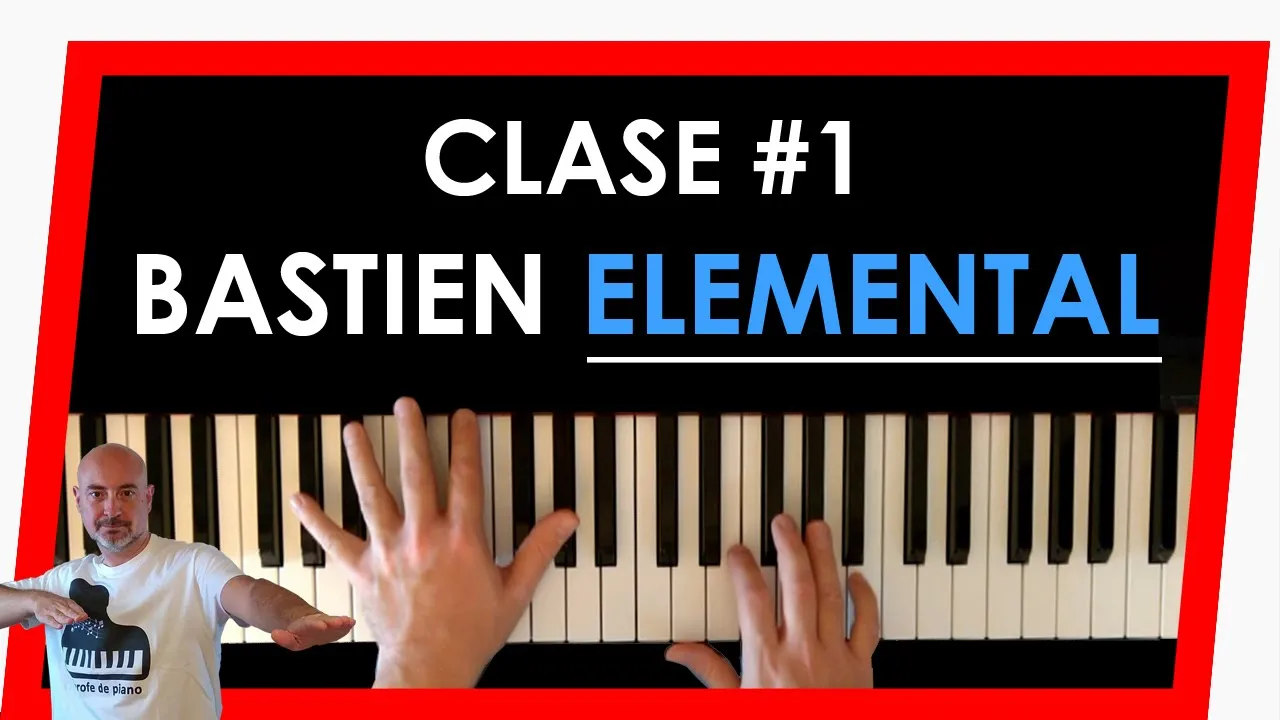













This beginner piano lesson teaches the foundational elements of the piano keyboard, including how to identify white note names (A-G) based on their position relative to black note groups, proper finger numbering (thumb=1 to little finger=5), and systematic practice methods to develop muscle memory for note recognition and smooth scale playing.
Piano for Beginners Lesson 1: Keyboard Notes & Finger Numbers
Added:Understanding of the musical alphabet, specifically how it repeats from A through G.
Basic spatial awareness of the piano, such as recognizing that the keys go from low pitch on the left to high pitch on the right.
Fundamental concept of hand relaxation and the physical readiness to sit at a keyboard with proper posture.
Learning the black keys and understanding the concepts of sharps, flats, and accidentals.
Mastering basic five-finger scales (pentascale patterns), starting with C major, to build finger independence.
Introduction to sheet music notation, including how to read notes on the treble and bass clefs and map them to the keyboard.
Basic rhythm and time signatures, allowing the student to play simple melodies in time.
Coordination exercises for playing with both hands simultaneously (hand independence).
2.7M views46.2Klikes11:39Original Release: 2016-12-08
OK, welcome to the very first in my new series of piano lessons for absolute beginners. There are going to be around thirty or so of these lessons spread throughout 2017. The idea is that they will help you to learn piano, and how to read sheet music, from absolute scratch.
If you already play piano a little bit but your skill at reading music is a little bit shaky, or you don’t read at all – and I know that a lot of you guys who are already subscribed to my piano channel fall into that category – then these lessons will give you some of the kind of formal background that maybe you’ve missed. Being able to read music is an immensely, immensely useful skill, and although it takes a little bit of effort at first once you’ve got the hang of it it’ll make you a much more flexible and capable pianist and musician in general.
OK, let’s get going. In the very first lesson we’ll just be learning our way around the keyboard and learning about finger numbering, because I want to make sure that you really know that stuff before we go any further. Now if you already know where all the notes are on the piano keyboard, and how the fingers are numbered – and you’re absolutely sure you know all of that stuff – then you can skip this lesson and go straight on to lesson two. But if you’re the slightest bit unsure, stick around for the rest of this lesson.
So we’ve got this huge expanse of 88 notes, and somehow we have to get to grips with them all. Right now I’m focused on the middle of the keyboard so you can get a good clear view. Now first things first: we only use ‘left’ and ‘right’ to talk about our hands, never to talk about direction on the keyboard. When we talk about the keyboard we talk about the bottom – which is down there – and the top – which is up there.
As we go ‘up’ the keyboard the notes get higher and as we go down ‘down’ the keyboard the notes get lower, OK?
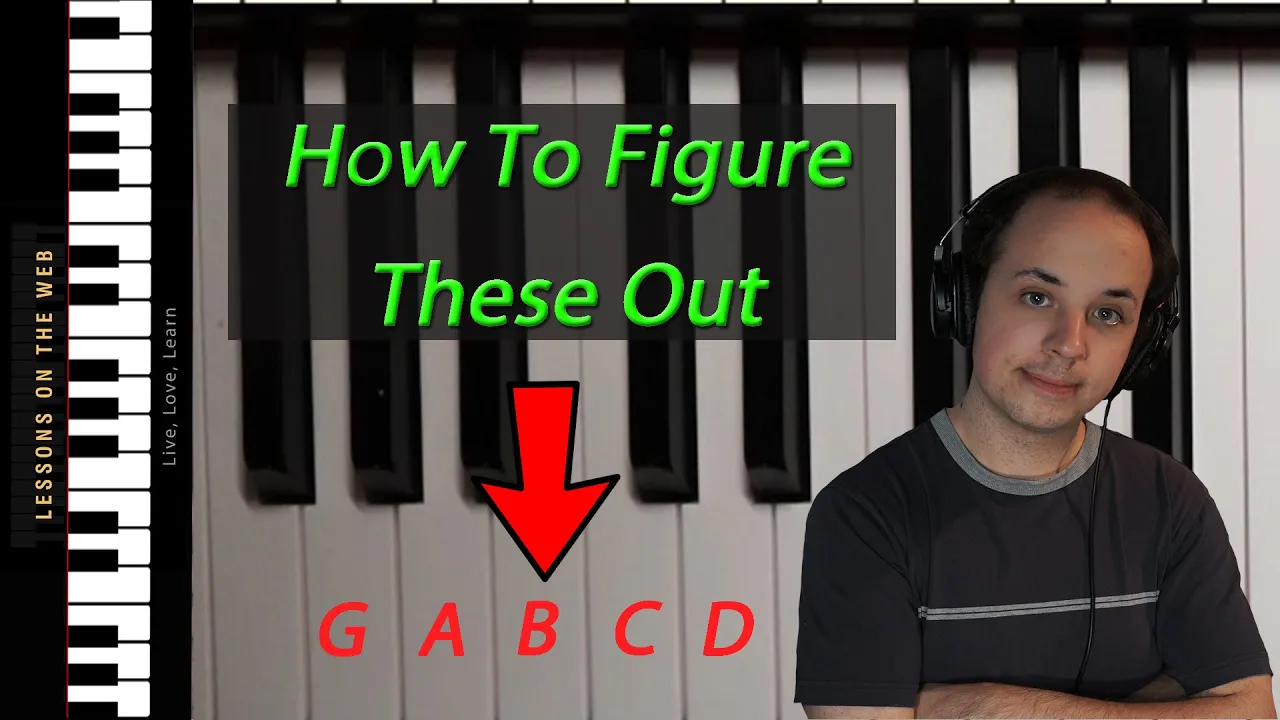
Now – 88 notes to learn sounds scary. But, like a lot of things in music theory, that's a lot easier than it might seem at first, because although the piano has all these notes they follow a fairly simple, repeating pattern. Every white note is named after one of the letters from A to G. So this note is F. Or rather, it’s one of the Fs on the keyboard.
There are others. This is an F, and that’s an F. Can you see what they all have in common?
Each one of those Fs is the white note immediately to the left of one of the groups of three black notes. F, F, F, F.
Here’s a C. Now where do you think I’m going to find the other Cs? That’s right, immediately the left of the one of the groups of two black notes. C, C, C, C, OK? And here’s an A – can you see how it sits in the kind of group of three black notes, there, with two black notes to its left, and one to its right? Again, A, A, A, A.
OK, so let’s name all the white notes, starting on A. We’ve got A, B, C, D, E, F, G – and look, now we’re back to an A. Now, we’re not always going to be thinking of them in that order, so now let’s try it starting on C. C, D, E, F, G, A, B and we’re back to C. I’ve just played a C major scale there, which is something we’re going to back to very soon.
So the first thing you need to do is learn those names of the white notes, because you need to be totally confident with them. Now, to do that I’ve created a diagram of the keyboard with the white notes labelled, so you don’t kind of have to keep coming to this video and wheeling back and forth to look at which note is which. If you head to www.billspianopages.com/beginners you’ll find a downloadable PDF, and in there is the diagram.
Now, having a diagram is great but we kind of need to get this knowledge off the page and into your brain, yeah? And the way we’re going to do that is by playing a game. Now, as well as helping you learn your notes, remember what we said at the start of this lesson about how to number our fingers? That’s in the game as well – as we’ll see. OK, it’s pretty simple, and has five kind of levels. What I want you to do is try to master each level before you move on to the next.
OK, so level one is to just think of a letter between A and G and play four notes with that name on the piano keyboard, using any finger on your right hand. So you might go for B – B, B, B, B. As you hit each one, name it. E. E, E, E, E. If you’re not sure where the notes are, remember to refer back to the PDF and the diagram. You’ve completed this level when you can just think of a note name like you know D and hit it – like that - pretty much without thinking. Try to vary the fingers you’re using, you know, rather than just using one or two and also the order you play the notes in so you’re jumping around rather than just going up or down the piano keyboard.
Level two. You can probably see this coming, but level two is just like level one, except we’re going to use our left hand. Again, you should be able to get to a point when you can just think of a note, stick your left hand out and play four different notes with that name. Remember to try different fingers and play the notes in different orders. Like this – G – G, G, G. Or C – C, C, C, C.
Level three is where we’re going to start thinking more carefully about our fingers.
OK, so take a look at your right hand. Now when we’re playing the piano, your fingers don’t have names – we don’t talk about middle finger or index finger or whatever – we use numbers. So the thumb is one, and then going out to the little finger we have 2, 3, 4, 5. And it’s the same in the left, starting on the thumb, 1, we go out to the little finger, 1, 2, 3, 4, 5 or first, second, third, fourth, fifth. First, second, third, fourth, fifth. The only partial exception to that numbers not names rule is the thumb – we sometimes do just call it the thumb – but usually it’s all about 1, 2, 3, 4, 5, first, second, third, fourth, fifth. Again, there’s a diagram in the PDF to help you remember.
Now what I want you to do is just exactly what you did in levels one and two, but using the fingers of each hand in order, starting with the right hand thumb. Name the finger you’re using, and think of a note. Name that too. Then play it four times with that finger. So, 1 – B – B, B, B, B. 2 – E – E, E, E, E. Work through all of the fingers of right and left hand and, you know, do it over and over again because what we’re aiming for is the point where you can think of a finger – fourth finger, right hand – think of a note – G – and go G, G, G, G.
In level four we’re going to use one finger on each hand, and we’re back to doing pretty much what we did in levels one and two. Think of a note, and hit it. But this time hit two of the notes at once, one with each hand – A, A, A, A. Again, we’re aiming for the point where you don’t even have to think about it. C.
OK, nearly there - level five. Here’s we’re going to be playing runs of notes like this.
Start in the right hand and pick a note – let’s say C. Play it with 1, your thumb, then play the notes up from it, using consecutive white notes until you reach your fifth finger, then come back down. Sounds complicated, looks simple let me show you. 1, 2, 3, 4, 5, 4, 3, 2, 1. Repeat it plenty of times. 1, 2, 3, 4, 5, 4, 3, 2, 1. Find a different note – G – 1, 2, 3, 4, 5, 4, 3, 2, 1. Each time we’re aiming to be smooth and even, yeah, we don’t want to hear loads of er, yeah, um, ah – I want each note to be the same length and the same sort of loudness if we can. Let’s start on E. 1, 2, 3, 4, 5, 4, 3, 2, 1 and so on. You can alternate naming the fingers with naming the notes.
E, F, G, A, B, A, G, F, E. That’s going to take a little while at first but stick at it, really practise that hard. And again we’re going for the point where you can just put your thumb down, and go D, E, F, G, A, G, F, E, D. 1, 2, 3, 4, 5, 4, 3, 2, 1.
Then you can also do it in your left hand, and this time we’re going to be starting on 1 and going down until we reach 5. Say, on A. 1, 2, 3, 4, 5, 4, 3, 2, 1. A, G, F, E, D, E, F, G, A.
So we’re doing that over and over and over until you can do it without thinking. And by the time you can do that you should have a great deal of confidence with, you know, finding all the note names of all the white notes on the piano, and also have some instinctive feeling beginning to grow for your finger numbers.
Once you can do all five levels without too much effort, you’re ready to move on to lesson two. Now, doing all of this note learning at first might seem like mindless slavery – because, you know, you want to get on to the interesting stuff, but it’s really, really essential – if you can just get your note naming and finding to a point where you don’t need to think about it, you free up lots of brain space for the more complex tasks that are to come, yeah? It’s – it will make things much easier.
I also just want to say something about piano practice – what’s the best way to go about your piano practice? Well, the golden rule, especially when you’re starting out, is that little and often is best. So rather than sitting down for hours at a time once a week, try to do just 20 minutes a day, or two lots of 15 minutes a day or something like that.
As well as helping you learn in the most effective way that’ll also help you to reduce the risk of injuring your fingers, because you need to gradually build up the muscles that you need for playing the piano. One thing you could do is have those little regular practice sessions of ten minutes or whatever, but also just try one of the levels every time you walk past the piano – you know, it only needs to take 30 seconds.
OK, so there we go. The good news is that now you know your note names you’re well set up to move on to lesson two, but there’s a bunch of other things you can do now as well – I’ve got quite a few piano tutorials on stuff like improvisation where you can start to have fun and mess around on the piano without even knowing anything else but the names of the notes. I’ve included links to some of those tutorials right underneath this video, so go and check some out.
If you’ve found this piano lesson useful make sure you subscribe to my channel so you don’t miss upcoming tutorials, you know number two is coming out very soon – just click the little subscribe button in the bottom left hand corner – bottom right hand corner, sorry - right now. I’ll see you in tutorial number two, where we’ll be looking at some written piano music for the first time.
Up Next
14:13
Piano Keyboard Layout and Key Names for Beginners | Music Theory Basics
@LessonsOnTheWeb
390.2K views•2013-05-08

26:22
Walking in the City: Urban Rituals and the Flâneur in Contemporary India
@PSBTIndia
1.9K views•2016-08-02

9:49
FastAPI vs Flask vs Django: Choosing the Right Python Web Framework
@TechWithTim
302.5K views•2024-05-26

1:42
Game of Thrones Opening Credits: A Cinematic Analysis
@gameofthrones
46.3M views•2011-04-18
Related Study Plans & Knowledge Roadmaps
Structured learning paths in General & Interdisciplinary Studies
general-studies
Artificial Light: History, Tech & Human Impact
01The Pre-Electric Era: Fire, Oil, and Gas Lighting
02The Incandescent Revolution and Grid Electrification
03Gas Discharge and Fluorescent Illumination
+ 3 more learning modules
14h6 modules
Explore Roadmap
general-studies
Elevator Engineering: History, Physics & Cities
01From Hoists to Safety Brakes: The Dawn of Vertical Lift
02Hydraulic vs. Traction: The Engineering Physics of Elevators
03Modern Speed, Safety, and Algorithms
+ 2 more learning modules
12h5 modules
Explore Roadmap
general-studies
Rubber: Material Science, History & Geopolitics
01Origins of Natural Rubber & Mesoamerican History
02The Chemistry of Natural Rubber & Vulcanization
03The Geopolitics of the Rubber Boom & Colonization
+ 2 more learning modules
12h5 modules
Explore Roadmap
general-studies
Containerization: Evolution, Logistics & Trade
01Ancient Trade & Bulk Cargo: Amphorae to Barrels
02The Industrial Revolution & Cardboard Packaging
03The Containerization Revolution: Malcom McLean
+ 2 more learning modules
12h5 modules
Explore Roadmap