






















The stress-strain curve is a fundamental tool in materials science that plots stress (force per unit area) against strain (extension per unit length) to characterize material behavior under tensile loading; the curve consists of an elastic region where materials return to their original shape after deformation and a plastic region where permanent deformation occurs, with key parameters including the elastic limit (transition point), yield point (where plastic deformation begins), ultimate tensile strength (maximum stress before fracture), and Young's modulus (stiffness, calculated as the gradient of the linear elastic region using E = stress/strain).
Stress-Strain Curve Explained: Young's Modulus & Tensile Testing Guide
Added:The fundamental definition of mechanical stress (force per unit area) and strain (relative deformation).
Hooke's Law and the concept of linear elasticity in physical materials.
Basic graphing skills, specifically how to interpret axes and calculate the slope of a linear region.
The concept of tensile force as a stretching load applied to a solid body.
The distinction between engineering stress-strain and true stress-strain curves, which accounts for changes in cross-sectional area (necking).
Advanced mechanical properties derived from the curve, such as modulus of resilience and modulus of toughness (area under the curve).
How temperature, strain rate, and alloying affect the shape of the stress-strain curve and material behavior.
Real-world application of yield strength and ultimate tensile strength in structural engineering design and safety factor calculations.
153.2K views2Klikes10:08Original Release: 2017-02-27
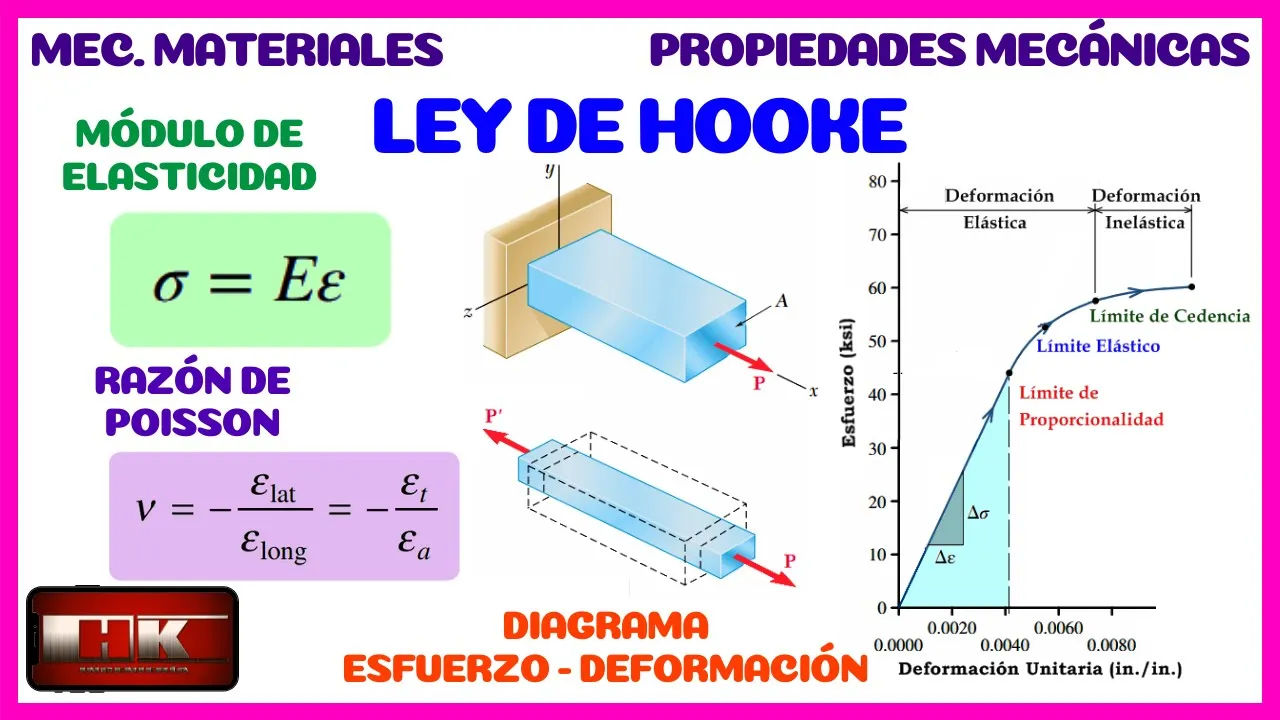
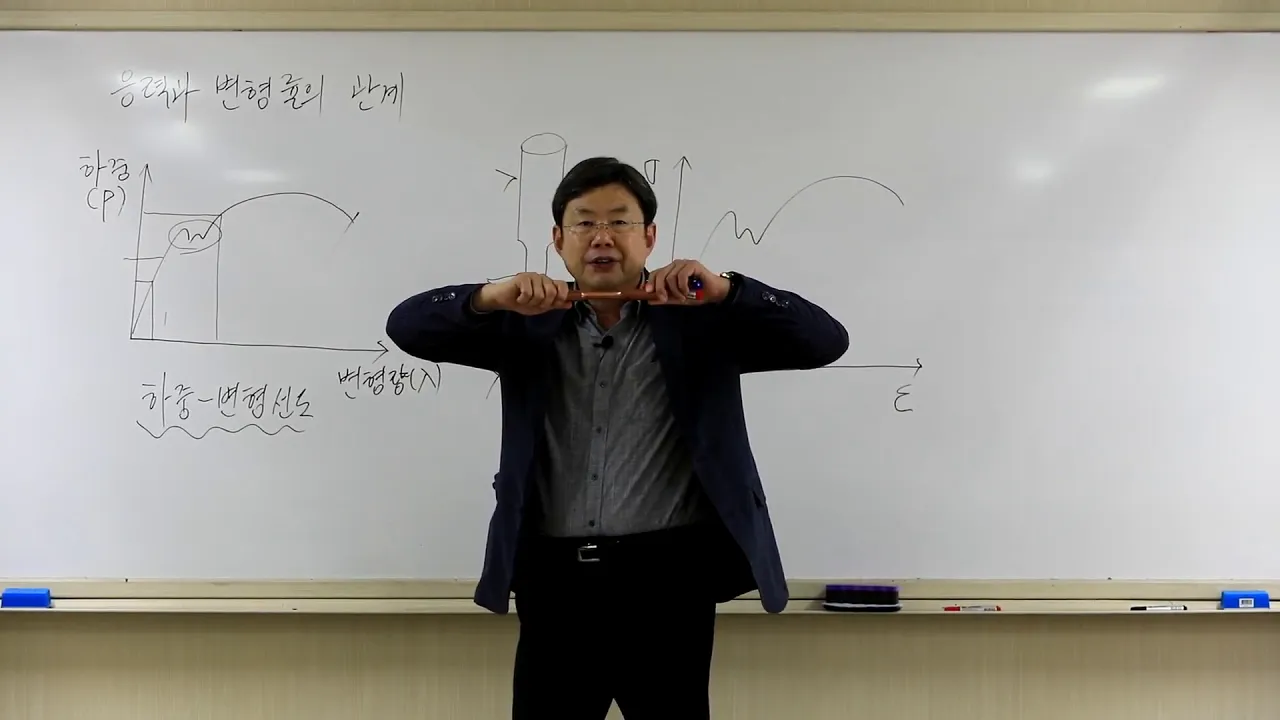
hello in this video we're going to cover another classic bit of engineering Theory the stress strain curve so in an engineering textbook you'll quite often see a graph that looks something like this which is all very well and good but what on Earth does it mean so this is a stress strain curve it's a plot of when a material is stretched or put under a tensile force um the proper name for stretching and we plot the the stress which is a fancy word for pressure against the strain which is a fancy word for extension and for dutile material very often you'll get a curve that looks something like this and this is a classic curve that's in all kinds of engineering textbooks if you do tensile testing on a variety of metals you'll see something very similar to this um so let's take a look what all these things mean so first off just remember this is effectively how hard how with how much force you're stretching and this is how much the thing has stretched so the first part of the graph is known as the elastic region so this bit here is the elastic region and the definition of something being elastic is that when you stretch it exactly 10 mm you let go it will go back to zero not one it hasn't deformed plastically which means if you stretch it 10 mm it might go back to 1 millimet so it's had a permanent deformation so in the elastic region you stretch it and it goes exactly back to its starting position onto this next section of the curve which is known as the plastic region and in the plastic region the material has gone past its elastic limit and it's permanently deformed I'm sure you've all taken a paper clip and if you spring it very lightly it will spring back you're working within the elastic limit there the second that you pull it far enough apart that it stays where it is you're very much into the plastic region so plasticity is can be used interchangeable with uh ductility or malleability and if something's deformed plastically it's deformed forever it's not going to go back to exactly how it was so let's have a look at some other points so as we increase the pulling Force we get in an extension and we're going to look at these two terms in some depth in a second eventually when you pull it it makes sense so that it will fracture and that's what this is this is the fracture point and if we look carefully at the graph we'll find that the maximum point on the graph in the stress region is up here that is the highest point on the stress axis and it's actually in the plastic region and that's what's known as the UTS so this point here is the ultimate tensile strength ultimate Tel strength okay here around here this point that's the elastic limit which makes sense it's at the point where you cannot stretch anymore before it starts deforming plastically so elastic limit and shortly after that point is the yield point it's where the material gives up the ghost so at the yield point it becomes plastic the material has given up and will never go back to how it was now there's all kinds of funky stuff you can do with these graphs so if you were to work out the area underneath the graph then you can find out the strain energy and then ultimately the work done in stretching this uh this material whatever is but the one we're interested at this level of course is the gradient of this section and the gradient is given by stress over strain and that the gradient of the section Here is known as the Young's modulus the Young's modulus is basically a measure of stiffness um of the material so Formula 1 cars and other high performance um racing cars use carbon fiber not only because it's very light but it also has a very high yung's modulus it's very rigid so the the car isn't flopping around when it's going into corner so yung's modulus is a key term that we're going to investigate in a second now so I'm going to rub this off the board we'll have a look at some key formula Okay so we've we now know what's going in the uh the stress strain curve we need to be able to work out some calculation so key letters and um and factors that we're going to look at in in here so we've already talked about stress being on the Y AIS so stress is given by the Greek letter Sigma and the formula for stress is force divided by area and you might notice that is exactly the same formula as pressure and it's the same units too so force measured in Newtons area is measured in me squar so Newtons per meter squar however in engineering applications it's more common to give the stress or pressure in Pascal so one pascal is the same as 1 Newton per meter squar so quite often we'll use Pascal and in engineering materials things like aluminium steel and Brass we working in the region of megap pascals or gigap pascals just a point of reference a megap pascal is equal to 1 * 10^ 6 pascals a gigap pascal is 1 * 10 to the 9 other words one with 10 nines after it next factor that we need to think about is strain strain given by the Greek letter Epsilon which is sort of like a back to front three um that is given by the change in length Delta L wherever you see a Del symbol 9 times out of 10 it will mean change in change in length over the original length this value has no units if we do a unit analysis quickly length changing length measur in meters original lengths measured in meters they cancel there are no units it's just a percentage increase it typically be a very small number it is a unitless quantity finally we're going to come on to the Young's modulus a measure of stiffness of the material so that is given by so yung's mod stiffness is given by E which is the gradient of this section remember and E is given by stress over strain now from basic high school maths you remember when you've got a straight line graph you work at the the gradient of that by calculating the change in y over the change in X so just to illustrate that we're going to do two separate examples right two lines there it's clear that this has got a greater gradient than this so let's quickly do it change in y for line one is going to be the change in y so in this case it goes three for every 1.5 along which is equal to two and for this one we've got a changing one for one so for line two it goes one unit up and one unit along so that's got a gradient of one exactly the same is the case so instead of using change in Y which happens to be stress and changing X which happens to be Epsilon or strain we've got Young's modulus is stress over strain that's just something you need to remember and that is going to be measured typically in megap pascals so these are our three important formula for working out on stress strain curves however I know some of you still aren't totally happy with rearranging uh formulas so let's just do some simple um formula triangles there we have it that might be helpful to uh to make a note of just remember all you do if you want to work out the area here cover up the thing you want to find out and you'll have Force divided by stress in that case talking of area it's worth just looking at um some basic area calculations because you're going to need some of those in working out some of these problems okay typically the sections of samples that we're going to be using in tensile tests are going to be in two forms the first is going to be some kind of rectangle and a really hope that you'll be able to work at the area of that you'll have a length you'll have a width we call it a breadth and a w width the area is obviously breadth time width remember to work in SI units you're going to be working in meters not millimeters or cenm or kilometers working meters if that means converting it first convert it typically the other sections that you will uh come across in tensile Tes in there's these little machined samples so that's going to be given by area is equal to piun R 2 where R is the radius of the crosssection area so just remember use those two when you doing your stress calculations for this section here
Up Next

75:40
De Havilland Comet Flight 781: The Fatal Crash Investigation
@carolefowler4133
10.5K views•2017-03-11

30:32
Ultrasonic Transducers: Resonant Frequency Measurement and Horn Design
@imajeenyus42
229.9K views•2017-02-22

54:16
Polymer Environmental Degradation: Mechanisms & Stabilization
@iit
1.8K views•2012-07-10

33:39
How a Student's Question Saved a NYC Skyscraper from Collapse
@veritasium
22.8M views•2025-04-26
Related Study Plans & Knowledge Roadmaps
Structured learning paths in Engineering
engineering
Building Acoustic Levitators: Physics & Arduino
01The Physics of Sound and Standing Waves
02Piezoelectric Transducers and H-Bridge Drivers
03Arduino Programming: Generating 40 kHz Signals
+ 2 more learning modules
14h5 modules
Explore Roadmap
engineering
Building Peltier Cloud Chambers: Particle Tracks
01Cosmic Rays & Cloud Chamber Physics
02Thermoelectric Cooling (TEC) Fundamentals
03Custom Liquid-Cooling Loop Design
+ 2 more learning modules
18h5 modules
Explore Roadmap
engineering
Yagi-Uda Antennas: Modeling, Build & VNA Test
01Introduction to RF and Antenna Fundamentals
02Yagi-Uda Antenna Design Principles
03Antenna Modeling and Simulation in 4NEC2
+ 2 more learning modules
18h5 modules
Explore Roadmap
engineering
ECG Monitor Design: Op-Amps, Filters & Noise
01Electronics & Breadboard Basics
02Op-Amps and Instrumentation Amplifiers
03Bioelectricity and ECG Fundamentals
+ 2 more learning modules
18h5 modules
Explore Roadmap