





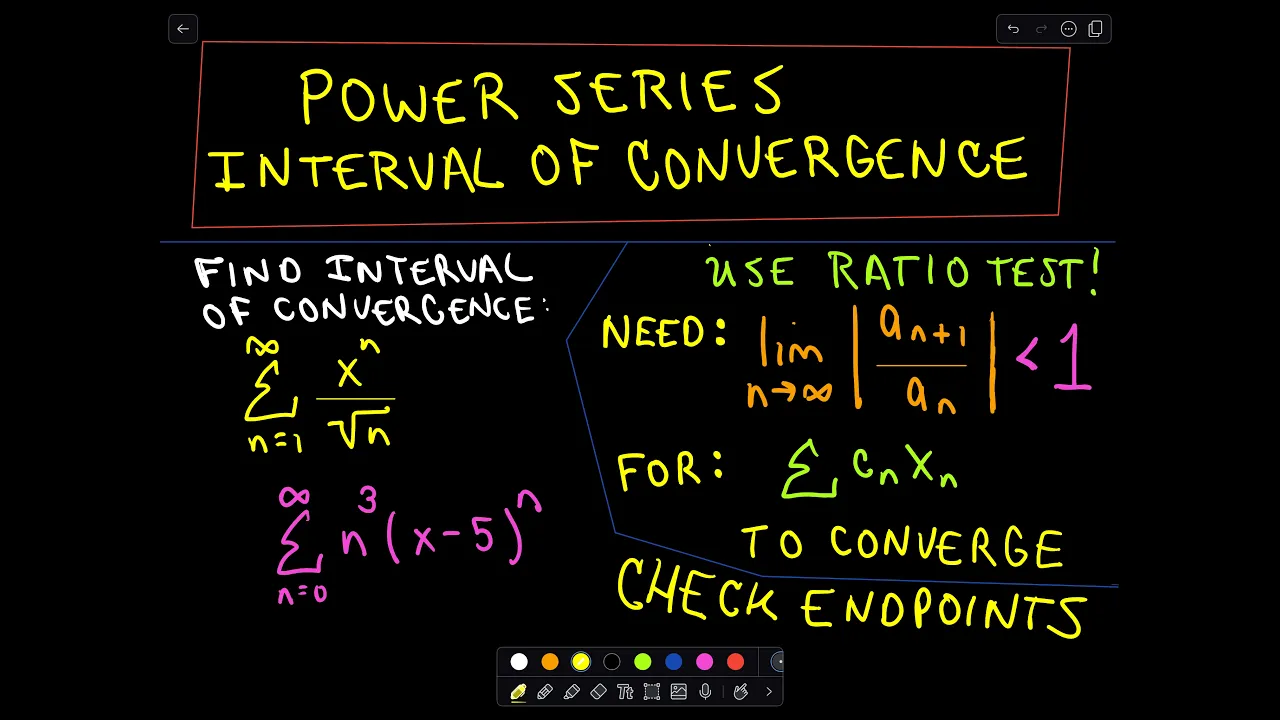
















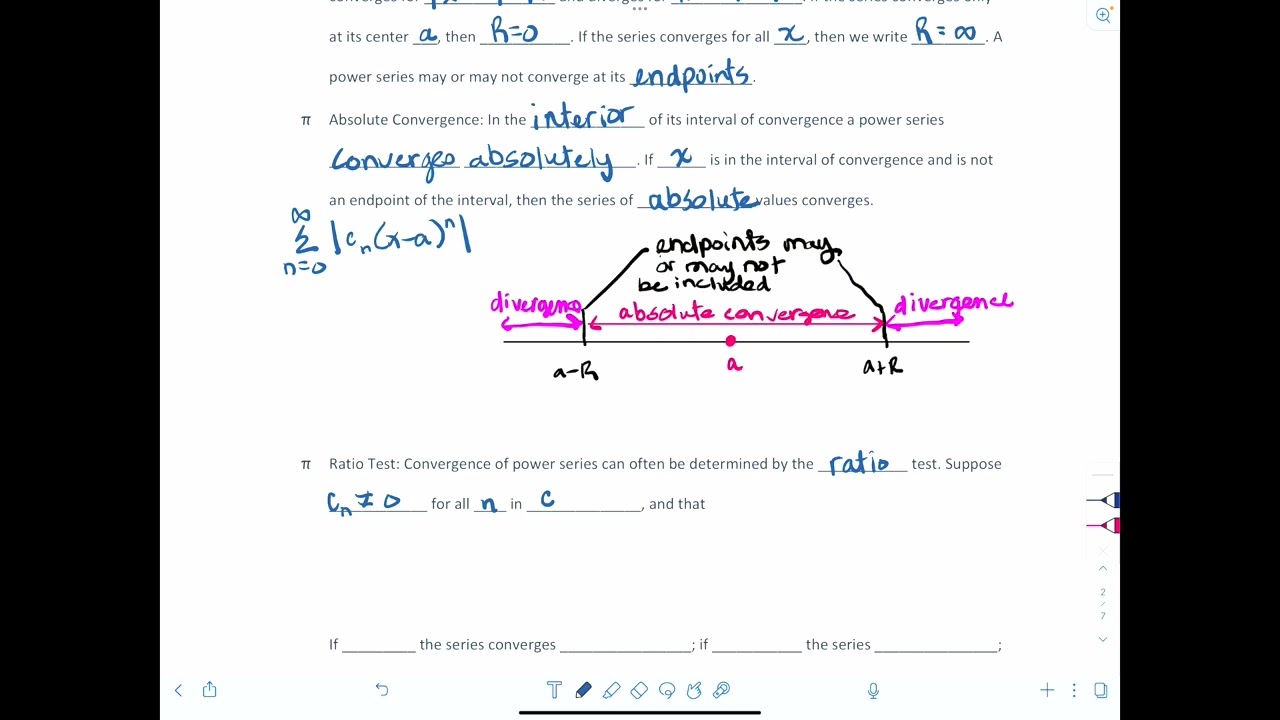
To find the interval and radius of convergence for a power series, apply the ratio test by taking the limit as n approaches infinity of the absolute value of consecutive terms; set this limit less than 1 to find the open interval, then test the endpoints separately using other convergence tests like the divergence test. The radius of convergence equals half the length of the interval of convergence.
Interval and Radius of Convergence for a Series, Ex 2 Error
Added:Understanding the basic structure and definition of a power series, including its center, coefficients, and variable terms.
Familiarity with the Ratio Test for infinite series, specifically how to set up and evaluate the limit of the absolute value of consecutive terms as n approaches infinity.
Knowledge of fundamental convergence tests used for checking interval endpoints, such as the p-series test, the alternating series test, and the divergence test.
A clear grasp of the distinction between absolute convergence and conditional convergence.
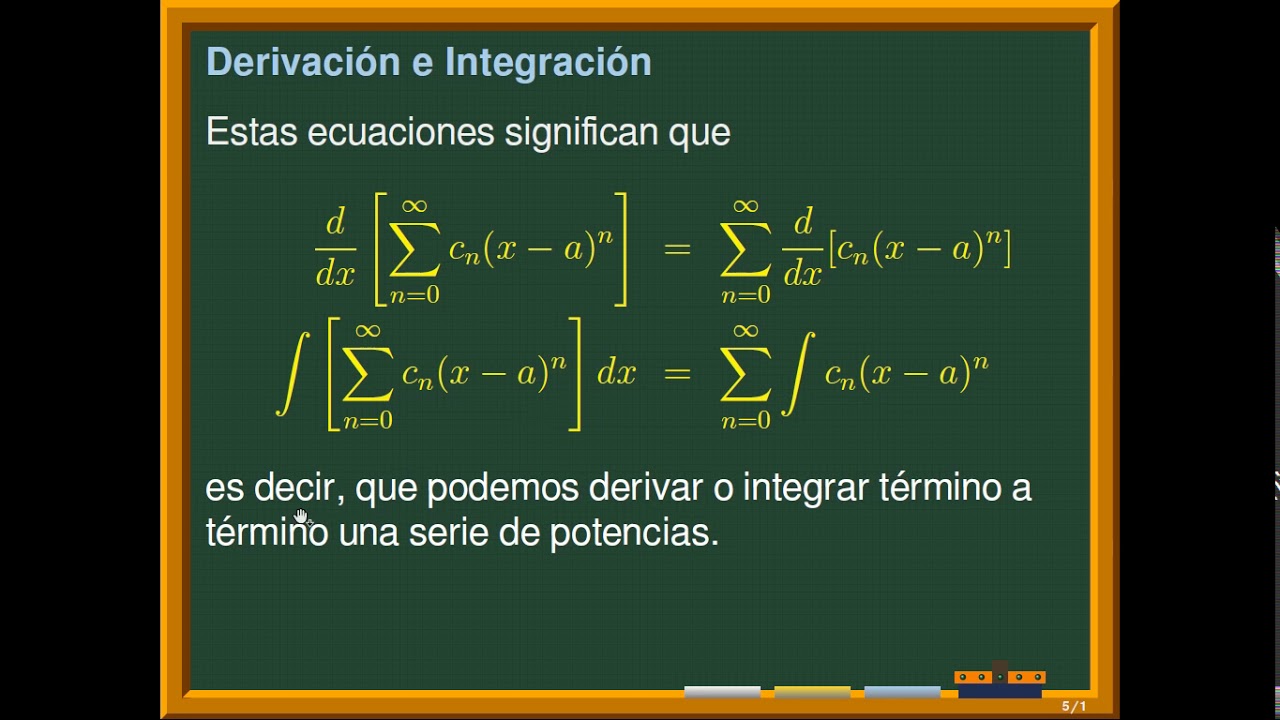
Performing term-by-term differentiation and integration of power series and analyzing how these operations impact the interval of convergence.
Constructing Taylor and Maclaurin series to represent common transcendental functions like sine, cosine, and exponential functions.
Applying error estimation techniques, such as the Alternating Series Estimation Theorem and the Lagrange Error Bound, to analyze the accuracy of Taylor polynomial approximations.
Using power series to solve ordinary differential equations that lack elementary closed-form solutions.
454.7K views2.2Klikes5:26Original Release: 2011-07-02
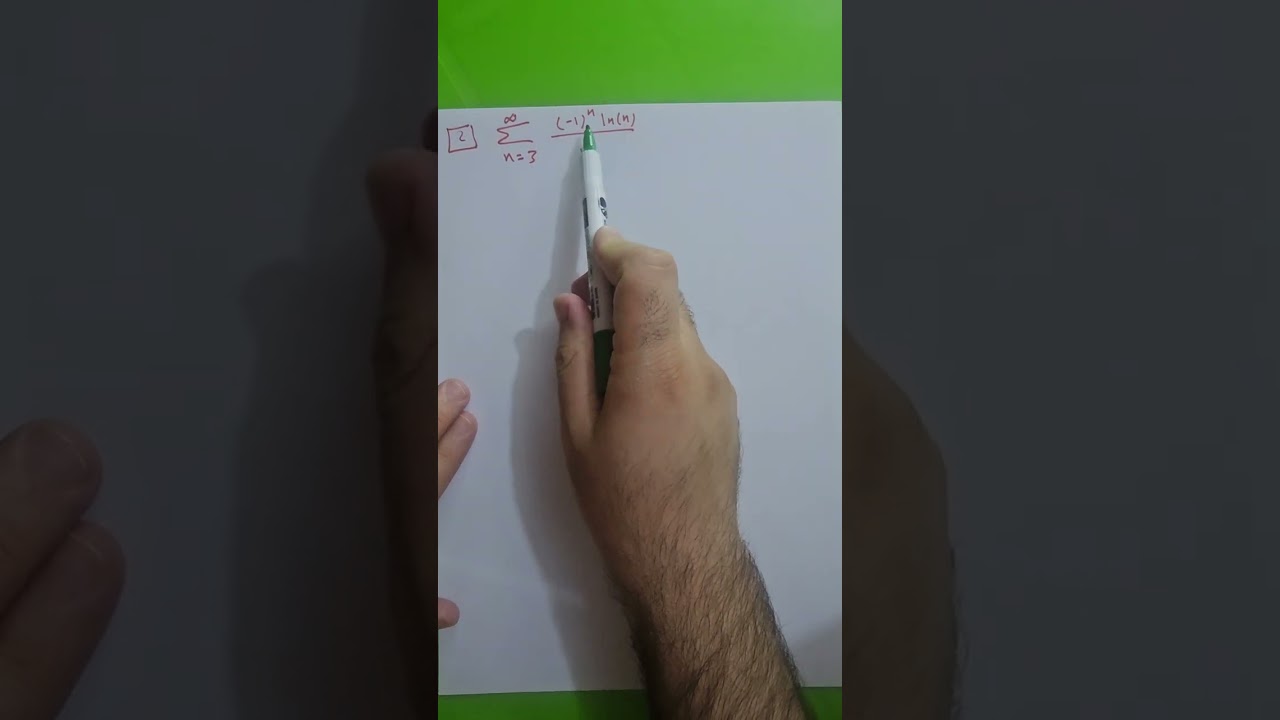
all right so another example here of finding the interval and radius of convergence so here we're going to look at Part B N the 3 * x + 5 n over 6 n so again we're just going to use the ratio test the limit as n goes to Infinity we would have n + 1 3 x + 5 raised to the n + 1 6 raised to the n + 1 then we uh flip and multiply by the reciprocal so 6 the N Over N Cub * x + 5 raised to the N power so let's see let's uh try to simplify this a little bit we've got the limit as n goes to Infinity uh n + 1 3r over n the 3 not a real good way to simplify that U we could always write it as n + 1 over n all of that raised to the third power let's see we've got x + 5 to the n + 1 over x + 5 to the N that's going to leave us with an x + 5 in the numerator and then we have 6 to the N over 6 the n + 1 that's going to leave us with a six in the denominator Let's see we can factor out the absolute value of x + 5 over 6 and then we can multiply that by the limit as n goes to Infinity of n Plus 1 n 3 but as n goes to Infinity since the degree of the numerator equals the degree of the denominator uh the n + one over n that's just going to approach one so then we have 1 cubed which is still going to equal one so really we've got x + 5 over 6 * 1 so that's our our uh ratio generically and again what we want we want the absolute value of x + 5 over 6 okay so times 1 we want that to be less than one so now we've got our little uh inequality uh our absolute value inequality that we have to solve so we have okay -1 less than x + 5 over 6 less than pos1 if we multiply both sides by six we'll get well I should say all parts by six we'll get 6 X less than x + 5 let's see less than POS 6 and now if we subtract five we'll get -1 less than x uh less than pos1 so I know for sure the series converges for any number between1 and 1 but we have to check the end points separately so we'll have to see whether or not the end points are included so let's see let's go back to our original series here so we have to check x = -1 kind of individually and then we'll have to check X = positive one individually as well so let's see I'm going to plug1 into our Series so we have Nal 1 to Infinity n cub1 + 5 raised to n/ 6 n well that's going to give us the series Nal 1 to Infinity we have n cubed this will give us -6 raised to the N power over 6 to the N power that simplifies to -1 to the n * n cubed well here we can just use the test for Divergence because when we take the limit as n goes to Infinity of -1 to the n * n cubed that's definitely not going to equal zero so this series is going to diverge so when X = -11 it's going to diverge the same thing I think when we plug in N equal or excuse me xal 1 we've got the series from 1 to Infinity we would have n cubed but now we would have 1 + 5 raised to the N over 6 to the N well this is 6 to the N over 6 to the N those will just cancel so we're left with a series from n = 1 to Infinity of n cub but the exact same thing if we do the test for Divergence the limit as n goes to Infinity of n Cub that definitely does not equal zero so that tells us the series diverges so in this case that tells us that our interval of convergence therefore the interval of convergence is going to be from1 up to pos1 and again the radius is just going to be the length of that interval so 1 -11 / 2 well let's see that's going to be 12 over two which is going to give us a value of six so the radius of convergence equals uh six the interval of convergence is uh1 to pos1 again parentheses because it does not converge at the end points
Up Next

4:55
Binomial Expansion with Negative and Fractional Indices
@MarkWillisMaths
53.4K views•2017-10-27

4:43
Elliptic Curve Cryptography Explained: ECC, ECDSA, ECDH
@PracticalNetworking
28.5K views•2024-10-21
7:22
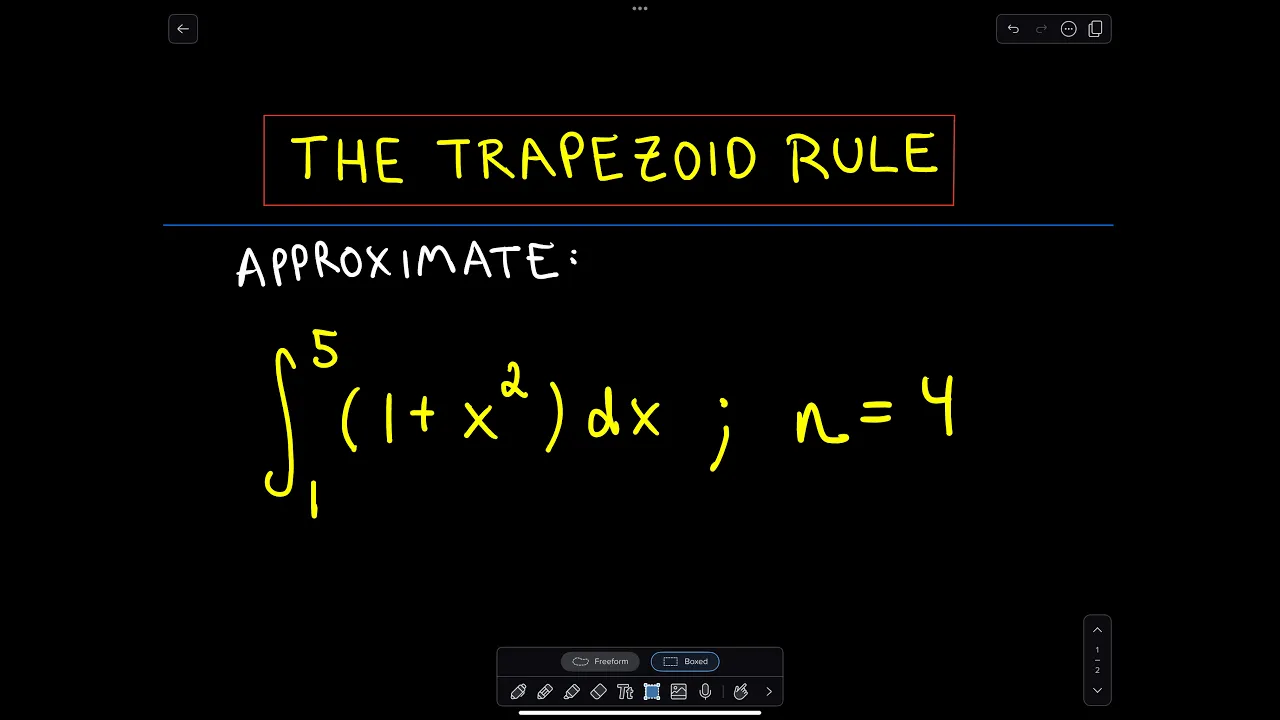
Trapezoid Rule Explained: Approximating Definite Integrals
@patrickjmt
661.2K views•2009-02-23

6:00
The Mathematical Impossibility of Accurate World Maps
@Vox
23.3M views•2016-12-02
Related Study Plans & Knowledge Roadmaps
Structured learning paths in Mathematics
mathematics
Tensor Calculus: Vectors to Riemann Curvature
01Mathematical Foundations: Linear Algebra & Calculus
02Covectors, Dual Spaces, and Tensor Basics
03The Metric Tensor and Index Gymnastics
+ 2 more learning modules
40h5 modules
Explore Roadmap
mathematics
Gödel's Incompleteness: Logic, Proofs & Limits
01Introduction to Formal Systems & Hilbert's Dream
02Set Theory, Cardinality, and Cantor's Diagonal Argument
03Arithmetization and Gödel Numbering
+ 2 more learning modules
14h5 modules
Explore Roadmap
mathematics
Galois Theory: Fields, Groups & Solvability
01Foundations of Abstract Algebra: Groups & Fields
02Polynomials & Field Extensions
03Splitting Fields & Symmetries
+ 2 more learning modules
24h5 modules
Explore Roadmap
mathematics
Non-Euclidean Geometry: Models & Geodesics
01Euclid's Fifth Postulate and the Birth of New Geometries
02Hyperbolic Space and the Poincaré Disk Model
03Geodesics: Defining Straight Lines in Curved Spaces
+ 2 more learning modules
15h5 modules
Explore Roadmap