






















The British Empire achieved global dominance through a systematic formula combining naval supremacy, strategic control of maritime choke points (Gibraltar, Suez, Singapore), and corporate governance via trading companies like the East India Company, which transformed from merchants into colonial powers; this model of economic control through logistics, infrastructure, and financial systems—rather than purely military force—created lasting dependencies that persist in modern global trade networks and digital platforms.
How British Sea Power Shaped Modern Capitalism | Empire Tax
Added:The economic theory of Mercantilism, which dominated European policy from the 16th to the 18th century, emphasizing state-regulated trade and wealth accumulation.
The concept and historical emergence of Joint-Stock Companies, such as the British East India Company, and their role in early global trade.
The basics of British colonial expansion and the geopolitical significance of naval supremacy in securing trade routes.
The fundamental principles of early commercial capitalism and how it transitioned from agrarian and feudal economic systems.
The transition of global economic hegemony from the British Empire (Pax Britannica) to the United States (Pax Americana) and the modern role of the US Navy in securing global trade.
Dependency Theory and World-Systems Theory, analyzing how historical colonial trade patterns created enduring global economic inequalities.
The evolution of international maritime law and corporate sovereignty, and how they protect multinational corporations today.
Modern global supply chain vulnerabilities, maritime chokepoints, and the contemporary geopolitics of trade routes.
91.9K views2.4Klikes25:01Original Release: 2025-12-17
maps. They pretend to show the world, but really they make it. A few lines from a feather pen and suddenly millions of people wake up belonging to someone else.
>> Mapping land was a fundamental part of settler colonialism.
A lot of the conflicts today uh [music] that we see happening around us, these are all very direct legacies of border drawing projects by uh different empires.
>> Think of it as history's first operating system and the blueprint of domination.
>> People say we have to do this for strategic reasons, but what they're actually saying is that everybody else who might have a different view is wrong.
Good morning, students.
>> Morning, professor. Welcome to the Colonizers Academy, where plagiarism isn't a problem. It's policy. Forget essays. Forget pop quizzes. At this academy, we don't just teach history. We teach you how to weaponize it.
Preferably at a profit. I'll be your tutor. And by the end of this lesson, you'll see how the British could hold the world in one hand and a cup of tea in the other. Welcome to lesson one, how to invoice an empire.
[music] >> [music] >> The British didn't conquer the world with just ships and cannons. They conquered it with spreadsheets. Empire wasn't just violence. It was logistics.
Sailing, sure, but sailing with receipts. The British Empire is very much dependent on having base facilities for fleets, but also for commercial activity in the places where it's trading. [music] History likes to brag about admirals and cannons. But wars are won in the ledger, not the trenches.
Bureaucracy and bookkeeping were an essential part of how the British Empire got going and how it consolidated itself.
>> Step one, naval dominance. England's rise gets its big cinematic moment in 1588 when the Spanish Armada sets sail from Lisbon to join the Duke of Parma and carry an invasion force across the English Channel. The plan dies in the channel. Part cannon fire, part weather.
The Armada showed up with around 130 ships and a mission to scoop up Parma's army. The English shadowed them with faster, handier ships sniping at range.
Then at Cala, the English lit fire ships and sent them drifting in. The Spanish formation scattered. Many [music] cut their anchors and the next day, slugfested gravel lines turned invincible into vulnerable. The British con constantly are engaged in wars starting with the Dutch, then with the French oversea control. It's winning those wars that enable Britain to be a great maritime power and and to succeed in creating this global network that funds the state and enables it to maintain its navy. But empire wasn't just gunpowder and sea battles. Once the wars secured control, the narrative shifted.
>> There are accounts of empire that are relatively positive, talking about how it brought advantages such as [music] railways or the extension of sort of uh new forms of civilization.
>> The same workshops that turned cannon fire into policy also pushed the boundaries of science, charting coasts, mapping currents, and standardizing time itself. There were also the circulation of ideas, the circulation of people that might well produce and have produced in the past more favorable outcomes. And those ships, they didn't only ferry musketss and manifests. They carried letters, migrants, medicines, and eventually steam engines, vaccines, and scientific expeditions. In the British Empire, there were various justifications, pretexts, legitimations, uh the idea of humanitarianism, of liberalism, of offering freedom and of bringing civilization. So the question of things like legal systems um and the English language or you know other kinds of institutions which were left behind by empire uh is often presented as once again part of a beneficial project uh that the empire was from cannons to classrooms empire learned to justify itself in softer tones and by the 19th century the mask was almost complete.
The Royal Navy was almost invincible across the 18th, 19th, early 20th century because the state made it its central concern.
>> How choke points.
>> Anything that blocks the passage of merchant shipping is a problem. It's an economic problem. Voyages are longer.
They're more expensive, more risky.
>> From the Med to the Indian Ocean, Gibralar, Suez, Aiden, Salon, Singapore.
Those are real choke points where you [music] can literally cut off the enemy.
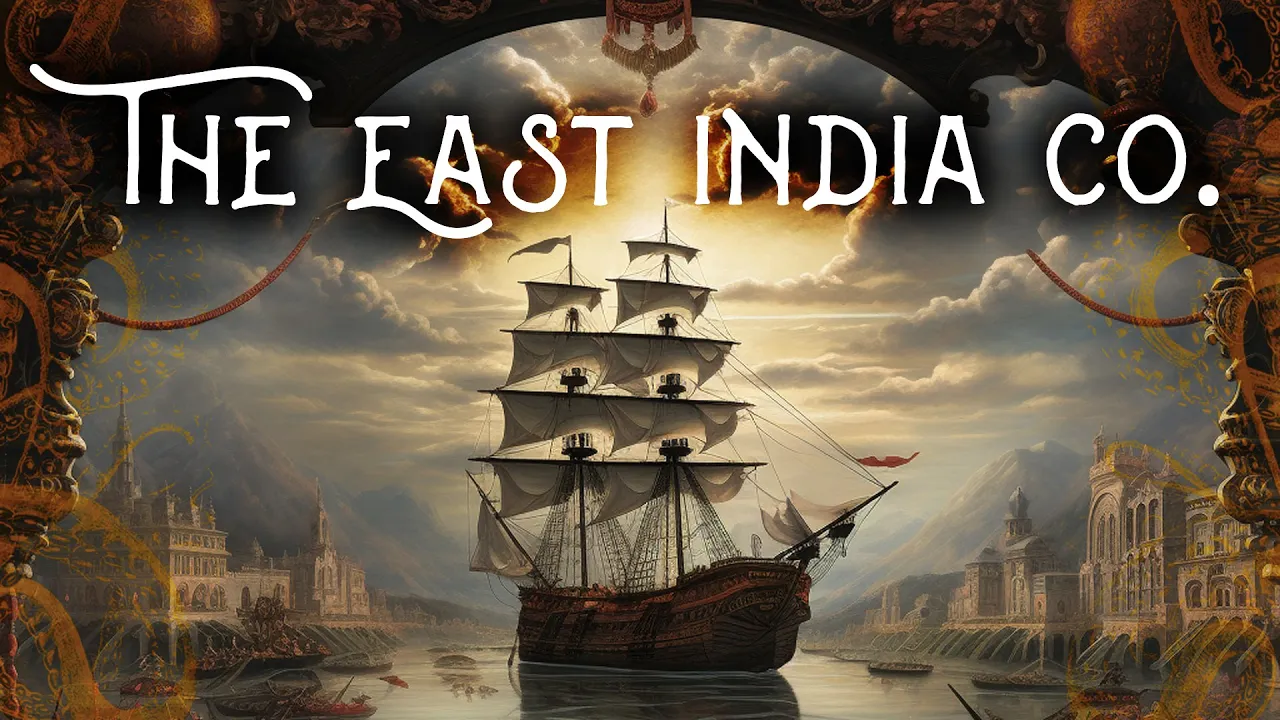
So Britain develops [music] an interest in the regions where these points of restriction exist. String those nodes together and you get a global connect the dots game except the dots are fortified ports. Step two, privatize conquest. Enter the East [music] India Company, a trading firm chartered in 1600 that discovered a brilliant growth hack. Stop trading the country and start [music] running it.
>> It's not accidental that the first British establishment in India is at Mumbai. [music] It's a it's an island. It's a trading hub and the British are there to do business and it it's going to expand out from there. [music] >> India was the empire's crown jewel.
textiles from Bengal, cotton from Bombay, tea from Assam, but also its cautionary tale. By the mid- 18th century, [music] it had morphed from merchants into a fullblown colonial power. The word governance was code for quarterly returns. The pivot point 1757.
>> A man called Robert Clive winning the battle of Placi against the Nawab of Bengal. The British becoming potent.
>> Robert Clive didn't just win with musketss. He bribed Nawab's general Mir Jafar to switch sides against the Mughal Empire. As the Mughal Empire fragmented, the East India Company was able to step in to their vacuum and to offer security um to Indian merchants, to Indian investors and supply the uh ensure the compliance of many Indian elites. Recent historians of the East India Company like uh Nick Robbins have pointed out that in order for us to understand capitalism today and corporate culture today, we really need to be studying uh the the [music] power, the might, the abilities and the influence of an organization like the East India Company.
>> Wait, so the East India Company was like a startup? Oh yes, a startup with shareholders in London and cannonballs in Bengal. Instead of pitching investors, they pitched villages into submission.
Now before we clap for efficiency, remember colonial rule didn't just move goods, it moved people and power.
>> The railways start in Britain, but they soon get exported right around the world because everybody else can see the advantage. and later on telegraph infrastructure helped the different parts of the empire to communicate with one another.
>> It's reasonable to say that the British Empire made genuine contributions uh as did other empires. I think the most important contribution in any uh government whether it's democratic or authoritarian is a degree of stability.
Step three, slavery. Franchised by paperwork. Conquest is tiring. Easier to sign a contract. Enter the Aento. In 1713, Britain scored a 30-year deal to ship 4,800 enslaved Africans a year to Spain's colonies. Who handled this franchise, you ask? I didn't. Oh, well, I'm going to tell you anyway. Not the government. too on the nose. They outsourced it to a public private darling. The South Sea Company chartered in 1711 to tidy up Britain's national debt and conveniently to turn people into units on a ledger. The contract even cut the Spanish king in for a profit share while letting British factors set up shop in key ports. Empire is a combination of hard uh violence and force applied on a society. But it also requires collaboration. No empire has succeeded without collaboration from some amongst those who colonized.
>> How did it go? You're paying attention.
Good. I was starting to think I was talking to myself.
On paper, neat columns at sea.
Horror. Over the life of the deal, the company shipped a little over 34,000 people on around 96 voyages with thousands dying in route because the business model priced bodies as throughput, not lives. There were many people in Britain who were disturbed at enslavement uh at famines, at massacres, and the things that were undertaken uh in Britain's name.
>> Supposed crusades against slavery became excuses to redraw trade terms and soon to redraw [music] entire maps. So they would conquer African kingdoms in the the prelude to the scramble for Africa on the pretext that they were putting down domestic slavery [music] when actually it was about terms of trade.
>> By 1750, Britain cashed out. Spain bought back the contract for £100,000.
A golden parachute for a human catastrophe.
Step four, maximize [music] profit. Minimize humanity. Bengal once the world's richest textile hub looked like a jackpot until the company did what companies do seize the revenue stream. After plac the East India Company didn't just trade in Bengal it took control of Bengal's revenues. The corporate version of buying a province and billing the people monthly. What followed wasn't governance. It was extraction.
Step five, brand piracy [music] as policy. Why rob ships at sea when you can just change the law and skim every cargo that floats by? Enter the Navigation Acts. In 1651, Parliament ruled that goods from America, Africa, or Asia could sail only on ships from England itself. No sooner were enslaved peoples freed than the Colonial Office and the East India Company started to work with planters to ensure a new supply of relatively cheap people of color to work on those sugar plantations. A decade later, the rules tightened. Sugar, tobacco, indigo, and eventually cotton were stamped as English only. The British Empire certainly saw itself as a kind of in their terms progressive empire.
Certainly by the 19th century with [music] free trade.
>> So the navigation acts turned oceans into a toll road. But on that road foods, tools and [music] ideas hitch height.
>> Diets changed. Populations grew. Markets widened. The empire collected the fees.
The world digested the cargo. sometimes literally. I see. And across the Atlantic, [music] the colonies that became the United States.
>> So, we look at the colonization of North America in the 17th century. The British were there to trade, and they quickly found that there was land.
>> Britain treated Virginia's tobacco and New England's timber like items on a shopping list, then charged for shipping, storage, [music] and a convenience fee. New England merchants, smugglers thrived. And when Britain cracked down, hello Boston Tea Party, the axe had already planted the seeds of revolution. As for Africa, the empire treated the continent like a clearance sale aisle. Gold from the Cape, diamonds from Kimberly, Coco from West Africa, all shipped out, all tallied. You bring in a geographer like Sirill Ratcliffe in India, uh have him partition the subcontinent or you have people drawing lines uh at the at the conference, the Berlin conference uh at the end of the 19th century to aortion Africa to different European powers.
>> Step six, when contracts failed, canon stepped in. China had the tea, Britain had the craving. problem. Under the Canton system, foreign trade was coraled to one port and one season. And China wanted silver, not British knickknacks.
[music] Solution: Turn Bengal into an opium factory. Auction the drug in Kolkata and smuggle it into China until the silver flows back your way. China is a very large empire and the the Chinese regime is not keen on trading with the British on British terms and it does end up with a conflict.
>> In 1839 Lynn Zashu seized and destroyed over 20,000 chests about 1,400 tons of Britishowned opium at human. Britain called it a property dispute. [music] China called it public health. London sent gunboats and the dispute escalated into the first opium war.
>> At the end of those wars with China, Britain comes away with the island of Hong Kong um as a naval station. It doesn't want territory. It wants offshore positions from which it can secure its trade. Hong Kong seated. Five treaty ports opened. A big indemnity and fair and reasonable tariffs. Plus follow-on rules granting foreigners extr [music] territorial courts. The ports pride opened by cannon fire. Hong Kong, Shanghai, Ningbo, Fujiao, Shaman didn't close when the smoke cleared. They hardened into global hubs. Comprador networks brokered capital and credit.
Chinese reformers use the lanes to import machines, send students abroad, and translate science [music] back in.
Shanghai went from an occupied waterfront to an Asian financial engine.
[music] Hong Kong from a coing stop to a global market maker. Fast forward to the early 20th [music] century. The empire's map now stretched into the Middle East.
Mesopotamia carved into mandates, borders pencileled straight through tribes, [music] sects, and histories.
The most infamous receipt, the Balfor declaration of 1917.
>> After World War II, which ends in 1945, Britain is exhausted. It's been exhausted by the war.
>> So, you get these crises emerging one after another after the Second World War. initially beginning with the pull out from India and Pakistan, then British troops getting embroiled in Palestine uh and finally pulling out having promised the same land to contending parties and creating much of the mess that we see ever since uh in Israel and Palestine.
>> Two invoices, same land, it wasn't diplomacy, it was double booking real estate. But it doesn't work and the British really empire collapses [music] very quickly.
>> Empire eventually becomes too expensive and too costly uh to maintain both in terms of human lives and the resources that it takes to keep places [music] down. So yes, rebellions, resistance, uh um movements against colonialism absolutely have a very central role in bringing empires to an end.
Okay, sure that's all terrible, but that was like a hundred years ago. Things are different now. We don't have empires anymore. Not in the old sense.
>> If we were doing it today, they would be using a different form of empire. It would be an economic [music] control rather than a political or territorial control.
>> In 2023 alone, one platform delivered almost 5.9 billion US deliveries through its logistics network, more than some traditional carriers combined. If you want to scale and reach, you must enter their system. Around 60% of Amazon's retail sales come from third-party sellers. Most depend on fulfillment by Amazon to remained visible in search results and prime eligible. On top of that, Amazon takes fees at nearly every stage. Referral fees 8 to 15%, fulfillment fees, storage fees, advertising fees. The results dependency.
Most sellers can't survive outside the system. Step off the lane and your prices climb. Your delivery slows. Your store disappears. But isn't that a good thing? Same day delivery, oneclick shopping, instant answers. It's magic.
>> It feels like magic. But magic always has fine print. Because once you're hooked on empire level efficiency, stepping outside the system feels like time travel. Old Empire seized rivers and irrigation canals. The Coca-Cola bottling plant in Plimada began operations around 2000. Soon afterward, villagers reported that wells began to dry, drinking water turned brackish, and agricultural output fell. In March 2004, the Kerala High Court ordered Coca-Cola to stop its groundwater extraction at the plant for three months owing to drought conditions and the strain on local water sources. The plant eventually shut down, but the water stress and loss of local autonomy remain. KO operated not merely as a consumer of water, but as a power broker, choosing extraction friendly regions, overriding local water self-governance, and converting a shared resource into corporate throughput. So instead of taxing tea, they're charging for water. Exactly. Liquid dependence never goes out of style. The old toll gates were Gibralar and Suez. Today's toll gates are app stores and marketplaces. Independent studies of digital platforms suggest that developers hand over 15 to 30% commissions, follow opaque rules, and risk instant removal. In Apple's 2023 fiscal report, its services agreement, which includes the app store, reported $85,200 million in revenue. Legal and economic scholarship on app stores highlights the gatekeeper role of Apple and Google.
These platforms impose rules and fees, and developers have little recourse if [music] rejected or delisted. Many app developers depend on app stores [music] for visibility, distribution, updates, and user reach. If you're not in the app store, you lose access to billions of potential users. If you're relying on a trade with a country that you don't control, and this is the logic of empire, uh that trade can be taken away from you very quickly. So like the East India Company, but with better fonts.
>> Someone's aiming for an A+. Empire once carried the promise of civilization and medicine while also spreading [music] disease. Today, Bayer sits at that same intersection. After acquiring Monsanto in 2018, it merged control of patented seed genetics with chemical inputs like herbicides. Meanwhile, farmers are barred from saving or replanting seed.
Contracts forbid it and Monsanto has enforced this through lawsuits and audits. The irony, Bayer straddles both sides of the crisis. On one side, its agrochemicals are accused of ecological damage and linked to health risks through glyphosphate litigation. On the other, it sells pharmaceuticals and health products, positioning itself as part of the cure. If I was running a academy trying to teach people how to establish an empire, what I would say is look for ways in which you can persuade people. It might involve intimidating, but persuade people that it is in their interest to do what you want. But the 21st century seal lanes aren't just water. They're fiber. Well, over 95% of international data rides along subsea cables, not satellites.
They're the real ocean highways of everything from video calls to bank transfers. Who builds them?
Increasingly, the hyperscalers.
For instance, Microsoft and Meta jointly own the Maria transatlantic cable.
Meanwhile, hyperscalers are estimated to consume 70 to 80% of global subcid routes. Where it works best is where empire was a shared process. Now by a shared process we don't mean that everybody was equally bene benefiting by owning the pipes hyperscalers dictate who gets priority who pays tolls in fees service levels or access [music] and who remains secondass.
Behold the modern imperial fantasy. A world with switches. On means growth off means [snorts] chaos. feels powerful.
But here's the trick. Most of us aren't in this control room or on the conveyor.
Control is a feeling. [music] Interdependence is a fact.
>> If I was to advise students who wanted to replicate Britain's global success, the first thing I would say is give up on the idea of empire. Give up on looking back nostalgically at the British Empire. It's not going to be replicated because colonialism is always met with resistance.
>> So if control is an illusion, what's real?
>> Throughput and whoever designs it. Wow, I think I get it now.
>> Congratulations.
You've completed lesson one. You've learned the basics. Rule the roots.
Write the rules. Graduate. Your certificate is provisional. Benefits include power, privilege, and the fine print that owns you back. Just remember, the terms tend to renew themselves forever.
>> [music]
Up Next

64:47
Japan and the West: First Contact to Isolation (1298-1854) | History
@VoicesofthePast
1.3M views•2020-11-29

33:02
The Great Schism of 1054: Causes and Consequences
@SacredCathedrals
113.5K views•2026-02-19
43:41
Iran 1979: Anatomy of a Revolution | History Documentary
@aljazeeraenglish
575.5K views•2019-02-04
17:05
Understanding the Cold War: Superpower Conflicts and the Road to Détente
@OverSimplified
46.1M views•2019-01-24
Related Study Plans & Knowledge Roadmaps
Structured learning paths in History
history
Byzantine Iconoclasm: Theology, Art & Politics
01Foundations of Byzantium and Early Christian Images
02The First Iconoclasm: Leo III and the Crisis of Images
03Empress Irene, Nicaea II, and the Second Iconoclasm
+ 2 more learning modules
9h5 modules
Explore Roadmap
history
Iranian Revolution (Causes, Events & Legacy)
01The Pahlavi Dynasty and the Roots of Discontent
02The Spark of Rebellion and the Rise of Khomeini
031979: The Fall of the Shah and the Climax of the Revolution
+ 2 more learning modules
8h5 modules
Explore Roadmap
history
Mali Empire: Mansa Musa, Trade & Timbuktu
01Foundations of the Mali Empire
02The Trans-Saharan Gold and Salt Trade
03The Reign and Pilgrimage of Mansa Musa
+ 1 more learning modules
6h4 modules
Explore Roadmap
history
1947 Partition: Politics, Borders & Legacies
01Foundations of British India and the Divide
02The Political Negotiations and the Mountbatten Plan
03Drawing the Boundary: The Radcliffe Line
+ 2 more learning modules
8h5 modules
Explore Roadmap