
















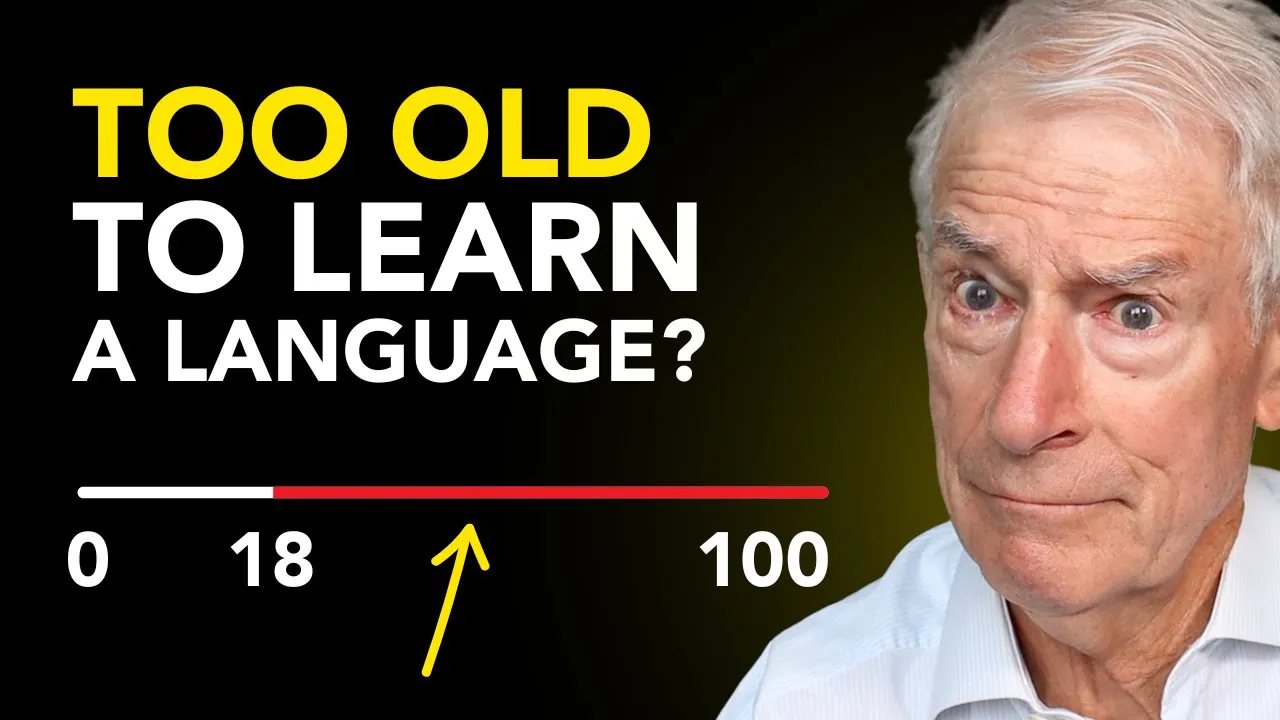



Adults struggle to learn languages as easily as children because their brains have developed categorical perception, which filters out unnecessary phonetic details, making it harder to acquire new sounds; however, adults excel at vocabulary memorization through systematic methods like flashcards, allowing them to communicate effectively even without native-like fluency.
Why Adults Struggle to Learn Languages Like Children
Added:Basic neuroplasticity and how the brain adapts and rewires itself during different stages of life.
The distinction between first language acquisition (L1) and second language learning (L2).
Fundamental concepts of developmental psychology, particularly how children process sensory and environmental input.
An understanding of basic linguistic components, such as phonology (speech sounds) and syntax (grammar structure).
Advanced cognitive strategies and methodologies designed specifically for adult language learners (e.g., spaced repetition, immersion).
Stephen Krashen's Input Hypothesis and the concept of the 'Affective Filter' in adult learners.
The neurobiology of bilingualism, examining how the brain structures and accesses multiple languages depending on the age of acquisition.
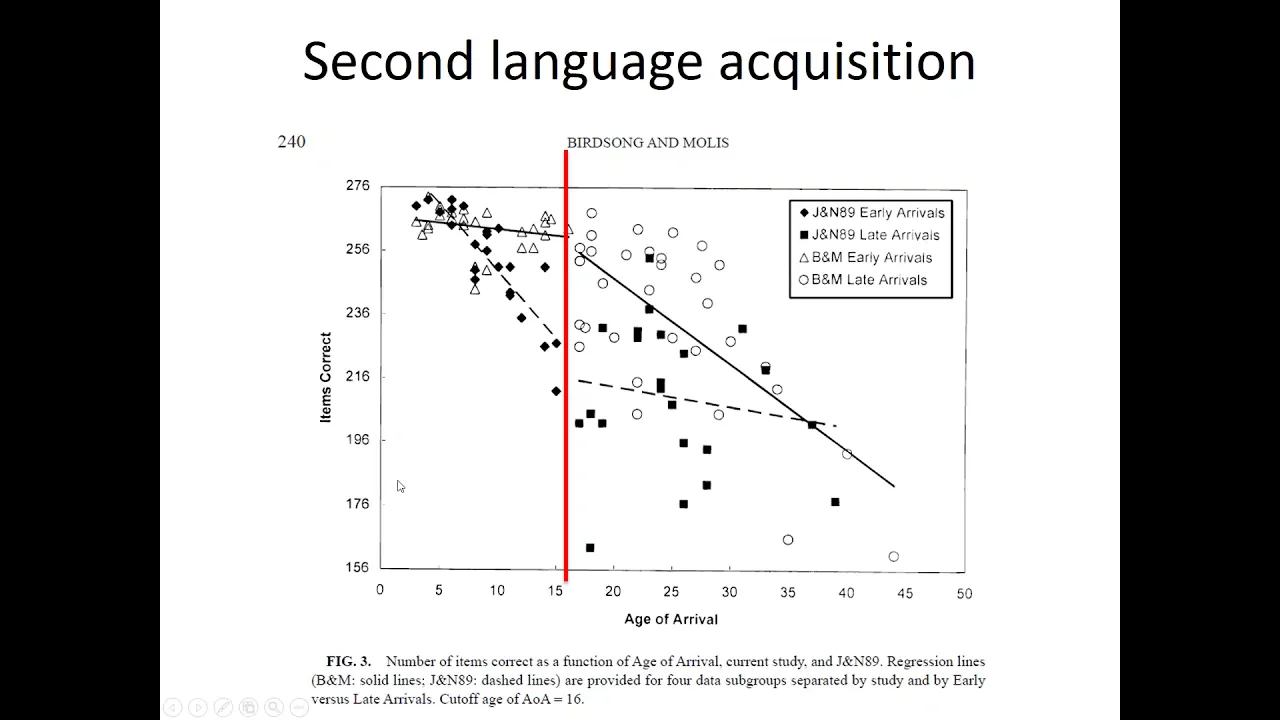
Scientific debates surrounding the exact timeline and boundaries of the Critical Period Hypothesis in linguistics.
2.8M views93.9Klikes4:00Original Release: 2015-06-04
If learning a language is so easy for young children, why is it so difficult when you’re older?
We have entire industries devoted to helping adults learn languages “the easy way”.
I mean, never mind there isn’t an “easy” way for adults to learn language, and never mind that different people learn in very different ways, there are a hundred companies that’ll happily take your money. I’ve tried a couple. They didn’t work all that well, and my French is just as stumbling as it was when I tried to learn it in school -- probably worse, given that I’ve forgotten half of what I had to learn then.
But young children just learn languages automatically, don’t they? Surround them with language speakers, and they’ll just pick it up easily.
Well, first of all: easily? I mean, a baby spends about a whole year with nothing but input before it even starts producing any sort of coherent sound, while an adult can concentrate for an hour or so and get a few basic sentences memorised. And that baby’s learning constantly, almost every minute it’s awake. Adults have a heck of a lot of other things to do, including communicating and thinking in the languages we already know.
There is something called the “critical period hypothesis”. The idea is that for the first couple of years of life, the brain is particularly good at picking up languages.
Noam Chomsky proposed a “language acquisition device” in the brain that switched off as you got older. Now, that hypothesis is well-known enough to be taken as fact by the public at large, but linguists are still debating it. Chomsky moved away from his language acquisition device, towards the idea that we steadily narrow down the parameters of the language we’re taught from a long, long list of possibilities. And that theory is still getting a lot of criticism.
In fact, if you ask the big question: “how do children acquire language”, then the answer is: nobody really knows, but some linguists have really strong opinions on it.
We know that language must be partly based on genetics, and partly based on surroundings.
No matter how much you talk to a gorilla, it’s never going to be able to understand more than a few words -- and there are serious questions about whether any of the great apes have actually managed that. Even the smartest animal, with the best tutor, will never be a conversation partner. So there must be something fundamentally human about language.
But at the same time: there’s nothing genetic about which language you can speak. If I’d been adopted at birth by French-speaking parents, I would be speaking and thinking in French: there’s no gene for the English language.
There is one thing that’s clear, though. We’re born with the potential to speak any human language. But after a while, surrounded by just a few languages, or maybe just one, we work out what we need to listen for -- and we stop listening for anything else.
Many languages on the Indian subcontinent have a distinction between p and p(h). So, pa would be different from p(h)a. Hear the difference? The second one is aspirated, there’s a bit more air coming out my mouth. Pa versus P(h)a. If you don’t speak one of those languages: do you reckon you could hear a subtle difference like, when there’s someone speaking at full speed? Do you reckon you could produce that difference, reliably, without thinking about it? Millions of people, billions of people, can and do, and they learned it automatically: but try and pick that up as an adult, and it’s going to take you a long, long time.
It’s called categorical perception: our brain takes this strange input, these electrical signals based on changes in air pressure, and we look for particular categories within them. And once we’ve filed something into a category, the other details don’t matter.
But it’s not all over if your brain is too set in its ways, like mine is. Adults are really quite good at learning vocabulary, the same way we’re good at memorising anything else. Most of the language courses aimed at adults emphasise that: they use flashcards and translation exercises, and don’t worry too much about getting production perfect.
You may never sound, or even think, like a native speaker, but that doesn’t mean you can’t at least make yourself understood.
[Translating these subtitles? Add your name here!]
Up Next

3:02
How to Draw a Syntactic Tree Diagram: Simple Steps
@GracerodV
128.2K views•2020-09-20
36:52
Constraint Interaction in Optimality Theory: Epenthesis & Deletion
@Vidyamitra
180 views•2018-08-20

5:32
Grice's Maxims: The Hidden Rules of Conversation
@TomScottGo
5.8M views•2020-05-04

21:32
Accent Expert Explains U.S. Regional Dialects | Part 1
@WIRED
9.3M views•2021-01-21
Related Study Plans & Knowledge Roadmaps
Structured learning paths in Linguistics
linguistics
Optimality Theory: Tableaux & Constraints
01Phonological Basics: Sounds, Syllables & Rules
02Foundations of Optimality Theory: GEN, CON, and EVAL
03The Constraint Inventory: Markedness vs. Faithfulness
+ 2 more learning modules
15h5 modules
Explore Roadmap
linguistics
Morphosyntactic Alignment: S, A & P Systems
01Foundations of Syntax: Transitivity and Arguments
02The Linguistic Variables: Mapping S, A, and P
03Nominative-Accusative Alignment
+ 3 more learning modules
12h6 modules
Explore Roadmap
linguistics
Analyzing Sign Language: Phonology & Syntax
01Foundations of Sign Language Linguistics
02Phonology: The Five Parameters of a Sign
03Morphology: Word Formation and Classifiers
+ 2 more learning modules
14h5 modules
Explore Roadmap
linguistics
Pragmatics: Speech Acts, Grice & Politeness
01Introduction to Pragmatics: Meaning in Context
02Grice’s Cooperative Principle & Implicature
03Speech Act Theory
+ 2 more learning modules
14h5 modules
Explore Roadmap