


















![Атомні звички. Джеймс Клір. [Аудіокнига]](https://i.ytimg.com/vi/qkR8yOVYL90/maxresdefault.jpg)




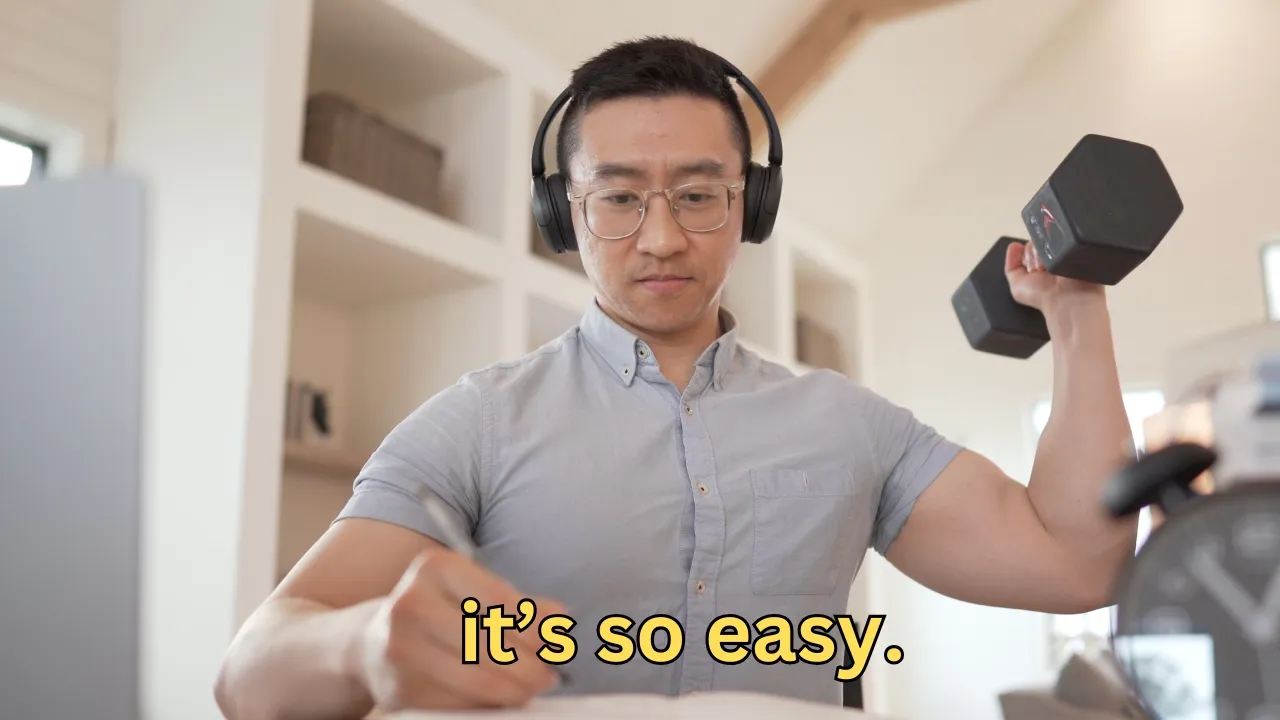


Dopamine is the brain's neurotransmitter associated with reward, motivation, and pleasure, but in modern society, constant exposure to highly stimulating activities like scrolling social media, watching videos, and listening to loud music keeps the brain in a heightened state of awareness. This overstimulation makes it nearly impossible to focus, reduces creativity, and diminishes enjoyment of work. The brain adapts to high stimulation levels, building up a higher baseline, which makes slower activities like studying or walking seem boring in comparison. A dopamine detox involves gradually reducing stimulation sources over 5 days: (1) phone-free first hour after waking, (2) reducing playback speed of videos and podcasts, (3) using the stop-and-drop method to address urges to check phone, (4) enabling grayscale mode on phone screens to reduce visual stimulation, and (5) practicing 5 minutes of absolute nothingness. This process helps recalibrate the brain's baseline dopamine level, making it easier to focus, feel motivated, and achieve goals without relying on external stimulation.
A 5-Day Dopamine Detox Plan for a Regulated, Focused Mind
Added:Last Sunday, I felt particularly out of character. Sundays are usually the day when I would tidy my room, clean the bathroom, and prepare for the following week. It's a time where I reset and I refresh, and I put my mind and body in the best possible place it can be to go into the next week feeling as calm and productive as possible. But last Sunday, things could not have been more different. I woke up and I immediately checked my phone. I spent an hour horizontally on my bed scrolling through Instagram. I cleaned with a podcast on 2x speed and I played vlogs in the background while I sorted my finances.
And the very second that I was not 110% stimulated, I was bored. I was uneasy and I was completely restless. My brain was wired and it was extremely uncomfortable. Thankfully, this is a rare occurrence for me. But regardless, I still knew that I needed to do something and have some kind of intervention so that I didn't continue to get sucked down this rabbit hole of just continuously giving in to these dopamine impulses. Because I know from past experiences that when my brain stays in this state, it is near impossible to get anything productive done. I cannot focus, my brain is not creative and I do not enjoy my work. On the other hand, when I am regulated and not over stimulated, I become unstoppable. So, I did what any somewhat self-aware person would do and I decided to run my own dopamine detox. And today, given by the fact that you're listening to this episode, you are planning on doing one, too. So, let me just say congratulations. It is a hard thing to do, but you will be so grateful that you did it and it will be so worth it. But hello everyone and welcome back to the successfully balanced podcast. I am your host Arya Bradley and I am so excited to be here with you today. I am so grateful to all the beautiful souls listening to this podcast. Whether you're watching on YouTube or listening on Spotify, I am so grateful for you. And if you're new to this channel or to this podcast, this is the podcast where we help the ambitious girlies who want to go above and beyond to achieve their most quote unquote delusional goals in the fastest, highest, and most fulfilling way possible without sacrificing their health and happiness in the process. So, if you are a highly ambitious woman like myself, you are in the right place. And I really hope that you enjoy this episode. If you do, it would mean the world to me. If you're on Spotify, we currently have a fivestar streak. I think it's like 30 people have rated it five stars now. So, if you're listening on Spotify, keep that streak going. Rate us five stars if you've enjoyed this podcast. And if you're on YouTube, then I would love if you could rate, not rate, subscribe, and like this video.
And tell me in the comments what you loved about this video and what you want to see more of because I really want to make this channel as helpful as possible to you. And so, I just want to know how I can serve you best. And as I always do at the start of every episode, I like to say one thing that I've been doing to work towards my goal, i.e. the successful part of this podcast and then on the other side I do something that I have done to have more balance in my life i.e. the balance side of this podcast. So to work towards my goals I have been absolutely grinding for the last week of the creative college VIP cohort. If you guys don't know I'm a coach with creative college and it's been just the most beautiful time with that cohort. So wrapping that all up and having to farewell my students was really bittersweet and very heartwarming. So it was a really lovely experience. Then on the balance side of things, this evening I am going ice skating with my boyfriend, which I'm so excited for. And then tomorrow night, I'm going to watch one of my best friends musical performances, which I have not seen them perform in a really long time. So, I'm really excited. And then on Sunday night, I am going to have dinner with my boyfriend's grandparents.
So, overall, it's going to be a really lovely weekend, but it has been such an intense week with the VIP. And then I've still got some meetings. Tomorrow morning at 5:00 a.m., we are farewelling the cohort of class of VIP 10. So, got to be up early for that. But there's just so many exciting things which I'm really looking forward to and are really filling up my cup. So, in today's episode, I'm going to be sharing with you a 5day dopamine detox that you can literally start doing as of today or tomorrow and move you from a place where you are feeling really addicted to dopamine and really impulsively checking your notifications and impulsively scrolling on social media to a place where you feel a lot more calm and at ease and focused and ready to go after your goals. Now, I will also be running a full 30-day dopamine detox alongside my girls in Elev. And like I did with the August challenge, which was on building unbreakable selfrust, I am opening this challenge out to you guys to join along with us. So, if you find this episode helpful and you genuinely think that going further with this is going to bring you closer to your goals, then I strongly recommend that you check out the link in the description and that is where you can enroll into the full 30 days. By the way, we're only accepting enrollments until September 1st. So, make sure that you don't hesitate if you want to do that. But regardless of whether or not you decide to join the official challenge, I truly hope from the bottom of my heart that you still get so much out of this episode and that you end up changing your life as a result. Cuz if this episode can change even one person's life, then I am happy with that. So, let's get into it. A quick note about the actions that I'm giving you. So, the actions are cumulative. So essentially what you do on day one, you then want to take that and keep doing that on day two and day three and day four as well. And then what you start on day two, you want to add to that. You know, obviously within reasons sometimes you decide whether this is something that you do once off or um as a habit, but most of these things will be accumulative. But first of all, we have to talk about the role of dopamine. If you've never heard of it or looked into it, dopamine is essentially the neurotransmitter in our brain that is associated with reward and motivation and pleasure. But that alone isn't really the problem. The problem is that in our modern society, we have a plethora of things which are so stimulating for our brain. And when we are constantly shifting and switching between really stimulating tasks or activities like scrolling on our phone or watching Netflix or listening to loud music, that constant switching between things leaves our brain in this really heightened sense of awareness and alertness because essentially your brain is receiving so much more dopamine than it naturally would. And so it keeps you in this state where you feel like you constantly have to keep hitting that high level of dopamine as stimulation.
And a really big thing that releases dopamine or causes our brains to release dopamine is novelty. And so when you scroll on social media, it is literally designed to keep you entertained and to keep you wanting the next new thing because every time you scroll, you see something different. And that's literally neuroscientists developing that so that you stay addicted to it.
But over time, as you adapt to this high level of stimulation, your brain ends up kind of building up this really high baseline of stimulation. And then as a result, slower activities and less stimulating activities like studying or going for a walk or literally just sitting in silence with your thoughts, they will become really boring in comparison because they just aren't designed to keep you feeling super gauge all the time. Thankfully though, this isn't permanent. It just means that your brain has temporarily adapted to a higher level of stimulation and activation. Now, the more often that you immediately satisfy those urges and you immediately give into those dopamine cravings like checking notifications, opening social media, typing YouTube into your search bar, and just seeing what's there. The more you do that, the stronger that habit loop becomes, and therefore, the harder it is to break out of that habit loop and actually do something that's going to make meaningful contributions to goals that you care about. The good news though and the reason that this episode exists is that you can change this. Your brain is very highly adaptable. And so by gradually reducing the sources of stimulation that you have and like the intensity of those stimulation, we can over 5 days or 30 days if you join the challenge, you can bring your baseline dopamine to a much lower level and it will essentially become really easy for you to then go and do those things which you care about that are going to lead you to hitting your goals. Now, as this adjustment happens, you will first of all notice some restlessness, and that is completely normal. As with anything that you're sort of withdrawing from, it's normal for your brain to want to have some time to adapt and recalibrate.
But what you'll also notice is that ordinary activities, especially the more challenging ones, which you know you need to do to get to your goals, are going to start to feel way more easy and not like there's this massive brick wall up against you when you go try and do the thing. they actually start to feel engaging again and you will actually be able to focus more and you won't procrastinate so much and put things off and you'll become less dependent on external stimulation in order to feel motivated. We cannot possibly eliminate dopamine and that really is not the goal here. We aren't trying to remove dopamine per se, but we're just trying to reduce the exposure and the intensity of the dopamine stimulation that we're getting so that our brain can stop relying on the stimulation and stop getting in the way of us hitting our goals. So without further ado, let's get into the actual day one and that is to have a phone free first hour. I did try when I was planning out this uh challenge to have it so that all the days kind of add on to each other and it gets progressively harder. However, this first day if you are typically someone who wakes up and immediately goes in your phone, this will probably be feeling like you are getting thrown in the deep end. So sorry, not sorry. When you wake up and the first thing that you do is scroll, you are immediately putting your brain in this super heightened state of activation. Which then means that when you go and try to do anything else in your day, whether that is cooking, cleaning, going to the gym, doing work, studying, no matter what it is that you try to do after that, your brain is going to find that impossible. It will feel absolutely terrible and boring and just so uninteresting, and you're just going to want to procrastinate all day and just go back to scrolling in bed. So instead, I want you to set a boundary. This could be any length of time depending on what works for you and what you do genuinely need your phone in the morning for, but a good sweet spot is around an hour. I know you might feel like it is really urgent to check your emails or see what your friends have been up to on social media. But remember, this is your life and you are the one that's living it, not anyone else. And you get the privilege of choosing how you want to spend it. So, leave your phone on the other side of the room when you go to bed. And if you need to buy a separate alarm clock so that it's not the first thing that you touch as soon as you wake up. And instead when you wake up, you can do other beautiful things like go outside and get some sunshine. Do some gentle movement or some yoga or some stretches. Eat a healthy breakfast. Have a warm bath. Anything that genuinely fills up your cup and your energy and your peacefulness so that you can go about your day with calmness and with focus and really productively. Trust me, you will thank yourself later. Day two, one time speed. Okay, be honest with me.
Are you watching this video right now or listening to this podcast episode on two times speed? If you're like I have been recently, you probably are. I get it. It is more efficient. It's faster. It takes less time. You get to the point faster.
But do you actually synthesize that information better? No. I will give you some grace because according to studies, listening to videos at two times speed doesn't actually decrease the amount that you are learning, but it doesn't actually increase it either. So, you don't really gain anything. But my oh my, does it increase your level of stimulation. Essentially, you are just doubling the amount of input that your brain is getting from the same origin, which as we know is just going to put your brain in a heightened state of stimulation. And right now, if you find that listening to something or watching a TikTok on one time speed is like the most boring thing ever, you really need to do this. So, unless you have a genuine reason for needing to take that information in in a much shorter time frame, you can just slow it down. If you must put it at 1.75 times speed today, put it at 1.5 time speed tomorrow, put it at 1.25 speed the next day, and then eventually get down to one time speed.
Trust me, I get it. I'm impatient as well, but we both know that this is going to be for our own good. Just slow down. Day three, the stop and drop method. All right, by day three, you're probably going to be feeling a little bit restless because you're kind of annoying your brain and interrupting its constant urge to want to get a hit of dopamine. This is when you enter this really awkward and uncomfortable phase where you're not quite out of being embedded in dopamine, but you're also not quite on the other side, where you're perfectly peaceful and relaxed yet. This phase is the most critical.
Thus, I'm introducing to you the stop and drop method. This is a tool that you can start to use anytime that you get that urge that you really want to check your phone or you really want to scroll on social media or you just have to open up Netflix. So, here is the procedure.
Step one, stop. Take a physical pause.
Step two, drop. Sit down on the floor.
Step three, breathe. Take a deep breath in. Step four, question. Ask yourself, what am I feeling right now? What task am I trying to avoid doing? What emotion am I trying to suppress? Once you've found the root reason, sit with it and address it properly. Nine times out of 10, the solution is not to scroll. The more you do this, the more you'll start to notice your patterns and triggers.
And you can start to equip yourself with alternative things to do and alternative coping mechanisms rather than just giving in to the cravings and the impulses that your brain is going to try and convince you is the best way of dealing with the situation. Day four, grayscale mode. This one is probably the simplest and the easiest. Now, I'm not sure about other phone models because I've only ever used Apple, but if you have an iPhone, you can go into settings and you can turn on what's called grayscale mode. Essentially, what this does is it takes out the color and the saturation of your phone. So, your screen is literally just varying shades of black and white and gray. Also, if you're reading the substack version of this, which by the way, if you guys want the written like article newsletter version of this episode, it's linked in the link in my bio. Um, so you can go and read my substack over there. But basically, when I was writing this, I put all the photos in grayscale. So, if you're reading, then you'll be like, "Oh, wow. Yeah, she did that." Anyways, I digress. As we talked about before with novelty, color introduces extra novelty, which basically is really exciting for your brain. So, by reducing the bright artificial colors from a screen, you give your brain a little bit of a break and it can start to feel more calm and refreshed and at peace again.
Not only that, but it also makes it really hard to stay on your phone for a long period of time. Like, I found that when my phone is on grayscale mode, which at the moment it pretty much 90% of the time it is, other than when I'm editing content, cuz obviously I need to know how it's going to look for you guys. But when I'm just like on my phone and it's on grayscale, I find it so hard to stay on my phone because I'm just like this is so boring. Like this sucks.
I just put my phone away. So extra little bonus hack there. It is boring.
That is the point. Day five, 5 minutes of nothing. Day five might just be the most boring part of this challenge, but that is again the point. So often we tend to consider physical challenges or things that are going to physically push us out of our comfort zones as the kind of mark that something is beneficial for us. However, in the case of dopamine detoxing, we kind of want to do the opposite. So today your task is to do absolutely nothing for five whole minutes. No music, no exercise, no reading, just you and yourself sitting or laying on the floor for 5 minutes.
Often when I get a new client or I have a new girl join Elevate, she'll often be like, "Oh my goodness, I'm so overwhelmed. I have so much going on in my life." And I'm like, "Girl, go lay on the floor for 5 minutes." And every single time that they do it, they're like, "Oh my gosh, I feel a million times better." So extra little hack that I give them. Set a timer on your phone, put your phone on the other side of the room, and just be. The first time you try this, you will likely feel bored out of your brain. Good. Keep doing it.
Later down the challenge, we do longer variations of this, but if you can master 5 minutes, you will be pretty good to kind of build up from there. And the really good news is that when you bring your baseline level of stimulation down to like as close to a zero as you possibly can, pretty much any task or action will feel exciting in comparison to doing absolutely nothing. And that includes that thing you've been putting off doing, which you kind of can see the tie here. The more bored you get, the easier it's going to be to do those hard things. So, the more often we can get into the habit of doing absolutely nothing and letting our brains bring theelves back down to baseline, the more creative, the more disciplined, the more focused, the more hardworking we can be.
So, that brings us to the end of the 5day dopamine detox challenge. Of course, this is literally just the beginning. So, if you found this episode as helpful as I did when I was creating and triing and testing and developing this whole challenge, then I strongly encourage you to check out the challenge which is linked in the link in my bio.
My gosh, not my bio. Sorry guys, in the description of this video. Whether your goal is to run a marathon or launch a business or hit a six-figure investment portfolio, regulating your dopamine is going to get you there 10 times faster.
And I would love to say that I have played some kind of role in your success. So, this challenge is open from the day that this video is published until September 1st, 2026. So, do not hesitate, do not put it off. If you're interested in joining, make sure you do that right now. But, as always, I wish you every single success, and I cannot wait to see where you go from here. So, I hope you have the most amazing day, and I will see you in the next episode.
By now,
Up Next

Social Media Dopamine Loops: The Neuroscience of Gooning
@logoffwithlo
327.7K views•2025-11-06
Whole Brain Architecture: First International Workshop 2024
@thewholebrainarchitecturei9784
640 views•2024-07-22

FastAPI vs Flask vs Django: Choosing the Right Python Web Framework
@TechWithTim
302.5K views•2024-05-26

Game of Thrones Opening Credits: A Cinematic Analysis
@gameofthrones
46.3M views•2011-04-18
Related Study Plans & Knowledge Roadmaps
Structured learning paths in General & Interdisciplinary Studies