Ulrich Beck's concept of Risk Society (1986) argues that modern society is increasingly structured around new qualities of risk that didn't exist historically: risks that are invisible and undetectable without science (like climate change), universal risks that cannot be escaped regardless of wealth (unlike historical pollution where the rich could relocate), and irreversible risks (such as GM crop environmental impacts) where ignorance and unknowns become more significant than known information, fundamentally challenging traditional institutional trust and creating what can be termed 'risk crimes' or environmental crimes.
Risk Society Explained: Ulrich Beck's Theory in Sociology
Added:Deep Dive
Classical sociological theories of industrialization and modernization, particularly how traditional societies transitioned into industrial ones.
Classical Sociological Theories
56.1K
Classical sociological theories by Marx, Durkheim, and Weber emerged in 19th-century Europe to understand the dramatic transformations of modernity, including industrial capitalism, urbanization, and social dislocation; Marx emphasized historical materialism and the relationship between social being and consciousness, arguing that individuals make history within given circumstances; Durkheim introduced the concept of social facts—external, general, coercive constraints that shape individual behavior—and distinguished mechanical solidarity (traditional societies) from organic solidarity (modern specialized societies); Weber developed interpretive sociology focusing on meaningful action and introduced the disenchantment of the world, instrumental rationality, and ideal types as analytical tools; these theories remain relevant today because modernity's processes—capitalism, technology, migration, and inequality—continue shaping contemporary societies globally.
Click to watch →

Teori modernisasi perubahan sosial
1.5K
Modernization theory explains how societies transition from traditional to modern industrial societies through a process of social change, characterized by five stages identified by Rostow (traditional society, preconditions for takeoff, takeoff, drive to maturity, and high mass consumption), with modern humans exhibiting nine key characteristics including openness to new ideas, rational freedom of opinion, time consciousness, planning skills, self-confidence, calculated decision-making, respect for others, trust in science and technology, and merit-based rewards, while modernization impacts society across social, economic, political, and cultural domains.
Click to watch →
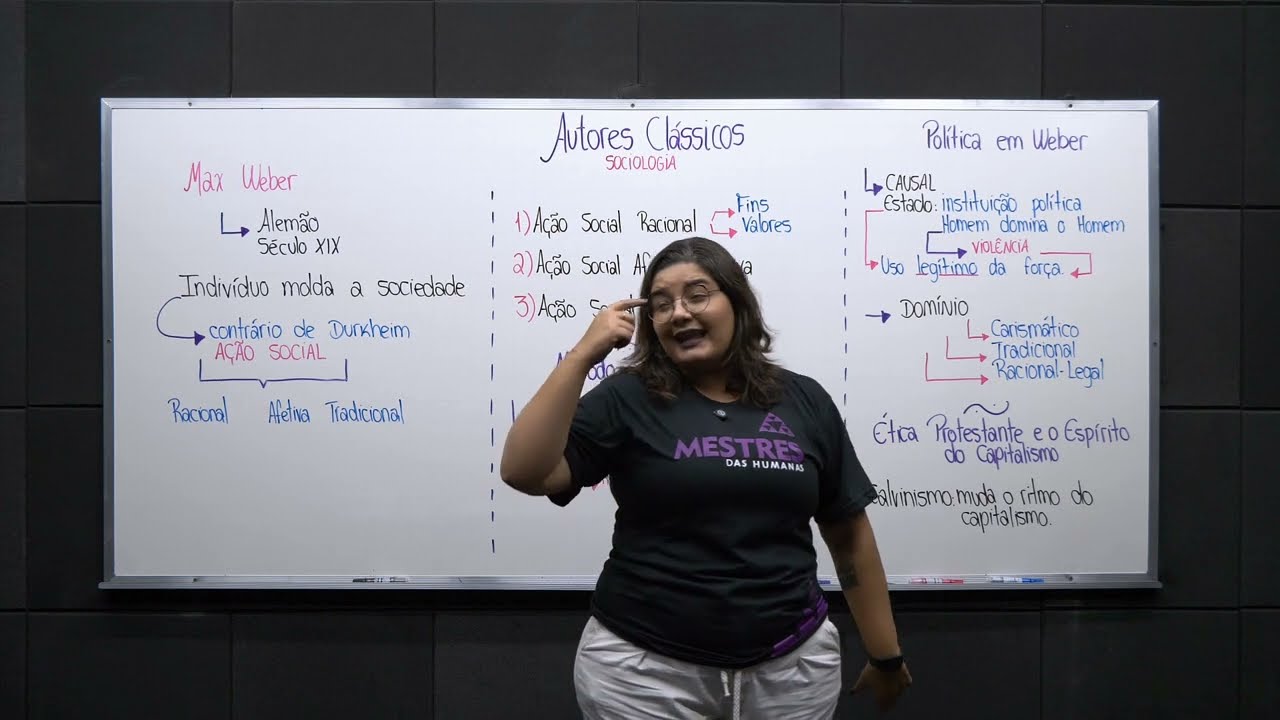
Sociologia no #enem: revisão Autores Clássicos
33.1K
This lesson covers three foundational sociologists: Émile Durkheim (French, 19th century) established sociology as an academic discipline through his concept of 'social facts'—phenomena that are general, exterior to individuals, and coercive, which control society and generate solidarity (mechanical in traditional societies, organic in modern ones); Max Weber (German, 19th century) argued that individuals shape society through 'social action' (rational, affective, or traditional), and analyzed domination types (charismatic, traditional, rational-legal) and the Protestant Ethic's influence on capitalism; Karl Marx (German, 19th century) developed materialism, dividing society into infrastructure (forces and relations of production) and superstructure, and argued that history is the history of class struggle between bourgeoisie (owners of means of production) and proletariat (workers who sell their labor), with exploitation occurring through surplus value extraction.
Click to watch →
#14 Marx Durkheim & Weber | Classical Sociological Theory
6.7K
Classical sociologists systematically examined fundamental questions about modernity: origins and characteristics of capitalist society, differences from traditional pre-modern society, driving forces of industrial development, fate of the individual, and new social problems. The individual emerges as autonomous in modern society, separate from traditional community structures—a both emancipating and challenging transformation. Unlike conservative thinkers, Marx, Durkheim, and Weber were active defenders of modernity. Even Marx acknowledged capitalism's civilizing influence as an unavoidable positive transition from feudalism, while wanting a more egalitarian society. Durkheim empirically supported industrialization, individualism, and egalitarianism. All three were ideologically committed to Enlightenment values of equality, critical thinking, rationality, and individualism while applying scientific methods to analyze social change.
Click to watch →

MODERNIZATION AND DEVELOPMENT I SOCIOLOGY OF CHANGE AND DEVELOPMENT I +2 LECTURER SOCIOLOGY I JKPSC
1.7K
Modernization theory proposes that development is a universal process where societies progress from traditional to modern states through specific stages (Rostow's five stages: traditional society, precondition for takeoff, takeoff, drive to maturity, age of high mass consumption) and by adopting modern values (Parsons' pattern variables: achievement over ascription, universalism over particularism, specificity over diffusion, self-orientation over collectivism), though critics argue this theory is Eurocentric and ignores historical exploitation and global inequality structures.
Click to watch →
Deep Dive
The distinction between natural hazards (such as natural disasters) and manufactured risks (technological, ecological, and economic risks created by human decisions).
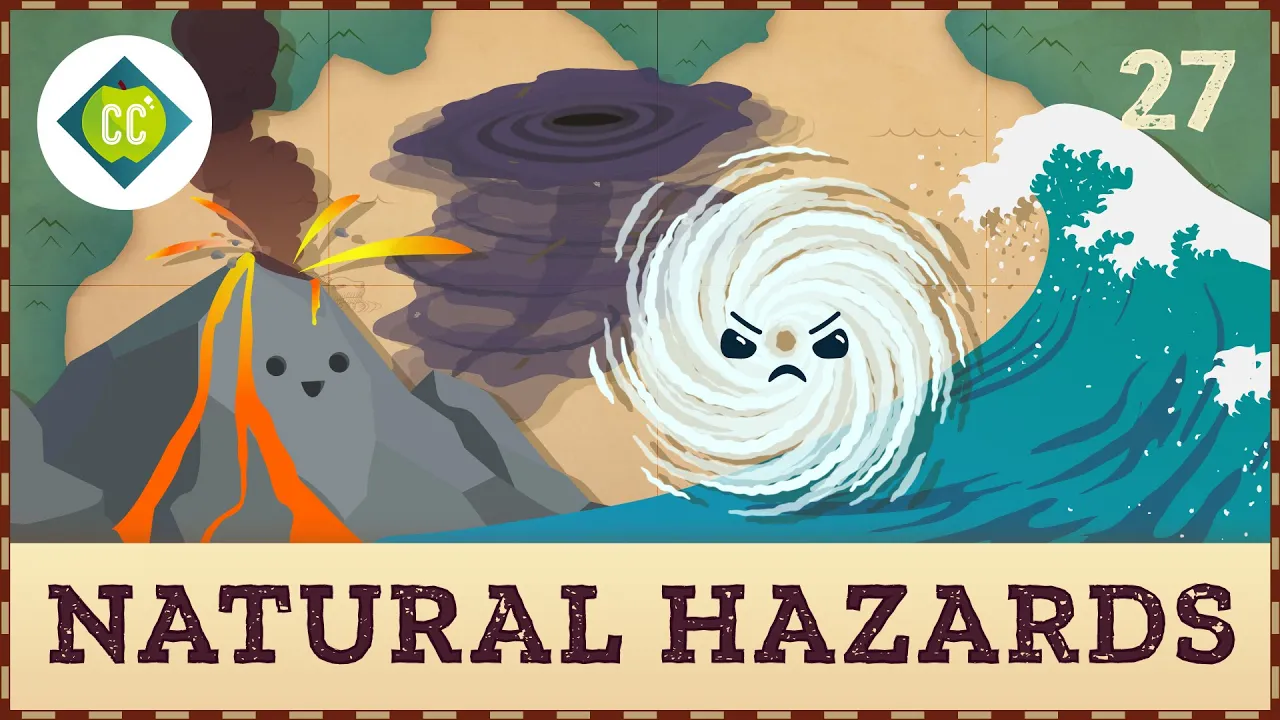
Natural Hazards: Crash Course Geography #27
378.8K
Natural hazards consist of two components: physical events (meteorological, geological, hydrological) and human impact. The distinction between natural hazards and human-made disasters matters. Geographers evaluate hazards through magnitude, time dimensions (frequency, duration, onset speed), and spatial extent. Human factors increasingly create vulnerability as populations settle in hazardous areas. Socioeconomic factors like income and historical patterns (white flight in New Orleans) determine who bears disaster risks. Wealth, education, social organization, and technology reduce vulnerability. The traditional view of natural disasters is being replaced by understanding hazards as complex interactions among peoples, environments, and technologies.
Click to watch →

Ulrich Beck's Risk Society
3.6K
Manufactured risks are defined as risks created by human activity, particularly through technological and industrial developments, in contrast to natural risks which stem from natural disasters or diseases. Climate change serves as a primary example of a manufactured risk, being largely driven by industrialization and human exploitation of natural resources. Beck argues that because manufactured risks are created by human intervention, they are more unpredictable and difficult to control compared to natural risks.
Click to watch →

Theory of Risk Society by Ulrich Beck | Sociology
110
Manufactured risks are risks created by human activity, particularly through technological and industrial developments, in contrast to natural risks which stem from natural disasters or diseases. Because manufactured risks result from human intervention in the natural world, they are more unpredictable and difficult to control. Climate change serves as a primary example, being largely driven by industrialization and human exploitation of natural resources. The global interconnectedness of modern society means that the impacts of these manufactured risks can be far-reaching and cross national borders, creating global problems that require global solutions.
Click to watch →
Toplumsal Cinsiyete Duyarlı Afet Yönetimi
396
Natural hazards (such as earthquakes and floods) are natural phenomena, but disasters are created by human decisions and actions. The term 'natural disaster' is a misnomer because disasters result from human choices about land use, building practices, and resource allocation. Human decisions transform natural hazards into disasters by creating vulnerability. This distinction is fundamental to understanding disaster risk reduction and shifting responsibility from nature to human decision-making.
Click to watch →

NALAR Ep. 115. NALAR TALKS: KEBIJAKAN LINGKUNGAN DAN MITIGASI BENCANA DI INDONESIA
605
Sociologist Ulrich Beck introduced the concept of 'Risk Society,' distinguishing between two types of risks. Natural risks are inherent to the environment, such as volcanic eruptions or earthquakes. Manufactured risks, however, result from human activities and can manifest as natural disasters like floods or landslides, which occur due to deforestation, illegal logging, or inappropriate land use such as building villas on mountain slopes. The key difference lies in their root causes: natural risks stem from natural phenomena, while manufactured risks arise from poor environmental governance and short-term profit-driven development policies.
Click to watch →
Deep Dive
Basic sociological concepts of social stratification and resource distribution, which Beck argues are being complicated or overshadowed by the distribution of risk.

The Theory of Modernity (A Comparison of Anthony Giddens and Ulrich Beck)
85.2K
Ulrich Beck argues that in classical modernity, the distribution of wealth between proletariat and bourgeoisie was the main issue. In contemporary modernity, the focus has shifted to prevention, causes, and minimizing of risks, with an emphasis on safety. Unlike earlier periods when risks were more predictable and could be mapped, today's risks (such as global warming, obesity, and environmental downfalls) cannot be definitively answered regarding their causes or outcomes, requiring people to face them head-on with uncertain consequences.
Click to watch →
Ulrich Beck's Risk Society Explained | Sociology Concepts
45.2K
Ulrich Beck's concept of the Risk Society describes how modern societies have shifted from addressing immediate survival concerns to anticipating and managing future risks, particularly environmental ones; unlike earlier industrialization where risks were localized and could be escaped by wealth (like moving to suburbs), contemporary risks like climate change, radiation, and pollution are evenly distributed across populations and transcend national boundaries, necessitating new forms of global cooperation and cosmopolitan solidarity to address shared challenges.
Click to watch →

Sesión Cuatro: La sociedad del riesgo
1K
Ulrich Beck, a German sociologist drawing on Marxism and Max Weber, proposed that modern society corresponds to a specific class of risk central to its functioning. His work is an ideal type, not a description of actual societies. The first modernization (19th-20th centuries) was characterized by the Marxist model of industrial society of class, organized around unequal but legitimate distribution of material goods. The second modernization represents a new paradigm where society produces progress while simultaneously producing new risks, shifting the central question from how to distribute wealth to how to avoid, minimize, and channel risks systematically produced in advanced modernization. In risk society, unlike previous paradigms where goods were visible, risks are invisible and escape immediate human perception. Making risks visible becomes a social construction process relying on scientific expertise. Once visible, identifying causes and determining responsibility requires not only scientific expertise but also civil society organizations. The entire society becomes fractured over each risk issue.
Click to watch →

RISK SOCIETY :ULRICH BECK
4.8K
Ulrich Beck's Risk Society theory (1986) proposes that modern society has transitioned from 'first modernity' (industrial society characterized by nation-states, collective patterns, and wealth distribution concerns) to 'second modernity' or 'reflexive modernization,' where risk becomes the central issue rather than wealth; this transformation involves five interlinked processes—globalization, individualization, gender revolution, underemployment, and global risk (including ecological crises and financial market crashes)—producing unintended hazards that challenge traditional social structures and create a 'boomerang effect' where risks return to their originators regardless of national or class boundaries.
Click to watch →

Главная опасность прогресса
122.8K
German sociologist Ulrich Beck developed the concept of 'risk society' in the 1980s. He observed that while earlier generations were primarily concerned with survival and later with prosperity and social equality, modern people are now primarily concerned with risks. In pre-industrial societies, the list of potential threats was constant and finite (natural disasters like floods, droughts, fires, locusts). However, industrialization created what Beck called 'secondary nature' - a new environment where each invention and discovery introduces new risks.
Click to watch →
Deep Dive
An understanding of the role of scientific authority and institutional expertise in shaping public policy and societal trust.

Sheila Jasanoff: Expertise, Democracy, and the Politics of Trust | PERITIA Lectures
1.2K
Trust in expertise is not determined by the strength of evidence but by the efficacy of institutions that societies rely on to translate expert knowledge into policy actions; it is a political achievement that requires attention to modes of evidence-making and public reason foundational to political cultures, and the remedy for breakdowns in trust lies in repairing the institutions charged with persuading publics that claimed states of knowledge support proposed forms of public action.
Click to watch →

Why Did 'The View' Lie About the Karmelo Anthony Jury? | 6/24/26
988
Scientific authority can influence public trust and behavior, with different perspectives existing regarding the appropriate relationship between scientific expertise and public compliance. The relationship between scientific authority and public trust represents an important area of public policy consideration that affects democratic governance. Scientific authority can influence democratic participation and public discourse, with different perspectives existing regarding the appropriate relationship between scientific expertise and democratic decision-making. The relationship between scientific authority and democratic participation represents an important area of public policy consideration.
Click to watch →

Gérard Lasfargues - Science, expertise et décision en santé environnementale - 29èmes JSE
116
The science-policy interface requires recognition that scientific evidence is rarely definitive and policy decisions involve values beyond scientific evidence. Public trust in science and institutions depends on perceived transparency, demonstrated competence, and responsiveness to public concerns. Research shows public trust in science has remained relatively stable, but institutional trust can fluctuate based on actions.
Click to watch →
Democracy & distrust after the pandemic: 2022 Dr Seng Tee Lee Lecture
333
In modern democracies, expert institutions have evolved to exercise political authority through three key operations—representation, aggregation, and bridging—that parallel the functions of elected bodies, yet this delegation of epistemic authority to experts without adequate accountability mechanisms creates tensions with democratic principles of individual judgment and public reason, as evidenced by pandemic responses showing how different national cultures (adversarial pluralist in the US, consensual in Germany, rule-focused in the UK) shape public trust in scientific mandates.
Click to watch →

THE OSHOW: Will Poilievre Plummet? Can Carney Fix Economy? Are Ford and Smith MAGA Policies Failing?
2.8K
Modern society functions based on trust in specialized expertise and institutional oversight. People rely on professionals (doctors, engineers, food safety regulators) to make complex decisions affecting daily life. When political leaders attack scientific consensus and institutional expertise, they undermine the very systems that enable society to function safely and efficiently.
Click to watch →
Prerequisite Knowledge
- Concept 01Classical sociological theories of industrialization and modernization, particularly how traditional societies transitioned into industrial ones.
- Concept 02The distinction between natural hazards (such as natural disasters) and manufactured risks (technological, ecological, and economic risks created by human decisions).
- Concept 03Basic sociological concepts of social stratification and resource distribution, which Beck argues are being complicated or overshadowed by the distribution of risk.
- Concept 04An understanding of the role of scientific authority and institutional expertise in shaping public policy and societal trust.
Subsequent Learning
- Step 01The concept of 'Reflexive Modernity' (with Anthony Giddens and Scott Lash), exploring how modern society critically reflects upon and reacts to its own structural failures.
- Step 02Brian Wynne's sociology of scientific knowledge (SSK), particularly his theories on 'lay expertise' and the public understanding of science in risk-prone environments.
- Step 03The application of the Risk Society thesis to contemporary global crises, such as anthropogenic climate change, systemic financial crises, and global pandemics.
- Step 04The 'Precautionary Principle' in environmental law and public health as a policy mechanism designed to manage invisible and irreversible risks.
- Step 05The role of media and communication in the social construction of risk, exploring how threats are defined, dramatized, and politically contested.
Risk Society Theory
Irreversible Risks
Risk Society Theory
0:00Playing Section
- 1
Beck defines modern society shaped by novel, undetectable risks like climate change.
- 2
Risks are universal and inescapable, transcending class and wealth barriers.
The Cultural Theory of Risk
Developed by anthropologist Mary Douglas and political scientist Aaron Wildavsky, the Cultural Theory of Risk offers a major counterpoint to Ulrich Beck’s structuralist view. While Beck argues that modern technological risks are objective, novel, and universally threatening, Douglas contends that risk is a socially and culturally constructed concept. According to this perspective, societies do not respond to risks because they are objectively dangerous; instead, they selectively perceive and prioritize threats based on their internal social organization and cultural values (categorized into hierarchical, egalitarian, individualist, and fatalist worldviews). Rather than representing a fundamentally new epoch of 'universally shared' danger, the focus on specific risks serves as a political and moral tool to maintain social boundaries, assign blame, and reinforce institutional authority. This perspective challenges Beck’s assumption of a 'democratic' risk distribution, pointing out that risk perception is highly subjective and tied to cultural worldviews rather than just scientific or physical realities.
Deep Dive
The concept of 'Reflexive Modernity' (with Anthony Giddens and Scott Lash), exploring how modern society critically reflects upon and reacts to its own structural failures.

Modernidad Reflexiva según Beck, Giddens & Lash Educación Primaria
1K
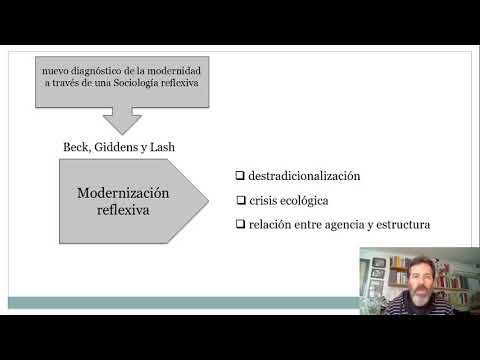
Reflexive modernity is a sociological framework analyzing contemporary society through three key authors: Ulrich Beck (German), Anthony Giddens (British), and Scott (American). The theory examines multiform societies with diverse appearances but underlying structural similarities, described metaphorically as 'liquid modernity' by Zygmunt Bauman. Structure refers to dominant interpersonal relationships within groups and societies, such as family relationships. Human history divides into three periods: pre-modern (until mid-17th-18th century), modern (18th-20th century), and reflexive/late modern (mid-20th century onward). Reflexive modernity is characterized by de-tradition, environmental crisis, and transformed agency-structure relationships. Ulrich Beck's risk society concept distinguishes systemic risk from personal insecurity—risk arises from capitalism's economic organization, creating daily uncertainty individuals must navigate. Contingency—the constantly changing reality—is characteristic only of reflexive modernity. Institutions that once buffered individuals against change have retreated, forcing individuals to reflexively construct and reconstruct their subjectivity. Anthony Giddens explains how modernity displaces grand narratives and traditions, replacing tradition guardians with scientifically-backed experts, yet individuals now draw from multiple sources to construct personalized understandings, creating contradictions between collective memory and individual practical memory.
Click to watch →
UGC NET / SET/ UPPSC Asst. Prof. 2025 | Paper - 2 | Sociology | Anthony Giddens |Dr. Imtiyaz Sir
3.2K
Giddens described modern society as 'reflexive' - individuals continuously monitor, evaluate, and modify their own actions based on ongoing reflection. In reflexive modernity, individuals are not simply following predetermined scripts but are actively constructing their own lives through constant self-examination and adjustment. This reflexivity extends to all aspects of social life, including identity, relationships, and social institutions. Giddens' concept of 'disembedding mechanisms' explains how social relations are lifted out of local contexts and restructured across expanded time-space ranges. In modern society, social interactions are increasingly mediated by abstract systems (like money, language, and technology) that allow people to interact without direct physical presence. He characterized modern society as a 'risk society' - a social formation characterized by the proliferation of risks that are largely human-made rather than natural, including environmental degradation, nuclear proliferation, and financial instability.
Click to watch →
Introducción a la Modernidad Reflexiva: Beck, Giddens & Lash
5.7K
Reflexive modernity, as analyzed by sociologists Ulrich Beck, Anthony Giddens, and Scott Lash, describes a historical phase characterized by three interconnected theses: (1) de-traditionalization where individuals are left in solitude without collective guidance, requiring them to autonomously construct their subjectivity using environmental resources; (2) an ecological crisis involving environmental catastrophes and climate change; and (3) the tension between individual agency and structural forces. Central to this framework is the concept of reflexivity, which differs from mere reflection—it involves self-reference and self-construction where individuals become agents capable of self-critical rationality. This phase emerged from simple modernity's decline in the mid-20th century, representing a radicalization of modernity where individuals gain autonomy to navigate an unpredictable, contingent reality while simultaneously facing new risks and uncertainties.
Click to watch →

What is REFLEXIVE MODERNIZATION? What does REFLEXIVE MODERNIZATION mean?
1.8K
Reflexive modernization is a sociological concept developed by Anthony Giddens, Ulrich Beck, and Scott Lash that describes how modernity turns its attention to its own processes, leading to the transformation of traditional institutions (state, family, religion, political parties) through globalization, individualization, and the rise of risk society, where progress is achieved through reorganization and reform rather than expansion of resources.
Click to watch →
【静かに学ぶ近現代思想】現代の社会学 ハーバーマス、ルーマン、バウマンらの入門解説
115
Anthony Giddens, a British sociologist influential in Tony Blair's government, resolved the agency-structure debate through structuration theory, proposing that structures both enable and result from action. His concept of reflexive modernization describes how modern society continuously questions and revises its own structures and identities, requiring constant reconstruction of marriage, work, and self. His Third Way political proposal transcended traditional social democracy versus market fundamentalism, emphasizing that rights come with responsibilities and advocating social investment enabling work over mere welfare. His work bridges academic sociology and political practice, providing frameworks for understanding identity transformation and welfare state reform in the information age.
Click to watch →
Deep Dive
Brian Wynne's sociology of scientific knowledge (SSK), particularly his theories on 'lay expertise' and the public understanding of science in risk-prone environments.

Sociology of scientific knowledge
1.8K
The sociology of scientific knowledge (SSK) is the study of science as a social activity, examining how social conditions, structures, and processes influence the development and acceptance of scientific ideas; emerging in the late 1960s-early 1970s, SSK distinguishes itself from traditional sociology of science by providing sociological explanations for scientific ideas themselves rather than merely studying scientists' behavior, and it employs frameworks like the strong program which considers sociological factors as influencing all beliefs, not just erroneous ones, while also facing criticism from theorists who argue it overemphasizes human actors and social rules in explaining scientific knowledge.
Click to watch →

Experten und Laien /// Freundliche Losdemokratie-Bewerbung auf Social Media
262
Democracy allows laypeople to bring both scientific expertise and everyday life expertise into the political process. Citizens have access to different life worlds and realities that scientists cannot access. This everyday expertise is potentially more important than scientific expertise because it includes knowledge about how policies actually affect people's daily lives. Science is highly specialized, meaning different political decisions require different scientific expertise. We cannot rely on a single 'Renaissance universal genius' scientist to provide answers for everything.
Click to watch →

Prof Brian Wynne: Whose expertise counts?
2.5K
The 'framing issue' refers to the critical problem that policy questions must be addressed before scientific expertise is applied, as demonstrated by cases like the Chernobyl fallout where farmers' practical knowledge was ignored despite being essential for effective policy responses; this highlights how science often defines public issues as purely technical matters, excluding important social, political, and cultural dimensions that are crucial for comprehensive policy analysis.
Click to watch →
3 1 Risk Reflexivity and Transition
286
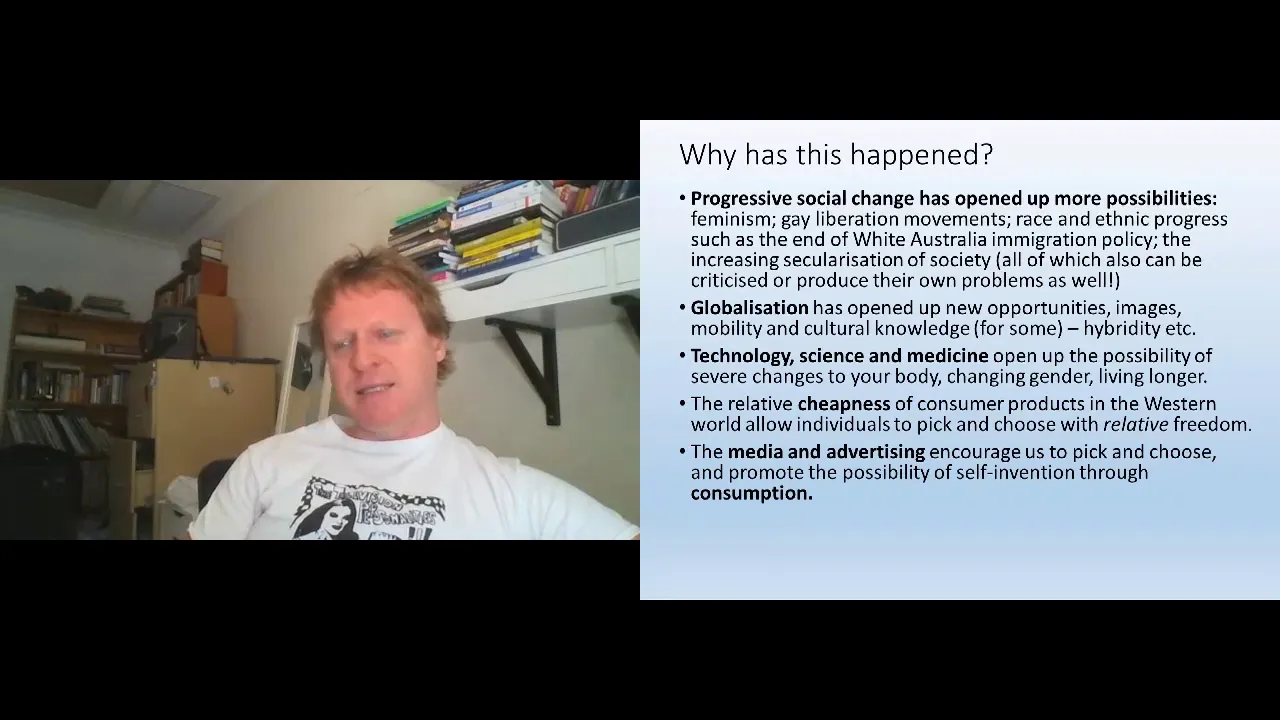
Scientific rationality, intended to provide post-Enlightenment security, actually produces risks. Rapid technological progress means science conducts experiments on society itself, with laboratory predictions failing to capture real-world outcomes (Chernobyl, asbestos). Modern life requires reliance on expertise for career, health, and lifestyle decisions, yet increasing suspicion of experts creates paradox where individuals must become 'lay experts' navigating incomprehensible risks. Daily decisions like breakfast choices involve negotiating future health risks, illustrating how risk calculus permeates everyday life.
Click to watch →

Reiner Grundmann (University of Nottingham)
287
In sociological literature, there are two main groups of expertise: (1) Professional bodies providing expertise, and (2) Field expertise growing from below, sometimes called 'lay expertise.' However, 'lay' and 'expertise' are opposites on a spectrum, and an expert is someone experienced whose judgment people trust. Expertise fundamentally involves trusting someone's judgment based on client evaluation rather than peer review.
Click to watch →
Deep Dive
The application of the Risk Society thesis to contemporary global crises, such as anthropogenic climate change, systemic financial crises, and global pandemics.
#1488: Speelde Nederland een rol in het ontstaan van COVID-19? | Gesprek met Maurice de Hond
42.8K
Ulrich Beck's concept of the 'risk society' describes how modern technological development creates risks that no longer come purely from nature but are increasingly manufactured by humans themselves. The coronavirus pandemic exemplifies this theory: the virus may have originated from human-manipulated laboratory research rather than natural zoonotic transmission. Humanity then combats this human-created risk using the same technology—vaccines and lockdowns—demonstrating how technological solutions to human-made problems can become part of the same systemic cycle. This creates a fundamental tension between technological advancement and human vulnerability.
Click to watch →
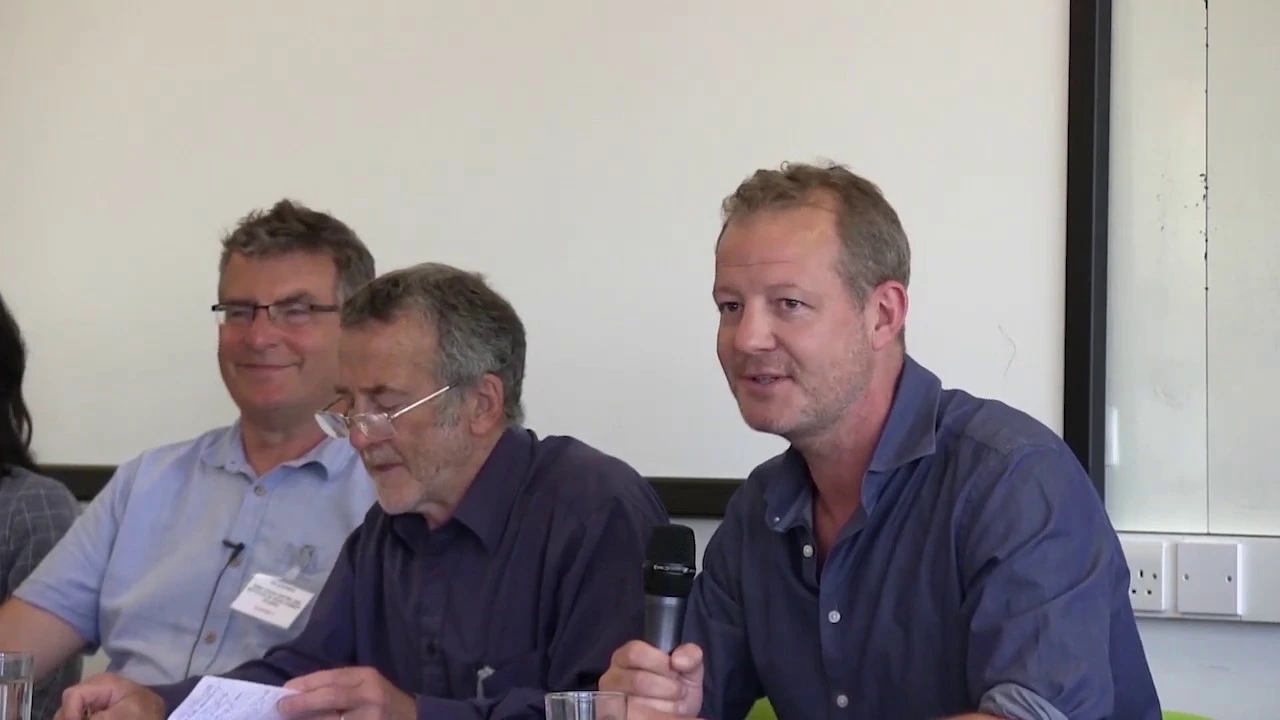
What Happened to the Risk Society? - Panel discussion
493
Ulrich Beck's risk society thesis, which argues that late modernity produces unique risks that are global, non-measurable, and uninsurable, remains conceptually valuable despite criticisms of its Western-centric focus and overgeneralization; the thesis's core insight—that modern institutions simultaneously produce and fail to manage risks they cannot fully comprehend—continues to illuminate contemporary challenges with emerging technologies like AI and social media, though its usefulness requires careful adaptation to address issues of inequality, political economy, and diverse modernities.
Click to watch →
#39 Ulrich Beck | The Risk Society | Part II | GlobalizationTheoretical Perspectives
1.3K
Ulrich Beck's risk society theory argues that contemporary society is fundamentally shaped by omnipresent risks that transcend traditional social boundaries, creating three key dynamics: (1) risk has become a pervasive, marketable commodity driving new economic sectors while simultaneously undermining democratic governance through the legitimization of emergency powers; (2) scientific knowledge alone cannot adequately address complex risks due to their delocalized, temporal, and incalculable nature, requiring societies to embrace multiple rationalities beyond scientific objectivity; (3) this creates three possible societal responses—denial, apathy, or cosmopolitan transformation—where the latter offers the most constructive path toward global cooperation in managing transnational threats like climate change and pandemics.
Click to watch →

📺 La Sociedad del Riesgo de Ulrich Beck.
2.3K
Ulrich Beck's concept of 'risk society' describes contemporary society as an era where risks—political, social, cultural, economic, military, and technological—are increasingly global and irreversibly evade institutional control, creating systemic uncertainty that amplifies social inequality by disproportionately affecting the working class through precarious employment, lower wages, and heightened vulnerability to global crises like climate change and nuclear threats.
Click to watch →
![Sociedade de Risco | Parte 2 [O caso do COVID-19]](https://i.ytimg.com/vi/YJzL2zTerx0/hqdefault.jpg)
Sociedade de Risco | Parte 2 [O caso do COVID-19]
1.7K
The five main theses of risk society are: (1) Risks are consequences of wealth production but differ from disasters by causing irreversible damage while remaining invisible; (2) Risks create universal threats affecting all society members; (3) Despite risk expansion, capitalist logic of economic survival overrides health prevention; (4) Wealth is possessed while risks are attributed to individuals, creating unequal exposure and defense capabilities; (5) Knowledge becomes essential for managing risks, with those lacking knowledge facing greater vulnerability.
Click to watch →
Deep Dive
The 'Precautionary Principle' in environmental law and public health as a policy mechanism designed to manage invisible and irreversible risks.

Nous serons toujours les gardiens des libertés publiques !
48.8K
The precautionary principle holds that when there is scientific uncertainty about potential risks, action should be taken to prevent harm rather than waiting for conclusive evidence. This principle is particularly important in environmental and health policy, where the consequences of inaction can be severe and irreversible. Democratic societies should apply this principle when making decisions about environmental protection and public health.
Click to watch →
BTS Droit - Th5 Chap3 : Le principe de précaution
25.1K
The precautionary principle is a legal doctrine that mandates preventive action when scientific uncertainty exists about potential environmental or health risks, requiring authorities to implement proportionate measures to prevent serious and irreversible damage even without definitive proof of harm; this principle is recognized internationally through the Rio Declaration (1992), at the EU level via Article 191-2 of the Treaty on the Functioning of the European Union, and in France through the Barnier Law (1995) and the 2004 Environmental Charter, with applications including OGM moratoriums, food safety scandals, and regulations on electronic cigarettes.
Click to watch →

🚨ENCONTRONAZO EN EL SENADO TRAS LA RENUNCIA DE GERTZ! PANISTAS EN SHOCK SE PUSO CALIENTE
23.8K
The proposed reform to the General Law on Ecological Balance and Environmental Protection incorporates the precautionary principle as a guiding axis of environmental policy. This principle allows authorities to take preventive measures against serious or irreversible environmental risks even without scientific certainty about damage occurrence. The reform establishes four guiding principles: proportionality, non-discrimination, coherence, and periodic scientific review. The Supreme Court of Justice has recognized this principle in its jurisprudence, stating that the state must act with caution before potential environmental damage to protect the right to a healthy environment.
Click to watch →
Precautionary Principle / Environment Law / Important principles of Environment Law with case laws
4.6K
The precautionary principle in environmental law states that prevention is better than cure, requiring legal action even before irreversible environmental damage occurs; unlike the assimilative capacity concept which only acted after damage was caused, this principle mandates that environmental measures be taken by anticipating potential harm and stopping activities that may cause serious or irreversible damage without requiring scientific proof of harm, with the burden of proof placed on the actor proposing the activity to demonstrate it won't cause environmental damage, as established by Supreme Court judgments including Wello Citizen Welfare Forum v. Union of India (1996) and MC Mehta v. Union of India (Taj Trapezium case, 1997).
Click to watch →
¡BOMBA! Gonzalo Guillen explota contra Uribe y DESTAPA su Secreto Mas SUCIO #uribe
105.6K
The precautionary principle, established in the Rio Declaration and Colombian environmental law (Law 99 of 1993), states that when there are indications of serious or irreversible damage, lack of full scientific certainty shall not be used as a reason to postpone cost-effective measures to prevent environmental degradation. This principle should have prevented the Ranchería River diversion project, but was ignored.
Click to watch →
Deep Dive
The role of media and communication in the social construction of risk, exploring how threats are defined, dramatized, and politically contested.

Saúde em Transformação - Manhã
105
Risks are not only produced but are socially defined. This definition is not intuitive, natural, or peaceful but is an object of discussion, dispute, and political negotiation. Risks are not visible to the naked eye but are defined by specialists and disputed in public debate. This means that risk is always a matter of social construction and political contestation.
Click to watch →

Seminario Criminología Zaffaroni 1.flv
4.9K
Media construction of reality serves to identify specific groups as natural enemies. In the US context, this includes African Americans and Latinos, who are portrayed as sources of all social problems. These groups are depicted as threats that prevent citizens from sleeping with doors and windows open, endangering children, and disrupting vacations. This construction justifies policies of enclosure or elimination.
Click to watch →
Czy zagrożenie naprawdę zniknęło? Ekspert o strachu i faktach | Godziny Rozkminy #3
1K
Security threats are not purely objective realities but are partially socially constructed through processes involving media and public discourse. This concept, known as securitization theory, explains how problems of security and safety are created within social processes and are largely constructed by media narratives.
Click to watch →

"La sociedad del riesgo: hacia una nueva modernidad" de Ulrich Beck: una breve reseña
378
The media plays a crucial role in constructing and amplifying risks by bringing distant or abstract dangers to public awareness. The media shapes how risks are perceived and prioritized. This phenomenon contributes to what is called the virtualization of risk, where people react more strongly to media representations of risks than to real threats.
Click to watch →

L1 Grenoble/Sainté - vidéo complémentaire Gestion du risque : Analyse d'article
310
This section analyzes media's role in constructing threat perception and shaping security policies. Tsoukala's research reveals that media discourse rarely questions the legal basis of security measures or proportionality of responses. The analysis examines how security discourse limits critical questioning by experts - while authorities cite researchers and professionals to legitimize measures, questions posed remain limited to information gathering rather than critical analysis. This prevents experts from expressing criticism or proposing alternatives. The continuum of threat concept, linking hooliganism to terrorism and urban violence, enables application of similar security measures across categories without questioning appropriateness. The research demonstrates how media's role in threat construction has significant implications for the balance between security and freedom in democratic societies.
Click to watch →
Risk Society Theory
Irreversible Risks
Risk Society Theory
0:00- 1
Beck defines modern society shaped by novel, undetectable risks like climate change.
- 2
Risks are universal and inescapable, transcending class and wealth barriers.
The Cultural Theory of Risk
Developed by anthropologist Mary Douglas and political scientist Aaron Wildavsky, the Cultural Theory of Risk offers a major counterpoint to Ulrich Beck’s structuralist view. While Beck argues that modern technological risks are objective, novel, and universally threatening, Douglas contends that risk is a socially and culturally constructed concept. According to this perspective, societies do not respond to risks because they are objectively dangerous; instead, they selectively perceive and prioritize threats based on their internal social organization and cultural values (categorized into hierarchical, egalitarian, individualist, and fatalist worldviews). Rather than representing a fundamentally new epoch of 'universally shared' danger, the focus on specific risks serves as a political and moral tool to maintain social boundaries, assign blame, and reinforce institutional authority. This perspective challenges Beck’s assumption of a 'democratic' risk distribution, pointing out that risk perception is highly subjective and tied to cultural worldviews rather than just scientific or physical realities.
Classical sociological theories of industrialization and modernization, particularly how traditional societies transitioned into industrial ones.
The distinction between natural hazards (such as natural disasters) and manufactured risks (technological, ecological, and economic risks created by human decisions).
Basic sociological concepts of social stratification and resource distribution, which Beck argues are being complicated or overshadowed by the distribution of risk.
An understanding of the role of scientific authority and institutional expertise in shaping public policy and societal trust.
The concept of 'Reflexive Modernity' (with Anthony Giddens and Scott Lash), exploring how modern society critically reflects upon and reacts to its own structural failures.
Brian Wynne's sociology of scientific knowledge (SSK), particularly his theories on 'lay expertise' and the public understanding of science in risk-prone environments.
The application of the Risk Society thesis to contemporary global crises, such as anthropogenic climate change, systemic financial crises, and global pandemics.
The 'Precautionary Principle' in environmental law and public health as a policy mechanism designed to manage invisible and irreversible risks.
The role of media and communication in the social construction of risk, exploring how threats are defined, dramatized, and politically contested.
41.1K views0likes3:33@ShortcutstvOriginal Release: 2016-08-24
[Music] risk Society is an idea about modern society that was developed 1986 originally by the German sociologist urish Beck who's written a lot more on it since then his first book on this was published in English in 1992 and essentially what he was arguing was that modern society as we now know it late 20th century Society perhaps is is actually being increasingly structured around and affected by new qualities of risk which haven't existed before in history really so for example um risks which he said uh can't be easily identified even without the use of science so essentially not just invisible but undetectable except by science climate change would be a good example of this we wouldn't know that climate change was existing just by using our ordinary everyday senses it requires a lot of sophisticated technical stuff and Technical knowledge in order to work out the climate is actually changing and perhaps human beings are responsible for it another quality that he outlined was actually that risks are essentially Universal they stretch and spread everywhere you can't escape for them from them rather so in other words for example the rich can't buy their way out to them as they used to do with the pollution around say the mills in Lancashire the rich people went and lived in windir in the Lake District or up the hill and The Valleys were The Valleys that that had all the smog and the smoke from the Mills so the rich could buy their way out of those risks and Beck's argument is you can't do that anymore you can't escape the radioactivity which stretches globally from nuclear technology say risk isn't any longer discriminated by social class or social wealth or anything of that kind um and uh other qualities they're essentially irreversible when we grow GM crops we don't know quite what the um environmental or health risks might be they might be very indirect they might be longterm if they do occur they're going to be irreversible we can't just call All The Germ crops back in and say hey come on you're more dangerous than we thought so you better all come in we better continue again once they're out they're out and so this is in his view was a new quality as well several properties of that kind where he basically said these are qualitative new we don't know how to deal with these and another interesting and important element of his theory was that as part of the risk Society thesis was that actually with these kinds of risks ignorance including scientific ignorance the unknowns about them are more significant than what we know so this gives a whole new dimension to the question of institutional trust for example or public trust in institutions which are supposed to be handling those risks and taking responsibility for them which I guess gets us towards the whole issue about green crime environmental crime or if you like Risk crimes as well
Up Next

70:04
New Orleans After Katrina: Immigrant Labor & Street Vendors
@TheMajorityReport
36.2K views•2025-09-08

108:25
Mutual Aid Explained: Definition, Examples, and How to Participate
@BCRWvideos
24.2K views•2020-07-24
19:23
How to Analyze Conversations Scientifically | Elizabeth Stokoe | TEDx
@TEDx
1M views•2014-12-04
9:41
What is Sociology? The Sociological Perspective Explained
@crashcourse
4.6M views•2017-03-13
Related Study Plans & Knowledge Roadmaps
Structured learning paths in Sociology
sociology
Disaster Sociology: Risk, Power & Recovery
01Foundations of Disaster Sociology
02Structural Vulnerability & Social Inequality
03Ulrich Beck and the 'Risk Society'
+ 2 more learning modules
15h5 modules
Explore Roadmap
sociology
Celebrity Culture: From Hollywood to TikTok
01Foundations of Celebrity Sociology
02The Rise of Micro-Celebrity & Digital Platforms
03Parasocial Relationships & Algorithmic Intimacy
+ 2 more learning modules
12h5 modules
Explore Roadmap
sociology
Hostile Architecture: Space, Power & Control
01Introduction to the Sociology of Space
02Social Control and Surveillance in the City
03Hostile Architecture and Defensive Design
+ 2 more learning modules
12h5 modules
Explore Roadmap
sociology
Loneliness Epidemic: Third Places & Isolation
01Foundations of Social Capital and Community Cohesion
02The Death of Third Places and Urban Space Erosion
03The Privatization of Leisure and Atomization
+ 2 more learning modules
12h5 modules
Explore Roadmap