


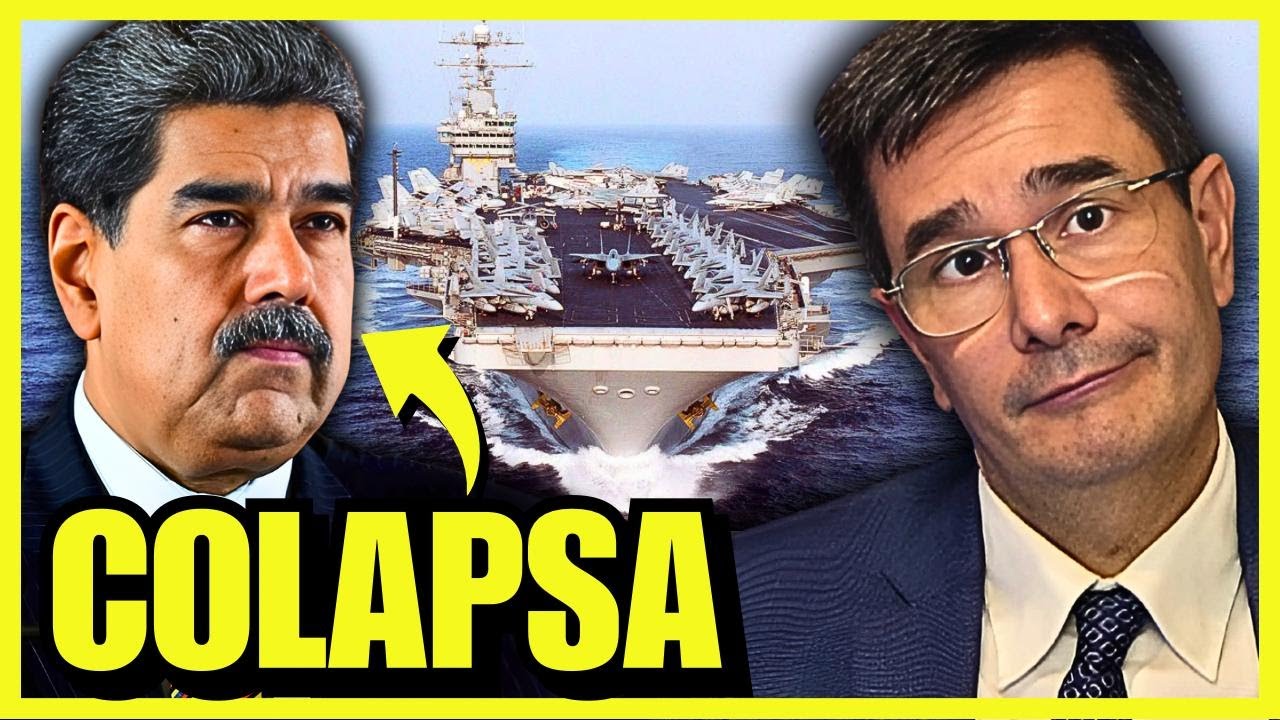
![DW Noticias 27 de julio: Venezuela vota entre la continuidad y un nuevo régimen [Noticiero completo]](https://i.ytimg.com/vi/yTQB4KhlC8k/maxresdefault.jpg)



![MILITARES NO CAMBIAN EN VENEZUELA | 21ABR2026 | [GOCHO.OFICIAL]](https://i.ytimg.com/vi_webp/bP_ZdHheH94/maxresdefault.webp)











The United States has significantly increased its military presence in the Caribbean, deploying the USS Gerald Ford carrier strike group to apply pressure on the Maduro regime in Venezuela, which is seen as a key component of a broader strategy to counter transnational organized crime networks that generate approximately $358 billion annually in illegal activities; however, achieving democratic transition in Venezuela requires addressing the regime's sophisticated information control systems, its deep institutional capture across state apparatuses, and the need to offer attractive alternatives to military officers who have been systematically couproofed through rapid promotions, purges, and embedding of intelligence agents, while also navigating the complex dynamics of regional cooperation and great power competition with China and Russia.
US Strategy for Democracy in Venezuela After Maduro
Added:Good morning everyone and welcome to those joining us in person or via my favorite TV channel uh ACTV.
Uh thank you for joining the Adrian Ars Latin America Center in partnership with the Sko Center for Strategy and Security and my colleague Matt Cronig for this incredibly timely conversation on US military posture in the Caribbean and the road ahead in Venezuela. I'm Jason Marzac, vice president, senior director here at the Adrien Arch Latin America Center. And I would like to begin by acknowledging today the presence of Adrien Arst, uh, the executive vice chair of the Atlantic Council and founder of the Adrien Arch Latin America Center. As all of you know here or watching, she is true the true visionary of all of our work here on Latin America since we founded the center over a decade ago. Uh, I'd also like to welcome Fred Kemp, uh, president and CEO of the Atlantic Council as well, uh, who is joining us today. Uh, on stage is our first plan panel, which includes, uh, General Laura Richardson, Alexander Gray, Daniel Alkins, and Matt Cronig, uh, who runs our Scofcrop Center. Uh, Matt will introduce the panel more formally in a moment. Uh, but first, let me give some context. As we gather this morning, developments in and around Venezuela have once again placed the country at the center of not only hemispheric attention, but I would even say global attention. Led by the world's largest aircraft carrier, the arrival of the USS Gerald Ford carrier strike group into the Southern Command area of responsibility just on Tuesday. It underscores the Trump administration's focus on the Western Hemisphere. with the arrival of the Pentagon commented that the quote enhanced US force presence in the US Southcom a will bolster US capacity to detect, monitor and disrupt illicit actors. Uh end quote. At the same time, the ratching up of US military presence has heightened alarm for Nicholas Maduro in Venezuela, reflected by his defense minister issuing a statement to place the country's military arsenal on what he calls full operational readiness. As I wrote last week, escalating tensions also come with Maduro seen across the region as a cancer. The erosion of the Venezuelan economy, the erosion of civil rights, the erosion of political freedoms has led to, among other things, the largest mass migration crisis that this hemisphere has seen. And although President Trump has been elusive on what exactly the plans are for Maduro, the president has said that the dictator's days are quote numbered. At the same same time, questions have once again risen on what will come with with Nicholas Maduro at some point no longer being in power. Remember, in July of last year, Maduro blatantly stole the Venezuelan presidential elections, even as members of the opposition proved that Edmundo Gonzalez had won at least 67% of the vote. Since then, the erosion of state institutions and repression of civil society in Venezuela have only continued to worsen. In the last decade, almost 8 million Venezuelans have been forced to flee their homeland as a catastrophic medical and food shortages among other things have jeopardized the lives of millions. With heightened attention on Venezuela, today's event brings together leading experts to discuss and analyze US Venezuela dynamics. Today, our force first panel will dive into the evolving US military posture in the Caribbean and its implications for Venezuela, the rider region, and what it also looks like from a global basis. I will then come back to moderate the second panel, which will focus on Venezuela's path to democracy.
With that, I'd like to turn over to Matt Cronig, uh, vice president and senior director of the Skov and of Strategy and Security. Matt will moderate this first panel on US military posture and technical capacity. Matt, over to you and your panel.
>> Great. Well, thanks very much, Jason, for that introduction. Uh, thank you all for joining today. It's an honor to be joined by this distinguished panel to discuss US military posture in the Caribbean. Uh, we're joined first by General Laura Richardson, who's had a distinguished career, uh, including serving as the 32nd commander of US Southern Command, where she oversaw US military strategy and partnerships across 31 countries in Latin America and the Caribbean. Uh we're also joined by Alex Gray. Uh uh he's chief executive officer of American Global Strategies.
Uh he's u also served as deputy assistant to the president and chief of staff of the White House uh National Security Council in the first Trump administration and importantly a non-resident senior fellow in the Skraftoft Center. Uh and then finally in the middle uh Daniel Elkins uh former Green Beret uh chief executive officer of the Special Operations Association of America and also a non-resident senior fellow in the Skraftoft Center. So welcome to you all. Thanks for being here. And uh General Richardson, maybe we'll start with you. Could you talk a little bit about the uh security and threat environment uh in Latin America and the threats posed by Maduro's Venezuela uh in particular?
>> Yes. So, uh, good morning and thank you for having me here and, uh, to be on this distinguished panel. And so, uh, I've, uh, testified many times and I've said many times in terms of, uh, the, um, drug trafficking, the human trafficking, the, uh, transnational criminal organization, uh, networks that are in Latin America and the Caribbean. Um we had figured out in uh US Southcom that about $358 billion annual revenue business uh that uh all the illegal uh activities that occur there. Um but not just you know when you're talking about uh uh the narco uh trafficking and and those sorts of things but the thing is is that uh there's also the threat of our axis of aggressors that's in the in the region and more importantly I think uh and so when you uh look at um the the Chinese belt and road initiative 23 of 31 countries uh and through this economic it looks like economic diplomacy from the Chinese but really and all the critical infrastructure in the region very very concerning in terms of in the electrical grids deep water ports 5G space uh safe city smart city technology and so uh you know and I've also said that uh just right under our nose and so clearly and so closely to our US homeland I've said that uh the first and second island chain to our homeland uh has been uh built through this belt and road initiative and um and so we worked hard in in Southcom to try and figure out and get our US companies and western companies more involved in the tenders that come out from the countries to compete on the tenders number one for critical infrastructure and so um because you can't complain if you're not competing uh in the tender process and so working very hard about that but back to the you know the transnational organized crime uh and transnational, right? So, global connections and you're talking about all the illegal activity, not just the drug trafficking, the human trafficking. We saw all the migration numbers that were unpre unprecedented levels uh that were flowing to our southwest border here in the United States. Um as a result of the uh insecurity, the instability, can't get food, health care, not families aren't safe. And so, uh, illegal mining, illegal logging, all the illegal activities, you add that up, $358 billion. It's very, very powerful. And when you add up the, uh, the defense budgets for the countries in the region, doesn't even come close to that figure.
So, how do you how do you, uh, even put a dent into that and counter that? And so, uh, this activity that we see um is sending a very very clear message. I think the administration has been very clear in terms of uh the the drugs that are coming to this country uh and the emergency crisis that we have on our hands and uh they're doing something about it.
>> Great. And um as Jason mentioned, there's been a lot of focus on this uh military buildup in the region. I I think less an analysis on on what are these assets, what are they capable of, uh how how does the arrival of the Ford change that calculation? Could you comment a little bit on on what does the United States have in the region now and and what can these forces do?
>> Well, you had quite a bit before the uh US the USS Gerald Ford uh carrier strike group came uh and uh and that brings with it uh additional uh destroyers and ships uh aircraft obviously you have nine squadrons as part of that air carrier wing that's on the aircraft carrier. uh you already had an a uh ARG MEW uh capability which is like a mini aircraft carrier, the amphibious readiness group and the marine expeditionary unit uh that's already there. Uh the eight ships, the uh F-35s that are in Puerto Rico. There is a lot of capability uh that is in the region right now. And so how does the the Gerald Ford strike group uh change that calculus? I think it just adds more capability to monitor to detect uh to provide the platforms that you can track uh and identify uh all the illegal activity.
>> Well, I I want to bring the others in soon, but maybe just a final question for you. Uh could you talk a little bit about the kind of the balance of power?
How capable is Venezuela's um military?
What assets do they have? And um uh yeah, what is the uh the military balance? So I'd say it's um you know in terms of the capabilities they have uh older systems the modernization is lacking the operational readiness is lacking they have maybe about uh 20 Russian SU30 fighters uh maybe about 15 16 F-16 Alpha or Bravo models which are the older models not very capable but still they're they're some sort of cap uh capacity you have some tanks and some armored carriers um but in a layered air defense system but again it's old it's outdated uh and really I think it's more to protect the internal part of the country the capital the regime uh versus uh being you know really a a c a country's defense uh system about 120 uh active duty members in the armed forces the reserves about 100,000 the guard about uh 120,000, but Maduro's been very vocal about mobilizing 4.5 million militia uh and showing uh pictures of them having man pads and things like that, surfacetoair missiles. Uh so they have some capability uh more capability than uh most countries in Latin America, but uh certainly not the uh not to counter the capability that is in the region from the United States. Clearly.
>> Well, I have many more uh questions for you and we'll we'll be coming back, but I think maybe now I'll turn to Alex next. And Alex, you worked in the first uh Trump administration at the NSC. You know, traditionally US foreign policies focused more on Europe, Asia, Middle East. Uh this administration has prioritized the Western Hemisphere. Can you talk a little bit about why you think uh the Western Hemisphere is is so important for the Trump 2.0 administration?
>> Sure. Well, thanks so much for having me, Matt. It's great to be here at the Atlantic Council and on this distinguished panel, General, good to see you again. Um, so I'm going to do a very Washington thing and reference uh my own article. Um, [laughter] so two probably two weeks after the president's re-election, I wrote a piece in foreign policy and I said this is going to be a western hemisphere focused administration. And I think we were already seeing some very clear signs of why the president was headed in that direction. Um, I can tell you from my personal experience having worked for him for over four years, the president has a very keen sense of place that comes from his background in real estate and business. And it was always clear to me from my interactions with him that he took Western Hemisphere issues very personally. to him it was it was about place. It was about our proximity and he was particularly interested in Bel and Road economic related issues uh foreign adversaries in this hemisphere. Um, so going into the election, going into the transition in 2024, it became very clear to me that the president was really all of these trends of issues that he's been focused on for many years were going to come together in this renewed focus on the region, on the hemisphere. So you saw very early on, I think within days of his election, you saw talking about the Panama Canal, talking about Greenland again. Um when you look at you know a lot of people uh here in this room and who are watching know that traditionally when the president is announcing his team the first ambassadorships that get announced are Western Europe maybe Asia maybe you know Israel he was announcing 12 Latin America political ambassadorships within weeks of being elected in 2024. um Greenland, Panama, tying in the immigration and border security issues, elevating his most one of I would argue his most trusted long-term aid, Steven Miller, to be the Homeland Security adviser with direct responsibility for controlling Western Hemisphere or controlling drugs and southern border, tying that into the Western Hemisphere.
So, all of these personnel policy focus issues were coming together very quickly after he was reelected. And I think what we've seen ever since is tying all of this kind of thematically into the president's focus on um what are the ways in which our foreign policy can directly impact Americans. And we've seen this conversation in the Biden administration, you know, foreign policy for the middle class. I think as the president's trying to think about what is a foreign policy theme that can get buyin from the American people over the long term, one of the things that's going to resonate is directly related to Western Hemisphere, our security, economic security, security from fentinel and illegal narcotics. So all of these themes that have characterized the president's now 12 years in public national political life are all coming together in the focus on this region.
And the last thing I'd say, Matt, is I think when you're thinking about the president's uh focus on Venezuela and the hemisphere and how much of that is narcotics focused, I think there's a major emphasis on, you know, what is the number one direct security threat to the average American going about their business? And the president's team would argue that it's narcotics coming into our into our streets into our neighborhoods and that is sourced from places like the cartels in Venezuela.
And so I think if the president's trying to draw this larger theme between, you know, what are our direct security threats at home, where is this this historic sense of America's predominant security interests, that being in our hemisphere, the hemisphere we share? Um, I think this all comes together in a much more expansive approach to our interests in the region than maybe you've seen in the last 20, 30 years.
>> So that makes sense, the focus on the Western Hemisphere, but the president's also talked about Greenland, about Panama. Why the focus on Venezuela and Maduro now? Well, I think the case that I would make and that I think the president's team would probably make is Venezuela constitutes one of the most significant uh direct threats because of the tie between the Venezuelan regime and the narot traffickers. It constitutes a direct threat to core American security interests. Right? And if the president, I think if they're defining what those core security interests are, one of them I mentioned was the ability to protect Americans from the importation of deadly uh of of deadly narcotics and the direct contribution that the Venezuelan regime makes to that effort. Um, and I would argue, and this is something we may touch on later, is, you know, the president, uh, I think there's been speculation in the press that the president's going to have a conversation in his national security strategy, maybe in his national defense strategy about prioritizing the Western Hemisphere and placing that at a a higher level of strategic urgency than maybe it's been placed in previous national strategies.
I think part of that in my view is the role of our number one peer competitor, the People's Republic of China in this hemisphere. And so I think, you know, a lot of the speculation by my friends in the China hawk community have been, well, the president's going to deemphasize how significant uh the competition with China is in favor of the Western Hemisphere. What I would argue is that Venezuela uh given the ties that it has with China, the ties that it has with Russia, is part of the larger great power competition that's going on globally.
And so when the president, presuming that this is accurate, the president prioritizes in his NSS and his NDS Western hemisphere and American security interests in the hemisphere. I think that's simply acknowledging the fact that China and Russia are deeply involved in very nefarious ways in this hemisphere and Venezuela is probably along with Cuba one of the most pronounced ways in which they're exerting that malign influence. So I think we have to think about this in a holistic and global way and tying these disperate threads together to better understand what this overall strategy is.
>> Thanks very much. Interesting um analysis, Alex. And Daniel, let's turn to you now. You're a former Green Beret CEO of the Special Operations Association. Uh Laura, General Richardson talked about the overall posture in the region. What about uh special operations forces? What special operations forces are in the region and what role might they play in any uh contingency involving Venezuela?
>> Well, Matt, thank you so much for having me today. It's two uh very very tough acts to follow. So, I'll try and add some color from the perspective of special operations, but I think it's important for u the audience to contemplate that uh this president in the American first agenda uh is is very unique in terms of it's not a second term president. He's a third-term president. He never stopped thinking about putting America first um during the interim between 45 and 47. And I think what we're seeing is a very sophisticated, calculated and coordinated effort, you know, as the other panelists have mentioned to u secure uh hemispheric uh dominance. From the soft perspective, I I think it's important for people to understand the role of special operation forces. Uh they serve as a shaping operation, not the main effort, right? So we have to take into consideration what the initial military objectives are for the current COCOM and how soft in the region is going to help shape you know and we are a surgical tool not a sledgehammer right so I think it's important to understand the force posture um obviously you have the ocean trader that's been in the region for you know the last two months um you know there's been uh a lot of publicity around some of the deployments of uh soft personnel to coast Rica. Uh, so you are seeing a a force structure that's building up that offers a very sophisticated but very surgical capability, but it doesn't end there.
Um, I think it's important to understand um, how soft is used in what the day after looks like. Um, and I know we'll get into that a in in a little bit, but you have regional uh partnerships that have spanned multiple decades that I think highlight um, you know, a potential way forward, right? It's not occupation, it's partnership. And I think we can look to Colombia for a great example of what a strategic partnership has looked like and a successful partnership um, and contrast that against uh, Afghanistan and Iraq.
>> Great. And um you've served all over uh the world. What are the lessons um from other um operations around the world or maybe in the region? Looking back historically at things like Granada and uh Panama, what are what are the lessons that we might want to think about as we we think about um a contingency with V Venezuela?
>> Yeah, I think you have uh two great case studies with uh Panama and Grenada. And then I also think you have a a great case study of the soft capability uh in the first several months when we went into Afghanistan under General Mahaland and Task Force Dagger. Um you see highly trained, highly elite um highly specialized forces uh capable of uh doing a lot. Um, and I think uh in in Panama you saw a significantly higher force structure and um you know I think I would argue the Grenada was a uh much more successful operation both in terms of human terrain and the lasting impact.
Um, I think uh the president understands what the American people want and uh we want safety here in the United States and as my colleagues mentioned uh this uh illicit flow of drugs which starts in uh Colombia and Venezuela and then as it makes its way up the chain it's laced with fentanyl and you know the statistics are uh different between who you ask but you know anywhere from 80,000 to 100,000 deaths every single year. Uh I would argue that that is war.
Um that that death toll um you know uh s uh exceeds Vietnam. Um and I think uh the lessons learned of counterinsurgency, occupation verse partnership, really understanding um that uh the day after and what that looks like. The president has been watching this for, you know, over a decade and I think he's very keen and um he uh we're massing these forces as a way of projection. I mean, I think we all would agree that a peaceful transition of power would be ideal here, but we have the soft capability in the region uh to give the president optionality in case we need it.
>> Great. Thanks very much. And we will be turning to audience questions in just a moment. So, be thinking of your questions. Um, and you can submit those um online at askac.org.
Again, askac.org. It'll populate up here in my iPad, and I'll um come to those in in just a moment. Um, but General Richardson, let's maybe um come back to you and you obviously had responsibility for this region. When you were there, where did Venezuela uh kind of rank and and the threats and the um contingencies that you worried about? Was it was it at the top of the list or um how did you you think about Venezuela when you were in the role? So in in terms of Venezuela and how we looked at it in in terms of uh uh from the perspective of US Southcom is the capabilities and the uh what was happening just internally within the country and the 8 million people uh from Venezuela that uh fled from Venezuela into a region already hurting um from GDP impacts from COVID.
So countries, you know, as I would go down and visit in Chile, uh they have a migration problem, right?
[clears throat] So the the migration problem just didn't go from Venezuela and then up through Panama through the Derenne and and so on and so forth. I mean, it went around the entire South America. all the countries were uh dealing with uh an influx of people uh and and figuring out how do we take care of these people, assimilate them into the countries or you know continue their move uh back north. And so um as we looked at Venezuela, Venezuela pretty much kept to themselves, you know, internally in the country in terms of the threats. Uh, of course we've seen the saber rattling that they've done to Guyana uh over the past 3 years with the offshore oil that was discovered. I think the Esakibbo disputed region all all of a sudden became a big deal again.
Uh, but I think that really that was due to the oil that was discovered offshore and one of the fastest growing GDP countries in the globe for the next five years, 25% GDP growth. Uh and of course you have uh Exxon and Chevron that are um uh working that offshore oil field.
So uh ironically half of the disputed region is half of that oil field. So um but you know in terms of threatening either way uh but we didn't look at them really as so much of a threat uh because they weren't outwardly other than what they were doing with Guyana. Now certainly uh the if you go to the uh Venezuela and Colombia border uh and and the activity the uh major drug activity that was ongoing and the safe haven that Venezuela provided right for uh those cartels to just move uh you know go back and forth across the border. And so, um, when you think about that and that, uh, that, uh, huge activity that goes there and and Colombia is not able to to do anything about it, uh, it just fosters that continued, as I talked before, the 358 billion transnational organized crime in the region, that foothold, uh, that it had there.
>> So, um, assets like the Ford are are scarce. Uh my my sense is that combatant commanders are often um uh fighting over these scarce assets. Uh this is a unprecedented buildup in in the region.
H how unprecedented is it for the Southcom commander to have uh this many assets at their disposal and and how enduring can this be? Um is there's been a lot of speculation that the Ford can only stay so long. It's going to be needed in other regions soon. Can you kind of talk about what this means for global force posture? Well, for global for force posture. Exactly right. I mean, this is a lot of capability that's in the region. And so, um, but you talk about peace through strength. I think it just further doubles down on how our administration and how President Trump is looking at this situation. And by bringing the uh Gerald Ford and the carrier strike group, you know, it's not just the one aircraft carrier, it's a bunch of other capability that comes with that. I mean he is doubling down and uh and so certainly we would like to see um uh something happen peacefully and not have to use that but that is definitely a symbol and uh the the uh world's largest warship that is sitting right off the coast of Venezuela with a lot of capability.
>> Um good and as I said we will be going to audience questions in a moment so please do uh submit your questions at askac.org.
Um but Alex um back to you and maybe a similar question. I know some of our friends in the Pentagon have been saying for a long time that that China needs to be the priority. How do you think they're thinking about all this capability coming to the Western Hemisphere and and how enduring do you think this focus can can be?
>> You know, it's funny, Matt. I I actually think that if you want China to be the priority, I think you have to think about where where is China most a threat to our core interests. And I would argue that the logical place to start is our own hemisphere. Um, and you know, we can go through the litany of things that China is doing in this hemisphere uh that are antithetical to American interests and it's the Belt and Road activity. It's launching I think there Chinese Marines are now training uh in Brazil I believe. I mean the number of activities that China is doing in this region are remarkable and they've accelerated rapidly since co um and so I don't think that you can draw this neat delineation between the US is in a competition with China and we are only going to focus on where that competition in East Asia the Indoacific I think you know if you look at previous national security strategies there was always this kind of throwaway line that you know was red is a throwaway line that you know our core interest is homeland defense in our hemisphere but we have all these other global interests as well. I think what the president's doing is he's kind of rejiggering that formula and he's saying yes we are in these global competitions but before we can be successful globally we have to be successful in our region in our hemisphere against these foreign adversaries and only once we have secured our core interests at home can we then go and focus on projection abroad um and and I think you know my guess is that's likely to be the way they frame this now in terms How long can we sustain this presence? You I would defer to the general on on the technical ability to sustain it. I think from a political will standpoint, the president's made very clear that this is one of his top priorities. The president's made clear this region is probably his top priority. Um, I think from the perspective of the national leadership, they're going to sustain this as long as humanly possible until they obtain the objective they want, which is to stop the flow of deadly narcotics into the United States, killing Americans at home every single day, uh, with the full contrivance of the Venezuelan regime. And so, I think from a national political standpoint, um, I think that this is a a long-term objective.
General Alex just raised the question of technically how long can this um posture be sustained in the region? Could could you comment on that? Is this something that can be sustained over the long term?
>> Well, I think the uh it can uh but it's it's uh in terms of the exercises and the training and building the readiness uh building the readiness not consuming the readiness of the forces. And so a lot of exercises that would be going on with uh partners in the country as well uh in the region and uh different exercises. We've seen exercise going on in Panama uh with with uh with US forces and so um just continuing that training and those sorts of things and exercising and you just continue to build the readiness. Now, how long can I mean there's not a a specific uh you know time that that you know turns into a pumpkin and you got to leave. But the the other thing is too is this is a priority for the president. And so uh in terms of stopping the flow of drugs, I mean the this what uh what uh Maduro has been able to do by uh having a safe haven in Venezuela for the drug cartels and the transnational organized crime intertwined with his military. And then you add uh the Chinese uh the Russian I mean there's Chinese capability that Venezuela has. There's Russian capability that they have as well. Uh and so um uh it it just it's a safe haven for that. And you just add in terms of the visits that Maduro has uh has had there in terms of the Russian foreign minister that visits periodically like every quarter and goes to Venezuela, Cuba, Nicaragua. Uh the Iranian president had visited. Um, so you just have all these highlevel visits from our axis of aggressors. And as we see Maduro reaching out to China and also to Russia for help, you know, and uh you're not hearing a whole lot.
You're hearing a little blip about how Russia might help. And we've seen an aircraft land there probably with some spare parts and things like that for, you know, I discussed the uh the readiness problems that they have with their old equipment. uh but it's just a safe haven for all the things pretty close to our homeland like I said and so uh focusing on this uh ability to be able to have all these um illegal illicit drug trafficking all the illegal activity and then um all of our access of aggressors to be able to work so close to our homeland not good >> well that's a good transition into audience questions we have about 10 minutes to go and so I'll turn to uh the questions which are coming in here on the um iPad and again if you'd like to submit questions uh you can do so at askac.org.
Uh and so first question is about the axis of aggressors and if there is some kind of US action against um Venezuela, how likely is it that uh Russia, China, Iran, other global players will come to Maduro's defense?
Daniel, you haven't uh spoken in a while. Would you like to take this one?
Yeah, I mean I think understanding how our adversaries work um really sheds light into what their actions are going to be and uh especially when you look at how the the Chinese work in their total war concept um as well as how Iranians use proxies. I think absolutely there's going to be support. Now, does that look like um you know overt military support in the form of kinetic activity? Uh probably not. Um but uh they're already uh giving support uh and they have for quite some time. You know, uh as my colleague uh mentioned, you know, the the Chinese are training in Brazil right now. Um so they're already there. Um, so I I don't think that that's going to change if there is u military action uh that takes place. I think that we will see that escalate.
>> Well, here's a great question for the Atlantic Council. Our mission is all about uh US leadership alongside allies and partners. We have a question here about allies and how can uh US allies outside of uh the Western Hemisphere support the Trump administration's efforts in in the Latin uh in in Latin America? And Alex, do you want to take this one? Maybe. What could the Europeans or Asian allies um do to to help?
>> Yeah. Well, I uh maybe an unsatisfying answer, but I would say the best thing that they can do is to help burden share and focus on securing their regions so our European allies can continue to build capability so that they can be the front line of defense against Russia in Eastern and Central Europe. Our Asian allies can continue to grow their capacity like our friends in Japan are doing so uh impressively since Takichi was elected. Um I think you they are the bull work against Chinese aggression in the Indoacific and the more that we have that type of uh sophisticated burden sharing the more we can focus on our core interests here in this hemisphere.
Great. Uh and another question about what this means for relations with um other countries and uh General Richardson maybe this one for you. uh how does this US strategic posture shift? Um what what does this mean for relations with countries in the region and uh are we seeing countries in the region supporting these efforts uh reacting badly? Uh uh so yeah what are the implications for the uh US relations with the rest of the region?
>> I think the uh the relations remain very strong. Uh I think the countries are very supportive. they've all had to deal with the additional burden of uh Venezuela and what's happened in Venezuela and so but I think you know uh you know they're waiting to see what's what's going to happen as well and I would say that you know a peaceful transition is what uh uh I would think the goal would be I think that's what the entire region uh would want to see as well uh but you know Alex made the point in terms of uh all of these things uh happening in the region do are globally connected and what happens here matters in other places as well. I think that uh our axis of aggressors are are watching very closely in terms of what we're going to do and what capabilities that we're going to use and that sort of thing. But again, I go back to the peace through the peace through strength and the deterrent effect that it creates by having all that capability there. And so certainly, I mean, we can't u uh ignore the $50 million bounty that's on Maduro's head as well. Uh but, you know, uh it would be good for an internal uh an internal uh thing to happen to u Maduro just departs.
>> Um great. And um I do remember on the Sunday shows a couple of weeks ago both Lindsey Graham and and Rick Scott said that that's the best thing that Maduro could do is to uh leave and and go find a new home in in Russia or China. And in terms of the regional support I saw an interesting poll um maybe you all saw this as well really competing polls but uh one that showed uh that there's actually majority support for some kind of action against Maduro within the region. So I think he has worn out uh his welcome. Uh we have a question here from uh Fred Kemp uh president and CEO of the Atlantic Council. Uh 35 years ago I wrote a book about our ouster of the dictator Noriega in Panama. What's in common is federal indictment. Could this also be about regime change?
Um and I guess on on the Sunday shows or uh his interview with Norah O'Donnell uh recently she asked are Maduro's days numbered and he said yeah I think so.
So, um, Alex, you said this is about, um, counter narcotics. Um, is is it also about, um, a new new government in in Venezuela?
>> Well, I I agree with what the general said. I think if we can have a change in the regime that happens internally, uh, that's the best outcome. And, you know, as has been said, um, the Maduro regime is directly responsible for a significant amount of the narot trafficking that's killing Americans. So we have to draw this direct parallel. It's not like there's this amorphous. These things are just happening. They're happening because the Madura regime is working hand in hand and in some ways is almost inseparable from [snorts] the narot traffickers. Um and you mentioned the the $50 million bounty general. I mean that that is because of particularly because of what is happening on the narot trafficking side. And this is this is a um to try and peel that away from Maduro himself is impossible. He is totally integrated into that system. So, you know, to the extent that we can have regime change that occurs from an internal source, that's ideal. But I think where we're headed is this regime as currently constituted poses a direct threat to US national interests. And that is why the president has taken the action that he has. And this definition I keep talking about of what are our core interests and that the hemisphere constitutes a key core American interest and it is inseparable from homeland defense. Um I think leads to the conclusion that there has to be a change in the Madura regime >> and this is a good transition into the next panel which will get into uh the domestic political situation in uh Venezuela. But uh Daniel looked like you wanted to comment on this regime change.
>> I'll be I'll be very direct. I think yes 100%. And I think that anyone that doesn't think so um is being very very political um or say so I should say. Uh but I think it's important to understand what the context right this this isn't a grand strategy. If if nothing um is is vital because everything is vital then we don't have a coordinated strategy.
And I think um uh the regime change does not need to be porative. Uh it's good for Latin America. Uh but it's also good for American interests. Fentanyl has impacted the United States from West Virginia to Wisconsin. Every one of us in this room have been touched by it.
You know, the suicide epidemic for veterans is 20 a day. It's 4x of that from fentanyl, right? And this is about um uh protecting American interests. So, I just wanted to be very very direct to your question.
>> And uh General Richardson, would you like to comment on uh on Fred's question about what are the objectives here? Is it regime change? And with just a couple minutes to go, I guess any final thoughts you'd like to leave with our audience? I think it's definitely a a pressure campaign uh and with the capability and the arrival of the Ford carrier strike group uh as well uh to build up that capability even more and put even more pressure um on uh on that uh on that situation. So um I would I would concur. I would agree that that's uh that's probably what that is uh beyond uh just drugboat diplomacy and um and so um but what what has been able to occur I mean uh in terms of you know I just go back to $358 billion annually I mean how do you break that uh that is following the money that is transnational organized crime at its best that is global threat to uh all of the countries. And so uh it's it's uh and what it's done to the United States of America and our fellow Americans. And so uh it's very very clear again I I think it's been very clear in terms of the objectives about the crisis about the emergency in our country and uh and uh action is being taken >> well consistent with uh the Atlantic Council approach. I think this panel has uh shed light not heat on this issue.
I'm certainly more informed than I was um an hour ago. I hope uh our uh audience is as well. Uh and it doesn't seem like this issue is um going away. I So maybe we'll come back in the coming weeks and months and uh reassess. But uh for now, it's been a terrific discussion. So thank you very much, Alex Gray, Daniel Elkins, and General Richardson. So thank you. Thank you.
[applause] >> And now I'd like to uh turn the floor back to uh Jason Marzac, the director of our Adrien Arch Latin America Center.
Well, thank you, Matt, for uh moderating an excellent first panel. That's probably actually this is probably one of the quickest panel transitions as well that we've had at at the Atlanta Council. Uh uh so General Richardson, Daniel, Alex, thank you as well. Again, I'm Jason Marzac, vice president and senior director uh here at the Atlantic Council's Adrien Ars Latin America Center. I'm going to introduce our distinguished panelists. In a in a moment, uh this next panel will build on insights from that first panel on military uh engagement, military posture, uh by focusing more specifically on the political and institutional uh dimensions of Venezuela's future. Uh as the Madura regime continues to pose a threat uh not only to its own people and but also the region at large, it's more important than ever to understand what a path to democracy in Venezuela could look like.
The role of international and um domestic actors could play in this transition and and at the same time also to recognize that at this point in time uh hopes are are pretty high. Uh that this this is about this moment. Uh General Richardson mentioned uh the the pressure campaign as well. Uh before we dive in this panel, I'd like to of course introduce our our speakers uh sitting next to me um is Elliot Abrams.
Elliot is a uh senior fellow at the Council on Foreign Relations. Uh he is also the former US uh special representative uh to Venezuela and then concurrently served as special representative to Iran and the and the first uh Trump administration. um alongside and I could probably spend the next 10 minutes talking about Elliot's background, but I will also say uh he has also served as as US deputy national security adviser from 2005 to 2009 among other things. Welcome Elliot. Great to great to have you here. Uh next to Elliot is I Pasa. I is a senior research fellow here at the Atlantic Council's democracy and tech initiative. uh area investigates information operations that undermine uh democratic institutions and that fuel political instability. Uh as well she was previously an associate professor uh at the central university in Venezuela and received her mers from the Andreas Beo Catholic University in in Venezuela. So great to have you as well. Next to Idia is John Pulga Hovich.
John is a associate professor at the US Naval Academy. um speaking here today and your for your own uh personal uh perspective. Uh John also recently co-edited I I will say one of the many must-read books right now uh but a book that came out earlier this year I believe it was in March John uh titled Authoritarian Consolidation and Times of Crisis Venezuela under Nicholas Maduro.
Uh Erie is actually one of the contributors to that book. Uh so thank you all for being here today. As with the first panel uh we will also be taking questions via askac.org. org. So feel free to submit your questions uh whether you're in the room or watching via live stream around the world. Uh feel free to do your questions uh via video, text uh or or audio. Uh most people don't choose video. Uh so if you're brave, you can you can choose video questions, but let me let me start with with you, Elliot. Um, as I mentioned, as special representative for Venezuela from 2019 to 2021, you experienced firsthand uh, an incredibly historic moment, moments of of hope, I think, in in Venezuela and a time in which at that point the interim government was amassing uh, substantial international recognition at that point.
How does this moment compare to uh, to to that period in time? How does this moment where we are today compare to that that moment? [clears throat] >> Thanks Jason and uh I'm delighted to be here at the Atlantic Council.
U there is one political difference and that is that uh Venezuela now has an an elected president. Every democracy, every NGO you can think of has said u that there was a landslide victory for Edmundo Gonzalez. Um, so there isn't anything about well the election was or wasn't good and well the constitution says it's a speaker of the no no there's an elected president after and a landslide victory that's different what is the same today I would say is that there is a pressure campaign uh economic political diplomatic uh and now the military's been added added. Um, but so far it isn't enough. We found out obviously last time that the economic sanctions plus the diplomatic campaign, we had 60 countries as I remember right saying Maduro's got to go. It wasn't enough.
[clears throat] What has been done so far isn't enough.
Quite obviously, it hasn't worked.
Maduro's still there. So it raises the question of whether uh well let me let me put it a different way. We had a pressure campaign. This campaign is a pressure campaign as of today. It's a kind of SCOP I'd say. Um the announcement that we have a covert program it's a SCOP.
The assembly of this flotilla as of today it's a scop from the point of view of the regime. whether it will go further um is I think the the key question and it was being discussed of course at at the end of the last panel.
>> Great. Thank you. Thanks Ali. I'm going to get back to some of your your points in a moment. Let me go to to you area.
So you spent over a decade investigating the nexus of information networks and authoritarian regimes uh with a focus as well on asymmetrical information warfare in Venezuelan media uh spaces. What are some of the insights that you can give on how the regime exploits Venezuela's information ecosystem to retain power and and how is it also doing that now?
>> Um I I want to start by uh describing the whole system. So information operation is one pillar of the system the digital system repression and the authoritarian government in Venezuela. But there are other two uh pillars is we had the surveillance pillar and we had the censorship pillar the information operations connect of that. So I I want to spend a little bit more time of describing how the surveillance system work because it's is a part is not uh often described outside Venezuela. So the the Venezuelan regime had established a system in which every bre every ST that Venezuelans uh do online and also offline is recorded. So they intercept private communications for at least a half of the population.
There is a network of facial recognition CCTV cameras across the countries with is connected to the command and control centers of the security forces. There is a a continuous monitor of social media activity and there is also all the database integrities to the homeland system which tracks uh food consumption uh welfare benefits medicine access chronic illnesses how the people uh move around the country because it's is it's targeted with the how people fill gas in their cars or how they use public transportation like the subway. So all that information is at disposition of the regime and is used to track dissident and in some case have been used to jail people but mostly works as a deterrence as a way people to know you are being watched. So it it affect the way in what people move around and is able to demonstrate. More recently they had all the patrolling drones. We had uh uh surveilling manifestations uh surveillance public demonstration. Uh on top of that we had restriction of the access to information. So most of the digital media is censored in the country. uh so uh about 200 websites are blocked night websites devoted to news are blocked in the inside the country and have been over a year in which signal uh YouTube tik tok Twitter have been blocked uh for for the access within the country so people need to use BPN to access information about what is happening that makes things a little bit more difficult and in top of that there is are the information operations apparatus Venezuela have been very active in the use of the internet and social media for spreading propaganda for since 2009 at least. So we have been uh first they were interesting in domestic information because at that time it was contestation within the country where it was still some electoral contestation. So they want to make sure their their their kid uh mobilizes their the grassroots in that time they had grassroots and and and they can uh arrest the opposition and their point of view. uh but over the years that had moved also to empheric operations of information and they have are very high capacity states in in that regard with a different kind of tactics uh working together affecting the word in the information environment wars in Venezuela.
>> Thank you. Thank you so much. So uh media censorship, information blocked uh uh propaganda and uh everything you do online is being seen heard uh recorded.
I think that's really important to put into into context. Uh so John, as I mentioned, uh you recently co-edited uh uh a book with IRA, authoritarian consolidate consolidation, times of of crisis. It provides unique insight into Maduro's specific brand of authoritarianism.
Authoritarism isn't isn't the same everywhere. And Maduro, so what does the audience need to know in so far as how Maduro has consolidated his authoritarian regime?
Thank you Jason for uh for the invitation to to be here on this distinguished panel. Uh the point of the book is was was to explore whether Maduro as as an authoritarian was something that was responding to the political moment really the political moment beginning in 2017 uh and culminating more or less with a pressure campaign in in 2019 uh or whether it was part of a a deeper longer project which is to say was authoritarianism meant for him to survive or was authoritarianism his logic of governance and And I think what the volume proposes is that this is a logic of governance, right? This is a a long-term project and not something just about the survival of the individuals that make up that regime. Uh and you know it is no accident I guess is is uh the answer because Maduro and his allies have carried out uh several mechanisms or implemented several mechanisms to to ensure authoritarian stability. uh I write about couproofing within the military right which is one of the uh main drivers of of his survival >> and that's really important John you can explain a little bit more of how Madur has deployed crew proofing within >> sure sure yeah so coup proofing is this idea that um measures are taken to either prevent uh coup attempts in the first place or if coup attempts take place to decrease their probability of success right and I kind of think we have we have evidence that that has been successful so far, right? So, the the measures that he has taken uh include the selective uh promotion and purging of uh flag officers, right? Uh promotions at a dizzying pace, right?
So, I believe over the past since he came to power, I believe there have been more than 2,200 promotions to the flag officer level, which is uh far more. I believe our our number of flag officers is capped in the United States at 96 something like that. Uh but certainly many more in Venezuela with a much smaller force than than in the United States. So that's one. Um a second mechanism that he has used is is counterbalancing. So creating these civilian the civilian militia uh funding that civilian militia that Chavez created right the the Bolivarian militia as well as uh using collectivos as shock troops as paramilitary groups um to put down protests right so these are groups that could counterbalance a military that might seek to overthrow uh Maduro.
He has also uh seated uh intelligence agents from both Cuba and and Venezuela's own military counter inelligence uh organization into the military in order to impede coordination because coordination is necessary for a coup especially from the junior ranks.
Uh and the fact that there are so many generals and animals means that coordinating a coup at the officer level is also very difficult. And so in some sense these are like innovations in couproofing that Maduro purposefully or not has has carried out. I think it goes back to your original point, John, authoritarian regime for for governance, right? And long-term growth. Ellie, I want to get you to ask you to feel free to comment on uh points that area or or or John made. Uh but also um I think important context and you mentioned this at the outset. I mentioned this in my opening of the event today as well is the blatant stealing of the election uh in in 2024 and and h and and and how you see a path toward a democrat transition in Venezuela taking shape now um given given the given the the fact that the writing is on the wall for the world uh that uh that he actually wasn't reelected uh a year ago. So feel free to comment but also what is that path to to to democratic transition? How does that that differ if you could explain a little bit more about how does that differentiate that uh that path uh given those developments from last year?
First, I I think this is a unique situation in South America. As I think back to the transitions to democracy in, you know, Brazil, Argentina, Urway, Chile, um you [clears throat] had a negotiation between the democratic parties and the military. And basically, it was if they'll go back to the barracks if they get amnesty. These were military regimes. This is not a military regime. This is a criminal regime. This is a criminal gang. And it's different.
And I think it helps explain why it's harder to figure out um a way to negotiate them out. In fact, I think it's impossible. Uh I I think really there will have to be a kind of uprising. It can be civilian, it can be military, it can be both. And uh I think your your points about the military are very well taken which means to me that there needs to be [clears throat] an outside form of pressure and that means us uh so far the you know the ships floating in the Caribbean hasn't done it because while they've hit while the US military has hit these little boats they haven't touched Venezuela.
Um my uh hope of course and maybe maybe I'm too optimistic because of that hope would be that if the United States does that you will begin to see more cracks in the military. There are cracks in the military or there wouldn't be whatever the right number is that I think it's not very uh far short of 200 military officers in prison right now. Why did they feel they needed to kill Lieutenant O'heda in Chile?
Again, I think it's fear of the dissension that they know exists in the military. I just think some kind of shock to the system is needed to produce that opening.
>> Thanks. I I want to I'm going to get into after this next one. want to get more into uh kind of uh foreign actors and and and uh and actually specifically you talked about the um ability of countries to consolidate. Uh years ago there was the Lima group. We don't have the Lima group right now, but I want to go into I want to first uh ask you you mentioned the the threat to the online environment and the challenge the online environment presents, but also are there opportunities that online spaces could provide for alternative narratives to combat Maduro's disinformation at this time?
>> Yes. effectively Venezuelans have been using online spies for contestation for years years. So we have been that that dual dynamic. So the the regime using for propaganda and tracking this sense and the opposition force and uh journalists independent journalists activists using it for uh spreading ideas about democratization and the defense of freedom expression. uh currently what uh uh the situation is even more limited and more restricted.
As I mentioned before uh the most popular apps had been uh blocked in the country. people still had access using VPNs, but it's a little bit more complicated. But uh also there is the the repression uh uh occurring after the the elections in 2024 uh made people to be a little bit more cautious about how they express online. The cut on the dissident was so harsh and so many people were used just for opinions. uh the they the they people are know more uh cautious about the way they use the internet. So that that means people have been moving for to more private space and a lot of the conversation about political matters in Venezuela had moved to wasat. So Venezuelans lead in Wasad.
Venezuelan organize in Wasad. The all the public the the the what used to be public debates in universities of mass media is now happening in closet groups.
And that is uh uh something made difficult for people outside Venezuela to understand the country uh political climate because you are not into into those spacing with activists, politicians, journalists are talking every day and that also means it's more difficult for the regime to control the narratives because they are also lack the visibility they used to had. Um that that that allowed people to continue to organize uh during this kind of high repression that created different dynamics about the way people uh spread information and the normal everyday sitting consume information is always happening through these more private closet channels. um that make a little bit more impredictable to see how the public opinion is going and how that can translate from opinion to mobilization because it's more restricted the access to information we all has as analysts.
So Erie, what you're saying is that the the uh the threats to the information environment allow Madura to perpetuate power, but at the same time as the information environment has changed, it also gives opportunities for uh organization and and and a more private uh environments with uh maybe less threats to those who are who are organizing given the private.
>> Exactly. We observed that dynamics in the last two years. We observed what people weren't expecting the organization with the primaries but it was happening in those private space people wouldn't expect the organization for the presidential election but it was happening in private space and probably we are seeing the same dynamics right now >> John I want to go back to you how does as we look at this particular consolidation of institutions that you've uh you've written about um how does this impact the future of a country and its potential and its hopeful transition to back to democracy What does that look like with the with the way in which Maduro has uh not you mentioned you talked about the military previously but it's institutions across the country uh that have been uh the victims of his authoritarianism >> certainly uh Chavez began the politicization of of state institutions and we've seen that kind of uh completely uh take hold under under Maduro since 2015. there is no longer any space for the opposition in Venezuela as as Edday was just alluding to. Uh and and that means that uh a postmaduro Venezuela needs to confront needs to to deal with institutions that are entirely politicized and are pro Maduro and are staffed with people uh who have towed that party line for a long time. And so the question is how do you how do you de dchaveify these these institutions, right? uh something like the military well uh debathification didn't doesn't seem to have been very effective in in Iraq. What do you do to reestablish the uh efficacy of uh of of these institutions and organizations that have been so completely taken over and I think that's a a real challenge moving forward.
>> So, but I want to ask you a follow question on that on that John. Also a reminder for those uh in the audience or watching via ACTV feel free to submit your questions if you've come in on askac.org.
U John your your research I mean there's a focus on the effects of government the the opposition has a plan uh uh Maria Cordina Machano has spoken out about a plan for 100 hours 100 days uh and so on. So, in this interview, what do we need to know about the diverse actors and institutions in Venezuela's political regime and how they might respond to any uh internal transition?
>> Sure. I think that that, you know, even speaks to the fact that there are plenty of of non-state armed actors in the country that are tied to to the regime and and the 100 hours and 100 days and uh 100 years after need need to to to confront that. We have seen uh how regime change in other places has um resulted in a proliferation of those of those groups in spaces that the state doesn't totally control. Uh and so that plan needs to include what do you do with a collectivos? Uh what do you do with a syndicatos in in the mining arc?
What do you do with the ELN and and uh the non-demobilized FARC that are that are spread across the country? What do you do with these groups that are that have pledged their loyalty and allegiance to to the regime and and um that that includes I'm going back to the military. You you need to count on the support of the armed forces in order to do that. Can I say that the really interesting points and um as I think about again Venezuela and other South American countries um the analogy to the the change to a democratic transition really is not there because of what you're saying about the institutions.
It's more like Eastern Europe after the fall of communism where the party, you know, pervaded every political and civil institution and it had to be purged. But in in Eastern Europe, you didn't have all this violence. And I think that that's a huge difference. So I I think you're exactly right. One of the things that the opposition should be saying and that we should be saying and I hope that our covert CIA program is doing this is conveying to people in the military Venezuela [snorts] has long borders and lots of violence and it needs you. It needs an army and it's going to be a better army and it's going to be a better trained and equipped and paid army. So you're not you're not going to be disadvantaged by this transition. you're gonna be happier. I hope we're saying that, >> you know, and and I think Elliot on that point, the the pay is important, right?
I mean, milit military officer I mean in Venice make, you know, >> yeah, >> minim minimal salary strugg they struggle to survive. Uh and so that that kind of backdoor messaging is absolutely fundamental.
>> I said something about this [snorts] once when I was special representative in a speech where at the Atlanta Council. Um the problem was we didn't say it every day and the president didn't say it, the secretary of state didn't say it. I hope we're I wish we were conveying that more and more often.
So Elliot, a follow question, but president has said that Maduro's days are quote numbered. [clears throat] Um how do you think uh and it's a difficult question here, but how do you think Maduro is reacting or to Trump's pressure and to the buildup? Um what do you think he might be thinking at this point? and and um and what what kind of reaction do you continue to expect potentially from him and those around him?
I think that um he's beginning to he must be wondering now does Trump mean it uh in the first term you know we've had a big challenge to the regime but in the end he survived in that sense he won and he must be thinking well maybe this will go away that is maybe you know we get to I don't know January February the armada can't stay there forever you cannot keep the USS Gerald Ford in the Caribbean till July, I think. So, >> [snorts] >> um, something's got to happen or, and this is my great fear, or we walk away.
And, uh, it's not inconceivable. I mean, it worries me a lot, that is we, the US has been saying this is about narcotics.
This is about narcotics. That's the official position. So we could announce, you know, in February, well, the narcotic shipments are down, so we won.
But it's false. I mean, if Nicholas Maduro is still there at the end of this, then he won. All he has to do is survive. And I I I hope the president recognizes it's too late to back away. Either Trump is going to win or Maduro is going to win. That contest is now in place and I hope the president recognizes he can win, but he's going to need to do more, I think.
>> Yeah.
>> What What do you think it'll take for Maduro to leave power? And is there an option for him doing so that's not by force?
>> Uh, sure. in in principle um in principle uh I I think they would certainly well we'll get to a point where I think they've got to think maybe just Maduro has to go you and I can stay you know uh and Deli Rodriguez becomes president or something like that and I think we've already made it clear that is the United States has made it clear no that that's out of the question um that would not be an improvement I I think Maduro does not yet feel he has lost and is in danger of being Noriega.
And I I think that we need to keep saying that too that you know it would not be so great to end up in Russia or Cuba. But try federal prison. He is after all under indictment. I'm sure that Noriega thought this don't be ridiculous. How could this happen? Well, it can happen. So, um I I think we need to get to the point where more and more messages are saying um the president's made up his mind and you are going to leave power and the only question is how and I don't think we're at that tipping point yet where everybody in the military uh and in the dehim you know sort of recognizes gee mad is actually going to go. So the question is what happens to me? Where do I end up? We're not there yet, but I think that's where we need to get.
>> Area, how are you know, it's difficult to monitor communications uh with within Venezuela as we've talked about, but are you are you what are you seeing potentially in the way people are communicating internally with regard to some of the expectations that have been created for this for this moment?
>> Yes. uh we are what I'm observing is uh a lot of hope is I may it may sense paradogical uh from us outside uh Venezuela but but the reaction for the everyday people when they see the this this deployment around in the Caribbean and all this conversation here in the United States they feel hot and that is a testament of the enormous damage shabis caused to Venezuela. So having a population who looks at the perspective of war or aerial attacks as something hopeful if it tells you the magnitude of the suffering people are are undertaking at the moment. Uh we see this in conversations as I mentioned in mostly in social media but and in closet group groups in What was people kind of at expectation of something happen the shame is coming and there have been a few a few uh demonstrations across the country in in the in the way know about know concentration of people by uh graffitis uh uh um that that can that kind of seem people express that message. Uh the few survey data has has seen agree with that. So people are kind of optimistic change is coming. Uh probably people are not seeing the issues of uh reconstruction of the country or reconstruction of the institutions. So they are looking just at at the short term and and in that regard is a is a optimistic look of what may happen. So people are thinking about Maduro living and that is something that make people feel hopeful it's going to happen. We don't know.
>> Thanks Ariel. I want an additional question for John Elliott. Then I'm going to go to some of the uh questions we've got in via asac.org.
John I want to bring uh Colombia into the conversation. Uh pro recently proposed that its security forces cooperate uh with Venezuelan counterparts to protect sovereignty and regional integration. He was clear to say not to defend Maduro. uh but to to protect uh sovereignty. Um very different Colombia uh today than uh back in 2019. Um uh Colombia historically one of the US's most uh important allies, not frankly even in the Western Hemisphere, but I would even say globally and I I hope we will get back to that point uh uh when we're on the stage in hopefully a year from now or or earlier. Um but what do you see in so far as the role of of Colombia at this time? And Colombia previously was a facilitator in trying to bring back democracy when Elliot was special representative. Colombia was a a strong a strong partner in the past. Um versus the role of Colombia uh today given obviously the many shared interests, the ELN, the FART that go across the border and and the migration other aspects.
>> Yeah. Unfortunately, Colombia under Petro is a facilitator in a in a different way. Um, and it facilitates the the the regime in Venezuela, right, by by not loudly denouncing the the sham elections, right? the fraud in in the 2024 elections by uh not cooperating with with efforts [snorts] from the United States, right?
And and other allies in the region to uh to combat uh elements of of the Venezuelan regime that that feed off of that poorest border and feed off of of the traffic. I mean, we I've heard a lot about narcot trafficking today, uh, but that cocaine isn't coming from Venezuela, right? That cocaine is coming from Colombia. Uh, and so that requires buyin from the Colombian government and from the Colombian military and and Colombian policy makers. And it starts with Pedro. Uh, and and you know, uh, [snorts] I don't think that he will be president in, you know, however many months from now when when there are elections. and and so that changes the calculus, but we're dealing with with the present moment. Uh and and right now, Petro is more of a hindrance than than an aid for the United States.
>> Yeah. Um yeah, I think I I wrote recently, I'll do the Washington thing, wrote recently that the US Colombia relationship has never been at this difficult of a point in probably at least 30 years, right? Uh since uh the uh sanction of SAR in the in the '90s, right? Um Elliot, um you've looked at non-western hemisphere countries and their and their role in Venezuela. Last question and and uh General Richardson spoke mentioned uh Russia and the and the in the first panel as well. A Russian aircraft that had recently arrived with some spare parts for uh for Venezuela. How strong are these alliances for Venezuela at this point?
Russia, [clears throat] Iran, you know, >> I think we learned a lesson in Iran after the US bombing. What did their friends in Russia and China do? Nothing.
It was either yesterday or maybe Tuesday the Russian foreign minister Sergey Lavrov was asked about this and he said we have no defense agreement with Venezuela.
>> So they're not going to do anything. I mean I'm not suggesting they they may not, you know, land a plane or two and but but fundamentally just look at the balance of forces between the United States and and Russia. Never mind China [snorts] in this region. They're they're you know they may call for UN Security Council session etc. But they're not going to do anything.
>> I'm going to take a a question here uh from uh uh Dan Ericson who's a non-resident uh senior fellow here. Uh do you think and we got to this a little bit earlier. Do you think there will be a mission accomplished moment with the current US military and diplomatic strategy regarding Venezuela? If the answer is yes, what does that moment look like? And if the answer is no, why not?
>> I'll turn it to you, Elliot.
>> Uh, the mission accomplished moment is when Maduro is gone.
Um, obviously whether that's a real mission accomplished moment depends on what else is going on, what's what's the context. But I think from a kind of uh political point of view, that's the moment. Um if he doesn't go um President Trump has lost this engagement.
>> Any other additions? No.
>> I will say from the point of view the Venezuelan population mission at Colis is when a democratic government is in place.
>> So Deli Rodriguez won't do it.
>> Yeah. Yeah.
And the hope that's being created right now as you were mentioning area as well within hope how credible is that I left to the military analysts.
>> I'm going to take a uh actually meant to take another question for this panel as well from uh Fred Kemp who's our uh president CEO in the in the audience today. Uh I will read it aloud. Ellie, good to see you. Um, you were involved in Panama 35 years ago when Noriega was removed. Can you compare the situation then with Maduro and Venezuela? Now the stakes seem even higher now.
>> The um [clears throat] one thing in common is the indictment for drug trafficking. Um and it's not just um Maduro, it's you know Cababo and others um in the regime.
Um and I think that's very that's a very significant um analogy.
I think the difference is that um Noriega hadn't had enough time in power to do what Chavez and Maduro have done. And John was describing this kind of system that's been been built that didn't exist in Panama. In fact, Panama actually had a civilian president who who'd been elected. So the um the change away from Noriega back to democracy was a lot easier uh in in the in the political system and in the society more generally u than it will be in Venezuela.
Thank you. I'm going to take an an anonymous question here uh because I think it's an an important one that uh we haven't addressed yet, which is how does the presence of armed groups like FARC dissident and the ELN affect internal stability in Venezuela? And how would they also affect a transition to democracy? Maybe John, I'll turn to you on that question.
>> That's a fun one. Um [snorts] >> certainly they make they make a transition to democracy more difficult and they make sustaining that democracy more difficult. make deepening that democracy more difficult because they present uh real obstacles to governance in in regions not just far-flung regions right in Apur and Anoati and places like this but in you know the urban centers of Karakas and Maraka and Valencia and places like this. So how do you how do you get those groups on board with uh a democratic government and a democratic government that is uh of a different stripe, right? Uh, and I think that that that will take some a great deal of planning. Uh, it will take convincing and it will take probably some hard power as well.
>> And and probably also the cooperation of Colombia, going back to your earlier point, >> without a doubt, Colombia will be instrumental uh in in helping Venezuela with its transition when it occurs. Uh but that means again fortifying the border and going after these groups in Colombia so they aren't seeking safe haven in in Venezuela.
>> Do you want to comment on that? Yeah, I just want to add your point about paying people um [snorts] for certainly for the what should be the forces of order afterwards police and army. Nothing would be more important I think than being able to pay salaries.
>> I [snorts] know the opposition's thinking about this. We were thinking about this in the Trump first term as well. Um, using some of the frozen resources, um, perhaps borrowed money, IMF, World Bank, etc. to begin to pay salaries would be a terrific way to begin to win loyalty.
Excellent points. I want to take another question here. Um uh which looks at the uh oh actually it's not coming up there.
There we go. Go live. Um Felix Schultz uh Alturnar if I'm pronouncing that correctly. Democrization partially depends on the region the country is located. How do you assess the opportunities and capabilities of neighboring countries and the US to support this development? We've talked a little bit about um uh Colombia as part of this panel. Uh but there's also uh a much broader swath of countries across the region that I think have a a vested interest in democratization in in Venezuela given the uh as I mentioned the from the outset the the the cancerous effect that Maduro has across the region. Um, so in in that moment, what is an what is the what is the ability for a hemisphere that's pretty divided in many areas uh to be able to uh uh support any opportunity for for democratization?
>> I'm a I'm a pessimist in general, but but with regards to this question, I think I'm an optimist uh because uh Venezuela has the the luck of being located in Latin America, which is largely democratic, right? It's not Libya located in a sea of of dictatorships. Uh and so in in that sense, we know that diffusion effects are real, regime diffusion effects, and that democracies help other democracies.
And so I think that a democratic Venezuela would receive support from from its neighborhood, so to speak, uh and that it would also help fortify other democracies potentially. So I I'm totally optimistic take. Also, I think uh um countries in South America and Central America will see the opportunity of a democratic Venezuela for for to begin with the issue of the forces migration will be under control and that is a net benefit for the whole hemisphere but also that is particularly true for Colombia.
The reconstruction of Venezuela will signify a economic boom for the whole region.
>> Yeah. there there and there there's also the the vested self-interest of countries across the hemisphere, right?
Because countries have felt the impacts of Nicholas Maduro's uh corrupt uh naroterrorist regime in Venezuela and they see the implications across the hemisphere with additional insecurity that countries hadn't previously felt a lot of it uh an outgrowth of what we see across uh Venezuela. Uh we're just about uh time uh maybe a last kind of 30 seconds. Any final comments from across the panel?
Specifically as we're looking to the the the weeks, days, weeks, months ahead, are there any key signs that we should be looking out for? Key indicators, uh uh things that you're you think that we haven't touched on the panel that that viewers should be keeping their eyes out for? I'll start with 30 second Elliot and then Erie. Then John, >> I think the critical question at this point is whether the United States will will do anything militarily that actually touches Venezuela. itself even if it's you know a a drug airirst strip someplace in western Venezuela something inside Venezuela I think that's the key turning point >> and after that happen how people in Venezuela react particularly how the economic sector react and how the different factions within the chabismo react is there still going to look more presidential that tell you a lot >> who does Maduro decide to jail >> I think that tells tells us a lot about how uh he perceives the strength of his regime in that inner circle.
>> Well, with with that, I want to uh end by thanking our Sko Center again for this uh partnership. Uh thanking our incredible speakers, uh General Laura Richardson, our first panel, who is also an Atlantic Council board member uh and concurrently serves as an advisory council member for the Adrian Arch Latin America Center. Uh, of course Elliot Abrams, uh, Era Poisa, John Pulgaovich, uh, Alex Gray, Daniel Elkins, and all of our Atlantic Council colleagues for their organization of today's conversation that, uh, we put together in just a few days, and also acknowledge again and thank uh, Adrien Ar, Fred Kent for joining us for this conversation.
Please stay tuned, uh, to the Atlantic Council as we continue to provide insight and analysis on this incredibly important uh, unfolding situation in our hemisphere. Thank you all for joining us today.
[applause]
Up Next

How Indonesia Ended Military Rule in Politics | CNA Insight
@CNAInsider
567.9K views•2021-04-14

Donna Haraway's Cyborg Manifesto Explained: Key Ideas
@TheoryPhilosophy
39.8K views•2020-09-26
Government Surveillance Methods: 10 Ways You May Be Watched
@BeAmazed
1.6M views•2017-04-09
Explaining the Saudi-Iranian Proxy Conflict in the Middle East
@Vox
18.2M views•2017-07-17
Related Study Plans & Knowledge Roadmaps
Structured learning paths in Political Science