
















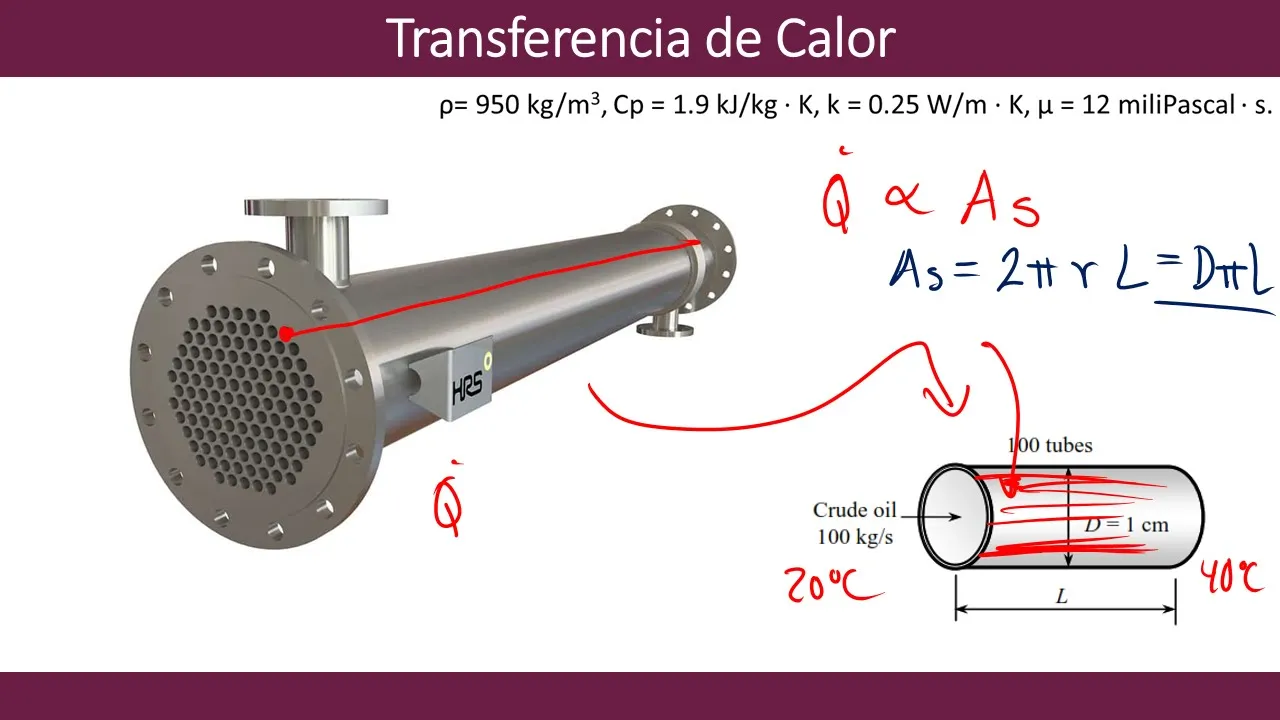

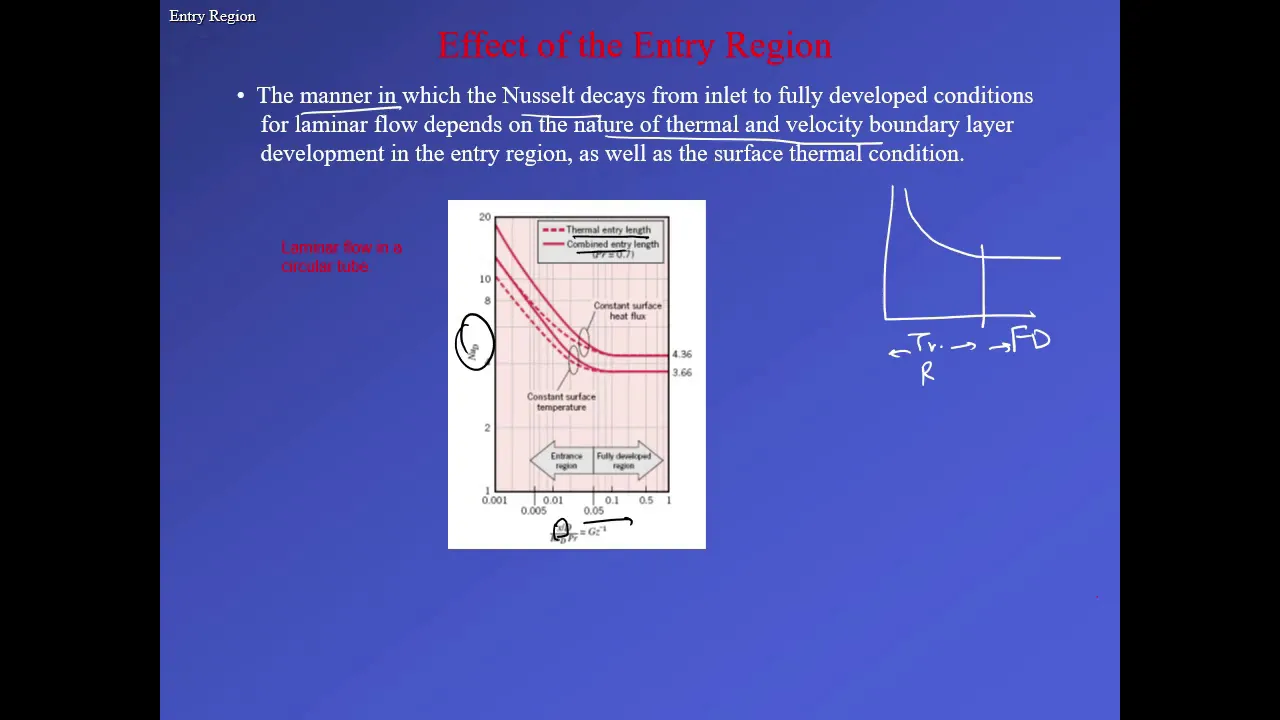

![6️⃣ TODO LO QUE DEBES SABER SOBRE [CONVECCIÓN] - Lección 6, curso Transferencia de Calor](https://i.ytimg.com/vi_webp/Cz1j-_PWbK4/maxresdefault.webp)
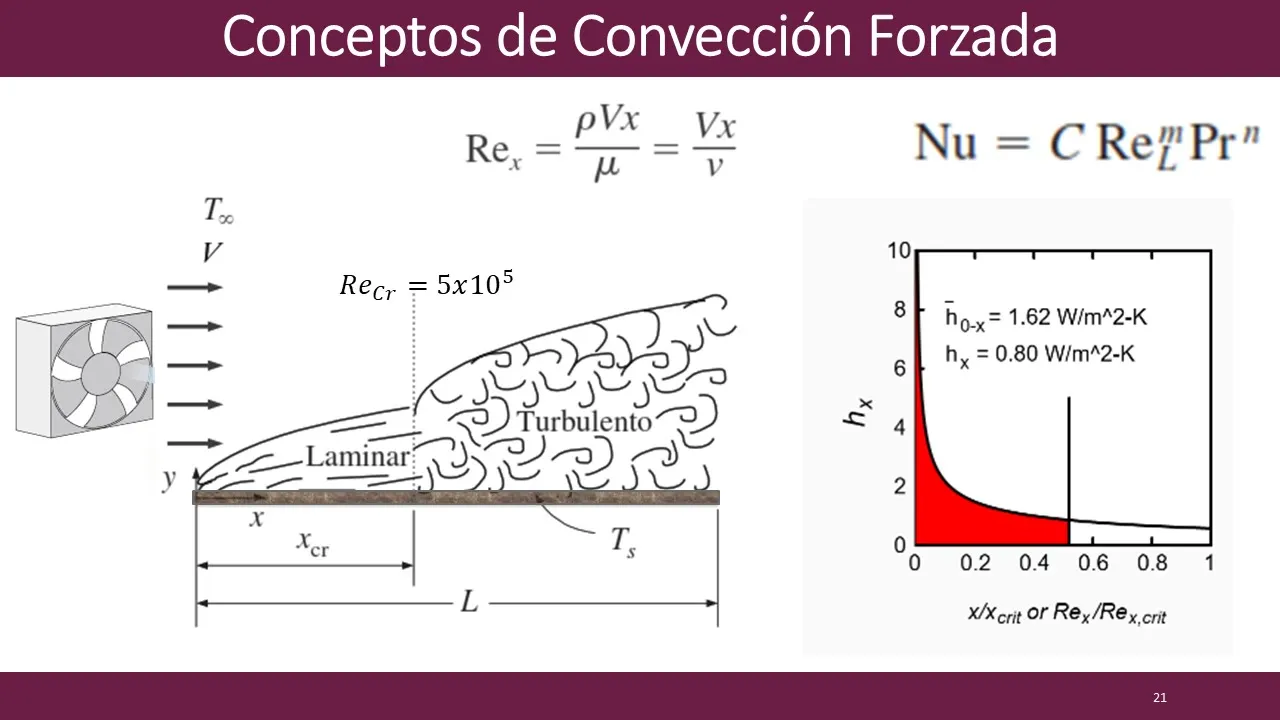
Convection heat transfer differs from conduction by requiring bulk fluid motion, where heat is transferred between a solid surface and a moving fluid; the heat transfer coefficient (h) quantifies this rate as q = h × A × (Ts - T∞), and the Nusselt number (Nu = hL/k) represents the enhancement of heat transfer due to fluid motion compared to pure conduction, with Nu > 1 indicating convective enhancement and Nu = 1 representing pure conduction.
Convection Heat Transfer Fundamentals | Lecture 21 (Part 1/3) by Prof. Josua Meyer (UP, 2014) | Nusselt Number & Boundary Layers
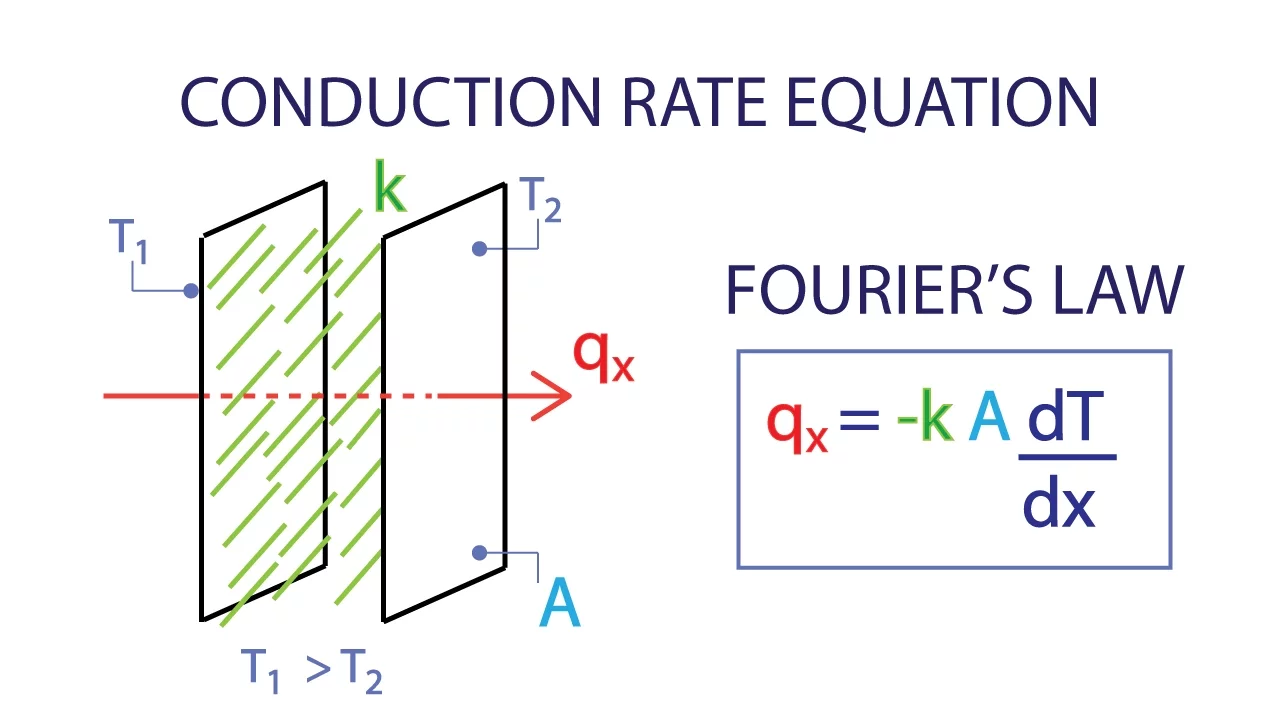
Added:Fourier's Law of Heat Conduction and the fundamental mechanisms of thermal energy transfer through solids and fluids at rest.
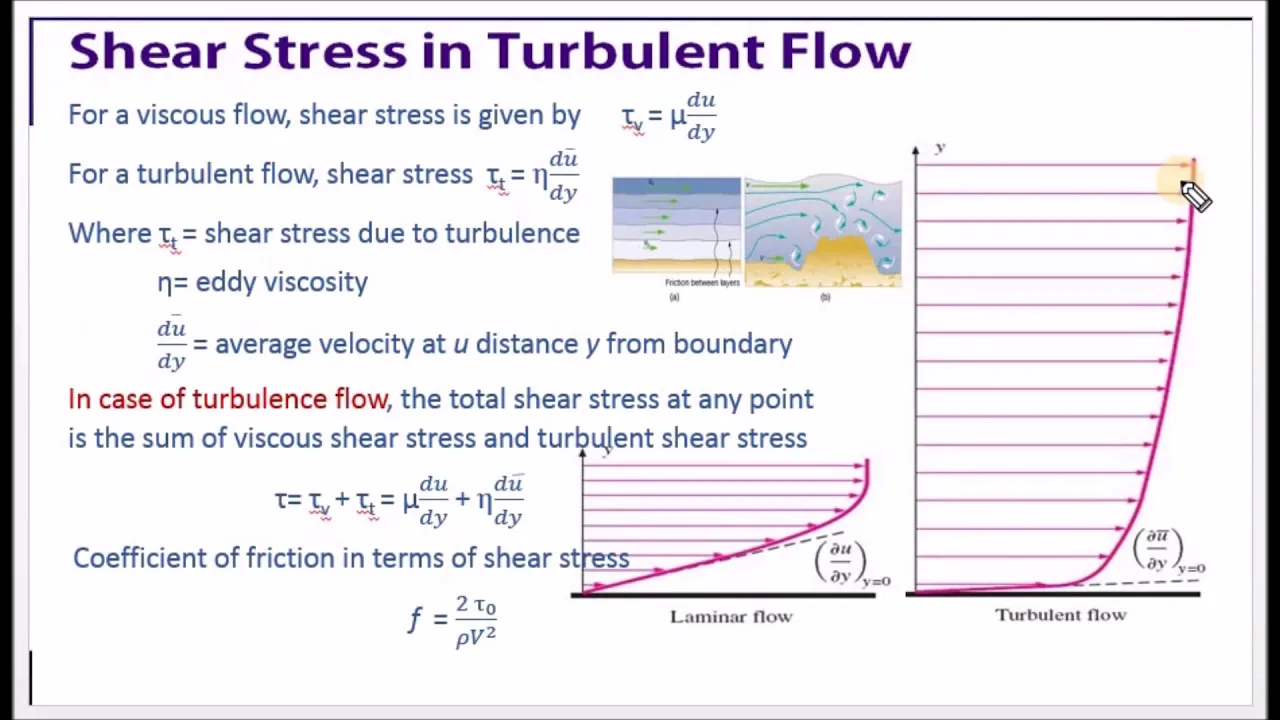
Basic fluid mechanics principles, specifically fluid viscosity, shear stress, and the distinction between laminar and turbulent flow regimes.
Newton's Law of Cooling and the basic definition of the convective heat transfer coefficient (h).
The concept of dimensional analysis and why dimensionless groups are used to scale physical phenomena in engineering.
The concept of the Thermal Boundary Layer and its relationship to the Velocity Boundary Layer via the Prandtl Number.
Deriving and applying empirical correlations for the Nusselt Number in forced convection (both internal pipe flows and external flows over plates/cylinders).
Natural (free) convection analysis, including buoyancy-driven flows and the significance of the Grashof and Rayleigh numbers.
Applying convective heat transfer coefficients to the design and performance analysis of practical thermal systems, such as heat exchangers.
95.4K views744likes48:58Original Release: 2014-03-19
okay okay ladies and gentlemen we continuing with chapter six now in the textbook of single and gajar uh we've done now or in the previous course you already done the three different types of heat transfer conduction conviction and radiation we did transient heat conduction or unsteady heat conduction and we also did go back in fluid mechanics to look at the derivation of uh some of the differential equations which are very important to us now the next few chapters are all about convection and that is really the difficult part of of heat transfer so the convection part consists firstly out of a chapter chapter six on the fundamentals of convection and then after that there will be three more chapters the one on external external convection another one on internal convection and another one on natural convection okay so this chapter is very important as as a foundation chapter for all for the following three chapters that's going to follow now the chapter has a lot of material in but many of it we've already covered either in the in the chapter of white or in your other flute mechanic scores so on some of it we're going to go over it very quickly just on the surface just to do a little bit of a the vision but you will see this this chapter consists firstly of the mechanism of convection then the classifications of fluid flow the velocity boundary layer that you already didt then we going to introduce the thermal boundary layer then we're going to look at laminar and turbulent flows heat and momentum transfer in turbulent flow then the derivation of the differential convection equations we already did that then the solution of convective equations for a flat plate and then non-dimensionalized convection equations and similarity then part 10 functional forms of on friction and conviction and then lastly 6.11 analogies between momentum and heat transfer so it's quite a long chapter and if everything goes well we're going to to cover it in about three lectures okay so let's start with um um the f fals of convection and just look quickly again at [Music] conduction conviction and [Music] radiation conduction convection and radiation in for each one of them you already did the necessary equations now to explain convection let's just go back quickly to condu ruction and let's look at the differences of the three different modes of heat transfer the one thing that is different from conduction and convection is that it needs the presence of an internal of or material medium okay so there should be a presence of a material and the material can be uh in the case of conduction can be a solid uh or it can be a liquid or a gas and uh I'm going to show it to you just now radiation is different because it doesn't need a medium okay it doesn't need a medium it can radiate right through a vacuum so that is what is different from a radiation transfer now if we just come back to conduction again and the mechanism of conduction with conduction if we've looked at a body then we've said that typically in a solid there will be molecules and they are relatively close to each other and as we know they vibrate okay and because especially in something like copper or Diamond are very very close to each other if we now increase the temperature here we give this molecule more energy and it will bump again against the molecule next to it it will become more excited it will start moving faster and faster and that is the mechanism of conduction transfer so normally we've got this structure of a densely packed material and that is now a solid now let's start making the molecules moving further and further apart okay and there are solids like that and that would be solids which do not have a high thermal conductivity but in the limit we can also start moving over to a gas or to a liquid and the only difference is going to be that the distance between the molecules is just going to move further and further apart okay so the question is now well if it is a gas and uh I heat that molecule is the heat transfer through the medium by conduction or what is the what is this thing of convection now coming in what does what makes it different okay now the difference between the two is that with convection is always in the presence of bulk fluid motion okay so bulk fluid motion what do we mean with bulk fluid motion it means that most of that fluid is actually moving okay it is moving with conduction it will be where there will be an absence of a bulk fluid motion and that is one of the most important differences between conduction erron ER and convection he transfer and let me illustrate it to you with a very simple example let's look at the case where we have a a flat plate okay which is at a temperature of 50° C okay and we have a fan which is forcing Air at 20° c and a velocity of 3 m/s over this flat plate okay so what happens with this medium here we have a bulk fluid motion so all the fluid would sort of move over the flat plate okay and this flat plate if it meets a beautiful molecule here it will see it once and then it's gone okay so it's going to disappear okay in general so and that would be forced conviction okay so we call that forced conviction he transfer forced conviction remember HD just heat transfer forc conviction heat transfer so this heat transfer rate let's call it q do1 that is forced convection transfer now let's suppose there's no electricity okay and the fan stops working okay what is going to happen now it's the same plate it is it is at 50° C okay and now we know the air here is going to be at 20° C its velocity is going to be zero but because this hot plate of 50° C is going to heat that molecule there okay all the molecules in that region its density is going to decrease and the result is that the buoyancy force is going to move it up so we will start creating very very low velocities very very close to the wall okay and that is also what is happening now here in this venue if you sit here your skin temperature close to maybe 30° 37° C uh this venue 23 well not 24 25° C and it would heat the air and the heat close to you would rise up and it would cause some currents that starts flowing into this venue they are not the velocities are not that that high that your that your hair is going to stand up like that okay so we call that natural conviction okay so the bulk the bulk motion the fluid it moves okay and therefore it is called natural convection now let's suppose okay and what is very important here to remember is and we did put it in is that gravity is working in this direction now let's suppose we do the same experiment with air again at 20° C okay and the plate still at 50° C so in all three cases the plate temperature is 50° C but different environmental condition but now the gravity is equal to zero okay so there's no gravity so that molecule is going to be heated okay now what is it going to do it is going to be excited and it is going to bump against another one and the mechanism now is conduction transfer okay so in the limit now we have here conduction transfer and it doesn't matter if it is a gas or a liquid it can have conduction you transfer in a gas or a liquid also okay in the limit okay now in general we know that the higher the flow or the bulk fluid motion is over a plate or whatever the higher the heat transfer rate will be okay now the study of conviction he transfer is a is quite a difficult subject a difficult field uh it is still open for the Nobel Prize and I'm going to show you just now why okay and uh so so yeah so in the study of this obviously Engineers looked at this and say you know how are we going to solve this problem and from many experiments what they have found so from experience and experiments if you start doing experiments on it uh it has been found that the conviction you transfer right okay conviction NE transfer [Music] rate okay is a function of quite a number of variables if we look now at this case of the flat plate it would be a function of okay I'm going to write it here it's a function it's going to be a function of the viscosity the K the row and the CP of the fluid okay which means it is the fluid properties so from experiments we know that if we do this experiment with water with air then we get different results if the air is at a temperature of 20° C in comparison with 20° C or 400° C it's going to influence these variables and because of that theat transfer rates are going to be different okay so it has been found from experiments then also we know that the velocity is a very important variable the freest stream velocity and obviously the surface temperature and the freeze stream temperatures are also important but now there are other variables which are also important if we do this experiment for a flat plate and then I repeat the experiment for a cylinder or a sphere or an aero foil then the results change so it is also a function of geometry the geometry of the body okay and surface roughness and also the flow regime so is the flow over the body in the laminar flow regime is it in the transition flow regime or is it in the turbulent flow regime so this very very complicated relationship of the heat transfer rate is a function of all these variables Newton really took a shortcut with this okay and what he did is he said well let's make it very simple we know that if things are simple then usually it works easier and it's easier to understand so he said well all we do is we are going to say the convection e transfer is equal to the he transfer coefficient multiply by the surface area multiplied by TS minus t environment okay or you can write it as the heat flux of conviction heat flux of convection divided by the area is equal to the heat transfer coefficient multiplied by TS minus the fre stream temperature okay where this guy here okay the transfer coefficient the transfer coefficient is now a function of all these things that we've discussed on this side except now surface temperature and the freest stream temperature okay so he made it very very simple so where's the Nobel price well the Nobel price is if if you can derive from first principles what the heat transfer coefficient will be or always is a function of that then I'm sure you'll get it okay okay so that is the challenge hasn't been done yet so if you can get that very very simple relationship and in nature things are simple so it will be a simple equation that we also know will be a simple equation right so we know that this H is called the heat transfer coefficient okay the heat transfer coefficient many cases we are going to write out HTC the transfer coefficient and its units is watts per square met de cus okay in many cases people are confused because sometimes they see it as watts per square met Kelvin it's the same it doesn't matter because in this equation if you work with Kelvin or with Del de C doesn't matter it's the same delta T and you can write the convection transfer coefficient as per de Ci or per Kelvin it doesn't matter right now this heat transfer coefficient has a definition okay and the definition is quite long and I'm going to write it down as four important steps and this definition says it is actually the rate of he transfer okay I'm writing it out now as very simple the rate of transfer okay between a solid and a fluid obviously the fluid can also be a gas per unit surface the unit surface area and per unit temperature difference so that is actually the definition of the convection he transer coefficient okay now let's look at our flute mechanics and that is why it is important why we cannot really separate heat transfer from fluid mechanics you've already done it with boundary layer theory that if that is the freest stream velocity okay that if there's a solid surface then there will be a boundary layer developing like that okay and far away from the surface that velocity would be equal to the free stream velocity okay so if I would now keep my measuring instrument there and I would bring it closer and closer and closer up to the point where that velocity is equal to 99% of the freest stream velocity then you have learned that that is the boundary layer thickness okay boundary layer thickness and that is being caused by viscosity and also the fact that the velocity there must be zero and that is also called the zero slip velocity so the velocity is there is equal to zero there it must be equal to the free stream and in between there's a differentiation in terms of velocities and when we measure the velocity where that velocity is 99% of that one then that is the height of the boundary layer thickness okay now what is this implication of the no nonslip velocity that is quite important for us from a heat transfer point of view because if we now try to think of the transfer what is the mechanism that occurs here then it is actually how does the how is the heat being transferred because what we say now is that the velocity there is equal to zero okay so it means that on the boundary the heat transfer mechanism is by conduction okay so let's look at it in terms of the implications [Applause] okay so the implications is that the heat transfer from the solid surface okay so the heat transfer from the solid surface to the fluid the heat transfer from the solid surface to the fluid let's look at the convection the convection must be equal to the conduction and the conduction is equal to minus K take note of the fluid okay multiplied by partial DT Dy where Y is equal to Z so it is that gradient there partial DT d y where Y is equal to Z and we choose that as our y AIS so where Y is equal to Zer that gradient there that would be the conduction he transfer now from this let's call that equation one okay equation of convection e transfer convection flux is equal to the transfer coefficient multiplied by TS minus the infinite and this one equation two so let's equate equations 1 and two and then we get that the transfer the transfer coefficient multiplied by TS minus the free stream temperature is equal to minus thermal conductivity of the fluid multiplied by partial DT d y where Y is equal to Z and the result of that is that the heat transfer coefficient fundamentally is equal to minus the K value of the fluid multiplied by partial DT d y and Y is equal to0 divided by TS minus t infinite okay so what do we say we say that at the wall the mechanism of the transfer is by conduction okay once a conduction occurred obviously from there on it is convection but because of this we can actually write that the conduction must be equal to the convection and the result is fundamentally that the transfer coefficient coefficient can be determined if we have the temperature gradient very close to the wall okay so if you can go and measure if you can go and measure the temperature gradient very close to a wall then you can get the heat transfer coefficient however it's almost impossible to do it you have to do there there are experiments in which in which it can be done but they have to be controlled very very carefully and in general for most practical bodies or things that we want to calculate the he transfer from and before we can do that we need the he transfer coefficient it is not possible for us to go and measure it okay so we need to make another plan okay now in general what is also important to realize is that the heat transfer coefficient is not a constant it is some it is actually something that is a function of position again let's look at the flat plate case Okay so if we look at the flat plate and that is the free stream temperature and velocity and we look now at different positions 1 2 3 and four okay and let's suppose you can go and do those measurements okay let's suppose you can go and do it how will they typically look like okay the transfer coefficients as a function of x well what is going to happen is here at the Leading Edge of the plate at the Leading Edge the temperature gradients is going to be the largest okay the TD Y is going to be the largest there okay do you agree okay the largest gradients is going to be at the Leading Edge so the he transfer coefficient there is going to be quite High okay but now remember he is being transferred to the fluid okay so what what happens to its temperature its temperature is changing and the result is that this temperature gradient is actually changing as you go Downstream the downstream the plate so because this temperature now here is higher than there the gradient is going to be different and the result would typically be that theat transfer coefficients if you go and measure it at different positions is going to do something like that okay so that would be the heat transfer coefficient at 0.1 that would be at 2 3 and at 4 so in general the heat transfer coefficients are not the same okay at a stage they will get to the point where the flow is so-called fully developed and we will get to that later on and then they will be the same but in general the transfer coefficients will not be the same so as Engineers if we are interested in a specific body whatever and we do have data like that well we're going to look at it like this and say well that is sort of the average okay and we would like the average transer coefficient so in many cases we would like the average okay but to get the average obviously we need to understand what is happening on the inside of it now another another very important uh group that we that we use with convection heat transfer is the mled number okay so the mled number the NL number by definition is equal to the heat transfer coefficient multiplied by the characterist IC length divided by the thermal conductivity just want to clean the board on this side okay so then nled number is a non-dimensional variable and it is equal to the heat transfer coefficient multiplied by a characteristic length divided by the thermal conductivity again this thing of the characteristic length you remember with a bu number there was also a characteristic length so if you look at flute mechanics and he transfer in general ladies and gentlemen listen okay there are many variables there's the Reynold's number there is the nled number and there are going to be many more all of them are usually based on a characteristic length and you need to know what it is especially when the experiments were conducted because if you use another one you're not going to get the right values so it is very very important and it's a trap in general so always be very very careful when you calculate the rle reyolds number or the nistle number that you know what characteristic length were used when the experiments were done or when the correlation that you're going to use uh uh was developed okay now I just want to give you a very simple example let's suppose uh we have a flat plate okay and temperature on the outside is 100° C the heat transfer coefficient is equal to 100 wats per square met de C okay and this is a copper plate and K for copper is equal to 400 watts per meter Kelvin or degre Celsius and uh this characteristic length uh LC the characteristic length is um I think eight okay eight okay okay so calculate the no number for me simple isn't it okay this number is equal to the heat transfer coefficient multiplied by the characteristic length divided by K the transfer coefficient is 100 the characteristic length is 8 and K is 400 so the nle number is equal to two you happy with that who said no why cuz that's not the characteristic length that used not just the length of the plate area volume area well no I can say the nle number based on the length of 8 m so as long as I do that that's fine okay so so I actually yes if I if I say a NL number I should say on what length it has been based and in this case the length of 8 m any other objections no no what's wrong the what the k value should be for the medium and not for the it's such a simple thing but many of you are going to make this mistake so it should be the K of the fluid okay so you should have asked me but you didn't give us the K of the air okay and the K of the air typically would be equal to 0.03 watts per meter Kelvin okay and look at the difference it's obviously going to make so now the nled number is equal to the transfer coefficient multiplied by the characteristic length divided by k equal to 500 or sorry 100 multiplied by 8 divided by 0.03 and now it is something like 27,000 watts per square met de C okay so be careful for that okay that you do not make that mistake when you calculate the nled number the nled number is an indication of the transfer in the fluid and I'm going to explain it to you in a little bit more detail specifically what the nled number means so the physical significance of the nled number let's just go and look at what does the nled number mean and we take some fluid okay and it's a fluid layer typically okay a fluid layer okay and what we now have is we say that that let's consider that temperature there as T2 and that one T1 and the difference between the two fluid layers is L okay now the two fluid layers can be very very close to each other it's not that we're talking of meters now so what we can say is if the fluid is in motion if the fluid is in motion therefore it is convection okay then the convection heat transfer would be equal to the heat transfer coefficient multiplied by delta T and delta T would be equal to T2 minus T1 okay okay if the fluid is stationary okay so firstly if it's in motion then if it's stationary then it would be conduction and if it's conduction then we can say that the transfer rate of conduction is equal to K multiplied by delta T / by L okay let's take the ratio of the two so the ratio of the convection divided by conduction the ratio of convection to conduction and now we have the transfer coefficient multiplied by delta T ided by K delta T / by L we see that the Delta T's disappear and now we end up with HL ided by K or the nled number okay so now except now for the fact that this is the ratio of convection to conduction what does it really mean it represents what does it represent it represents the enhancement in h transfer the enhancement it represents by how many times the heat transfer will be increased so if the number is equal to one okay if that ratio is equal to one then we know it is conduction he transfer only okay if the Sal number is equal to three then it means the bulk fluid motion the bulk fluid motion okay increased theat transfer rate with 300% theat transfer rate would be increased by three times that is what the noled number means what does it mean if the nle number is smaller than one if it's one it's conduction if it's more than one it is how much it has been enhanced that is what The Missle number actually means if it's smaller than one it means you've made a mistake okay can't be it's a fundamental error okay fundamental error and it can happen very easily some of these equations you will see are very very long and all of us make mistakes when you do the calculations so if you get a nled number smaller than one you must know can't be it's a fundamental error I'm making okay any questions on conviction he transfer and the nled number nothing yep question I just want to find out the unit you with the missile number that can't be correct it can't be correct uh uh by by uh at which one oh oh my goodness I'm sorry sorry yeah it's a non-dimensionalized thing sorry sorry sorry sorry sorry yeah yeah yeah sorry I got yeah yeah okay okay Nole number is a non-dimensionalized value so in this case thank you very much okay that's a good example okay a good example so it means this nled number of 27,000 means that the bulk fluid motion the bulk fluid motion increased the transfer rate by 27,000 times okay if there was no bulk fluid motion and no gravity and only conduction then the heat transfer rate would be 27,000 times lower so that would be what the bulk fluid motion will cause in this case all right right we are not finished yet unfortunately paragraph 6.2 is about the classification of fluid flow classification of fluid flow now in this paragraph paragraph 6.2 there are work that you need to read through very carefully and it is important okay but it is work that you've already done but we are going to use it so firstly the classification of fluid flow is a very short summary of what do we mean with viscus versus inviscus flow internal versus external compressible versus incompressible laminar versus turbulent natural or forced flow and steady versus unsteady flow and then onedimensional two-dimensional and threedimensional flow are you all familiar with this do you know it easy it takes a long time you know before you get used to it and in that regard there's one flow regime that I specifically would like to discuss with you because I know so many of you have problems with it and the problem I'm going to select or the example I'm going to select in doing it is uh gaster line on an air bus okay so let's suppose that is the Airbus Wing I'm not going to try to draw the wing okay and there's a gas turbine engine and the gas turbine engine schematically I can show it like that okay and the air buus is moving at a mo number of 0.2 okay so the air bus is mov moving at the M number of 0.2 so and you're going to do this in the next semester uh when you're going to look at gas turbines but with a gas turbine the first thing that's going to happen is there's going to be blades there okay and they going to direct the flow and then just after the blades there's going to be another set of blades and they are rotating okay a very very high speed okay and then again after that there are some blades again which are stationary so they direct the fluid again for the next set of blades okay and this goes on quite a few times okay the purpose is to compress the flow so that is called the compressor so the compressor the combustion chamber and the turbine right so in the combustion chamber gasoline is being added there's a big fire and as you can think things expand and the pressure is going to increase so there we have a high pressure and high temperature now it is going to be expanded through the turbine again there will be some blades there that will direct the flow to the blades of the turbine that rotates and again another set of blades and another set of blades Etc okay so that is a gas turbine uh compressor uh combustion chamber and a turbine now let's look at the density typically through through this what will happen with the density so if this is now the air coming in going through the gas turbine what will happen with it right what will happen with it is that firstly in this region here it would be the outside density okay if it's a 10,000 M then I think it's something like I don't know 0.1 or2 something like that very low density but the flow there would be incompressible okay two reasons firstly the density doesn't change it's a constant the mo number is smaller than 0.3 okay so it is incompressible then things are going to start changing through the compressor the first set of blades is not going to do much but then after that the density is going to increase because the pressure the air is being compressed that's the function of the compressor is to compress it okay then in the combustion chamber uh it's going to increase more and then it has to expand again and in the expansion process it goes through the turbine through all the different stages and then it will go out like that that again so there it's incompressible and there it is incompressible in this region here it is compressible for obvious reasons we can see the density is changing as a function of position you agree okay now let's look at how the density changes as a function of time let's suppose we do a measuring we measure the density at position one there okay and in position two and position three so we measure the density so the density as a function of time take note now it is a function of time and it is in a specific position in the field okay so what happens with the density at 0.1 well not much it's going to be quite constant okay what will happen with the density at 0 2 it will be higher than at one but it's not really going to change okay in position three is about the same typically something like that okay and that would be the inlet of the compressor so our gas turbine would be would be operating in that region there no sorry I should have actually do that yeah forget about that sorry cuz this is not function of time okay okay so this flow is steady so it's steady flow okay so the flow would be steady and incompressible there and at position two and three it would be steady and compressible you agree so at one one it is steady and incompressible at position two it would be steady and compressible right now what happens if we get a bird strike bird strike okay now we have a a poor chicken going through the gas turbine okay so by the way how the how do they test these things if they test it on ground they use frozen turkeys to throw through the engine okay I'm serious frozen turkeys are been used okay okay so what is now going to happen with the density as a function of time okay okay at position one if you measuring there and you don't see the bird then the density is going to be constant and then suddenly the bird is going to be there and then that is going to happen Okay so steady and then suddenly unsteady and then steady again at position two just a fraction of a second later it would be like that and in position I three something like that so that is the unsteady flow Behavior okay okay obviously the unsteady flow Behavior we will also have when the engine is being being put on and off or when the throttle is being changed more fuel or less fuel then we have an unsteady Behavior so make sure that you really understand the differences between steady flow unsteady compressible incompressible okay thank you very much woo
Up Next
37:55
Heat Exchanger Design: Area & Pressure Drop Estimation
@NicholasSiefert
112.7K views•2014-02-22

30:32
Ultrasonic Transducers: Resonant Frequency Measurement and Horn Design
@imajeenyus42
229.9K views•2017-02-22
54:16
Polymer Environmental Degradation: Mechanisms & Stabilization
@iit
1.8K views•2012-07-10

33:39
How a Student's Question Saved a NYC Skyscraper from Collapse
@veritasium
22.8M views•2025-04-26
Related Study Plans & Knowledge Roadmaps
Structured learning paths in Engineering
engineering
Building Acoustic Levitators: Physics & Arduino
01The Physics of Sound and Standing Waves
02Piezoelectric Transducers and H-Bridge Drivers
03Arduino Programming: Generating 40 kHz Signals
+ 2 more learning modules
14h5 modules
Explore Roadmap
engineering
Building Peltier Cloud Chambers: Particle Tracks
01Cosmic Rays & Cloud Chamber Physics
02Thermoelectric Cooling (TEC) Fundamentals
03Custom Liquid-Cooling Loop Design
+ 2 more learning modules
18h5 modules
Explore Roadmap
engineering
Yagi-Uda Antennas: Modeling, Build & VNA Test
01Introduction to RF and Antenna Fundamentals
02Yagi-Uda Antenna Design Principles
03Antenna Modeling and Simulation in 4NEC2
+ 2 more learning modules
18h5 modules
Explore Roadmap
engineering
ECG Monitor Design: Op-Amps, Filters & Noise
01Electronics & Breadboard Basics
02Op-Amps and Instrumentation Amplifiers
03Bioelectricity and ECG Fundamentals
+ 2 more learning modules
18h5 modules
Explore Roadmap