



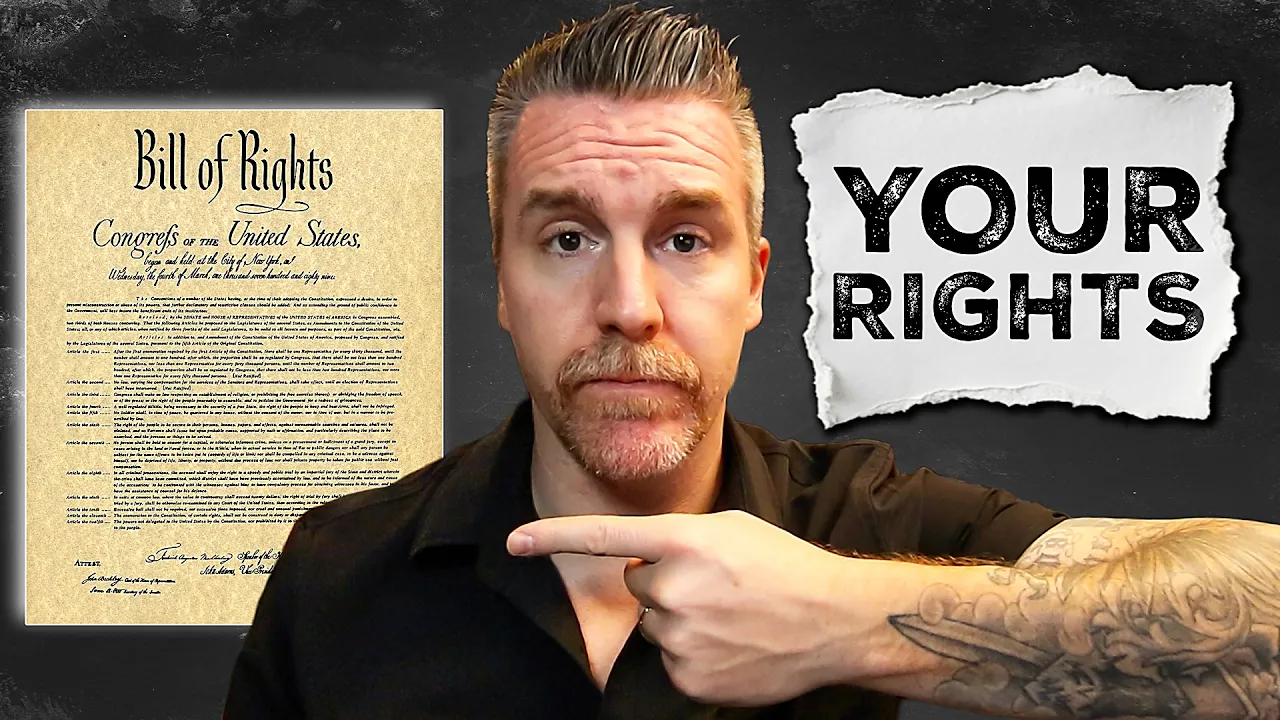

















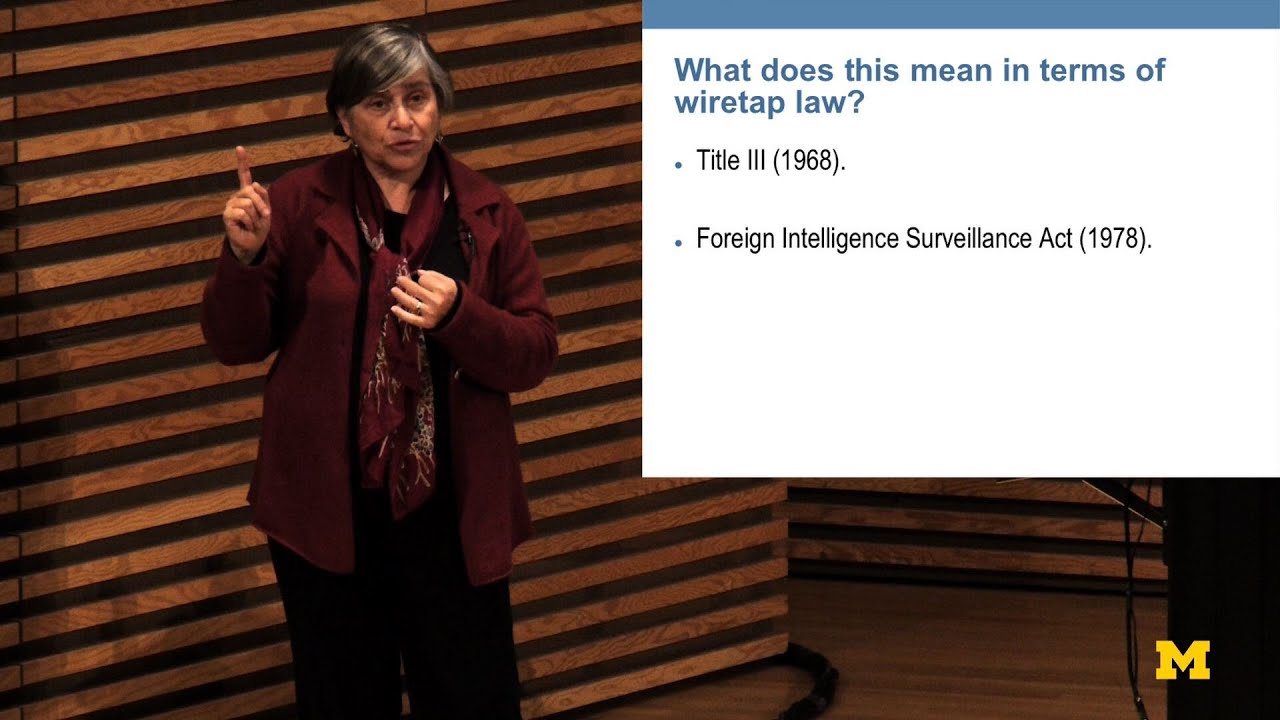
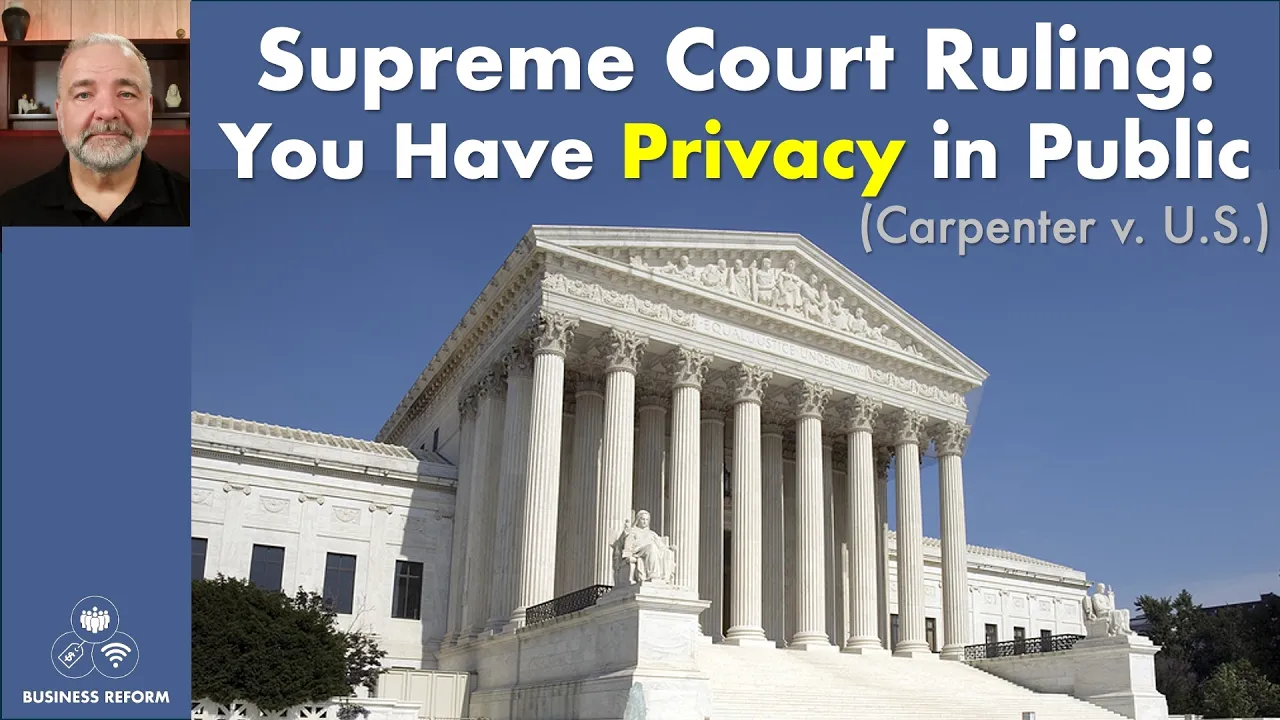


In Olmstead v. United States (1928), the Supreme Court held 5-4 that wiretapped private telephone conversations obtained without judicial approval did not constitute a Fourth Amendment search or seizure, as the Court interpreted the amendment to apply only to physical intrusions into property rather than electronic surveillance; however, this decision was later overturned by Katz v. United States (1967), which established that the Fourth Amendment protects individuals' reasonable expectations of privacy in their communications, regardless of how those communications are transmitted.
Olmstead v. United States: Fourth Amendment and Wiretapping
Added:The fundamental protections of the Fourth Amendment, specifically regarding warrants, probable cause, and 'searches and seizures'.
The Fifth Amendment's protection against self-incrimination and how it historically applied to evidence gathering.
The historical context of the Prohibition era (the 18th Amendment and Volstead Act), which led to increased federal surveillance and bootlegging investigations.
The traditional common-law concept of property rights and the 'physical trespass' doctrine as it relates to search and seizure law.
Justice Louis Brandeis's dissenting opinion in Olmstead, which introduced the concept of the 'right to be let alone' and laid the groundwork for modern privacy law.
Katz v. United States (1967), the landmark Supreme Court decision that formally overruled Olmstead and established the 'reasonable expectation of privacy' standard.
The Federal Communications Act of 1934 and subsequent statutory regulations (like Title III of the Wiretap Act) designed to govern electronic surveillance.
Modern digital-age surveillance cases, such as Riley v. California and Carpenter v. United States, which apply Fourth Amendment protections to cell phone data and location tracking.
2.6K views1likes17:57Original Release: 2016-01-14
Olmstead v. United States, 277 U.S. 438, was a decision of the Supreme Court of the United States, in which the Court reviewed whether the use of wiretapped private telephone conversations, obtained by federal agents without judicial approval and subsequently used as evidence, constituted a violation of the defendant’s rights provided by the Fourth and Fifth Amendments. In a 5-4 decision, the Court held that neither the Fourth Amendment nor the Fifth Amendment rights of the defendant were violated. This decision was later overturned by Katz v. United States in 1967.
The case = Background information = Until 1914, the American judicial system, including the Supreme Court of the United States, largely followed the precepts of English common law when it came to matters dealing with the validity of introducing evidence in criminal trials. In most cases, the general philosophy was that the process by which the evidence was obtained had little, if anything to do with the permissibility of its use in court. The only limiting factor was that the police agents could not break the law to seize the evidence; however, since what is now illegal seizure was then permitted by the courts, it rarely presented a significant challenge. In 1914, however, in the landmark case of Weeks v. United States, the Court held unanimously that illegal seizure of items from a private residence was a violation of the Fourth Amendment, and established the exclusionary rule that prohibits admission of illegally obtained evidence in federal courts. Because the Bill of Rights did not at the time extend to cover states, such a prohibition extended only to federal agents and covered only federal trials. It was not until the case of Mapp v.
Ohio that the exclusionary rule was extended to state courts as well.
The question here, then, was whether the recordings of wiretapped private telephone conversations constituted impermissibly-seized evidence and thus constituted a violation of the federal exclusionary rule.
= Case details = The case concerned several petitioners, including Roy Olmstead, who challenged their convictions, arguing that the use of evidence of wiretapped private telephone conversations amounted to a violation of the Fourth and Fifth Amendments.
The petitioners were convicted for alleged conspiracy to violate the National Prohibition Act by unlawfully possessing, transporting, and selling alcohol. Seventy-two additional persons, aside from the petitioners, were indicted. The evidence provided by the wiretapped telephone conversations disclosed "a conspiracy of amazing magnitude" to engage in bootlegging, involving the employment of some fifty persons, use of sea vessels for transportation, an underground storage facility in Seattle, and the maintenance of a central office fully equipped with executives, bookkeepers, salesmen, and an attorney. According to the record, even in a bad month, the sales amounted to some $176,000; the grand total for a year probably came out to some $2 million. Olmstead was the general manager of this business, receiving fifty percent of all the profits. The information that led to the discovery of his involvement and the conspiracy itself was largely obtained by four federal Prohibition officers who were able to intercept messages on his and other conspirators' telephones. No laws were violated in installing the wiretapping equipment, as the officers did not trespass upon either the homes or the offices of the defendants; instead, the equipment was placed in the streets near the houses and in the basement of the large office building.
The wiretapping went on for several months, and the records revealed significant details on the business transactions of the petitioners and their employees. Stenographic notes were made of the conversations, and their accuracy was testified to by the government witnesses. The evidence disclosed full details of the operations of the bootlegging business; in addition, it showed the relationship between Olmstead with members of the Seattle police, which resulted in prompt release of some of the arrested members of the conspiracy and promises to officers of payment.
= Opinions = Chief Justice William Howard Taft delivered the opinion of the Court. Chief Justice Taft Writing for the Court, Chief Justice Taft was joined by Justices McReynolds, Sanford, Sutherland, and Van Devanter. After outlining the factual and procedural history of the case, Chief Justice Taft lists the relevant amendments – the Fourth and Fifth – and proceeds to examine the legal matters and precedents in question. Boyd v. United States concerned the Act of June 22, 1874, which provided per section 5, a United States attorney with the power to use a marshal to obtain evidence that the defendant had refused to provide, in cases that were not criminal under the revenue laws. The Court held that Act of 1874 was a violation of the Fourth and Fifth Amendment, even though it did not constitute a clear case of search and seizure. Chief Justice Taft next examines "perhaps the most important" case, Weeks v. United States, which involved a conviction for using the mail to transport lottery tickets. The defendant was arrested by a police officer without a warrant, and subsequent to the arrest, the defendant’s house was searched and a number of papers and articles was seized despite the lack of a search warrant. Although the defendant applied for and successfully obtained a court order directing the return of his property, he was denied return of relevant evidence. He appealed; the Court held that such taking of papers was in violation of the constitutional rights of the defendant, and that the trial court could not permit their use at trial.
Chief Justice Taft cites several other cases, and concludes that there is no permissible way to apply the Fifth Amendment to this case unless it could be shown that the Fourth Amendment was first violated. In this instance, there is no evidence that the defendants were in any way compelled to talk over their telephones, and were voluntarily engaging in business. Thus, “our consideration must be confined to the Fourth Amendment.” Taft writes that the aggregate outcome of the Weeks case and those that followed it was that the Fourth Amendment forbade the introduction of evidence in court if it had been obtained in violation of the amendment.
This is in compliance with the historical purpose of the Fourth Amendment, as it was in part intended to prevent the use of governmental force to search and seize a man’s personal property and effects.
While it may seem that the language of Justice Field in ex parte Jackson could be viewed as an analogy to the interpretation of the Fourth Amendment qua wiretapping, Taft believes that the analogy fails. The Fourth Amendment applies to sealed letters in the mail because there exists a constitutional provision for the federal postal office and the relationship between the government and those “who pay to secure protection of their sealed letters.” However, the United States does not take such care with telegraphic and telephonic messages as it applies to mailed sealed letters, and Taft is quite emphatic in drawing the distinction: "The amendment does not forbid what was done here. There was no searching. There was no seizure. The evidence was secured by the use of the sense of hearing and that only. There was no entry of the houses or offices of the defendants." He points out that one can talk with another at a great distance via telephone, and suggests that because the connecting wires were not a part of either the petitioners’ houses or offices, they cannot be held subject to the protections of the Fourth Amendment.
Taft, in keeping with his personal judicial philosophy, suggests that Congress may "of course" extend such protections to telephone conversations by passing direct legislation that would prohibit their use in federal criminal trials. Until such legislation is passed, however, "the courts may not adopt such a policy by attributing an enlarged and unusual meaning to the Fourth Amendment," as there are no precedents that permit the Fourth Amendment to apply as a viable defense in cases where there had been no official search and seizure of the person, his papers, tangible material effects, or an actual physical invasion of property.
He concludes that such wiretapping as occurred in this case did not amount to a search or seizure within the meaning of the Fourth Amendment.
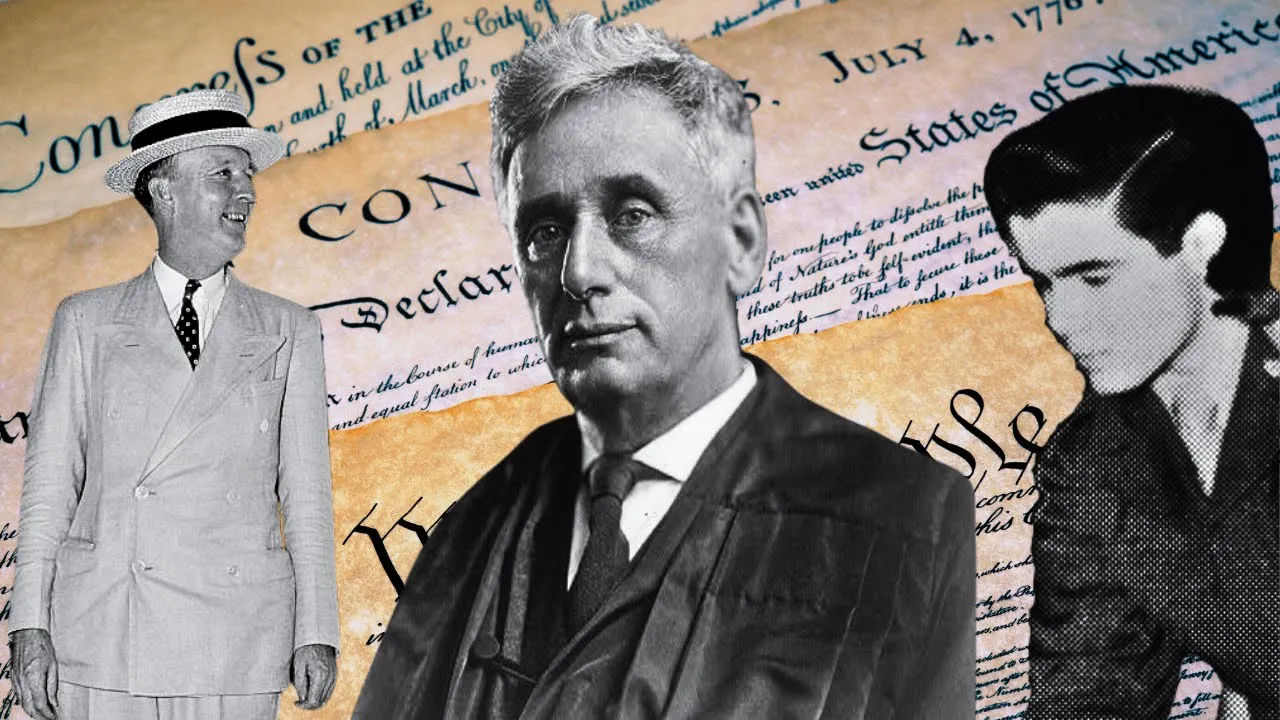
Associate Justice Brandeis Associate Justice Louis Brandeis wrote a dissenting opinion that in subsequent years became very famous.
The government made no attempt to defend the methods employed by federal agents, and, in fact, conceded that if wiretapping could be deemed a search or seizure, such wiretapping as took place in this case would be unreasonable search and seizure and thus inadmissible in court. However, it claimed that the protections of the amendment do not extend to telephone conversations.
Brandeis attacks the proposition that expanding the Fourth Amendment to include protection of telephone conversations was inappropriate. At the time of the adoption of the Fourth and Fifth Amendments, he writes, “force and violence” were the only means by which the government could compel self-incrimination. Thus, the protections offered by these Amendments were necessarily limited to address only imaginable forms of such force and violence. However, with the technological advances, the government has received the ability to invade privacy in more subtle ways; further, there is no reason to think that the rate of such technological advances will slow down. “Can it be that the Constitution affords no protection against such invasions of individual security?”, Brandeis asks. He answers that a clear negative answer is evident in Boyd v. United States.
Brandeis argues that the mail is a public service furnished by the government, and the telephone is "a public service furnished by its authority." He concludes that there is no difference between a private telephone conversation and a sealed letter. In fact, he writes, "the evil incident to invasion of the privacy of the telephone is far greater than that involved in tampering with the mails." In its past rulings, the Court has refused to read a literal construction of the Fourth Amendment, most notably in the Boyd case. Unjustified search and seizure violate the Fourth Amendment, and it does not matter what type of papers were seized, whether the papers were in an office or a home, whether the papers were seized by force, etc. The protection guaranteed by the Fourth and Fifth Amendments are broad in scope. The framers of the Constitution sought "to protect Americans in their beliefs, their thoughts, their emotions, and their sensations." It is for this reason that they established, as against the government, the right to be let alone as "the most comprehensive of rights and the right most valued by civilized men.
To protect that right, every unjustifiable intrusion by the government upon the privacy of the individual, whatever the means employed, must be deemed a violation of the Fourth Amendment. And the use, as evidence in a criminal proceeding, of facts ascertained by such intrusion must be deemed a violation of the Fifth." Brandeis argues further that even independently of the constitutional question, the judgment should be reversed. By the law of Washington, wiretapping is a crime, and a federal court should not permit a prosecution that makes use of such crime to continue. The Eighteenth Amendment did not empower Congress to authorize anyone, federal agents or not, to violate the criminal laws of a state; nor has Congress ever purported to do so. These unlawful acts were not directed by the Attorney General or the Secretary of Treasury; they were committed by individual officers. Thus, the government was innocent from a legal point of view, since it did not direct its agents to commit a crime on its behalf. However, when it sought to "avail itself of the fruits of these acts" to convict the defendants, "it assumed moral responsibility for the officers' crimes." If the Supreme Court were to permit the government to punish the defendants by the sole means of its officers’ transgressions, it would present all the elements of a ratification. "If so, the government itself would become a lawbreaker." Brandeis cites an old maxim of unclean hands, inherited from courts of equity, whereby a court will not redress a wrong when he who has requested its aid has unclean hands. This principle, he believes, is very much relevant here. The Court should deny its aid to maintain respect for law to promote confidence in the administration of justice and preserve the judicial process from contamination.
We must subject government officials to the same rules of conduct that we expect of the citizen. The very existence of the government is imperiled if it fails to observe the law scrupulously. As Brandeis puts it, "if the government becomes a lawbreaker, it breeds contempt for law; it invites every man to become a law unto himself; it invites anarchy. To declare that in the administration of the criminal law the end justifies the means—to declare that the government may commit crimes in order to secure the conviction of a private criminal—would bring terrible retribution. Against that pernicious doctrine this court should resolutely set its face." Justice Brandeis' opinion was quoted by Timothy McVeigh at his trial for the bombing of the Federal Building in Oklahoma City. After remaining silent throughout his trial, he was asked before sentencing if he would like to make a statement. He responded "I wish instead to use the words of Justice Brandeis dissenting in Olmstead to speak for me. He wrote 'Our government is the potent, the omnipresent teacher. For good or ill, it teaches the whole people by its example.'"
Associate Justice Holmes Citing the extensive dissent filed by Brandeis, Holmes says that he need "add but a few words." While he is not ready to say that the penumbra of the Fourth and Fifth Amendments covers the defendant, he does concur that even apart from the Constitution, the government should be prohibited to use evidence obtained by a criminal act.
Holmes writes that in his opinion, it would be a lesser evil that some criminals should escape prosecution than that the government "should play an ignoble part." Associate Justice Butler Justice Butler begins his dissent by registering his regret for being unable to support the opinion and judgments of the Court. Because the writ of certiorari limited the counsel’s arguments only to the constitutional question, he writes that it does not participate in the controversy of the admissibility of evidence because "the mode of obtaining it was unethical and a misdemeanor under state law." The sole question that he considers is whether the government may direct its officers to engage in wiretapping without violating the search and seizure clause of the Fourth Amendment.
Butler writes that though there was no direct search and seizure in Boyd v.
United States, the Court still found such exercise as occurred in that case to be in violation of the constitutional protections afforded to the criminal defendant. The Court does not limit its decisions to the literal meaning of the words of the Constitution. "Under the principles established and applied by this court, the Fourth Amendment safeguards against all evils that are like and equivalent to those embraced within the ordinary meaning of its words." Thus, when all these facts are evaluated, Butler concludes "with great deference," that the petitioners should be given a new trial.
Associate Justice Stone Justice Stone concurs in the opinions of Justice Holmes and Justice Brandeis, and also with that of Justice Butler insofar as it deals with the merits. Though the order granting certiorari did indeed limit the argument to a single question, Justice Stone does not believe that it prevents the Court from considering any questions present in the record.
Aftermath Mr. Olmstead spent his 4 year prison sentence at the McNeil Island Correctional Institute. He then became a carpenter. On December 25, 1935, President Franklin Delano Roosevelt granted him a full presidential pardon. Besides restoring his constitutional rights, the pardon remitted him $10,300 dollars in costs. Eventually, Mr. Olmstead became a well-known, full-time Christian Science practitioner, who also worked with prison inmates on an anti-alcoholism agenda for decades until his death in April 1966 at the age of 79—just over a year and a half before the Supreme Court issued its decision in Katz reversing its holding against him.
See also Elkins v. United States List of United States Supreme Court cases, volume 277 References External links Text of Olmstead v. United States, 277 U.S. 438 is available from: Findlaw Justia Brief case summary courtesy of www.oyez.org
Up Next

5:48
Katz v. United States: The Reasonable Expectation of Privacy (Fourth Amendment) | FLETC
@federallawenforcementtrain6564
24.3K views•2018-09-04

4:27
US Secondary Sanctions Impact on EU Businesses and Blocking Legislation
@Bureauvandijk
1.6K views•2019-03-20

5:27
Forensic Phonetics: Speaker Identification in Legal Cases
@nptel-nociitm9240
539 views•2025-03-19

24:42
Police Interrogation Tactics: False Confessions & Legal Reform
@LastWeekTonight
7M views•2022-04-18
Related Study Plans & Knowledge Roadmaps
Structured learning paths in Law
law
Self-Defense Law: Imminence & Castle Doctrine
01Foundations of Self-Defense Law
02Imminent Threat & Reasonable Belief
03The Principle of Proportionality
+ 3 more learning modules
12h6 modules
Explore Roadmap
law
Defamation Law: First Amendment & Actual Malice
01Introduction to civil torts and the First Amendment
02Elements of Defamation: Libel and Slander
03Public Figures vs. Private Individuals
+ 2 more learning modules
8h5 modules
Explore Roadmap
law
Hearsay Rule: Trial Evidence & Exceptions
01Introduction to Trial Evidence & Courtroom Basics
02Demystifying Hearsay: The Core Definition
03Non-Hearsay: Exclusions Under FRE 801(d)
+ 3 more learning modules
14h6 modules
Explore Roadmap
law
Medical Malpractice: Law, Liability & Care
01Foundations of Tort Law and Civil Liability
02The Four Elements of Medical Malpractice
03Defining and Proving the Standard of Care
+ 2 more learning modules
12h5 modules
Explore Roadmap