









![SCOTUS upholds Criminal GeoFrence "Search" 6-3 in Major Fourth Amendment Case! [Chatrie v. U.S.]](https://i.ytimg.com/vi/W5qbfUOe0C8/maxresdefault.jpg)


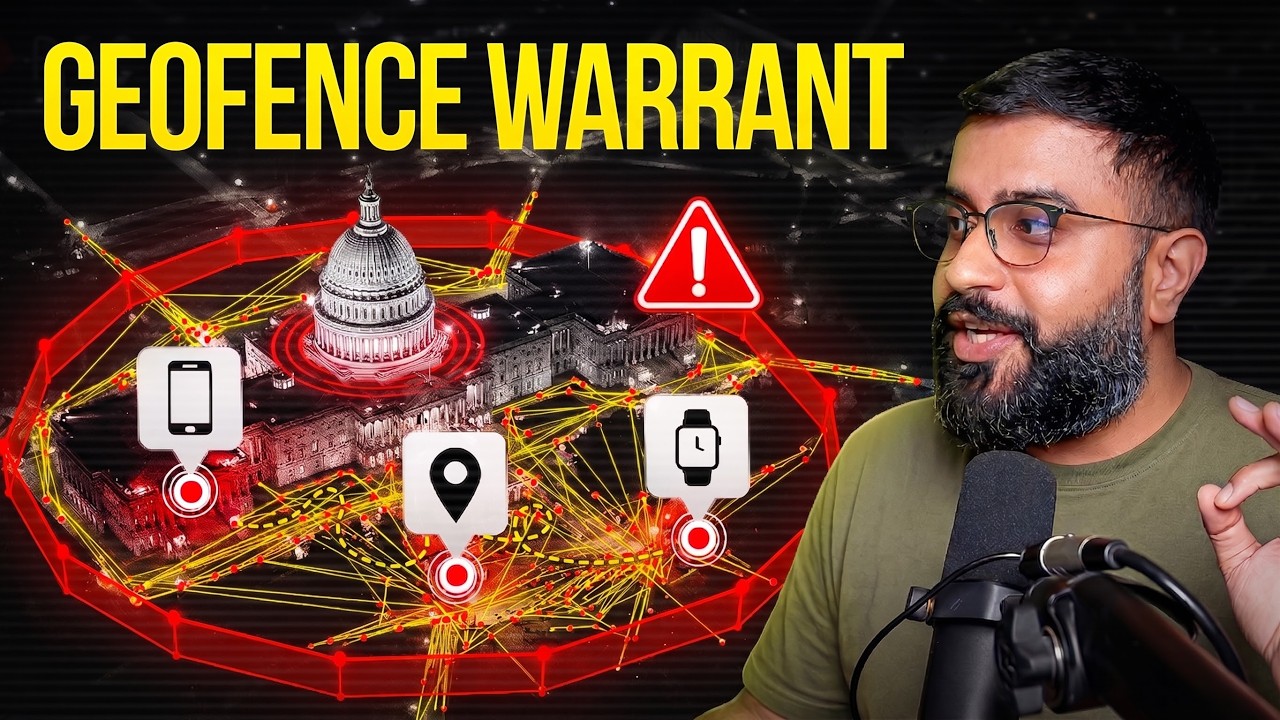




In the landmark 2018 Supreme Court case Carpenter v. United States, the Court unanimously ruled that individuals retain Fourth Amendment protection against warrantless government access to their cell phone location data, even when collected in public spaces and held by third parties, because such data creates an exhaustive chronicle of personal movements revealing intimate details about one's life including familial, political, professional, religious, and sexual associations; this ruling overturned Timothy Carpenter's convictions because the FBI obtained 127 days of his location history without a warrant, establishing that modern surveillance technology fundamentally transforms privacy expectations and requires warrants for comprehensive location tracking.
Carpenter v. United States: Supreme Court on Public Privacy Rights
Added:A person does not surrender all Fourth Amendment protection by venturing into the public sphere. While I agree with that statement, those aren't my words.
Those are the words of the majority of the United States Supreme Court justices in the 2018 case of Carpenter v. United States. Over the past few years, I have heard countless people say or post comments about how nobody has an expectation of privacy when they are out in public. But by a 5-4 decision, the Supreme Court of the United States, also known as Scotas, ruled that people do have some expectation of privacy even when they are in public. In this video, I will discuss several important concepts and quotes from the majority opinion and one dissenting opinion in one of the most important fourth amendment cases of the 21st century. In the seven years since the Carpenter case was decided, two of the justices who voted to uphold the Fourth Amendment, and one of the justices who voted to allow warrantless searches have either retired or passed away. I will conclude this video with my prediction of what will happen if a similar case to Carpenter was to be heard by today's Supreme Court. I am Dr. John Padfield, an engineer turned state representative turned business professor. And this is Business Reform, where we discuss issues at the intersection of business, technology, and society. As always, links to all of my sources can be found in the description. The facts in the Carpenter case are easy to follow.
Between 2010 and 2012, a series of armed robberies occurred in Detroit, Michigan.
Police arrested several suspects and one of them told police Timothy Carpenter had organized the robberies. Without obtaining a warrant, FBI agents obtained 127 days of Carpenters's location history from his cell phone's wireless carrier. His location history showed that he was near several of the robberies at the time the robberies occurred, and that information was used in court as evidence he organized the robberies. Based in part on the cell phone data obtained without a warrant, Carpenter was convicted of six counts of robbery and six counts of carrying a firearm during the commission of a felony and was sentenced to 116 years in federal prison. Carpenter's attorneys appealed the conviction on the basis the FBI violated Carpenters's Fourth Amendment rights by not obtaining a search warrant for his location history.
The Fourth Amendment guarantees the right of Americans to be secure in their persons, houses, papers, and effects against unreasonable searches and seizures, and that warrants for searches must be based upon a standard of evidence known as probable cause.
Probable cause has been described as more than suspicion, but less than proof. Generally speaking, law enforcement must show a judge enough factual evidence to convince the judge a crime has happened and that the place to be searched is connected to that crime.
Carpenter's appeal eventually reached the Supreme Court, who agreed to hear his appeal and rule on whether a search warrant was constitutionally required for the FBI to obtain and search Mr. Carpenters's location history as recorded by his wireless carrier. Chief Justice Roberts wrote the majority opinion in the Carpenter case, and he explained in detail the precedents and factors the court examined before deciding that yes, a warrant was constitutionally required to search Carpenters's location history, as recorded by his phone cell tower data.
Robert cited the 2012 precedent of United States v. Jones, where the court held people do have an expectation of privacy in their physical location and that law enforcement needs a warrant before putting a GPS tracker on a suspect's car. That case was decided 5 years before Flock Safety started making license plate readers that essentially do the same thing as a GPS tracker, but without having to attach a device to anyone's vehicle. Using Flock cameras, law enforcement is not limited to surveilling known suspects. They can do mass surveillance on anyone who drives a vehicle. That is why the Institute for Justice filed a federal lawsuit against the city of Norfolk, Virginia over their installation of flock cameras to warrantlessly surveil the entire driving public. Justice Roberts also cited the 1976 precedent of United States v.
Miller, where the court held people do not have an expectation of privacy regarding their bank records and the 1979 president of Smith v. Maryland where the court held people do not have an expectation of privacy related to phone numbers they dial because that data is maintained by the phone company.
Justice Roberts then noted that the facts of the Carpenter case did not fall cleanly into any of these precedents.
Was Carper's location history more like the Jones precedent where the court determined the government needs a warrant to track your location? or was it more like the other two precedents where the court determined the government does not need a warrant to obtain information held by a bank or a phone company? He then went on to discuss why the technology involved in the Carpenter case is something unique that the court had not previously addressed. This is where it gets really interesting and relevant to today's issue of law enforcement outsourcing mass surveillance to companies like Fog Data Science and not for-profit organizations like Project Nola, who doesn't install surveillance cameras all over the place. They only install crime cameras. That subliminal marketing trick of calling them crime cameras instead of surveillance cameras is a Jedi level mind trick designed to mislead the public into thinking if they aren't committing a crime, these cameras are not recording their movements 24/7 365.
And of course, Flock Surveillance, I mean, Flock Safety, who has installed over 80,000 surveillance cameras across the United States with major security vulnerabilities in them, as documented in Ben Jordan's excellent video a couple of weeks ago. I have teamed up with one of the cyber security experts who remained anonymous in Ben's video. Josh Michael has decided to go public and he gave me permission to show his face in the interview we recorded about Flock Nova. Flock's patented AI powered dynamic surveillance network, which is far more invasive than just tracking everywhere you drive. Notice they did not patent a dynamic safety network.
They patented a dynamic surveillance network, which is why I keep calling the company Flock Surveillance. I am currently editing my interview with Josh, and I will be releasing it within the next few days. I will then hold a special office hours live stream 24 to 48 hours after posting that video so we can discuss it together as a online community. Flock Nova's tagline is search once, see everything, and they do mean everything, including highly sensitive aspects of your life you probably didn't realize were just one click away for anyone with access to Flock Nova. Please share this video and my upcoming interview with Josh with anyone you think might be interested. It is up to us to make everyone aware of just how invasive of our privacy and how dangerous to our civil liberties Flock Nova really is. But going back to the Supreme Court ruling in the Carpenter case, Justice Roberts wrote, "There is a world of difference between the limited types of personal information at issue in the Smith and Miller cases that dealt with phone call records and banking records and the quote exhaustive chronicle of location information casually collected by wireless carriers." Justice Roberts also addressed the issue that people do not voluntarily share their location information as the word shared is normally understood. He also acknowledged that cell phones have become quote indispensable to participation in modern society. That means the court recognized it is unreasonable to argue a person just shouldn't have a cell phone if they don't want to be tracked everywhere they go. Justice Roberts quoted from another president which explained the basic purpose of the fourth amendment is to quote safeguard the privacy and security of individuals against arbitrary invasions by government officials.
Justice Roberts also cited the 1967 precedent of cats which established Americans Fourth Amendment right to be secure in their persons, houses, papers, and effects from unreasonable searches, protects people, not places. Justice Roberts continued citing Supreme Court precedents going back over 130 years, showing the Fourth Amendment seeks to secure the privacies of life against arbitrary power and that a central aim of the framers of the Constitution was to quote place obstacles in the way of a too permeating police state. Justice Roberts wrote, quote, "Prior to the digital age, law enforcement might have pursued a suspect for a brief stretch, but doing so, quote, for any extended period of time was difficult and costly and therefore rarely undertaken. For that reason, society's expectation has been that law enforcement agents and others would not and indeed in the main simply could not secretly monitor and catalog every single movement of an individual's car for a very long period.
This is a crucial point. Law enforcement agencies used to have to have a very good reason to surveil someone because surveillance required a lot of cost and manpower. But today's technology has made it increasingly cheap and easy to surveil people because private companies such as wireless carriers are already collecting the data that law enforcement wants. Justice Roberts continued, "Mapping a cell phone's location over the course of 127 days provides an all-encompassing record of the holder's whereabouts. As with GPS information, the timestamp data provides an intimate window into a person's life, revealing not only his particular movements, but through them his familial, political, professional, religious, and sexual associations.
These record locations hold for many Americans the privacies of life. That last item, the quote privacies of life, is also important. Paraphrasing the court, they said that location tracking reveals where people sleep, where they work, where they worship, which doctors they visit, what political meetings they may attend, who they spend time with, their habits, associations, and intimate patterns. Justice Roberts also pointed out how modern technology was giving police something they have never had before, the ability to surveil someone's past. Quote, "The retrospective quality of the data here gives police access to a category of information otherwise unknowable. In the past, attempts to reconstruct a person's movements were limited by a der of records and the frailties of recollection. With access to cell site location information, the government can now travel back in time to retrace a person's whereabouts, subject only to the retention policies of the wireless carriers, which currently maintain records for up to 5 years. Justice Roberts concluded, "We declined to grant the state unrestricted access to a wireless carrier's database of physical location information in light of the deeply revealing nature of cell site location information, its depth, breadth, and comprehensive reach and the inescapable and automatic nature of its collection. The fact that such information is gathered by a third party does not make it any less deserving of Fourth Amendment protection. The United States Supreme Court overturned Timothy Carpenters's 12 felony convictions because the FBI obtained his cell phone location information without a warrant.
To summarize, the Supreme Court ruled in 2018 that law enforcement agencies needed a warrant to obtain Carpenters's location data even though he was a known suspect identified by another suspect already in custody. His movements were made in public and the records of his movements were held by a third party.
Nearly everything stated about cell phone location data in the Carpenter case could also be said about the data collected by Flock's 80,000 surveillance cameras littering the highway rightways across the United States. Mark Talbot, the police chief of Norfolk, Virginia, described the flock cameras as quote, "a nice curtain of technology, which would make it difficult to drive anywhere of any distance without running into a camera somewhere." This warrantless 24/7 surveillance of people's movements in public is virtually identical to what the Supreme Court struck down in the Carpenter case. The Institute for Justice lawsuit against the city of Norfolk for their use of flock cameras is being heard in the Eastern District of Virginia. Based on the precedent of the Carpenter case, I am optimistic the Institute for Justice will win that case. But regardless of who wins in the federal district court, the case will almost certainly be appealed. So, how would today's Supreme Court rule if they were to hear a similar Fourth Amendment case today, such as an appeal of the Norfolk case? In 2018, the Supreme Court voted 5 to four to uphold the Fourth Amendment and require warrants to access cell phone location data. But, as I mentioned at the beginning of this video, three of those justices have retired or passed away. How would the three new justices likely vote? I believe it is safe to assume justices Roberts, Sodto Mayor, and Kagan, who all voted to require warrants in the Carpenter case, would again vote to uphold the Fourth Amendment. Based on her voting record on civil rights issues, I believe they would be joined by Justice Brown Jackson. Likewise, I believe it is relatively safe to assume justices Alo and Thomas, who voted to allow warrantless searches of cell phone location data, would again vote to expand the surveillance powers of law enforcement. and they would likely be joined by justices Barrett and Kavanaaugh. That would leave Justice Gorsuch as the tiebreaker. I know Justice Gorsuch voted in the minority in the Carpenter case, but he wrote a dissenting opinion and explained why he voted like he did. Justice Gorsuch is very conservative, but he is also considered by many to be the most libertarian leaning justice on the Supreme Court today, and he is often criticized by mainstream conservatives.
Justice Gorsuch wrote in his dissenting opinion, quote, "The Fourth Amendment protects your property, not reasonable expectations.
It grants you the right to invoke its guarantees whenever one of your things, your person, your house, your papers, or your effects is unreasonably searched or seized. Period." He also added, quote, "The Cats test has drifted far from the original meaning of the word search, a meaning tied to personal security and property, not judicial assessments of expectations."
In other words, Justice Gorsuch is all in favor of protecting the Fourth Amendment, but he views the standard of reasonable expectation of privacy as a flawed standard. And I absolutely understand his point. If society were to accept the 247 surveillance state as normal, then our expectation of privacy would simply disappear. If the Fourth Amendment is interpreted as only applying where society agrees we have an expectation of privacy, then the Fourth Amendment loses its meaning when people agree we no longer have an expectation of privacy. Justice Gorsuch has repeatedly implied he would vote to strengthen privacy protection if the case were based on stronger legal arguments rather than the flawed concept of the expectation of privacy being a prerequisite for Fourth Amendment protection. Because of his statements, I believe Justice Gorsuch would vote the pro privacy position, assuming the legal argument presented avoided using the expectation of privacy standard. If you like this video, I invite you to join me for office hours, my live stream held from 7 to 8:30 p.m. Eastern on the 1st and third Monday of each month or shortly after I post a major video like my interview with Josh Michael. These are some of the videos I am currently working on. So, if they are of interest to you, please subscribe and turn on notifications so you don't miss them when they are posted. My 2026 Brushfires of Freedom tour will kick off in Milwaukee in January, and I am working on an event in Fort Lauderdale in February. Please visit brushfires tour.com to sign up for updates on my tour schedule. I hope this video has equipped you to politely engage and challenge your friends who say we have no right or even expectation of privacy in public. The Supreme Court has ruled that we do. And I believe the Eastern District of Virginia will honor the Carpenter president when it hears the Institute for Justice's case against the city of Norfolk. What do you think will happen? I can't wait to read your comments.
Up Next

Federal Court: Warrant Required for Border Device Searches
@stevelehto
80.5K views•2024-07-28

US Secondary Sanctions Impact on EU Businesses and Blocking Legislation
@Bureauvandijk
1.6K views•2019-03-20
Forensic Phonetics: Speaker Identification in Legal Cases
@nptel-nociitm9240
539 views•2025-03-19

Police Interrogation Tactics: False Confessions & Legal Reform
@LastWeekTonight
7M views•2022-04-18
Related Study Plans & Knowledge Roadmaps
Structured learning paths in Law