Primary cosmic rays, which are extremely high-energy particles from deep space (typically protons, helium nuclei, or photons), rarely reach Earth's surface as most interact in the upper atmosphere to create secondary cosmic rays; when captured in a cloud chamber, these primary particles produce distinctive tracks characterized by their straightness, thickness, and brightness, allowing identification of their doubly positive charge (like alpha particles) and revealing rare collision events where they split atoms and produce additional particles while passing completely through the chamber.
Rare Primary Cosmic Ray Track Captured in Cloud Chamber
Added:Deep Dive
The basic structure of an atom, specifically understanding that a helium nucleus consists of two protons and two neutrons (often referred to as an alpha particle).

what is alpha particles||alpha rays ||alpha radiation alpha particles
679
A helium nucleus consists of 2 protons and 2 neutrons. The atomic number is 2 (due to 2 protons), and the mass number is 4 (2 protons + 2 neutrons). This structure forms the basis of an alpha particle.
Click to watch →

الفصل التاسع ( الفيزياء النووية ) المحاضرة الثالثة
878
An alpha particle is a helium nucleus (4He2) consisting of 2 protons and 2 neutrons. It has a mass number of 4 and atomic number of 2. This is why alpha particles are sometimes called helium nuclei. The symbol α or 4He2 represents this particle.
Click to watch →

ATOMIC STRUCTURE in 60 minutes || Complete Chapter for NEET
646.2K
An alpha particle is essentially a helium nucleus consisting of 2 protons and 2 neutrons. It is emitted during radioactive decay. When both electrons are removed from a helium atom, only the alpha particle remains.
Click to watch →

03 Size and Structure of the Atom and Isotopes
887
An alpha particle has an atomic mass number of 4 and an atomic number of 2. This means it contains 2 protons and 2 neutrons, which is exactly the composition of a helium nucleus. Therefore, an alpha particle is essentially a helium nucleus.
Click to watch →

2bac // Cours : transformations nucléaires part 2
121
The instructor explains that a helium nucleus (alpha particle) consists of 2 protons and 2 neutrons. This gives it an atomic number of 2 and a mass number of 4. The helium nucleus is stable and represents the most common form of alpha decay emission.
Click to watch →
Deep Dive
The concept of cosmic radiation, distinguishing between primary cosmic rays (originating from outer space) and secondary cosmic rays (produced by atmospheric interactions).

Il laboratorio dei raggi cosmici (D. Domenici)
26K
Cosmic rays are divided into primary and secondary. Primary cosmic rays arrive directly from cosmic sources like supernovae and the Sun. Secondary cosmic rays are produced at ground level when primary cosmic rays interact with atmospheric molecules, primarily nitrogen and oxygen. Primary cosmic rays arrive uniformly from all directions (isotropically) because cosmic ray sources are distributed uniformly throughout the galaxy and universe. Secondary cosmic rays have a specific angular distribution depending on the zenith angle. There are many more cosmic rays with small zenith angles (vertical) and the flux decreases as the angle increases, almost vanishing for horizontal directions. This distribution follows the cosine squared of the angle. A vertically arriving cosmic ray must traverse only about 20,000 meters of atmosphere, while a particle arriving at an angle must traverse a greater thickness calculated as 20,000 meters divided by the cosine of the angle.
Click to watch →

【ゆっくり解説】トリチウムってなに?宇宙と関係あるの? 宇宙視点解説
38.4K
Cosmic rays are classified into primary and secondary types based on their origin. Primary cosmic rays originate directly from celestial bodies and travel through space. When these primary cosmic rays collide with atoms in Earth's atmosphere (oxygen and nitrogen nuclei), they produce secondary cosmic rays through a process called spallation. This collision process transforms the original atomic nuclei into different types of particles, including tritium.
Click to watch →
Evrenin Harikaları Süper Dev Dünyalar Buzul Gezegenler ve Dünya Denen Bir Gezegen - Uzay Belgeseli
289.8K
Cosmic rays are high-energy particles originating from outside Earth's atmosphere, primarily from the Sun and distant galaxies. Primary cosmic rays consist mainly of protons (about 90%) and helium nuclei (about 9%), with trace amounts of heavier elements and electrons. When these high-energy particles collide with atoms in Earth's atmosphere, they produce secondary cosmic rays consisting of various particles including pions, muons, and electrons. The highest-energy cosmic rays ever detected have energies of about 3×10^20 electron volts, far exceeding what can be produced in particle accelerators on Earth. Cosmic rays are detected on Earth's surface despite the fact that many of their component particles have very short lifetimes. This is explained by Einstein's theory of special relativity, which states that time passes more slowly for objects moving at high velocities relative to stationary observers.
Click to watch →

moistcr1tikal reacts The Universe is Hostile to Computers
197.3K
Cosmic rays are high-energy particles originating from outer space, primarily from stars and supernovae. They consist mainly of protons (about 90%), helium nuclei (about 9%), and heavier nuclei (about 1%). These particles travel at nearly the speed of light through space. When they enter Earth's atmosphere, they interact with air molecules and create secondary particles including pions, electrons, alpha particles, and photons.
Click to watch →

#AskAbhijit 124: Science, Technology, Astrophysics!
31.7K
Cosmic rays are high-energy atomic fragments (primarily protons and helium nuclei) originating from outer space that constantly bombard Earth's atmosphere. Upon entry, they collide with atmospheric atoms, creating pions that decay into muons penetrating to Earth's surface. Most cosmic rays originate from supernova explosions, though some ultra-high-energy cosmic rays (carrying energies exceeding LHC capabilities) may come from active galactic nuclei or exotic processes like dark matter annihilation.
Click to watch →
Deep Dive
The operational mechanics of a diffusion cloud chamber, particularly how a supersaturated alcohol vapor condenses around ions to make subatomic particle tracks visible.

Cloud Chamber
304.7K
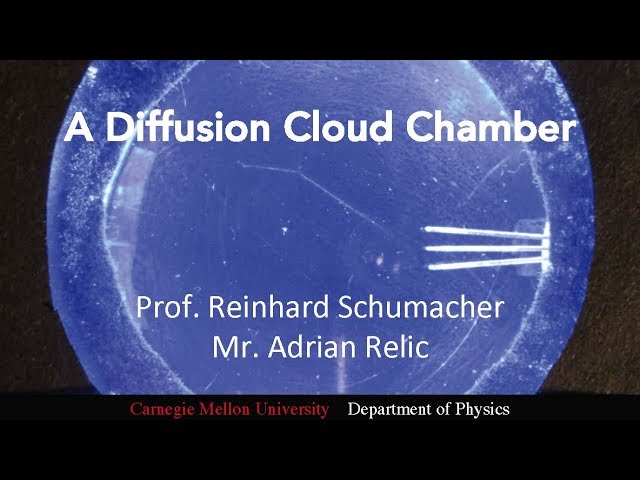
A diffusion cloud chamber visualizes the paths of charged subatomic particles through condensation trails in a supersaturated alcohol vapor-air mixture. Charged particles ionize the vapor along their trajectory, creating ions that act as condensation nuclei, forming visible droplet tracks. Alpha particles from a 2% thorium alloy rod produce dense, short tracks within about 4 cm of the source, with track density increasing toward the end of their path due to greater ionization as they slow down. Beyond 10 cm, other particles are observed: muons and energetic electrons leave faint, straight tracks; low-energy electrons and beta particles produce faint, tangled tracks; alpha particles from radon decay may also appear at greater distances. The chamber uses dry ice beneath the floor to establish a steep vertical temperature gradient and felt strips soaked in 95% ethanol to supply vapor. The viewing area is 51 square centimeters, marked with "+" signs every 10 cm for scale. The setup was designed to qualitatively demonstrate particle presence, with potential for more precise measurement techniques. The technology was originally developed by C.T.R. Wilson, who won the 1927 Nobel Prize for his work on cloud formation and particle detection. The demonstration is supported by references to scientific literature on diffusion cloud chambers and radon measurement. A Kodak Ektagraphic III projector with a special slide minimizes glare during viewing.
Click to watch →
How does a diffusion cloud chamber work?
40.4K
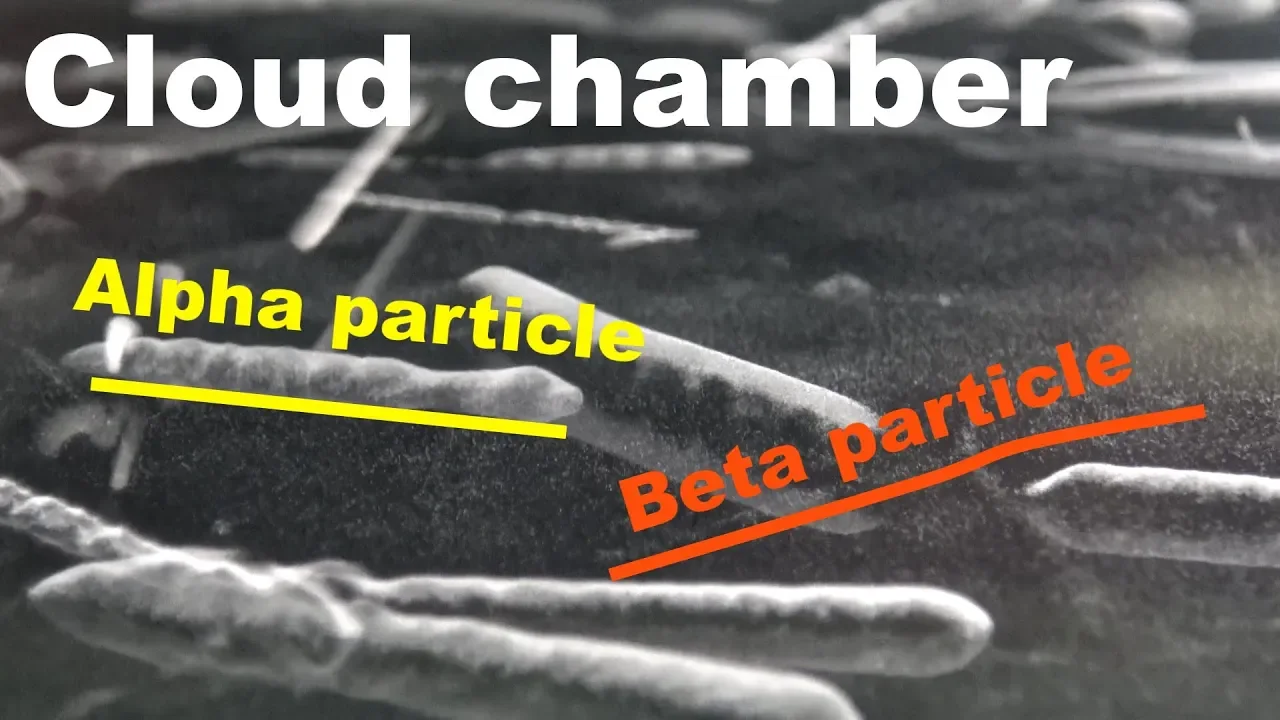
A diffusion cloud chamber makes invisible ionizing radiation visible by creating supersaturated alcohol vapor; when charged particles like alpha or beta particles pass through, they ionize air molecules, which then act as condensation nuclei and form visible tracks of alcohol droplets along the particle's path, with alpha particles producing wide, short tracks and beta particles producing long, thin, curved tracks.
Click to watch →
Radioactivity lesson 3: Cloud chambers, electroscope, photographic emulsion as detectors
170
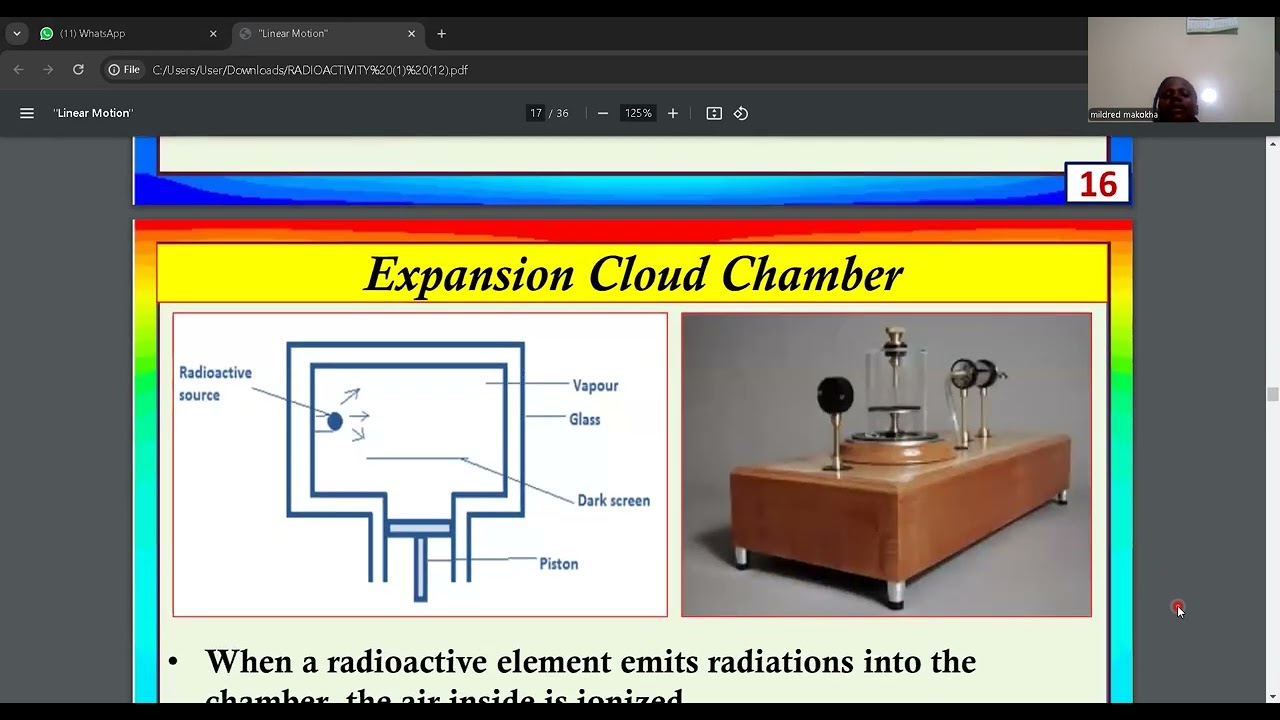
A diffusion cloud chamber consists of two compartments with dry ice at the bottom to create cold temperatures. Alcohol vapor diffuses upward toward the blackened surface. Radiation from a source ionizes the air, creating ions. The alcohol vapor condenses on these ions, forming tracks. An electric field created by rubbing the perspex lid makes tracks more visible. Alcohol is preferred over water because it is highly volatile and evaporates quickly.
Click to watch →
A Diffusion Cloud Chamber
22K
A diffusion cloud chamber detects ionizing radiation by creating supersaturated alcohol vapor that forms visible tracks when charged particles pass through. The system uses thermoelectric cooling (Peltier plates) to achieve temperatures below -25°C, with a CPU heatsink dissipating heat. Key components include a felt ring impregnated with isopropyl alcohol, a clear plastic ring to stabilize convection currents, and LED illumination. The chamber works by creating a temperature gradient where vapor becomes supersaturated near the cold surface. Different radioactive sources produce distinct track patterns: alpha particles create sharp, straight tracks about 3.8 cm long, while beta particles produce short, diffuse tracks that appear and disappear quickly due to lower ionization density.
Click to watch →
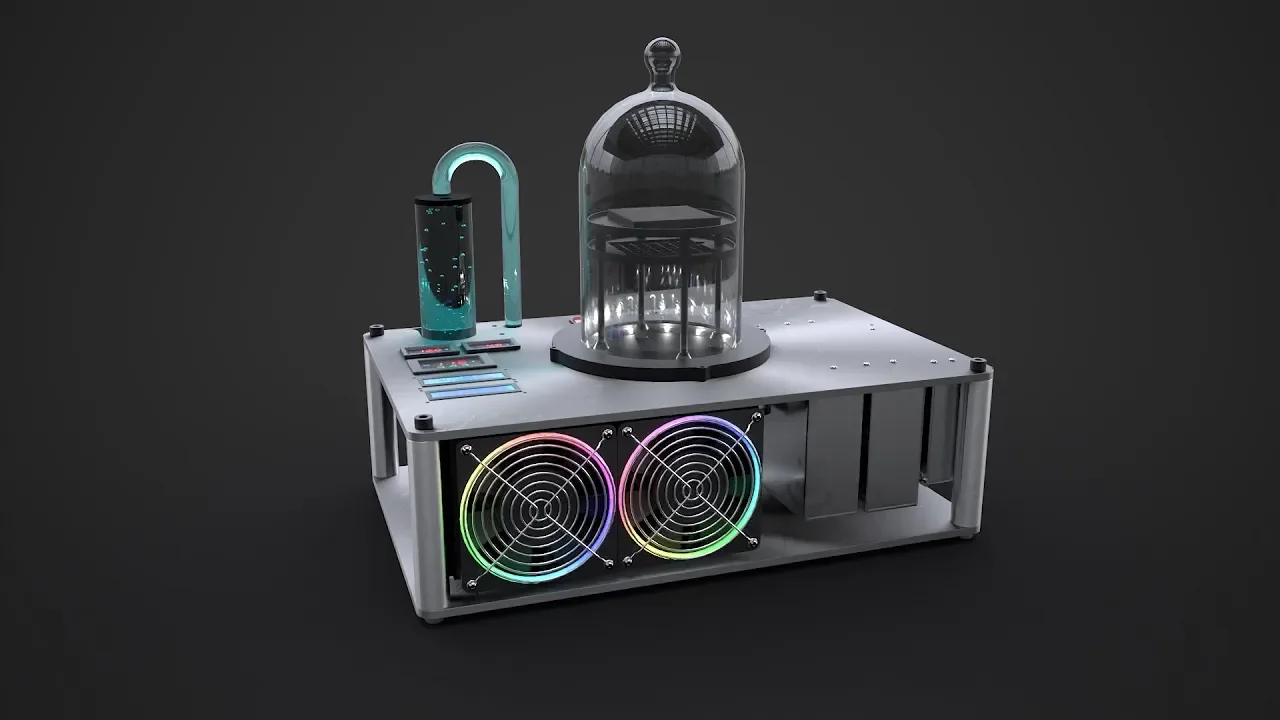
Wilson Diffusion Cloud Chamber - S03E10
46.8K
A Wilson diffusion cloud chamber detects ionizing radiation by creating a supersaturated alcohol vapor atmosphere that condenses along the paths of charged particles, revealing invisible radiation such as alpha particles (short, fat tracks from helium nuclei), beta particles (thin, curved tracks from electrons or positrons), and cosmic muons (long, straight tracks from high-energy particles from space), with the chamber requiring extreme cold temperatures (around -30°C) and high voltage to function effectively.
Click to watch →
Deep Dive
The principles of electromagnetic interaction and ionization, where high-energy charged particles strip electrons from gas atoms along their travel path.
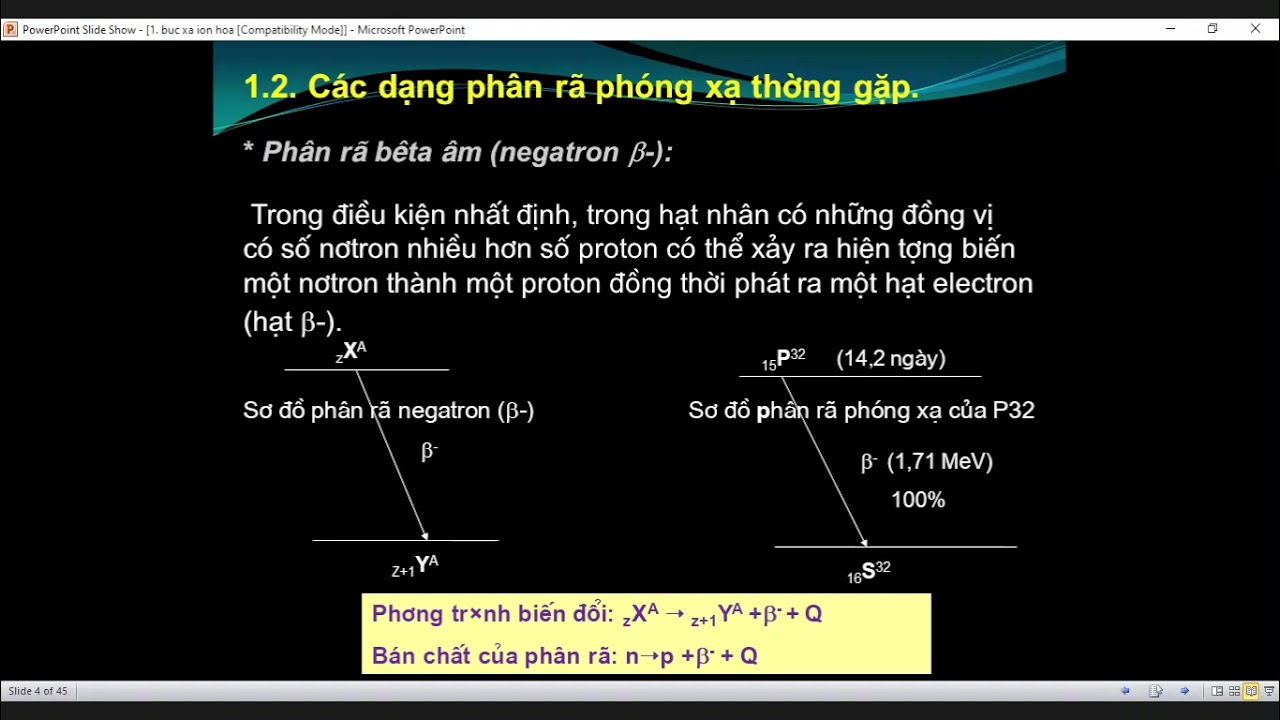
Lý sinh - Chương 7: Bức xạ ion hóa & cơ thể sống - 31/12/2021
3.8K
Charged particles (alpha, beta, protons) interact with matter through: (1) Excitation - energy transferred to electrons, raising them to higher energy levels; (2) Ionization - energy sufficient to eject electrons from atoms; (3) Bremsstrahlung - deceleration of charged particles near nuclei produces X-rays; (4) Nuclear reactions - interactions with atomic nuclei. These interactions cause continuous energy loss along the particle's path.
Click to watch →

Interaction of charged particle with matter(Nucleus and atom)|Nuclear Physics|urdu/hindi
699
Charged particles can ionize atoms by transferring sufficient energy to eject electrons completely from the atom. When an electron is ejected, it creates a vacancy (hole) in the electron shell, resulting in the formation of an ion. The type of interaction (excitation or ionization) depends on the energy of the incoming particle.
Click to watch →

Space charge Effect
162
Charged particles lose energy in matter by ionizing and exciting atoms. Ionization occurs when particles interact with orbital electrons, requiring 33.78 eV to produce an ion pair in air. Secondary ionization produces delta rays when ejected electrons cause further ionization. Specific ionization—the number of ion pairs per unit path length—depends on particle charge and energy. Higher charge particles like alpha particles have lower velocity and higher specific ionization than protons because they interact more frequently with medium atoms.
Click to watch →
![The Various Interactions of Charged Particles with Matter [L14]](https://i.ytimg.com/vi_webp/CsNNo7A-bTs/maxresdefault.webp)
The Various Interactions of Charged Particles with Matter [L14]
3.7K
Charged particles (alpha, beta minus, beta plus) lose energy through Coulomb interactions with atoms and molecules. Two primary effects occur: excitation (electron moves to higher shell without removal) and ionization (electron is completely ejected). The energy lost by the particle equals the electron's binding energy plus its kinetic energy. Secondary electrons with sufficient energy become delta rays, causing additional ionizations. Inner shell ionization produces characteristic x-rays or Auger electrons when vacancies are filled. Bremsstrahlung occurs when particles penetrate electron clouds and accelerate near nuclei, emitting electromagnetic radiation. The spectrum is continuous, with photon energies ranging from near-zero to the particle's initial kinetic energy.
Click to watch →
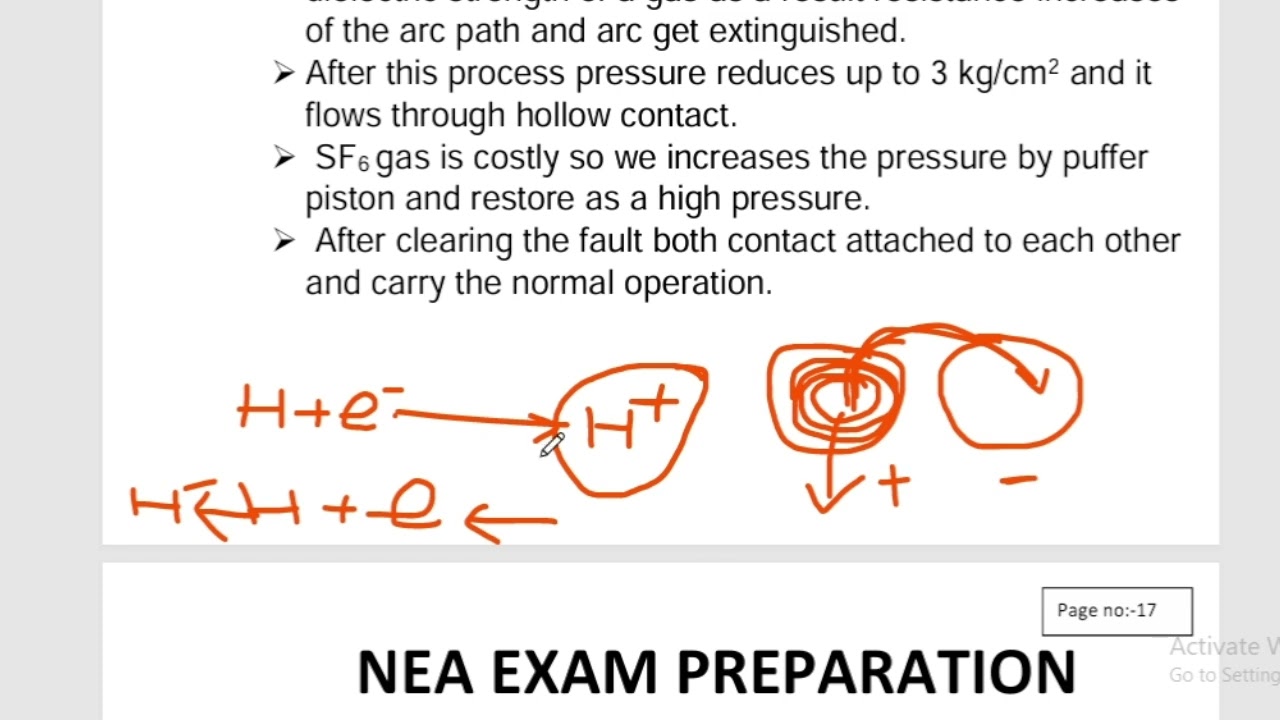
circuit breaker part-2
146
When high-energy electrons collide with gas molecules, they can knock electrons out of the molecules, creating positive ions and additional free electrons. This process, called impact ionization, increases the conductivity of the gas along the arc path.
Click to watch →
Prerequisite Knowledge
- Concept 01The basic structure of an atom, specifically understanding that a helium nucleus consists of two protons and two neutrons (often referred to as an alpha particle).
- Concept 02The concept of cosmic radiation, distinguishing between primary cosmic rays (originating from outer space) and secondary cosmic rays (produced by atmospheric interactions).
- Concept 03The operational mechanics of a diffusion cloud chamber, particularly how a supersaturated alcohol vapor condenses around ions to make subatomic particle tracks visible.
- Concept 04The principles of electromagnetic interaction and ionization, where high-energy charged particles strip electrons from gas atoms along their travel path.
Subsequent Learning
- Step 01Advanced particle detection technologies, such as bubble chambers, spark chambers, and modern silicon trackers used in particle accelerators.
- Step 02The physics of high-energy particle collisions, including conservation laws (energy, momentum, charge) and the production of new secondary particles through spallation.
- Step 03The astrophysical origins and acceleration mechanisms of ultra-high-energy cosmic rays, such as Fermi acceleration in supernova remnants and active galactic nuclei.
- Step 04The practical impacts of cosmic radiation on human technology, including radiative hazards for astronauts and single-event upsets (bit flips) in aerospace electronics.
Rare Capture
Event Details
Rare Capture
0:04Playing Section
- 1
Primary cosmic ray hits Earth's surface, captured in cloud chamber.
- 2
Track identified as a doubly charged helium nucleus by direct comparison.
- 3
Event shows the particle colliding with an atom, splitting a secondary particle.
Terrestrial Background and Secondary Particle Misidentification
While capturing a 'primary' cosmic ray (such as a helium nucleus) in a ground-level cloud chamber is a compelling claim, physicists note that primary cosmic rays rarely reach the Earth's surface intact due to atmospheric shielding. Almost all cosmic rays detected at sea level are secondary particles, such as muons, created by collisions in the upper atmosphere. Furthermore, thick, highly ionizing tracks in a cloud chamber are far more likely to be alpha particles emitted from local terrestrial sources, such as the decay of ambient radon gas, rather than extraterrestrial visitors. Without specialized deep-underground shielding or high-altitude deployment, definitively proving a track is a primary cosmic ray rather than local background radiation is highly challenging.
Deep Dive
Advanced particle detection technologies, such as bubble chambers, spark chambers, and modern silicon trackers used in particle accelerators.

1999 Nobel Prize lecture by J. G. Veltman in physics
235
Two revolutionary detection instruments transformed particle physics research. Bubble chambers, invented by Donald Glaser while drinking beer, contain superheated liquid near boiling point; charged particles create visible bubbles along their tracks, photographed for analysis. Spark chambers use parallel metal plates with gas between them; charged particles ionize gas molecules, and high voltage creates sparks revealing particle paths. Both instruments only detect charged particles directly, while neutral particles require indirect detection methods. Spark chambers offer the critical advantage of precise triggering capability, allowing researchers to select rare events of interest. Large bubble chambers like CERN's European Hydrogen Bubble Chamber required complex infrastructure, taking pictures at rates of one every three seconds. These instruments enabled systematic study of particle interactions and properties.
Click to watch →

The Cloud Chamber: Revealing a Hidden World
11.3K
Cloud chambers were largely replaced in the 1950s by bubble chambers invented by Donald Glaser in 1952. Bubble chambers work similarly but use pressurized liquid hydrogen instead of supercooled vapor; particles passing through create streams of vapor bubbles along their tracks. Later, spark chambers and drift chambers (similar to Geiger counters with charged plates) replaced bubble chambers. Today, solid-state silicon sensors serve the same purpose. Each generation improved upon previous technology, with modern detectors using computerized sensors to track cascades of electric discharges created when particles pass through spaces between charged plates.
Click to watch →

НОВЫЙ ДЕТЕКТОР ДЛЯ ЧАСТИЦ ТЁМНОЙ МАТЕРИИ (беседа с будущим нобелевским лауреатом)
23.5K
Particle detectors evolved from simple spark chambers to sophisticated bubble chambers. Spark chambers use two electrodes with high voltage; when a charged particle passes through, it creates a spark along its path. Bubble chambers use superheated liquid (originally liquid hydrogen) where particles create visible tracks of bubbles as they ionize the medium. These detectors allowed scientists to visualize particle interactions and became essential tools in particle physics research, enabling discoveries of new particles and understanding of fundamental interactions.
Click to watch →

UKRN webinar: OpenMAPP UK - Meta-Analysis and reinterpretation in particle physics
282
Particle detection technology evolved from simple cloud chambers (discovered by CTR Wilson in Scotland) to sophisticated bubble chambers and finally to modern silicon-based detectors. Modern detectors like ATLAS at CERN are massive structures (20m high, 40m long) with multiple layers designed to measure different properties of particles passing through, allowing physicists to reconstruct collision events like examining broken watch components to understand the original mechanism.
Click to watch →
Particle Detectors and Accelerators
4.2K
Particle detectors like cloud chambers, bubble chambers, and spark chambers enable scientists to observe subatomic particles by making invisible tracks visible through condensation or ionization; particle accelerators like CERN's Large Hadron Collider use electric fields to accelerate charged particles and magnetic fields to steer them in circular paths, recreating extreme conditions to study fundamental physics and discover particles such as the Higgs boson.
Click to watch →
Deep Dive
The physics of high-energy particle collisions, including conservation laws (energy, momentum, charge) and the production of new secondary particles through spallation.
LHC : le Grand Collisionneur #09 Science
314.2K
The LHC maintains ultra-high vacuum (1×10^-10 Pascals) where virtual particle-antiparticle pairs constantly appear and disappear. High-energy collisions create conditions millions of times hotter than the Sun's core, transforming kinetic energy into mass via E=mc². The Higgs boson requires at least 125 GeV of energy to be created, explaining why the LHC's 14 TeV collisions are necessary. Protons consist of three quarks held together by gluons, but quark rest mass accounts for only 1% of proton mass—the remaining 99% comes from binding energy creating pressures exceeding neutron star densities by a factor of 10. When protons collide at 14 TeV, energy distributes among many quarks and gluons, creating numerous smaller collisions. The probability distribution shows many low-energy interactions and fewer high-energy ones, explaining why discovering rare particles requires billions of collisions.
Click to watch →

El Gran Colisionador de Hadrones: Una mirada al mundo de las partículas elementales
217
When particles collide, kinetic energy converts to mass, creating new particles. Conservation of energy and momentum allows reconstruction of collision events. The total energy before equals total energy after, including new particle masses and kinetic energy. Momentum is measured by trajectory curvature in magnetic fields. This enables identification of particles by their energy and momentum signatures, revealing fundamental physics processes.
Click to watch →

RHIC - Exploring the Universe Within
1.6K
At the heart of RHIC's operation lies Einstein's theory of relativity. When particles travel at near-light speeds (186,000 miles per second), most energy goes to increasing mass rather than speed. Gold ions, stripped of electrons to become heavy ions, are accelerated through multiple stages: first by a linear Tandem Van de Graaff accelerator using static electricity, then through a booster accelerator, and finally by the Alternating Gradient Synchrotron before reaching RHIC. These ions form thinned streams circulating in opposite directions, with relativistic effects causing them to appear flattened. The collisions concentrate all mass and energy into brief, hot dense blobs that recreate early-universe conditions.
Click to watch →

Tema 09 - Cinemática Relativística | Aula 01 - Colisões
911
Two fundamental conservation laws are essential for analyzing particle collisions: (1) Conservation of Energy - the total energy before the collision equals the total energy after the collision, regardless of the number of particles; (2) Conservation of Total Momentum - the sum of all momenta before the collision equals the sum of all momenta after the collision. These laws can be applied in any reference frame, including the laboratory frame or the center of mass frame.
Click to watch →

18.7 Modern Physics - XII Physics, AKUEB (Urdu/Hindi)
489
Pair production demonstrates that pure energy can convert into matter particles. A gamma ray photon converts into an electron and positron near a heavy nucleus. The electron has negative charge, while the positron has positive charge but identical mass. This requires minimum photon energy of 1.02 MeV. Three fundamental conservation laws govern all particle interactions: (1) Energy conservation: total energy before equals total energy after; (2) Charge conservation: total electric charge remains unchanged; (3) Momentum conservation: total momentum vector remains constant. The heavy nucleus absorbs recoil momentum to conserve momentum. These laws are fundamental principles that all particle interactions must obey.
Click to watch →
Deep Dive
The astrophysical origins and acceleration mechanisms of ultra-high-energy cosmic rays, such as Fermi acceleration in supernova remnants and active galactic nuclei.

Засов А.В. - Общая астрофизика I - 8. Космические лучи
183
Potential sources of ultra-high-energy cosmic rays include supernova remnants, pulsars, and active galactic nuclei. Observations show correlations between cosmic ray arrival directions and nearby energetic objects like the Centaurus A galaxy (with an active nucleus) and M82 (with intense star formation). The Fermi acceleration mechanism explains how cosmic rays gain energy through repeated interactions with moving magnetic irregularities. Particles gain energy when colliding with irregularities moving toward them and lose energy when colliding with irregularities moving away. Statistically, particles encounter more approaching irregularities than receding ones, leading to net energy gain. This mechanism operates in supernova remnant shocks and other astrophysical environments with turbulent magnetic fields.
Click to watch →
A Origem Dos Raios Cósmicos de Alta Energia - Space Today TV Ep.877
8.2K
Astronomers have determined that ultra-high-energy cosmic rays (above 8 × 10^18 electron volts) originate from extragalactic sources, not from our Milky Way galaxy, based on research conducted at the Pierre Auger Observatory in Argentina using Cherenkov radiation detection technology; this discovery was published in the journal Science and provides insights into extreme astrophysical phenomena such as active galactic nuclei that can accelerate particles to extraordinary speeds.
Click to watch →
It Came From the Local Void? The Amaterasu Particle with John Matthews and Toshihiro Fujii
71.6K
Ultra-high-energy cosmic rays represent one of physics' greatest mysteries. The Oh My God Particle (1991) and Amasu Particle (2021) both violated fundamental expectations: they exceeded the GZK limit (10^19.6 eV), meaning they should have lost energy traveling through space, yet came from empty regions like the local void. These particles are at least five orders of magnitude more energetic than supernovae can produce, yet no known astrophysical process explains their acceleration. Scientists are investigating active galactic nuclei, dark matter decay, and other exotic hypotheses. The fundamental question remains: what cosmic accelerators can produce particles with energies exceeding all known natural phenomena?
Click to watch →

How Supernovas Act as Cosmic Particle Accelerators
295.5K
Supernovae accelerate protons to ~10^17 eV, but highest-energy cosmic rays exceed this by 100x. The Pierre Auger Observatory shows ultra-high-energy cosmic rays scatter across the sky, correlating with cosmic structure rather than the Milky Way, indicating extragalactic origins. Potential sources include magnetars, supermassive black holes in active galactic nuclei, hypernovae, gamma-ray bursts, and galaxy-scale shocks. Active galactic nucleus jets create giant lobes spanning hundreds of thousands of light-years where weak magnetic fields can still accelerate particles to extreme energies through the Fermi mechanism.
Click to watch →

Promieniowanie kosmiczne - Astronarium 120
268.2K
Cosmic rays are high-energy particles (protons, alpha particles, nuclei) traveling near light speed through space. The 'Oh My God Particle' (1991) carried energy 30 million times greater than Earth's largest accelerators. Detection requires indirect methods since charged particles are deflected by magnetic fields. Fermi acceleration at supernova shock fronts explains how particles gain energy through incremental interactions with turbulent magnetic fields. Standard galactic sources have limited maximum energies; ultra-high-energy cosmic rays likely originate from supermassive black holes at galactic centers or active galactic nuclei. Multi-messenger astronomy combines gamma-ray and neutrino observations (which travel straight) with cosmic ray data to identify sources.
Click to watch →
Deep Dive
The practical impacts of cosmic radiation on human technology, including radiative hazards for astronauts and single-event upsets (bit flips) in aerospace electronics.

The Worst Case Scenario For Artemis II Is Way Scarier Than You Think
13.4K
Single event upsets (SEUs) represent a radiation hazard that most people never think about but that spacecraft designers lose sleep over. A single event upset occurs when a high-energy particle passes through computer memory and avionics, flipping a single bit from zero to one or vice versa. One bit in the right place can corrupt a command sequence; one bit in the wrong register can cause the spacecraft to execute a false command. During the August 1972 solar event, if modern avionics had been present, flight computers would have experienced hundreds of single event upsets. The radiation environment is not just a hazard to human tissue but also to the systems that keep human beings alive.
Click to watch →

SpaceX construit son propre ACCÉLÉRATEUR de PARTICULES ! - Le Journal de la Starbase #338 - Le JDE
29.4K
Beyond low Earth orbit, astronauts face three major radiation hazards: galactic cosmic rays (ultra-energetic particles from outside our solar system that penetrate virtually any shielding), Van Allen belts (trapped particles requiring traversal twice during lunar missions), and solar events (potentially lethal particle storms from solar flares). Artemis 1 measurements showed radiation levels vary by factor of 4 depending on location inside spacecraft. For extended missions to Mars, accumulated doses pose serious cancer, cataract, cardiovascular, and degenerative disease risks. Modern digital electronics face single event effects where energetic particles can cause bit inversions, circuit failures, or permanent damage. SpaceX's new cyclotron enables comprehensive testing with protons and heavy ions to identify vulnerabilities and develop protection strategies including shielding, redundancy, and error correction.
Click to watch →
El Universo es Hostil con las Computadoras
4.4M
This section examines cosmic ray effects across technological domains. Cosmic rays create particle showers when primary rays collide with atmospheric molecules 25 km above Earth. IBM estimates one bit change per 256 MB RAM monthly from neutron-induced errors. In 2008, Qantas Flight 72 experienced a 200-meter dive when cosmic rays caused ADIRU bit errors, misidentifying altitude as angle of attack. Radiation increases with altitude: 0.5 μSv/h at 5,500m, exceeding 3 μSv/h at 10,000m. Spacecraft employ radiation-hardened electronics and quadruple-redundant systems. The Perseverance rover uses PowerPC processors designed for 40x more radiation tolerance. Throughout Earth's history, cosmic rays may have contributed genetic mutations for natural selection, demonstrating their pervasive influence on both technology and biology.
Click to watch →
The Universe is Hostile to Computers Reaction
4.6K
Cosmic ray effects extend beyond computing to transportation and human biology. At cruising altitude, radiation increases single event upset probability by 10-30 times compared to ground level. The 2008 Airbus A330 incident demonstrates catastrophic consequences: a bit flip in the Inertial Reference Unit caused altitude data to be mislabeled as angle of attack, triggering simultaneous over-speed and stall alarms. The plane pitched down 200 meters in 20 seconds, injuring 119 people. Spacecraft require specialized computing: the Perseverance rover uses a 2001 PowerPC computer radiation-hardened to withstand 40 times ordinary computer radiation. The Space Shuttle employed four redundant computers running identical software, with three overruling any single computer experiencing soft errors. During mission STS-48, 161 bit flips were detected. Humans can perceive cosmic radiation through visual flashes when heavy particles pass through the eyeball or optic nerve, a phenomenon observed by astronauts. This demonstrates that cosmic radiation affects both electronics and human physiology, with the same particles that flip bits in computer memory potentially causing mutations in DNA over evolutionary timescales.
Click to watch →
The Universe is Hostile to Computers | xQc Reaction
524.6K
Cosmic rays—high-energy particles from space that originate from supernovae, black holes, and other astrophysical sources—can cause single event upsets (SEUs) in electronic systems by striking transistors and flipping bits in computer memory, potentially causing errors ranging from minor glitches to catastrophic failures in critical systems like aircraft computers and spacecraft electronics.
Click to watch →
Rare Capture
Event Details
Rare Capture
0:04- 1
Primary cosmic ray hits Earth's surface, captured in cloud chamber.
- 2
Track identified as a doubly charged helium nucleus by direct comparison.
- 3
Event shows the particle colliding with an atom, splitting a secondary particle.
Terrestrial Background and Secondary Particle Misidentification
While capturing a 'primary' cosmic ray (such as a helium nucleus) in a ground-level cloud chamber is a compelling claim, physicists note that primary cosmic rays rarely reach the Earth's surface intact due to atmospheric shielding. Almost all cosmic rays detected at sea level are secondary particles, such as muons, created by collisions in the upper atmosphere. Furthermore, thick, highly ionizing tracks in a cloud chamber are far more likely to be alpha particles emitted from local terrestrial sources, such as the decay of ambient radon gas, rather than extraterrestrial visitors. Without specialized deep-underground shielding or high-altitude deployment, definitively proving a track is a primary cosmic ray rather than local background radiation is highly challenging.
The basic structure of an atom, specifically understanding that a helium nucleus consists of two protons and two neutrons (often referred to as an alpha particle).
The concept of cosmic radiation, distinguishing between primary cosmic rays (originating from outer space) and secondary cosmic rays (produced by atmospheric interactions).
The operational mechanics of a diffusion cloud chamber, particularly how a supersaturated alcohol vapor condenses around ions to make subatomic particle tracks visible.
The principles of electromagnetic interaction and ionization, where high-energy charged particles strip electrons from gas atoms along their travel path.
Advanced particle detection technologies, such as bubble chambers, spark chambers, and modern silicon trackers used in particle accelerators.
The physics of high-energy particle collisions, including conservation laws (energy, momentum, charge) and the production of new secondary particles through spallation.
The astrophysical origins and acceleration mechanisms of ultra-high-energy cosmic rays, such as Fermi acceleration in supernova remnants and active galactic nuclei.
The practical impacts of cosmic radiation on human technology, including radiative hazards for astronauts and single-event upsets (bit flips) in aerospace electronics.
94.9K views1.8Klikes3:02@wayneschmidt490Original Release: 2015-05-04
cosmic rays are extremely high energy particles from deep space typically uh protons a uh nucleus from a hydrogen atom or uh alpha particles the nucleus from a helium atom which is two protons and two neutrons or extremely high energy photons the vast majority of cosmic rays interact in our up upper atmosphere spere and are destroyed and create secondary cosmic rays however every once in a while a primary cosmic ray will make it down to Earth's surface I was extremely fortunate to capture one of these cosmic rays primary cosmic rays as it passed through my cloud chamber here's what the track looks like the thickness straightness and brightness of the track makes it easy to identify it as the doubly positively charged nucleus from a helium atom this is by direct comparison to alpha particles which I've seen many times In This Cloud chamber what's really remarkable is that not only did I get lucky enough to capture a primary cosmic ray I also captured it colliding with an atom and splitting a second alpha particle off and they both continue onward while it looks as if the particle appears and then uh disintegrates within the cloud chamber in fact it passed all the way through the walls of the chamber and out the other side the reason it looks like it starts and stops within the Cloud chamber is that it passed through the active uh sensing area of the cloud chamber at a slight angle so starting at the lower left it was above the uh active area entered it and at the end of the fork the particles haven't stopped they've just gone downward out of the active area again this is an extremely rare event to capture in a cloud chamber and I'm very lucky to have captured if you'd like to see how to build a cloud chamber like the one I made to capture this particle uh the link at the top of this page will show you how to do so thank you for watching
Up Next
100:39
Roger Penrose on Consciousness & the Physics of the Mind
@JordanBPeterson
2.1M views•2022-04-14

12:53
21cm Hyperfine Transition in Neutral Hydrogen: Radio Astronomy Basics
@AaronRobertParsons
12.4K views•2011-10-13

32:32
NMR Spin Physics I: Zeeman Effect, Resonance Condition & Larmor Frequency
@nptel-indianinstituteofsci8064
2.3K views•2024-01-17

27:14
Entropy and the Second Law of Thermodynamics Explained
@veritasium
27.5M views•2023-07-01
Related Study Plans & Knowledge Roadmaps
Structured learning paths in Physics
physics
Nuclear Physics (Decay, Fission & Reactors)
01Atomic Structure and the Binding Force
02Radioactive Decay and Half-Life
03Nuclear Fission Mechanics and Chain Reactions
+ 2 more learning modules
12h5 modules
Explore Roadmap
physics
Soft Matter (Polymers, Colloids & Rheology)
01Foundations of Soft Matter & Thermal Forces
02Polymer Physics and Macromolecules
03Colloids, Surfactants, and Self-Assembly
+ 2 more learning modules
38h5 modules
Explore Roadmap
physics
Analytical Mechanics: Lagrangian & Hamiltonian
01Mathematical Foundations: Calculus of Variations
02From Newtonian Mechanics to Constraint Dynamics
03The Principle of Least Action & Lagrangian Mechanics
+ 3 more learning modules
28h6 modules
Explore Roadmap
physics
General Relativity (Spacetime & Cosmology)
01Foundations of Relativity: Special Relativity
02The Geometry of Spacetime: Equivalence Principle & Curvature
03Einstein's Field Equations: The Mathematics of Gravity
+ 2 more learning modules
55h5 modules
Explore Roadmap