





















America's original sin is not slavery or genocide, but the belief that white people ought to matter more than others—the 'value gap'—which has distorted democracy and requires confronting the lies that sustain national innocence to achieve genuine multi-racial democracy.
Dr. Eddie Glaude Jr. — Democracy and Race in America Q&A — University of New England Keynote
Added:Familiarity with the life, essays, and social critique of James Baldwin, particularly his views on the American racial landscape.
An understanding of the history of American democracy, including the historical contradictions between democratic ideals and systemic racial inequality.
Conceptual knowledge of systemic racism and institutional bias as distinct from individual prejudice.
Basic awareness of Dr. Eddie Glaude Jr.'s concept of the 'value gap'—the societal belief that white lives are valued more than others.
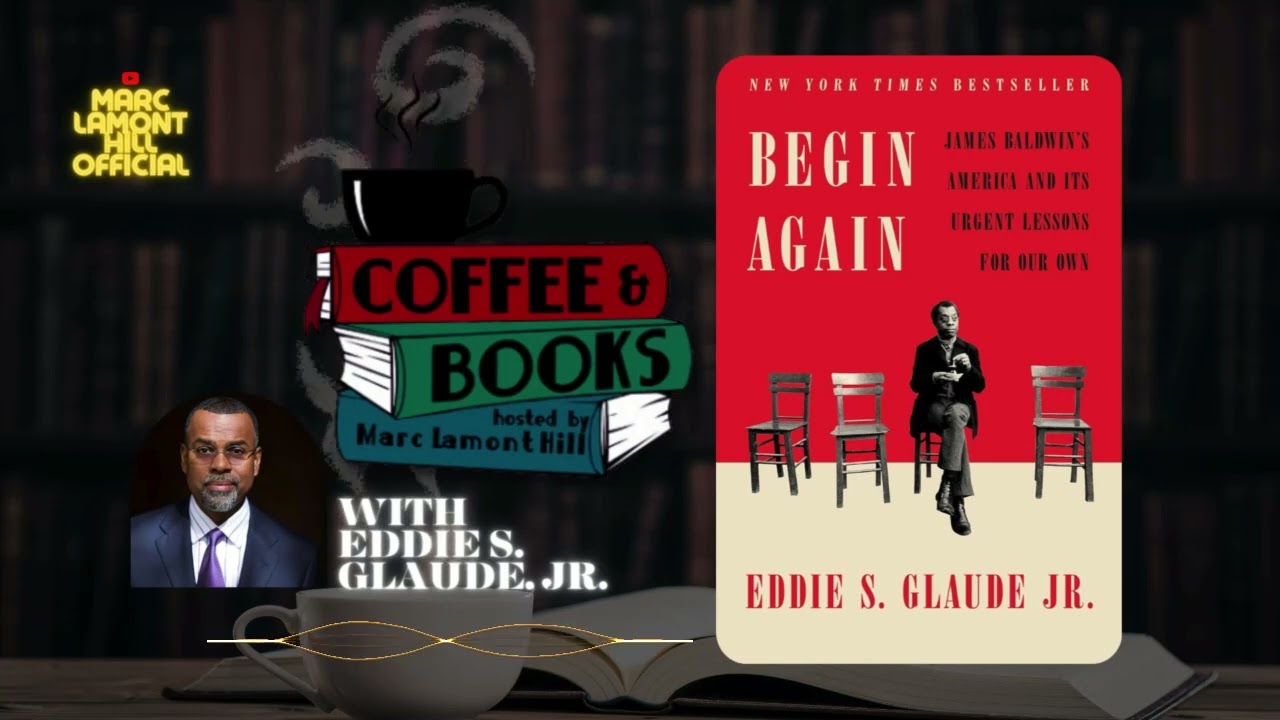
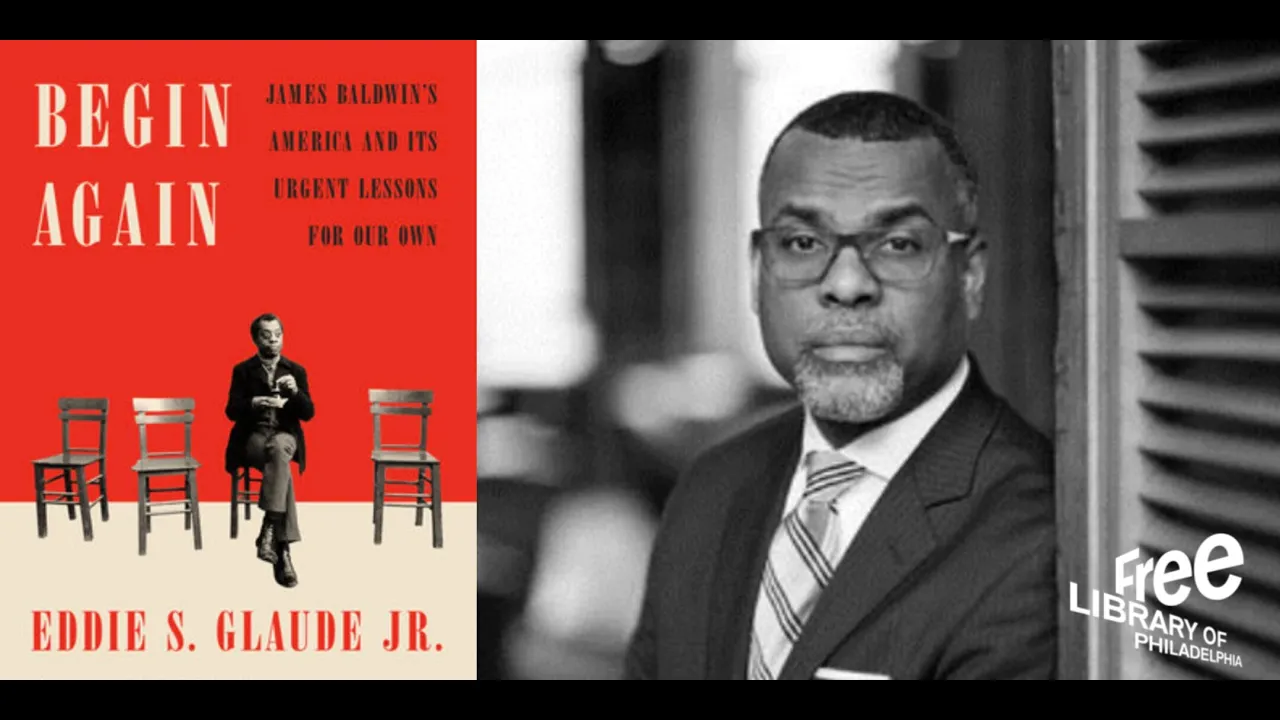
An in-depth study of Dr. Eddie Glaude Jr.'s book, 'Begin Again: James Baldwin's America and Its Urgent Lessons for Our Own'.
Exploration of contemporary policy debates surrounding voting rights, systemic reform, and the realization of a truly multiracial democracy.
Comparative analysis of mid-20th-century civil rights discourse and modern racial justice movements.
Critical examination of how literary criticism and political philosophy intersect in African American political thought.
10.4K views193likes1:16:15Original Release: 2021-03-01
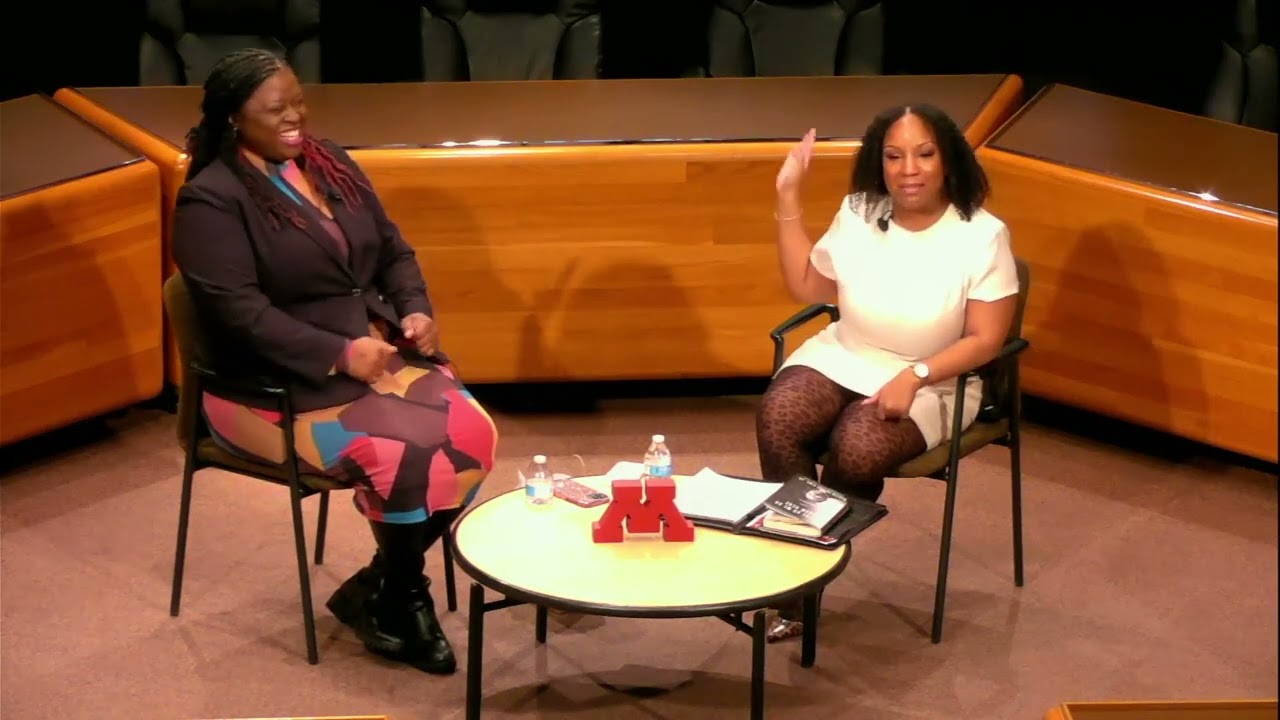
Good evening, everyone, and thank you for joining us. I'm Erica Russo, the director of Intercultural Student Engagement here at the University of New England.
I will be brief, as we are all excitedly awaiting our keynote speaker, Professor Eddie Glaude Jr.
I want to first thank our students, in particular the students of the Cultural Council, the members of the Brothers of Color United and the Black Student Union. They were adamant about having a Black History event, and of course they wanted the best.
So, I promised them about that I would try my best.
But, I didn't do this alone, and there are so many people that work to support, advocate for, and ensure the success of our students.
There are too many to name, but to all of you, I sincerely express my gratitude.
I want to take a minute to give a shout-out to a person in the audience that is near and dear to our Nor'easters, Dr. Theodore Johnson.
Dr. Johnson joined us last January and facilitated a discussion with Leader Stacey Abrams for our annual MLK celebration.
And when I mentioned to Dr. Johnson about this event, he sent his well wishes and told me that Professor Glaude wrote a blurb about or for his latest book, When the Stars Begin to Fall. Um so, thank you for logging in tonight, Dr. Johnson.
Um as you can imagine, Dr. Glaude has a full schedule.
So, we are especially appreciative that he is joining us on a Friday evening.
Following Professor Glaude's address, we will have a question and answer period facilitated by Dr. Chris Hunt, our Associate Provost of Community Equity and Diversity, and Mr. Will Wood, who is the president and founder of the Brothers of Color.
So, please drop any questions in the Q&A box if you're logged in through Zoom or on our Facebook live stream.
Because of the style of this webinar, I can't physically see you all right now.
So, next week I will be contacting a few lucky students that have won Dr. Glaude's latest book, Begin Again.
So, without further ado, I want to welcome Dr. James Herbert, our beloved president, to introduce Professor Eddie Glaude Jr.
Thank you, all.
So, thank you so much, Erica. I appreciate it, and thank you for your efforts in bringing Professor Glaude to us this evening. I really appreciate it.
And um so, welcome, everyone. I'm so pleased, uh Professor Glaude, that you're here with us tonight, and I want to extend a warm welcome on behalf of the entire UNE community. Uh those of you who may not know him, although I I'm sure most of you do, Professor Eddie S. Glaude um is one of the nation's prominent scholars. Uh Professor Glaude, it's it's really an honor to have you with us here. I I wish that you were with us on one of our beautiful main campuses, and please make sure to come back and see us when it's safe to travel.
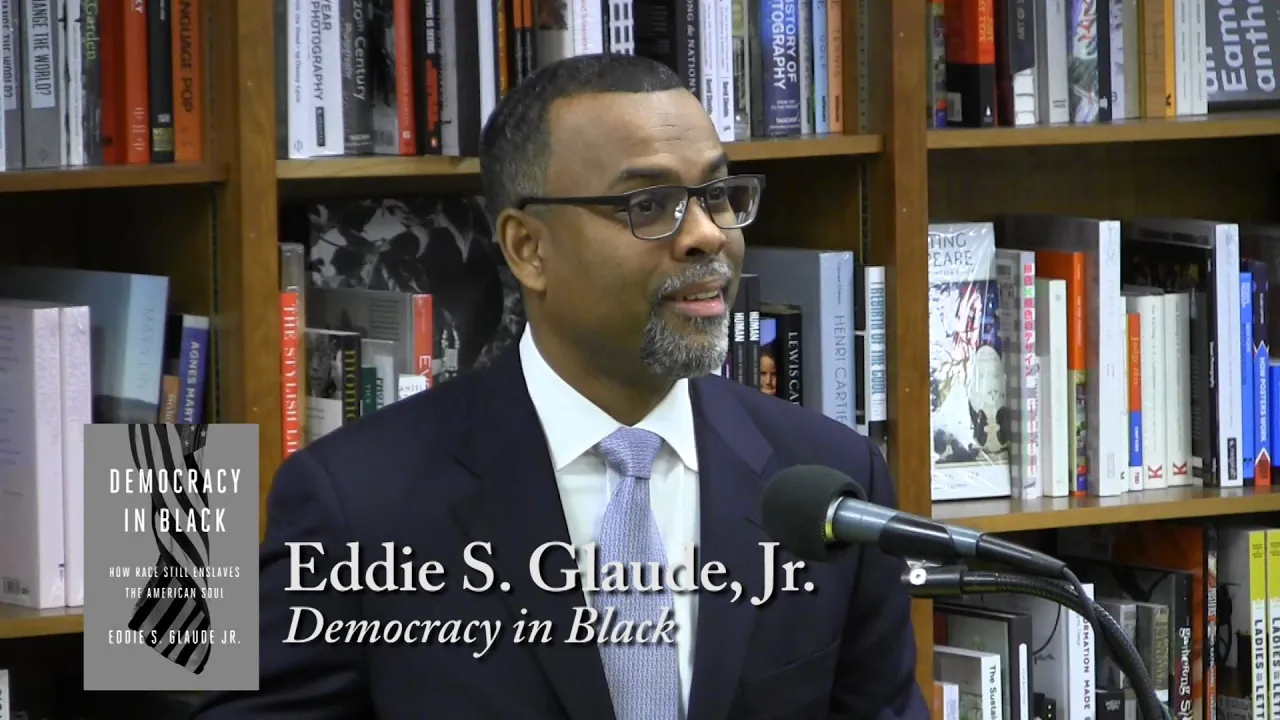
So, Professor Glaude is an author, political commentator, public intellectual, and a passionate educator who examines the complex dynamics of the American experience. He he's the author of many books, and I'm the proud owner of several of them. Uh they include Democracy in Black: How Race Still Enslaves the American Soul, In a Shade of Blue: Pragmatism and the Politics of Black America, and his most recent book, the New York Times bestseller, Begin Again: James Baldwin's America and Its Urgent Lessons for Our Own.
These books take a wide look at Black communities, the difficulties of race in the United States, and the challenges that we face as a democracy.
In his writing and his speaking, Glaude is an American critic in the tradition of James Baldwin and Ralph Waldo Emerson, confronting history and bringing our nation's complexities, vulnerabilities, and hopes into full view.
He underscores a vision of hope that is in in the words of one of his favorite quotes, W. B. Du Bois, not hopeless, but hopeful.
A bit hopeful. Glaude is the James S.
McDonald Distinguished Professor and Chair of the Department of African American Studies at Princeton University. He frequently appears in the media as a columnist in Time magazine and as an as an MSNBC contributor on programs like Morning Joe. I'm sure most of us have seen him there.
Um Deadline White House with Nicolle Wallace. He regularly appears on Meet the Press on Sundays.
Um Glaude also hosts Princeton's AAS Podcast, a conversation around the field of African American Studies and the Black experience in the 21st century.
A also a highly accomplished and respected scholar of religion, Glaude is a former president of the American Academy of Religions. Uh his book on religion and philosophy, his books include An Uncommon Faith: A Pragmatic Approach to the Study of African American Religion, African American Religion: A Very Short Introduction, and Exodus: Religion, Race, and Nation in Early 19th Century Black America. And the latter, by the way, was awarded the Modern Language Association's William Sanders Scarborough Book Prize.
Some like to describe Glaude as the quintessential Morehouse man, having left his home in Moss Point, Mississippi at age 16 to begin studies at the HBCU and alma mater of Dr. Martin Luther King Jr.
He holds a master's degree in African American Studies from Temple University and a PhD in religion from Princeton.
It is my sincere honor to introduce Professor Eddie Glaude Jr. to the University of New England. Professor Glaude, please take it from here. Thank you so much. President Herbert, thank you for that gracious and wonderful introduction. I really appreciate it.
It's such a delight to be here at the University of New England, at least virtually. I wish I was on campus to see how how beautiful I know how beautiful the campus is. Um but you know, hopefully in the near future we will be able to be together. I want to thank Erica Russell for all of the wonderful work that she's been doing on for your campus and you know, and for the issues that matter to us so much in these trying times. I also want to thank all the people who are working behind the scenes. I mean, our virtual world is is is a bit easier, uh but it still takes folks to to to make it happen. So, I want to thank Brother Lee and others who are behind the scenes orchestrating, moving the things to make it uh to make this moment um uh worth uh to let's let's let's put it this way, to to make sure that it happens without a glitch. So, let me just jump into this. Oh, I should say this, that I was I was so happy and delighted to hear Dr. Johnson is out in the Theodore Johnson is out in the audience. I I just grabbed the book, you know, the books are real behind me. So, this is a wonderful book, When the Stars Begin to Fall: Overcoming Racism and Renewing the Promise of America. I can't wait till it till until it hits the stands. So, let me just jump right into this. I want to begin with two epigraphs.
Uh one is from James Baldwin, and the other is from Ralph Waldo Emerson.
Uh Baldwin writes, "It is terrible to watch people cling to their captivity and insist on their own destruction.
I think black people have always felt this about America and Americans, and have always seen spinning above the thoughtless American head the shape of the wrath to come."
It's from No Name in the Street, published in 1972.
The second quotation comes from Ralph Waldo Emerson, Circles. His essay Circles, published in 1840. Quote, "Our culture is the predominance of an idea which draws after it this train of cities and institutions.
Let us rise into a new idea, and they will disappear. Let us rise into a new idea, and they will disappear."
I found myself recently, and it was prompted by a surprising request by Oprah Winfrey's book club, thinking about Alain Locke's 1924 essay, Enter the Negro.
A manifesto of sorts for the Harlem Renaissance. And as you know, the Harlem Renaissance was this extraordinary expression of black cultural genius in the early part of the 20th century. It was one among many Renaissances, right?
One in Chicago, one in Pittsburgh, across the the country in some ways.
But, the Harlem Renaissance was unique in some.
The book club wanted me to suggest a few texts that were central to the period.
Of course, I mentioned Alain Locke's anthology, The New Negro, and Jean Toomer's Cane, and Zora Neale Hurston's Their Eyes Were Watching God.
But, Locke's essay kept attracting my attention.
Not so much because of its powerful declaration of a new phase of black life, his account of a new kind of black subject with a maturing aesthetic and cultural voice stepping on the scene, or how the material shifts in African American life unleashed by the mass migration from rural countryside to cities, from south to north, made all of this possible, and what it all might have meant for American democracy. Instead, I was more interested in a formulation that actually served as the backdrop of Locke's analysis.
And that is what preceded the emergence of the so-called new Negro.
What occasioned and necessitated such a declaration in the first place?
And I kept returning to this quotation.
Locke writes, quote, old negro had long become more of a myth than a man.
The old negro had long become more of a myth than a man. The old negro, we must remember, was a creature of moral debate and historical controversy.
He has been a stock figure perpetrated as an historical fiction partly in innocent sentimentalism, partly in deliberate reactionism.
So, for generations in the mind of America, the negro, Locke writes, has been more of a formula than a human being.
A something to to be argued about, condemned or defended, to be kept down or in his place or helped up or to be worried with or worried over, harassed or patronized, a social bogey or social burden, end quote.
With this view in mind, even black people, Locke suggested, came to see themselves, quote, in the distorted perspective of a social problem.
It reminds me of Du Bois's formulation in The Souls of Black Folk, published in 1903, quote, to the real question, how does it feel to be a problem? I answer, seldom a word, end quote.
So, Alain Locke commends the new negro against the backdrop of a host of assumptions about black people that have shaped how this country actually treats them and how the country imagines itself.
Or to put the point more directly, this vision of the new negro, of this new black subject, makes sense only if we are to understand a certain view of white people in this country, how they are valued more than others, and how that valuation dictates the distribution of advantage and disadvantage.
The new The new negro, and this is what is, to me at least, striking about the formulation, is an attempt to break free from the stranglehold of assumptions about black people that justify a society organized to value particular people more than others.
As Locke put the point, quote, the negro today wishes to be known for what he is, even in his faults and shortcomings, and scorns a craven and precarious survival at the price of seeming to be what he is not.
Hm.
He resents being spoken for as a social ward or minor and to be regarded a chronic patient for the sociological clinic, the sick man of American democracy, end quote.
Many of the works of the Harlem Renaissance remain highly regarded today. Of course, they are.
But the idea of American democracy Locke imagined, or at least aspired to, has yet to come to fruition.
We still live in a society where some among us believe that this country must remain a white nation in the vein of an old, fantastical Europe, where the stock assumptions about black people continue to circulate.
I actually believe that what happened on January 6th was the latest expression of this view.
A mob of mostly white men and women sacked the capital.
They roamed the halls of the Congress and declared they were here to, quote unquote, stop the steal, to act as patriots on behalf of a country in peril.
And what was revealed, at least to me, was a clear expression of a different register of civic expression, of civic life, a different kind of citizenship, of those who have the right to dissent and who can claim ownership of the country while the rest of us are expected to shut up and be grateful.
In 1925, Alain Locke asserted, implicitly at least, that the presence of the new negro challenged the underlying logic of whiteness that threatened to swallow whole our democracy.
And here we are in 2021 grappling still with the same serpent, reminded of something James Baldwin said, the horror is that America changes all the time without ever changing at all.
Now, to my mind, Black History Month isn't simply about a detailed listing of black excellence or examples of black achievement. It is an occasion to examine the deep contradiction that rests at the heart of this country, one rooted in this idea, what I've called the value gap, that is that white people ought to matter more than others, and the lies we tell to protect ourselves from the implications of such a view.
What is clear to me, and I think Theodore Johnson's book will will echo this, well, he substantiates it in some ways, is that the American idea is in trouble.
We have too long told ourselves a story that secures our virtue and protects us from our vices, but today we confront the ugliness of who we are.
And that ugliness isn't just about who occupies the White House or murderous police officers or loud racist screaming horrible things. It involves, in part, the millions of Americans who feel this that the country has turned its back on them.
That the demographic shifts, the browning of America, represents, in some ways, a distinct decline.
Some among that group sacked the capital because they believed the election was stolen.
They believed that only white lives matter.
For many, with their white militia, with their white militia paraphernalia, this was a riot fueled by white resentment, white grievance, and white fears.
And what has been revealed, I think, at least over the last few months or so, and especially over the last 4 years, is that the ideology of white supremacy threatens, once again, right, to consume this fragile experiment in democracy.
We've been here before.
We've been at this crossroads, as as Robert Johnson, the blues man, would say.
This interregnum, where the country has had a chance to imagine itself otherwise, and the nation doubled down on its ugliness. Think about, just for a moment, the Civil War and Reconstruction, right? The what historians call the second founding, right? Literally, the formation of the modern US nation-state with the passage of the 13th, 14th, and 15th amendments.
This effort, in some ways, to, right, to to allow, to enable these formerly enslaved slave people to enter to the enter the body politic, right, as full-fledged citizens bearing the burdens and responsibilities of citizenship.
What did we get in response?
We got the sedimentation of Jim Crow in the South. Frederick Douglass lived long enough.
He lived long enough to see Abraham Lincoln sign the Emancipation Proclamation, and he lived long enough to see the state of Mississippi pass the first Jim Crow law.
What else did we get in response to this effort at a genuine multiracial democracy? We saw the conscription of black labor through policing and criminal and and and and the criminal justice system with convict leasing, what historians call, right, another form of slavery.
Where literally the state deploys the the criminal justice system and the police to conscript black labor to build cities like Birmingham in Alabama.
What else did we see? Of course, we saw the ideology of Anglo-Saxonism, and I mention Anglo-Saxonism here because we tend to exceptionalize the South. I mean, we tend to echo what Gunnar Myrdal argued in The American Dilemma, that if only this region would live up to American ideals, align its practices with our ideals, but in fact, the ideology of Anglo-Saxonism reveals that it's not a Southern affair. In fact, Malcolm X used to say that as long as you're south of the Canadian border, you you're in the South.
But Anglo-Saxonism presupposes this hierarchy of the races with Anglo-Saxons at the top and this constructed fantastical history about them that claims the classical civilization of Greece, and this, of course, underlies what would become an ideology of Aryanism that would set the foundation for Nazism, yes?
This ideology of Anglo-Saxonism would would inform and shape America's imperial ambition across the globe.
At the very moment in which we're consolidating a racial regime in the South, right, with Jim Crow segregation, America is annexing, right, territories, bringing territories under its rule, millions of people of color, right, are suddenly under US rule at the moment in which we're consolidating this racial regime in the South. Think about the Philippines and Guam.
Our only export is not Our export is not just simply, uh, baseball, y'all.
Right?
At the moment in which we reach for a different way of being as a nation, right?
To be a truly racial multiracial democracy, the country doubled down on its ugliness.
It doubled down on the belief that white people mattered more than others. And just as an aside, I want you to understand the connection between that claim and what happened on January 6th and January 7th.
There was a debate on the Senate floor about the certification of the election in November, and we heard from the mouth of Senator Ted Cruz of Texas that we ought to use the framework of the 1877 compromise as a way to resolve the issue. And Senator Dick Durbin, exacerbated, said, this is why we are here in the first place."
Oh, the the failed promise of reconstruction.
But the same thing happened in the mid-20th century.
Think about the black freedom struggle which demanded broad-based inclusion.
Historians refer to this period as the second reconstruction, an attempt to fulfill the broken promises of the first.
What do we get in response to all of those everyday ordinary Americans who risked their lives for full citizenship rights?
What did we get in response to Dr. King's sacrifice, to those calls for black power, right? What did we get in response?
Right, literally, after King is assassinated on the balcony of the Lorraine Motel, the response, of course, of the nation is is to elect Richard Nixon twice.
We get the hard hat rebellion. We get this insistence on on on the so-called silent majority, right?
We get calls for law and order.
Calls that in some ways put in place the building blocks for what would become the carceral state and the form of policing that would lead to locking up millions of our fellows.
We get the tax revolt in California, which led to the shredding of the social safety net that was so much a part of the New Deal. It's a part of our social and moral contract with each other.
And this view of government, big government, as tyrannical, as infringing on liberty, folk argued that what was going on was that big government was taking money from hard-working white people and giving it to undeserving black and brown people.
And of course, we got the election of Ronald Reagan in 1980. Think about this. The last piece of major legislation passed in the Great Society is the Fair Housing Act of 1968.
12 years later, Ronald Reagan is elected to undo it all.
There's even a an example even between now, then, and now.
In 2008, with the election of Barack Obama, we heard politicians and others say that America say that America had fundamentally had put its past behind it, that we had turned this corner.
William Bennett, the former Secretary of Education on the Ronald Reagan, declared on CNN, "No more excuses." But what did we get in response to this historic moment?
We got the gutting of the Voting Rights Act with the Shelby decision.
We got voter ID laws in places like Texas, and Georgia, North Carolina, and Wisconsin.
We got voter suppression.
We got the vitriol of the Tea Party.
And of course, the election of Donald Trump.
At every turn, at every turn, when we have faced in this country the kind of moral reckoning we now face, we have doubled down on our ugliness. At every turn, when a new America is about to be born, the umbilical cord of white supremacy has been wrapped around the baby's neck, choking the life out of it.
I'm reminded of this poor this this powerful passage in Jesmyn Ward's powerful novel, Sing, Unburied, Sing, talking about all of the death left in the wake of America's broken promises, left in the wake of America's ongoing betrayal, left in the wake of this insistence on believing that this country must remain a white nation in the vein of old Europe. She writes, "The branches are full.
They're full of They're full with ghosts.
Two or three all the way up to the top, to the feathered leaves.
There are women and men and boys and girls, some of them near to babies.
They crouch looking at me, black and brown, and the closest near baby smoke white.
None of them reveal their deaths, but I see it in their eyes, their great black eyes. They're They perch like birds, but look as people.
They speak with their eyes.
He raped me and suffocated me until I died. I put my hands up and he shot me eight times. She locked me in the shed and starved me to death while I listened to my babies playing with her in the yard. They came in my cell in the middle of the night and they hung me. They found I could read and they dragged me out of the barn and gouged my eyes before they beat me. Still I was sick and he said I was an abomination and Jesus say, "Suffer little children, so let go Let her go." And he put me under the water and I couldn't breathe.
Eyes blink as the sun blazes and winks below the forest line so that the ghost catch the color, reflect the red.
The sun making scarlet plumage of the clothes they wear, rags and breeches, t-shirts and tignons, fedoras and hoodies.
Their eyes close and then open as one looking down on me and then up at the sky as the wind circles them and moans, their mouths gaping now, their the airy rush, their song, the rush. Yes.
Yes.
What has been left in the wake of our ongoing betrayals? The tree of death.
Now, the election in November didn't settle any of this.
And I pray that we do not trade one fantasy for another, that somehow the election affirms America's inherent goodness and puts a grateful republic back to sleep.
Presidential elections alone, no matter how momentous, do not settle the question of who we take ourselves to be.
The answer to that question will emerge in what we do now.
Will we finally leave behind this idea of white America that Alain Locke referenced in 1925?
Can we release ourselves into a new way of being in the world? Can we finally leave behind this idea that America is always changing without ever changing at all?
Whatever happens, it seems to me, we will have to face three interlocking crises. The fact of death unleashed by COVID-19. Remember that the second founding was framed by the unimaginable carnage of the Civil War.
Death shaped and and in some ways provided the boundaries within which we imagined ourselves anew.
The modern US nation-state was born, birth in death.
What will over 500,000 dead mean to us?
What will it mean that the majority of those dead have been poor, black and brown and white brothers and sisters and native peoples? What will it mean for us to have lost so many in less than a year?
But the fact of death unleashed by COVID is joined by the epidemic of selfishness that threatens to choke the life out of the polity.
Ayn Rand's idea that selfishness ought to be conceived considered a virtue has become in some ways mainstream.
As a political ideology has made us this political ideology of the last 40 years, linked to Reaganism, has made us self-interested persons in pursuit of our own aims and ends with little regard for others. We even have a theology for it all called prosperity gospel.
So, the death of COVID, the epidemic of selfishness, so much so that liberty has become a synonym for selfishness, joins with the fact of loneliness.
That we're not only bowling alone, but we're locked into our narrow spaces without a robust sense of mutuality and connectedness. These are the killing These fertilize the killing fields of American democracy, in my view.
Part of what we need to do, I think, is is forge a new social and moral contract, but it goes a little too far afield from this talk tonight.
But it's one that announces our obligations to each other. It states our values as a democratic society for the 21st century.
But the question, the fundamental question, is can we finally give up this idea of whiteness that requires the old negro?
And this takes us to the heart of the vexing issue of race and democracy in this country. Remember, I think, you know, at least I hold this view, America's original sin was not slavery.
Hm.
It wasn't the genocide of native peoples, either.
Those are consequences, I believe.
America's original sin is the belief that white people mattered more matter more than others, what Baldwin called the price of the ticket.
And that belief, combined with greed, has distorted and disfigured our democratic way of life and has left, right, all of these bodies in the wake.
We have to tell ourselves a different story about who we are.
We cannot rely on this notion of American virtue that secures our innocence.
And here I notice an interesting connection or convergence between Alain Locke and James Baldwin. Baldwin was only 1 years old when Locke published the essay to enter the negro enter the negro.
Baldwin would eventually, you know, as you remember, he rejects Richard Wright's Native Son because the character of Bigger Thomas bore the imprimatur of those assumptions that Locke so brilliantly delineated in the essay.
Assumptions that had little to do with the actual lives of black people, assumptions that said more about white people than they revealed about anything else. Bigger Thomas was this flat character.
He had no interior life according to Baldwin.
And Baldwin loathed that kind of sentimentality, even if it was the kind of reverse of the sentimentality of Harriet Beecher Stowe's Uncle Tom's Cabin.
He saw Bigger Thomas as the flip side of Uncle Tom.
As he put it in Notes of a Native Son, "Sentimentality is the mask of cruelty."
I love that formula.
The point here is similar to Locke's, right? That the view of black people is one that is bound up with a certain view of white people. That the value gap requires that black folk be considered, quote, "as a kind of ward or as a kind of victim," in quote. Not as human beings with complex lives. Now, for Baldwin, the country, quote, "will not change until it reexamines itself and discovers what it really means by freedom. Reexamines all of these assumptions that lay at the root of the matter."
And that will involve, among other things, telling itself the truth, or better, no longer lying to itself about what it has done and what it continues to do.
In fact, Baldwin insisted that the country confront the lies that sustained its innocence. As he put it in The Fire Next Time, "It is not permissible that the authors of devastation should also be innocent. It is the innocence that constitutes the crime." Baldwin.
He would echo that point a few year, you know, a year later in an essay entitled Nothing Personal, written with a a book of photos with Richard Avedon, who went to do Dewey Clinton, DeWitt Clinton High School with him.
Baldwin puts the point succinctly. He writes, quote, "We are afraid to reveal ourselves because we trust ourselves so little.
And in this labyrinth, the person is desperately trying not to find out what he really thinks. Therefore, the truth cannot be told even about one's attitudes. We, Baldwin writes, we live by lies."
And not only, for example, about race, but about our very natures. The lie has penetrated our most private moments and the most secret chambers of our hearts.
In quote.
I mean, it is hard to admit, I know it is, but the United States has never been a beacon of virtue.
The mountainous of bodies suggests that.
The United States has never been an example of democracy achieved.
Democracy achieved?
The late political theorist Judith Shklar says said from Harvard said that America didn't really become a genuine democracy until 1965 with the passage of the Voting Rights Act.
We're not the shining city on the hill.
We're struggling to imagine who we are.
We tell ourselves these stories, I think, in order to protect ourselves from what we've done.
And Baldwin understood that our problems in the United States went beyond who occupied the White House or the latest example of American racism. Instead, we had to get to the rot at the heart of the matter. And this requires, or would require, that we deconstruct all that the nation holds sacred, our stories.
That we tell the truth so that we might release ourselves into a different way of being in the world. To understand why there was a need in the first place to give voice to a new negro.
Why there was a need in the first place to give voice to a new black subject. Why in the first place there is a need to shout black lives matter.
As Baldwin wrote in Nothing Personal, "I take this to be the American situation in relief, the root of our unadmitted sorrow, that we live by lies.
We are trapped in a history that we refuse to know, but carry within ourselves.
The terrors and panic we experience have everything to do with the gap between who we imagine ourselves to be and who, deep down, we really are.
And that the nation actively evades confronting this gap locks the country into a kind of perpetual adolescence, where those who desperately hold on to the American myth as some kind of New World Eden refuse to grow up.
And for Baldwin, condemnation to eternal youth is a synonym for corruption.
Imagine being stuck forever in Neverland.
That we're always lost boys and lost girls. And what's this distinctive about being a lost boy or a lost girl? You don't have to be responsible for anything.
You don't have to be held to account for anything.
I can't help but connect this insight Mhm.
to what has happened over the last few years and and over the last month or so.
Witnessing Americans who refuse to grow up, reveling in the fantasy that ours must remain a white nation in the vein of old Europe. Just think, just today we saw images at CPAC, this conference of conservatives, of a golden statue of Donald Trump, right? Pushed down the hallways of the conference center, like the golden calf of there.
You know.
Like Dollar Tree at its at its best.
Country refusing to grow up.
Feels all along like underneath it all is a suppressed terror and panic.
That it lurks beneath the surfaces of the rants and the hatreds.
That it seems as if everything is unraveling, revealing the true monstrosity hidden underneath.
Right? These nostalgic longings for making America great again.
In 1962, James Baldwin published in the New York Review of Times Book Review an essay entitled As Much Truth As One Can Bear.
There he wrote, quote, "The effort to become a great novelist simply involves attempting to tell as much of the truth as one can bear and then a little more."
We must, as Baldwin put it, deal, quote, "with what words hide and what they reveal."
And this is all the more important in a country like our own, where our stories obscure the horrors and the panic that's at the root.
Telling the truth in America, especially in dark times like these, requires, I believe, a certain kind of courage and commitment to shatter national illusions that offer us safety, comfort, and protection in order to maintain the status quo. Oh my god, we're seeing this in real time today.
It involves risking it all in moments like these in order to release us into a new way of being together.
And this will entail, at times, a withering criticism of the past that haunts and constrains, a scathing critique of our self-conception.
Baldwin insisted, and I try to get at this in my book Begin Again, that we ask the hard question, "How shall we put ourselves in touch with reality?"
To leave behind the sentimentality, to bury the view that desperately needs black folk to be the sick men and women of American democracy.
Both Baldwin and Locke understood the pernicious effects of the lie on America's character. Character that the lie involved what we tell ourselves about black and white people. That white people ought to be valued more in this country. Ought to be valued more.
And we've witnessed the monstrous consequences of what follows from this view in terms of our dispositions and our practices.
We have to, honestly, as Baldwin put it, describe us to ourselves as we are now.
And to do so, to echo Henry James, at the pitch of passion.
Too much is at stake.
This is a challenge all of us must take up.
America has to finally grow up.
We have to change.
The country stands on a knife's edge.
The background conditions that made our democracy possible have cracked.
All of us have to dare to be otherwise in this moment.
To do everything in our power to break from the old frames that have us trapped in categories that blind us to the humanity of those around us.
We have to understand that racial justice, that racial equality, if it is to be genuine, is not a philanthropic enterprise. It's not an act of charity.
It's not white folks' possession, and it's not yours to give to anyone.
We have to break that frame. We have to live into a different way of being together in this country. I keep saying it over and over again.
And that means, in my view, committing ourselves to building a country that affirms the dignity and sacrality of every human being, no matter the color of their skin, no matter their zip code or where they are from, or who they love, or their gender, or their ability.
It must involve what Dr. King called a revolution of values.
A shift in what and who we value.
Yeah?
In order for this to happen, we would have to tell ourselves some hard truths about our failures.
That will open up the space for us to be bolder, to be more visionary and creative.
We have to step outside of our comfort zone, y'all.
We have to stop fighting on the old battlefields and shift the ground beneath our feet.
As Baldwin said a year before cancer took him from us.
Quote, "We are living in a world in which everybody and everything is interdependent.
It is not white, this world.
It's not black, either.
The future of this world depends on everyone in this room.
It is not white, this world. It's not black, either.
That future depends on everyone here. I had to repeat it.
And that future depends on to what extent Baldwin says and by what means we liberate ourselves from a vocabulary that can no longer bear the weight of reality.
Baldwin said, "Not everything that is faced can be changed.
But nothing can be changed if it's not faced.
Nothing can be changed until it is faced."
Such powerful words for our country and for us.
We cannot stick our heads in the sand this time.
We cannot tinker around the edges this time.
We can't aspire for unity and leave the old frame intact. This time the costs are too high and I honestly believe the country will not survive this time if we make a bad choice.
I think we must shake loose from the shackles of the past and their gods and as I argued in in my book Begin Again, remembering that no matter what has been done, no matter the death that shadows our steps, we can we cannot turn away from our responsibility.
We must risk everything right now.
Right now.
To finally put the sin of racism behind us and figure out how to do this thing differently.
And that will be hard work.
But you know, human beings are at once miracles and disasters, as Jimmy said.
We have to protect ourselves from the disasters that we've become, that we are.
But if we show up and risk ourselves in this moment, we at least have a chance for a miracle.
We have to do what Amanda Gorman asked us to do on inauguration day, to see the light and be the light.
And if we follow her Whitman-esque instruction, then maybe we can announce not just a new phase for black people, to echo Alain Locke, but maybe we can bring about a new America.
The first genuinely multiracial democracy in the history of the modern world.
But it all depends on what we do now.
Thank you so much. I look forward to the conversation.
Professor Glaude, thank you so much. Um I can say that that was inspiring for for all of us.
Many of us are engaged in a lot of important work and um we'll accept that as marching orders. I appreciate um your your comments. Uh Will Wood and I, brother Will and I are going to facilitate the question and answer. Sure. Um and just uh and again, uh before we joined, I I told you welcome back to Maine. Uh in some ways having started your career um right up the road at at at at Bowdoin.
So, uh thank you for being here.
Thank you for having So, I'm going to ask I'm going to ask Will to offer our first question. Will is a senior um and moving on to do great things. And he's also the founder of our Brothers of Color organization. Just started doing a really important work. Uh so, Will, if you want to get us started, please.
Uh Will, thank you, Chris. And thank you Professor Glaude. Really appreciate you coming out tonight and being here and sharing all of this information with us.
Um the question that I have, first and foremost, is talking about the really sort of interested in the the synchronicity that it would take for us to both be the light and carry the light and understanding that we all have a role to play in the changing of our democracy and what the face of our nation would look like for us to become this multi or this multiethnic ethnic populace, right?
And so, my question in in following with um Amanda Gorman's quote, how do we both be the light and carry the light while also managing the frustration and the anger and the sometimes rage of Yeah.
watching inaction and or continuing to watch this cycle just perpetuate itself almost endlessly.
Yeah, it's almost it feels Sisyphean, doesn't it? Right? That we're constantly having to push this boulder up the hill.
Um we're First of all, we have to understand that we're not alone.
That there are those before us who have experienced these uh dueling tendencies.
And I get my lesson I learn my lesson from from Baldwin in some ways, right?
Baldwin taught me how to love and to be enraged at the same time.
Right? How to act on behalf of uh a brighter future, on behalf of a new Jerusalem, on behalf of the next the next generation and to give voice to the rage that lights the kiln.
Right? If you're not enraged at injustice, I don't know what's wrong with you.
Right? If you don't If you're okay with If you're adjusted to the way the world is, I'm skeptical about your moral center in some ways.
That sounds harsh, but how can you not be enraged by the separation of children from their parents? How can you not be enraged by those who are allowing millions of people to go unemployed and some to starve? For what?
Right? We're making choices day in and day out. So, how does one do it?
Well, one has to be committed to to the new Jerusalem and understand that it it might not happen in your lifetime, but you got to continue to bear witness.
And one has to bear witness in such a way that, you know, sometimes it requires you to do the work uh that that in the temple, sometimes you got to turn over some tables, sometimes, you know, how.
Uh but not all the time. But you have to be uh you have to give expression to righteous indignation.
And then you have to create those moments, brother Will, and I want to thank you for all the work that you're doing at the University of New England and and and out and and elsewhere.
Uh but you also have to create those spaces where you can replenish.
Where you can have those communities where you can laugh full belly laughs.
Where you can cuss at the sh at the top of your lungs about the world or you don't even have to think about where if your knees buckle, you got close partners who will stiffen your back.
So, then you can replenish and reenter the fray.
Uh because it's a long distance race.
Right? Um that's how I would answer. We got to figure out how to love and be enraged at the same time. They go hand in hand.
Thank you um for getting us started. We have a question uh here. The the the person who asked the question said you wrote in Begin Again, "Uh we must disavow whiteness."
The questioner says, "I have been thinking so much about this and how we accomplish this. Can you shed some more light about how you envision this happening?"
What I was trying to do uh thank you for reading the book, first of all.
Appreciate you. Um part of what I was I'm trying to do is to to to to really shift to engage in this inversion.
The problem has never been us.
The problem has never been us.
Baldwin would put it this way. I've never been the N-word.
I've never thought of myself as the N-word. The question is, why did you need the N-word in the first place?
And until we figure that out, we're in trouble.
And you know, Baldwin would put put it in a different way. I He says, "I want us to do something unprecedented, to create a self without the need for enemies."
I love that formulation.
So, the idea here is not about, you know, blacks being entangled caught in entangled pathologies or or poor white people being caught in entangled pathologies or Latin Latino ex Latinx people who are who are trying to migrate to America. That's not the The problem is the original sin.
So, how do we deconstruct it? I think we do it in a number of different ways. We bear witness to its effects over and over again.
And then by way of policy, we try to build a society that dismantles that dismantles the view.
Which means we try to build a society where if you hold the view that some people because of the color of their skin ought to be valued more than others, that that view accords you no advantage.
Right now, we see that it does.
If those were black and brown people who sacked the Capitol on January 6th, the thousands of people would be dead.
And if they weren't, they would be in jail, in prison, right now.
Their families would homes would have been raided, right now.
And so, what's on full display is a very different conception of citizenship.
A very different register of citizenship.
And until we begin to dismantle this idea that there are certain special treatments that accord to you because you're white, then we're going to be on this racial hamster wheel. This is not about us.
It never has been.
It's about you.
That's hard to swallow.
But it's the truth.
And now, as as one who has been immersed in the academy for a long time, Mhm. um you know right now that colleges universities are grappling with their curriculum, for example, and other things that are embedded in the in the academy. What what would you say are some things that uh those uh faculty and university leaders should be thinking about when they are thinking about their curriculum, um and and the narrative that has constructed um you know uh higher ed?
You know, it's it's it it varies. You know, I think as as an African-American, as someone who's dedicated to the field of African-American studies, I think you know, we should be really you know uh thinking carefully about what a liberal arts education entails.
Right? No student that graduates from an American university should should come out of that university or college not equipped with a kind of cultural literacy to deal with the diverse world.
Right? We're talking demographic shifts in the country, the browning of America.
We're already seeing it on TikTok. We're already seeing it on Snapchat, social media platforms, in popular culture.
It's already happening. Madison Avenue is well ahead of us. When you look turn on your television, you're seeing all of these racially ambiguous people all around, same same-sex couples, range of things that are happening. It's already happening at the level on the lower frequencies, right? We have to begin to educate our students to move about a culturally diverse world. They have to be able to be literate in reading difference, in living difference.
How do we How do we make that a part of our curriculum in a way that isn't additive, but constitutive?
Right?
Um so, one of the first things I did, Doc, um uh when we founded African-American studies at Princeton not so long ago, we were about to cut the ribbon for the new building, and I stopped everybody because I'm prone to the dramatic, as you can imagine. So, stop.
And I ran over to Nassau Hall, which is our administrative building, and I snatched ivy off of Nassau Hall.
And then I came to the building that we were opening, and I snatched ivy off of that building, and I twisted it.
And then I put them together, and I said, "No, we're going to symbolically cut this."
Because what I was trying to say in that moment is that African-American studies has to be seen as a critical feature of a Princeton education.
That our students can't matriculate through here without in some ways encountering this subject matter, this particular vantage point. Um so, we have to be true. We have to be true at the level of admissions, at the level of faculty, at the level of staff, at the level of of administration, at the level of the board. We have to be true to this commitment to diversity as a constitutive value of who we take ourselves to be, not as an additive value.
That's that's wonderful. And then my follow-up, and then um Will, I'm going to ask you to to come back in, is if we agree on that, which we do, how do we and you know, you have the benefit of having the discipline that you have, so you you know, this this is a part of you.
Um and faculty are brilliant scholars in their discipline.
For those who aren't uh so steeped in the work, how do we um equip our colleagues to make sure that they are prepared to deliver that education?
I mean, that's the hard that's the hard part, right? Um uh it it's it's it's it's I don't have the answer.
Because it's the hard nut to not to crack because it's one feature of um uh Doc, it's one feature of the broader task in the country, right? In its various spheres, whether it's in education or whether it's in corporate America, we have to figure out how to be together differently.
So, it's not just simply I and I don't want to outsource to the experts.
Oh, they're going to do that over there.
We don't have to worry about it. Or when we teach, we we constantly make mistakes and and put our feet in our mouths, as it were.
Um we have to build in mechanisms, whether it's ongoing training, um uh giving giving our colleagues opportunities to to really understand how bias enters into instruction and evaluation, uh a range of resources available to uh uh all of the members of our community, right? To kind of work their way into being together differently. And the thing we have to begin with, I think, Doc, is that we're going to mess up sometimes.
We're going to fall flat on our face as we're trying to figure this out. There going to be moments where we overstep and moments where we take few steps back. But this is the hard work of trying to figure out how to be together differently.
Thank you. Thank you, Will.
I don't think that was an answer. Just to follow up on that. Go ahead, Will.
Just to follow up on that. That's beautiful, and I think that that's the value of being able to take those steps and be willing to fall on your face.
As a student to see my faculty or even my administration to be uncomfortable and make mistakes when trying to have a conversation is a is an incredible value to me because it shows a sense of desire for a true understanding and a and a true dialogue as opposed to saying nothing because we don't have this expert or this training. Mhm.
And it seems to me that uh we of all places should be really good at this.
Cuz at the heart of a liberal liberal arts education is sitting in discomfort.
Is the unsettling of our assumptions.
Right? Um but you know, sometimes uh it's it's ironic that it we're one of the the most recalcitrant of of spaces in terms of sitting in that discomfort.
Um but again, I think it's the hard work that we have to do together. Some of us are going to have to do some heavy lifting, but it's not ours alone to lift. So, we'll see what happens.
So, you talked about previously that the US is not unique in its sins, but it might be unique in its failure to address them, as we have seen and we continue to see. It's clear that we've not done enough to acknowledge our history and its legacy, and I think that most people agree with that fully.
Um the models out there for how to do better, for example, the how the Germans have confronted the Holocaust, and at the same time, we wonder if that's true that we've been uniquely neglectful of our past. Slavery has been ubiquitous in human societies, yet most societies have not done even as much as we have to confront their past. Um consider the Arab slave trade, for example, or the way Europe European societies have failed to confront their own history of slavery and colonialism. Again, this is not an excuse for self-congratulations or complacency.
We have much work to do, but the question being posed is is that the US is in its neglect, as you suggested. In any case, would you agree that we should decouple the need for our own reckoning from our own past from the comparison with other societies?
Well, I mean, we could we could actually debate the particulars of that account, actually.
Um I think it's We had an opportunity. I I tried to give us a couple of historical coordinates.
It is true that uh the pace in which the abolition of slavery and the incorporation of those who were formerly enslaved into uh the social fabric of the society is actually pretty pretty fascinating against the backdrop of history as such.
That much is true.
But in terms of the modern world, in terms of our own uh uh self-conception, we often use that as a way of affirming our own exceptionalism, right? That See, they were once slaves, they're no longer. See, we are on our way to a more perfect union. No, no, no, no, no.
Um I can give you I can give you the list of the bodies that that have been left in the wake in in for your progress, for this progress, as it were.
So, I think part of what we have to do is tell those tell the story of the moments of retreat.
Of the moments when we failed to step up and live up to our principles.
Now, what that means in relate cuz our sin is not ours alone, it's also Europe's.
Right? If the sin is whiteness, right?
It's it it is not our inherit it is our inheritance. It's it's not ours alone.
It takes on a particular kind of of resonance or or or a resonance here or valence here.
So, I guess the short answer would be um I I want to I don't want to quibble with the the the the historical framing, but I want to suggest that we have to we have to confront um how um uh our failures to really fundamentally transform the society has produced um um the outcomes that we're railing against in this moment. It has become our prison, our cage, and we have to understand that. So, and let me say this too, I am not grateful for the fact that America has gotten this far.
Because in some ways there there's an underlying uh implicit claim in the question that perhaps we might should be thankful about what we have done up to now against the backdrop of the world. No, no, no, no, no, no, no. I expect much more of us than that.
I almost cussed.
Do you think too that it is a part of our clingingness to our our our our exceptionalism that we we're so fond of that that we don't want to create a space of balance in where we have to address the inherent ugliness that comes along with Yeah, I think I think many Americans believe that they would lose their identities if we didn't have whiteness and exceptionalism.
They don't Some people believe that they don't know what they they might not know what to do with themselves if we lost that.
I actually hold the view that, you know, the idea of the value gap, this belief that white people matter more than others, that idea isn't redeemable. The idea of white America isn't redeemable.
But that doesn't mean we are irredeemable.
That doesn't mean that they are irredeemable. Baldwin makes this wonderful dis- distinction where he said there are white people and then there are people who happen to be white.
Choose.
Which one you're going to be?
But that's a different kind of question a different kind of indication.
Professor Glaude, we have a thank you for that. Uh we have another question from um the participants.
The question uh the question goes, "How much hope or faith do you have that religious institutions will play a leading role in the effort to bring about the revolution of values that you described?"
Not much.
Not much.
Remember, Frederick Douglass said that the the church steeple was right next to the to the slave auction block.
Over the last four years, we have seen this um intimate relationship between a certain white evangelicalism and a certain political conservatism or Trumpism. I mean, they've been intimately connected.
Even during the sacking of the Capitol on January 6th, you had folk praying over the whole thing.
So, American Christendom has always been fraught and vexed.
You know?
Howard Thurman said of the of the enslaved who converted to Christianity, they dared to prove they dared to redeem the religion profaned in their midst.
That the adjective mattered more than the noun for some people. White mattered more than Christianity.
You know?
And so, I think some churches, I should say, will play a role.
Some prophetic churches are playing a role.
But, you know, the history of American Christendom is the history of America.
It is a political history, as I said on the documentary around the black church.
And so, everything that we're talking about broadly is actually experienced in in American Christendom now.
The most is still one of the most segregated hours in the country.
Um and it evidences itself in how how people actually invoke the gospel in terms of the way in which they live their lives.
Thank you. We have another question here.
This one is more about class and how class fits into the conversation. And the question is, "What is the role of poverty uh and the fear being poor and the fear of being poor, how does that um fit into the ills of our democracy?"
Well, absolutely. I said, remember I said it was this combination of this this belief, the value gap, and the and greed that has distorted and disfigured our democracy and left bodies in its wake.
We have to understand class in in in light of a kind of intersectional analysis. It's never, you know, the late Stuart Hall told us that, you know, race is the modality through which class is experienced in the United States.
Not always, but most of the time.
So, there's a way in which we can index race to poverty. Who's poor? Who's not?
We know that class cannot be the universal or galvanizing um uh uh strategy as it were or our count way of accounting for things because uh if that was if that was the case, we would have seen instances more at least more instances of class solidarity across races in the history of the country.
Um So, but but I should say this, we're in a moment now where the economic philosophy of neoliberalism has produced dire consequences for all of us.
There are there segments of of white America that that whiteness ain't going to save them.
You know, y'all know that in Maine.
I mean, when I when I lived in Maine, I was just, you know, the face of poverty was white. It wasn't black because of the demographics of the country of the of the state.
And what we know is that uh uh many of our white fellow brothers and sisters are are struggling to keep their noses above water.
They're working 40 hours and 50 hours a week and barely able to put food on the table and keep a roof over their heads.
They can't imagine paying for a skyrocketing cost of college.
Right? They are I said the poor are disproportionately represented among those 500 plus thousand dead. Poor black brothers and brown brothers and sisters and native peoples and poor white people are disproportionately impacted by COVID-19 because it has revealed the deep existent fissures in our society.
Uh so, there is a sense in which wealth inequality, the brokenness of our economy offer us an opportunity to imagine cross-racial solidarities in particular sorts of ways, but it has also occasioned what it has occasioned in the past, moments of scapegoating, othering. They are the reasons why we are not been we are not thriving. They are the reasons so you get scapegoating around immigrants, scapegoating around people of color and the like. We have to uproot this idea that whiteness ought to accord you a distinctive advantage if we're going to begin to think about class solidarity in a very very substantive and sustainable way.
They go hand in hand.
Thank you.
Uh another question from the audience.
And you remember uh sort of backstage uh when President Herbert was talking about some of the distinguishing characteristics of University of New England, one of the things that we are really proud about is our amazing health care um health professions programs. Uh so, the question uh that that's been asked here is, "Dr. Glaude, as a future health care practitioner, uh they ask, what are some specific ways that I can incorporate uh this vision into my future practice and help towards a more accepting nation free of white supremacy and one that's more inclusive?"
You know, let me first say this, that even though I'm a scholar and even though I'm on television, I don't have all the answers.
You know, I I've I've already said I don't know in certain moments in our conversations, Dr. Hart. Um I think more than anything we have to be aware of how racial disparities evidence themselves uh in the work that we do.
Whether it's in certain assumptions about the capacity of our patients to endure pain.
Whether or not we don't believe them when they're telling us they're feeling X way or Y way or Z way.
How we prescribe how we manage them, prescribe medicines for them. In other words, understand as clearly as you can the data around how racial disparities impact health care delivery.
And try to be deliberate in how you address them in your practice. Let me say it really really quickly because I think this is the key.
Racial inequality is not the result of just bad individual decisions.
It's the result of policy.
And we deliberate policy.
And the only way we're going to remedy it is by being deliberate.
So, I would urge you to understand uh in your as you're as you're making your way to to to your practice, what are all of the elements that have defined, right, a racially biased healthcare system and particularly healthcare delivery? And then you become deliberate in how you build your practice in order to in order to not duplicate that in what you do and and in your day-to-day in your day-to-day work.
That's what be deliberate in how you attack it.
For for someone who said that they don't have the answers, that was solid.
That was That was solid. I appreciate that. Thank you, doc.
Absolutely.
Um well, do you have one more and then I have a closing question.
Yes, I have one more. Um Um for this person is asking if you would be willing to expound on Baldwin Baldwin's um lessons and contemporary so-called well-meaning white folk this criticism of Harriet Beecher Stowe.
Oh, yes, sentimentality is the mask of cruelty.
Baldwin is Baldwin is you know, he reads his Henry James very carefully.
And what James is trying to take particularly in the trying to explore it particularly in The Ambassadors is our inability to see see the human being right in front of us.
That we traffic in these at least for Baldwin, we're often when it comes to black folk and white folk, we're often trafficking in stereotypes with each other.
That we really don't know each other.
We're walking mysteries to each other.
So Baldwin um is is is insistent on grappling with the interior life of black folk.
That that we're much more complicated than uh you know, the jungle of statistics statistical you know, general generalities about who we are.
Right? Toni Morrison even said this in in terms of our own fiction, right? That you know, you have the slave narratives, but you had to have these folk writing prefaces to authorize the voice and the narratives couldn't do certain things because they didn't want to offend those who were reading it. So you couldn't get a sense of the depth and the complexity of the human being.
Right? And so what Baldwin was saying is that sentimentalism trades in all of these stock assumptions of who the so-called negro is supposed supposed to be.
As Ralph Ellison would say, they're they're actual human beings under these stereotypes, Jack.
You know? And so he's he's They're Tom has to be unsexed. He has no desire. He has no depth. Why? Because what's driving this is a kind of theological terror. They think they're going to hell because of what they're doing to black folk.
Has nothing to do with us.
Right? And then Baldwin is as just as critical of the flip side of the formulation.
Right? What do we do with the complexity of who we are?
Right?
Get to know me. Get to know us.
Baldwin would be really funny. We have to know you because we have to survive you.
You see?
But you know, hey, I love me some Jimmy Baldwin.
Thank you. And we're going to begin to wrap up and uh Sure. I'll say I'll say that we we're not going to get close to all the questions that are coming in here. Um we have a really a really engaged audience tonight on a Friday night in February.
So thank you so much for your time. I really appreciate it. This was uplifting, inspiring um and um and knowledge is spreading. So I appreciate it. So we have an active library staff um some excellent friends in in our library uh and they have created uh this resource called the Community Equity Diversity Library Resource Initiative.
Uh and it was something that um our our our president and some other collaborators worked on with the library and and they're doing excellent work there. Uh folks in the audience have read even um The Afro-American Lowdown uh and and some of your other I wrote the liner notes on that. Yeah, that's great.
Um so the question that that we have here is Dr. Glaude, you and your librarians approve of your bookshelf with exclamation point.
Uh and they say what are you reading right now that's been inspiring you and thank you for the talk. What am I reading right now that's inspiring me?
I'm actually reading again um The Sum of Us by Heather McGhee.
It's an extraordinary book. And I'm actually, you know, I haven't started yet, but I just got it uh the Library of America edition of Dos Passos.
You know, so you know, we got to do our thing. Cuz the whole for me, I revel in the life of the mind. Um and I'm most at home when I'm just kind of diving into novels and and books. So But you know, I mean my reading group my reading group I'm in a reading group with some of my closest partners from Morehouse and Cornell West, you know.
Uh we read every 2 weeks and and next Saturday we're going to be reading The Evidence of Things Not Seen by James Baldwin. So I'm excited about that, too.
Uh again, we are we are um the better for your visit this evening. Thank you so much for the talk and engaging with us on a Friday night. Um Brother Will, I'll give it to you.
Thank you, Dr. Glaude. I really appreciate you coming out tonight. I appreciate you taking the time and I thank you for all of the information that you've given us and shared with us this evening. And to all of those watching, I appreciate you taking the time as well on a Friday night and coming out and being with us. Your questions for the depth of your questions, for your willingness to participate.
I'm super grateful and appreciative.
Hope you all have a really wonderful weekend. Dr. Glaude, again, thank you very much. President Herbert, Erica Rose, thank you so much for taking part in this evening and making it happen.
Thank you all.
Y'all be safe out there now.
Thank you so much, Be safe. Thank you, President Herbert. Thank you, Erica.
And Brother Chris, I see that I see that Omega Psi Phi that that I see it.
I see it.
Thank you so much, Professor Glaude. We really appreciate it. This was good for my soul. So thank you so much.
Appreciate y'all. Be safe out there and and take care of yourselves, okay? You, too.
Okay.
Up Next

99:47
Governing Nature-Based Solutions: Global Insights & Action
@nathalieseddon553
305 views•2020-07-21

24:30
BRICS Pay and de-dollarization: A New Financial Order Emerges? | 55 chars
@DannyHaiphongYT
164.6K views•2024-10-22

7:33
Government Surveillance Methods: 10 Ways You May Be Watched
@BeAmazed
1.6M views•2017-04-09

10:19
Explaining the Saudi-Iranian Proxy Conflict in the Middle East
@Vox
18.2M views•2017-07-17
Related Study Plans & Knowledge Roadmaps
Structured learning paths in Political Science
political-science
Economic Statecraft: Sanctions & Chokepoints
01Foundations of Geoeconomics and Economic Statecraft
02The Mechanics of Weaponized Interdependence
03International Sanctions: Types, Implementation, and Efficacy
+ 2 more learning modules
12h5 modules
Explore Roadmap
political-science
Central Bank Independence: Politics & Policy
01Foundations of Central Banking and Monetary Policy
02The Time Inconsistency Problem & Inflation Bias
03The Delegation Model and Designing Independence
+ 2 more learning modules
12h5 modules
Explore Roadmap
political-science
Consociationalism: Power-Sharing & Stability
01Democratic Dilemmas in Divided Societies
02Introduction to Consociational Democracy
03The Four Pillars of Consociational Design
+ 2 more learning modules
12h5 modules
Explore Roadmap
political-science
Rebel Governance: Legitimacy, Economy & State
01Foundations of Rebel Governance and Statehood
02Establishing Political Legitimacy and the Rebel Social Contract
03Wartime Economies and Rebel Resource Management
+ 2 more learning modules
14h5 modules
Explore Roadmap