























Metal-Organic Frameworks (MOFs) are crystalline materials with extremely high surface areas (up to 10,000 m²/g) that can trap water molecules from air even at low humidity levels (as low as 20%), enabling water harvesting in arid regions where traditional methods fail; these materials work through a cooperative binding mechanism where initial water molecules bind strongly to metal oxide sites and act as seeds to attract additional water molecules, allowing water to be absorbed during cooler nighttime hours and released during daytime heating, producing pure drinking water without requiring external energy input beyond sunlight.
Water Harvesting from Air | MOF Technology Explained
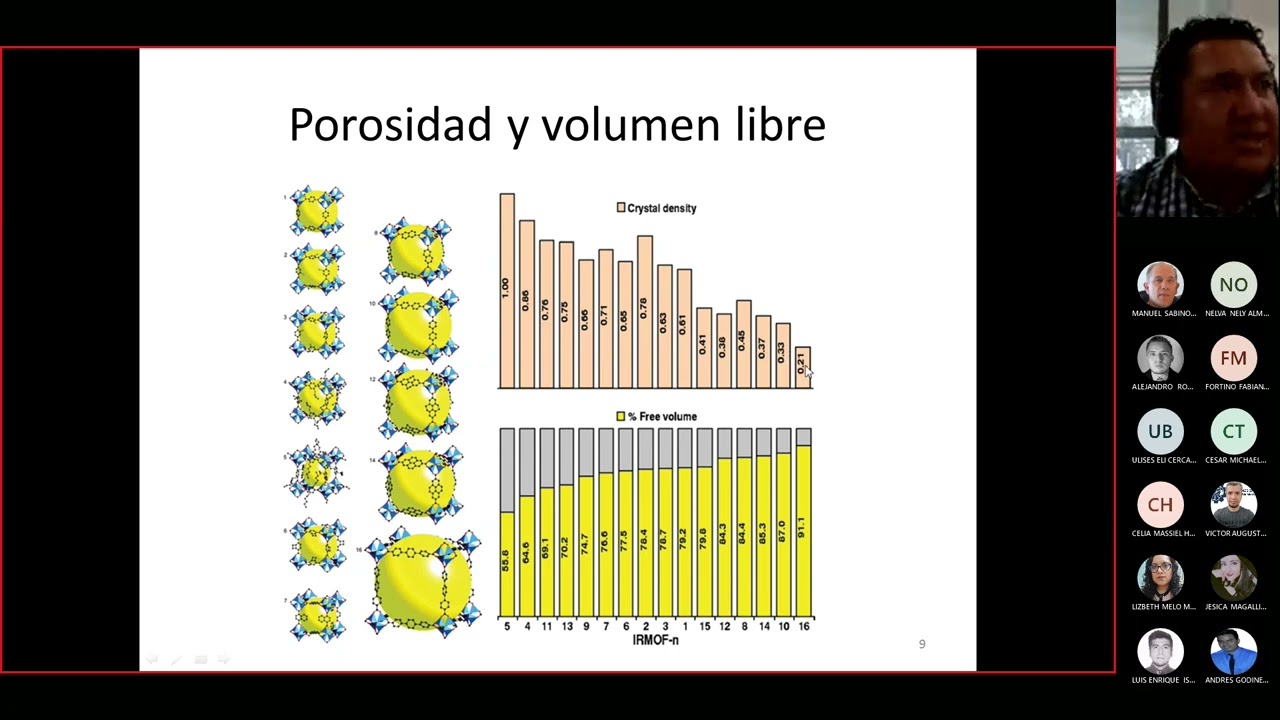
Added:Fundamentals of coordination chemistry, including how metal ions and organic linkers bond to form porous crystalline structures.
The physical chemistry distinction between adsorption (surface adhesion) and absorption (bulk penetration), and the thermodynamic principles governing gas-solid interactions.
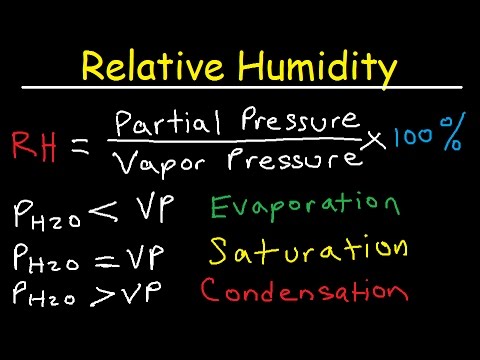
Basic atmospheric physics, specifically the concepts of relative humidity, partial pressure of water vapor, and the dew point.
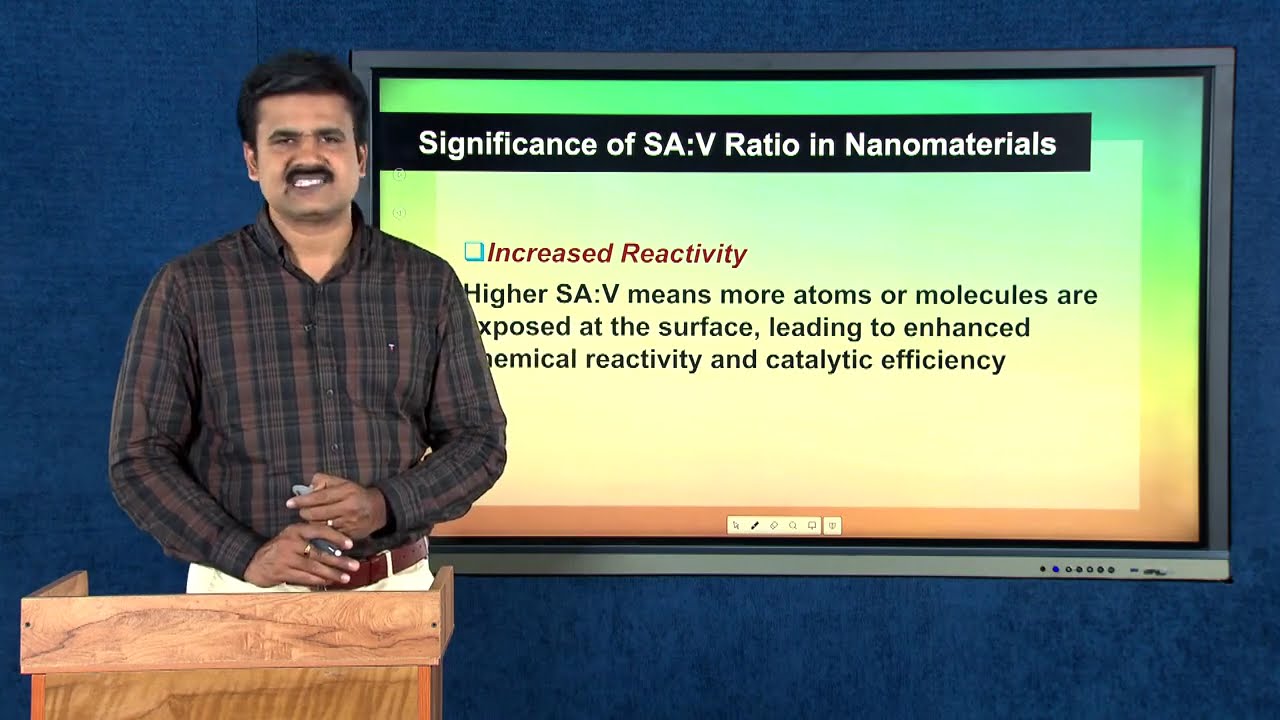
The concept of high surface area-to-volume ratio in nanomaterials and how it influences chemical absorption and storage capacity.
The engineering design and thermodynamic cycles involved in building solar-powered atmospheric water harvesting devices.
Broader industrial and environmental applications of Metal-Organic Frameworks (MOFs), such as carbon capture, methane/hydrogen storage, and selective gas separation.
The synthetic chemistry challenges and cost-analysis associated with scaling up MOF production from laboratory scale to industrial manufacturing.
The socio-economic and geopolitical impacts of decentralized water production on global water security and arid agricultural practices.
35K views601likes1:00:50Original Release: 2021-04-14
LAURENT DE JANVRY: Welcome everyone to today's talk on water harvesting from anytime, anywhere.
My name is Laurent de Janvry.
I'm the Assistant Dean of College Relations and Development here at the College of Chemistry at UC Berkeley.
And it's my pleasure to introduce today's talk.
Today's talk is part of Berkeley Ecosystems, a new initiative where you can learn, explore, and connect with Berkeley faculty, alumni, students, and industry innovators on relevant topics.
This month we are hosting two talks, so we hope you'll join us again on April 28 for a talk from Professor Jeff Reimer on our changing atmosphere, evidence that demands a verdict.
We hope you'll register in the link provided in the chat or later at ecosystems.berkeley.edu.
Now for a few logistical matters regarding today's discussion.
Today's panel discussion is being recorded as were all past events.
In the coming days, you'll be able to find today's recording and other recordings from past events at ecosystems.berkeley.edu.
We are planning to field questions today towards the end of our discussion, so please use the Q&A function as opposed to the chat function to share any thoughts or pose any questions to our speaker today.
And finally, directly following our event today, you'll receive a short survey.
Please take two minutes to give us feedback on today's session and talk, but also give us some ideas on future topics that you might be interested in hearing about.
And now it is my great honor to introduce today's speaker, Professor Omar Yaghi.
Omar is a member of the US National Academy of Sciences and has been honored with many awards for his scientific accomplishments, including the Wolf Prize in Chemistry in 2018 and recently the Royal Society of Chemistry Sustainable Water Award from the United Kingdom in 2020.
Omar is currently the James Neeltje Tretter Chair Professor of Chemistry at UC Berkeley and a Senior Faculty Science at the Lawrence Berkeley National Lab.
Omar is the founding director of the Berkeley Global Science Institute and co-director of the Kavli Energy Nanoscience Institute and the California Research Alliance by BASF here at the College of Chemistry.
Omar's work encompasses the synthesis structure and properties of inorganic and organic compounds and the design and construction of new crystalline materials.
He is widely known for pioneering several new classes of materials, one of which he'll be talking today, which are Metal-Organic Frameworks or MOFs.
These materials have the highest surface areas known to date, making them useful in clean energy, storage, and generation and the production of water.
Omar's work has led to the creation of new materials previously unknown in chemistry, and he has coined the new field of work as reticular chemistry.
Omar is among the top five most highly cited chemists worldwide, and thus, I love to say, he is always on the short list for a potential Nobel Prize.
So thank you Omar for speaking to us today.
I'll hand it over to you.
OMAR YAGHI: Thank you very much, Laurent.
It's a pleasure to be here and to participate in this important series.
I would like to share with you some of our work on water harvesting from air.
And I'd also like to say that we would like to do this anywhere and at any time of the year.
I hope that by the end of today's lecture, I'll convince you that we have a method to do just that.
So let me just introduce this topic by way of sharing with you some of the important molecules that are part of the challenges facing our planet.
Our planet is facing issues dealing with clean energy, clean air, and, of course, clean water.
So hydrogen is a small molecule that when burned, only produces water as a byproduct.
So it's a highly desirable molecule that we need to figure out how to store.
Carbon dioxide-- let's say a child born today is breathing almost double the amount of carbon dioxide than a child born before the Industrial Revolution.
So carbon dioxide in the atmosphere is a problem and we need to find a way to pluck out carbon dioxide.
And I suspect that would be the subject of the next talk you'll hear from Professor Jeff Reimer using metal-organic frameworks.
The third is water.
And water, of course, is essential to life, but it is one of the most precious materials and increasingly we are in need of water in arid regions and even in places where there is plenty of water.
So let me just say that in order to address these vexing issues on clean energy, clean air, and clean water, we need to think about what kind of materials do we need to invent or work with in order to address these challenges.
But I like to start by looking back and thinking about what are the materials that have been invented before and are being used today to address the problems that have emerged in the last century and will emerge in this century.
So I guess let's make a mental list of the most important materials that are in use today.
I think you and I will probably agree that wood is a very important material, concrete, metals, glass, silicon, petroleum, plastics, pharmaceuticals, fabric, and paper.
I would say these materials really are the most important materials today, and without them we would not have fast communication, we wouldn't be able to fly planes, and so on and so forth.
So they have impacted all aspects of our society.
However, I believe that the next generation materials to address the problems that I have been talking about in terms of clean air, clean energy, and clean water have to be different.
And these materials have to be able to carry out a way to store those gases or/and transform them into clean fuels such as CO2 conversion to clean fuel.
Or trap water as a subject of this presentation will be trap water from air to deliver clean water.
So I would like to propose that in fact Metal-Organic Frameworks have the scope, depth, and diversity to fill the materials gap that we are facing in addressing those topics.
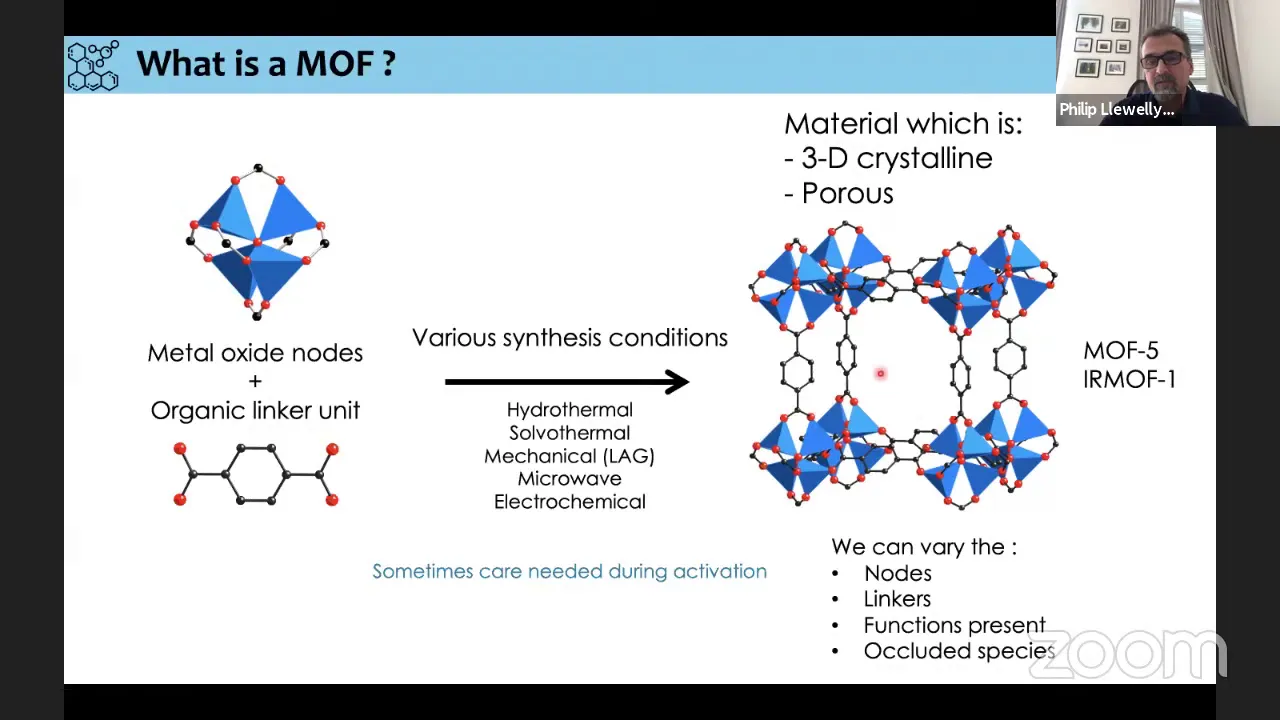
So Metal-Organic Frameworks, let me just describe what they are.
They are made from metal units shown here in blue and organic units shown in gray.
We also have Covalent Organic Frameworks.
They look like this except without the metal.
Now, the reason I make the point that these are really the materials of the 21st century and that they are the materials that will address those problems is because of the great variety that could be made.
So for example, in this structure that I just showed rotating, all the components can be varied.
They can be changed.
They can be functionalized to alter the poor environment and tailor the poor environment for very specific molecular binding, whether it's hydrogen, CO2 or water, and it can be expanded to even incorporate much larger molecules.
So there's a lot of flexibility built into the chemistry that we have developed since the mid 1990s.
So we call this chemistry reticular chemistry and in just simply stated that it uses the component of minerals and organics.
Combine them together to make new porous materials as you see here.
So this is truly infinite chemistry.
In the history of humankind, there has not been a class of materials as extensive and as diverse as MOFs or Metal-Organic Frameworks.
So its infinite chemistry leading to infinite materials and infinite applications.
Now the atypical MOFs, just like the one I just showed you, has an extremely high surface area, meaning that if I was to unravel a gram of MOF, it would cover an entire football field on the atomic molecular level.
And it's that space that is available to trap molecules like hydrogen, carbon dioxide, and water.
So in specific terms a gram of MOF can have a surface area of 10,000 meters per gram.
And that has created tremendous excitement because with the ability to functionalize the MOFs, the MOFs interior and tailor that pore for a specific function then the possibilities are endless in terms of storing gases such as hydrogen that are difficult to store under practical conditions, but with MOFs, we are just a step closer to doing that.
The same thing applies for CO2, to tailor the pores so that you can pluck out CO2 from the atmosphere and indeed for water, to pluck out water from the atmosphere and concentrated into the pores so that you can harvest clean drinking water.
Well, you can imagine the excitement in the world about these discoveries.
Back in 1995, where I started in Arizona State University, we made the very first MOFs and showed that they have permanent porosity and they can be crystallized and characterized fully.
And that really launched the field.
Today the field has grown to encompass laboratories in over 100 countries around the world.
So it has become a global activity and this new field that we've created that I call reticular chemistry, pertains to linking molecules together to make extended structures, robust structures, just like the material that I showed you rotating on the screen a few slides ago.
So with this ability to design materials on the atomic molecular level and with the incredible porosity that these materials have, we can begin to address a formidable challenge such as the water stress in the world.
This is a map of the aridity map, let's call it of the world.
And you can see all the regions that are not yellow are water stressed.
And in fact, one third of the world population lives in water stressed regions.
And even in the regions where there's plenty of water, there are questions pertaining to water purity.
And I think another thing to keep in mind is that almost 160 countries around the world import their water.
So for many countries this is also a national security problem.
So our idea is that perhaps we could use the MOFs to address this water stress.
Because the current solutions, which already deployed successfully, such as desalination, they're great in providing water, but they also have tremendous environmental impacts, such as increasing the salinity of water and tremendous energy costs.
There are desalination plants being built in the Middle East for production of 1 million cubic meters of water daily.
But the impact on the salinity of water around those plants is tremendous and it's not easily reversed.
The other problem that we are facing around the world, not just in the Middle East, but in other parts of the world, is that including the US, West, Midwest, and even West of the US, is that the underground water is being depleted a much higher rate than it's being replenished.
So that's another part of the water stress.
Even in some countries as you see here in Sao Paulo, a dam is drying up.
And the UN predicts that by the year 2050, almost half of the world population or, excuse me, even 5 billion people, not more than half, 5 billion people around the world will be facing the water stress problem.
So I think that there is potentially a solution and the solution is harvesting water from air.
This is how much water is in the air at any one time.
3 sextillion liters of water exist in the air at any one time.
This is a natural resource that if we can find a way of trapping this water in the air, we would be able to use it and recycle it back into the air.
And it's a completely recyclable resource.
We are not destroying water, we are just using it and it is released back into the atmosphere.
So the idea of harvesting water from air is not a new one.
In fact, in many regions where there is a humidity in the air, high humidity, even natural species can harvest water.
This beetle in Namibia right off the coast there as there is fog, it can harvest the water granules on its back where there is nano-ridges that nucleate the water and build up the water droplet, which then, as you see here, seeps down to hydrate the beetle.
So that's from fog regions.
In other fog regions of the world, there are these devices that trap fog just like sometimes you see on your window screen to trap fog and collect water.
Again this requires high humidity.
Also, what requires high humidity are these machines that are sold everywhere in the world for harvesting water from air.
They work on direct cooling where the water in the atmosphere is cooled down and therefore condensed and then collected.
Now, the problem with these machines is that they work only on humidities greater than 60%.
So at the humidities lower than that, they don't work and if they do, it's only for a limited part of the year.
So these are not solutions that work in the red regions of the world.
You can see here that the direct cooling mechanism will not be able to accomplish water harvesting from air in these red regions.
Exactly where you want water harvesting from air, these will not work because they can only work at high humidity.
So there are no solutions right now to trapping water from air in an energy economic way, especially by direct cooling.
So our vision has been how do you collect water from air anywhere in the world, not just that even the red regions, but also the blue regions at any time of the year?
So all year round.
So I want to show you our results in that direction.
But first I want to show you why it is difficult to trap water from air and collect it.
So here is a psychrometric chart.
I'm plotting here on the y-axis the water vapor in air grams per cubic meter versus temperature.
And I have colored two regions here.
The green region is where let's say you have high humidity and this yellow region or pink region is where you have low humidity.
You see here, this is the line for relative humidity 10%, 20%, 30%, 40%, and so on, up to 100%.
As you reach this line, you get liquid water.
So I want to show you what happens if I'm in a city, let's say here in A, a city at 20% relative humidity and 30 degrees Celsius.
Let's say I want to cool that air to get the water out.
To get to the water, to liquid water, to condense the water, I have to cool down that air from 30 degrees Celsius to 4 degrees Celsius.
OK, that's not very economical.
That does not work and is not a viable way of generating water from air.
However, let's imagine that I have the MOFs that I just showed you.
And I have the ability to trap the water in the pore and fill it up with water.
What happens is that I'm creating humidity.
So the MOFs is taking up the water at 20% relative humidity, concentrating it into the pore.
And now I have-- let's say I have the MOFs in a container.
I have humidity that could be up to 90%.
OK, increase the humidity by virtue of having the MOFs trap that water.
Now, in order to get liquid water, I only need to cool down by few degrees, 4 degrees from 30 degrees C to 26 degrees C. So if I can create a MOF that takes up water from low humidity, then I've solved the water problem in the arid regions of the world.
And so this is the results that I want to show you.
But first as I said before, there's been many attempts to do this before.
There are many materials that are now being examined, such as zeolites, polymers, hydrogels, even molecular crystals, simple salts.
And none of them has emerged as a viable solution because in order to have a good water harvesting material, you need to meet three very important characteristics.
One is that the material has to have high capacity.
If you're not storing a lot of water, then you have to do many cycles and that requires energy.
You need to have fast kinetics.
Water has to be able to get in very fast and come out very fast, otherwise, you have to wait a long time to get water.
And definitely, your material should work at low humidity.
This is the challenge facing the world in terms of water stress.
So these materials meet one, but they really fail a lot in the other categories.
So we were investigating the carbon capture of MOFs.
And when you capture carbon dioxide from the atmosphere, you have to separate it from water in the atmosphere.
And so you need to understand what is the interaction of water with the MOFs just as much as you have to understand how carbon dioxide is processed in the MOFs.
So we were studying both molecules and trying to understand how the MOFs behave, and we made a discovery.
The discovery was that this MOF is able to take up water.
Let's focus on the red line here.
Take up water at relative humidities around 20%.
OK, that's low humidity and that's typical humidity in the desert.
So that's one very important discovery.
It means that the MOF that we were using is able to pluck out water from low humidity.
The second important thing is that the way the MOF behaves when it's taking up water is in a cooperative fashion.
So you have this very sharp step.
And then as the pore gets saturated with water, of course, you get a flat uptake.
OK, so this step is very important because it maximizes the amount of water, my working capacity, the amount of water that I can not just put in, but take out.
Now, the third very important observation that we made is that the water that goes into the pore can come out.
This is now the green line.
When I heat the material to 45 degrees Celsius it comes out in the same way it went in.
OK, so when I looked at this, I immediately realized that this could be a material that can be deployed in the desert, where at night, when it's cool, it can trap the water and during the day when it's hot, we can release the water.
So unlike other materials like zeolites and other materials that take up water, they are extremely hydrophilic.
Zeolites can take up water from low humidity, but you need to heat a zeolite up to 300 degrees Celsius to remove the water.
Again, that makes it not a viable solution for harvesting water from air.
But for a MOF, you have the inorganic part, let's call the hydrophilic part, and the hydrophobic part is the organic part.
And this modulates how tightly water can bind to the interior of the MOF and therefore, we can modulate this strength very nicely and which allows us to then have the water come out at lower temperatures.
So we cycled water in and out of the pore as you see here over 80 cycles, leaving no imprint on the MOF.
Now, some of you may notice that after the first cycle you see a slight drop in the uptake of water before it is stable in terms of uptake and release.
This slight drop when we look deeply into why is there a slight drop, initial slight drop, it gave us the secret for making MOFs for water harvesting.
Let me elaborate on that.
You can use X-ray, single crystal X-ray diffraction technique and neutron diffraction techniques to look deeply in the pores of the MOF and locate where those very first water molecules reside in the structure.
And then we look at their interactions with the structure.
So you see here for this MOF, we found the water molecules shown here in red bound to the metal oxide unit or to the inorganic unit.
And then as more water comes in, they make up aggregates such as these cubic aggregates.
And we find that these are the seeds unto which other water molecules come in and bind.
So in fact, the water structure, these red spots you see here, are built up in the pore, almost like ice, I would say ice chunks that fill the pores.
And the key here is that the very first water molecules bind strongly to the metal oxide unit and they act as a magnet to the water molecules that are in the air.
Bring them in and bind them and build the structure up of the water in the pore.
So this was the key, the seeding effect, which we attribute to the excellent properties of the MOF taking up water from low humidity air.
OK, so from the laboratory, we wanted to take this outside and show that in fact this works in the desert.
So here's a device.
This is a very small device that only has 2 grams of MOF.
OK, it's a handheld device.
And the way it works is that the MOF is put in the container and during the night, the MOF is exposed to the air.
Water from the air goes into the MOF.
And during the day you close the container.
And when the container is closed, you can expose it to the sunlight and as the interior heats up, this is the interior of this box, shown here 50 degrees Celsius and increases 60 Celsius and so on.
And you see small droplets of water that are beginning to grow.
OK, so this is basically a proof of concept that the MOF works outside the laboratory at humidity.
In this case, the humidity was between 20% to 30% relative humidity.
And so this was very, very exciting because for the first time, it's very clear that one can trap water from air and take it out at very mild conditions with absolutely no energy input aside from sunlight.
So we wanted to scale this up, so we scaled it up to a kilogram quantity of MOF and we changed the design of the device so that the MOF it's basically a box within a box design.
The interior box has the MOF and that put inside a larger box.
The larger box is open during the night to allow desert air to come in and the MOF trap the water from desert air.
And during the day you close the outside box, expose that to sunlight.
As the interior heats up, water comes out of the MOF and condenses on the walls of the box.
That's roughly the principle of how this works.
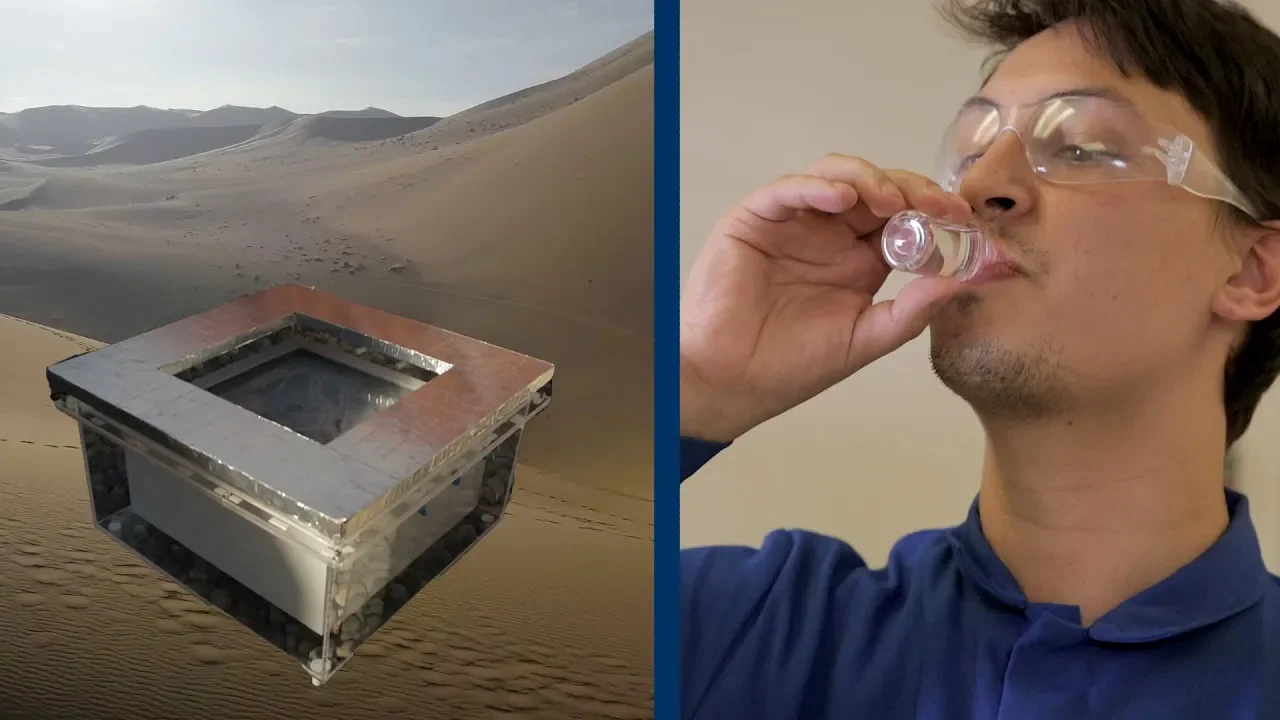
This is what this water harvester looks like.
It's a plexiglass box on the interior and the larger box on the outside.
They're both made from plexiglass.
Very cheap, easy to make.
The box inside has the MOF and the box outside collects the water.
This is the experiment that we have run in Arizona using 1 kilogram of MOF.
And you see here, these are pictures of the walls of the outside box showing water droplets forming and running down and we collect the water.
So for 1 kilogram of MOF, we were able to collect 200, depending on the exact weather conditions, to 300 milliliters of water.
OK, so that's one cycle between day and night.
So at night, you're exposing them off, taking up the water.
During the day, you're releasing it.
The MOF stays in the device and you can use it again and again and again.
Our idea is that the MOF is used over and over again.
It takes up the water, it releases the water, you can collect the water and use it, and then you can start the cycle again and the MOF can stay in the device for many years.
The current idea is that we have done enough cycles that the MOF can stay in the device for at least five years, as I will show you shortly.
But this was a very successful experiment because now I have a bottle of water produced by just having a kilogram of MOF sitting there and no energy input aside from sunlight.
So the water is pure.
It contains absolutely no contamination.
It's distilled water and Eugene volunteer to drink it.
EUGENE: Nice.
OMAR YAGHI: All right, so we tested the water and it's pure, which means that the MOF is acting as a container to trapping the water and it is not contaminating the water at all.
So the water to be drinkable, of course, it would have to be mineralized, but one can use it for drinking.
And if you so desire would be mineralized, but also one can use it for agriculture and many other applications.
Just pure water coming out of the MOF.
Now, the power of reticular chemistry is that one can go in and change the metals.
You can go from a metal where in the case of the MOF that Eugene was using there, that's a zirconium MOF and zirconium is expensive metal.
But we can go in and make aluminium MOF.
Aluminium is much, much cheaper.
And so we can design a material as you would see here, the MOF is the backbone.
Here are our aluminum oxide units linked by organic units containing nitrogen and carbon.
And these are the water molecules that are diffusing through the pores.
Now, how does this MOF do?
So we learn that instead of waiting for day and night cycle, we could push the air, just use a fan to push the air into the MOF, and then with solar panel, we could have power to heat up the MOF to release the water.
So we designed a prototype that has basically shelves of MOF and is designed in such a way that certain shelves take up the water from desert air while other shelves release it.
OK, and then it's condensed on basically a powered condensation to produce liquid water.
Now, how does this MOF-303 perform?
So we took one kilogram base device to the Mojave Desert, which is the driest desert in North America, and tested it in the desert.
OK, and so I would like you to focus on the relative humidity panel here and the water harvested.
And I want you to ignore the first point because this is the water that was in the MOF from Berkeley.
So that's released and then this is the amount trapped in the desert.
OK, that's during the night.
This is during the day.
During the night, during the day, and so on.
Now, the amazing thing is that when you look at the humidity during the day, it dips down to almost 7% relative humidity.
And you see how even at these very low humidities, the MOF is still harvesting water.
So for one kilogram of MOF, we can harvest one liter of water.
And here is a video of the water dripping down in real time as it's being harvested.
This is the device.
It's a sort of a homemade device by deploying one kilogram of MOF.
And this is Nikita holding the one liter of water harvested.
So this device can work over and over again.
You can cycle.
And like I said, the MOF remains in the device producing one liter of water per day under these conditions.
Obviously, when we look deeply into how the MOF is working and how much water is going into the MOF, we realized that the form in which we were deploying the MOF does not allow the entire MOF sample to be accessed by water.
So we were only using a fraction of the MOF.
So in fact, the potential for much more than one liter per kilo was great.
And the other factor I think that is so important is not only do you take up water very fast.
So you see here, let's focus on this purple line.
You see that in less than three minutes, the MOF is saturated with water from the atmosphere, and in less than three minutes you can remove the water.
So this fast kinetics gave us the idea that you can run multiple cycles per day.
And so our next generation water harvester, it looks like this.
Is able to carry out over 200 cycles per day.
OK, and in this particular device, it only employs 100 grams of MOF.
So 1/10 of a kilo of MOF and delivers four liters of water per day.
So this is a tabletop device and not much larger than a microwave and is able to deliver four liters of pure drinking water from only using 100 grams of MOF that stay in this device for five to six years graded for the lifetime of the electronics of the device.
So this is just a short video of how this device works.
You see, this is a door that opens air goes in, the MOF is inside, and as you heat later the water condenses and it will be collected down here at the bottom.
You see here a puddle of water that is then filling up this bottle.
OK, so like I said, the productivity of this device is 100 for 100 grams of MOF.
You can harvest four liters of water.
So we've gone from our handheld device all the way to this pre-commercialization, let's call it prototype, and we like to always talk about the amount of water per kilo.
By the time we are here, we are at 100 liters per kilogram of MOF per day.
And we have not achieved 100 yet, but we have achieved a significant percent of that.
I would say right now we are at about 60 or 70 liters of water per kilogram of MOF per day.
That's real water that you can get every day from just 1 kilogram of MOF.
So based on those results, one can check the weather conditions in all over the world.
And here I'm plotting the driest deserts in the world, the Atacama Desert in Chile and you see here at the most stressful times of the year, the driest time of the year, you're still delivering water.
OK, that's around, let's say, 7 letters per kilogram of MOF per day.
Those are the driest desert.
And you can see that in a place like Lanzhou in China, in the middle of China, depending on the weather you can harvest still significant amount of water in the most stressed times of the year.
Kabul another dry place, you see here significant amount of water can be harvested.
And this is Riyadh in the middle of the desert in Saudi Arabia, you see almost 40% or excuse me, 40 liters per kilogram of MOF per day and so on.
You can do this for Baghdad, New York, Stockholm, Los Angeles, London, Mediterranean region, Granada, Rome, Perth in Western Australia, Cape Town and so on.
OK, so what this is telling us is that because the MOF works at very low humidity.
I showed you MOF-303 at 7% relative humidity.
It can work at all humidities beyond that.
And therefore, I think the vision of achieving water harvesting anywhere in the world at any time of the year is becoming real.
And if you're worried that we're going to be consuming all the water in the atmosphere, think about this if we serve 50 liters to each person in the 6.7 billion population of the world, we would have only used 0.002% of the water in the atmosphere at any given day.
So with these developments, what we are looking at is a distributed process for water delivery.
It's mobile.
It's off grid.
You can also personalize it to your taste.
The water that is produced is pure, so you can use it for drinking or agriculture or household use.
And ultimately, my vision is that we as citizens of the world will achieve water independence so that we are not importing our water from other places.
So that's basically my presentation.
And I just want to conclude by saying that I think we have developed not just new chemistry, but a wide range of materials and applications that are addressing the water stress in the world.
And as I said, Jeff Reimer will be talking about how MOFs will address the carbon capture challenge.
Thank you for your attention.
LAURENT DE JANVRY: Thank you so much Omar and we have a number of questions for you.
I'll try to group them in this capacity in the sense of I'll start with some of the questions about your latest water production device and then get into a few more technical questions about the MOFs themselves.
The MOF obviously you explained does produce pure water, however would the quality of the air degrade the device, such as dust or grit that you might find in the desert?
OMAR YAGHI: Good question, Laurent.
So the MOF as you saw is really a molecular filter.
And in our case, it only admits water molecules into the pores.
Even if you have, let's say, carbon dioxide in there because water binds stronger than carbon dioxide, carbon dioxide does not stick to the material.
So that's one aspect to think about, is that if you are in an environment where let's say there are gasoline molecules and octane that would not fit in the pore.
So the pores are naturally filtering water in.
The second point is that we have tested the last water harvester prototype that I just showed you without any filtration of the air.
And the performance has been maintained over tens of thousands of cycles.
So that does not seem to be an issue.
Now, at the end of the day if you really want to filter the air, there are filters such as what you use in your automobile that could be used.
So it's not a major issue.
LAURENT DE JANVRY: And there's a couple of questions here, just about the cost of a liter of water.
So I presume that's related to there's a fixed cost with the device, but then there's also the MOF itself that presumably must be manufactured.
Could you talk a little bit about what is the cost of a liter of water?
OMAR YAGHI: So many people point to-- you see these beautiful illustrations of the MOFs very intricate and they look like they're very expensive.
And I just want to say that the variety of MOFs that could be made all the way from complicated components to simple components to even edible components, natural components is just, I mean, it's staggering.
The variety is staggering.
So you have flexibility in terms of going from as I did from zirconium, which was expensive to aluminum which is very cheap.
OK, so that works in your favor.
The other thing that works in your favor is that device that I just showed you, once you know how to maximally expose them off to the air, then you can get the maximum performance of them out of the MOF.
So that only deploys 100 grams of MOF, a 100 grams of an aluminum MOF.
Now, how expensive could that be?
Aluminum is only $2 a kilo.
And the price of the MOF in general, unless the organic linker that you're using is very exotic scales with the price of the metal.
OK, that's all I can tell you.
Because the cost of MOF is something that has held the secret held by the chemical companies that make it.
OK, but that gives you an idea.
You're not going to be able to make this possible unless the cost of the MOF is low or negligible compared to the rest of the device.
So to answer the question in terms of right now, in terms of production of water, using the device that I just showed you, if you assume that the electricity price is about $0.06 or $0.07 per kilowatt hour, then the cost of one liter would be in the range of $0.04 to $0.05.
OK, so it's a fraction of what you would pay for drinking water.
Now, if you're thinking that this is going to replace desalination, I don't think that it will anywhere in the near future.
But it certainly can provide access to water for drinking and for agriculture in many places of the world.
LAURENT DE JANVRY: Yeah, there was a question here.
Sorry, I need to look for it in the number of questions we have about desalination.
And let me see if I can find it here.
Yeah, the question is, what is the power consumption of-- wait, no, sorry.
Let me see here if I can find it for you.
Yeah, here it said, what are the prospects for desalination using MOFs?
And I read a report recently that a university in Australia had promising results related to that.
Is that something that might be a possibility?
OMAR YAGHI: Absolutely.
Absolutely because you could have the MOF in any kind of humidity and it would trap water.
OK, so yes the results from Australia are very interesting using MOFs for this application.
And I think once you start thinking like a MOF chemist who is doing water harvesting, the number of applications are almost endless of what you can do once you know how to pluck out water from air.
LAURENT DE JANVRY: And here's a question more about the MOF itself.
So is there any rule of thumb to the rationality of the design of the MOFs for water harvesting and what percent added on would you foresee adjusting the MOF for different regionality differences?
OMAR YAGHI: So again, very good question.
Some people are working on devices that have more than one MOF for different regions of the world.
I think that let's say, if you have a MOF that works down to 7% relative humidity, you may not want to operate that MOF under that humidity all year round under those let's say conditions.
So you could design a MOF that is going to give you a lot more yield under a range of conditions and therefore minimize your power requirements, your heating requirements and so on.
So yes, you could do that.
We are not doing that in these prototypes, but potentially there will be varieties of devices that would have different MOFs for different regions of the world.
And those different MOFs by the way exist.
There are out there.
They've been designed and they are being deployed for that purpose.
I think the initial part of the question was about the design of the MOF.
Some MOFs are made by design and some are not.
And I'm so happy for that because it allows us to go beyond our imagination.
Let nature help us sometimes with discovering structures that we have not imagined, such as MOF-303.
MOF-303, which is a very important MOF, was not made by design.
We just put the components together, but we didn't know it was going to make that specific structure.
But it turns out that that structure is ideally suited for all weather conditions around the world.
So I think you have to have an open mind between design and then being humble and letting nature teach you what it has to offer.
LAURENT DE JANVRY: And I know your specialty is obviously in the design and crafting of the MOFs themselves, but there's a number of questions just about the device and in the sense of how best to power such a device to enhance efficiency, maybe even with hydroelectric power.
Can you comment on what you have thought through in terms of the powering of a device to create water production out of MOFs?
OMAR YAGHI: Well, I think the numbers that I quoted in terms of cost per liter, they're really based on a solar farm that supplies basically equipped with these, not this particular device, but this kind of technology that allows you to harvest water and then channel it to where it's needed.
Based on that, those calculations, you can produce millions of liters and then you can also bring down your cost down to $0.01 actually per liter.
So we're thinking more solar, but obviously, you could use wind, you could use any other source wherever might be available, might be convenient in that locale.
LAURENT DE JANVRY: This is an interesting question.
I know you and I have talked about the future of chemistry and what your vision is about the future of chemists.
Is there a role for computational scientists in helping to make water harvesting via MOFs a greater reality?
OMAR YAGHI: Absolutely.
Let's just take an example, in MOF-303 we know exactly what makes it a great water storage material because we've gone in there and we've analyzed exactly where the water molecules are located.
All of them.
Even when the MOF is filled with water.
That's a beautiful piece of work from my student Nikita.
Once you know that, now you can say to yourself OK, I'm going to create a MOF in the image of MOF-303 but with larger pores so that it can store even more water.
So right now, this MOF takes up 40% of its weight in water.
And a computational chemist could take that information and then simulate and calculate structures that take that replica but in different arrangement so that the pores are a little bit larger.
And if they are, it makes a huge difference.
All the costs that I was sharing with you would be cut in half immediately, OK, still operating under those weather conditions that I discussed, the extreme conditions, as well as the normal conditions.
LAURENT DE JANVRY: I've always wanted to ask this question.
So you've talked about using the MOFs for water production in very dry areas.
But we see everybody has now solar panels that are taking them off the grid of PG&E. Could you ever foresee an urban application of MOF to produce water so that we could unplug from East Bay MUD?
OMAR YAGHI: That's my vision.
I showed you a device that works on no power except sunlight.
Now, you can imagine a box sitting out in a corner in your house and modulating between day and night.
And for every cycle, you're getting that much water per amount of MOF that you're using.
Absolutely no maintenance.
No power requirements.
All right, so I would say that that is a very important development because it puts water off grid completely.
But short of that, if you really-- we are all impatient.
We want lots of stuff now.
Then you plug into your solar panel and you can deliver water.
I mean, that's if your solar panel is off grid.
OK, so is your water, but it's connected to the solar power.
But we have that other solution, which is the completely passive device that works on the day and night cycle.
So that's another option that we are developing.
LAURENT DE JANVRY: Let me just ask this last question, which is, where do you hope the study of MOFs goes and in that same vein, how would someone venture down into a career in some sense of developing and leveraging MOFs?
OMAR YAGHI: I think what I stumbled through at the beginning of my talk with the old materials and the new materials.
What I was really trying to say is that in the whole human history, there has never been a class of materials that took everything that nature has given us and figured out a way to make new materials out of that.
So to me, I can't see any other class of materials as extensive as MOFs.
So MOFs are here to stay.
And for the last 25 years since our initial discovery, there has been tremendous intellectual advances, not just in making the materials but in also covering the entire periodic table.
Almost the entire periodic table is now being used to make MOFs and COFs.
So we're talking about new compositions, new structures, but also new applications.
And so let's talk just very briefly about the intellectual advances if a student is really interested in what is the future of MOFs and whether there is a career in MOFs.
Aside from the fact that they are going to be able to address these vexing societal problems.
These I call them infrastructure problems, energy, water.
If that's not enough, if you're just interested, like me in just basic science, then you can think about designing structures as we have recently found, that have sequences of chemical information that operate almost like a biological system where depending on the sequence of these chemical information, you can design the code for very specific properties.
These could be carbon capture and converting the carbon to a fuel or they could be things that are much more sophisticated than that, such as sorting chemicals, sorting molecules, separating CO2 from water or water from air in a way that allows you to do it without input of energy.
OK, so the sequence, what I call sequence-dependent materials, I think is yet another multivariate domain that is yet to be exploited.
And it's really there where the most exciting discoveries are being made today.
LAURENT DE JANVRY: Well, that is fascinating Omar.
You never cease to amaze me.
And I just want to thank you once again for joining us today and providing us this talk on the application of MOFs for water production.
I want to thank you all that joined us today.
We had a great number of people that joined.
Please check us out again at ecosystems.berkeley.edu and register for future events and also to access recording of past events.
Quick reminder-- to fill out the survey that you will receive later today.
And I just want to wrap up, as always from Berkeley with a big, Go Bears!
Up Next

29:40
Synthesis & Applications of Metal-Organic Frameworks (MOFs)
@stephenburgin1321
58.8K views•2019-04-28

83:56
Biocatalysis and Catalysis in Islatravir Synthesis | Merck Webinar
@SCIwheresciencemeetsbusiness
675 views•2020-10-08
10:06
1H NMR: Determining Number of Peaks from Structure
@MSJChem
59.2K views•2017-04-06

17:31
Edible Water Bottles: A DIY Guide to Sodium Alginate Spherification
@ryan
10.5M views•2019-06-21
Related Study Plans & Knowledge Roadmaps
Structured learning paths in Chemistry
chemistry
Nuclear Chemistry: Decay, Meds & Fuel Cycle
01Introduction to Nuclear Structure and Radioactivity
02Decay Dynamics and Kinetics
03Radiation Interaction and Detection
+ 2 more learning modules
24h5 modules
Explore Roadmap
chemistry
Supramolecular Chemistry: Forces & Machines
01Foundations of Chemical Bonding and Intermolecular Forces
02Introduction to Host-Guest Chemistry
03Thermodynamics and Dynamics of Self-Assembly
+ 2 more learning modules
16h5 modules
Explore Roadmap
chemistry
Photochemistry: Excited States & Reactions
01Foundations of Light-Matter Interactions
02Molecular Orbitals and Electronic States
03Photophysical Processes and Jablonski Diagrams
+ 2 more learning modules
18h5 modules
Explore Roadmap
chemistry
Coordination Chemistry: Bonding & Properties
01Introduction to Transition Metals and Ligands
02Crystal Field Theory (CFT) and Geometry
03Magnetic Behavior and Spin States
+ 2 more learning modules
14h5 modules
Explore Roadmap