


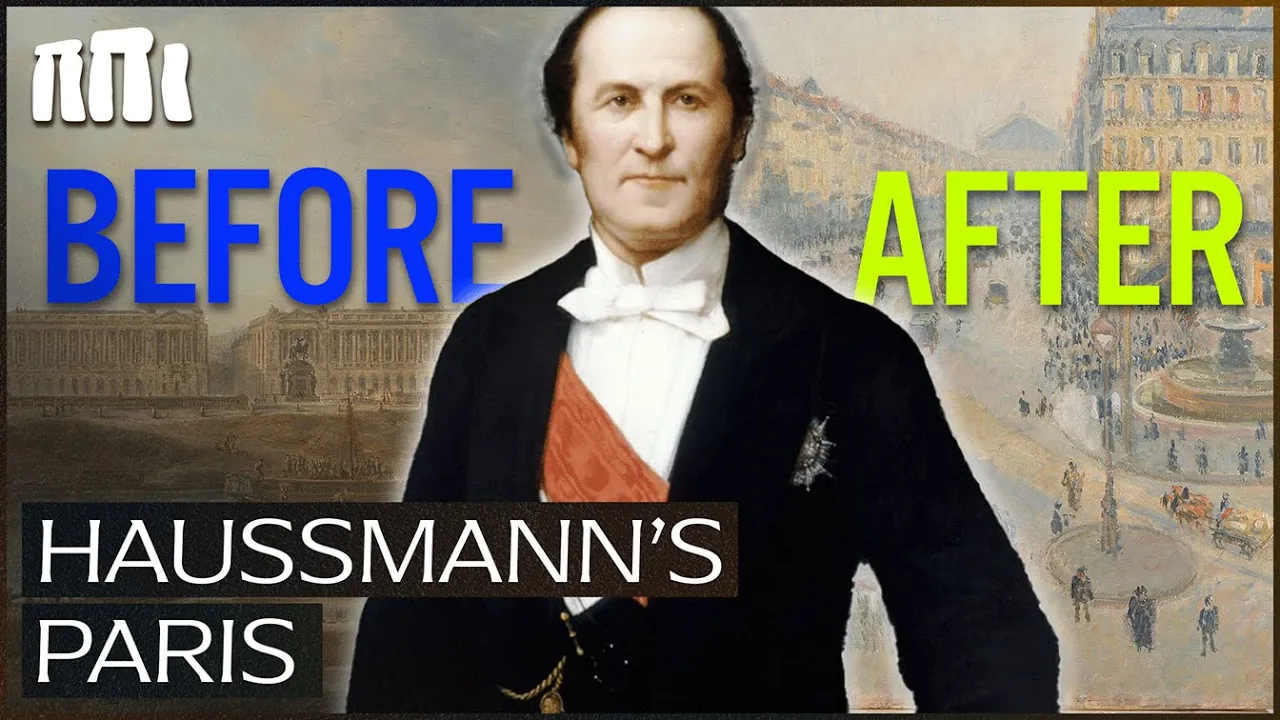




Under Emperor Napoleon III, Georges-Eugène Haussmann transformed Paris from a disease-ridden medieval city into a modern metropolis between 1853 and 1878, creating broad avenues, effective sewers, beautiful parks, and uniform apartment buildings that fundamentally reshaped urban planning worldwide.
How Haussmann Transformed Paris: Urban Planning History
Added:Understanding the social and environmental impacts of the Industrial Revolution on European cities, including rapid population growth and overcrowding.
Familiarity with the political context of the Second French Empire under Napoleon III and the motivations for state-sponsored modernization.
Basic knowledge of pre-industrial urban structures, characterized by narrow, winding medieval streets and a lack of centralized municipal planning.
The historical link between poor urban sanitation, public health crises (such as cholera epidemics), and early miasma theories of disease transmission.
Analyzing the concept of 'Haussmannization' as a global model, including its influence on urban projects in cities like Vienna, Brussels, and Chicago.
Critically examining the socio-political consequences of Haussmann's renovation, specifically gentrification, working-class displacement, and the strategic design of avenues to suppress civil unrest.
Exploring subsequent 20th-century urban design movements, such as the City Beautiful movement, Garden Cities, and Le Corbusier's Modernist planning.
Investigating the ongoing tension in modern urban planning between preserving historic urban tissue and implementing necessary infrastructure and sustainability upgrades.
229.2K views11.3Klikes12:04Original Release: 2019-04-10
in 1845 a French social reformer wrote Paris is an immense workshop of putrefaction where misery and pestilence and disease work in concert where sunlight and air rarely penetrate Paris is a terrible place where plants wither and perish industrialization and rapid growth that simply left infrastructure behind and in the 19th century Emperor Napoleon the third undertook one of the most ambitious plans of renovation ever undertaken in any city anywhere and to oversee that renovation he chose the skillful and audacious George Eugene Houseman and between 1853 and 1870 Houseman transformed Paris from a squalid disease-ridden city of the Middle Ages to the modern era with broad avenues effective sewers beautiful parks it is history but deserves to be remembered by the 19th century the overcrowding of Paris had become an acute social issue as far back as 1739 the writer Voltaire had complained that the streets were showing off their filthiness and spreading infection the first Napoleon had ambitious plans as well writing from his prison on st. Helena that if he'd had 20 more years of rule in a little leisure one would vainly searched today for the old Paris nothing would remain of it but vestiges the widest streets in the worst neighborhoods were only 5 meters the narrowest only 2 carts and horses could hardly navigate these parts of the city elected the first president of France in 1848 Napoleon the third worked as president to beautify the city but was able to accomplish very little it wasn't until he overthrew the government and declared himself Emperor that the project would begin in earnest after selecting Hausman oversee the project the Emperor asked him to give the city more air in space to make it beautiful and to better connect the sprawling capital the first stage of the project was complete the grunt crusade Perry great cross that would bisect the center of the city and which had begun under the first a polio the Emperor wanted a new hotel built the first luxury hotel in the city the Grand Hotel de Louvre in time for the exhibition Universal in Paris the exhibition was a kind of World's Fair held in 1855 was held partially as a response to the exhibition held in London in four years earlier Hoffmann relished the challenge it worked 24 hours a day had 3,000 workmen finished the most important parts of the Cross and the hotel in time for the exhibition the project involved tearing down enormous sections of the city tested has been called the gutting of old Paris many of the neighborhoods torn down were simply turned into the broad avenues that defined the city today and many small streets were eliminated entirely in favour of one navigable one this was only possible because Napoleon the third had made himself Emperor he had the Parliament changed the law so that Houseman could seize land on either side of the streets and he reported only to the Emperor himself husband finished the cross in 1859 centered at a large square that was widened with two new theaters which still stand today facing each other across the obtain two Palmer victory fountain built under Napoleon the first to memorialize his greatest military victories the fountain itself was moved to sit at the exact center of the square and redecorated with sphinxes amour designed by architect gabriel de vionnet Davi ode was almost important to the project as Houseman while Houseman worked on the greater design of the city Davi ode was the architect for many notable buildings built during this time including the theatres in the central square as well as other distinctively Parisian Street furniture he designed benches Bava streets fountains signpost and much more during the renovation this work as well as that of other architects under Napoleon the third had a unique style much of which can still be seen all over Paris today one architect who designed during this time called the style simply Napoleon the third possibly the most distinctively Hausman part of the whole renovation where the buildings he built to line the streets of Paris husband planned the apartment complexes as architectural holes treating them as he treated everything in the project as part of a larger urban design while the interiors of the building were left up to the owners the exteriors were strictly regulated uniformity of balconies and cornices was prioritized even to the detriment of interior rooms the facades were required to be either made or faced with stone and the changes of the Industrial Revolution made it possible to cut and move the stone like never before it is Houseman's apartments which line the streets of Paris still that have less the most lasting mark on the care during appearance of the city the first stage of the project was generally considered to be a success as Houseman opened up and beautified parts of the city he'd built about six miles of new avenues for a cost of 278 million francs which depending on how that is converted would be between one and four billion u.s. dollars today but the second stage was even more ambitious he hoped to add another 16 miles of new avenues to connect the city center to the grand boulevards that have been created during the great restoration between 1814 and 1830 and he hoped to do that using a hundred million fewer francs the plan involved tearing down even more sections of the city and replacing them with new plazas gardens and buildings the many theaters hotels and government buildings built during the renovation were meant to command the streets they sat on and be visible from long distances one of the most dangerous neighborhoods of the city the Petit pallone or little Poland was demolished during this time in the square of the star around the Arc de Triomphe was redesigned with new avenues being added so that 12 half of those converged there in 1960 the square was renamed after Charles de Gaulle additionally this phase involved almost complete renovation of the Ile de la Cite a or one of the two natural islands in the Seine along the center of the city until the renovation the island had been largely residential with the exception of the eastern end which since the 12th century had been home to the Cathedral of Notre Dame the square in front of the cathedral was widened bridges to the island completely rebuilt and several large new government buildings constructed there while some of these changes were welcomed the project began to garner persistent criticism critics complained that hodgman had destroyed much of the Luxembourg Gardens built in the 17th century as well as the growing cost of the projects the cost ballooned to some 410 million francs partially because of local building owners claiming made-up shops had been torn down and petitioning the government for lost revenue the enormous social cost was not imaginary though as thousands of Parisians were forced to transplant their lives with little recourse and many critics believed the new apartments were pressing out poorer Parisians still husband enjoyed greater status under Napoleon the third and continued his projects streets were not the only thing that Hausman was concerned with together with several colleagues that had brought with him from port four major parks were planned at the Cardinal compass points around the city workers dubbed new Lakes and constructed grottoes lawns and gardens in addition to the large parts they built 24 new squares throughout the city husbands goal was to make parks and green spaces accessible to all Parisians in total he added over 2,000 hectares of green space to the city and over the 17 years he worked planted over 600,000 trees he also revolutionized the city's woefully inadequate water and sewer system he enlisted Eugene Bell brand to head the work and Bell grant built new aqueducts to serve the city with more water and both the largest water reservoir in the world to store water for the city he effectively quadrupled the number of homes in the city with running water Bell Grant's waste were transformed the city even more before the renovation solid waste had to be picked up by sanitation workers and the sewers emptied directly into the Seine the new sewer was significantly larger could handle the solid waste was capable of draining water from basements where the safe when the Seine was high could take in rain water in the large channels which drained the waste could be cleaned by specially designed boats the underground also provided gas to the city gas that would turn Paris into the City of Lights in 1816 Napoleon the third officially annexed to Paris eleven suburban communes quadrupling the city's population and more than doubling its size many of the locals were unhappy with the new arrangement as a necessitated higher taxes but for Hodgeman the annexation presented a new obstacle he now had twice as much city to renovate he connected these outer parts with large new avenues integrating them into the plan of the greater city in 1860 the Emperor also made some changes to his regime in response to popular outcry giving Parliament more control and more voice to the opposition opponents latched on to Hausman is a point of criticism decrying the cost of his renovations the social disruption and the project's lack of oversight an opposition leader ridiculed Haussmann's accounting as the fantastic bank accounts of Hausman the same men also decried the costly confusion the triumph of vulgarity the awful materialism of the renovation we weep with our eyes full of tears for the old Paris he said and he was not alone husband had a deep dedication to clarity and later historians have criticized him for the destruction of historical buildings for no better reason than his rigid desire to have straight roads by 1867 even many people friendly to the concept were growing tired of the renovation Paris is a marvel an M Houseman is done in 15 years where the century could not have done but that's enough for the moment there will be a 20th century let's leave something for them to do said one Parisian despite the growing opposition husband continued with his plans for a third stage of renovation improved in 1869 he planned to build the Opera palais garnier named after its architect to build yet more straight streets to renovate gardens and of course more plazas Hofmann would not see these projects finished as Napoleon the third under intense scrutiny from his opponents sick with gall stones and preoccupied with the growing political tensions that would lead to the franco-prussian war as for his prefixed resignation husband would not resign and Napoleon dismissed him on the 5th of January 1878 months later Napoleon the third was captured by the Prussians and the Second Empire overthrown though Hausman and the Emperor were gone worked on many of the projects continued into the Third Republic with the Paris Opera finished in 1875 and the boulevard haussmann finally finished in 1927 one of the more controversial discussions around the renovation involved the control of the city and the military purposes of the long straight streets between 1830 and 1848 Paris had had six armed uprisings centered in the narrow streets of the city center where discontents could easily block streets with barricades and where the army maneuvered poorly the wide streets made it easier for military units to enter and control the city cost money even admitted he had used that argument wood arguing for more fonts but I said that it didn't design any piece of the renovation for its greater or lesser strategic value overall Houseman's projects were estimated cost about 2.5 billion francs between 1853 and 1871 and the debt wasn't fully retired until 1929 project sense of Tom's sometimes embraced and sometimes ignored his work and ideals but the city was greatly transformed and those transformations are still prominent in the city today the city no longer suffered from the frequent violent uprisings and health in the city greatly improved as residents gained access to clean and frequently running water husbands urban planning dominated the future of the city essentially directed the city's growth and traffic flow a hundred fifty years later husband's ideals have outlived both their critics and their creator and for better or for worse they're an integral part of the character of one of the world's great cities part of both its history and its present I hope you enjoyed this episode of the history guy short snippets of forgotten history between 10 and 15 minutes long and if you did enjoy please go ahead and click that thumbs up button if you have any questions or comments or suggestions for future episodes please write those in the comment section I will be happy to personally respond be sure to follow the history guy on Facebook Instagram Twitter and check out our merchandise on teespring com and if you'd like more episodes on forgotten history all you need to do is subscribe [Music]
Up Next

93:30
Zola, Baudelaire, Maupassant & the Transformation of Paris, 1852-1900
@SylviaSagona
5.6K views•2015-05-31
10:04
Baron Haussmann's Transformation of Paris: 19th-Century Urban Renewal
@AntonandSinan
1.4K views•2021-01-31

15:08
The Evolution of Elevators: From Ancient Lifts to Skyscrapers
@TheHistoryGuyChannel
436.7K views•2020-01-08
17:05
Understanding the Cold War: Superpower Conflicts and the Road to Détente
@OverSimplified
46.1M views•2019-01-24
Related Study Plans & Knowledge Roadmaps
Structured learning paths in History
history
Byzantine Iconoclasm: Theology, Art & Politics
01Foundations of Byzantium and Early Christian Images
02The First Iconoclasm: Leo III and the Crisis of Images
03Empress Irene, Nicaea II, and the Second Iconoclasm
+ 2 more learning modules
9h5 modules
Explore Roadmap
history
Iranian Revolution (Causes, Events & Legacy)
01The Pahlavi Dynasty and the Roots of Discontent
02The Spark of Rebellion and the Rise of Khomeini
031979: The Fall of the Shah and the Climax of the Revolution
+ 2 more learning modules
8h5 modules
Explore Roadmap
history
Mali Empire: Mansa Musa, Trade & Timbuktu
01Foundations of the Mali Empire
02The Trans-Saharan Gold and Salt Trade
03The Reign and Pilgrimage of Mansa Musa
+ 1 more learning modules
6h4 modules
Explore Roadmap
history
1947 Partition: Politics, Borders & Legacies
01Foundations of British India and the Divide
02The Political Negotiations and the Mountbatten Plan
03Drawing the Boundary: The Radcliffe Line
+ 2 more learning modules
8h5 modules
Explore Roadmap