


















![[오름테라퓨틱 주가전망] 항체-분해약물접합체(DAC) 신약 개발 혈액암 신약 후보물질 강력 효능 확인](https://i.ytimg.com/vi/pF-1nh9H8Gk/maxresdefault.jpg)


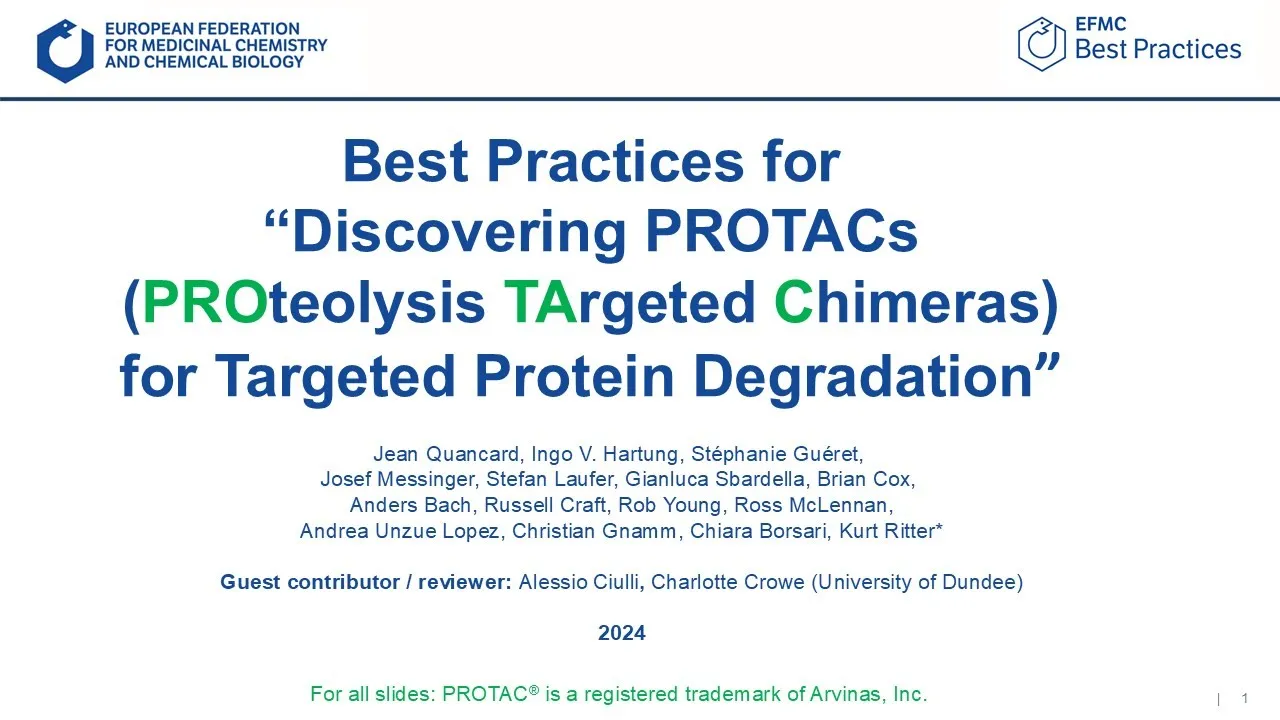
PROTACs (Proteolysis-Targeting Chimeras) are bifunctional molecules that hijack the ubiquitin-proteasome system to degrade target proteins by simultaneously binding to the target protein and an E3 ubiquitin ligase, forming a ternary complex that marks the target for proteasomal degradation; successful PROTAC design requires careful consideration of target selection, binder choice, linker length and chemistry, and E3 ligase selection, followed by rigorous experimental validation using techniques such as fluorescence polarization assays, time-resolved FRET, NanoBRET cellular assays, western blotting, and whole-cell proteomics to assess binding affinity, ternary complex formation, cellular engagement, degradation efficacy, and off-target effects.
PROTAC-Mediated Targeted Protein Degradation | Webinar
Added:hello everyone i'm tanuja koppel consulting editor for biocompare and welcome to this bench tips webinar today we'll learn more about one of the hottest topics in drug discovery today and that is protax-mediated targeted protein degradation i think it has attracted attention from academia pharma biotech alike so it's going to be a good discussion so as many of you may know the bench tip webinar series was created to bring together senior graduate students and postdocs to share some of their technical knowledge which sometimes really gets you know buried in their lab notebooks or you know just in a research paper and it never comes out so this is really a unique forum to for them to come and share some of their best practices with us and for you as an attendee to ask questions and possibly even learn from some of the mistakes that they may have made so the goal is really to keep everything very informal and interactive so let's begin um each panelist will give short talks and we'll follow that with a q a session there is a ask a question button which is at the upper right hand corner of your screen i really recommend sending in those questions as soon as they come to mind because if you wait until the end sometimes you know we have so many questions we may not get to yours so type away and send it in uh if you're having any problems with the connection we have a test your connection button which is at the bottom of your screen so just click on that and you will find the help that you need we also have some social media widgets that you can use to share this webinar with your friends or colleagues who you think might benefit from listening to this webinar on the right-hand side of your screen we have an overview of the webinar we also have some information about our speakers their expertise their experiences and finally we have some resources that we have been provided by our sponsors so i do want to extend a big thank you to our many sponsors nanotemper bps bioscience ta instruments and biotechnique for supporting this webinar and for sharing some of those resources with us today so please take a look and download them i'm sure they'll be very helpful so with that i'm going to actually turn things over to our moderator for this webinar who is dr catherine donovan she's a senior scientist and dr eric fisher's lab at the dana farber cancer institute she works on the development of molecular glues and protects and she has helped set up optimize and actually lead a high throughput proteomics pipeline both in the fischer lab as well as a part as part of the center for protein degradation at data fabric so uh catherine will be providing us with a short overview on the topic and she will be introducing the speakers for the webinar as well so welcome catherine and appreciate your help with moderating this webinar uh so thank you tunisia uh for the very kind introduction um i wanted to start by giving a quick summary of the ups system and kind of what the whole goal is here in degradation so the ups system is one of two major systems that eukaryotic cells use to maintain produce homeostasis in this system different signaling events can occur that initiate various cellular processes such as post-translational modifications or unfolding events that can initiate various cellular processes leading to the recruitment of proteins to the ligase this recruitment results in ubiquitination of these specific targets and then downstream proteosomal degradation um so over the last several years we have learned from a lot of different groups and experiences that this process not only happens naturally but also that we're able to use small molecule chemical induces to hijack this degradation pathway to induce degradation of proteins that we choose to remove so for example a protein that is overexpressed in different cancers could be specifically targeted and down regulated in cells um using specially designed small molecules so there are two types of small molecule degraders that are often described in the literature the first are molecular glues which do basically as their name suggests and act as a glue to bind two proteins together and get and a ubiquitin ligase this leads to ubiquitination of the target and then downstream degradation so these types of molecules are usually discovered serendipitously and they've been notoriously difficult to design rationally the second type of small molecule to greater heteroby functional degraders these allow a little bit of control or target selectivity because we can design these dual headed molecules we have a single head here and a second head here where one end binds to the target of interest and then the other end binds to the e3 ligase this allows us a bit more control over which targets we're able to degrade so we can target things that we would like to remove so the question that starts to arise when thinking about these degraders is how do we even start out degrading these or designing these molecules and then once we've designed them and we've synthesized them how do we know if they're even working in our cell experiments or in vitro experiments so there are many questions that we ask ourselves when we get started synthesizing these molecules such as is my protein of interest a good target or how do i prioritize a specific target which binder should i use do i need high affinity or high selectivity is there a linker length that works best and what about liquor chemistry is that important does it really matter and which e3 like should i try first should i try all of them or is there one that i should start with so once we develop this library and we synthesize our molecules there are many more questions about how to experimentally test these molecules so we want to determine you know are they effective at degrading our target of interest as well as other perhaps unanticipated targets so at this point we start to think about the steps that are required for effective degradation of the proteins of interest so one question that arises is which cell line do i use is this important does it really matter which style line i use for my experiments how do i know if my molecule is getting into cells i know my molecule needs to engage the target as well as the ligase but how do i test this should this be tested in vitro or in cells and how do i know what this complex actually looks like i know ternary complex is important for ubiquitin transfer but how do i really explore this how do i know if my target is being ubiquitinated or i run a western blot and i see a degradation of my target of interest but how do i know if that's the only target and is it possible that i'm missing other targets that are being degraded as well so today we have a panel of experts who are going to share their real life experiences with the design and characterization of degrader molecules this webinar is an opportunity to hear about some of the different methods that we in the degradation field are commonly using to explore the development and testing of different targeted protein degraders at the end of the talk we'll have a live q a session to dive into more technical detail and please use this as an opportunity to ask and receive everyday tips and tricks for best practices in performing a lot of these experiments so our panel of experts today includes uh dr vesna vedma who did her phd in cancer biology at the university of stuttgart germany and has been part of the truly group since 2019 as a cell biologist currently working in the truly labs collaboration with bi um at the university of dundee in the uk dr brianna zurfus who did her phd in chemical biology at boston college and her postdoc in the department of medicinal chemistry and molecular pharmacology at purdue university brianna is now a scientist in the biochemistry group at the dana fiber center for protein degradation dr shroya roy berman who obtained his phd from johns hopkins university and is now a biomolecular engineering research fellow in dr eric fisher's lab at dana farber cancer institute and finally dr kusal samara singh who completed his phd in the department of chemistry at wayne lake university and he is now a postdoctoral fellow in dr craig cruz's lab at yale university and with that i will welcome dr brianna surface to start us off with the first presentation uh thanks catherine for the great introduction as catherine mentioned i'm currently a scientist at the dana-farber center for protein degradation in boston in the biochemistry group so what i'm going to be going through today are some of the assays that we use to look at binding ternary complex formation and engagement in live cells so before i get to that i just want to give everybody just a quick look at to where i stand in the field and you know the perspective that i have as far as targeted protein degradation so within the center of protein degradation um we were established in 2019 under the leadership of nathaniel gray and eric fisher here at dana farber and we were set up as a way to advance their current targets but also to innovate and develop new platforms for targeted protein degradation so here are just a few examples of some of our capabilities and really what i'll focus on are two of the ones that i work towards including the biochemical assays as well as some of these cell-based occupancy assays so to get us started for target binding a really popular technique is fluorescence polarization one of the reasons why this is popular within the tpd field is because it's not dependent on enzymatic activity so we're looking strictly at binding and don't need to have um an active protein or a an active site inhibitor to look at binding so you'll start with a fluorescently tagged molecule and this is going to be something that is already known to bind your protein of interest when these two are then mixed together you can equilibrate to allow for binding and then you'll be exciting the samples with polarized light such that all the light is moving within a parallel axis if we look at the two extreme situations here where we have all of this bound all of our probe bounds and then the opposite extreme of being all of it unbounds what happens with the polarized light in these two situations are quite opposite so for the bound samples you may um you maintain polarization and this is going to be based off of the size of the molecules so when we're bound the probe is tumbling less quickly through a solution and the light is therefore scattered less from its original axis so we see a lot more of the light moving in the same parallel direction versus the perpendicular direction in the unbound um so this will then keep our polarization maintained in the unbound situation the light is being more scattered and you see it going off in several directions and the intensity of the parallel versus the perpendicular um has now changed to become more even so in this case your polarization is lost we can uh define milli polarization based off of this equation here where you're just measuring those two different directions um this g factor is going to be dependent on your um your fluorophores as well as uh insurance specific so in most cases you can ignore that especially if you're doing a a screen and not changing instruments um but the other advantage of this is that you can use it to look at protein protein interactions a good rule of thumb here is to have a 10 times difference in molecular weight in order to be able to detect the difference in levels of polarization so in a typical assay setup uh you would be initially starting with a given concentration of your probe and doing a titration of protein so for these types of assays you will need to keep in mind that it can sometimes require high quantities of protein to pick your conditions you would want a point where you have about 50 percent of the probe binding for the protein concentration using a probe concentration close to 10 to 50 nanomolar um depending on the type of probe this concentration may vary but once you have this these conditions set that will be what you use uh moving forward otherwise changing either those conditions may vary the ability for you to compare across experiments so the final readout is actually a competition-based assay where you will take these conditions and then do a dose response for your competitor compounds in the case of a non-binder your melee polarization will stay consistent as the probe still maintains binding affinity to your protein but in the case of a competitive binder you'll start to see this dose response and that can be used to look at binding affinity of that competitor so as the probe is displaced you'll see that the polarization starts to decrease as the probe is then free in solution a few other things that are worth considering when optimizing this assay is your binding affinity of the probe to your protein using the best binder is typically not the best case here as that makes it more difficult to displace in the first place also your choice of fluorophore and linker length is also going to be important here and these two tend uh especially with the fluorophore that's going to be dependent on your instrument capabilities you're going to need to use a floor floor with the filter set that um you have within your instrument so typically you want to try multiple different compounds here in this initial validation step another popular type of assay is time resolved fret for looking at ternary complex formation so typically here we're looking at our target protein of interest and most often you're also looking at an e3 ligase in order to have fret you'll need to have complementary labels um these are not necessarily dependent on don't always have to be used with the donor on the target and acceptor on e3 ligase but most often you're going to use a lanthanide based system as your donor and then a fluorophore on your second protein which will act as an acceptor so after the addition of compounds you would expect to see this ternary complex forming now that your donor and acceptor are close together there can be a fret exchange occurring uh one thing i do recommend for these types of assays is really taking advantage of all the information you can get from an initial setup so changing the amount of equilibration time that you have for the addition of compounds can give you more information not just on potency but also on binding kinetics so ultimately the readout is going to occur after exciting with the wavelength of light for your donor and as that gets excited and emits light it should fall within the excitation wavelengths of your acceptor and you can then see an intensity for your donor in a separate intensity for the acceptor so again instrument wise is going to um your fret pair is going to be dependent on what filters you have available on your instrument of choice taking the ratio of acceptor to donor you can then get what is known as the tr fret ratio and that's what you will plot against um concentration of compounds most often for these types of assays you will use a lanthanide chelate because this has a large stoke shift and also it has the time resolved capabilities so um typical assay setup would include the equal concentrations of the proteins and a dose response of your compound so again we see this increase in tr fret that occurs as your compounds come close together and then if you increase the compound further you will start to make monovalent species and your fret will then decrease just a couple of things here again link your length and placement of your labels as well as your choice of fret fare using europium and terbium so i just want to go through a couple of challenges these are things that i've personally observed um probably the major one is intrinsic fluorescence from compounds and this is just the structure of pomalidomide and it's a common on cerebone targeting compounds that is used for protacs what you may not know is that this aminothalamine structure has fluorescent properties and can then directly interfere with both fp and tr fret readings so some gen some suggestions for overcoming this would be to just examine the absorbance properties of your compounds before testing them um an advantage here for tr fret is that you can run a counter screen in which you're excluding one of the proteins and if you see this change in tr fret you know it's coming from the molecule another challenge that can occur when using purified proteins is having the right construct and the right labeling sites so it may be important to try different protein constructs especially if you're looking at a larger protein and looking at different labeling sites in order to get what is going to uh give you the right distance for uh for fret to occur the final assay i want to go through um is cellular engagement assays this follows a lot of the same concepts as the in vitro tr fret except you'll be using now nano bret where you have a luciferase in this case nanoluke uh which uh then transfers energy to your fluorophore probe the advantage of nanoluke here is that it's smaller and brighter which makes your reading urea much more sensitive so again we'll perform a competition assay and displacement of your fluorescent probe will decrease the nano breath signal in order to set up these types of assays what you'll need is your target protein of interest labeled with nanoluke this can be done either transient and transiently or through stable expression just a quick note this is not limited to kinases as this uh figure may suggest um so keep that in mind that you can really use any variety of protein that you want you'll also need a fluorescently labeled probe something that will fall in the excitation range of 460 nanometers and you'll also need the substrate for nanoloop which is going to be what's amending the luminescence in the first place one of my favorite things about this assay is that it is cell-based so it um is very important for protects to get at um differences in cell permeability so just um in the same way as with the other assays you'll want to do a titration with the probe pick that um 50 occupancy so that it's easy easily displaced and then do a dose with your competitor so similarly your nano nanobrett will stay the same when you have a non-binding molecule and then when you um have a well-behaved binder you will see this dose response so again run a competition and you're looking for a decrease in nano bret and as i mentioned since most of the concepts follow the same as tr fret a lot of the challenges also follow the same so you'll need to try multiple constructs of your protein and design different probes trying out different floor floors and intrinsic fluorescence of your compounds will also cause some issues here as well so um always running that counter screen excluding your fluorescent probe can uh keep you from going down the wrong path as far as a compound comes so that just would like to thank you for your attention and i'll hand off to vesna for our um our next talk uh thank you brenna and thanks catherine for the kind introduction um so as catherine said i am a cell biologist working at the center for targeted protein degradation at university of dundee in scotland here at the center we have multi-disciplinary teams working on academic and translational projects in protect drug discovery our teams consist of chemists structural biologists biophysicists and cell biologists and together we are trying to advance the field of targeted protein degradation so for myself as a cell biologist my main role here is just first to screen compounds for degradation and nominate the best compounds into like further development i'm also establishing essays that help understand underlying mechanisms of the graders and together with chemists and biophysicists i'm trying to move projects forward so i'm sure you're all aware of the cascade that protag has to go through in order to degrade a target and today i'm going to focus on one aspect of this cascade which and i will be talking about targeted degradation itself so the first thing we do when we get a fresh batch of new compounds is we test those compounds for degradation understanding degradation can really help move projects forward and nowadays we have a plethora of techniques that can help us answer different questions so um i will start with mentioning different cell lines so this is very project specific and you should always be focusing on several different cell lines that that are suitable for your project then when we come to perform degradation experiment we need to think of a time point at which we're going to do that so sometimes we have fast degraders sometimes we have slow degraders and it's not the same if we measure degradation at 4 hours and 24 hours or 24 hours we can sometimes miss out on things then of course we need to be mindful of the concentration we're going to use to treat the cells and measure degradation if we go too high we may be in the hook effect field and if we go too low we may not see the effect so when we have these things measured then we can rank the compounds so is a better than b better than c and redo this based on the dc50 and dmax the gradation essays can also help us establish the specificity of the compound so we can determine on target effects or off-target effects then we can also examine whether uh the degradation we're seeing is really dependent on the e3 like is in the proteasome so we can do different co-treatment and competition essays so for all these things that i've said that i've mentioned uh there are a variety of techniques we can use and in this talk i'm going to be presenting a few of the techniques that i'm personally using and they can be split into low throughput and high throughput techniques but they can also be split into endpoint essays and kinetic essays so to start with uh the endpoint degradation so the first thing that we always do is a classical western blot during the years the last few years there has been a development of automated western blood devices so here i have kind of summarized the similarities and differences between these two different techniques so first of all they're both antibody based and when you start a project and you want to do a western blot or an automated western blood you need to first find if if there is a specific antibody for your target on the market and if there is you need to buy it and you need to validate that antibody so you need to make sure that the antibody is specific for your target now um so classical western blot is quite low throughput it requires a few days to get the final result so we normally re-probe for our targets and loading controls uh we don't strip the western so it takes a few days to get the final results whereas with automated western blood you get to your result in a few hours uh both of these technique techniques uh have the advantage that they do they you do endogenous detection of your target so there are no tags required or anything else like that um classical western blot is easy to do it's easy to optimize whether automated western blot requires really heavy optimization and also classical western blot can be made very cheap or cheap ish depending how uh how you whether your gels are lab made or they're precast are you doing like slow transfer or like those very fancy six minutes transfers whereas automated western lots are actually quite expensive and they do require quite a heavy optimization so these two techniques are quite low to mid throughput when it comes to higher throughput techniques uh we like to use plate-based essays so for this for these kinds of essays so brianna has already mentioned uh a nanolook luciferase not only phrase so for these essays we use the split luciferase technology so another look can be split into two parts one of them is a high bit which is 11 amino acid smaller part and then the high the larger part called large bit these two parts of the luciferase have quite high affinity so when whenever they are in proximity they're gonna form the nanolook luciferase as a whole so this hybrid tag can be attached to the proteins and that can be done either endogenously by crispr approach or you can overexpress it and or make a stable cell line and having this hybrid tag on our proteins can enable us to screen a larger number of compounds in a 96 volt plate for example or a 384 well plate other techniques plate-based essays that are a bit higher throughput are elisa based and imaging based so one other technique that relies quite a lot on the hybrid tag is the kinetic degradation so it is more low throughput but it gives you quite a lot of information so if we have our tag on the protein endogenously for example or overexpressed both both views are valid but they do give you a different information and you have to be mindful of that so by doing this technique you can do measurements every few minutes through a very long time period and the parameters you get from this kind of experiment are really valuable so you can measure the the degradation rate the degradation maximum the recovery rate the time your compound stays at the maximal degradation uh so you can see it uh in this example here so you can also see in this example how degradation at four hours differs from the degradation it's 24 hours so for example if we measured the degradation at 24 hours initially with this compound we wouldn't have caught this early more potent degradation so you have to be mindful of the time points but you also have to know the biology of your target how does your target behave so now if you have a compound that you want to move forward uh it is advisable to do an unbiased whole cell proteomics experiment to see how does your compound affect other proteins in the cell of course you can always perform western blood to uh to probe several different targets but proteomics experiment really gives you the big picture so uh in proteomics you can detect between five to seven thousand proteins um in one experiment and this experiment can tell you how specific your compound is there are some considerations you have to keep in mind for this kind of experiment so that is that the treatments have to be done under eight hours otherwise you start seeing a mixture of different responses to your compound uh the you do require negative control uh so for example we make cis hydroxyproline vhl control so for example uh compounds that have this hydroxyproline vhl binder can't bind the e3 ligands so therefore we don't see degradation um there has to be a significant vein of degradation between your active pro attack and your inactive protect and uh my advice is before you embark on proteomics experiment always check for degradation always and this is my final slide so i'd like to say just a few words about the degree on technology so degrom tags are used when for example you want to orthogonally validate your target if for example you don't have compounds yet for your targets or if you want to see whether your target is worth degrading what would be the effects so there is quite a lot of these diagram tags on the market and these systems that you can use to check for that so the most popular ones are i guess dtag and aid degradation system and we have loads more uh the contact technologies being developed so we have this bump and hold bromo domain base tag by dana farber cancer institute and the bromotech by ctpd in dundee and i would like to thank you for your attention and i'd like to hand over to the next speaker shorya thank you vesna today i'll talk to you about some computational tools for product modeling and the new tool that we've developed for predicting how degradable a certain protein is so before i jump into the tools uh let's talk a little bit about how we think about complexes formed by these molecular fluids so conventionally we think of two molecular clues a monovalent molecular glue is something like what's shown here where the compound sticks to one of the proteins and that modifies its surface and it helps it recruit a non-endogenous target for example in the e3 like is a substrate receptor decar15 e7820 binds and it changes the surface so that this new substrate beam 39 can be recruited you have the coordinated and decreated a second class of decreaters are the bivariant degraders such as flotax as the topic of today's discussion and we usually visualize them as having two parental compounds which are which are in which bind their respective proteins and they they're linked together by a certain anchor but this sort of representation gives the idea that the e3 substrate receptor and the target are not in contact with each other and they don't have defined ways in which they bind each other luckily over the last three four years we've been lucky to have a bunch of a bunch of structures of e3s with their targets and what you can observe in each of these cases is that there are extensive interactions between the target and the e3 like is in all three cases so perhaps we should uh modify a picture of a protac from this to this such that the protag act very similar to the monovalent molecular glue and there is an interface a rather extensive interface between the e3 substrate receptor and the development and this picture is what allows us to use computational tools because we can now go on to predict what the ternary complex looks like and from there we can derive structure activity relationships but before we go any further uh we need to address the fact that what's been observed is that different protocs with the same set of proteins so it's cerebral as your a3 ligase here and brd4 bd1 as the target gives completely different structures depending on which protox you use and what differs in these products is the linkers and where the linkers are placed so when designing a product this becomes an essential thing that we need to look for we need to look at the length of length rigidity and that ultimately affects not only how these proteins bind the e3 like is but also the biological activity and other properties like cell permeability so it's reasonable to assume that if through some sort of a computational tool we are able to assess that there are certain preferred binding modes and these are the binding modes that are preferred uh we should be able to figure out what kind of link is fit best in this case unfortunately we can't really use a a very new tool like alpha fold multimer or other machine learning based tools because these are not evolved interfaces but we have some older structural modeling tools which work very well in this case so here i'm showing you an attempt by a company called as chemical computing group where they tried out four different ways in which they try to model the protac and externally complex so the two big tasks in this case are protein protein docking to determine what the overall complex looks like and then link a sampling within that so in one case they tried to sample the length of the product and then place the proteins that didn't quite work out then another uh method they tried to cut off half the product and modeled uh and then uh sampled the linker just by itself and then put one the the other binding partner in place that also wasn't as accurate what they found to be the most accurate tool was this where they first docked the e3 like yes to the target with both parental compounds in place then they sampled the protac with the linker independent of the context of the protein and finally they matched these docked e3 target complexes to the product conformations and they were able to arrive at these complexes well this was the most accurate of the methods tested there was still a few drawbacks that is there were steric clashes between the lanker and the protein because the linker was sampled without the context of the protein and also there was an improper improper overlap between the parental compounds and the proton more recently uh the meth some methods have adapted this approach and refined it and right now what we see working the best is that we do local protein protein talking and when i say that i mean we start off uh with a confirm a case where the protein the target and the e3 ligase are close to each other with their respective compounds facing each other and we sample locally or very we just sample this region around around the e3 like and the target and the tool of choice at least for us is razara dock but i must give a disclaimer that i wrote the most recent version of rosetta docks so there might be a bit of bias in that case but what we've observed is that after doing these docking and clustering these complexes we can assess them using other independent tools like this one called mqa which uh which we can think of as a black box for most purposes but it deals with veronite tessellations and how they overlap another alternative approach is to do short molecular dynamics simulations and look at the residence times of each of these different modes that you observe from docking and the one that has the longest residence time is probably the one that is most likely using these methods there have been two published methods called p residency and product model both of which have highlighted here what they do is they first do local docking as i have described and then they used rdk to model in the linker but if you don't know what the link is then dlinker is one more recently published method which uses an ml-based algorithm to construct the linker itself now both of these methods have uh achieved pretty high accuracies on the handful of structures that we have uh complexes that we have experimental structures for so uh let's assume using one of these methods we can form a ternary complex which does resemble what's there inside the cell very well does that guarantee product activity the answer turns out to be no so here's a paper by our moderator catherine and her colleagues in the fisher and grey labs and what they did was they took 91 different compounds and they tested these kinase degraders against all kinases in our in the human uh proteome and what they observed was that some kinases degrade very easily whereas others don't at all and one might assume that this is because uh they don't the the products don't form the ternary context but they could experimentally observe complex in many cases but no definition so this god is thinking how is that possible how is that the formation of a stable ternary complex is not sufficient for regulation our colleagues and surely lose love adena fargo they took these kinase degradability data and they looked for associations across these large publicly available data sets and the two associations that came out most uh that had the best associations the two the two features that had the best associations were ubiquitination potential that is the fraction of ubiquitin ubiquitinated sites of the total lysines and these ubiquitination sites are lysines where there has been experimental evidence that uh they were ubiquitinated in the cell at some point and this is done through mass spec and they found that that had the best positive correlation and the half-life of the best negative correlation based on this uh they've come up with this model called as mapd and i'm giving you the website here where you can check it out uh so it turns out that the degradability of a particular protein is partially entranced to the protein itself and you can if you have a bunch of targets which you want to design degraders against perhaps if you run them through this program you can it will help you prioritize your targets as what is more likely to be amenable to degradation also there is no requirement of a target structure the limitation however is that because it's dependent on external databases there are many cases where some data is missing so you do see artificially low mapping scores which does not necessarily mean that the target is interruptable an example being brd4 which we all know degrades very well so we took this data and we thought uh what does that mean in terms of the structure so here i'm showing uh the colon 4 complex and this is the part that we talked about before the substrate receptor and the target but when you put it in complex you see that it's in this sort of banana shaped molecule the e2 is at this end and so it's reasonable to assume that if there are let's say four lysines on the surface of this target these two lysines in red they will not be accessible by the e2 so we can't really pinpoint where the e2 is because uh colon is a fairly flexible uh protein but we can say that it won't reach this far but these two lysines are whether it's reach however not all lysines are hypocritical there could be a variety of reasons why a certain lysine uh just cannot accept an area of equipment although it is other services so based on some uh e3 target docking we were able to look at all these about 200 kinases which had structures and what we saw was when we divided the jubilation sites by e2 accessibility we could very easily distinguish in many cases which kinases had high degradability and which ones had no degradability and this is if you were to randomly arrange the ubiquitination sites around that would not be the case and a similar was uh recently used and developed completely independently by lab at the university of florida and they used this to design uh degraders against bcl2 and bclxl what they did was they docked using this p rosetta c method that we've described before they docked uh bcl's 2 and bcl excel to vhl and they figured out that there's a narrow euronation band in which the e2 can deliver these lysines and they used that to predict uh which lysines are within the range and also then they rationalize looking at the structure which lysines are possible possibly available for your cretination based on that they only had one or two lysines in each case and the mutation analysis revealed how the representation mechanisms proceed by this product so i think the message uh from here is that that we can use these docking programs and your patention site uh code to not only figure out what are the best protags that will work uh in our case but also which positions can will likely be ubiquitous and hence give us an idea of what the hypocritical nation mechanism is with that i'd like to thank uh my friends in the facial lab in the leola our founding sources our organizers and thank you all for your attention and now i'll pass it on to question all right welcome everyone to the last part of the webinar so during next 10 minutes i will walk you through how to design craft tax to induce the degradation of transcription factors so since transcription factors recognize and binds to specific dna sequences one can hijack their dna binding ability to selectively recruit and direct them to a proteolytic pathway for it degradation to do that you can simply find the consensus sequence dna sequence for the bi-functional molecule design uh to record transcription factor of interest and e3 like this uh so we can do this in uh in different ways uh but today i'm going to focus only on uh the first generation draft tags that we developed using a chimeric uh crisp rna and double stranded dna as a chemical biology tool so uh what we call a trough tag is uh the chimeric crisp rna and double stranded dna so in this draft tag design uh the space sequence of the guide rna is replaced with the double-stranded dna that is specific to a transcription factor of interest so next uh the transfection of draft tag uh into cells uh that expressed the cas9 hero attack 7 will recruit transcription factor of interest uh into the the proximity of vhle3 ligase in the presence of a heinous project so in the current system uh we are using a dks9 herotax 7 as the e3 recruiting channel therefore we need to make sure that herotax 7 fused dks9 is not getting degraded by the henna protag so one way to address this issue is by uh fusing uh you know halo tag seven at noc terminus of decas9 and evaluate its degradation by addition of a halo prototype so we can also fine-tune the the orientation of the uh and the proximity of recruit at vhl by exploring different link attachment sites uh different linker length and composition uh within the hello pro tag so as an alternative strategy uh other low molecular weight uh but ligandable uh proteins such as fkbp uh can also be used in the place of halotax seven and we should remember that again we had to perform you know optimization in terms of uh you know the degradation of the cas9 herotax when we want to avoid the degradation of dks9x7 uh so once we come up with the non-degradable the cas9 herotax 7 protein or at least a system that is less susceptible for degradation by halo protags so we next pick a transcription factor and custom synthesize uh the traffic tag to target it so what i really want to highlight here uh is that uh how to select uh and predict uh uh the predict uh whether the the traffic and the cas9 hero tech 7 combinations are going to do their intended job or not so uh depending on the the position of the halo attack 7 on dks 9 hero attack 714 and the traff tag so you are using uh so which means uh so whether the double-stranded dna portion is at three prime end or the five prime end can dramatically affect the degradability of your target protein so if you look at the the first crystal structure uh which shows on uh how guide rna excuse me how guide in a position uh when uh it's uh bound to uh castline protein so as you can see both in terminus and c terminus of the cas9 are facing as the same side as the three prime end of the guide rna so this suggests a high probability of getting e3 ligase and transversion factor uh to the the same side of the uh the protein complex if you append double stranded dna at the three prime end of the crispr name however so if you look at the the other side of the the structure so you'll see that the phi prime end of the guide rna is facing the opposite side of the c terminus but the same side as the interminus of the cas9 protein therefore you still have the chance to explore different combinations of c uh terminus o and terminus dks9 with uh three prime o five prime traffic depending on uh different transcription factors you are targeting so when you design traff tags so you have only two options uh either you have you can attach double stranded dna at the five prime end uh or the three prime end of the the crisp rna as we discussed uh in the the last slide however so there are many uh ways to optimize stuff tech uh to find a better uh composition that can be used to successfully uh degrade your transcription factor of interest uh when we design double strand dna sequence uh so we should consider adding a few extra bases at both uh you know at both sides of the the transcription factor binding side so this allows our transcription factor to fully recognize its consensus binding of conformation uh as it recognizes it with uh the genomic dna also it allows a less strain and you know more flexibility to the the tough time so including uh three or several extra bases uh will be helpful in that way so adding extra copies of uh consensus dna sequence uh so we'll further facilitate uh the interaction or recruitment of transcription factor as we are usually seeing uh in you know reporter plasmid as well so in addition you can also play around with the space dna sequence which is a position in between the the double stranded dna uh and the crispr name so this gives more flexibility and more room to optimize the the distance or the the precision proximity uh to physically interact uh the transcription factor uh with the recruited e3 like is so you change uh three bases at a time or in in the latest stage of craft evaluation so you can fine tune the degradation by changing even a single base at a time so if you are worried about the the stability uh of your traffic tax you can also synthesize them with the phosphorous thyroid bonds which are you know resistant towards nuclear nucleus attack so but usually uh you might not want to uh you know do that because uh one staff tag is uh you know complex with a decas line fellow tag seven within the cell so it is a pretty stable and you know pretty stable towards our new places so in addition to exploring uh different uh composition of craft tags you might also want to consider uh using a control traffic in your experiments simply choose a scramble sequence now after the dna portion and you can link that to the crisp rna to get the control draft type so this should not bind to the transcription factor and theoretically the degradation should be spared next uh important step i wanted to highlight is that the transfection of caftac and more importantly the order of addition so you will use rnai max as the transfecting reagent and in general you can follow the manufacturer recommended protocol for the transfection step however the most critical factor as i mentioned is that the introduction of craft tag uh prior to the the halo product treatment so even though uh you use uh dks 9 halo tech 7 that is less such susceptible for degradation by halo protect so if you introduce this hello protag prior to the traff tag sometimes it can negatively affect the stability of the dks9 so in addition uh if the e3 like is complex uh complex is uh preformed uh before we introduce traffic to the system it can statically affect the uh you know the binding of the guide rna as well as the recruitment of transcription factor uh to the degradation uh complex uh therefore a transfection of traff tag prior to a halo product treatment is a critical step to keep in mind finally you can consider including an epimer control to control uh to confirm the a3 like recruit and we can use a scrambled uh draft tag to confirm uh transcription factor equipment so in addition to these uh so we can also uh design uh old scramble uh that is incapable of binding to both dks 9 and the transcription factor so this will provide additional confirmation of dks9 involvement in the process all right so i think um so i could share key aspects of craft tech design uh during the time i have and i hope uh this will uh be helpful to folks who are interested in applying draft tags in their transcription factor related uh biological experiments so uh to quickly summarize uh that we uh uh what we talked today uh so we can uh include a single or multiple copies of consensus uh transcription factor binding sequence uh within the double strand dna portion of the trap tag uh addition of extra flanking um basis at both end of double stranded dna may provide higher probability of successful transcription factor binding so we have the chance to optimize the space of dna sequence within the draft tag as well as uh the link composition of telepro tags and most importantly so we can readily use this approach to target many uh transcription factors with non-dna binding sequences so which are readily available via many online resources with that i want to thank everyone for attending the webinar and i will hand over back to catherine to continue with questions thank you kusal and thank you to all of today's panelists we will now be starting our q a section of the webinar uh please type in any questions in the ask a question box in the upper corner of your screen also please note that the webinar organization team have put together a resources section and this can be found in the upper right of your window so now let's jump into some of these questions that we have so the first question i have is for sure how often is the linker length prediction successful and do you see many cases where it is just completely wrong so most of the methods that have been tested have been on modeling already existing products and rationalizing why something worked and something didn't i'm not aware of any publicly available method to predict lincoln from scratch which has been extensively tested which really is the holy grail of protect design so to answer your question if we really don't have a good answer awesome uh as a general question for everyone what criteria do you typically use to prioritize which targets to pursue or which degraded molecules to develop brianna so as far as targets go i guess it depends on what the overall goal is and like disease relevance for those targets um and how that kind of fits into our overall portfolio and our overall expertise as far as the center goes um so sometimes we'll prioritize if we see that there's a greater therapeutic need over other potential targets it's also about like our set of compounds and how much sar we can build into that is there any information in terms of i guess ligase scaffolds or target scaffolds that you would use to kind of help you prioritize what molecules you would use to design your structures or your compounds um we do use modeling at times so having a more attractive model would also help us prioritize in that case if it looks like the binding model is more favorable then we'll use those types of tools in order to prioritize as well awesome let's go to a question for vesna and brianna and possibly sharia and cursel as well do you usually run the whole suite of essays on all new targets and compound series or what are your feelings on the best standard workflow for screening molecules for a new target so i know you all have targets you're working on but do you have a favorite workflow that you would go to for a new target um i can take that question first uh so typically uh it depends on the where the target came from whether um which office it's going to go through so if we do a biochemical high throughput screen then typically we would go through the biochemical assays first ahead of doing degradation aphase and then i would say the next assay that we prioritize is a western blot since that doesn't really require any genetic modification and it can also be done in several different cell lines without having to do anything new to the cell lines just treating with our compound as long as there's a reliable antibody awesome what are the feelings from the other panelists do you think along the same lines or any additions there yeah i would agree with brianna's workflow awesome uh this question is for shroya is preset c a program which can keep targets private to preserve ip or is that data you collect on your program let's see so this is not a program by us but on the website i think you might have an option to keep the targets private but you can always uh download it and run it locally so that might be a good option if you want to keep your targets private awesome and this is a question for everyone what are some important considerations when selecting cell lines for your experiments and if you're looking at cerebellum-based degraders or vhr-based degraders do you often look at the expression levels of your ligases in those cell lines first or how do you go about deciding what cell lines to use uh yeah so in terms of the you know the expression of the three ligases depending on the cell line you are using from my experience i think it is not a you know good uh uh idea to just look uh for the expression levels of your e3 like this uh sometimes you won't see it actually depend on what type of um you know essay you are using to uh look for the expression of uh whatever you feel like it sometimes even though you cannot detect the e3 like gate by western blood and that's the most common way of people doing it and still uh you know so there might be undetectable level of e3 like this and it might be enough to induce the duration if you introduce you know active protect into the system so i think uh so in the in the first place it's not a good idea it's okay to screen but even though you are not seeing that it will like this within that cell line uh or panel of cell lines you are planning to use you can always go ahead and you know test protects in the cell line sometimes you know depending on the sensitivity and the the the potency of your protect you might still see the degradation unless it is you know fully if it is not like expressing uh at all so you won't see the degradation but uh i think it is not a good idea to based on that just the expression level by investing blocking something like that yeah you should definitely test for the expression level of your target in in the cell line you want to use that's something you should do in the beginning and i think also that having a panel of different cell lines will kind of help you to get the clear picture if you if you limit your experiments only to one cell line you might have what we call like a saline specific effect so it's always good to have a few different cell lines in your panel that you work with and those cells should be for example if you work in cancer they're going to be cancer cells and if you work in lung cancer then they're going to be derived from lung cancer they're going to harbor different mutations or however different isoforms or the protein you're looking at and so on so in terms of cell line specific effects how how often do you see things like that are there specific cell lines that might not be as good to look at with degraders like i know the elk paper from the grey lab shows that there's higher expression of abc transporters which pump out the molecules but are these things that you all commonly think about when when do planning your experiments uh to be honest i don't think i've encountered anything along those lines in the past few years uh i'm just aware that they do exist like you said the high level of transporters and so on but to be fair we just use like a really large panel of cell lines to kind of avoid this to start with i would just to add on to that i would say we have a few cell lines that we kind of use throughout and then we wouldn't get to uh specific cell lines too too much until we have something more as a validated degrader um and once we know we want to make a bigger investment into a specific target that makes a lot of sense we will go back to briana have you found that the linker link for fret protein labels varies a lot for different targets or do you have a go to link a link that works in most cases for most targets that you're looking at okay great so i would say that just based off of synthetic ease we do have a small number of linkers that we use so that we can obviously apply these across several different compounds typically i'd say it's between 8 and 12 atoms between the fluorophore and your your binding molecule but uh yeah you want to keep you want to keep that somewhat flexible and you also want to try to avoid a short distance so that your 404 isn't having interfering binding with your protein target as well okay great we have a question from fort kusal a question of redundancy and specificity of occupancy by transcription factors is it possible that target sequence binds other transcription factors in addition to one that you may be trying to target and if so is it less specific than one would wish yeah so it depends on what transcription factor you're trying to target i agree with the comment some transcription factors you know within the same family of transcription factors so they tend to uh you know recognize and bind to a similar uh you know consensus sequence uh but um so if you want to go after you know it's one specific uh subclass of transcription factor you can always optimize the uh the sequence uh to get a some you know kind of uh specificity uh so you can always play around with the flanking sequence uh to you know get rid of other target protein and find uh you know optimized sequence that is specific for your transcription factor so it's a little bit laborious in that way but uh most of the the target you know transcription factors are more specifically you know the disease are relevant transcription that's what we are interested in we want to get rid of you know this troublesome proteins or trans transcription factors so most of which i think uh i'm not really recognizing at least according to my knowledge are they not binding to the same uh the sequence so in that way we have the the opportunity uh of targeting with uh transcription factors by the traff tags so the limitation is there so always you know if we talk about like protags or molecular blues so it has you know its own limitations uh i think it's it's true for draft tax as well so we have a nice practical question here for everyone uh what time course do you initially use to test for degradation by western blotting uh 24 hours or 48 hours and then do go back to four or six or where do you start um with gloves i think i can start with that uh so in general if you are when you when you're testing a protac you know so if you know your protectives are really working so you can always do a time course you know at least covering uh one hour to 24 hours so if you start testing your protac with a long hour probably 24 or 48 hours sometimes depending on the turnover and the stability of your protac uh and depending on the cell line as well uh so you might not see the degradation of your target protein even though it degrades as a you know like early time points because uh so if your protein is not protect is not stable enough uh to you know uh have a persistent degradation and your target protein have a you know higher tiny uh you know turn off weight so you will not you know capture your liquidation but i think uh so the best way to uh start with is at least doing three uh times uh maybe uh three hour 12 hour 24 hours in that way you can track um you know at what time point uh you are uh you know you see the degradation are there any differences of opinion here i feel like this is the sort of question where we all do it differently um i would say it depends on where the target comes from we do find new targets using proteomics so we would typically validate that through a similar time course as that experiment was done in other than that i would say 24 hours is a good start unless you're aware that your protein gets resynthesized really really quickly yeah i would also start at 24 maybe with a wider titration range and then go back to four if there is like a hint that you should do that perfect so what are some of the common mistakes that people make when running degraded experiments what are some of the mistakes we have all made when learning to greater experience i would say personally not having a fully validated antibody can really cause some problems when you're starting off with western blots so putting in the investment to make sure that your antibody is high quality and that your the protein you're labeling is on your western blot is actually what you think it is it will definitely help you out in the long run and also probably not trying out multiple mix and match for binders when you're when you're talking about protacs you want a high level diversity to begin with so that you don't miss anything by pigeonholing your your compound structures i can drop in some issues from proteomics point of view where not working on cells that are healthy or happy and thinking that you're degrading lots of targets but really it's just your cells dying that's something i've seen a fair bit of over the last few years does anyone else have any common problems or issues they notice in their experiments that might be helpful for others for a lot screens i've noticed that the results of the screen are very dependent on the degrader concentrations so i had for the longest time for these very large screens been using a very high concentration but then when i did a concentration as a like concentration titration for these uh screens the results are quite different that's a good point so i have a question here about setzer essays has anyone thought about certain essays for protacs or does anyone have an opinion here about satsa as a method to explore protacs i've done a few sets of experiments i can comment maybe so so i did this uh actually only a few times and it was when we wanted to check if the binder would bind to our protein of interest so i quite liked it so you can do it i did it actually like two different ways you can do a classical western blot after after heating your cells so you can load sterilization probe for your protein with antibodies or if you use hybrid tag you can detect high bit by adding large bits so therefore you can also make it a bit more high throughput i think both techniques are quite nice to use and i think sets i will give you a yes or no answer uh like is there binding or is there no binding which is a really good starting point sometimes uh the only thing i would say to someone is maybe check the literature before like whether your protein of interest has been tried out in ceta because not all of the proteins can actually generate a shift in the melting curve it depends on their size uh how do they look like so if they are small and globular like it's most likely that they won't do the the shift when you do the the melting so that's my advice just have a look at the literature before you start with these experiments awesome so i'm just going to round up on the final question uh so what are the current gaps in protect technology essays that you would like to see improved upon in the near future so where do you think we need help i think so we need uh you know uh a large uh pool of accessibility like cases we all know like we have like over 500 e3 like cases uh but not many utilities is actually used in protect design i think so if we can improve uh uh you know the ligand goal it will like case so that will you know increase uh the potential of protect using in cell line dependent or tissue dependent or tumor specific protects so that is um so one thing i think we should that that one gap in the in the protect technology uh and i think also um since our protags are a little bit in larger molecules uh you know compared to conventional inhibitors uh so if we can like play around with the the link composition and um novel you know link chronology uh that makes a shorter and you know simple connecting molecules between the two wall heads and also i think as i mentioned uh we need to find more tissue and human specific nuclei ligases so if you want to have you know more specific uh effect on the disease models so those are the other things that i can't think of right now awesome thank you uh we are out of time so i'm going to turn it back over to tunisia for some closing comments thank you so much catherine for your help moderating the webinars reading the questions um and thank you brianna vesna kosel and uh sauria i think just having this input from you guys i mean your labs are some of the you know the labs in the world that are driving the research in this rapidly evolving field so having you come on and talk about your work share your experiences i think it's really very helpful so really appreciate you doing that and uh just wanted to remind the audience that this webinar will be archived on the biocompare website which is biocompare.com and a link to the archive version will be emailed to all of you um i think within 24 hours so you will have the ability to go back view the archive and also you know feel free to pass it along to others who you think might benefit from listening to this you know to the advice that all our panelists shared with us today there are also resources on the webinar platform that have been shared by our sponsors so a big thank you to our four sponsors nanotemper bps bioscience ta instruments and biotechnique for of course supporting this webinar but also for sharing the resources that they think will help the community so don't forget to check out those resources before you log out today and uh with that i must thank all of you i know we all have such busy lives but thank you so much for taking the time to join us today and we very much look forward to seeing you at one of our future bio bio compare driven bench tip webinars so that's all i have thank you and goodbye
Up Next

PROTACs Explained: Chemistry of Targeted Protein Degraders
@Labroots
2K views•2021-03-16
Quantitative Real-Time PCR (qPCR): Principle, Method & Data Analysis
@animatedbiologywitharpan
129.2K views•2023-09-06
Microbial Degradation of Plastics: Biodegradation Pathways & Sustainability
@majeedhammad
2.9K views•2021-04-11
CRISPR and Genetic Engineering: How Gene Editing Works and Why It Matters
@kurzgesagt
30.5M views•2016-08-10
Related Study Plans & Knowledge Roadmaps
Structured learning paths in Biotechnology