





![[뉴탐스런 세계사] 28강 현대사 - 제국주의와 1차 세계대전_(고1,고2-초급) (류성완)](https://i.ytimg.com/vi/vxqbpcurTdw/maxresdefault.jpg)








![Perry Anderson – Modernity and Revolution [Review of Berman's All That Is Solid] (1984)](https://i.ytimg.com/vi/_ljGP9KY2u0/maxresdefault.jpg)







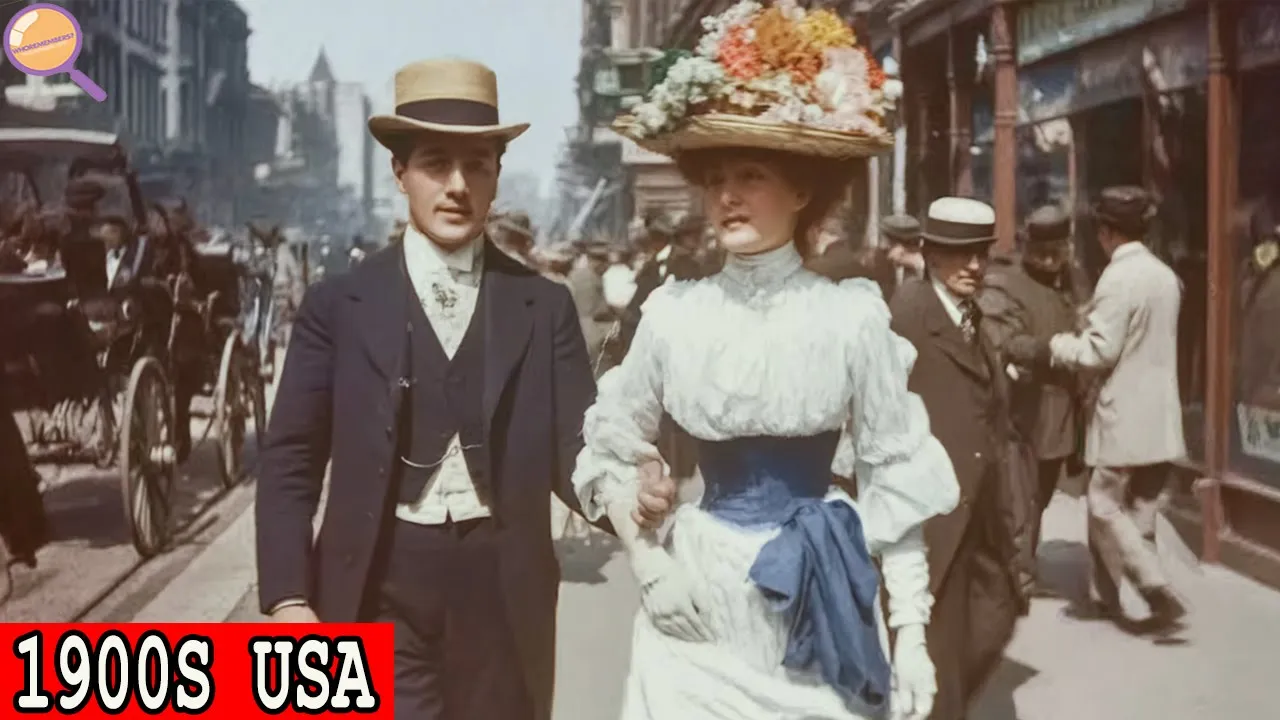


The years between 1900-1914 witnessed unprecedented transformation across Europe, driven by scientific breakthroughs (relativity, quantum physics, radioactivity), technological innovations (electricity, automobiles, airplanes, cinema), and social upheaval (women's suffrage movements, urbanization, colonial exploitation). This era saw the rise of modern ideologies including psychoanalysis, eugenics, and futurism, fundamentally reshaping European society and setting the stage for World War I.
The Birth of Modernity: 1900-1914 Documentary (SLICE HISTORY) | A Turning Point in Western Civilization
Added:The impact of the Second Industrial Revolution on technological and urban development in the late 19th century.
The geopolitical landscape of late 19th-century Europe, including imperialism and the early alliance systems.
The social hierarchies of the Victorian era and the emergence of early labor and women's suffrage movements.
The foundational tenets of 19th-century classical liberalism and the growing philosophical challenges to rationalism.
The outbreak of World War I (1914–1918) and how pre-war industrialization transformed the nature of global conflict.
The development of High Modernism in art, literature, and architecture during the interwar period.
The collapse of multi-ethnic empires (Austro-Hungarian, Ottoman, Russian) and the subsequent redrawing of global borders.
The socio-political transitions of the 1920s, specifically the expansion of democratic franchise and the rise of mass consumer culture.
173.9K views2.1Klikes2:06:17Original Release: 2025-07-20
[Music] Paris 1900. The World's Fair reveals the new possibilities of electricity to millions of visitors. Machines from many countries are competing with one another and progress and technology explode into the world. The 20th century begins with the flick of a switch.
Paris provided the stately backdrop for the world exhibition. It was visited by more than 50 million people. The main entrance alone was designed to admit 60,000 people an hour.
Behind the traditional style facads of the national pavilions, it was clear that a revolutionary new era had already begun.
Every hall was filled with new machines and inventions gleaming, rotating, and vibrating.
New technologies were beginning to change every aspect of life. Telephone operators were kept busy connecting cities and continents.
Ferdinand Porsche presented the first electric car at the exhibition.
His patent fell into oblivion.
Among the millions of tourists was a German school master, Jean Sovage.
When the Berlin school teacher Jean Sovage bought a hat in a Paris hat shop, he didn't want to be recognized as a German in the streets. Not by the tour guides who would pursue him and ask him for money, and not by the Parisians who would see him as part of the nation that had won a war against France only 30 years before. Sovage wanted to go around unrecognized, discover the technological miracles of the Paris exhibition which he had come here to visit so that he could tell his students in Berlin all about it.
You gaze at this giant machine with admiration and a certain fris of excitement.
A shudder grips you when you see the huge wheels spinning on its axis in a terrific whirl, and you behold its unearly strength. It would smash a puny human being to atoms if ever its bonds were loosened. Everything was overshadowed by those gigantic dynamos softly humming. Another victory for German technology.
The softly humming dynamos were delivering electricity for 50,000 light bulbs in the palace of electricity and also for mechanical walkways going at three different speeds.
The old world was on the move. Stable structures were beginning to break down.
Old certainties were beginning to waver.
Artists and scientists were making this process clear.
The German doctor William Conrad runken even worked out how to look behind the facade of the human body. In 1901, he was awarded the Nobel Prize for his discovery of X-rays.
Radioactive equipment used during those days is still being held in a basement underneath the Paris Technical University.
Electrical apparatuses and X-rays changed the ways in which people saw the world. But in this room, which is really nothing more than a decent kitchen, someone changed the way in which matter itself was perceived. Marie Curi came from Poland and as a woman and as a foreigner, she was an outsider twice over in science.
In a drafty little shed under life-threatening conditions, Marie Kuri and her husband Pierre labored at discoveries that would change the world.
The element uranium possessed an energy that was identified for the first time as radioactivity.
Her immense persistence and her scientific intelligence allowed her not only to unravel the secrets of radium but also to enjoy a career that ended in two Nobel prizes.
But despite her great achievements, the French remained hostile to the brilliant foreigner among them. For many of them, the new century was a time of uncertainty and even threat. Their defeat in the war against Prussia in 1871 was still an open wound. Since then, industrialization and immigration had altered their once familiar cities.
So much rapid change was frightening.
The Great World exhibition was also a temporary destruction from a long and deep crisis in France itself. The country was split into monarchists and republicans, reactionaries and modernists.
France was undergoing a transformation.
[Music] It was a conservative society with a strong monarchical tradition, a tradition of aristocratic elites.
And then there was a great change with the ideas of human rights and the rights of the citizen.
But then this process came to a halt and nationalism began to take hold again.
And why? Because it was a time of bitter rivalry with the Germans.
>> Germany had beaten France in 1871.
France had lost Alzas and Lauren. She wanted to get them back and get her revenge.
The view over the Rine alarmed the French. While their own population was static, German families were having more children, more potential soldiers and workers.
Germany had become their great rival in Europe.
[Music] [Music] Germany, an empire since 1871, was the fast beating heart of the continent.
[Music] In the Ruer area, new towns sprang up faster than anywhere else. In little more than a generation, the region had become a gigantic industrial metropolis.
Chemical works, machine tool factories, blast furnaces, car manufacturers, and arms factories formed the backbone of German success.
Germany's official image was stamped by the pomp of the Prussian army.
The victory against France had finally united the nation.
Berlin burst on the scene as the capital of the new empire. Within just 30 years, more than a million people had moved to the city, making it the fifth largest metropolis in the world.
Kaiser Wilhelm II had enlarged the city with splendid new buildings along the boulevard on in Lynden and a new residence of his own, the Pal in Potan.
As head of the Protestant church, the Kaiser also brought about the construction of Berlin Cathedral, a solid world made of stone, at least mimicking stability.
But in the Berlin suburb of Kaput, Einstein was shaking this apparent certainty. In his general theory of relativity, he showed that there was no fixed dimension to space and time.
The so-called Einstein tower was constructed to test the theory empirically.
Physicist Max Plank had made a further astounding discovery. Depending on how it was observed, light could behave either as wave or as particles. The so-called quantum of action.
A new branch of physics had emerged.
>> If we're talking about quantum physics, it has the most enormous consequences.
>> Practically the whole of modern high technology depends on quantum physics.
Modern computers, semiconductors work on principles of quantum physics.
lasers work on principles of quantum physics. So on and so forth.
[Music] >> Germany was being propelled by a breathtaking technical and scientific revolution.
Universities, fundamental research, Nobel Prize winners. Germany was beating all its international competitors in every field.
The impulsive young Kaiser constantly on the move and rushing from one meeting to the next symbolized this new Germany.
The late communation was running an unprecedented race of catchup with the other European powers. Germany's neighbors were apprehensive.
The impulsive young Kaiser was capable of anything. His most earnest wish was to impress his grandmother, Queen Victoria.
>> During Vilhelm's birth, it appears that his body got caught. uh it was a breach birth and um it was very hard to deliver him and so uh an obstitrician arrived but very late and sort of had to force him out and his left arm seems to have become dislocated or something happened and so subsequently it never really developed properly and he couldn't use it and there was I think a very strong feeling uh in the royal family in in Prussia in Germany that um a man who wasn't sort of fully a man who who wasn't completely, you know, able to ride and shoot and be athletic could really be a good Kaiser for Germany.
The most absurd methods were used in an attempt to heal his crippled arm. The terrorized child was bathed in hair's blood and clamped in stretching machines.
[Music] The German army was incredibly important to Wilhelm. I mean, it was very important in Germany anyway. Obviously, it it was, you know, in a country that had only recently been unified, it became the sort of almost the sole symbol of the collective Germany.
Wilhelm always wore military uniforms as if to kind of prove how incredibly tough and hard he was.
And he was sort of fascinated by that. I think partly perhaps because of the withered arm.
>> The painter discreetly concealed little William's arm behind flounces, but his mother, the daughter of Queen Victoria, was appalled by her child's disability.
For the past two decades, the British Empire had been ruled not from London, but from Osborne House on the aisle of White.
Queen Victoria had had this country residence built in happier days with her German husband, Prince Albert. Now she returned to it to rest from official duties and the tiresome reverence of her subjects and to escape the popeyed vulgarity of her eldest son, Prince Edward.
From a little writing disc surrounded by knickknacks, she ruled a vast empire.
[Music] Great Britain was the richest and most powerful nation in the world.
[Music] But even the greatest power on earth couldn't stop the rush of modernity.
Here too, centuries old structures collapsed within the space of a few years. Until 1900, Great Britain had been the engine of the global economy.
It was not the meek, but the British who had inherited the earth.
The strands of power were woven together in the drawing rooms of a few London clubs.
For Great Britain, the Victorian era had been a time of colossal achievement.
God looked at this mighty empire and saw that it was good. No nation could compete with Great Britain with its possessions, with its navy, with its glory.
But at the heart of this magnificent success lay a deceptive idol.
For centuries, the British aristocracy had managed to defend their position of power. Now the revolution was coming not from the cannon's mouth or the savage swish of the guillotine but quite peacefully from overseas accompanied by a gentle drone.
Refrigerator ships were bringing meat from Australia and wheat from Canada and these imports struck British agriculture with enormous force.
By 1905, the island kingdom was importing 60% of its meat and 80% of its grain at much lower prices than local farmers could ask. Globalization had begun.
[Music] [Laughter] [Music] For the aristocrats and landed gentry, this was a disaster. Prices for agricultural products fell by as much as 60% and soon 14,000 country estates were mortgaged.
Those who still had money speculated.
The stock exchange boomed. From now on, real power was wielded in the city of London, where vast sums of money were moved about and trade deals turned around in empty space like a solar system. Nothing was solid anymore.
At the University of Cambridge, Ernest Rutherford discovered that even solid matter wasn't really solid at all.
He had observed radioactive waves passing through gold leaf with only a few particles appearing to bounce off the surface.
As a physicist, he knew that there was only one explanation. Atoms were not what they had been thought to be. An atom was not like a big cake with electrons scattered about like sautanas.
Instead, it was like a solar system, mostly made up of empty space, with its mass concentrated in a kernel and the electrons circling the kernel like planets.
The discovery spelled the end of matter in the conventional sense. Ratherford had demonstrated that matter was neither fixed nor static, but rather a state of energy, constantly in movement.
The new scientific discoveries and theories made a deep impression on artists.
Hearing of Rutherford's results, the painter Vasili Kandinski noted, "The discovery struck me with a terrific power, as if the end of the world had come. All things had become transparent without solidity or certainty."
The hurtling emptiness of modernity had motivated the young Kandinski to withdraw from what was going on around him and to turn instead to the old folk rituals of Russia's Comey people. He was fascinated by the animistic symbols on everyday objects he found.
The path to modernity led Kandinsky and other artists back to a pre-Christian era, back to forms which spoke to an earlier collective memory and whispered of a world without electric light or cars or even cities.
With artists like Kandinski seeking a new art and scientists shaking the foundations of matter and the cosmos, Great Britain symbolically reached the end of an era.
When Queen Victoria died on the 22nd of January 1901, her grandson Kaiser II was at her side. The story is true that she died in his arms or rather his arm because he only had one that worked. But uh yes, it's certainly true that uh he was the one who was holding her when she died. And I think he felt it was very important moment that in a way somehow her status as the sort of grandmother of Europe was going to pass directly to him. But of course that ignored the fact that he had his his uncle Edward who was actually Queen Victoria's heir to contend with.
>> Behind the gun carriage wrote her son Edward and representatives of every kingdom in Europe.
Europe wouldn't be the same without Victoria.
And as at Windsor they bore the widow to her last resting place. There were many who wondered, fearful of change, unsure of the future, unsure of themselves.
When Victoria had died at Osborne House, Henry James noted in his diary, "The wild waters are upon us now." But what came upon the British Empire was Edward VIIth, Edward the Caressa. Short, fat, and vulgar, he was only interested in his own pleasure, and his first act of state, as it were, was to waddle through Windsor Castle, and to destroy the statues of his mother, her papers, her photographs, and to make crystal clear the Victorian era has ended. The Edwardian age has begun.
>> No one sees this. I'll show it to you today, but normally it's hidden in a store room and no one sees it, even if they ask to see it.
[Music] >> London was preparing for Edward's coronation, the first in 65 years.
This piece was made by Subri at the end of the 19th century for a famous establishment, a brothel called La Shabanet, a place for the upper echelons of the amusement seekers of Paris.
It was the place to come to and this piece was made to Edward II's specifications.
At the time, he was still Prince of Wales.
[Music] and you can see for yourself.
I think it was made for several people at a time.
>> It's not for me to tell you how it was used, but the possibilities are endless.
Edward was crowned in 192 in a splendidly decked out Westminster Abbey and to the strains of Elga's pomp and circumstance, watched by his present and former mistresses.
Among Edward set, there was a feeling that you could pretty much do whatever you wanted as long as you weren't found out. And the main thing was never to be found out because if you went public with anything, the rest of society could criticize you and also question why you were you had this exalted position in the first place.
In Vienna, the double moral standards prevailing in aristocratic and bourgeoa circles were particularly strongly marked.
Dr. Sigman Freud made it his mission to analyze the effects of this double standard.
[Music] It's no coincidence that psychoanalysis was developed in Vienna. The dangerous national feelings of different peoples were welling up in all the provinces and could be suffocated only under the mantle of the almighty house of Hapsburg.
[Music] The facads of the ringstrasa in Vienna, the capital of the Austrohungarian dual monarchy, were escapism in stone, a petrified determination on the part of the vianese to flee the problems of their own time. Politically stagnant and culturally torn, Vienna was a place of bitter controversy.
Sigman Freud succeeded in looking behind the facades of this society.
With a combination of medicine and psychology, Freud was able to fulfill his ambitions and realize a dream that would influence an entire century.
In 1900, he published the interpretation of dreams.
Freud had finished the book before 1900.
It was already at the printers, but the publishers wanted to delay publication until they could stamp it with the historic date of 1900.
That's how the interpretation of dreams became the book of the century.
Freud's analysis of his patients dreams was the raw material of his therapy.
>> The poet Hoffman once said, "The two most important tasks that young Vienna set itself were to dissect its own soul and to dream Maurice Ra's Laval was originally supposed to be called Vienna. The piece captures the city's atmosphere and music. Rall describes an imperial residence and dancing couple swirling around, but the piece ends in dissonance and chaos.
[Music] [Applause] The end of the dual monarchy was already in the air. The different nationalities within the empire had nothing in common but the figure of the emperor peering down upon them from hundreds of thousands of portrait photographs.
In this way, every Habsburg subject became a little edypus trying to overcome and perhaps kill his almighty father.
Since 1848, the emperor France Joseph had ruled over Germanspeaking Austrians, Hungarians, Checks, Poles, Sloines, Jews, Italians, sober crowits, Bosnians, Romanians, and other minorities living not so much with one another as against one another. On the whole, the imperial government seemed to think that it could triumph simply by surviving, by wielding a longer arm than history itself.
The emperor himself was only happy going off in his later hosen on hunting trips to Bat Ishel or visiting his mistress, the actress Katarina Schroat. Like everything else in his empire, this affair lasted for decades without ever reaching a climax.
>> I think it was just the length of time.
When you reign so long that people can even say their grandparents were born under the same emperor, then it's very hard to stay flexible, very hard to react to changing developments.
And the emperor had come to the throne just after the 1848 revolution. It was a different world, and he'd continued on into these modern times that had taken off so rapidly.
The empire borrowed itself in for good.
extending the Hofberg Palace with a vast new wing.
Behind the splendid facade with its columns and statues, the construction of the building itself revealed the reality of the new industrial age.
[Music] Behind the scenes, steel and technology ruled.
Directly opposite the Hofberg's neo baroque entrance, Adolf Los showed what modern architecture could really look like. Commissioned by an exclusive gentleman's tailoring business, he designed a very new building indeed.
In the immediate vicinity of the august presence of his majesty, Los erected a building of aggressive functionality, a building without ornament, in fact without a facade at all.
follows. Dishonesty and decoration were two sides of the same coin. Ornament, he wrote, is crime.
The evolution of culture is synonymous with the removal of ornament from the object of utility.
We have transcended ornament. We have brought ourselves to a state of being without ornament. The time is nigh.
Fulfillment awaits us. Soon the city streets will gleam like white walls, like the holy city of Zion, the shining city of heaven. Then all will be fulfilled.
When the scaffolding came down from the house without eyebrows, there was a huge scandal because the building was a manifesto against historicism. The disgusted emperor ordered all curtains on this side of the Hofberg palace to be closed. And with the falling of the curtains, the curtains also fell for the future of the house of Hapsburg.
[Applause] Maxis [Music] to find such another quarreling unhinged family. You'd have to go into Greek mythology. The Habsburg's many tragedies provided raw material for films, books, and stage plays. Even before Romy Schneider's famous impersonation, a romantic aura hung about the Empress Elizabeth known as Cece. Her life wasn't much more than a succession of temper tantrums, attacks of anorexia, and long Mediterranean journeys in search for the elixir of eternal youth.
But the reputation of this mostly absent and deeply unpopular empress was rescued for posterity by an assassin in Geneva in 1898. He thrust a file into her heart and turned her into a martyr.
[Music] It was the second violent death in the family in less than a decade.
The first tragedy had befallen Crown Prince Rudolph and his mistress Mary Vetera.
The brilliant Crown Prince realized that he had no chance of succeeding to the throne.
For one thing, his ideas were too liberal. For another, he was suffering from syphilis. The emperor knew that a dreadful end awaited his son.
In 1889, Crown Prince Rudolph together with Mary Veter had shot himself in my look at Austria, you have you know enormous numbers of Hapsburgs who turned out to be crossdressers and you know all completely mad.
>> France Joseph's youngest brother Lut Victor had a palace built for himself on the ring. From there, it was only a step to the central bath house, today's Kaiser Brundle, where the prince was fondly known as Luty Vootsie.
[Music] Lutri Victor's escapades in women's clothes and gay clubs were legendary.
[Laughter] [Music] But when he approached an imperial officer in the central bath house, a brawl broke out.
[Music] Lutri Victor got away with no more than a black eye, but it was too much for his stern brother and Ludvik was exiled to Salsburg.
[Music] The emperor let none of this come to public attention.
In the dual monarchy, concealing the obvious was a fundamental principle.
[Music] But one group of Vienna artists wasn't prepared to play this game. Gustaf Climpmpt revealed the emotions beneath the surface.
[Music] In Climpmp's hands, Nuda Veritas, the naked truth, the slogan of the secession movement, unfolded its subversive power.
His new goddesses confronted the observer with his own desires and worse, with the desires and fantasies of the women themselves.
When Climpmp received the commission to decorate the ceremonial hall of Vienna University with three large wall paintings, women were still forbidden to study there.
>> The fascinating thing about Climpmp is the conflict with the soul, the unconscious, with the human libido, weakness, human infirmity. Everything is placed in a wider context.
>> Climp presented his paintings in 192.
The professors were appalled.
Today only reproductions survive.
Philosophy with the enigmatic sphinx.
Jewish prudence with the accused helpless before her.
Medicine with her longing for eternal life and lust.
Perhaps the Senate of Vienna University felt that Climpmp's paintings had shown them too much about themselves. In any case, they rejected the works which enraged the artists so much that he withdrew them. Vienna was not ready for its own avantgard and in the political world there were controversies everywhere. Vienna was, as Kowaus had said, an experimental station for the apocalypse.
In 195, it looked as if the apocalypse of the old world would begin in Russia.
Russia's cities, too, were on the path to the 20th century.
But in the countryside, little had changed since the Middle Ages.
In 1905, the Russian photographer Sergey Praudin Gosski built a camera that could capture images in color. People being photographed had only to be keep perfectly still. The resulting 700 plates left us a wonderfully bright picture of the Tarist Empire. But the reality on the land was much less colorful.
In the villages, several generations lived under the same roof. Only one in every five children went to the village school. Justice was dispensed by village courts without the benefit of formal laws. Those condemned might be whipped, castrated, branded, or hacked to death with sickles. Everyday life too was marked by extreme violence, especially towards women who were unprotected by any law from the whim and will of their husbands.
With the onset of industrialization, hundreds of thousands of peasants driven by hunger and poverty arrived in the factory slums of Moscow and St. Petersburg.
In St. Petersburg ruled S Nicholas II.
Isolated from the social and political realities of the empire, he did everything that lay in his almost unlimited power to crush every impulse towards democracy or freethinking.
Zan Nicholas saw himself as guardian of the mystical union between the Russian people and divine providence. His authority came directly from above and all those seeking social reforms couldn't hope for a sympathetic ear. To him, industrialization was only a means to the end of financing his medieval vision of Russia.
One doctor described the living conditions in the urban underworld from his own observations.
>> These people aren't living. They're rotting. Down there, the people believe in nothing. They love no one. Nothing impresses them.
>> Through his competence as an engineer and through hard work, Sergey Vit had climbed the ladder from provincial official to prime minister. He described the Zar from close proximity.
>> Nicholas II is like an average guards officer from a good family. Amiable, but totally ineffective and unrealistic. His wife, the German Alexandra Fodorovna, with her blunt, self-serving character has a strong influence on the effeminate monarch. She would be suitable for a tsar with backbone. But unfortunately, this tar has no will of his own.
Nicholas did see the death of his grandfather, Alexander II. He he bled to death uh after being uh hit by a bomb basically in front of his grandson. And it was obviously the most tremendous traumatic event in his life. And I think it did make him feel that the forces of uh revolt and change were obviously evil.
>> Even today, it remains difficult to bring about democratic change in Russia.
In our country, there is a tradition of fundamental mistrust on the part of the citizens towards those in power.
So to have a better claim to their own authority in the eyes of the people, they use the church as a kind of transcendental force from God the father that confirms their own power.
In Moscow's Red Square, government representatives together with the Orthodox Church celebrate the 125th anniversary of Russia's Christianization.
They manipulate the national faith in the Orthodox Church so that the people don't just believe in God, but also in Putin. For example, in some Russian churches, there are Putin icons. Now, >> at that time, the Zah was worshiped like a god.
The modern factory surfs gathered together in workers unions. Their leader was the charismatic Orthodox priest, Father Gapon.
When he began to campaign for four workers, 140,000 people went on strike.
A peaceful procession to the ZA was organized to request his support against the exploiters.
On the 9th of January 1905, Serge Vit stepped out onto the balcony of his city palace. He'd heard noises. What he saw was a sea of hits. More than a 100,000 workers with holy icons and flags on their way to present a petition to Nicholas II. Their little father knew nothing of their miserable living conditions. They were convinced. If only they could tell him, he would help them.
[Music] "Amid the hail of shots and saber thrusts, disillusion struck the demonstrators more bitterly than any bullet." There is no thou, there is no God," shouted Father Gapam as those around him fell to the snow covered ground, wounded or dead.
It's true that the Romanovs have been canonized. Yes. And there is now a church on the spot where they were uh murdered in a Katarinburg and it's described as being on the blood and that's a sort of traditional phrase for you know a martyr basically. So yes, they are now saints.
>> In the year 2000, Nicholas II together with his wife became saints of the Russian Orthodox Church in Moscow's Cathedral of Christ the Savior.
[Music] That's why we performed in the Cathedral of Christ the Savior because it's an important place in our country. The Russian Orthodox Church meddles in national politics and dictates which laws are to be adopted and which are not, which the church shouldn't do in a secular state. That is absolutely not correct at all. That's why we went to the Cathedral of Christ the Savior because it's a central symbol for the Russian Orthodox Church and for its new power and also for the Putin regime.
>> The unrest continued in December 1905 in St. Petersburg alone, 418,000 workers went on strike.
Interior Minister Boulein tried to persuade the monarch that he must make concessions.
Nicholas II answered, one would think you were afraid of a revolution.
Majesty, said the minister, the revolution has already begun.
From the electricity of the universal exhibition to the little Russian revolution of 1905, gigantic tensions were being released.
Nothing was as it had been before, and the course of history appeared to be exhilarating by the day. People looked into their future with exhilaration, but also with fear. Maxva wrote that it was like sitting in a speeding train and not knowing where the points were set.
The early 20th century was all about speed. Sailing races were in vogue, but what really counted were fast engines.
[Music] I think the invention of the internal combustion engine brought on one of the great changes in the history of civilization. It really did.
It revolutionized things much more than even a Mar Kuri could in her laboratory because suddenly there was movement.
People encountered each other and discovered new horizons, new people, new ways of living.
[Music] No European country was more enthralled by speed than Germany.
[Music] The Kaiser insisted on presenting the trophy personally.
[Applause] Testosterone.
>> It's testosterone, I'd say. I mean, that's how it was in ancient Rome. The gladiators with their swords. And then it goes on and it takes different forms on the battlefield and through to the internal combustion engine. And that brings about different kinds of challenge. With an engine, you can break through a lot of constraints. You can break through gravity. You invent the airplane.
After land and water, now humanity conquered the sky.
Within a few decades, flying soap boxes had turned into complex aircraft.
[Music] Ottoantal in Germany and the Wright brothers were only three of many inventors who'd sought to defy gravity.
Only 60 years later, men would land on the moon.
In France, where flying was the height of fashion, Lu Blero set out to be the first pilot to fly across the English Channel.
Louis Blio was a once wealthy producer of car parts who had all but ruined himself with his flying experiments.
When he set off to cross the channel in one of these type 11 planes, everything was at stake. The problem was that the other 10 types had been complete flops.
And he knew that if it wouldn't make it this time to bag the huge prize money, his dream of flying would be over.
[Music] [Music] Bliru had already flown considerable distances over land, but as yet never over the open sea.
[Music] The challenge was more psychological than technical.
Bleio wasn't the only pilot trying to cross the channel that day. To get a head start on his competitors, he set off in his plane at 4 in the morning.
[Music] I am alone for about 10 minutes. I lose my bearings. It's a peculiar situation to be in the air above the channel without a compass.
My hands and feet rest lightly on the levers. I let the flying machine find its own way.
And then 20 minutes after I left the French coast, I see the cliffs of Dova.
At 13 minutes past 5, Birio landed on a golf course near Dover Castle.
The channel crossing was the sensation of the era. Blio was richer by £1,000 and London prepared a triumphal reception for him.
Headlines on both sides of the channel announced England is an island no longer.
But not everyone rejoiced at this. The latent fear of invasion began to grow.
Counter measures were required.
Admiral John Fischer battled to rearm the Royal Navy.
In the end, his plans were set in motion. A revolutionary new type of battleship was developed, the Dreadnaugh.
The ship was christened by His Majesty King Edward in the uniform of an admiral of the fleet.
[Music] The 20,000 ton 530 ft colossus was the beginning of a new era in the arms race.
[Music] It had all begun quite harmlessly with the visit of a German boy to his grandmother, Queen Victoria. Kaiser Vilhan made no secret of the fact that the motivation behind his expansion of the German fleet was very personal.
As a little boy, I was allowed to visit Portsmouth and Plymouth to admire the marvelous ships.
That sparked in me the desire to build ships like that myself one day and to possess a navy like the Royal Navy when I grew up.
In later years, he became an enthusiastic sailor.
>> 30 seconds.
The German Empire had been founded in 1871 and was in no way as self-confident as the British Empire.
>> Perhaps that was part of the reason why William II was so desperately keen to impress his uncle Edward II.
>> 3 2 1.
>> The main theater of this war to impress was here at cows. The cow's weak riata became a battleground where German and English yachts competed. But year after year, the English yachts came home first.
[Music] In the end, the emperor was exasperated and simply declared the rules were unfair and went home and founded his own riata in Ke. But the logic of competing and outdoing one another persisted.
Never before had such unbelievable sums of money been spent on arms. Military expenditure was soon swallowing up a third of the entire national budget in France and Russia, a little less in Great Britain and almost a quarter in Germany. The smoke stacks of Crook and Tissen were redot.
The Germans built their own dreadnots which were ships which were technically just perhaps a year or two behind in terms of armament. But on the other hand, they were very sturdy ships. They had less range because the British were a country with an empire and they wanted to have the option of sending those ships elsewhere and for that you needed range. The German ships to the British perception appeared to be slanted to one thing only and that was conflict between two large battle fleets in the North Sea.
The Kaiser was driven by a burning desire to break England's global predominance.
His plans fitted perfectly with Germany's expanding heavy industries.
>> You know, you go from sort of toy boats to navies. It's it's like a kind of children's game that gets completely out of control.
>> A wave of national enthusiasm for its own force gripped the German Empire.
Even Christmas was decked out with the trappings of future victories.
and compare.
[Music] Within a few years, Russia, Austria, Italy, Japan, Germany, and Great Britain had built more than a 100 battleships, ever stronger and ever faster.
The arms race was a game for men, but the factory work was increasingly done by women. They were even forging the heavy ships chains.
Wages were on the increase, but so was the pressure to deliver.
Industry needed cheap labor. Women did the same work as men, but they were paid not much more than children who themselves started in the factories at only 10 years of age.
Suffrage, the right to vote, was a central demand of the women's movement which began to organize in the industrial north of England.
In the chain forge of Cradley Heath, protesting women put down their tools.
Led by Mary MacArthur, the women were demanding a minimum wage.
Today, Crowdley Heath is an open air museum where actors retell the story from the viewpoint of those striking workers.
My wife's on strike today. Absolutely incredible that it should come to this.
This is the first time that I know of anywhere around here that women have gone on strike.
>> I've got all these kids to feed. um no money coming in. So um we've got Mary MacArthur. She's come to help us.
>> Our women, they making a chain for them.
They flog them off. They have a good profit and we get a pittance at the end of the the day for what our women have made. Ton on this this could have such farreaching consequences for everybody around here.
I mean there could be insurrection. You don't know do you?
Hide Park Corner in London is a legendary place for free speech and on the 21st of June 1908 people came here to demonstrate against the fact that half of all people in this country were disenfranchised and couldn't vote. These people of course were women and the organizations that had called for this demonstration brought people here in seven huge processions in uniforms and with banners to demonstrate men and women together calling for parliament to change the law.
500,000 turned up to demonstrate in Hyde Park. It was the largest gathering of people ever known.
The women's movement had proved that it was a mass movement. Success eluded them all the same.
The men in parliament weren't interested in women's rights, but the women had gained in self-confidence.
[Music] After 9 weeks of strike, the chain forggers of Prdley Heath got the minimum wage they demanded.
Questions of social justice were in the air.
Dera Dudley, eighth richest man in the world. You know what he does sometimes for his workers? He's a really benevolent benefactor bloke. This chap right every once in a blue moon he gives him a picnic.
A picnic. They richest man in the world.
Then all he gives you is a bit of bread and butter and a cake and a cup of tea.
And sometimes you think this gets you cuz you're on there sweating away. My mates I'm dying at the age of 36. What for?
To make somebody else rich.
>> Although Emilyn Pankhurst, the leader of the suffragettes, tried to conduct a moderate campaign, activists became increasingly radical.
More and more of them were sent to jail where many went on hunger strike. They were brutally force-fed.
The suffragettes were treated with great cruelty and violence and they were force-fed and um uh and imprisoned and we we all know that that story. And then on the other side there are a great mixture of people, working women, intellectuals, radicals, activists, left-wing people, people from many different groups who clearly thought that women should have the vote uh and that there should be gender equality and that things should and that also that women should be able to enter the professions because the the struggle for the vote is only part of the story.
At the Epsom races, Emily Wilding Davidson attempted to get in the way of the king's thundering horse and was fatally injured.
[Music] >> Her funeral was the last mass rally of the women's movement before the war.
[Music] While suffragettes in England were laying their lives on the line, the public position of women in France was very different. There was Sahara Berna, the great star of theater and cinema.
There were the novels of Colette that created huge literary sensations.
Society hostesses like the princess deolyak had everybody in their salons who was anybody. And in the studio of August Rod, there was a young woman who wasn't only his lover, but also a great artist in her own right. Her name was Camille Claudell.
[Music] Cludell wasn't interested in politics, but in her own way, she protested against the domination of men.
She accused her lover and former mentor Rodan of plagiarizing her work and in protest destroyed her own sculptures.
This desperate act was Cludell's last outburst on the path to madness. She ended her life in a psychiatric clinic.
In his stage drama Electra, Hugo Fonhoffmanal presented a picture of female rage to a horrified public.
Strong women were not society's ideal.
And by the beginning of the 20th century, I think there was already a much stronger debate about women making themselves independent and their sexual drive was acknowledged.
So naturally, women who were seen as erratic, who'd adopted masculine traits to force their way through to combine their forces, these women were not admired.
In Rihad Strauss's opera, the already overwhelming effect of Hoffman Tal's Electra reached a new level of intensity.
[Music] Many men felt threatened by these ecstatic new women.
The fight for women's rights changed society, but no action without reaction. In his book on the physiological imbecility of women, the German doctor Paulio Murbio argued that with their on average smaller brains, women weren't even able to do anything else than look after household and children.
Reactionaries all over Europe applauded him, but history had already passed him by.
In summer, the wealthy Europeans fled away from the big cities like here in Austria and the Utter.
On the opposite bank, Gustaf Mala wrote his second and third symphonies. And in the villa behind us, Gustaf Climp spent many summers painting. He lived there with his girlfriend Amelia Fluger, who used these summers to design beautiful flowing dresses for women. dresses that no longer constrained them in corsets, but gave them a completely new feeling for their bodies.
Emmelia Fluger was not only Gustaf Climpmp's model and companion, she was a fashion designer, too.
Her reform clothes allowed women to put aside their corsets and discover their bodies as they were.
Sports and movement brought a completely new experience to the lives of many women.
Bicycles allowed them to leave the narrowness of bourgeoa life quite literally behind them.
In his novel, Here are wings. Maurice Leblon described two couples going on a cycling tour.
Spurred on by speed and excitement, they take off their clothes and fall into an open air orgy.
[Music] Moralists were appalled at the potential effects of this anarchic vehicle on public morals.
Women, in particular, pedalling along without corsets and in reform clothes, were viewed as in danger and dangerous.
It was claimed that their movements on the leather saddle could produce an unbearable erotic stimulation, making them hysterical or even sterile.
Alise Gee, the first woman director in the history of film, parodyied the supposed new roles of the sexes. Men were on their way to becoming the weaker six.
[Music] The new perception of women's sexuality was not only discussed in public, it slipped into bed with the couples themselves.
With women already on the way to a new understanding of themselves, men had to come to terms with this new relationship.
Men were not prepared for this sexual revolution. Now it was their turn to follow.
In the new urban societies, it was no longer important from which village you came, who your parents were. New tribes came into being with new rituals. This was the high time of the socialist movement, of the workers association, of the big political parties and of football clubs. The great clubs like Manchester United, like Borosia Dortmund or like Bayern Munich were all founded in these years.
In Great Britain alone, there were 12,000 football clubs with 300,000 players and millions of male spectators.
For them, the stadium was a place of retreat, where the world still functioned according to fixed rules.
In her book, A Survey of the Woman Problem, Austrian feminist Rosa Miraa analyzed the situation in which men now found themselves.
[Music] The machine operator is merely the turner of a handle that could mostly be operated just as well by women and children.
The strong arm which in other social circumstances was indispensable for a man and was the basis of his authority has become completely superfluous.
[Music] So one reaches the paradoxical conclusion that through civilization which has been almost exclusively the work of masculine intelligence, men themselves are working to destroy masculinity.
The office, the branch, the registry, mere coffins of masculinity, but their monumental tomb is the modern city itself.
The elite ignored these changes and went hunting.
Emperor France Joseph spent several weeks every year at his hunting castle in the Salsamagoot.
In her analysis of masculinity, Rosa Miraa wrote, >> "Like an old image that's still worshiped, although it's long since ceased to work miracles, the idea of masculinity still ruled in modern culture.
Besides pretty actresses, King Edward IIIth loved gambling, horse racing, and exclusive hunting parties.
William II alone was said to have bagged 250,000 kills.
[Music] From the cult of masculinity sprang medieval blooms. Jewels became modern again.
Real men reached for weapons to defend their honor.
A positive epidemic of dueling broke out and quickly gathered pace.
[Music] Sportsmen became the public representatives of a spectacular masculinity.
In 193, the first tour de France was run, but muscle-driven speed had had its day.
Sensational prototypes created new desires, but the triumphal procession of the automo began with mass production.
2013 is the time in which manual labor for many people in Europe is disappearing, being replaced by labor that's done by technology rather than by people.
In 1913, there was always a calculation between what it cost to produce a laborsaving job and to employ cheap human labor.
And um that calculation usually resulted in um driving down wages.
Abbittoars in Chicago gave Henry Ford the idea of introducing assembly lines where each worker had only one movement to perform.
The assembly line and the 20th century are as inseparable as the 20th century and the car.
[Music] In 198, the first Model T rolled off the assembly line. It cost $825.
Within 8 years, mass production techniques had driven the price down to $360.
The buyer can have a car in any color he wants as long as it's black. Henry Ford repeatedly said, "Time was money, and black paint dried fastest."
[Music] According to our capitalist logic, time means money. Speed allows you to earn money. The faster you are, the better you use your time. That's why there's such an excessive striving for speed today. You always want to be faster than you are.
[Music] Europeans frustrated with the outdated conventions of their own countries frequently headed for America.
The Austrian steel baron CL Vitkinstein, the architect Adolf Los, and the Italian car manufacturer Giovanni Anelli all made this pilgrimage.
Inspired by what he'd seen in the United States, Anelli designed a factory which wasn't to be built until after the First World War, Lingoto in Turin.
Here, the production line went higher and higher with the finished car on the roof in the open air.
On a circuit more than half a mile long, every car was tested before being driven off down a long ramp.
[Music] Within the automotive industry, there was a kind of mania that you could compare with the internet bubble. At the end of the 20th century, there was an incredible enthusiasm for the automotive industry.
[Music] [Music] Italian futurism too was a child of speed.
Filippo Marineti wrote futurism's manifesto.
First love of danger, courage, daring, and revolt.
We want to praise the man at the controls.
We want to glorify war, [Music] the beauty of speed.
[Music] We want to destroy the museums and fight morality, feminism, and cowardice.
The futurists wanted to rejuvenate the country by an enormous wave of force, a massive provocation.
They wanted to subvert academic conventions and undermine tradition and in the end provide a new aesthetic, artistic, literary model for Europe.
Unintentionally, the futurists were helping to pave the road to fascism.
But for them, it was all about speed.
In his painting, Girl on the Balcony, Jakobala says he was inspired by photography. It's like the single exposures of a film. You can see the different moments as the light falls on his daughter on the balcony.
>> It was a car accident that gave Marinetti the idea for futurism. For him, a new era had dawned.
Space and time died yesterday. We're already living in the absolute because we've already created eternal ubiquitous speed.
[Music] Seen at first distrustfully as dangerous horseless carts, cars quickly became the most exciting symbol of the 20th century. Cars made you mobile. Cars were sexy. Cars were dreams on four wheels.
From the simple Model T Ford to the legendary Rollsroyce, cars had become heavier and more powerful.
A race lasting several days over the highest passes in the Alps was intended to demonstrate man's victory over nature.
A 100 years later, the very same race was run again.
[Music] The underbelly of this life of luxury was the misery of those at the bottom of the production chain like these workers in Paris.
[Music] Within a few decades, cities like Berlin and Vienna grew into metropolises where the working poor lived lives of bitter hardship.
They had little share in the rising standards of living. They lived in slums on the edge of the towns or in tenement flats.
Dozens slept in a single room. Shift workers shared the same bed, one using it by night, the other by day.
Soup kitchens for the poor provided one small meal a day.
>> And the beginning of the 20th century very fast transition. People were moving. You see that there is masses of people who used to live in the countryside who lived by subsistence economy. They grew everything that they ate on farms, moved to cities, and were part of a big capitalist economy. So, it's a huge change in the life of millions of people.
I mean, you can see that the cities really were transformed mode of life in relation to the countries. So, even politically the cities were governments were afraid of cities, right? Because cities were the place where revolution happened.
>> In Russia, conditions were even harsher, particularly for women who suffered doubly from urban poverty.
Many of them were forced into prostitution.
It was a desperate situation for countless women, but neither the Zahar himself nor the parliament had any interest in seeing women as equal before the law.
In Russia, democracy can still not be taken for granted.
Once people start thinking we need to start fighting for democracy and individual rights again with renewed force, they'll want different people in power and they'll take to the streets.
Putin is afraid of that. Putin is afraid of those who get other people out into the streets, who make other people think.
After Bloody Sunday, unrest broke out all over Russia. The responded with force.
In Moscow, a crowd of 200,000 insurgent workers following the coffin of a murdered workman was attacked by troops loyal to the Zar.
Some of the rebel workers barricaded themselves here in the Proarov works and were shelled by the army with heavy artillery. The young factory worker, Nikolai Pavlovich Schmidt, even sided with the rebels and was promptly arrested by police. After days of interrogations, he was found in his cell with knife wounds in his lower arms and neck. The police recorded his death as suicide.
In Russia, once again, the Zar had succeeded in beating down the rebelling masses, so preventing a revolution.
But a different revolution was already well underway.
Women were on their way up.
[Music] 3 years after Louis Birio's crossing, Harriet Quimby became the first woman pilot to fly across the channel.
Again and again, women activists sought to formulate alternatives to the structures of a man's world.
At a peace conference in the Hague, delegates of the great powers issued statements about the possibility of arms reduction.
But no one was really interested in peace.
The Austrian writer Beta Fonzutnner was an observer at the conference.
Her passionate commitment to peace was the result of her own personal experience living in Georgia at the time of the Russo Turkish war. She had been horrified by the suffering she had witnessed.
>> I think you can compare the battle on the ship pass with Stalingrad. the same futility just dropping dead in the snow in the cold.
Moved by this experience, Sutnner wrote the novel Lay Down Your Arms, a passionate plea for peace that became a bestseller.
that had witnessed this kind of war, had seen it rationally and written about it is really remarkable and important for the time.
For her commitment, she was awarded the Nobel Prize for peace in 195.
But Europe's men were not much interested in conducting politics through tolerance and peace.
Vienna's mayor, Carl Lee, had built his entire career by manipulating social hatred.
When Adolf Hitler was a young aspiring painter in Vienna, the mayor of the city was Carl Luigga. Anti-semitism is a useful vehicle for making a career, he once said. But when you've made it, you have to leave it aside because it's a sport for the plebs. This sport for the plebs was played with great passion in Vienna and Luigga made it acceptable in high society.
One of the most fervent admirers of Vienna's mayor was the young Adolf Hitler.
He was then living in one of the city's homeless shelters. He applied to become a student at the Academy of Arts, but he wasn't accepted.
In 1910, Carl Luiga died and was given a state funeral.
It was to take more than a hundred years before the Carl Luige ring named after him was renamed Universates ring. While male politicians were inciting social hatred, in a school in the center of Vienna, Oeniusvald was educating the children in her school in a spirit of tolerance and openness.
Dr. Oinwatzite didn't want that dreadful system that she'd had in her childhood.
The way schools were then with punishments and beatings and the teachers always right and you're nothing. Nothing at all. You just have to pay attention and see that you get through. She wanted to avoid that above all and she did.
The building's roof served as a sports ground.
Adolf Los designed the interior space and taught architecture. Arnold Schernburg taught music. The only problem was the art teacher Oscar Kokoska.
>> The ministry didn't want to allow it because it had no teacher training. And Dr. child apparently said, "Minister, he's a genius."
>> And his reply was, "Geniuses aren't part of our curriculum."
>> The school's teaching goals were self-confidence and tolerance.
We did that at school, too. It didn't matter at all what religion you belong to. You had separate religion classes, but that was all. this was >> that's why for me this upheaval in 1938 was like a bomb exploding because I had no idea when Hitler invaded Austria in 1938 the school was closed fled the country after 1900 the world accelerated so much that the old answers were no longer helpful people like Oenius Schwartz sought for new answers beyond social convention, militarism and machines, Catholicism and communism which could show the path to a better tomorrow.
[Music] One big transformation after 1900 was the change in everyday habits. For the first time in history, millions of people took public transport every day to get to work.
In Berlin in 1900 alone, 550 million people bought tramway tickets.
Underground trains, trams, and elevated railways were timed to the minute. And in the weekends, people streamed out to the sports stadiums to watch events like football or horse racing.
It was something new, exciting, fascinating to be part of a huge anonymous crowd of people.
>> A crowd that seemed to have a will of its own.
[Music] The years before 1914 were a time of the masses, of spectators, of the public.
[Music] The mass had arrived in history, and the new industrialized world lived off it.
Hardly anyone realizes today what a dawning that time was. The end of the 19th century and the beginning of the 20th. Everything was awakening. People wanted everything. Could do anything.
Believe they could do anything. There was everything. There was cinema.
Everything.
Cinematography was invented in Chicago by Thomas Alva Edison.
But the real history of cinema begins in Paris with the Pate brothers and their competitors, the Lumiere brothers.
They shot their films in studios by daylight and for the first time with electric spotlights, too.
Before 1914, cinema was almost always French.
By 198, there were already 200 cinema theaters in France.
The Gumo Palace Cinema opened on the plastic cliche in 1911.
[Music] It had room for an entire orchestra, sound effects, and 3,400 spectators.
In 1912, London's 500 cinemas sold 350 million tickets.
At first, people were content to watch moving images and fairgrounds, but soon they wanted more from their films. They wanted more lavish sets, better plots, and bigger stars. The 20th century was acquiring its own art form, cinema.
Arian Nushkin staged her play Lenov in her Paris studio in the carto.
It's set in the time of the cinema pioneers. The stage metamorphosis into a silent movie set in the cinema of that time within 10 or 20 years. They'd invented everything.
the language of the image, the whole potential of the art of film, everything that strikes accord with me, the boldness, the imagination, the poetry they revealed by lighting up those little rolls of film by turning the handle.
In the cinema, people could see for themselves things that until then they'd only known from newspapers and books.
Important events, disasters, distant lands.
Never before had people been able to have the same experience at the same time in different places.
This technology changed the way people saw the world. Cinemas turned people all over the world into a single community of experience.
[Music] I think it comes from my love of the cinema and probably from affection for my father too. When I was very small, I saw the scene from Jean Cocktor's The Eagle with two heads being filmed. You know the scene where he falls down the staircase and I remember how it felt.
Cockto's emotion. My father's emotion at the camera.
[Music] I was very small when I saw that. It created all sorts of feelings.
Danger, beauty. It was all mixed up for me.
Stars were born. Sarah Bernard Ladiv.
When she turned to cinema, she was already 60 years old and had a wooden leg. But audiences worshiped her.
This kind of celebrity had only just begun, >> but all the foundations were already there. The mass media could spread pictures and stories by the millions.
Sarah Berna played the media for all it was worth. She had countless affairs.
Her lovers included the writers Gabriela Dunio and Pier Loi as well as the inevitable Edward IIIth.
The scandals were outrageous and irresistible.
[Music] The big city offered any number of temptations and possibilities of erotic discovery and conquest.
By night, theaters and chorus lines beckoned on boulevards lit by electric light.
Cinemas showed the audiences as much nudity as they could.
[Music] There were brothel and prostitutes everywhere.
The flood of often completely impoverished women from the countryside meant an inexhaustible supply of prostitutes.
Unmarried men were discreetly expected to sew their wild oats in this millure.
[Music] The threat of infection with syphilis lurked everywhere. You got a smooth.
>> The very thought of the hideous progress of this incurable disease guaranteed that every man and every woman was terrified half to death by the slightest symptoms of it.
It's >> panic in the face of an unstoppable descent into madness and a painful death.
Syphilis was sexually transmitted and at the time was absolutely fatal. The first symptoms were ulcers on the skin and mucous membranes. After 3 to 5 years, the infection would have spread through the entire body into the bones and vital organs.
Attempts to cure it with mercury failed.
Misguided open heart surgery only increased the patients suffering.
Babies could be infected with syphilis even in the womb, coming into the world already diseased.
It was a German doctor pow who finally made a cure possible. After many lengthy attempts, he discovered a powerful arsenic compound salvasan.
His discovery gained early the Nobel Prize.
But the Catholic Church reacted with open hostility. It regarded syphilis as God's punishment for sexual excesses.
Sexual liberation, anarchism, socialism, communism, leism, free love, all that was modernity.
It's quite clear that the church expressly rejected modernity.
In Paris, the war between the traditional and the modern reached a new climax. The premier of Iggo Stravinsk's ballet, the right of spring.
He had a dream, a vision of a pagan ritual in which a young girl dances herself to death.
The Russian composer Stravinsky lived in Paris in the teatra dean. He wanted to risk something quite new.
This kind of music had never been heard before.
The work was choreographed by the famous ballet star Vatlav Nijinski.
So Njinski was working almost more like a filmmaker, you know, to give each person a gesture and a part. It takes a long time to do that. And I think one of the problems with the work was how difficult it was to learn the complex rhythms, the antic-class movement, and this tremendous detail of gesture. But it looks on stage like it's all this sort of cosmic mechanism.
The whole pitilus ritual had a primeval power.
[Music] Stravinsky had abandoned every traditional structure.
His sounds were revolutionary, polyriythmic. Even the orchestra found them strange.
There were no conventional themes.
Motifs and fragments attacked the audience with unexpected force.
It was perhaps partly that certain composers didn't want to be liked.
They took the attitude, I write this because I must write it because it's right and important for contemporary art. Now, [Applause] >> it was so pure. It was like the new dance, like very like what came out of Central Europe 10 years later. This um expressionistic movement, the emotion coming from the inside out. And I think it shocked people that it was so pure and so extreme.
Jean Koku, who was to work as director of Arian Nushkin's father, recorded at the time, "The Russian troop taught me that you must burn yourself up before you can be born again."
Conservative circles were horrified by this thrust into modernity.
Pope Pius I 10th even went so far as to have all priests swear an oath against modernity.
The Pope wrote, "Modernism is the synthesis and the poison of all heresies.
It attempts to undermine the basis of faith and destroy Christianity."
The whole premise of that was that we're going to reject this whole modern development towards equality towards republics towards democracies. You know, pas the 9th is the high point of that.
And then the anti-modernist uh you know oath that pis the 10th wanted his priests to swear and this turned out to be of course in the long run catastrophic because it was running so much against the whole you might say spirit of the age but I mean the whole development that we've just been describing towards greater equality greater mobility and so they were running against that >> the New city temples were the department stores.
Where earlier church and schools had projected images of noble self-sacrifice into the minds of people, now the cinema screens and the facads of the big department stores formed projection services that were altogether more exciting. This gospel did not ask you to do without. It promised you everything.
And now, even around 1900, people shop themselves into their very own heaven.
The hour of consumerism had struck. In every city appeared gigantic engines of consumption.
Mure and Marilles in Moscow was sending goods to every last corner of the Tsarist Empire.
[Music] In 1905, Harros installed the first 24-hour telephone service for orders.
[Music] Enrico Caruso's recording of the area Vestila Juba from Leon Cavalo's opera was the first record to sell over a million copies.
[Music] The palatial department store dufael in Paris was a temple to consumers dreams.
Here customers needed to pay only 20% down with the balance in installments.
By 1900, Dufa had 3 million customers and 400 branches.
Their installment plan wasn't designed to appeal to the comfortable middle classes, but to people of modest means.
Even during the 19th century, being well-dressed was the privilege of the happy few. Bespoke tailoring is a costly business. But around 1900, all that changed because tens of thousands of people were measured up, and average sizes were formulated, clothes were pre-produced and sold off the rack at a fraction of the price.
This was the age of the statistician, and people became a cipher first and an individual second.
City streets were covered in advertising. The engine of this development was mass-roduced industrial goods.
[Music] Consumption changed people's understanding of themselves.
When people came to cities and were working, they begin to began to form new associations, you know, trade unions or membership of various groups that were trying to, you know, make their way or defend themselves and so on. So, automatically they had more complex identities. They didn't lose their identity of a, you know, the the identities became complex, more manysided.
In the modern big city, a person wasn't really a single entity anymore. People were fragmented, then put together again in various different ways.
Pablo Picasso captured this phenomenon of fragmentation in paintings such as Lemoiselle Davin.
The painting shows naked prostitutes posing in a brothel salon.
Picasso reduced their bodies to geometric lines and fleshcoled surfaces.
A face shown from several perspectives simultaneously destroyed the unity of time and space as much as the imaginary unity of the subject.
Out of fragments, a new individual was formed.
>> This means people were making choices.
You see, when you have a many-sided identity, you consider yourself, well, this is really important for me and that's less important, right? So, people begin to make choices.
In the big city, identities became mixed.
A Protestant man from southern France, perhaps a socialist, a fan of a particular football club, could marry a woman who might come from Catholic Britany.
And what united them was the intoxication of consumption.
Fairs and major exhibitions were held at the Gro Pal constructed for the World Exhibition of 1900. Even at the turn of the century, the fulfillment of millions of lives was determined through consumption.
It's better to have than to be. When you have, you are. The more you own, the more you are.
Consumerism makes everyone think he has a chance to make it big. No one's going to attack capitalism if he thinks that's what guarantees him the chance of having things someday, the chance of being forever.
[Music] The Grand Pal, a jewel in the middle of the capital. It had up to 40,000 visitors in a single day.
[Music] One historian of the time thought, >> "The nature of the new luxury is benality.
We shouldn't complain so much about this. There used to be nothing more banal than misery.
Regular hours of work also brought planned leisure time.
Train connections became better and cheaper.
People wanted to travel, to be entertained, to forget their ordinary everyday lives.
For decades, the so-called better classes had spent their summers in the country. Now suddenly hundreds of thousands of people could leave the hectic pace of the city behind them and take a holiday of their own.
The Germans went to the Baltic and North Sea to the islands Rugan and Helgoland.
The French went to the Mediterranean or the Atlantic.
But the world champion holiday makers were the British. Blackpool and Brighton were two of the main destinations.
In 1900 alone, they were visited by three million people. In 1914, by four million who came here, went to the beach and lay there or took their hard-earned cash to the peers where they went to the amusement arcades, to the music halls, or to the fairground attractions.
Blackpool had had electric lighting since 1879, and the lights had been switched on in Brighton only a few years later.
The tourists came in droves. By 1914, every tenth Britain had been to one of the seaside resorts.
A large part of this general affluence was financed by the colonies. Their exploitation made Europe rich.
At the turn of the 20th century, King Leopold II of the Belgians expanded the little coastal town of Oend to sophisticated bathing resort with horse racing and column prominades along the beach.
The statue erected to his memory is missing a hand.
It was cut off by political activists for the history of Leopold II is one of Europe's darkest chapters.
The king was responsible for the greatest mass murder committed up to that point with 10 million victims.
The Belgian Congo's past is one of many open wounds in Belgium's endless troubles.
It cost us an enormous effort to accept that one of our monarchs was a cruel tyrant in Africa.
>> This harrowing story began with a harmless invention. For his little son's tricycle, the Irish veterinarian John Dunlip had taken a hose and made out of it three inflatable tires.
Inflatable rubber tires really took bicycles to the masses. But these tires were stained with blood because the couchuk used as a raw material mainly came from the Congo, the personal position of Leopold, king of the Belgians.
Leopold had a virtual monopoly on the natural rubber that was needed for production. For a part of the Congo as big as Europe was his own personal property, he exploited the land by installing a regime of terror.
Women and children were taken as hostages to force the men to tap as much natural rubber as possible.
Those not reaching their quotota were murdered or the hands of their wives and children cut off.
>> It was a regime that insisted on a very thorough accountability.
The soldiers had to deliver the hands they'd cut off.
of how tall I'm leaving.
>> Watching the loading and unloading of ships in Antworp harour, shipping employee Edmund Moral became suspicious.
Instead of the trade goods listed on the bills of landing, only arms were being shipped to the Congo. It was an indication of the systematic violence occurring there. Tomorrow, it was clear that the responsibility lay with Leopold II.
He quit his job and began an unparalleled press campaign against the king.
It was the first time in history that a private individual attacked a ruler publicly. The reports drove the British government to send its consul Roger Caseasement to investigate.
What he saw in the Congo determined Caseasement to begin his own campaign against the Belgian king.
King Leopold, however, carried on murdering, spending the profits on vastly expensive monstrosities.
The triumphal arch in Jubilee Park, the Palace of Justice, Whenever I'm walking through Brussels or Antworp or along the coast or past the royal palace, >> I say to myself, >> I can still smell blood, I smell clotted blood.
To justify himself, King Leopold claimed that he was missionizing the Congo. But the Baptist missionary, John Harris, already working there, saw through the plan and began sending shocking reports back to Europe. And even more shocking, he sent photographs.
Finally, however, the pressure generated by moral and casement became so intense that he saw himself obliged to sell off his own colony to the Belgian state.
For the Congo, Belgium paid about€500 million euros to Leopold.
His direct heirs are still ruling the country and after 100 years, the topic is still off limits in public.
The king himself retired to his castle at Lan, where he liked to pedal through the park on a tricycle and married a woman he had met as an underage prostitute.
She was known derisively as the queen of the Congo.
[Music] People at the head of the state, the kings, the powerful people, the popes, they say you have to act morally, but they don't act morally themselves.
You get the impression that morality was constructed for ordinary people to keep them quiet.
But ordinary people too were beginning to want more.
The consumer revolution was also a sexual revolution.
Journalist Hans Oswvelt in Berlin reported.
In front of a shop window, rows of books inside, several of them with a tape over them. Interesting, forbidden, confiscated.
And looking in, boys and old men and youths and young girls staring at this peculiar world with wide big eyes.
Women were still regarded as secondclass people. They had no vote and in some places couldn't legally own property.
Prostitutes stood on the lowest rung of society.
In his play laurus Schnitzler perfectly captured the atmosphere of vianese society at the time. The work was automatically condemned as pornography.
In the play, couples from different social backgrounds sleep with each other, exchanging partners from one scene to the next. Lon begins with the harlot and the soldier.
morality is of great significance.
But at the same time, it isn't consistent because of the double moral standard. So if anything, you can say the stricter the morality, the more frequent the moral lapses because the law creates the transgression.
of me.
>> There's nothing so attractive as what's forbidden.
>> Under the pressure of these relationships, the psyche refused to cooperate.
Women often responded with hysteria, a new kind of social illness. This Steinho psychiatric hospital in Vienna was built to a design by Ottovagna.
60 pavilions, administrative buildings, a theater, and a church formed a little city within the city for psychiatric patients.
Professor Shakur in Paris had been using hypnosis to research the puzzling illness of hysteria in women.
In Vienna, his pupil sigment Freud recognized the connection between hysteria and sexuality.
The unheard message of hysteria is we are people too worth just as much as men and we have our own wish for self fulfillment.
We don't want to be suppressed anymore.
We have our own sexuality too and we want that acknowledged.
We have our own desires.
At the same time, men felt threatened by women's new self-confidence.
Neurosthenia attacked especially men.
Hysteria could be explained by the fact that the fairer sex was also the weaker six. Now, however, it was the men who became the weaker sex.
Neurosthenia was a kind of exhaustion depression.
Many patients reported their own sexual anxieties as the cause of their symptoms.
Masturbation was regarded as a serious vice. Visiting prostitutes, however, was socially acceptable and morally problematic at the same time.
Neurothenia was an urban phenomenon. It mostly affected people working in big city offices.
Electrotherapy was supposed to help, but the problem was psychological.
Schnitzler's London is full of people who repress their problems.
People whose own actions drive them crazy.
>> They are as unfree as electrons circling around an empty center.
Unable to control the course of their own lives, they are driven by invisible forces, never sure whether they're waking or dreaming.
>> The older generation's ways were no longer a useful guide for young people.
Parallel with the world of adults, youth culture was becoming a mass phenomenon.
Young men and women were joining newly founded sports clubs [Music] separated by political or religious affiliation.
[Music] Jews in Berlin founded the Macabi Union and in Vienna the Hakoa.
[Music] For the first time, young people were organizing themselves separately from adults. In Ramblers clubs like the Vander Fogle, they defined their own environment.
[Music] The new masses moved in sync. Mass gymnastics was in fashion.
From this a new being was supposed to emerge. But this was not only a matter of physical training, genetic conditions mattered, too.
Why not take a hand in creation when everything else seemed possible?
Why not breed the new human being systematically?
This new science was called eugenics.
Its first congress was held at University College in London.
It seemed the entire intellectual establishment was supporting the event.
The prophet of eugenics was Francis Golton. As with horses and dogs, he wanted to use selective breeding to produce a highly gifted race of people.
[Music] Patterns of hair and eye color helped to determine the ideal combinations.
[Music] Criminals and the mentally or physically weak were to be prevented from breeding.
Even the young Winston Churchill was won over by eugenics.
Named home secretary, he suggested off the record that a 100,000 British subjects should be sterilized.
>> It was even more clear if you look at Germany. where it wasn't called eugenics but race hygiene.
>> Two self-declared baronss Guido list and Jük Lanson Libenfelts were the leading theorists of this new religion the Germanic church.
They constructed a new mythology complete with runes and rituals.
They invented the myth of the procreation of fire.
They approached their lord with a prayer for light. But there was also an evil counterpart to the noble Nordic Aryan race.
>> This negative embodiment, this dangerous hostile adversary manifested itself to a high degree in anti-semitism.
Anti-semitism.
Their ideas were publicized in Lienfeld's journal Oara with Hitler. You find a lot of pronouncements based on these ideas.
Before the first world war, they were widespread among the people who talked about race.
>> From their self-invented heroic past, they inferred an exclusive claim to the future. It wasn't enough for them to invent a new ideology. It had to be seen as a divine mission.
They were, as it were, backward-looking prophets in that they constructed their own path and argued from that.
But that's also a part of modernity. A progressive step backward.
Opposite this backward-looking modernity was the radical avantgard.
[Music] The painter belonged to a new generation of artists.
He died at only 28. But what he produced in his short life was incomparable.
Sheila pushed his exploration of the human soul to the limit.
The existential nakedness of his figures precludes any hint of voyerism.
Sheila is erotic.
>> For Sheila, the erotic is not so much a means of doing the viewer a favor or awakening his interest. It's always about existence itself and sexuality, the erotic is for him a means to an end. The psychologizing this uncontrollable part of human existence.
That's what Sheila revealed.
>> Everything that had been taboo, everything that happened in secret but was publicly denied was shown here in full view.
Sex, masturbation, impotence, all presented starkly by the artist.
Sheila's works tore down the last facades, destroyed the last hiding places of the human soul.
In music, the great revolution was the 12 tone technique.
Alanber wrote four songs to picture postcard texts by Peter Altonberg.
>> Arnold Shernburgg and his pupils abandoned tonality, a provocation to the way music had been heard until then.
[Music] When Shernburgg conducted B songs in Vienna's music for there was an uproar.
There was probably already an aggressive undertone in many European countries.
And this had been pent up for years or even decades.
It was probably connected with a kind of melancholy that the values people had taken for granted in the 19th century just didn't count anymore.
>> The violent reactions of the public became a defining moment of modernity.
[Music] Stravinsky Sheile Albanberg. The avancgard had smoothed the path into the 20th century.
The world in which we are still living was born before 1914 because the greatest intellectual, emotional, and scientific advances were made in these years.
Never before had there been so much reason to be optimistic. But never before had there been so many people who looked into the future with skepticism.
Europe's rulers by the grace of God insisted on their absolute right to power.
New masses and old countries were creating a dangerous dynamic and industry supplied them all with consumer goods and weapons.
One provocation was enough to set this monstrous machinery in motion.
When Archduke France Ferdinand visited Sarah Yeevo in June of 1914, his visit was also an attempt to control the centrifugal forces of history. But these developments were already too strong to be mastered. And for the next 30 years, Europe would sink into a mastrom of violence, nationalism, and ideologies.
Only afterwards could the modernity that had already begun to assert itself in 1914 be fully expressed. For the time being, however, nobody was prepared for what would happen next in the deepest provinces of the Hapsburg Empire.
[Music] [Music]
Up Next
88:33
The War of the Currents: Edison, Tesla & the Electrification of America
@HISTORY
2.1M views•2022-05-17
31:27
History of Candles & Medieval Lighting: From Oil Lamps to Rushlights
@LynneFairchild
5.5K views•2021-02-11
51:47
Alan Turing: The Codebreaker Who Shortened WWII | Full Documentary
@SLICEHistory
464.1K views•2023-06-18

17:05
Understanding the Cold War: Superpower Conflicts and the Road to Détente
@OverSimplified
46.1M views•2019-01-24
Related Study Plans & Knowledge Roadmaps
Structured learning paths in History
history
Byzantine Iconoclasm: Theology, Art & Politics
01Foundations of Byzantium and Early Christian Images
02The First Iconoclasm: Leo III and the Crisis of Images
03Empress Irene, Nicaea II, and the Second Iconoclasm
+ 2 more learning modules
9h5 modules
Explore Roadmap
history
Iranian Revolution (Causes, Events & Legacy)
01The Pahlavi Dynasty and the Roots of Discontent
02The Spark of Rebellion and the Rise of Khomeini
031979: The Fall of the Shah and the Climax of the Revolution
+ 2 more learning modules
8h5 modules
Explore Roadmap
history
Mali Empire: Mansa Musa, Trade & Timbuktu
01Foundations of the Mali Empire
02The Trans-Saharan Gold and Salt Trade
03The Reign and Pilgrimage of Mansa Musa
+ 1 more learning modules
6h4 modules
Explore Roadmap
history
1947 Partition: Politics, Borders & Legacies
01Foundations of British India and the Divide
02The Political Negotiations and the Mountbatten Plan
03Drawing the Boundary: The Radcliffe Line
+ 2 more learning modules
8h5 modules
Explore Roadmap