



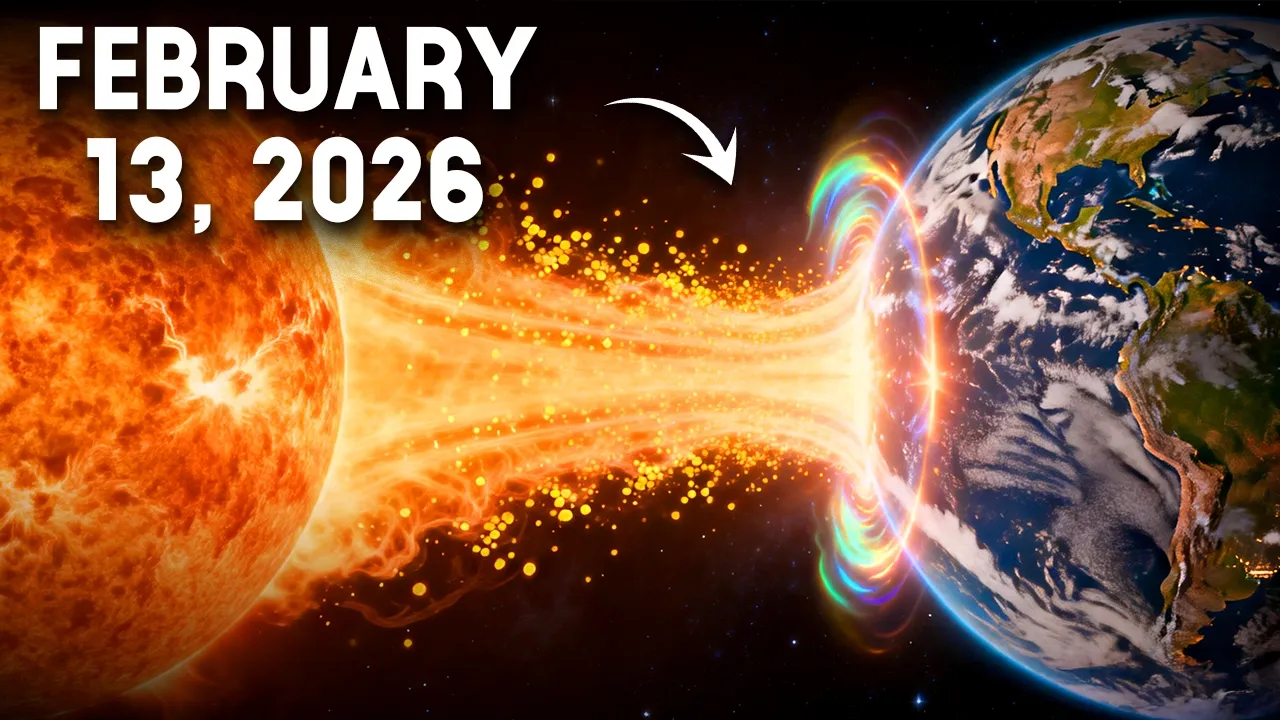








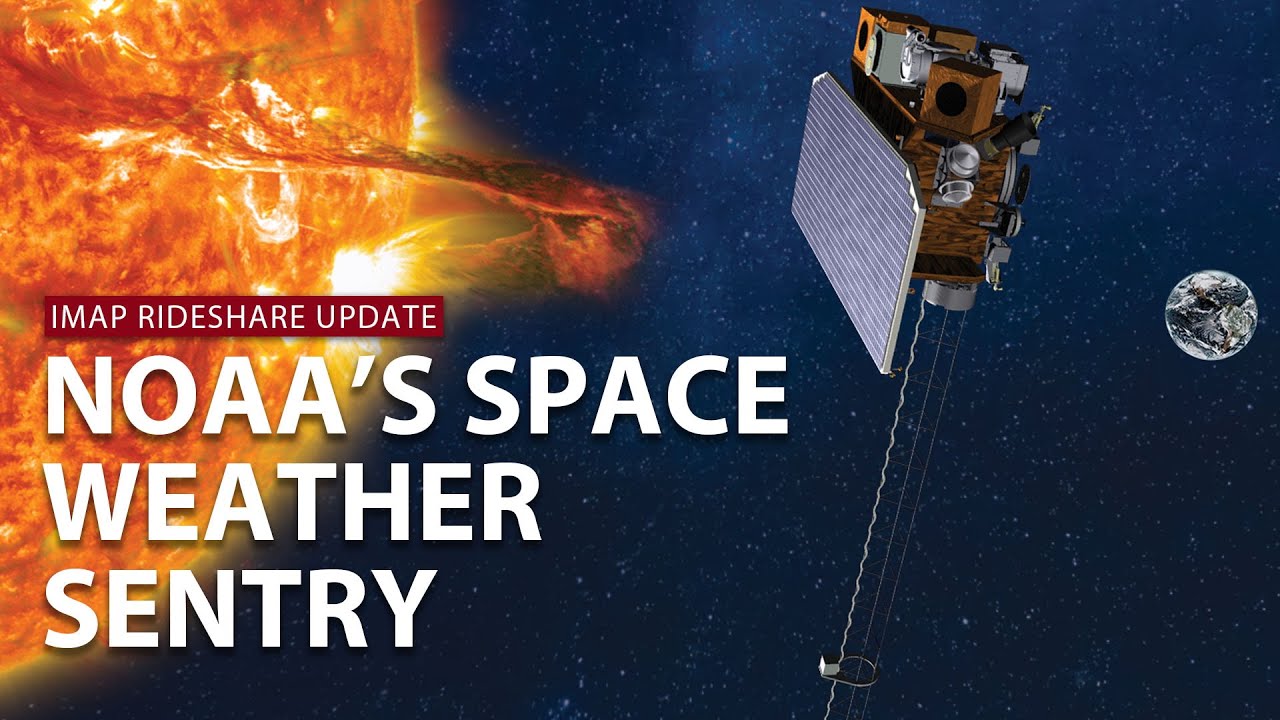






NASA and NOAA have launched three new space weather missions—IMAP (Interstellar Mapping and Acceleration Probe), SWFO L1 (Space Weather Follow-on L1), and KATHERINES (KATHERINES Geocorona Observatory)—to study the sun's effects on Earth and the solar system. These missions will monitor space weather from Lagrange Point 1, approximately 1 million miles from Earth toward the sun, providing early warnings of solar storms that could impact power grids, GPS systems, satellites, and astronauts. The heliosphere, a protective bubble created by the sun's solar wind, shields Earth from dangerous galactic cosmic rays, and understanding its boundaries is crucial for protecting human space exploration.
SpaceX Falcon 9 Launches IMAP, SWFO-L1, & K-Ursa for Space Weather Missions
Added:The concept of Lagrange Points, specifically the Sun-Earth L1 point, and why it provides an ideal gravitational vantage point for solar observation.
The fundamentals of space weather, including solar wind, coronal mass ejections (CMEs), and how solar radiation interacts with Earth's magnetosphere.
Basic orbital mechanics and launch profiles, including rocket staging and how payloads are injected into transfer orbits.
The distinct and collaborative roles of NASA (scientific research) and NOAA (operational weather forecasting) in monitoring space and Earth environments.
Advanced heliophysics, specifically how the Interstellar Mapping and Acceleration Probe (IMAP) analyzes the boundary of our solar system (the heliosphere).
Space weather forecasting models and how real-time data from satellites like SWFO-L1 are used to predict geomagnetic storms and issue early warnings.
The engineering challenges of designing scientific instruments (such as magnetometers and solar wind analyzers) to survive and operate in radiation-heavy deep-space environments.
Infrastructural mitigation strategies, exploring how Earth's power grids, satellite fleets, and global communication networks are hardened against solar disruptions.
325 views21likes2:39:53Original Release: 2025-09-24
[Music] Heat. Heat.
[Music] [Music] Heat. Heat.
[Music] [Music] Heat.
[Music] Heat.
Heat. Heat.
[Music] And there is our ride to space this morning. A SpaceX Falcon 9 rocket carrying three satellites that will help us better understand and predict how space weather could impact us.
>> The sun is a massive dynamic place.
Its impact is felt across the solar system.
Three new missions are going to help us understand our star like never before.
They will monitor the sun's effects from up close out to the edges of the solar system.
>> We need to understand how our own home in the galaxy was created.
Every time we've gone someplace new, we've been surprised.
We expect there to be great discoveries of things we can't even envision today.
Good morning and welcome to the Space Coast of Florida. I'm NASA's Megan Cruz and we are counting down to liftoff of three new space weather missions. We have everything you need to know about each one, but first, my co-host, NASA helophysicist Kelly Cor. It's an amazing day for a launch, Megan.
>> Beautiful. We're about to see sunrise here. Wow. I just need you to turn around. Gorgeous view there and then also the launch pad right here. We are ready for liftoff. But Kelly, tell everyone what you do as a helopysicist.
>> As a helophysicist, I study all things sun, especially that space weather that we were talking about uh and all the effects it has here on Earth from our power grids to astronauts in space.
>> And all three missions are going to help us study our sun. So, we have NASA's Interstellar Mapping and Acceleration Probe or IMAP. NASA's Kurther's GIA corona observatory and the National Oceanic and Atmospheric Administration's Space Weather Follow Lrangewan or SWFO L1. Today's launch time is 7:30 a.m.
Eastern time from launchpad 39A here right behind us. And let's introduce you now to our team of commentators paying very close attention to the countdown.
That's NASA's Daryl Nail and Norman Phelps here in Florida and Amanda Years from SpaceX in Hawthorne, California.
>> That's right. Thank you very much, Megan. Norman Phelps, mission manager with launch services program here at NASA. Thank you for being in the booth with us today.
>> Happy to be here.
>> We're glad to have you. And of course, as you mentioned, Amanda Yars is in Hawthorne, California with SpaceX. We've been going through a number of polls today and the spacecraft poll. We just heard them go. This is the IMAP poll, which as the primary mission, they have the right to say, "Hey, something's not right. We might need a hole." But that hasn't been the case. Clear poll there.
You've been listening in some polls as well.
>> Yeah. So, not only is the spacecraft poll looking good, but our engineering team here at NASA LSP actually did a quick poll as well, just to see if we're ready to step into the other poll, which is coming up soon, or the big one, talking about prop load, and that poll cleared as well. So, so far, we're looking good here as we go towards launch this morning.
>> And when we get into that prop load poll, it's important to note that that locks in our T0, and at the moment, we have a 7:30 and 50 seconds a.m. Eastern time launch. And this takes into account a COLA report which they did which quickly what is that?
>> Yeah, that's the commission's collision launch avoidance p uh look which what they do is they want to make sure that when we launch we don't run into any satellites the ISS or anything up there in orbit because we don't want to create any debris. That'd be a bad day. So we're making sure that everything's clear, everything's done being done decent and in order before we launch.
>> All right, great update there. Let's toss it over to Amanda.
>> Good morning from the West Coast, Daryl and Norman. It's great to see you both.
I'm Amanda, a ground systems engineer here at SpaceX in Hawthorne, California, and we'll be with you through today's countdown to launch all the way up to spacecraft separation. So, currently at the T-minus about 47 minute mark, Falcon 9 is tracking no issues and our payload is healthy. Earlier today, the Falcon 9 team reported on console at the T-minus 2hour and 15 minute mark to begin their final checks and then final checkout of the flight termination system was performed at T-minus 1 hour and 45 minutes. Coming up next, we expect our team to complete a technical readiness poll that'll be at the T-minus 38 minute mark to proceed with propellant load and launch. Now, we're currently forecasting favorable uh favorable weather conditions with a 10% probability of violation. We'll be back with more in a bit, but for now, we're going to send it over to Megan and Kelly at Kennedy Space Center.
>> Thank you, Amanda, Norman, and Darl.
Now, before we go any further, a quick programming note. We are also broadcasting this launch in Spanish, and you can watch it by scanning this QR code on your screen or jotting down the address you also see there. Now, Kelly, let's define some key terms that's really going to help everyone understand why IMAP, Swift L1, and Kurthers are so important. So, first, the exosphere.
That's the outer layer of Earth's atmosphere. So, we'll pull up a video just so you can uh see what we're saying here. And then there's Earth's magnetosphere or magnetic field that protects us from harmful solar radiation. And then finally, the heliosphere, a vast bubble created by the sun's solar wind that surrounds our entire solar system. Kelly, >> yes, it's in the helere phys heliosphere is definitely vast. It's 9 billion miles away from Earth. And that's our first shield uh for all the galactic cosmic rays and the galactic wind and that space weather that it can cause. Um and then we have shields in terms of the fact that we have the magnetosphere uh that's around us that also protects us from space weather and then the exosphere and all these different places. Space weather is a little bit different. So we need different things in different places.
>> So it's really understanding the different shields that protect us from the space weather.
>> Exactly. Yeah.
>> Okay. Gotcha. Well, as you can see everyone, Kelly is very, very smart. So feel free to ask her any questions about today's missions by using the hashtag askNASA and we will try to answer as many as we can live. Now NASA's about to poll its teams to see if they're ready to begin fueling the Falcon 9. Let's send it back to Daryl, Norman, and Amanda.
>> All right, thank you very much. And uh indeed, we are getting ready for the NASA launch manager poll, Norman. And uh tell us a little bit about what this poll is.
>> Yeah, so Dr. Denton Gibson, our NASA launch manager. What he's going to do now is he's going to go through each of the different disciplines that are actually on console. He's going to talk to our chief engineer. He's going to talk to the NASA launch services program office. He's going to talk to the SMD office, so forth and so on to make sure that everyone is gearing up and that everyone is ready for us to begin prop loading. Once he gives that go no-go, we're then going to give pass our go-go then on to SpaceX who's then going to conduct their own internal poll and then we're going to proceed with fueling from there.
>> And we got that at t-minus 43 minutes.
So, we're about a minute and 10 seconds out from that. Meanwhile, as you can see on your screen here, it is a beautiful morning here on the Space Coast. Sunrise is at 7:11 a.m. Eastern time. Our launch is at 7:30. And so, we are currently in uh twilight right now and it is just beautiful outside as we gaze at our mission right there inside the fairings.
three spacecraft which took LSP they put a lot of work into this one when you have three different spacecraft all going to the same place.
>> Yeah. So a lot of work went into this.
So I want to tap tip my hat off to the team and I will be conducting the propellant load and launch readiness poll. And before I get into the poll I just wanted to acknowledge uh one of the pillars of the launch service program who is responsible helping get LSP to where it is today. Mike Carney. This will be his last launch and just wanted to add him as honorary member of this poll. Starting with CFA.
>> Thank you. NLM CFA is go.
>> NASA C.
>> NASA C is go.
>> SMA. SMA is go.
>> SMD.
>> This is SMD. IMAP is go.
>> NASA M. NASA Mim is go.
>> LSP.
>> LSP is go.
>> NASA team is propellant is ready for propellant load and launch.
>> All right. And there you heard it. A little early with the pole, but uh we're good to go. We can start loading that propellant.
>> Yeah, this is a big deal. I mean, all the analyses, all the technical work that the team worked so hard to get to is is really coming to a head here. So, I want to congratulate the team for getting to this point.
>> All right. Very good. And so as we look out uh awaiting a beautiful sunrise uh in just a little bit, we will also look forward to launch. Let's send it out to Amanda.
>> Thanks, Darl and Norman. That's right.
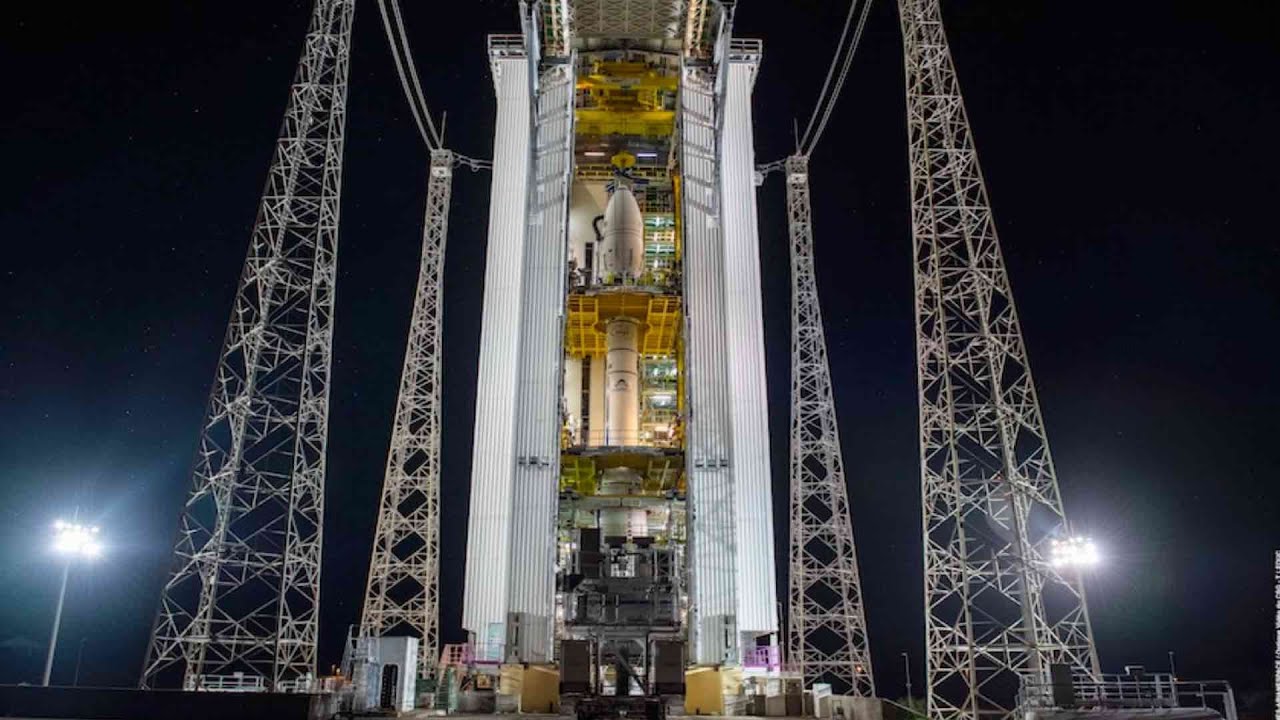
So with that poll, we're tracking towards the start of propellant loading, which will be at the t-minus 35 minute mark. And in the meantime, let's meet our launch vehicle. That's SpaceX's Falcon 9 on your screen. It's a two-stage rocket that is 229 ft tall.
It's getting ready for liftoff in just under 42 minutes from now. Falcon 9 recently completed its 500th mission overall, and it has flown more than 100 missions this year alone. At launch, it produces more than 1.7 million pounds of thrust. And rockets like Falcon 9 don't use all that power just to go straight up. So early in flight, Falcon 9 will perform a gravity turn. And that's a smooth pitch maneuver that will tilt the rocket sideways and build up its horizontal velocity. You may hear this called out about 10 seconds into launch as the vehicle pitching down range. Now, once the first stage booster completes its portion of the mission, it will shut down and separate. A staged rocket like Falcon 9 sheds that booster so that stage two and the payloads can keep climbing faster and more efficiently.
After today's stage separation, the booster will land on our drone ship.
Just read the instructions, which is currently stationed in the Atlantic Ocean. And this particular booster will be returning to Earth for a second time following its first flight earlier this year in July. Now, following stage separation, the second stage will take over, and that's powered by a single Merlin vacuum engine, also known as the MVAC for short. And topping it all off is the payload fairing, a 17 foot wide carbon composite shell, and that protects the payload during the uphill trip through the atmosphere. About 3 minutes into flight, both halves of the fairing will separate and parachute back to Earth. And if recovery goes to plan, the fairings will be pulled from the ocean and prepped to fly again. Both of today's fairings are actually flying for the first time. Now, back to today's mission. Just over the t-minus 40 minute mark, everything is still on track for liftoff. So, let's check in with Megan for more on today's mission.
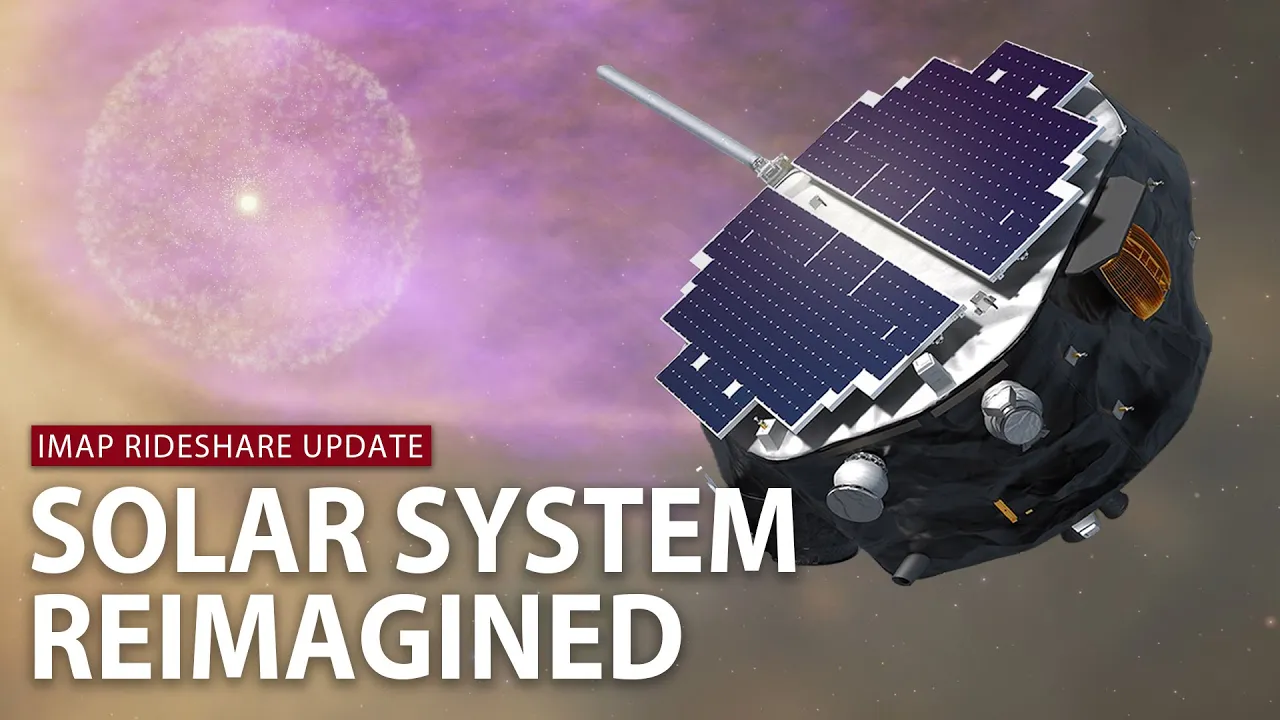
>> All right, thank you all. Let's start by talking first about NASA's IMAP. It's about the size of a hot tub and weighs a little less than a compact car at nearly 2,000 lbs. There are 10 science instruments on board, and the instruments will work together to map the heliosphere.
NASA's interstellar mapping and acceleration probe mission or IMAP will study the giant invisible shields surrounding the solar system called the heliosphere.
The heliosphere helps make life possible on Earth by protecting us from dangerous cosmic rays coming from across the galaxy.
>> The heliosphere is our home in the galaxy. It's really important. We couldn't live without it. The boundary of the heliosphere located around 11 billion miles from Earth at its closest point is hard to study, but that's changing with IMAP. As a modern-day celestial cryptographer, IMAP will fill in the blank spots on our map of the heliosphere and help us understand fundamental processes happening across our solar system.
The spacecraft will be stationed at Lrangee.1, a location approximately 1 million miles from Earth toward the sun. From that vantage point, IMAP will study our heliosphere as well as measure the constant stream of particles coming from the sun that can endanger spacecraft and astronauts.
>> That can allow us to give a half an hour warning to astronauts on the space station to the power grids so that they can take precautions to help protect them from the damage that might happen from space weather.
>> The only precipitation I guess we got to worry about is what comes from the sun blasting our way. But we've got a whole team of super duper smart people that are tracking that stuff to give us fair warning. IMAP's measurements will give scientists a more complete look at our heliosphere than ever before. It will also help us better prepare for dangerous solar particles and radiation that are headed toward Earth. This information will be essential for the future of human exploration as astronauts venture to the moon, Mars, and beyond.
[Music] So, Kelly, let's talk a little bit more about how space weather can affect our astronauts. It's those high energy particles, right, from the sun that can pose serious health risks.
>> Yeah, that's really the issue. Uh, when they're in really high doses, they can cause uh radiation sickness and long-term cancer or even very acute radiation sickness.
>> Yeah, that's very serious. And serious.
So, I mean, when we have, you know, these missions that can give advanced warning to our astronauts, then then what can they do?
>> So, they can do a couple of things. they can uh plan missions around it. They could do things like uh go interior to a space uh spaceship that has more shielding from these particles.
>> So, it's really planning um for ways that we can warn them because these are so uh serious issues we're talking about.
>> And so, IMAP is going to make its uh observations from Lrangee Point one along with SWFO L1 and Kurthers. So, why is this such an opportune location for all three missions? This is a great a great location because of the fact that it has a clear view of the sun and it's ahead of us. So it gives us that 30 minute warning um by being ahead of us and it is also a gravitational balance between the earth's gravitational pull and the sun's gravitational pull. So it's a place where spacecraft can kind of idle or use very little fuel in order to be able to stay there. So it's very advantageous for those reasons.
>> This is the launch director with the board instructions for non-urgent nogo conditions. brief the CE or LD and they will approve aborting the countdown. For urgent issues affecting the safety of the operation, operator shall call, hold, hold, hold on the countdown net.
Launch control will abort the launch auto sequence immediately and proceed into the launch abort auto sequence. At t-minus 10 seconds, launch control will be hands off and relying on automated abort criteria for the remainder of the count.
>> And you just heard there some operational um um mission loops. Uh again, we try to pause for those so that you can follow along with the countdown there. Uh again, just going through the motions to uh get us to liftoff today.
And a check of the clock again. T-minus 36 minutes and counting until liftoff.
Let's check back in with our team of launch commentators. Starting with Amanda.
>> Thanks, Megan. So, a few minutes ago, the SpaceX team did pull go for the start of Propload, and that will be the next milestone in the launch countdown starting in just under a minute from now. You'll hear that called out as propellant load having started and that will mark the beginning of the automated processes where the rocket begins to load its propellants which include RP1 or rocket grade kerosene and liquid oxygen. This propellant loading process will continue until the final minutes ahead of liftoff. And once fully loaded, Falcon 9 will carry 1.1 million pounds of propellant across both the first and second stages. Falcon 9's Merlin engines use liquid oxygen in the combustion reaction to generate thrust. And most burning on Earth also uses oxygen, which makes up about 21% of the air that you breathe. But of course, in space, there is no atmosphere to provide that oxygen or other oxygen bearing molecules. So rockets like Falcon 9 need to carry their own. In the liquid form, oxygen is chilled to over 300° below zero.
The launch auto sequence has started.
>> With that confirmation, propellant will now begin loading onto Falcon 9. And we intentionally load late into the countdown. This is part of the thermal management strategy for the cryogenic fluids. In addition to liquid oxygen and RP1, Falcon 9 will be loaded with cryogenic helium. As the tanks expend propellant during flight and empty of liquid, that helium will maintain the required tank pressure to continue to feed the engines a nominal flow rate.
The helium will also be chilled to remain compatible with the cryogenic plumbing on the vehicle. And the loading of cryohelium will begin in just a few minutes around the t-minus 30 minute mark.
The Merlin 1D engines on the first stage and the MVAC engine on the second stage use the same propellants again RP1 and liquid oxygen, but they are each optimized for performance in their unique operating environments.
So now that propellant load is underway and that will continue again until just a few minutes before liftoff. Cryohelium coming up next in about four minutes.
Let's check back in with Daryl and Norman for more on today's mission.
>> All right, thank you very much. And uh we just heard the spacecraft team give a brief as well. We heard the launch director for SpaceX give their brief.
That was during Megan's uh and Kelly's portion just giving a brief to let the team know um their direction as we move forward. But the spacecraft team has said, "Hey, listen. If you have any issues the with the spacecraft from now up until t-minus 45 seconds, let me know and we'll call a hold." So far we are expecting uh nothing and everything looks good.
>> Yeah, that's this is a good place to be, right? No, no major issues right now.
Everything looks nominal and let's just, you know, fingers crossed that we stay that way.
>> Our T0 currently locked in at 7:30 and 50 seconds a.m. We do have a 20 second window, but no more cuz now we've locked in that T0. Correct. So, we have to hit it at that second or we're not flying today.
>> Correct. And I want to, you know, tip my hat off to both the LSP flight design teams who work tirelessly here to extend that launch window to the 20 seconds that we do have. mean that if we do run into an issue, we have some time to kind of clear that issue to hopefully get off the ground today, which we are going to do. We're going to launch today. I'm quite confident.
>> And a real quick note on the NLM poll where uh Denton Gibson, Dr. Denton Gibson, gave a shout out uh to a gentleman who's uh retiring after 40 years.
>> Yeah, I want to just uh also give a shout out to uh Mike Carney as well. I started here in LSP and his group. So, I have some fond memories of Mike Mike Carney. So, I just want to say Godspeed as he goes into his next chapter of his life. He will be missed.
>> All right. We'll be tracking in the meantime all of the action as it happens and unfolds. We've got the IMAP to internal power coming up at 10 minutes 15 minutes and for now we'll send it back to the host desk. Thank you guys.
All right, now let's learn more about the National Oceanic and Atmospheric Administrations or Noah's newest satellite. Swifto L1 is roughly the size of a washer and dryer while its solar panel is about the size of a door. When fully fueled, it weighs about the same as a large grand piano. It is the first Noah satellite designed specifically to monitor space weather 24/7, serving as an early warning beacon for potentially disruptive events.
Meet Swif, Noah's first purpose-built space weather observatory.
When a solar storm erupts from the sun, Swift L1's coronagraph observes the event right away and sends the data back to the Swif ground segment, a network of antenna stations all over the world with the Swift command and control in Maryland. But spotting a storm is one thing. Actually measuring it close up is another. It's the difference between tracking a growing hurricane on radar and flying through the storm on a hurricane hunter aircraft. Swift does both. After the spacecraft spots a storm with its coronagraph, it watches the approaching weather and waits. Somewhere between 18 and 70 hours later, the incoming storm passes over Swiftol. Then the spacecraft's instrument suite measures the storm's severity and speed and sends that data home, too, giving Noah early warning somewhere between 15 and 60 minutes before the storm arrives at Earth. Noah's space weather prediction center in Colorado is constantly on the alert using all the data SWIFO L1 collects to develop and communicate real-time forecasts and warnings to industry, government agencies, and the public so they can take action before the storm arrives to minimize its impact.
Now, you heard about Noah's Space Weather Prediction Center in that video.
Here's NASA's Joy, live at a nearby viewing location with that cent's director, Clinton Wallace.
>> Clinton, thank you so much for joining us today.
>> Good morning. We have a beautiful day for launch.
>> Yes. Are you excited?
>> Very excited. So, I can't wait.
>> Um, so the Space Weather Prediction Center at Noah monitors space weather 24 hours a day. Can you tell me who relies on that information?
>> Well, Joy, you know, today we're more vulnerable than we've ever been to space weather because of the technology that we rely on and the advancements that we've had. So, everything from power grids to people using GPS to aviation, even our astronauts rely on space weather information.
>> And can you tell me why early detection of these solar storms is critical for us here on Earth?
>> Absolutely. So the space weather um it affects so much technology and so when it um you know early warnings we're able to mitigate a lot of the impacts from space weather. Early warning allows us to inform power grid operators so they can protect our grid infrastructure and prevent blackouts. Satellites well they can be dragged down by solar storms. It can shorten their lives and it can also increase the risk of collision. So GPS, our farmers today now rely on GPS more than they ever have.
Pilots flying around the globe, they also rely on uh GPS as well. In fact, last year in May, May of 2024, we had the largest solar storm that we've seen in over 20 years.
20 years ago, our farmers weren't relying on GPS the way that they do today with centimeter accuracy. So, we actually realized about a billion dollars of economic impact just the corn alone because of that story.
>> Thank you so much, Clinton, for joining us and have a wonderful launch.
>> All right, thank you so much. Looking so much forward to it.
>> Okay, so uh back to you Megan and Kelly.
>> And speaking of launch, 28 minutes until liftoff. Time now for Kelly to answer some of your questions. So we'll take the first one now. This is from Universe Cosmos 4119.
What is the most dangerous space weather phenomenon and how can it affect nearby celestial bodies?
>> Well, the the different phenomenon affect things differently, but the most probably dangerous to humans, especially astronauts out in space, is probably those energetic particles. Large doses of energetic particles could again cause that radiation sickness. Long-term effects such as cancer or very short-term acute effects. um such as death uh very early. So, we really uh do want to make sure that we're protected from those things. Uh there are other dangers like uh Clinton actually referred to as satellites. Um that's the drag or the the impact of the space weather on the earth and that drags satellites down and that costs money when satellites don't last as long as they're supposed to.
>> A wide range of impacts for sure. Um, King Calvin asks, "How long will it take for the spacecraft to reach L1 and what happens when they get there?"
>> Oh, it'll take around six months for them to get there, or actually three and a half months. And then once they get there, they're going to spend some time uh actually turning on all the instruments, making sure that they work properly, that they're getting the data back, and that they understand it. And then it's around six months to when we get that science data flowing.
>> All right, thank you for those questions. Keep sending them # askNASA across our social media platforms. And now some quick facts about the third mission flying today. NASA's Kurther's Gia Corona observatory is about the size of a small couch and is as heavy as a full-size refrigerator. It will study our planet's exosphere. And studying this outer layer of Earth's atmosphere will help us forecast space weather, understand how atmospheres change over time, and even trace the history of our planet's water.
The goals of the Kther's Geocorona Observatory are to study the nature and origin of Earth's exosphere and how it evolves over time. The exosphere itself is the uppermost layer of the Earth's atmosphere. It's comprised almost entirely of atomic hydrogen. This is the lightest chemical species uh in existence and it floats away essentially evaporates off of the top of the atmosphere and when the sun shines on these atoms they essentially scatter it off into all directions and so it glows like a a gigantic halo around the earth and so that's called the geocorona that fuzzy halo of light uh that's given off by those exospheric atoms. Many times we think of the transition between the atmosphere and space as being this very abrupt boundary where at one altitude you've got atmosphere and the next altitude you have space. But in reality this transition is much more gradual and can extend over thousands of kilometers.
By imaging the geocorona, we can actually answer fundamental questions about the size of the exosphere, the structure of the exosphere, and how it changes over time. And all of this in response to the input from the sun.
And what you're seeing now is a live look at the University of California, Berkeley's Space Sciences Lab, mission operations center. This is where Kurther's mission managers are anxiously awaiting liftoff and will monitor the spacecraft throughout its mission.
>> It's a little early there.
>> Not yet. They're they're there. They're taking a little break. We'll take a little break too a little bit. But there they are in that or will be in that room now. But the Cor's principal investigator is actually here with us.
This is Laura Waldrop from the University of Illinois. It's really great to have you here.
>> My pleasure. Very excited. So the geocorona part of the earth's exosphere uh that glows. Why does it play such a critical role in helping us to understand space weather?
>> Well, you know, the the exosphere plays a vital role in Earth's recovery from these storms. So when they hit, they accelerate ions and that's how they create these extremely energetic particles that pose the dangers that have been talked about. Well, when those energetic particles collide with an exospheric hydrogen atom, it slows them down. So this weakens those currents. It speeds Earth's recovery. The more hydrogen atoms there are, the faster the recovery. And so what the Kather's mission will measure is exactly that density. And so we can improve measurements of those recovery time scales.
>> Great. Yeah. So what are we going to learn about the Earth's history of water through the Kther's mission?
>> Oh, you know, so these hydrogen atoms that populate this region were originally liquid water on the surface of Earth. That water evaporated up, became water vapor, and when the sun shines on it, it underos a lot of chemical reactions and produces the atomic hydrogen atoms that populate the exosphere. Well, when a drop of water makes it to that altitude as hydrogen gas, eventually it will escape into space. Now, this process is so slow at Earth. But what we don't know is how it might be affected by Earth's magnetic field or by space weather itself. And so by learning more about how it works on Earth, it can also help us understand more about how it happened on ancient Mars, how Mars once lost its own surface water, and potentially help us identify potentially habitable planets beyond our solar system that can retain their water, their surface water as long as Earth has.
>> Got it. And the mission was named after American physicist Dr. George Kurthers.
Tell us about him.
>> Absolutely. So Dr. Kurthers uh recently as soon as he as soon as he graduated from the University of Illinois uh he invented the camera that took the first pictures of Earth's exosphere was deployed by Apollo 16 astronauts on the moon. That's right. And he uh played such a role in that development. Now this was a really special camera. Could only take pictures of ultraviolet light.
Uh, and that's the exact same approach that we're taking to study the exosphere ourselves.
>> Yeah. So, really continuing that legacy.
Thank you so much, Lauri. I appreciate you being here and let's see a launch today.
>> Absolutely. Go for others.
>> Now, IMAP is the primary mission of the three satellites. Christoff Fernandez, who plays Danny Roas in the show, Ted Lasso, has a message for the IMAP team.
>> Now, I may not be a scientist, as you all might know. I'm more of a football guy, but I do know something about passion and goals. In Ted Lasso, I play Danny Roas, a joyful and passionate Mexican footballer whose positivity inspires his teammates to remember the pure love of the beautiful game. In the same way, I believe that what you're doing with IMAP is like aiming for the biggest goal of all, understanding our place in the solar system and keeping humanity safe. So from one team player to another, congratulations on this incredible mission. Keep inspiring the world. Keep reaching for the stars. And remember, when we play as a team, we can achieve the impossible.
>> I love that. What powerful words.
>> That's so that's so important. Teamwork did really make the dream work here. I mean, this is uh this is a such a team effort, all three missions, and uh so inspirational to hear him send those well wishes. We we really appreciate it.
>> Yeah. And for those who watch the show, you know, I think Christa would admit that the sun is life and I think Joyy's next guest would also agree.
>> So I'm here with Joe Weslake who is the helopysics division at NASA. Joe, thank you so much for joining me.
>> Hey, thanks Joy. Really excited to be here.
>> Are you excited for the launch?
>> Oh my gosh, what a beautiful morning that we have this morning and what a great day to celebrate NASA science and see all of the great work that we're doing here out at out at Cape Canaveral and Kennedy Space Center. Yeah, couldn't agree more. So, all of the three missions today are part of helopysics, which is the study of the sun and its effects in space. Can you tell me why it's important to study the sun, uh, the sun's influence in space?
>> Yeah, you know, you think about the sun every day. You see it rise and set. We don't really think too much about how it affects our day-to-day lives, but did you know that it affects everything from our GPS to our crops to our power systems on the ground to our commercial aviation to the satellites and technology that we re rely on every day, right? The space weather, the sun, the activity of the sun is something that really impacts our daily technological lives. And these three missions are going to provide us information that help us to really live with this star.
And um NASA also has a huge fleet of spacecraft that study all aspects of the solar system. How does helopysics connect to those other missions?
>> Yeah, our entire fleet is massive, reaching from the closest to the sun, Parker Solar Probe, to the farthest reaches of the solar system with the Voyagers. But you know, the best connection that we have here is that we are actually connecting the sun to our to humanity as it reaches out into the stars. As our humans explore farther and farther out into space, they're going to need to know before they go. They have to know all of the different ways in which the space radiation in which solar winds in which space weather can affect them. And as we travel out past our magnetosphere, out into the moon to Mars and other other locations, we have to know this information to be safe and to bring our astronauts home safely.
>> Absolutely. And so, um, today's as a ride share, which is one rocket with three missions, can you qui quickly, uh, just, uh, tell me why it's beneficial to be on a ride share?
>> Yeah, I think of this as the cosmic carpool, right? We're going to the same location. We're bringing our these three satellites along together and with that we provide immense benefit to the American taxpayer who is paying for one launch and we're bringing three satellites along. Really great opportunity.
>> Thank you so much Joe and enjoy the launch.
>> Thank you Joy. Really appreciate it.
>> Thank you. Okay, so now behind us um on the the Falcon 9 rocket we're fueling right now. So let's head back to Amanda from SpaceX to get an update.
>> Thanks Troy. So, a quick check of the clock. At just under tminus 18 minutes, the next milestone for the vehicle is coming up in about a minute, which will be the start of stage 2 locks loading.
So, we're about halfway through the propellant load process, and stage 2 RP1 load is already complete. We're right on track. Now, all three payloads today are part of a ride share mission heading to Lrangee.1 or L1 for short. And L1 is unique for a couple of reasons.
spacecraft can remain at this point in a gravitational balance between the sun and the earth and that means that the payloads only need to carry a minimal amount of fuel to remain in control in that region. L1 of course also offers a clear vantage point to study the sun, space weather, the exosphere and that capability is critical for the science on board today.
Ride share missions like today's are a great opportunity to cost effectively launch multiple unique scientific payloads and overall just increase the amount of science that we send to space.
The three spacecraft aboard including IMAP swif and kurthers each posed unique mission services challenges.
These spacecraft were installed in a two-tier payload stack configuration.
Now this allows for the safe deployment of each one. The fairing itself also underwent a custom multi-dor >> lock is started.
>> That confirmation. So stage two is now loading liquid oxygen. The fairing that you can see there on screen underwent a custom multi-door modification and that enabled post encapsulation access to IMAP for pre-launch inspections in the hanger. Unique protocols and ground systems preparations were also developed to support the needs of today's mission.
For example, each spacecraft required an active gaseous nitrogen or GN2 purge line up until launch. So, two new purge supplies were developed for this mission. Historically, only a maximum of one purge line has ever been used for pre-launch payload support. So, this mission included three. Also, to support the heightened cleanliness requirements of today's spacecraft, a mission unique environmental control system was installed and some of the payloads underwent unique treatments. This included screening and deossing of both the IMAP and SWFO L1 payloads to account for their magnetic sensitivities. And finally, on the weather side, in order to enable a spacecraft retest prior to launch, lightning monitoring procedures were develop developed by the mission teams. So, across the board, from installation and integration in the payload fairing to purge and environmental control needs, this mission motivated several service innovations. Now, we're well into the propellant load process on Falcon 9 for today's launch. Let's check back in with Megan for more details.
Managing today's launch is NASA's launch services program out of Kennedy Space Center. IMAP, Swiffo L1, and Kurthers will play a critical role in protecting our explorers on the International Space Station and those launching to the moon.
Thank you.
NASA astronauts Reed Weissman, Victor Glover, and Christina Cook, and Canadian Space Agency astronaut Jeremy Hansen have been busy at Kennedy Space Center training with ground support teams for their upcoming mission around the moon.
The main goal to make sure everyone's on the same page. Over the past few months, the astronauts suited up, walked out, and traveled the 9-mile journey to launch pad 39B. They also spent a lot of time training inside their fully powered Orion spacecraft, going through launch day and simulated flight activities. Get this, it was the first time the crew had ever entered their spacecraft together.
And in the case of an unlikely event or emergency at the pad during the countdown to launch, the crew practiced climbing in and out of the emergency egress baskets. Those would carry them from the mobile launcher safely to the ground. All this training helps the Artemis 2 teams plan and understand the timing of events on launch day. That's your Artemis moon minute.
For more information about NASA's Aremis program, scan the QR code on your screen or visit nasa.gov/artreemis 2. Now, if you're just joining us, we're about 12 minutes away from launching three spacecraft to study space weather and how it impacts us. NASA's interstellar mapping and acceleration probe or IMAP, NASA's Kurther's GIA corona observatory and the National Oceanic and Atmospheric Administration's space weather followon lrangege one or SWFO L1. Now, IMAP is the primary mission of the three today.
Now, let's take a a live look now inside of uh APL because IMAP is an international team of about 27 different partner organizations led by Princeton University, but also including APL.
That's John's Hopkins Applied Physics Laboratory there. Great to see people there ready to go. Yeah, they're anxiously looking at things such as the uh temperatures and uh basically the health and wellness of the uh of the satellite, making sure it's ready to go and really anxiously awaiting that acquisition of signal or that first uh phone call home once the once it gets into orbit.
>> Yeah, APL built the IMAP spacecraft as well as uh one of its 10 instruments and after launch, APL is going to uh operate IMAP. Now, Kelly, we're still getting some great questions from social media, so let's take the next one here. This is Apex Arcane asking, "What types of particles are you detecting with these missions?"
>> These are such great questions. Yeah.
So, for these missions, we're detecting everything from UV light, ultraviolet light, which our eyes really can't see very well. Um, in the Kather's mission and a little bit IMAP, um, to the energetic particles, uh, which is an electron, a proton, um, as well as other, uh, uh, ions such as oxygen and hydrogen and carbon. Um, and that helps us tell things uh like the electrons are the ones that actually run ahead of the solar storm and they they're very near the speed of light and they're our warning that something else is coming along. So those are the types of particles that we're measuring with these missions.
>> Yeah, a lot to take a look at. Thank you so much, Kelly, and thank you again for those questions. Keep sending them along. Hash ask NASA. Now, IMAP was the first to arrive here in Florida before launch. Its parts were unboxed then processed at the Astrotech space operations facility near Kennedy Space Center here in July. Swift L1 and Kurthers both arrived and then all three were configured to fly together. Again, an amazing feat. Finally, last week everything was encapsulated inside Falcon 9's payload fairing. The two halves will protect the satellites during launch. And again, all three satellites headed to Lrangee Point One, a location a million miles from the Earth to study space weather.
>> From here on Earth, our sun looks steady and unchanging.
But close up, it's a dynamic, active place.
Loops of superheated plasma follow tangled magnetic fields across the surface while a steady stream of electrically charged particles. The solar wind expands into space in all directions. At times there are bursts of radiation called solar flares and explosions of plasma and magnetic fields called coronal mass ejections sending solar storms racing off into space through the solar wind. On Earth, we live in that constant stream of solar wind protected by Earth's magnetic field. But when the sun suddenly unleashes massive amounts of energy and material, our magnetic field can go haywire during what's called a geomagnetic storm. In May 2024, the biggest geomagnetic storm in over two decades hit Earth. The storm spread auroras to unusually low latitudes, disrupted GPS guided tractors, and forced transatlantic flights to reroute.
Storms like these are why NASA and Noah constantly monitor the sun's activity.
Noah provides realtime monitoring and forecasts of geomagnetic storms and other potentially hazardous space weather events. While NASA's research advances our understanding of the sun's behavior and supports research computer models used by Noah, our collaboration is vital to better prepare for space weather. Together, we help protect our technology on Earth, satellites in space, and astronauts as they head to the moon and Mars.
Kelly, with just nine minutes away from launch, tell us how much this moment means to you and everyone who worked on all three missions right there. I am just filled with so much gratitude and so much excitement um for the entire team, all the teams that really worked here uh here and Kennedy here at all the different uh mission teams um as well as SpaceX. So, we've all just pulled together. People are so excited and I'm crossing my fingers and toes hoping for a beautiful launch very soon.
>> Absolutely. It's absolutely going to be a beautiful launch. Take a look out there, the pad, the clouds, the sunrise in the background. So, let us get to liftoff. Let us countdown the final minutes to launch with NASA's Daryl Nail and Norman Phelps here in Florida and Amanda Years uh with SpaceX in Hawthorne, California.
>> Yeah, let's do it. We are all ready to go. We're here inside our mission director center at Hangar AE. You can see behind us, this is where uh all of the management for all three spacecraft uh are located and it's a high level uh area inside there, but they'll be tracking everything that's happening.
And uh so far so good.
>> Yeah, so far so good. I mean, they actually kind of gave a really important call out a little earlier about going to internal power. I don't really want to highlight the importance of that, right?
That means that our spacecraft, everyone is on in their final launch configuration. So, similar to, you know, in the morning where you unplug your cell phone from the wall, you detach it from your from your EGSC there in your wall. That means now that our spacecraft are ready to launch and it's ready to do business. Just like, you know, your cell phone is attached from his wall, ready to do business with you for the rest of the day.
>> Two spacecraft on internal power. IMAP and SWFO. We heard that call out. Swif L1. Kurthers though, not powered up. So, there was no switch for them.
>> Yeah. Cors is is powered off during launch. So, they're not powered on. So obviously there's no call to be on internal power for them, but you know this is typical. Some of our launch vehicles launch um powered on, some launch powered off. So nothing new to see here.
>> IMAP is one of the strictest contamination missions that LSP and SpaceX have worked and we heard a little bit about it >> from Amanda as we hear that engines are being chilled on the first stage of the rocket. Um and that is because these are very sensitive instruments.
>> Correct. And so we're trying to study something that is going to really literally rewrite the textbooks.
>> We're trying to study how these energetic particles really inter interact with our solar environment. And so to do that, we need really clean instruments to do that. So think about it like this, right? You're traveling down the road, right? It's a big truck in front of you. It's throwing all this goo in front of your on your windshield, right?
Char for RP1 complete there to actually see where you're going. right on that road, right? You need to make sure your windshield wipers are clean. So, just like we're trying to see what's going on in the local space space environment, we need our instruments on all these spacecraft extremely clean. And I want to give a shout out to our contamination teams, both at SpaceX and NASA's launch services program who made that happen today.
>> And Amanda, you're out there tracking uh the countdown from your vantage point in Hawthorne, California.
>> Yeah, that's right. So, as we enter these final minutes before liftoff, weather is still looking good. We have a 10% probability of violation. We heard a couple of key call outs. First that engine chill has begun on the first stage. That means that we are performing a priming process. So before any propellant flows, the plumbing and engines will be chilled down to prevent thermal shock and boil off when that ultra cold propellant begins to move at a high flow rate. We also heard that RP1 load has completed for the first stage booster. So that wrapped up the fuel side of the equation and we are still loading liquid oxygen onto both stages one and two. Now, RP1 rocket grade kerosene and liquid oxygen are the primary propellants for a Falcon 9.
Those are loaded separately onto the vehicle and chilled below 300° below zero. Propellant is intentionally loaded late into the countdown. Colder propellants are denser and denser propellants mean achieving more performance out of the same tanks. So, simply put, the colder it is, the more mass pressing for strong back retract.
>> That's a great sign that we're on track for an ontime liftoff. So, if you look closely, we'll begin to see the process of strong back or TE retraction.
Now, at this time, everything is on track. We are working.
>> We're getting some call outs uh from nets that you can't hear. We're listening to Norman and I are both monitoring and uh we're hearing good call outs so far.
>> Yeah, so far so good. Um we are definitely on track for this launch and um you know, go >> strong back retract has started.
And as you can see there, the clamp arms on the strong back, they will start uh pulling out. Let's watch that. In the meantime, IMAP has switched off their RF transmitter. They are no longer receiving any data from the IMAP spacecraft. That's intentional. And there go the arms as we see them open up with status check.
>> And there goes the other. Oh, this is this is NLM. NASA's go for launch.
>> Just heard a great confirmation.
>> SpaceX launch director checking in with NASA launch manager Dr. Denton Gibson.
He gave the go. Another milestone working us closer to a liftoff today.
>> So, like I said before, all the analyses, all the work has come to this moment. So, kudos to the team for getting through those polls.
Get ready for, in Joe Westlakes's words, our cosmic carpool taking three spacecraft, IMAP, Swift L1, and Kurthers on a million mile journey to L1.
Coming up next in just a few seconds, we're expecting the completion of stage one liquid oxygen loading.
See those clamp arms lock is complete.
>> Great confirmation. Right on time. And you can see those clamp arms are free and clear of stage two. Now liquid oxygen loading has wrapped up for the first stage which completes propellant loading for the booster. We mentioned these tanks are also pressurized using helium. And the helium is chilled too so that it stays compatible with the cryogenic plumbing on the vehicle during flight. That pressurization will help to force propellant into the engines as the tanks empty. And looking ahead a little bit, at the t-minus 60-second mark, Falcon 9 will enter startup. And at that point, the rocket's onboard flight computers will take over. From there on out, the countdown is fully autonomous.
Then, just inside of T-minus 2 seconds, the nine Merlin 1D engines will ignite, and once they're at full power, Falcon 9 will lift off the pad and begin its climb to orbit. After engines start, Falcon vehicles are actually held down until all systems are verified as functioning normally before being released for liftoff.
>> Still shut off.
>> Stage two lock is complete.
>> All right, the stage two locks load is finished. As as you can see, as you look at this rocket, uh you see the see that burst of locks coming off the side.
They're just clearing out the line there. Nice little clouds formed when that uh super chilled liquid oxygen hits this warm Florida air. It's a beautiful morning here on the space coast.
>> Little past sunrise.
>> They've closed out the uh the gases at the launch pad. As you can see there, >> the rocket is super cold. So, of course, it's condensing the moisture in the atmosphere and giving off those clouds.
We're getting ready to lock in on terminal count.
>> That's right. We're approaching the one minute mark, at which point Falcon 9 will enter startup.
>> Falcon 9 is in startup.
>> Right on time. So, at this point, the autonomous flight computers have taken over the launch countdown, and stages one and two will begin pressurizing for launch. Let's listen. Let's listen in to the launch director's final go. The >> launch director is go for launch.
t-minus 30 seconds.
>> T-minus 15 seconds.
E - 10 9 8 7 6 5 4 3 2 1 engines full power and liftoff. Go Falcon, go IMAP.
Go Swifto L1 and go corruptors.
And we are flying three new missions on a million mile journey to track space weather.
Good looking flight so far. Our tracking cameras getting a great shot as this mission climbs into the sky.
We'll be looking now for those engines to throttle down as we go through Max Q, the time of maximum dynamic pressure on Falcon 9 power and telemetry are nominal.
>> That's right. So coming up is max Q, which is the maximum aerodynamic pressure, largest structural load the vehicle will experience. So slowing it down helps to reduce some of the load it exper >> and that will help us recover and reuse the first stage.
Following max Q, we'll be able to throttle those engines back up as atmospheric density drops.
>> Max Q.
I'm back. Chill.
[Music] T plus 2 minutes into flight. You can see all nine Merlin engines. You can at least see the the exhaust from five of them there. Beautiful shot looking back to the Earth. Got a couple quick call outs coming up.
We're going to shut off the engine at 2 minutes and 29 seconds.
Stage set at 232. And then our first burn begins at 240. Here we go.
>> Stage separation confirmed.
>> And there it goes.
On the left side of your screen, you can see the first stage booster falling away now. And on the right side, our second stage flying IMAP, Swift1 and Kurthers.
This fir first burn is a key burn, Norman.
>> Correct. This is where we're trying to make sure that we're getting our our uh our spacecraft here in their optimal orbit just to start off with before we do our transfer into their to their higher orbit.
>> Fairing separation confirmed.
>> There go the fairings. And now you can see >> all three spacecraft revealed.
>> So now our three spacecraft IMAP, Swift 01 and K others are now exposed to the space environment. So one other note on these fairings, these are new fairings.
The SpaceX of course is going to attempt to attempt to retrie retrieve these fairings once they fall back to Earth on just read the instructions that that beautiful drone ship that's sitting there in the Atlantic. And we saw the fairings falling away.
I think you can you still see well that might be some debris but uh we we got a good shot of them falling and uh in fact uh as you mentioned they'll be recovering those and the booster will be landing on the drone ship. The reason for the drone ship in today's mission is because we need all that performance from the rocket. Right.
>> That's actually correct. Yes. So despite the fact that we also were launching due east, right, and taking advantage of the Earth's rotation to give us a little bit more >> following nominal trajectories.
>> All right. So we heard that both vehicles flying nominal trajectories.
That is actually excellent news there.
But despite the fact I said before, we're flying due east to take advantage of the Earth's rotation to give us a little bit more um velocity here as we got into orbit so we can carry a little more payload into orbit. We did need all the performance of this of this vehicle to actually get our payloads to where they needed to go do all that great science.
One more quick call out here on the left there. You see the first stage there, you see the grid fins that are actually deployed. Those are going to actually help guide the the uh first stage back to the drone ship when that when that drone ship first starts its um its boost back burn. Excuse me. He wants to see first stage starts to boost back. Drone ship's not burning anything.
>> You may have seen some hand side of your screen, >> we are burning that uh second stage. Go ahead, Amanda.
>> Yeah, just noticing here in the great views of that first stage. You may see some soot during the upcoming entry burn and prior to launch as well. So during the entry burn, that will be the second of three total burns. Falcon 9 will be decelerating by reigniting three of these Merlin engines on the first stage.
And that will cause the vehicle to fly through Merlin's exhaust gases or the rocket's plume. And that's what deposits the layer of soot on the vehicle's surface. It comes from the carbon based fuel that Falcon 9 uses and it builds up a little bit more on the outside of the vehicle which really gives the Falcon first stage fleet the distinctive reused look.
So, we're looking out for that entry burn coming up shortly.
The recovery and reuse of the first stage is what allows us to refly the most expensive parts of the launch vehicle and that drives down the cost of going to space. When costs are lower, both government and commercial customers can launch more missions, especially in the form of ride shares like today's.
And that helps to acceler accelerate research and development.
We're looking for that entry burn in just under 20 seconds from now. You'll be able to follow along with the uh Merlin engines relighting on the first stage with the telemetry on the bottom of your screen.
Stage one entry burn startup.
>> Stage one FTS is saved.
>> There we heard it.
>> That's the first call. That's the her That's the call for the first stage entry burn startup. We're going to be looking for entry shutdown here in a few seconds and finally looking at landing burn shortly thereafter. So stay tuned.
This is the second flight of this booster and if all goes well, >> they'll bring it back down and fly it again.
>> Stage two is in terminal guidance.
Just 30 more seconds on that stage two burn and then we'll cut it off and coast for quite a while.
>> Quite a while till we get to the right point in space to fire it again to put us in our final our final destination.
>> Just about 50 minutes or so.
>> Stage two FTS has saved.
>> All right, so we'll be looking for that cut off on the right hand side of your screen.
Stage one trans sonic. Impact shutdown.
>> You heard it. Index impact shutdown.
>> Cool views on the left with that booster coming back.
>> Shoot through those clouds.
>> That's right. And we're rapidly approaching the landing burn.
>> Got some trailing there.
>> This landing burn scheduled to start in just a few seconds. There it is starting up. This will last about 25 seconds and this will reduce the remaining speed of the vehicle for a soft touchdown on the drone ship. Just read the instructions.
The booster is also equipped with four landing legs that will deploy for a vertical touchdown. So keep an eye out for that just prior to landing.
>> Landing leg deploy.
>> Stage one landing confirmed. Beautiful touchdown there of the first stage. And that marks the second landing for this booster.
>> I must say that that never gets old.
>> No doubt.
And now the stack. There you can see it's not quite illuminated uh incredibly well, but uh up there is IMAP, Kurthers, and Swifto L1. We will continue to monitor the progress during coast phase.
But for now, let's send it back to the host desk with Megan and Kelly.
>> If you're just joining us, welcome to NASA's live launch coverage of three science missions. NASA's Interstellar Mapping and Acceleration Probe or IMAP, NASA's Kurthers GIA Corona Observatory, and the National Oceanic and Atmospheric Administration Space Weather Follow Lrange 1 or SWFO L1. I'm NASA's Megan Cruz and this is NASA helophysicist Kelly Cororic who was super excited to see launch today.
>> So excited to see launch today. It's always a great day to have a launch >> and with the beautiful sunrise we had here. I mean it was just really fun to watch and also there's like a crowd of people here behind us and we just all heard them cheering and clapping.
>> Yes. Yeah. And the fact that you can feel it here. There is something special about actually being here and being able to feel that and we're trying to tell you as much as we can about it, but there is something special about feeling the the rumble and watching it go up and just knowing all those hopes and dreams and scientific discoveries are on their way now.
>> Yeah. Yeah. It was really great to see you guys. Less than 10 minutes ago again, a SpaceX Falcon 9 rocket lifted off from that launchpad right behind us here, 39A at Kennedy Space Center in Florida. It really was an incredible launch and and you really said it there.
It is like we are watching the hopes and dreams of so many people from across the country that have worked together to bring these science missions uh to to launch today, >> right? Yes. Yeah. And to protect our astronauts and to really understand that space weather uh that those three will study, >> right? Yeah. Because all three spacecrafts are going to work together to study space weather. So, Kelly, what is space weather?
>> So, space weather is the effect of the sun on Earth and the entire solar system. that can range for things from uh creating satellite drag and shortening satellite life uh to affecting our GPS and affecting our power grids here on Earth. So, it's really important to understand it so that we can mitigate those effects.
>> Yeah, a really wide ranging uh swath of effects that we're talking about here.
But doesn't NASA and Noah already study space weather together? Like what makes these three special?
>> Yeah, we do study space weather together and this is the next generation. Uh the Swift O L1 is very dedicated and optimized to do the space weather that we know today that we need, not that we knew needed, you know, 20 30 years ago.
Um so that's very uh specified. And then the next two are the next generation of space weather. What are those things we're going to need when those astronauts are on the moon and Mars? Uh we're learning that through the uh through the Swift through the Cars and IMAP mission.
>> Gotcha. Kelly, thank you so much. Yeah, why don't we break down each one for our viewers right now? So IMAP is the primary mission of the three. It will study the giant invisible shield surrounding the entire solar system called the heliosphere which helps make life possible on Earth by protecting us from dangerous cosmic rays. IMAP will simultaneously study the sun's activity near Earth and also create the most detailed map ever of the heliosphere's boundary. Yes, that great big boundary that 9 billion miles away um is our first defense against the space weather that's created by the galaxy and those galactic cosmic rays that can cause some of that radiation sickness we were talking about earlier.
>> Gotcha. And then there's SWFO L1, Noah's newest satellite. It is the first Noah satellite designed specifically for continuous 247 data collection of space weather. And as soon as it measures the strength and speed of incoming solar winds, it alerts Noah. And this is usually 15 to 60 minutes before solar wind causes geomag magnetic storms here on Earth. Those are crucial crucial minutes.
>> Those are crucial minutes so that we can do those mitigation strategies from power grids to airlines to astronauts.
>> Yeah. And then there's Corthers, the first ever dedicated satellite to continuously monitor the geocorona or the part of the earth's outermost layer of atmosphere. It actually glows. And this will offer unique insights into how space weather affects our planet. The mission is named after American scientist Dr. George Kurthers who invented the camera that captured the first ever pictures of Earth's geocorona. Uh Apollo 16 astronauts placed the camera on the moon back in 1972 and it's still there today.
>> It's still there today and yes and we're carrying on his legacy to really understand that part um of our Earth's atmosphere that's so important in again mitigating those space weather effects.
>> Gotcha. Kelly, thank you so much. Uh, our broadcast today will take us to around 9:00 a.m. Eastern time when the Falcon 9 second stage will deploy all three satellites into space. Let's welcome back Joy now who is with Casey Swelles, NASA's deputy associate administrator, and Nikki Fox, the associate administrator of NASA's science mission directorate.
>> Casey and Nikki, thank you so much for joining me.
>> Thank you for having us.
>> How was the launch for you guys?
>> It was amazing. I have to admit, I completely cried. Um, and I'm trying not to do it again. We even the countdown I got so emotional on this one. There's so much on there. There's so much helopysics and so much great NASA science >> and her mom got to be on and got to see it. So it's fantastic.
>> Yeah, it's a beautiful day here at Kennedy.
>> Absolutely. So NASA is take I'm gearing to take astronauts back to the moon with the Arteimus missions. Can you tell us how the three new missions today will help get us back to the moon, Casey?
>> Yeah, absolutely. So, you know, when we go back with Artemis, right, we're going further into space than we've gone in over 50 years. And when we send our astronauts, it's important that we're sending them safely. And in order to do that, we have to understand space weather. So, even when you think about packing for a trip, what's the first thing that somebody asks you? What's the weather? What are you packing? And so, we have to think about that.
understanding space weather, understanding the sun better, understanding solar flares, solar storms, radiation, how it impacts a spacecraft, how that spacecraft interacts with the crew. That's really important. So, we're launching Artemis 2 next year. We're building a sustainable presence on the moon and then we're going to send astronauts to Mars. And so when we land those astronauts on the moon, land them on Mars, it'll be missions like this that help contribute to making sure they got there safely.
>> That is very, very exciting. So Nikki, um what other NASA science research um is happening right now that will help inform the Aremis missions?
>> There's so much um I mean, every mission in our fleet is really playing its part in the Aremis missions. Um, science enables exploration, exploration enables science, and you know, we are excited about all of the missions that we have up there. Um, these are going to, you know, really give us cutting edge, the newest measurements. We've been, you know, we've been measuring, uh, space weather for a long time, but these are just going to be this new next generation. And then, of course, a little bit later this year, we'll be launching Escapade, uh, which will go and and study basically the weather and the space weather at Mars. And so we really really are playing our part in the Aremis mission.
>> And so with astronauts going back to the moon, how will that benefit us here on Earth, Casey?
>> Yes. So you know, Artemis is more than just exploration, right? It's about inspiration. It's about national pride, national leadership. It's about economic growth. You know, for every dollar that's spent at NASA contributes to multiple dollars in economic output.
It's about technology advancement, AI, robotics, advanced manufacturing, and that leadership that NASA does, you know, contributes across the world. And so that's really what Artemis is going to bring back to everyone here on Earth when we go.
>> Thank you so much for joining me and I'm so glad that we could all be here for launch today.
>> It was a beautiful launch.
>> Yes. Thank you for having us.
>> Go IMAP.
>> Go IMAP. We're brothers. Go Swiffo.
>> Go NASA.
>> Thank you, Falcon. Okay. So, back to you, Megan and Kelly.
>> Go, go, go, go. That's right, guys. All right. We invited you to send in your questions about today's launch. So, Kelly is ready for a few more. Yeah, >> definitely. Yeah, I love the curiosity.
Keep them coming.
>> Yeah, really great questions so far.
This one's from Zan Amed. Uh, how long does it take to build and integrate the satellites onto the rocket?
>> Yeah, this these all took a long time.
Satellites, uh, 2017 was when this was initially proposed. Um, and so then we took that time to actually build it up.
Uh, then you go through a design phase, then a build, then you actually have to test it once you've built everything, and then you're integrated into the spacecraft. So it's taken the time from 2017 to now. So that's around uh eight years.
>> Yeah. And that's IMAP specifically. And then in that process, we identified the ride share Swift1 and Kurthers. Yeah.
>> Right. Definitely. Yeah. So within that then Kurthers was a little bit uh shorter of a time frame in terms of uh 21. It was approximately the time when it was turned on and started actually building. But before that, folks have been designing these and thinking about them for quite a while. Always we we always have that next question in mind and that next generation always innovating here. So it takes a little while to get those innovations into print and metal and then launched on a beautiful launch like today.
>> Yeah, that's what's so impressive about scientists always thinking about the next challenge and how they could meet it. So okay, well again, thank you for sending us those questions. Just keep them coming using the hash ask NASA across our social media platforms. All right, so the IMAP spacecraft was built by John's Hopkins Applied Physics Laboratory in Maryland. Here with us now is Dr. Matina Gulu, a uh project scientist with APPL. It is so great to have you here, Matina.
>> So happy to be here. I think my heart is still racing.
>> I know. I know. How was it to see Lodge today?
>> Oh, it was amazing. I teared up a little bit.
>> No, I'm glad. Again, this is so important to you guys. Again, she's part of the IMAP team. So really, we've been talking about the science behind what we're trying to study here with these spacecraft, describing the heliosphere as a bubble, right?
>> Yes, exactly. You can think of the heliosphere as a bubble that is being inflated by the solar wind, a constant stream of charged particles that is being emitted by the sun.
>> So maybe we can pretend this little guy is our sun.
>> Yes. So Matina had homework for me. She asked me to bring some props. So I have a balloon and I have a balloon pump. So you're saying the pump is going to be like the >> sun and the solar wind. So the stronger the solar wind, the more the heliosphere is being inflated.
>> And now when the solar wind gets weak, our heliosphere is being deflated.
>> Okay. So the pressure inside affects the shape, the size. Exactly. Yeah. So what about the outside though? What is that expanding into?
>> Yes. So the whole heliosphere is actually plying through our galaxy and what we call our interstellar medium. uh gas and dust that is existing between the stars. When the pressure from that medium is strong, the heliosphere contracts even more >> even more. Okay.
>> And when the pressure of that medium is weak, it allows the heliosphere to breathe again. It expands >> like this. Yeah. Yeah. Yeah. So basically we are taking into account internal and exterior forces that changes the shape of the heliosphere.
But why is that important to know?
>> Yes. So our heliosphere is actually a shield that protects us from harsh galactic radiation. So we don't know whether life would exist at earth the way it is now if we didn't have that pro protective bubble. Right?
>> So it is important as we go and explore other exoplanets in other astrospheres.
We want to understand first our home in the galaxy and how we came about.
>> And that's what IMAP's going to help us study.
>> Exactly. Go IMAP.
>> Go. That's right. Go IMAP. Thank you so much Matina. I appreciate you being here and congratulations. Congratulations.
>> Okay, so IMAP is going to start collecting data about three and a half months after launch. For more on that, let's bring back Joy who's now with Dave McCome, IMAP's principal investigator from Princeton University.
>> Dave, thank you so much for joining me today. How was launch for you?
>> Oh, it was so exciting. We are all so happy. The whole IMAP team is just delighted.
>> So, um, IMAP, as Megan said, is going to reach Lrange point one, which is a million miles from Earth, um, around January. What do you expect IMAP to be doing and seeing um as it takes measurements in January?
>> Yeah, so just incredible science. We'll be measuring the sun, what comes out from the sun, the particles, the magnetic fields. We'll be doing incredible space weather, helping people, helping the our whole country understand what's happening that's coming towards us from the sun. And we'll be looking at the outer part of the heliosphere, the boundary of our solar system basically, and how that interfaces with the galactic medium around us.
Um, as you just mentioned, IMAP is going to be studying the edge of the solar system, the heliosphere, as well as real-time solar activity coming off of the surface of the sun. Why was it important to build a mission that could do both of those things?
>> So, we've worked at both of those pieces before with other missions, but they've been on different spacecraft. They haven't been intercalibrated. They haven't been able to do the holistic science. Putting it all together on one spacecraft allows us to do the complete integrated science and understand our neighborhood of the of the sun.
>> And so as the principal investigator of IMAP, what are you most excited um for discovering with the mission?
>> What I'm most excited about is the things I don't know about. I know we're going to do a lot of great science, all the stuff we promis promised in our proposal, great new measurements, great new understanding. But the really exciting thing is when you fly new instruments that are much better than older instruments, you discover new things that you can't even imagine when you launch the spacecraft. That's really exciting.
>> And how do you um anticipate IMAP to be working with all the other helopysics missions that NASA has?
>> Yeah, I think IMAP will be sort of a a cornerstone for all of the heliospheric missions. There's a lot of great science that can be done by comparing data from different different missions in different positions and we hope to be sort of in the lead of doing that work.
Well, thank you so much for joining me and I'm so thrilled that IMAP launched today.
>> Uh, we are we are too. Thank you so much.
>> Okay. And so, let's head back to Megan and Kelly.
>> Managing today's launch is NASA's launch services program based here at Kennedy Space Center. It essentially acts as a broker to match uncrrewed spacecraft like the three today with suitable rockets for launch. NASA's Daryl Nail spoke to a flight and structural loads analyst about the challenges of getting three spacecraft safely into orbit >> and we are here with Natalie Hints who actually did the structural loads analysis for the IMAP mission. Thank you for being here.
>> Yeah, thank you for having me.
>> So structural loads sounds complicated but explain why it's important for us to know what's going on inside that rocket with regards to all the structures. So, we have this spacecraft which has all of these delicate instruments and components that have been designed with their science in mind. However, they're not really that structurally strong. And we are taking these spacecraft, we're putting them on top of a launch vehicle, in this case a Falcon 9, which has all of these rocket engines that are going to blast it from the surface of the Earth into orbit. And it's going to endure a very violent launch environment.
>> It's a lot of shake, rattle, and roll happening inside of a rocket.
>> Absolutely. So when it comes to a spacecraft and a launch vehicle system, it's going to be much more complex.
Imagine that the central beam is a launch vehicle, in this case a Falcon 9, and we have a mass at the top, which is representing a spacecraft, in this case, IMAP. Look at how that system is being excited. I'm not shaking the base very much here. And yet, look at how much it is actually vibrating. I'm activating the first mode of this system.
>> We think of this as, you know, something that's not good inside of a rocket if it were to move around like that. In that clam shell, >> we actually have a system of spacecraft.
So we have IMAP and we also have its ride shares, Swiffo L1 and Kurthers which are hanging out on an ESPA ring just underneath IMAP.
>> That's right.
>> So I actually brought my own Swiffo L1 and Kurthers here >> so that we can understand how that's going to change the system.
>> These are wood blocks but they got weight on them and so they essentially kind of you know they're a good analog for what you're doing. Right.
>> Exactly. So we can attach them here to this ride share ring and that is going to simulate the addition of the mass and overall structure of those rid share spacecraft. All right. So you can already see here the static deflection is changing because we've added mass to the system. But not only that, we're not really interested in the static shape here.
>> We are interested in the dynamic shape.
So again, it's sitting on the pad getting ready for liftoff. the engines ignite and look at how much more it is moving. Not only that, but the shape that it's moving at has changed. So looking at the spacecraft here, we have IMAP on top of a payload adapter and a ride share ring which has SWFO opposed to Kathers and all three of these spacecraft are forming one unique payload stack, one unique system.
Throughout our coupled loads analyses, we derived the launch environment that these would experience during flight.
And much like I shook this rocket model, we also shook those spacecraft during vibration testing to make sure that they are rated to and can survive the vibrations that these spacecraft will see during launch. So in the end, we found that through analysis and testing, these three spacecraft are ready to go and they are good for launch.
>> Thank you so much, Natalie. Appreciate the time and thanks for explaining it.
>> Absolutely.
>> Now, this isn't the first time NASA and SpaceX are working together to send great science into orbit. For more on that, let's head back to Amanda and Hawthorne.
>> Thanks, Megan. Since 2016, NASA's launch services program has partnered with SpaceX to fly some of the AY's most important science missions, spanning everything from Earth climate monitoring to astrophysics and planetary defense.
In 2016, we launched our first LSP mission, Jason 3, which was a payload to measure global sea level rise. That success paved the way for tests in 2018, a mission that transformed our search for planets by scanning nearly the entire sky for new worlds. In 2020, Sentinel 6 Michael Fry carried a radar alimemetry reference mission to extend the legacy of sea surface height measurements. This is critical to understanding climate change. Altimery is the study of height or measuring altitude, things that go up. And in this context, Sentinel Sentinel 6 carries a suite of instruments which provide high accuracy altimemetry data monitoring for sea surface height, significant wave height, and wind speed, as well as monitoring inland water levels and ice characteristics. Then in 2021, LSP entrusted Falcon 9 with Dart, the first ever test of planetary defense, and that went on to prove that humanity could intentionally change the orbit of an asteroid moonlet. That same year, XB opened a brand new window to the universe by measuring the polarization of X-rays from black holes and neutron stars. The collaboration continued with SWAT in 2022, which is now delivering detailed global maps of rivers, lakes, and ocean currents. And then with Psyche in 2023, a discovery class mission to explore the metalrich asteroid 16 Psyche. This will reveal how planets may have formed and that launched on Falcon Heavy.
PACE, GOU, and Europa Clipper all launched in 2024. Europa Clipper, NASA's flagship mission to Jupiter's moon Europa, was sent to search for signs of life beneath its icy shell. PACE and GOU are working to advance our understanding of plankton, aerosols, clouds, and ecosystems that regulate Earth's climate to strengthen severe storm and space weather monitoring, respectively. In March of this year, Falcon 9 launched the Spherex mission to survey the entire sky with infrared light that launched alongside Punch, which will study the sun's outer atmosphere. Just in July, tracers delivered twin satellites to investigate magnetic reconnection, the fundamental driver of space weather.
That brings us to today, where IMAP will head out to chart the boundary where solar wind meets interstellar space. And later this year, Sentinel 6B will take the next step in precision ocean altimery, extending the global sea level record, which is critical for tracking climate change. Now, looking ahead, the Nancy Grace Roman Telescope, an observatory designed to study dark energy and dark matter, search for exoplanets, and image them, and more, will tackle some of the biggest questions in science while generating data to help protect the Earth. In less than a decade, SpaceX has built a proven track record with NASA's launch services program, establishing Falcon as a dependable launch platform for some of the most ambitious and groundbreaking science of our time. And that brings us back to today's IMAT mission where we are just under an hour from the beginning of spacecraft deployment. So, let's check back in with Megan.
>> Yeah, it's time for more questions from social media. The first one is what new technology is being used on these missions?
>> That's a great question. So a lot of these missions have developed new technology in terms of the cameras that they use in terms that like the camera in Kurthers although George Kather's Dr. George Kthers built an amazing uh thing.
There's there's been a couple of advancements since 1972.
>> I would hope so. Yes.
>> Yes. I hope so. Um so there's been some updates there. uh all of the detectors have been uh you know updated and all the new instruments on IMAP are uh improvements upon the old uh the old older versions of these and for SWFO L1 since it's operational it is an upgraded version of former instruments but it's not too far off because again we want to make sure that they're the same in same we have a consistency in those measurements and that they're very similar to past measurements.
>> Yeah, absolutely that makes sense. You want to make sure you're still even though there's advancements like comparing apples to apples essentially.
>> Yeah. You want to Yeah. You want to keep that the same.
>> Got it. Same fruit. Um, now this next question is chili maple. How long will mapping the heliosphere take and when will the research contribute to safeguarding earth?
>> Oh, that's a great question. Uh so to actually map the helio heliosphere it's going to take a while because uh the spacecraft has is takes turns and basically gets little bits of the sky every time it turns and to make that full rotation as it rotates with the earth. It takes a about a full year to get one of those maps. Um so that's great because we have a two-year mission. However, it also has the eye alert system on IMAP which will be able to feed us data uh basically instantaneously or within 30 minutes. um get data about space weather that will be be beamed back. So that long-term space weather that galactic space weather will take about that year, but that that instantaneous will get started in six months once it's fully commissioned.
>> Wow, very impressive. Thank you so much, Kelly. And as Kelly said, really really great questions. Yeah, keep them coming.
You still have time again using that hashtag ask NASA on our social media platforms. Now all three space uh crafts IMAPs, Kurthers and SWFO L1 will monitor space weather from Lrangee point one. Uh that's about a million miles away from Earth towards the sun and specifically as you can see in that graphic there specifically on the line connecting the two. Why specifically here, Kelly?
>> Specifically there at the L1 point is the balance between the gravitational pull back to Earth and the gravitational pull towards the sun that allows them to have that uh use relatively little fuel and stay there for a while. It also gives them a direct view. If you're around Earth, sometimes Earth gets in the way of the sun view. Sometimes the moon gets in the way. And so you don't have those continuous viewing angles. So you really want to be on that line to save fuel and to have the direct view to the sun and to be in front of the Earth so that we have those 30 to 60 minute warnings.
>> Yeah. And again, I love that these this is a ride share mission. You know, we identified three that were going to want to go there anyway. They might as well fly together, >> right? Definitely. It's it's again the cosmic carpool is the best way to put it. It was the trains going in one direction. Everybody get on. Let's Let's stop there.
>> That's amazing. Now, all three satellites will continue the important work of space weather satellites already at Lrangee.1, but that have been operating well beyond their intended lifespans. We were kind of talking about that a little bit ago because of one of the social questions. You know, SOHO launched in 1995 and was only supposed to run for 3 years, but it continues to collect data. Then ACE launched in 1997 and like SOHO far exceeding its 5year lifespan. And then there's Discover which was also designed to operate for 5 years. And yet that launched 10 years ago. Kelly.
>> Yes. All of these spacecraft have been doing an amazing job at understanding our space weather and started as really more science uh driven uh that inquiry and so we learned so much about space weather from 19 you know the 1990s to now. Um, and so we need really that upgrade, that next generation. What really works for us? What do we really need to know? Maybe a quicker paid cadence or a little less cadence um to really get the information down to protect our everything from our astronauts to our pilots and and our our our farmers.
>> Yeah. And what I find really impressive again is NASA and Noah have been monitoring and studying space weather together for more than 50 years. So, let's go back to Joy actually. Now, she's with Paul Dar, uh, Deputy Secretary of Commerce.
>> Paul, thank you so much for joining me.
Oh, it's great to be here. Great to be back again another for another launch.
>> How was that spectacular launch for you?
>> Oh, I mean it was it was perfect. I mean, what a beautiful day and and most importantly all the scientists and engineers who've been working on all three missions for a very long period of time. This is a culmination of a lot of science and and effort.
>> Absolutely. So, can you tell me how do NASA and Noah work together when looking at space weather? So, uh, overall with space, Noah has a giant set of constellations of satellites looking at all sorts of different weather in LEO and geo and obviously dealing with hurricanes. But when it comes to space weather, uh, obviously it's a much a much bigger newer issue with technology in space and telecommunications and 5G and 6G coming up and GPS. uh for us to be able to uh you know move from science of of taking a look at helopysics to being able to see what could affect our technology uh and be able to uh to react to that uh is very very important and that's what this mission is about >> and how has studying space weather for the past 50 years benefited us here on earth. So, so he the the basic discovery of helopysics which some of the other missions IMAP in particular is doing right now has laid the groundwork for us to understand the various helopysics issues and magnetic storms you know coming coming off of the sun and has allowed us to be able to build uh a sensing device for what's called applied applications right for for applied issues. uh and that's what our satellite is uh that uh that's on this package here today.
>> Have there been any memorable predictions that have helped mitigate the effects of space weather on Earth?
>> Yes. So, uh, in May, uh, 2024, so not that long ago, uh, there was about a 3-day storm period in the sun, and we had, uh, uh, existing assets to, uh, be able to, uh, to map that. And, uh, we were able to support, uh, giving notifications just like we do with hurricanes at Noah, uh, but for, in this case, a space storm uh, you know, coming from the sun. and we were able to uh help uh you know various different technologies and users to uh to take precautions. Uh it still caused impact on earth and so that's why having a next generation and and our efforts in Boulder for our space weather uh center uh of communicating this data that we will be getting uh to to the to a broader number of people around uh the world. uh will be able to help move that forward and and prevent uh issues from solar storms.
>> Yes, it's definitely a very exciting s um time for um forecast and for science.
>> So, thank you Paul so much for joining me and um I'm so glad that we had a wonderful launch together.
>> Thank you very much.
>> Okay, so let's head back to Megan and Kelly.
>> Thank you both. All right, it's been about 40 minutes since launch here at Kennedy Space Center. Let's check back in on IMAP, Swift L1, and K others with Daryl and Norman.
>> All right, we're coasting and uh doing a good job of coasting as we continue to climb into this trajectory. We are going higher and higher and higher. This is a very highly elliptical orbit that we're going into. Much different than just your circularized orbit for low Earth.
Um we got to get out to a million miles.
So we're really getting high in this orbit.
>> Yeah, correct. So for us to go to L1, it's almost as if we have to do an escape trajectory. Although not quite.
Our C3 is still kind of negative. So we're not quite on our >> C3. Our C3. Yeah. It's the energy it takes for us to actually leave Earth's Earth's gravity, right? So it's not quite positive, which means we would need that to actually be, you know, to actually leave Earth's um Earth's gravity field, but we're close, right?
Um so we need that highly elliptical orbit for us to actually achieve that.
The other thing I'll mention, too, is that, you know, you say we're coasting.
People are like, "Oh, you're not doing any work right now." That's not true. We we're actually right now doing a very optimized flight right now. We're trying to make sure that we fire our second stage at just the right time so that we can transfer from our trajectory or our altitude we're at now to the higher trajectory that will push us at the point where we actually can separate our spacecraft so that our spacecraft can go to where it needs to go to do its science.
>> For the record, I'm still working and I'm and you are too.
>> Still working. Yeah.
>> Yeah. Yeah. Still working. Uh but coasting and thank you for pointing that out. We also will be sunfacing. Correct.
And that's important at uh the time of release.
>> Correct. So the idea there for sunfacing was that we wanted the sun right to be on the solar panels for IMAP. And that's for a couple of reasons. As you have heard before, IMAP's on internal power, right? So for us to get back some of that juice into our batteries, we want to be sunspacing so all that sun's energy can get back into our batteries, right? Solar panels produce energy, which is always a great thing for our spacecraft. We like that. Um the other thing there too is that by actually using the solar panels on IMAP, we actually are using almost as a solar shield, right? So it's reducing the thermal strain on the instrument suite of IMAP and the instruments on both Kathers and Swift L1. So we're actually doing double duty there. So we want to thank IMAP for their service to the cause here.
>> Absolutely. And in fact, uh because of that shading, Kurthers needed some their own warmth, right? Some heaters in order to keep them warm because they can't see the sun at the moment.
>> Correct. And there was a fear at some point that um given that Kathers was not on that the hydroine lines that they had you know the rocket fuel would would possibly freeze uh freezing lines is bad >> especially when it's your fuel. Yeah.
>> Exactly. So we want that to be liquid coming out. So we want to make sure we had heaters on those lines provided by SpaceX to actually make sure that did not happen.
>> All right. Well the next time you see us we'll be getting ready to do a second burn of that second stage which will be key to get it into and set it up for the separation of all three spacecraft. So, we hope that you'll join us then. That's in about t plus 1 hour and 12 minutes.
So, just a little over a half hour. In the meantime, we'll send it back to Megan and Kelly.
>> Yes, Megan and Kelly both here. And and >> and in it for the long haul.
>> And in it for the long haul because yes, as they just said, the second stage is going to coast now for about another half hour. So, it's time for this team to take a little break. But again, we will be back 8:40 a.m. Eastern time to continue with live coverage of IMAPs, Swift L1's, and Kurther's journey to Lacrosse Point One.
>> Yep. Join us for that separation.
>> Exactly. 8:40. Set an alarm. See you then.
[Music] [Music] [Music] [Music] [Music] [Music] [Music] [Music] [Music] [Music] Heat.
Heat.
Heat. Heat.
[Music] Heat.
[Music] Heat.
Heat. Heat.
[Music] [Music] [Laughter] Heat.
[Music] Heat.
[Music] Heat. Heat.
[Music] Heat. Heat.
Heat. Heat.
[Music] Heat. Heat.
[Music] [Music] [Music] [Music] [Music] Data.
[Music] [Music] [Music] [Music] [Music] [Music] Heat. Heat.
Heat.
[Music] Heat.
Heat up here.
[Music] Heat. Heat.
[Music] Heat.
Heat.
Heat. Heat.
[Music] [Music] [Laughter] [Music] Oh, [Music] heat.
Heat. Heat.
[Music] Heat. Heat.
[Music] [Music] [Music] [Music] [Music] Oh, [Music] hey.
[Music] [Music] [Music] [Music] Are you serious?
[Music] [Music] Heat.
[Music] Heat.
[Music] Heat. Heat.
[Music] Heat.
Heat.
[Music] Florida. I'm NASA's Megan Cruz and this is NASA helophysicist Kelly Cor.
>> Hi everyone.
>> We are back from a short break to continue live coverage of three new space weather missions that are headed about a million miles from Earth. NASA's Interstellar Mapping and Acceleration Probe or IMAP, NASA's Kurther's GeoCorona Observatory, and the National Oceanic and Atmospheric Administration's Space Weather Follow on Lrange One, or we like to lovingly shortly call it >> Swift L.
>> Now, liftoff was a little more than an hour ago at 7:30 a.m. Eastern time. If you miss it, check it out now.
>> Six, five, four, three, two, one.
Engines full power and liftoff. Go Falcon, go IMAP, go swip L1 and go Corruptors.
>> Now, Kelly, you were very excited during launch. I remember you going >> three new missions.
>> Yes. Yeah, there was just so much excitement there watching that go off and it's such a beautiful rocket and then when you start to actually feel it um and just to think again uh all those hopes and dreams going on their million mile journey today. Yeah. And so what's next for our journey? Let's bring back our team of launch commentators, NASA's Daryl Nail and Norman Phelps here in Florida and Amanda Years from SpaceX joining from Hawthorne, California.
>> All right, thank you very much Megan and Kelly and uh we are here again inside Hangar AE uh where we've got all the mission managers uh who have gotten together to watch some really big moments and one of them is the second burn which is coming up at uh T plus 1 hour 12 minutes and 28 seconds. So, we got about um about two and a half minutes before we get to that. About a minute and a half. Um you know, as we get ready for this burn, it's important to note that um we are not going to be able to see this burn and there's a reason why we're going to be on the TEDRS network, not the SpaceX ground station network. Can you explain what's going on there?
>> Yeah, correct. This is actually just a planned outage, right? We we always knew that we would not have ground station coverage for this portion of the flight, but I mean, this is what we do, right?
We we we plan these things out. We make sure that we have um telemetry that we have can store and forward that telemetry so we can look at it later. So this was always planned. So no issues here. But >> and in fact Tedrus they'll be able to get data in real time right as as that's coming. So they can see the data. We just won't be able to see the video.
>> Correct. No video. And but we will be able to get the data. Exactly.
>> Get the data get the video later.
>> The video later. You're right. Yep.
>> Um the other thing that's kind of interesting about um this burn I mean it's a short burn. It's a minute and roughly, you know, a couple seconds or so. But boy, this thing gets up and goes in that short period of time.
>> Yeah, this is a very, very important burn. As I mentioned earlier, this is the burn where we're taking it from this lower altitude to a higher altitude.
Kind of taking it out of that circular orbit to a highly elliptical orbit where we then go to our L1 Lrange one point there in space. So very, very important burn. It's short but mighty. This is what we need to do to get us our final journey, >> which we need to get a million miles away to the L1 point that you're talking about. Let's uh listen in for the call outs on the burns.
and back. Start up.
>> There you heard it, Amanda. We have uh the second stage kicking in.
>> Yeah, that's right. So, the second stage again, single Merlin vacuum engine, and we saw a great view of that during the first burn. This will be just about a minute long here. You may have also noticed that MVAC engine is equipped with a wider and taller nozzle compared to the M1D engines on Falcon's first stage. And that's just one part of what makes this engine uniquely optimized to perform in the vacuum of space. Although we can't see it, we do have that telemetry there on your screen of the engine firing.
This will be its last burn prior to payload deployments in just a few minutes after.
Now we should have shut down shortly of the MVAC engine. This is generating around 220,500 lb of thrust in vacuum.
This to the first stage, those M1 engines each achieve around 190,000 lbs of thrust >> shut down >> during ascent and descent. And then we have the ontime shutdown of the MVAC engine. So, with that, the second stage will continue to coast for just about 10 minutes and then we'll begin the payload deployments.
In the meantime, let's check back in with Megan and Kelly.
>> Thank you, Daryl, Norman, and Amanda.
And as we await those separation events, Kelly, what is space weather and why is it so important to have IMAP swift L1 and Kurther studying it?
>> Yes, space weather is the effects of the sun on Earth and the entire solar system and it really affects our technology. It can bring beautiful things like the aurora, but it could also affect things like precision agriculture, our GPS, our uh aviation not flying over the poles, as well as our astronauts are in danger sometimes when those energetic particles are coming towards them.
>> Yeah. So, let's learn about each spacecraft. Starting first with IMAP.
>> NASA's interstellar mapping and acceleration probe mission or IMAP will study the giant invisible shield surrounding the solar system called the heliosphere.
The heliosphere helps make life possible on Earth by protecting us from dangerous cosmic rays coming from across the galaxy.
>> The heliosphere is our home in the galaxy. It's really important. We couldn't live without it.
>> The boundary of the heliosphere, located around 11 billion miles from Earth at its closest point, is hard to study, but that's changing with IMAP. As a modern-day celestial cryptographer, IMAP will fill in the blank spots on our map of the heliosphere and help us understand fundamental processes happening across our solar system.
The spacecraft will be stationed at Lrangee.1, a location approximately 1 million miles from Earth toward the sun. From that vantage point, IMAP will study our heliosphere as well as measure the constant stream of particles coming from the sun that can endanger spacecraft and astronauts.
>> That can allow us to give a half an hour warning to astronauts on the space station to the power grids so they can take precautions to help protect them from the damage that might happen from space weather.
>> The only precipitation I guess we got to worry about is what comes from the sun blasting our way. But we've got a whole team of super duper smart people that are tracking that stuff to give us fair warning. IMAP's measurements will give scientists a more complete look at our heliosphere than ever before. It will also help us better prepare for dangerous solar particles and radiation that are headed toward Earth. This information will be essential for the future of human exploration as astronauts venture to the moon, Mars, and beyond.
[Music] NASA and Noah have been monitoring the sun and its effects through space for more than 50 years. Swift L1 will be Noah's first ever satellite dedicated to monitoring space weather 247.
>> Meet SWFO L1, Noah's first purpose-built space weather observatory.
When a solar storm erupts from the sun, Swif L1's coronagraph observes the event right away and sends the data back to the Swifto ground segment, a network of antenna stations all over the world with the Swifto Command and Control in Maryland. But spotting a storm is one thing. Actually measuring it close up is another. It's the difference between tracking a growing hurricane on radar and flying through the storm on a hurricane hunter aircraft. Swift does both. After the spacecraft spots a storm with its coronagraph, it watches the approaching weather and waits. Somewhere between 18 and 70 hours later, the incoming storm passes over Swiftol. Then the spacecraft's instrument suite measures the storm's severity and speed and sends that data home, too, giving Noah early warning somewhere between 15 and 60 minutes before the storm arrives at Earth. Noah's Space Weather Prediction Center in Colorado is constantly on the alert, using all the data Swift L1 collects to develop and communicate realtime forecasts and warnings to industry, government agencies, and the public so they can take action before the storm arrives to minimize its impact.
>> And the other secondary payload hitching a ride with IMAP is NASA's Kurthers. It will give us unique insights into how space weather affects our planet by monitoring Earth's exosphere.
>> The goals of the Kther's Geocona Observatory are to study the nature and origin of Earth's exosphere and how it evolves over time.
>> The exosphere itself is the uppermost layer of the Earth's atmosphere. It's comprised almost entirely of atomic hydrogen. This is the lightest chemical species uh in existence and it floats away essentially evaporates off of the top of the atmosphere and when the sun shines on these atoms they essentially scatter it off into all directions and so it glows like a a gigantic halo around the earth and so that's called the geocorona that fuzzy halo of light uh that's given off by those exospheric atoms. Many times we think of the transition between the atmosphere and space as being this very abrupt boundary where at one altitude you've got atmosphere and the next altitude you have space. But in reality this transition is much more gradual and can extend over thousands of kilometers. By imaging the geocorona, we can actually answer fundamental questions about the size of the exosphere, the structure of the exosphere, and how it changes over time. And all of this in response to the input from the sun.
And we asked you guys earlier in the broadcast to send us your questions using askNASA. Thank you so much for sending those in. Let's answer one now.
This is from Kevin Shannon asking, "L1 sounds like a crowded place. How will the observatories stop from blocking each other's measurements?"
>> That's a great question and it does sound like there's a lot there. Yet, at the same time, space is very big. It's nowhere near as crowded as low Earth orbit because it's actually kind of difficult to get that to make that million mile trip. Um, so what they do is they have very wide orbits like 60 to 100,000 kilometers. So this is not they're they're very spread out and they have all coordinated and make sure that they don't block each other.
>> Okay, perfect. Thank you so much again.
L1 Lrangege point.1 the location for all these three satellites for them to do their science. All right, so we promised you our broadcast today would take you all the way through all three satellites deploying into space. We are now just minutes away from those events happening live. So let's bring back in launch commentators Daryl Norman, Daryl Norman, and Amanda.
>> That's right. And we are here and we are looking forward to this big moment, the separation of the first of three spacecraft on board this second stage for the Falcon and that is uh the IMAP spacecraft uh SWFO L1 and Kurthers and they're going to go in that order and there's a reason why.
>> Yeah. So, first of all, I just want to say too that until we get to spacecraft separation, until we get to AOS, also known as acquisition of signal, our mission is not really successful. These are big events here that are coming up.
Um, but yes, so Swifto, so excuse me, IMAP actually is the primary here. So, IMAP gets first dibs on its separation and that's to make sure that there's enough commodities, there's enough um, you know, onboard things for to for IMAP to actually meet its requirements. So I'm Abigus first d on this first on this first separation here >> and we're looking for that in just about a minute and it should be interesting to see because as before it separates the second stage is planned to spin up to four RPM four revolutions per minute and it's very important for IMAP to be spun up by the second stage.
>> Correct. But even before it spins up to that 24 degrees per second or four revolutions per minute, this the launch vehicle is actually going to slooh towards the Earth a bit too before it gets to do that. And that's another challenge for this mission is that each of the different ride shares both had different um orientations that actually to be deployed at. So you had to account for all the other requirements there. Um you also had to account for which way they wanted to be pointed when they actually were separated. But to answer your question, yes. So the first thing happen is going to it's going to sloo to sllew to the IMAP attitude. We're going to spin up that second stage up to four RPM, right? And then we're going to deploy IMAP. And then after we deploy IMAP, the spacecraft, excuse me, the launch vehicle then is going to arrest at four degrees or four RPM. And then it's going to slooh to the Swift L1 deploy altitude or attitude rather, and then devoid deploy L1. And then again, it's going to slooh a different direction to to the Kather's preferred uh uh rotation, and then deploy Kathers.
So that's our sequence there. a very delicate dance indeed. And so we want to uh hopefully have a picture of uh this.
It would certainly be uh nice that we're not guaranteed. Uh we do need to remember based where we are in track.
Oh, there we do. We do have a camera. Uh that is the backside. So that's good. Um hoping to have a live view of IMAP separating off the top of the rocket, but we will have to wait to see if we're able to pull in that signal.
Yeah, that's going to be a spectacular image when we get that image.
One thing I will mention too is someone may ask the question, why does IMAP need to be spin stabilized? Right? And there's a there's a couple reasons for that. Number one, right, we all know from physics, right, that if you ask something that's spin stabilized, it doesn't perturb. So you can see there in the image right there, IMAP is spinning.
>> There we go. That's that four revolutions per minute we were talking about. That is not something that is wrong. That is intentional. And you're looking forward any moment now. We could have separation of the IMAP spacecraft.
>> That is a pretty cool image right there.
>> IMAP deploy confirmed.
>> There we go. IMAP has separated.
Beginning its mission to map to the solar frontier and reveal how the sun shapes our space environment.
>> Go IMAP.
You spin me right round, baby. Right round. Like a record, baby. Right round.
>> Yeah, there you go.
>> That's a great view.
>> It is. It's a great view. But the primary reason we do need a spin stabilized though, too, besides the angular momentum reasons, right, is it gives us when we're spinning, we get that full 360° view of the medium that it's trying to study. So very, very important there.
>> Now, the second stage has already arrested that spin or stopped the spin, correct? because the other two spacecraft do not need to be spinning.
Uh but IMAP is on its way with that everimportant spin. Now we've got another couple of uh big milestones happening. We should get acquisition of signal. We have a live camera at the location where we expect to see uh a big celebration. This would be the IMAP mission operations center at John's Hopkins University Applied Physics Laboratory. Their team there is looking now for the acquisition of signal and there they are.
We heard earlier that they had a lock on signal for the second stage in Hawaii.
So their expectation is that we should get that AOS pretty quickly.
You're looking at a view at the remaining spacecraft on the stack which is the Swift L1 and Kurthers.
IMAP is currently running an autonomous sequence. So it's springloaded. As soon as it came off the correct the spacecraft, it it started running an operation.
>> Correct. Yes. So they have all these commands already pre preloaded in there and so they're going through now probably their health checks autonomous health checks and also trying to dial or phone home and ET parlance. So we're still just waiting for the acquisition of signal which is very very important because we don't have a spacecraft unfortunately if we don't have a if we don't have acquisition of signal.
see them in the corner working hard there.
At the bottom of the screen, there's Kim Or.
She's the spacecraft operations manager.
>> Yep. We just received word that they did receive acquisition of signal. So, go IMAP. That's that's excellent news.
And that came fast because they had that lock on Hawaii. They also have two ground stations from the deep space network in California. So they locked in acquisition of signal that tells them that IMAP so far is there right where they expected.
>> Exactly. They knew where to look in the sky and they were primed and ready to actually talk to the spacecraft when it was ready. So kudos to them. I love physics. I love when things work the way they're supposed to work. This is great stuff.
>> It's a beautiful thing to watch it live as well.
>> It's a beautiful thing to watch it as well. Agreed. Agreed. So our next major milestone would be the separation of Swif L1 which is still on the stack.
That's scheduled for T+ 1 hour and 30 minutes. So we're just about a couple of minutes away from that one.
>> Correct. Correct. And as you Kremant commented before, we already arrested the spin rate because Swiff01 does not need to be spin stabilized. So that's good news as well.
And Amanda, you'll be tracking the separation of Swifto L1.
Yes, absolutely. We have had some outstanding views this morning.
Congratulations to the IMAP team on that successful deployment and acquisition of Signal. Huge milestones and the culmination of so much work to get to this point. Now looking ahead, we do have two more deployments. Next will be SWOO L1 and that will be followed shortly by Kurthers.
As a reminder, SWOO L1 is the National Oceanic and Atmospheric Administration satellite and that will be monitoring space weather 247.
It will essentially act as an early warning beacon for potentially disruptive space weather events. And that's critical because those could impact both communications for astronauts in orbit and also us here on Earth.
We're expecting the next deployment in just over a minute from now.
You saw during that IMAP deployment that we required a spin of 24 degrees per second and that's actually the fastest spin deploy that we've supported on Falcon 9 to date. Of course, that's not required for the following two ride chair payloads.
You see some great views of stage two as well.
Now, if you are just joining us, we did have an ontime liftoff this morning at 7:30 a.m. Eastern time from Cape Canaveral Space Force Station. During that flight, we achieved successful stage separation and reanding of the first stage booster. completed two burns on the second stage to get to this point and we've deployed the first of three payloads. That's IMAP has already been successfully deployed.
Swif L1 and Corthers will follow.
Now for the Kurther's payload, this is equipped with a geocoronal imager and this will be able to detect fundamental characteristics of the outermost layer of Earth's atmosphere.
We're listening in for the deployment of Swifto L1.
>> There we go.
>> Swiffo L1 deploy confirmed.
>> Beautiful separation and successful deployment of the Swiffo L1 payload.
We're not done yet. We do have one more payload coming up. That's NASA's Kather's Geocona Observatory. We already received that acquisition of signal from the IMAP payload.
>> So, KatherS, as a reminder, this is a AOS, we already had that for IMAP and that's a critical milestone for these payloads. It's the first communication from the payload to the ground stations on Earth. And it's normal for a spacecraft to take a few minutes to complete a startup and commissioning sequence, but acquiring that spacecraft signal here on Earth is like having our outgoing call answered. It helps us to confirm the system status and health.
So, it's great news that we already received that for IMAP. And the AOS for the the remaining payloads will come at a later time. So, right now, we are just awaiting the deployment of Kurthers.
>> That's right. We want to let the audience know if you want to catch up on the AOS for Swif L1. We've got a code that you can scan with your phone on your screen and you can uh find out when they get the acquisition of signal. Again, that's the acquisition of SO signal for NASA and Noah's Swift L1. In the meantime, we're coming up on Kurther's separation.
That one's scheduled to happen in just about three and a half minutes at T plus 1 hour and 36 minutes.
There is a shot of Kurthers, the last but not the least of our spacecraft.
And now Kurthers is helped by having IMAP off the stack because they get some sunlight on them which it's important for them to have some heating.
>> Correct. Yeah, it does reduce some of the strain. Strain is probably the wrong word but it does reduce the need as much for those launch vehicle heaters which are keeping their lines open at this point. So the sun is a good thing.
>> It is. Especially when they're hydroine lines, you want to keep those warm because that's that's your fuel.
>> Yeah. And we don't want we want hydrogen to stay fluid. We don't want it to turn solid on us. So solid hydrogen bad.
Again, if you want to track Swif's Swift L1's progress towards acquisition of signal, we got a QR code for you to scan.
And there you see it.
Just grab that image and you can track Noah as they seek to acquire the signal for SWFO L1.
Back to Kurthers now just a couple minutes away from separation off the second stage, the third spacecraft to separate. So far great separations for the first two, IMAP and Swift O1. looking to have another good one for Kurthers. Kurthers different in that it was not powered up before launch. It is going to power up after it comes off the rocket.
>> Correct. And that was always planned for this mission. So, um the team there at Berkeley which is going to be taking control of the satellite after separation. They've already practiced this procedure. They've already have everything down to the tea how they're going to turn the spacecraft on, perform all the health checks to make sure that everything is optimum and everything's being done decently and in order.
And the team that will be controlling Kurthers is out in the University of California, Berkeley from the Kurthers mission operation center. And there you see it on your screen.
It's about a dozen people there. They have some spacecraft experts and systems engineers ready to do their part at the Space Sciences Lab, which is, by the way, perched high at top the hills on a campus on the campus there. And they've been around 20 years, but they have one of the best views overlooking San Francisco Bay.
>> Yeah, it's a beautiful view. I've seen it myself.
>> It's a beautiful view.
>> It's phenomenal, isn't it? Out to the Golden Gate Bridge.
>> Yep.
>> But right now, their eyes are not on that view. They are focused on big screens in front of them. They are off the screen, but they are looking at all the data looking to see that sign of life that Kurthers has acquired signal first though hoping to have that camera view to watch Kathers come off the top of this stack or the side of the stack I should say. But it will position the second stage that is the second stage is get is putting them in position to release.
>> Correct. Right. So recall every one of these spacecraft had had a different orientation that they had to be deployed at. So the launch vehicles already slew to the correct um the correct orientation for Kathers to be deployed.
So mission accomplished there on that front.
There you have the second stage aiming at the sun.
and they're really moving quick away from the Earth and we're going 27,000 kilometers per hour. So the distance that has been put between IMAP and Swift1 is significant. We are at an altitude of roughly 5,000 kilometers.
>> Correct. And if you recall, we were looking at the altimeter there on the bottom right screen. We've kind of we deployed Swift L1 about 3,800 kilometers. And so as we're on that escape trajectory I was mentioning earlier, we are seeing our altitude steadily increase as we move to the Kurthers spacecraft also being deployed.
>> Brothers separation confirmed.
>> Awesome. There we go.
>> That is cool. Kurther separating beginning its mission to capture the faint ultraviolet glow of Earth's outer atmosphere.
All three released.
>> Yeah, congratulations to all three teams. I know this is a big day for all of them. And also congratulate to the LSP team and the SpaceX teams who worked tirelessly to get these missions off the ground. So kudos to all of them.
>> And the team for Kurther is now going to be very anxious as they look for their acquisition of signal.
No, because the spacecraft has to turn on and and run a number of a number of items, but I believe based on the reaction >> in the room, >> they may have gotten it pretty quick.
Let's listen and see if we get an update to the NLM, the NASA launch manager.
Unofficially, it looks like they may have got AOS, but officially we have not heard it yet on our nets.
>> So, we may have been seeing the reaction for the spacecraft separation and just uh general excitement about making it to this point, which is a big deal.
>> It's a very big deal. Very big deal.
Yeah. This mission was a mission where we had three three three payloads and it almost was trying to be almost like it was three primaries.
So I just want to give once again kudos to the team to getting this done. The team looked over almost 500 different requirement verifications they had to get this mission off. So just think about that 500 different requirements you got to verify. So >> So yeah, big deal.
Yes, with L1 have telemetry at the MOS.
>> Excellent news. Congratulations.
>> We just heard confirmation from NASA launch manager Denton Gibson was given confirmation that acquisition of signal has happened for Swift1.
>> Yep. Congratulations to Swift1. Big accomplishment there.
So it looks like uh everything was put into a good orbit. A great job by the second stage of the Falcon, Amanda.
>> Yeah, absolutely. It has been so exciting to see the successful deployment of IMAP, Swo L1 and Kurthers and already the acquisition of Signal for IMAP and SWOO L1. Now with these successful deployments, we will be signing off of our launch coverage from SpaceX in Hawthorne. You can follow NASA online to stay uptodate on the three mission payloads aboard Falcon 9 today.
Thank you so much everyone for tuning in and it has been so great to join you Daryl and Norman. And with that we'll hand it back to you.
>> All right, thank you very much. Great job Amanda and we will uh you know say congratulations not only to all three spacecraft team but also to launch services program for you know their insight and helping manage uh the spacecraft and launch vehicle getting them to the pad.
>> Yeah, this was um this was a journey right but this is a journey that had a really happy ending. So I'm really thankful thankful we got to this point and I want thankful um thankful to all the people behind us that worked this mission that made this a reality. It was a great great effort all the way around.
>> And I want to thank you, Norman, for sitting in this uh this hot seat right here. And >> it was fun.
>> Yeah, was it?
>> It was fun. It was fun.
>> Yeah.
>> Outside my normal day job, but uh it was fun.
>> Can we expect you back sometime?
>> Uh talk to my management. We'll see.
>> See what they say.
>> Well, we we really do appreciate it. Uh you help give us great insight and and knowledge about what's happening in today's mission, and that really helps the audience understand the importance of what we're doing. So sincerely our thanks to you Norman for uh making our broadcast special.
>> All right, happy to be here. It was fun.
>> All right, with that we'll send it back to Megan and Kelly.
>> And speaking of NASA's launch services program, here is Tim Dunn, senior launch director with LSP. Tim, congratulations.
We just saw live three spacecraft deploy and that was all managed by you guys.
>> Well, thank you so much, Megan. Very thrilling day for launch services program and for our agency. Yeah, >> what a what a great day for NASA. Uh I just want to say for a moment the excitement of the LSP team combined with all of our partners. We love launching spacecraft from science mission directorate from headquarters. Uh we love our APL partners with IMAP uh the the ride shares this time swift L1 and Kurthers just a terrific team together over the past many years. It's been like three years of really hard work to integrate these spacecraft and get this success that we were able to witness today. Uh the launch team is absolutely thrilled. I do want to pause and give a huge thanks to the space launch Delta 45 of the Space Force.
>> Absolutely.
>> We don't do anything here on the Eastern Range without the Space Force. So, thank you SLD45 >> and all of the many other partners. Uh, and what a huge team it takes to do mission success like we saw today.
>> Yeah, because it's not like you're just like, "Hey, I'm going to take more in my car with me." Like there's a lot that goes into packing everything together.
Absolutely. And how does it feel to be part of the space weather enterprise with IMAP and Swifto and uh and Kathers all going out there? How does that feel?
>> Well, it it feels special. I mean in in LSP we do get to launch several different varieties of science spacecraft >> but uh we do like some uh that we have repeat customers and our Noah customers we love working with those guys anything that deals with space weather it touches all of our lives and in LSP we love supporting that I would like to say there's one special word that I would like to talk about of a unique team member okay >> from LSP uh Mr. Michael Carney.
>> Mike Carney has led up our flight analysis division in LSP since LSP was a program 27 years ago.
>> Wow.
>> And today was his very last launch before he retires next week. So Mike, LSP loves you. Uh we wish you the best in your next chapter. Thank you for everything.
>> Thank you so much, Mike and and Tim for acknowledging him because yes, a lot of hard work goes into what you guys do. So what is next? What's next for LSP? So immediately what's next for us uh is on our full insight mission insurance contract is a mission called Sentinel 6B. We'll all go out to Vandenberg, California and launch mid November.
November 16th is our target date right now. Everything's going really well. The spacecraft's already out in California and uh we're going to work really hard toward that date. Uh and then on our Vader contract, our class D uh FAA license missions, we have a really exciting mission called Escapade.
>> Yes.
>> Uh and so Escapade, we believe we're targeting very late in October, maybe the first week in November for Escapade to launch on a New Glenn rocket.
>> So it'll only be the second uh launch for New Glenn, a Blue Origin rocket. And so we're all really excited about both Escapade and Sentinel 6B.
>> Yeah. No rest for the weary. If you're if you're dependable, if if you do the job well, they're going to keep coming to you. Absolutely. Keeps you busy.
Thank you so much, Tim. And congratulations again.
>> You're welcome. Thank you for having me.
>> All right, that's going to wrap up our live launch coverage of NASA's IMAP, NASA's Kurthers, and Noah's Swift L1 missions. I want to thank Kelly Cor here for joining us. It was such a pleasure to have you, >> Megan. The pleasure was all mine to to work with you and your amazing team here and to see that beautiful, beautiful launch. It has just it's it's perfect way to to watch a launch. I feel like we could thank the sun, right? Because we're doing all these missions for the sun. Also, a beautiful sunrise during launch. It was amazing.
>> Exactly.
>> Now, just the beginning for these missions. When can we expect data from all three?
>> Uh they'll take about three three and a half months to get out there and then in about six months, we'll be able to get start getting the data back. So, definitely stay tuned. Uh we share our NASA science with everyone. So, we want to make sure that that you know what's going to happen with these missions.
>> Yeah. So, definitely follow along and you can do that by scanning this QR code on your screen or you can take down uh the address you see there. You definitely want to check in even less than 10 minutes from now. Around 9:24 is actually when we're expecting Kurthers to maybe get that acquisition of signal.
So really a lot to still follow along.
Thank you again for hanging out with us this morning. We leave you now with another live look at launch. Go IMAP. Go Swifto L1 and go Kathers.
>> 6 5 4 3 2 1. Engines full power and liftoff. Go Falcon. Go IMAP. Go swip L1 and go corruptors.
And we are flying three new missions on a million mile journey to track space weather.
Good looking flight so far. Our tracking cameras a great shot as this mission climbs into the sky.
We'll be looking now for those engines to throttle down as we go through max Thank you.
Up Next
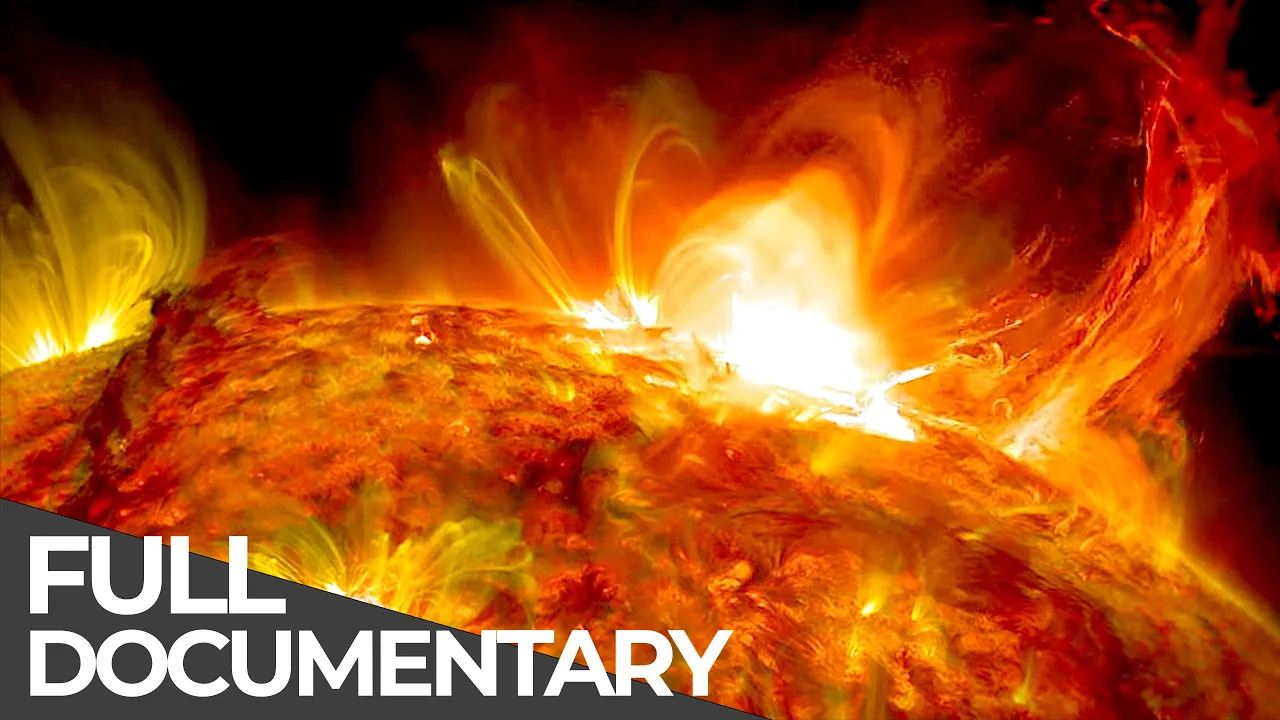
49:54
Solar Physics & The Search for Exoplanets | Space Documentary
@FreeDocumentary
615.8K views•2022-06-10
61:17
First Billion Years of the Universe with the Square Kilometre Array
@iaaudc
121 views•2022-05-26

6:25
Kepler's Laws of Planetary Motion Explained (Educational Astronomy Video)
@Peekaboo_Kidz
404.9K views•2023-02-17
6:10
Gamma-Ray Bursts: Cosmic Snipers Explained | Astronomy
@kurzgesagt
15M views•2016-07-31
Related Study Plans & Knowledge Roadmaps
Structured learning paths in Astronomy
astronomy
Reionization: Pop III Stars, IGM & 21cm Line
01Foundations of Cosmology & the Early Universe
02Population III Stars & Cosmic Dawn
03Physical Mechanisms of Reionization
+ 2 more learning modules
17h5 modules
Explore Roadmap
astronomy
Planetary Rings: Dynamics, Roche & Resonances
01Foundations of Gravity and Orbital Mechanics
02Tidal Forces and the Roche Limit
03Structure, Composition, and Collisions
+ 2 more learning modules
10h5 modules
Explore Roadmap
astronomy
Asteroseismology: Stellar Waves, Ages & Cores
01Foundations of Stellar Astrophysics & Wave Mechanics
02Stellar Oscillation Modes: P-modes and G-modes
03Mathematical Framework of Asteroseismology
+ 2 more learning modules
35h5 modules
Explore Roadmap
astronomy
Adaptive Optics: Physics, Engineering & Control
01Foundations of Wave Optics and Wavefronts
02Atmospheric Turbulence & Optical Distortion
03Wavefront Sensing Technologies
+ 3 more learning modules
35h6 modules
Explore Roadmap