




![[시민강좌] 조원빈 성균관대 교수 - 한국의 민주주의 수준? 정치제도적 측면 평가](https://i.ytimg.com/vi/IrDt-Zxv5g8/maxresdefault.jpg)
















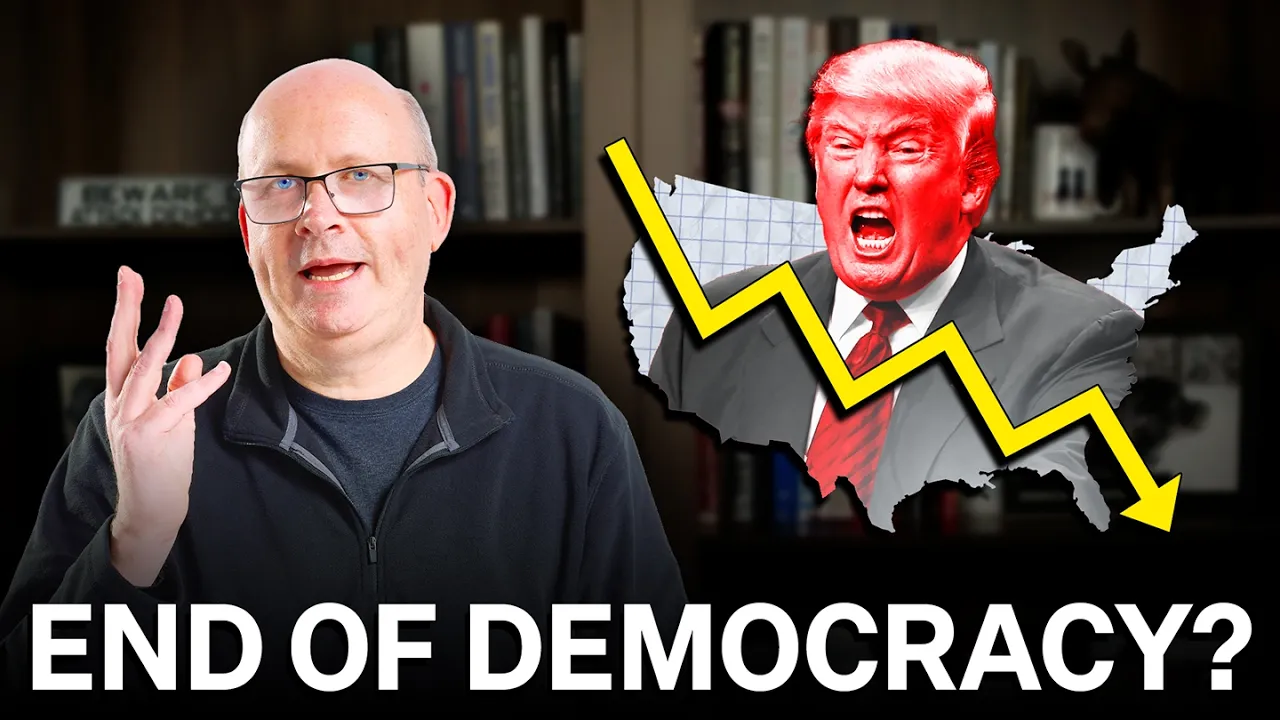








Democratic political systems foster populist politics through institutional design features: two-party systems with strong parties create incentives for politicians to appeal to broad coalitions and govern effectively, while multiparty systems with weak parties enable fragmented coalition-building that externalizes costs onto others, leading to clientelism, corruption, and anti-system populist movements; the weakening of political parties through reforms like direct member voting, primaries, and referendums further undermines governance capacity and enables populist leaders to exploit institutional weaknesses.
Populism's Political Sources: Incentives of Politicians | Yale Lecture
Added:Basic definitions and historical waves of Populism as a political ideology and rhetorical style.
Fundamental models of democratic governance, particularly the differences between majoritarian (Westminster) and consensus (proportional representation) systems.
Core concepts of Public Choice Theory, specifically how politicians act as rational actors driven by electoral incentives.
The role of political parties as crucial intermediaries between citizens and state institutions.
Democratic institutional design and electoral reforms aimed at neutralizing polarizing political incentives (e.g., ranked-choice voting, primary reforms).
Professor Ian Shapiro's broader thesis on the necessity of strong, responsible political parties to resist populist demagoguery.
Comparative analysis of contemporary populist movements in power (e.g., Hungary, Turkey, or the United States) to assess the erosion of democratic norms.
The impact of media fragmentation and social media algorithms on the strategic incentives of populist politicians.
136.7K views1.9Klikes1:16:09Original Release: 2019-12-06
- Good morning, everybody.
(students chattering) So we talked about the economic demographic and social sources of populism last time.
And today, we're gonna zero in on the political sources that interact with them and produce the kind of politics that we have all been experiencing since 2016.
- The leaders to the US, India, China, Australia, every single one of our allies, the Bank of England, the IFS, the IMF, the CBI, five former NATO secretary generals, the chief exec of the NHS, and most of the leaders of the trade unions in Britain all say that you, Boris, and Nigel are wrong.
Why should the public trust you over them?
- I'm not asking the public to trust me.
I'm asking the public to trust themselves.
I'm asking the British public to take back control of our destiny from those organizations which are distant, unaccountable, elitist, and have their own interests at heart.
- Elitist, elitist?
- Absolutely, because-- - The Lord High Chancellor conspiracy of elites.
It sounds like something out of (mumbles).
- Well, I haven't seen (mumbles), but the one thing that I would say is that the people who are backing the remain campaign are people who have done very well, thank you, out of the European Union, and the people increasingly-- (audience applauding) Absolutely.
(audience applauding) And the people who are arguing that we should get out are concerned to ensure that the working people of this country at last get a fair deal.
I think the people in this country have had enough of experts with organizations from acronyms-- - The people of this country have had enough of experts?
What do you mean by that?
- From organizations with acronyms saying that they know what is best and getting it consistently wrong.
These people are the same ones who've got consistently wrong.
- [Faisal] This is proper Trump politics, isn't it?
- No, it's actually a faith in the-- - It's Oxbridge Trump.
- It's a faith, Faisal, in the British people to make the right decision.
- [Faisal] Blind faith.
- I don't think it is because one of the striking things about this debate is that those who are arguing that we should remain have a vested financial.
The majority of people in this country are suffering as a result of our membership of the European Union.
- What's your factual basis saying that the majority of people in this country are suffering from EU membership?
- Well, I know myself-- - You don't have it, do you?
- I know myself from my own background.
I know that the European Union depresses employment and destroys jobs.
- [Faisal] We haven't got a majority.
- My father had a fishing business in Aberdeen destroyed by the European Union and the common fisheries policy.
- That's one person.
- The European Union has hollowed out communities across this country and it has also contributed to lower salaries for working people and it has also ensured that young people in this country don't have the opportunities to get the entry level job.
You're on the side, Faisal, of the elites.
I'm on the side of the people.
(audience applauding) - You said a majority, you, the Lord High Chancellor said a majority of the British public were suffering from the EU.
You have no factual evidence for that whatsoever.
- Let me give you a fact.
- [Faisal] No, you don't have any evidence for it.
- Yes, I do.
Because every year, we give billions of pounds to the European Union, billions of pounds that we should be spending here.
- Well, let's have a fact.
There's been a fact on the side of your bus in one meter tall letters, and let me quote, "We send 350 million pounds to Brussels every week.
"Let's fund the NHS instead."
Which week was it that we sent 350 million pounds to Brussels?
Was it this week, last week, was it Christmas week, Easter week?
Which week?
- Every week, we send actually more than 350 million pounds to Brussels.
- [Faisal] It comes out of a bank account in Britain and goes to Brussels. - Yes it does.
- Does it literally leave the country?
Does it leave the country?
- And then we get some of it back and we do get some of it back.
- You know it doesn't leave the country.
And you (mumbles) to me, UK Stats Authority say the figure's misleading.
The Treasury Select Committee containing Brexiteers says it's deeply problematic.
One of your own backbench colleagues, a conservative MP who's campaigning to leave, is a respected doctor, refuses to hand out leaflets because he say you're treating the public as fools.
(audience applauding) - So that was a video that went viral because of Michael Gove's declaration that the British people are tired of experts.
It was shortly before the referendum that was held later that month.
I chose to start with that because like the Tea Party videos I started with on Tuesday, it contains all the four elements of in this case, British populism, but astonishingly similar, you might realize on a little reflection to the four elements of American populism that we were talking about last time, namely the anti-elitism, the conspiracy theories, the hostility to taxes and government, and though not racist, this hostility to foreigners, this kind of xenophobic declaration that foreigners are hollowing out the labor market, taking jobs, destroying the British economy.
And so I start with this just to make the point that while we spent all of our focus on the US last Tuesday, we're talking about a much more general phenomenon and that's what's gonna concern us today.
We'll have much less to say about the US, although the three remaining lectures are gonna be very centrally focused on the US.
Today's agenda is to answer this question: what is it about democratic political systems that has fostered the resurgence of populist politics?
And our answer's gonna differ from much of what you read in that I'm gonna shift the focus away from exclusive attention to voters and voting behavior and instead also include attention to the incentives and motivations of politicians.
If you wanted a bumper sticker for this lecture.
I talked about the Tea Party narrative that Arlie Hochschild so cleverly portrayed with the cutting in comments that she made in that clip.
I said that that had become weaponized unlike many of the other narratives in around the questions of race in American politics that I gave you some flavor of.
But any time a social scientist starts talking in the passive voice, you should get nervous.
Become weaponized?
How did it become weaponized?
Just as people constantly talk about our politics has become polarized, but again, weaponization of, and populism, and polarized politics don't fall out of the sky and we need to think about who it is that is mobilizing people to vote in a particular way.
It's not as if 63 million Americans were sitting around saying, "If only somebody would come along "and propose building a wall."
That's not how mobilization works in politics.
Politicians see opportunities to mobilize voters in certain ways rather than others and then use them.
So this lecture's gonna be very much more focused on the incentives confronting politicians, how those incentives have changed, and how that has shaped the politics that we're experiencing.
I just am gonna be very centrally focused on the political system today, but we shouldn't lose sight of the broader content that we've talked about several times in the course.
The impact of globalization, technology, and slow growth on middle class incomes and working class incomes.
The aging populations in all of the developed countries that put more and more pressure on fiscal states as the working age population that's supporting retired populations is getting relatively smaller and smaller, and the collapse of the corporatist consensus between business and labor that underpinned the social democratic welfare states in the early postwar period largely as a result of the collapse of organized labor.
These are all themes from earlier in the course that we should have in the back of our minds.
What I want to say about them today is that all of those things make it much harder to govern and it leads voters often to demand political reforms and to the rise of anti-system parties or anti-system groups within political parties.
And that in turn creates the risk of what I'm gonna call the political equivalent of bloodletting, namely fixing things that were not broken in ways that actually make the situation worse.
And we will see particularly how this has played out in the United Kingdom since the 1970s.
The pressure to reform the British political system ramped up in the 1970s.
A very important book by Anthony King, unfortunately now deceased, called "The British Constitution" points out that apart from the war decades, the 1970s were one of the most difficult decades in British economics.
It was the three day week, it was the oil shock.
Britain was actually forced even to go to the IMF and be bailed out.
And that caused a lot of people to demand political reforms even though actually the problems that Britain was experiencing had nothing to do with the political system.
But they reformed the system in ways that have hamstrung its ability to confront many of Britain's problems.
So the central questions I'm gonna zero in on this lecture are how do the number and nature of political parties affect politics and there, I'm gonna be interested in when I talk about number two party systems versus multiparty systems.
And when I talk about the nature of political parties, I'm gonna be talking about weak parties versus strong parties and I'll say more about what I mean by weak and strong as we move along.
And then the second question is I'm gonna look at what are the implications of this for the economy and society?
How does it affect?
How do these phenomena, the number of parties and the strength of parties affect labor markets, corruption, the propensity for corruption, and growth, and also how do they affect the likelihood that we're gonna see populist politics.
That's out agenda.
So just for people who like tables, here's a two by two.
If we think of two party systems, the classic strong two party system would be the UK system before they started messing it up in the 1970s and subsequently.
So I'll have a lot to say about that and then weak two party systems would be the US system.
We have very weak political parties in ways that I will elaborate on.
Western Europe has traditionally had strong multiparty systems although they've also been weakened in recent years.
And in much of Eastern Europe, in France and much of Latin America, we have multiple parties that are also weak parties.
Israel also fits into that box.
To some extent, we'll see these if you like ideal types and many actual political systems are hybrids, but nonetheless, the center of gravity is what I'll be talking about when I think about these different possibilities.
Now, I'm talking about political parties.
Well, what is a political party?
How do we know one when we trip over it?
So here's one famous classical definition that Burke came up with in the 18th century.
He said a political party is a body of men, as they then were, united for promoting by their joint endeavors the national interest upon some particular principle in which they're all agreed.
It's kind of a verbose mouthful.
More simply put, you can say that parties promote what I'm gonna call partisan conceptions of the public interest.
They're partisan in that they come from a point of view, but they are declared to be conceptions of the public interest, not of a private interest or a sectional interest.
So if you remember when Mitt Romney got caught on a microphone I guess in what he thought was a private meeting saying that he represented only, he could only aspire to represent 53% because 47% were the takers and we're the makers.
It was a politically disastrous thing for him because you can't say that.
Politicians are gonna say the American people want, the American people need.
I'm gonna represent all of the American people.
So this is the idea of a conception of the public interest even though he comes from a partisan point of view and I'll unpack what I mean by partisan.
More of that later.
But let's start by two party systems versus multiparty systems.
Now, what is it that determines whether you get two parties or lots of parties?
It's the electoral system and there's something that political scientists call Duverger's Law.
And so Duverger's Law, this is a rather impenetrable mumbo jumbo.
It says single member plurality systems, SMP.
That's like we have and like they have in the UK, systems in which all you need is the most votes in a district to win the seat.
They will tend to produce two parties.
And indeed, his formula he says is district magnitude plus one.
So district magnitude means the number of people getting elected from a district.
So district magnitude in the US or the UK is one and plus one, you're gonna get a two party system.
All else equal, but need to unpack all else equal.
That assumes that most districts are gonna be like most other districts.
Or if you'd like to put it in more technical terms, that the median voter in a district is pretty much gonna be the median voter in the country.
So every district looks more or less like every other district in its political composition.
If that's not true as in India where there's big regional variation, then you'll get more parties.
So even though in India, they have single member district systems, they nonetheless have more parties.
Or in the UK for instance, you have regional variations so you can get the Scottish nationalists in Scotland.
But for the most part, if you have big diverse districts that are more or less like one another, you're gonna get two parties out of single member plurality systems.
Whereas if you have proportional representation and this is if in the limiting case, in pure PR as say in Israel, if you get 60% of the vote, you get 60% of the seats.
Your party gets 30% of the vote, it gets 30% of the seats.
Then you will get lots of parties, other things being equal again.
So for instance, you can reduce the number of parties in a PR system by putting in a threshold.
So in Germany, there's a 5% threshold.
Parties that fall below 5% don't get any seats in the parliament.
So that's one way in which you can make a multiparty system function more like a two party system.
Another way in which you could make a two party system function more like a multiparty system is by having multiple rounds.
So in France, they have a first round and a second round.
So even though they have single member district system at the moment.
The French change their system so often that it's hard to keep track of it.
But at the moment, they have single member district system.
They're beaten only by the Italians for changing their electoral system every five minutes.
So in France currently, they have single member districts, but because they have two rounds, the small parties stay in in the first round in order to then essentially extract rents or benefits for supporting bigger parties in the latter round.
So the two rounds keeps the small parties alive.
There's these variations around the edges, but basically, the big point is if you have PR, you're gonna get part proliferation of parties, and if you have single member district systems like we have, like the British have, like they have in Canada, although again, regional variation produces the different outcome with the Quebecois, but basically, single member district's gonna produce two party systems.
Okay.
Now, there's one big debate about well, which is better?
Which is fairer?
Which is more representative?
And people often say well, multiparty systems are much more representative in the sense that if you think about a multiparty system, the greens get their party in parliament, and the social democrats get their party in parliament, the libertarians get their party in parliament, the anti-immigrant people get their party in parliament, everybody gets a seat at the table and so it's more representative.
And in that sense, multiparty systems are often defended as fairer because they are more representative.
And the British liberal party endlessly complains that they get very few seats and if Britain had PR, they would do much better, and they've tried to at least.
They only took this view once they lost power at the beginning of the 20th century.
Before that, they were strongly opposed to PR, but now, they see that it would benefit them.
One important caution though is we shouldn't conflate the electoral stage with the government formation stage in a political system.
So if you think about, we think about the 2015 elections in Greece, that was the outcome of the election.
All the different parties were represented, but that was the government that formed with a far left party and a far right party.
So the people who voted for all these other parties were unrepresented in the government, right?
And so you could say it's more representative at the electoral stage, but not more represented at the government formation stage.
Three years later, the Italian electrons produced a comparable result.
Again, you've got a far left party and a far right party.
And as I mentioned to you in our very first lecture, in Germany in 2017, they had had a grand coalition between the SPD and the CDU prior to that.
The election result was such that the social democrats said, "We're sick of being in this coalition "which we get damaged by "'cause of all the concessions we have to make "to be in the government."
And so they didn't want to join and Merkel spent six months trying to put together a coalition between the free democrats who were sort of like libertarians, sort of Rand Paul type libertarians, and the greens who are for environmental regulation.
Not surprisingly, she failed because they want no regulation and they want green regulations so there's not much of an intersecting thet.
And during those six months, all the polling showed that the alternative for Deutschland was gonna do even better if they went to another election.
So finally, they put back together the grand coalition.
So when we're thinking about, this is really something of a trade off between increasing accountability and representativeness at the electoral stage which might come at the expense of accountability of actual governments, and that, I'm gonna dig into a little more deeply.
Now, one of the objections that people make to two party systems is the Tweedledee Tweedledum problem.
And the Tweedledee Tweedledum problem or as I put it here, the Tweedledum Tweedledee problem which is the mirror image of the Tweedledee Tweedledum problem, (students laughing) is basically that politicians in a two party system are chasing the median voter.
So if you think about it this way, if the right of center party went over here where I've got that B on the slide, the center to the left, the party to the left would move toward it to pick up a lot of votes, right?
So if you think about 1964 in the US, Barry Goldwater has a very conservative platform.
And the result is Lyndon Johnson wins a massive victory.
So you can't do that if you want to win.
The parties are gonna head for the middle.
But then if they do that, both parties are gonna be offering the same policies, right?
This just follows almost definitionally.
They might get it wrong, right?
So Goldwater maybe thought he was close to the median voter and when Ronald Reagan ran in 1980 on more or less than same program, everybody said, "What an idiot," "we saw what happened to Barry Goldwater."
But whether it was Reagan's brilliant strategy or blind staggering luck or some mix, the median voter had moved and so Reagan could prevail.
But generally speaking, all of the incentives for politicians which is what I'm focusing on here are to head for the middle in a two party system.
And so then people say, "But voters are not gonna get a choice."
If two parties are basically, especially if they have very sophisticated polling and they learn about where the median voter is.
It's much better now than it was in 1964.
It's gonna be a problem from the point of view of giving voters choice.
So that is true up to a point.
So if you think about Britain, National Health Service put in by Clement Attlee in the postwar labor government in 1946.
Comes into operation over the next couple of years.
Hugely popular in British politics.
It's bulletproof.
If you look at polling on the most popular institutions in Britain, it's more popular than the second most popular institution which is the Queen.
And this means that the National Health Service really is bulletproof.
People want to keep it.
And so even in Margaret Thatcher's rolling back the welfare state in the 1980s, she couldn't dismantle the National Health Service.
Of course, there'll be squabbling at the margins about funding, and coverage, and this sort of thing, but basically, it's there to stay because the median voter has an intense attachment to it.
Not everything's like that.
So if you think about nationalizing and denationalizing British Rail, that has occurred three times and if Jeremy Corbyn comes into office, they might renationalize British Rail.
Similarly, in the US, think about social security brought in by FDR, I talked about this last time, in 1935.
And Medicare insurance for people over 65 brought in by Lyndon Johnson as part of the great society in 1965, these are also bulletproof, hugely popular with the median voter, basically bulletproof.
But again, not everything is like that.
So if you think about how to respond in a recession, your left of center parties are gonna generally push for deficit spending.
They have Keynesian outlooks and think that the problem is insufficient demand and there's gotta be a demand-led return to revive the economy.
Whereas supply side is on the right.
They're gonna say no, what we need in recessions are tax cuts.
And so you're gonna get very divergent responses to recessions.
Or if you think about protections for labor, the Wagner Act I've mentioned before put in place by FDR in 1935 was the strongest protections for unions in American history.
By 1947 when the republicans were back in control of congress, they repealed the guts of it over Harry Truman's veto.
That means they had 2/3's in both houses to do that, greatly weakening the Wagner Act.
Or more recently if you think about the Dodd-Frank law which we've discussed a little bit, the Consumer Financial Protection Bureau put in as part of that law has since been savaged, and weakened, and might be completely dismantled by the Trump Administration and the republicans in congress.
So that's what I mean by a partisan conception of the public interest.
Go back to the beginning of the lecture.
So this is one partisan conception of the public interest and this is another partisan conception of the public interest.
There will be some overlap, so some Tweedledee's Tweedledum, but there will be a lot of areas where in fact there's divergence, partly for ideological reasons, partly because people don't actually know what the best way is to respond to a recession, and partly perhaps for other reasons as well.
And so while their Tweedledee Tweedledum is an issue to some extent, we should notice that for the most part, you do get significant divergence.
Now, some people say, "Well, "the electoral system doesn't really matter that much."
All the stuff I'm going on about, there's less to this than meets the eye because if you think about a two party system, it's about big tent parties.
They've got lots of different interests in.
Basically, they've put together a coalition before the election.
Multiparty systems put together the coalition after the election.
What's the big difference?
They're more or less gonna turn out to be the same.
So we shouldn't really get this hot under the collar about the differences.
I think that that is fundamentally misguided and there are five reasons and I'm gonna work my way through them why particularly when we focus on the incentives created for politicians, the differences matter and they matter in ways that are relevant to our larger concern.
And the differences all come down to the fact that in two party systems, it's winner take all and loser lose all.
And that creates a fundamentally different dynamic for politicians.
So I'm gonna start by again, this is mumbo jumbo, but I will unpack it into common sense terminology in a minute.
It's that in two party systems, politicians have an incentive to internalize the costs of the deals that they make.
So let me explain what I mean by this.
Let's suppose I in a two party systems am in charge of strategy for the party that's to the left of center in the diagram I just did.
And who's a right wing?
Steve Wisener over there is a right winger.
He's in charge of strategy for the right of center party, okay?
So Steve and I both know that if I lose, he wins, if he loses, I win, right?
And everything, can gain control of everything.
And so it's very important to both of us not to leave any voters on the table that we might be able to get because that one last voter you leave on the table might be the difference between winning everything and losing everything, okay?
So now think about in a multiparty system.
After an election, maybe the big like Germany grand coalition which often happens.
The big labor party and the big business party are forming a coalition.
What does business want?
Business wants industrial peace, predictability, no strikes.
What does labor want?
They want protection of worker's wages, protection of their members.
So they might make an agreement that gives both parties those things while externalizing the costs of that agreement onto others like higher prices for consumers, right?
Or if you think about an agrarian party, thinking of joining a coalition.
What does the agrarian party wants?
It wants protectionism, it wants price supports for agriculture, right?
And they make that the condition of joining a coalition, right?
But that might produce higher food prices for the rest of the population.
But the election's already over.
Nobody's worried about that, so they'll externalize the costs of the deals that they're making.
When Steve and I are confronting one another before an election, we have to worry that if we are seen as responsible for inflation or advocating policies that are gonna produce inflation, then the other party's gonna win.
So we both have incentives to make the deals we have to make to put together our party without externalizing cost any more than we have to.
We have to worry about what Americans like to call swing voters.
We will satisfy our core constituencies in ways that imposes few costs as possible on swing voters.
That's the basic incentive.
So that's an important distinction.
Then secondly, when we do that, we're gonna have to worry about I put it here and I mentioned this earlier when we talked about referendums during the lecture on the anti-tax movement, but I'll just come back to the analytical core of the point there, is that when we put together a platform, we have to bundle a lot of policies together, right?
Policies on abortion, policies on education, policies on spending.
We have to bundle all of these things because voters are getting a choice.
Essentially, you're forcing it down to one dimension and you've gotta push everything together.
And when you do that, you have to discount everything you propose by everything else you propose.
The example I gave you earlier just to remind you is if you ask Americans, "Would you like to get rid of the estate tax "which almost nobody pays?"
You can get 70% to say yes, but if you say, "Would you like to get rid of the estate tax "if that also meant getting rid "of prescription drug benefits for seniors?"
then you get majority saying, "No."
So in the second case, they're bundling their preference or discounting their preference for a tax cut by their preference for keeping prescription drug benefits for seniors.
So that's what parties do.
They bundle together lots of issues, but they've go to do the discounting.
Steve and I both have to worry about doing the discounting of all these issues against each other in ways that will alienate as few voters as possible because of the winner take all character of it.
In a multiparty system, it doesn't work like that.
If you're a representative of the green party, you're just gonna say, "I'm gonna go hell for leather "for green legislation if I get elected, "if our party gets elected," right?
You're essentially only appealing to your core voters and the more fragmented a system gets, the more parties you get, the more they're gonna be like that.
All your voters are sort of gonna be like primary voters in the US.
I have more to say about primary voters later.
And often, you'll have parties that only have a single raison d'etre like the green party has a single raison d'etre.
Anti-immigrant parties have a single raison d'etre.
The religious parties in Israel have a single raison d'etre.
So they're just going to try to, if you like, turn out their base because they know they're not really gonna appeal to many other constituencies.
And so they are not gonna do this kind of bundling and discounting of the things that are important to them with the things that are important to others born in mind.
And you can see this by taking a third analytical comparison that I put up here of two types of arbitration and industrial disputes.
So if you have industrial disputes, management and labor can't agree on a contract, sometimes there'll be a provision, okay, we'll go to arbitration.
We'll let a third party decide.
And when you do that, typically what happens is management takes their position, the unions take their position, the arbitrator comes in, does fact finding, and picks the solution, usually some form of compromise.
Of course, everybody knows that's gonna happen and so because they know that that's gonna happen, they behave strategically.
So the management might take a much more extreme position than it really believes in.
As well, the union.
Just like a store putting up their prices later to put them down and say they're having a sale so that when the compromise is made, they hope it'll get somewhere closer to what they really want.
There's a different kind of arbitration called last best offer arbitration.
And last better offer arbitration works like this.
Management takes their position, the union takes their position, the arbitrator has to pick one.
There's no fact finding, no compromise.
The arbitrator has to pick one.
And you won't have to think about this for very long to realize that in last best offer arbitration, people tend not to behave strategically and tend not to take extreme positions because of the fear that if you do that, the arbitrator will pick the other side.
So people tend to be reasonable, they tend to converge, they head toward their sincere preferences, if you like, and they head toward the middle.
Well, two party competition is much more like last best offer arbitration because the voter is essentially put in the position of being that last best offer arbitrator, right?
So Steve has to put together a platform and I have to put together a platform which we think that last best offer, that median voter in the position of political analog of the last best offer arbitrator will choose.
Whereas if you think about multiparty systems, again, the big incentive is to create a surplus to give away during the negotiations.
So you can say, "Well, I've made all these compromises," and so you're gonna get a lot more strategic behavior and you're gonna have parties making very different kinds of deals based upon the positions that they take.
And so if you want parties to put together programs that appeal to as many voters as possible, what we sometimes call programmatic policies, you want policies that are gonna serve the interests of the largest number of voters, you're more likely to get that out of a two party system than out of a multiparty system where coalitions are gonna be put together in the short run to protect the members of the coalition for that government, but nobody, as we'll see, is thinking much about the future.
Another difference that's important to notice has to do with opposition.
If Steve gets it right and I get it wrong, I go into opposition.
And then I will spend my time attacking his government and telling voters, "Vote them out.
"Put us in and you'll know what you'll get."
And we put together the alternative program.
In a multiparty system, you have no idea what will happen if you kick out the government because you don't know X and T what coalition is gonna be formed next time around, right?
Just think back to the Germany example I started with.
Had Merkel managed to put together the coalition with the greens and the free democrats, then the SPD, you'd have a centrist opposition.
And now that you've got a grand coalition, you've got splinted opposition of very disparate parties lobbing their different grenades at the government, but nobody knows what will happen after the next election and what sort of government might be formed.
So voters have no idea what the alternative to the current government actually is.
And so again, it's a feature of multiparty government.
Or to put it another way, in a two party system, parties are sort of like marriages.
Of course, sometimes people get divorced, but people don't marry intending to get divorced.
They intend to stay together and to be seen as a family, and to have certain characteristics, and to plan to exist for the long run.
Parties are just the same.
Occasionally, they fall apart.
The wigs fell apart in the 1850s in the US.
The liberal party collapsed in the first decade of the 20th century in the UK.
But for the most part, parties expect to be together over the long run to think therefore about policies for the long run and so on.
Multiparty governments are more like hook ups, right?
This is cool for me right now, but who knows?
All bets are off about the future.
The future will take care of itself.
And so again, if you want governments that are going to invest in policies for the long run, it's more likely that you're gonna get such governments when you have two party systems rather than multiparty systems.
So for all of these reasons, it's mistaken to think that there's nothing at stake here.
And if you want to think about what will make it more likely that politicians will develop policies for the longer run, you're more likely to get that out of two party systems than out of multiparty systems.
And the more fragmented that the multiparty systems become, the more difficult or the more pronounced these disadvantages are going to be.
So let's talk a little bit about strong versus weak parties.
So this is the second dimension of the two by two with which I began.
Now, an important feature of political parties that often goes unnoticed, and I haven't mentioned yet, but I want to bring it to your attention is that they're very unusual institutional creatures in that nobody owns them.
The closest thing there is is actually a private university in the US.
So think about Yale.
Who owns Yale?
The truth is nobody owns Yale.
If you sold off all of Yale's assets, as with a firm, if you sell off all the assets, there's a residual claimant.
It's the shareholders.
So if you sold off all the assets, pay the debts, you'd give the residual claimant is the shareholder.
There is no residual claimant at Yale.
So if you sold off all of Yale's assets and paid off all of its debts, it's not clear who would be entitled to the residual.
And that has the implication that governance is always controversial.
The faculty think they should govern Yale.
The students think they should govern Yale.
The alumni think they should govern Yale.
The corporation think they should govern Yale.
The donors think they should govern Yale.
Nobody agrees on who should actually be governing, right?
Because it's an unknown entity.
There's no analog to the shareholders.
Political parties have the same feature.
There is no equivalent of a shareholder or a residual claimant in a political party.
And so for that reason, the governance of political parties is endemically controversial.
There's always gonna be fighting over who should govern political parties.
And a lot of what we're seeing in our current politics is because the fighting over who should govern political parties has tended to come out a certain way.
And so that's what I want to zero in on now.
So, definitions are important.
What is a strong party?
Well, here's one definition from an article in World Politics last year.
A unified, centralized, stable, organizationally complex, and tied to long standing constituencies.
As I said, political scientists never saying words of one syllable what can be said in words of five syllables.
I like simple things, so I would say a strong party is a party in which everybody's on the same team.
Everybody is trying to achieve the same goal.
Everybody's pulling in the same direction.
That's what I would think of as a strong party.
And one feature of that would be back benches choose front benches, back benches being what we call members in the US, choose front benches, the people running the parties, who choose back benches who choose front benches.
And so let me explain why that's important.
First of all, back benches will give front benches a lot of leeway, what I call to discipline them.
I call it Ulysses and the Sirens discipline in the sense that you know the famous story of Ulysses and the Sirens is that Ulysses is tempted to do things that won't be good for him, so he wants to be disciplined, right?
So the intuition here is that going back to remembering Steve and I facing winner take all, loser lose all, if our back benches, if we're the leaders of the party, they know we both have incentives to design a platform and pick candidates for running in the different constituencies that can both win in their districts and support a national winning platform, right?
Whereas if you just focus on the individual back benches or the individual members, they're just trying to survive in their districts.
So they might want a very big margins.
If their idiosyncratic preference is in their district that might be unpopular nationally, they're gonna focus on those things.
So the idea is back benches will give a lot of leeway to front benches to discipline them, to determine what the platform's gonna be, to have a big role in candidate selection, but they only have enough rope to hang themselves.
One indicator is that we have very weak political parties is that Nancy Pelosi led the congressional democrats to four successive defeats and still stayed there, right?
Just as with a sports team, the quarterback or the coach has a lot of authority, but it's conditioned on delivering victories.
If they don't deliver victories, they're gonna be gone very quickly, right?
So this is the idea.
The back benches have a big interest in delegating authority to the front benches conditional on their delivering victories.
And if they don't, they won't survive for very long because the reason for delegating the authority will have gone away.
Weak parties are parties in which everyone's in it for herself or himself.
Lots of people worried about their own survival in their own district.
Lots of retail campaigning, not wholesale campaigning.
This comes back, by the way, to our discussion of money in politics.
Politicians in weak parties need much more money 'cause they're all campaigning for their own survival.
You'll see a lot of deal cutting.
It'll make an American system look more like a European system.
I'll support the unnecessary military base in your district if you'll support the unnecessary military base in my district, what political scientists call pork barrel spending.
You will not see individual members worried about the national program.
Candidates and platforms will tend to be controlled from below or from outside by the people who are funding the candidates.
And so you'll see a situation where leaders in the legislature find it very difficult to set the agenda and to whip the back benches to support their agenda.
Again, another symptom of the fact that we have very weak parties in the US is that when the republicans were in opposition, they voted 71 times, I believe, to repeal Obamacare, but when they came into office, they couldn't do it.
The leadership couldn't whip the back benches to support the program of repeal because they knew they would pay too high of a price for it in their own constituencies.
Now, the recent trend across the democratic world has been to weaken parties.
And this has taken a number of forms in a number of systems, but it's all tended to produce the same result.
So one way in which this has happened is in moving away from back benches selecting front benches, members of a parliamentary party picking its leadership, to instead having leaders elected at large.
So here's a pretty dramatic instance.
- Jeremy Corbyn elected as leader of the Labour Party.
- [Presenter] The veteran left winger has come to be reinforced his position as head of Britain's main opposition party.
Corbyn was backed by nearly 62% of half a million party members who voted in the leadership contest after he'd been challenged by many Laboor MPs.
He immediately called for unity.
- We have much more in common than that which divides us.
As far as I'm concerned, let's wipe that slate clean from today and get on with the work we've got to do as a party together.
- [Presenter] The immediate question is whether more centrist Labour MPs who'd opposed Corbyn will rally behind him.
Beyond that lies the task of mounting a serious challenge for power.
Critics say the in fighting has left a vacuum in opposition that's been filled by the Eurosceptic hard right.
- So Corbyn's call for unity there is a little bit alike we might call it the British equivalent of whistling Dixie in that.
But here's the interesting set of facts that led up to that.
It used to be the case that, as I said, the parliamentary labor parties elected their own leader.
Starting in the early 1980s, they put in a series of reforms to weaken the role of the parliamentary party and strengthen the role of larger constituencies out there of unions and others.
But in an any event, when Ed Miliband was leader, they put in a system that any member of the Labour Party could vote in the leadership election.
It costs three pounds to join the Labour Party and it has as you saw 450,000 members.
So in 2015 after Miliband was forced to step down because they lost the election.
As I said, in systems like this, if you don't deliver a victory, you're gone.
Corbyn won.
And Corbyn was a card carrying Marxist way to the left nevermind of the median voter in the Labour Party but of the median British voter.
And the parliamentary labor party quickly discovered they couldn't work with him and so there were mass defections from the shadow cabinet and eventually a vote of no confidence in him of 172 to 40.
That's a pretty big majority.
And then three months later as you just saw, he was reelected by 62% of the membership.
So if you now think about Corbyn coming into government which might happen in December of this year, you'll have a situation where he will not be able to govern with the members of the parliamentary Labour Party, many of whom could not survive in their constituencies if they supported his program.
So this is something that has gone on in country, after country, after country.
Many, many political parties have moved toward more direct election of their leaders.
And the difficulty is that the political activists who tend to join parties and participate are on the fringes with the parties and tend not to be representative of the people who turn out in the general election and elect people to parliament.
And so you get that problem.
Secondly, increasing use, I talked a little bit about this when we did the anti-tax class.
Increasing use of ballot initiatives, referenda, and plebiscites.
Again, since we're talking about England, let's stay there.
- Their verdict has been given by a vote and by a majority bigger than that achieved by any government in any general election in the history of our democracy.
No one in Britain, in Europe, or the wider world should have any doubt about its meaning.
It was a free vote without constraint following a free democratic campaign conducted constructively and without rancor.
It means that 14 years of national argument are over.
It means that all those who have had reservations about Britain's commitment should now join whole heartedly without stint in the task of overcoming the economic problems that assail us as a nation.
And work whole heartedly with our partners in Europe and our friends everywhere to meet the challenges confronting the whole world.
- So this is what many people don't know when they think about Brexit referendum that in fact the first British referendum ever was in 1975 called by Harold Wilson.
At that time, the Labour Party was split over Europe and tended to be more anti-Europe because British workers had stronger protections than European workers, whereas the Tories tended to be more pro-European.
So it was a flip, the mirror image of what it is today.
And so Harold Wilson was confronting a very divided party and rather than do the hard work of the discounting and so on to force a resolution within the party, he had this idea, let's just have a referendum.
And so they had their first referendum and as he said, 2/3's voted to stay in the EU.
I couldn't resist putting this on the slide.
He crowed later.
He said, "It was a matter of some satisfaction "that an issue "which had threatened several times over 13 years "to tear the Labor movement apart "had been resolved fairly and finally.
"All that had divided us in that great controversy "was put behind us."
Of course, five years later, they split anyway when the left wing had gotten control.
After the first set of reforms to the leadership election process, the left wing had gotten control and so called Gang of Four, Roy Jenkins, David Owen, Shirley Williams, and Bill Rodgers left and formed the social democratic party which would eventually unite with the liberal democrats.
Same thing with Cameron in 2016.
He was trying to duck resolving the conflict within the conservative party and so he thought he would do it with a referendum.
It wasn't any more successful than Harold Wilson's effort.
Interestingly, just to go back to Margaret Thatcher, in 1983, she was then a sitting prime minister.
She had won in 1979 the 1983 election.
She was pro-European in those days, but she said, "Britain's getting a raw deal "from the common market "and so we need to renegotiate."
And particularly the, as I mentioned in an earlier lecture, the agricultural policy and the fisheries policy that Gove was complaining about in that video worked to Britain's disadvantage.
And so she had negotiated a rebate for Britain.
It came to about 40 billion pounds a year.
That would be an example of trying to figure out a way to redo the bundling, right?
So yes, there's a Eurosceptic wing of the tory party.
They've got these complaints, so we'll do something to address them and redo the bundling and go on into the future.
And it was pretty successful.
Not only did she win in 1983 promising to do that.
After she did it, she won the next election as well.
So this was a very different approach than the use of ballot initiatives, referenda, and so on.
Fixed parliaments act.
Again, we've seen this playing out in real time.
Weakens the power of the prime minister to whip the back benches to support a program.
So in this case, if they had not had put in the fixed parliament act which was put in in 2015 again to limit the unilateral power of the leadership, you now have to get a 2/3 vote in parliament to call an election, but for that, Theresa May could have forced the tories to support her deal that she had negotiated.
No longer has that power.
Lots of calls to strengthen presidents partly because legislatures have become so dysfunctional and so difficult to form governments that can govern.
People say oh, we need to give more authority to executives to punch through all of the bickering in parliament.
And so you get especially in Eastern Europe, in Latin America, and increasingly here, claims that it's important to concentrate executive power because you can't otherwise govern.
And this is not just Trump, but in series one president after another relying increasingly on executive power.
Growing reliance on primaries and caucuses.
Again, primaries and caucuses are seen as ways of democratizing the control and governance of political parties.
They've been around for over a century in the legislature, but become more and more important because we have more and more safe seats.
And if you have more and more safe seats, the primary election becomes the only election that matters.
At the presidential level, primaries didn't become important until the McGovern-Fraser reforms that I talked about last time.
But here's the thing about primaries and caucuses is you're thinking about the primary, the left party's gotta go to the median voter you might think of their party, and the right party of the median voter of their party, but that's not what tends to happen because the people who turn out in primaries and caucuses tend to be on the fringes of the parties and so not even these people, but these people.
It's extremely low turn out in these primaries and caucuses, so you can get Alexandria Ocasio-Cortez elected in New York with an 11% turn out, Jim Jordan in Ohio or Mark Meadows again selected in primaries with 15 or 16% turn out.
And these people are not representative of the voters in their district and nevermine representative the voters in the country.
And so what tends to happen is they control who gets selected and then when the people go to Washington, either they do the kind of compromising that's needed to pass legislation in which case they get accused of having sold out by the people who selected them, or they don't, in which case you get gridlock and alienation of other voters.
And so either way, the remedy does not address the voter alienation that people so often complain about.
And just if you want a very recent illustration of this, I saw the other day on Morning Joe Mike Murphy, a republican strategist, was reporting on interviews of senate republicans and had concluded that if the vote on removal from office of Trump were a secret ballot, 30 republican senators would support it.
But they know that if they're known to have done it, they'll face brutal primary challenges and almost certainly not survive.
So that's the story about weakening parties.
Now, some people say well, maybe the best solution is the middle, is some mix.
We talk about Labradors being, a Labradoodle is a dog with a nice personality that doesn't shed, right?
And so people have often said the Germans got it all right.
They have a mixed system, partly of single member districts, partly PR, and they've been very successful for much of the postwar period, so maybe what we really want is a system that gets the both of all worlds.
And Germany was always held out as the Labradoodle, strong parliamentarism unlike Weimar which gave a lot of power to the president.
The president is very much answerable to the legislature.
The single member districts that they have, they only have 299.
They're very big and they're very diverse.
They're three times the size of Britain's and that tends to make it function more like a two party system.
You tend to get predictable governments.
Lots of party discipline until relatively recently in candidate and leadership selection.
No longer true in the SPD.
And then there are various external constraints, budget rules, constraints from the EU, anti-protectionism requirements, and so on that hemmed in the deals that governments could make.
But it was all underpinned by this postwar social democratic consensus that I have mentioned to you several times.
And even in Germany now, the truth is we saw it took Merkel six months to form a government after 2017.
The decentralized control of the SPD which meant that half a million almost members had to vote on every provision of the coalition deal meant that the negotiations were very tortured.
Merkel had to give up six ministries including the finance ministry and produced a government over which she has very little control.
The grand coalition splinters the opposition as we've seen.
And it's been very bad for both the parties in the coalition.
In the regional elections last year, they both hemorrhaged support and this has happened more recently again in the local elections.
So what's going on in Germany is replicating the pattern elsewhere.
I just remind you of the slides I showed you.
The number of parties has gone up steadily since the 1960s.
Particularly the fragmentation of parties on the left has been dramatic and it's paralleled the decline in unions.
Less dramatic on the right, but still if you look at the number of right wing parties as compared with the 1970s, they are much higher, many more of them than there used to be.
And so the upshot is that you get weakened parties who have diminished capacities to form governments and govern which produces more alienation of voters that then feeds demands for further reform.
And so think about the parallels with the 1930s with which we began this course.
So in the 1930s in Britain, there were also fascists.
They were called the Mosleyites.
And in 1936, the Mosleyites actually had larger membership than the Nazi party in Germany, but they didn't get any seats in parliament because of the two party system, right?
Whereas in Germany, in Italy, in these other countries, you got, I showed you this picture in the very first lecture.
You had a highly fragmented system, government impossible, and then the Nazi party just sweeping through and eventually taking power.
And people worry about whether this isn't where we are headed again.
And if you think about the last decade or so, again in Britain, we've had the rise of UKIP.
We've had the British national party which is even further to the right than UKIP.
But because they don't have PR, these parties don't get anywhere in the political system.
Instead, as we've just seen now with Nigel Farage, he's basically having to have influence through the tories if he really wants to affect the outcome if the tories win.
Otherwise, we'll be looking at a hung parliament and it'll make it look more like a European system.
And so he's essentially pulling Johnson to the right to take some of his concerns into account, but not being able unilaterally to determine the outcome.
Whereas in all the European systems, these very anti-Europe parties, anti-system parties are doing much better.
So again, we worry that this might not be some kind of portent for the future.
So what are the implications more broadly for the economy and society?
The take aways of today is that in two party systems, we should expect comparatively weak protections for organized labor because unions are not a majority of the party and comparatively low spending and redistribution.
That incidentally is why people on the left used to prefer multiparty systems because they were thought to be more redistributive.
But in multiparty systems today, you should expect organized labor to be decreasingly effective at protecting a shrinking labor aristocracy and that's what we have seen playing itself out in all of these European systems.
We should expect the emergence of populist parties with anti-immigrant and protectionist agendas.
And where parties are weak, we should expect primary challenges or presidential candidates running on anti-immigrant and protectionist agendas.
And we should expect that where you have fewer stronger parties, it'll be easier to resist this.
When we think about what's called clientelism, this is when you instead of pursuing programmatic policies in the interest of the polity as a whole.
Rather, you reward sectional interests.
We should expect that you're most likely to get programmatic politics out of strong two party systems when Steve and I are worrying about not leaving any voters on the table over the long run, you are gonna get what I call wholesale clientelism, giving the farmers their high prices or giving whatever you need to give, give the religious parties in Israel whatever you need to give them to form a government that's wholesale clientelism when you have multiparty system.
Where you have weak parties, you should see a lot of retail clientelism, bridges to nowhere, special deals for firms in your district 'cause that's what people are worried about.
And when you have lots of weak parties, we should expect lots of wholesale and lots of retail corruption.
Cleintelism, lots of corruption.
If you look at the statistics on economic performance, again, this is that paper from last year that I mentioned to you, the data also supports the idea that you get better economic performance when parties are strong.
You can peruse this slide and that paper which I strongly recommend at your leisure.
So reform agendas, they're hard because of the very widespread misdiagnosis.
People feel out of control.
They want more democratization of political parties, more control from below, more unbundling, more referendums, more direction of leadership, and they don't understand that that's making things worse.
It's hard also because the beneficiaries tend to not want to change the system that has put them in place.
So when Renzi tried to reverse some of this in a referendum in 2016 in Italian politics, he had his head handed to them.
Because starry-eyed progressives tend to think that more direct democracy is gonna help them, but in fact, the agenda soon gets hijacked.
It should be remembered that primaries were brought to us by the progressives at the beginning of the last century.
Hard because of the misguided faith in PR, people think it's more representative.
And it's hard because the direction that reform needs to go in is really the opposite of what most people think.
And what to do in that difficult situation will be the subject of my lecture on December 5th.
See you next week when we will talk about the building blocks of distributive politics.
(calm music)
Up Next

2:02
Understanding MMP: New Zealand's Mixed Member Proportional System
@ElectoralCommissionNZ
60K views•2020-07-13

24:30
BRICS Pay and de-dollarization: A New Financial Order Emerges? | 55 chars
@DannyHaiphongYT
164.6K views•2024-10-22

40:38
Rousseau's Social Contract and the General Will | Political Philosophy
@YaleCourses
106.6K views•2008-09-22
10:19
Explaining the Saudi-Iranian Proxy Conflict in the Middle East
@Vox
18.2M views•2017-07-17
Related Study Plans & Knowledge Roadmaps
Structured learning paths in Political Science
political-science
Economic Statecraft: Sanctions & Chokepoints
01Foundations of Geoeconomics and Economic Statecraft
02The Mechanics of Weaponized Interdependence
03International Sanctions: Types, Implementation, and Efficacy
+ 2 more learning modules
12h5 modules
Explore Roadmap
political-science
Central Bank Independence: Politics & Policy
01Foundations of Central Banking and Monetary Policy
02The Time Inconsistency Problem & Inflation Bias
03The Delegation Model and Designing Independence
+ 2 more learning modules
12h5 modules
Explore Roadmap
political-science
Consociationalism: Power-Sharing & Stability
01Democratic Dilemmas in Divided Societies
02Introduction to Consociational Democracy
03The Four Pillars of Consociational Design
+ 2 more learning modules
12h5 modules
Explore Roadmap
political-science
Rebel Governance: Legitimacy, Economy & State
01Foundations of Rebel Governance and Statehood
02Establishing Political Legitimacy and the Rebel Social Contract
03Wartime Economies and Rebel Resource Management
+ 2 more learning modules
14h5 modules
Explore Roadmap