

![C2.1 HL Signalling Molecules and Receptors [IB Biology HL]](https://i.ytimg.com/vi_webp/7CjPaKhyPPs/maxresdefault.webp)














Quorum sensing is a bacterial communication system where microorganisms use autoinducer molecules to detect population density and coordinate group behaviors; in the Vibrio fischeri system, the LuxI protein synthesizes an acyl-homoserine lactone autoinducer that diffuses across cell membranes, and when it reaches sufficient concentration, it binds to the LuxR receptor to activate the lux operon, which contains genes for light production, thereby ensuring energy-intensive bioluminescence only occurs when bacteria are present in large enough groups to make the behavior worthwhile.
Bacterial Quorum Sensing: LuxI, LuxR & the Lux Operon Explained
Added:The concept of bacterial operons and basic gene regulation mechanisms, such as promoters, operators, and transcription factors.
The principles of cell-to-cell communication, specifically how chemical signaling molecules (ligands) interact with receptor proteins.
Basic bacterial physiology, including passive diffusion of small molecules across the lipid bilayer membrane.
The fundamental processes of DNA transcription and translation in prokaryotic cells.
The biological significance of the mutualistic symbiotic relationship between Vibrio fischeri and the Hawaiian bobtail squid.
The differences in quorum sensing mechanisms between Gram-negative bacteria (using acyl-homoserine lactones) and Gram-positive bacteria (using oligopeptides).
How quorum sensing regulates bacterial pathogenicity, biofilm formation, and virulence factors in clinical pathogens like Pseudomonas aeruginosa.
The field of quorum quenching and its application in developing novel antimicrobial therapies to combat antibiotic resistance.
3.6K views89likes17:00Original Release: 2021-01-14
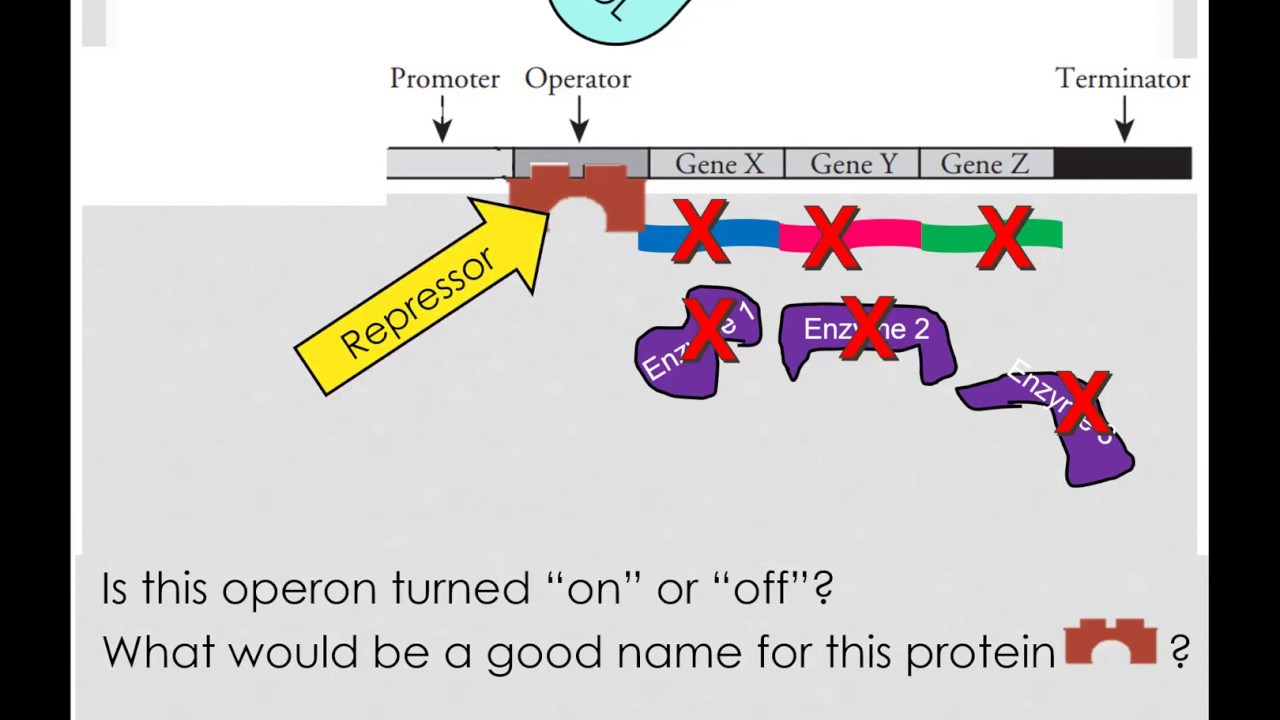
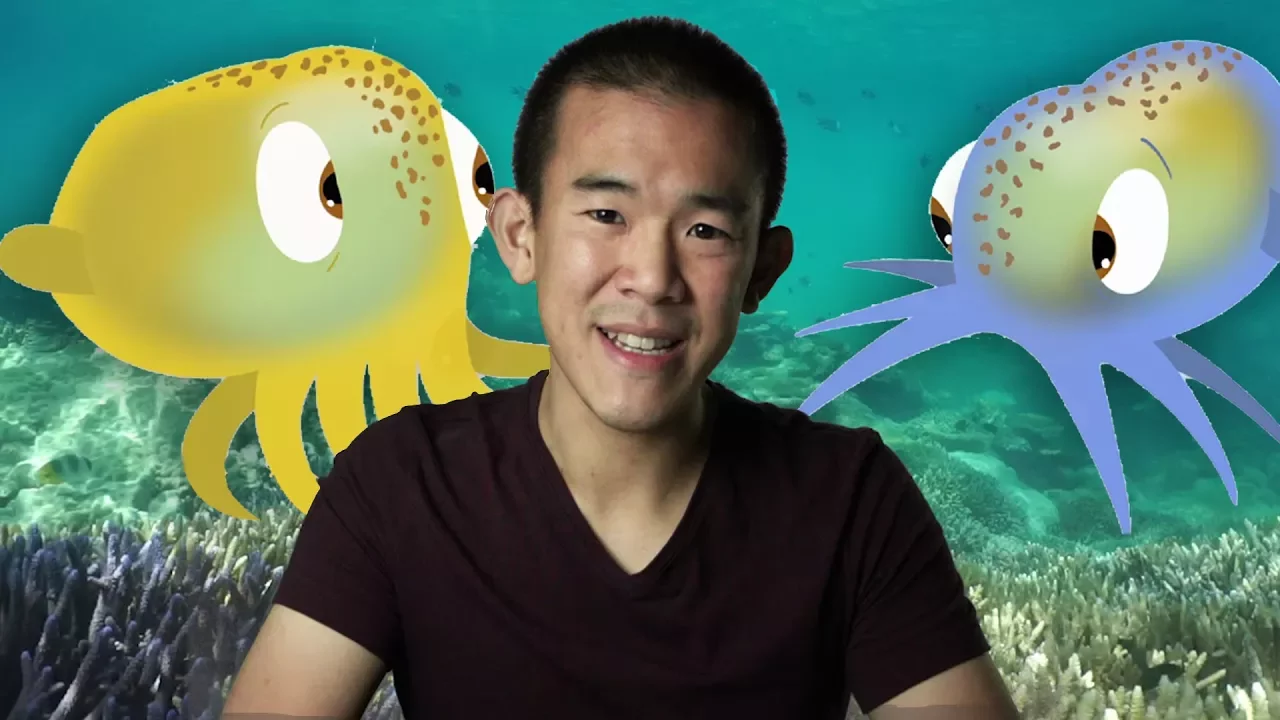
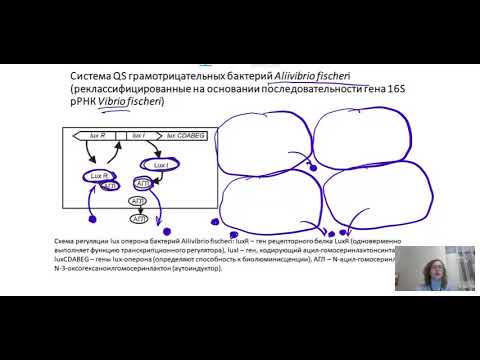
quorum sensing uh let me just make this disappear for a second quorum sensing is a major behavior that bacteria need to navigate their world because they often need to figure out whether they're alone or in a group and again if we think about what senses do they have they don't have sensory organs and they don't have neurons and so they have to figure everything out using simple chemistry with some enzymes some receptors and so this is an elegant set of systems that they can use for that purpose so the name comes from quorum which is a word you see in committees when a committee meets to make a decision usually they're only allowed to make a decision if enough community committee members have showed up to the meeting and it just makes sure that two committee members can't secretly meet somewhere and make a decision on behalf of everybody instead you have to have enough people there to make a formal decision so what they say is do we have quorum and that is do we have enough people to make the decision and so quorum sensing is when bacteria are asking do we have enough of us here to do a group behavior instead of the individual behavior and i i typically want you to think about why would there be group behaviors versus individual behaviors well we see this in humans where we have this silly example of homer simpson looking like a maniac you know trying to tell everyone something and people would be looking at him thinking okay well there's the maniac with the sign no one pays attention to him but if you see people at a protest they all feel powerful and they can't really be ignored because they're in a large group it's it's just it's a basic thing about our psychology okay so the first example of quorum sensing i'm going to give you i'm going to give you two and i'm going to walk you through this one in the most detail is the example with uh vibrio fischeri in the premise galoppe's the hawaiian bobtail squid this is an example this is an amazing example of a mutualistic symbiosis where this squid is a nocturnal squid and it's going to hunt at night pretty close to the surface of the water and it needs the bacteria because when the moon is up anything below this squid looking up at the surface of the water is going to see the silhouette and so a predator is going to see a silhouette and eat the squid so the squid needs to somehow hide itself and get rid of its dark shadow and so what they do is this squid has a special organ that feeds nutrients to these bacteria to get them to glow and that kind of makes this less of a shadow and camouflages the squid so what you're seeing in these pictures um is this same petri dish in normal lighting where you can see what color the cells are they're yellow the colonies are yellow and then if you turn the lights off the light they make is blue so it could kind of look like moonlight when viewed from underwater in the ocean so that's what the bacteria are doing that's the kind of behavior they're trying to control and the idea is that making light as you will see it is an energy intensive process and if there's only one cell present the amount of light it makes will be undetectable and so it's going to be using all this energy to make a pointlessly expensive invisible amount of light but if it's with a million of its friends if you have a million cells together the light they make will be visible and the squid will be able to use it so the squid is paying attention to how much light it's getting from the bacteria and if it's not getting enough it'll flush them out so that's a complex squid behavior but the bacteria have to figure out if there are enough of them to try to make the light and so that's what they're going to use the quorum sensing for so one thing we have to understand before we get into um the quorum sensing is operons so this is the thing from bacterial genetics so what is an operon i i don't know if you covered this or not but in your in your biology class you might have covered the lac operon which is an example of genetic regulation in an e coli bacteria um and what what any operon has is a set of genes in bacteria this is a bacterial thing a set of genes that share a single promoter and they are transcribed onto a single messenger rna so they are really right next to each other in the genome and if one of them is transcribed they all are on the same mrna molecule so the idea typically is that the bacteria want to have several related enzymes made at the same time they say oh my environment has changed i want to turn on a new bacterial metabolic pathway all those genes are on an operon turns that on makes all those enzymes for that new pathway and this quorum sensing thing is another example of an of an operon where the light making apparatus is several different genes that are part of an operon so an operon is a group of genes that share a single promoter and are transcribed as part of a single messenger rna so then what's the next step after you have a messenger rna well then the cell can translate the the genes and synthesize the proteins and this is where even though the genes are all in the same rna rna they can have sort of different translational regulation so some of the genes you'll get lots of copies of a protein and others you'll get a few copies of a protein even though they're all on the same messenger rna molecule so that's you don't get the same numbers of every protein but they all get made at the same time that's the idea okay so let's look at how this system works this is the way we draw um or we we look at genes in bacteria we'll typically have an arrow so this line here is meant to be part of the bacterial genome a very small part of the bacterial genome the part we care about and this arrow represents transcription of this operon which is going this direction so that's on whichever strand of dna would be transcribed in this direction and this arrow going the other way is a different gene that's on the opposite strand of dna so it's transcribed in the other direction um and so the way we make um the way we name genes in bacteria is with lowercase usually a three-letter designation that tells sort of what it does and then we give it a letter so what this how to read this is lux i luxe are the luminescence genes um so lux i lux c lux d lux a lux b and lux e they're in no real order the names at least don't tell us much about the order and that's because we discovered the genes before we discovered how they're organized so if they had been discovered through gene sequencing they might have been um named abcde but they're not okay so in this system we have an operon with all these genes that are going to be transcribed at the same time and then we have a separate gene that's going to be transcribed separately so they're going to be regulated independently this is not going to be transcribed at the same time this is so what do these all do uh well lux c d a b and e are all involved in making the proteins and and precursors that are ultimately going to make light and this is an energy intensive process it takes a lot of proteins and it takes a lot of metabolic activity and so the cell never wants to transcribe these genes at the wrong time it never wants to make light for no reason so that's why this whole system exists so what else do we have so so lux c d a b and e are the machinery for making light we also have lux r this is the receptor so that r does mean something um lux r is the receptor protein so what is it going to detect it's going to detect the auto inducer so lux i is the the protein that's going to make the auto-inducer molecule and excuse me um notice this is capitalized where this is not and that's that that's how we designate this is the name of a protein where this is the name of a gene so lux are lowercase lux that's a gene looks our capital um lux that's a protein so so this is what we call the auto and the auto inducer gene it's going to make the auto inducer molecule um so also when are these going to be transcribed what has to happen to make them transcribed well what has to happen is this lux r has to bind here in a certain condition it's going to bind here and initiate transcription it's going to recruit rna polymerase to initiate transcription so this molecule once it has detected the autoinducer it will bind here and make make transcription happen also there's always going to be a very low level of transcription of these genes with um translation of lux i and not not much translation of the rest of them the cell is always going to make a little bit of the luxe eye protein so lux i protein is going to make the autoinducer molecule that i'm going to draw as a square so that is called an acyl or isolated homoserine lactone so this is a lactone and somewhere in here is the amino acid serine as part of this structure and this structure doesn't matter [Music] i'm not going to ask you to draw it though i am going to ask you to think about its chemical properties later so the cell is always making some small amount of this protein and it is always making some amount of this molecule and that molecule can diffuse across the membrane because if we look at it again it's moderately hydrophobic it's got it's not charged in any way and it has a lot of hydrocarbon stuff here so it has lipid-like properties so we can diffuse across the cell membrane and so the cell is always going to be making some and it will always diffuse from higher concentration inside the cell to lower concentration outside the cell that's what it will do if any if the concentration inside the cell gets high if there's a lot of autoinducer inside the cell it's going to bind to the lux r to the to the receptor and that's going to activate much higher levels of transcription of this operon so it's kind of this loop where this protein is going to make the auto-inducer and if enough of the auto-inducer is present that's going to cause more production of the auto-inducer so this is a it's a possible feedback loop um so let's think about what can happen so if this is a cell alone by itself it's going to make the auto inducer at a low level and it's just going to diffuse away from it so it's never going to achieve a high concentration inside the cell so it's never going to activate it's never going to ramp up transcription it's never going to bind to the receptor and that's good for the cell because making light would be pointless and energy intensive contrast that with if you had a bunch of cells together well they're all making the autoinducer so for a lot of these cells the external concentration of the autoinducer is higher than the internal concentration so it's going to diffuse in and it's going to make a higher concentration that's going to bind to the receptor and ultimately make more transcription happen it's going to make more autoinducer all these cells are going to get activated they're all going to start transcription of deluxe genes the light making genes and that's what this is showing um and that that becomes a that does become a feedback where um once some of these cells are activated they ramp up production of everything here including the auto inducer and so that just vastly increases the amount of auto auto inducer present so all the cells end up getting activated so if in a large enough group quorum will be achieved and um what that leads to is they will all start producing light okay so that is the lux system of quorum sensing and this is a slide where i write that all out for people who didn't watch the videos or people who watch the videos and want to go through this later it you do have to spend some time on it to to understand it but again this is a good example of the way a bacterium solves a problem the way it sees its world using a small number of receptors a small number of proteins and genes allow it to do something fairly complicated which is figure out if it's in a big group or not and one of the goals of a microbiology class is to get you to think like a cell and this is a great example of that so that's the luxe quorum sensing system and there are other systems out there and i will talk about them in the next video so i'll see you there
Up Next

48:55
Bacterial Virulence Regulation | Gene Expression & Techniques
@pallenm
2.4K views•2012-01-13
50:12
Bacterial Communication: Quorum Sensing and Biofilm Formation Explained
@JHUAAP
12.6K views•2011-06-28

5:35
Enteric Nervous System Explained: The Gut's Brain | Neurobiology Lecture
@alumniu6029
438 views•2018-09-12
7:08
Bacteriophages: Earth's Deadliest Killers and Future Antibiotics
@kurzgesagt
34.6M views•2018-05-13
Related Study Plans & Knowledge Roadmaps
Structured learning paths in Biology
biology
RNAi: Biogenesis, RISC & Gene Silencing
01Molecular Biology Foundations: DNA to Protein
02Introduction to RNA Interference (RNAi)
03Molecular Biogenesis of miRNA and siRNA
+ 2 more learning modules
10h5 modules
Explore Roadmap
biology
Mycorrhizae: Signaling, Biophysics & Ecology
01Foundations of Mycorrhizal Symbiosis
02Molecular Signaling and Root Colonization
03Biophysics and Bioenergetics of Nutrient Exchange
+ 1 more learning modules
11h4 modules
Explore Roadmap
biology
Circadian Clocks: TTFL, SCN & Periphery
01Foundations of Molecular Biology & Gene Expression
02Introduction to Chronobiology and Actograms
03The Core TTFL: Molecular Architecture of the Clock
+ 3 more learning modules
14h6 modules
Explore Roadmap
biology
Population Genetics: Math, Drift & Selection
01Genetic & Probability Foundations
02The Hardy-Weinberg Principle and Baseline Models
03Mathematical Modeling of Natural Selection
+ 3 more learning modules
18h6 modules
Explore Roadmap