
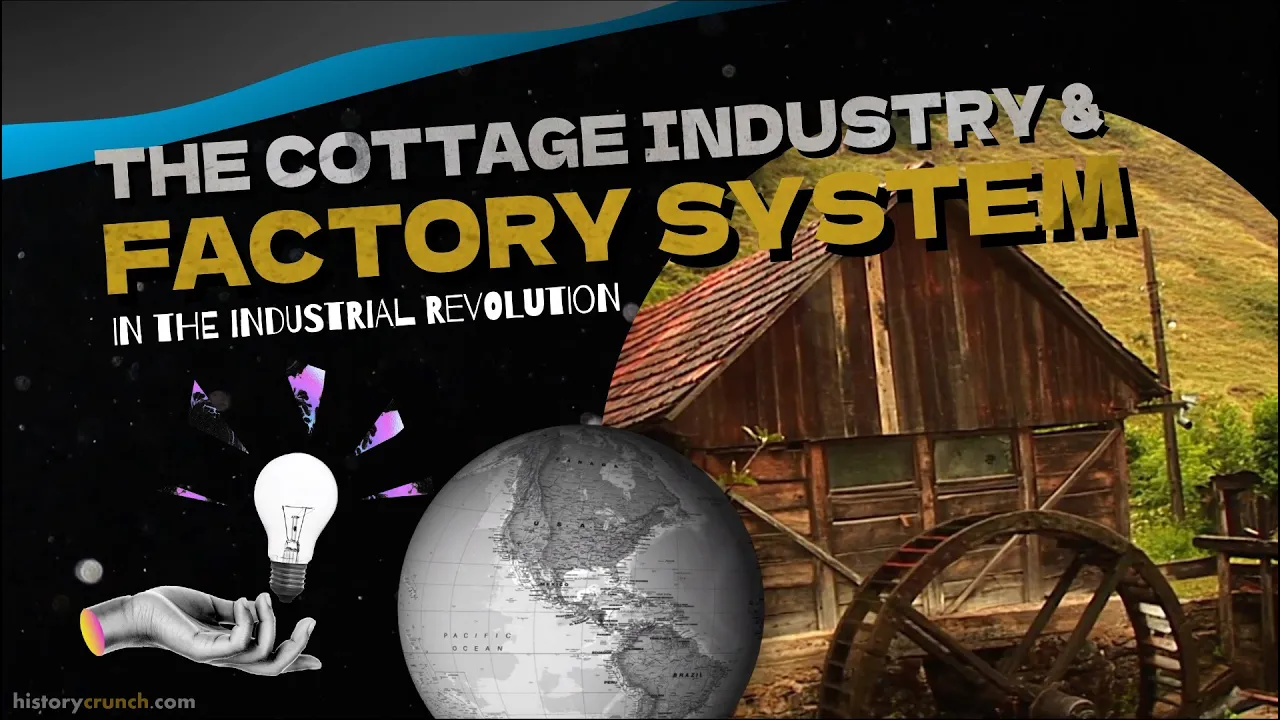
























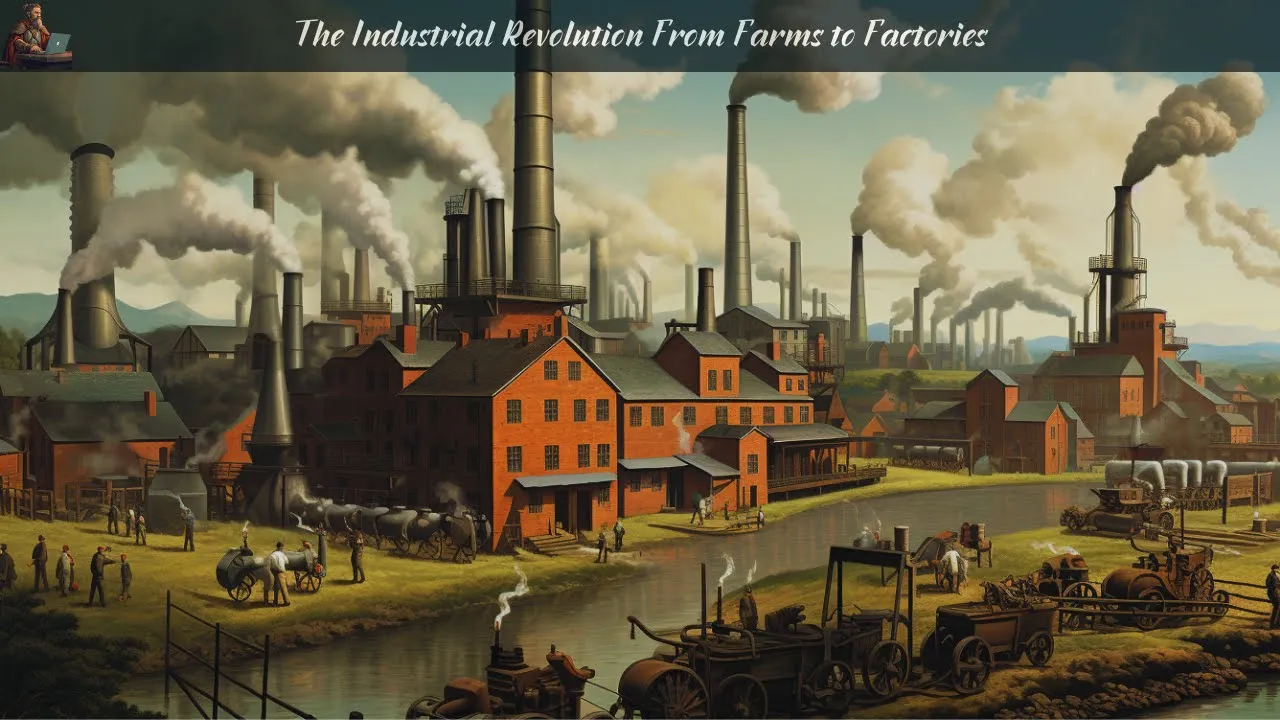







The Factory System of the Industrial Revolution required five essential elements: money/capital (often raised through pooled investments), stable legal systems and free enterprise, natural resources and power sources (initially water power, later coal and steam engines), innovative ideas and machinery designs, and labor (primarily women and children at first); this system replaced the cottage industry model by centralizing production in factories, enabling mass manufacturing and economic transformation.
Factory System of the Industrial Revolution: Key Factors
Added:The Cottage Industry (Domestic System): Understanding how goods were produced in homes prior to centralization in factories.
The Agricultural Revolution: How advancements in farming led to population growth and a surplus of labor.
Basic Concepts of Capital and Investment: A fundamental grasp of how money is used to generate wealth and fund enterprises.
The Geography of Natural Resources: The importance of coal and iron ore deposits, particularly in 18th-century Great Britain.
Social and Demographic Impacts: The rise of urbanization, shifts in family structures, and the emergence of working-class culture.
Labor Movements and Reforms: The history of trade unions, strikes, and the implementation of early labor laws like the Factory Acts.
Economic Theories of the Industrial Age: Exploring the ideological battle between Capitalism (Adam Smith) and Socialism/Marxism (Karl Marx).
The Second Industrial Revolution: Moving from steam and coal to electricity, chemicals, and the assembly line system.
971 views8likes10:12Original Release: 2021-02-02
[Music] so in this video we're going to look at the factory system and how factories developed and what was really necessary for the success of these factors and so the first thing we notice is that you need money if you're going to build a factory you need money and let's remember that the industrial revolution takes us from a cottage system where people are making things in homes and transitions to factory system where people or things are being made in the factory uh that doesn't happen immediately with every step of the process more and more steps are moved from the home to the factory over the course of time as inventions are created and as ideas generate better um more efficient ways of build of making the different parts of the the cloth and the textiles and that's one of the things to recognize textiles is one of the first things to really be part of the factory system so the first thing we see here on this page is money and so you've got to have money to build factories uh or capital and that is generally you just have the money or you raise the money by pooling the resources of many people together to start this factory and so you may have a group of investors that will invest in your company usually friends people that you know that will trust you um along with that you've got to have a stable system of laws people aren't going to be willing to invest if you don't have a stable system of government and laws where they can expect that the rules and and the exp and what's going what's the rules now will be the rules next year and the year after that when the rules change when laws change and they dramatically impact businesses that creates uncertainty and people don't want to invest a lot of money in uncertain times what goes along with this is the idea of free enterprise so you you have free enterprise in the united states for and what this means is simply buying and selling with limited government restrictions so you don't have lots of rules and laws and regulations that say before you can start your business you have to do this this this and this of course today we have a lot more rules and regulations than we had pre-industrial revolution and so it's more difficult today to start a business than it was in the 1800s in a lot of ways because of the rules and regulations but at the same time some of those rules and regulations we'll often see are there to protect society as a whole so there's a balance that we've talked about already of trade-offs between rules and regulations and innovation and creativity that continues so next so we've talked about money the next big things are resource our resources and ideas so you can't really have um you're not going to have um a factory you're not going to develop these things until you have the resources available for these factories so one of those big resources at first is water a waterway because most of our our factories were powered actually by water power and not by uh coal and steam engines at first and over time then we shift to steam engines but that shift to steam engine is not really going to be possible until we have really good access to coal and in the video you watched the other day you may have you may remember that there was a lot of abundant coal in great britain which is one of the reasons why the industrial revolution takes place there first um there's a significant amount of coal in the united states as well and so once that is that information travels to the united states about steam engines there's that availability of coal in the united states as well and so we've got you've got to have money people that are involved you've got to have power whether it's water power with rivers or coal power for the steam engines that will run the factories later and then you've got to have the ideas and you've got to have for example watt steam engine which is used the original use of watt steam engine is to actually pump water out of coal mines so they could pump the water out to get more to get to the coal more easily and to use the coal additionally uh ideas that come about are steamboats railroads and ultimately coal is going to will be used to power factories as well so then we have our group of factory men but actually let me go back real quickly we didn't talk about so what you see right here this is an example of the steam engine so on this side you have on this side over here you have the heat source that and water that would be boiling that would produce steam that steam goes through a pipe in this direction and it goes both ways it doesn't know which direction to go it just knows which direction there isn't any pressure and so it goes and it fills this side up of the pump and that moves this piston and then as it fills this side up that moves the piston up and you can see that there's a valve at the top and at the bottom so the valve at the top right now is releasing this spent steam and they're here at the bottom it's spilling over here it's filling with unspent steam and so it reverses back and forth that piston moves up and down which moves this wheel and this power wheel can then be used to power other machinery in your factory finally so let's get back to the factory man so samuel slater he's one of these men he actually works in a british factory and the thing about samuel slater is that he steals his desi this idea from a design for the machinery from british factories it was against the law to take the plans from the factory out of the factory and anywhere else because great britain wanted to keep those plans keep that secret so that they would keep a monopoly on the the production of these textiles well samuel slater didn't like steal the the papers and and put them in his pocket and then get on a boat to america no he memorizes those those plans he memorizes how to build it and what goes into it and how it works and then comes here and builds it himself that is still stealing it uh many people think well he didn't actually take anything he's just smart enough to remember those things well yes but he didn't have he was breaking the law by doing that so he stole those designs there wasn't much that britain could do about it and uh so he comes here and he's he you know starts setting up factories here in the united states uh francis cabot lowell really is one of the first people that really gets this going in the united states um and he uh gets the money together and he does it in an innovative way and that he sells shares to his business um shares for a thousand dollars so people can own a part or a share of the business by giving him a thousand dollars he generates that money to build the make the business and now these people are part owners he also has some other partners uh relatives family members that help him to do this but he then ultimately offers these shares to people as well where he can really develop this factory system and one of the last thing that we haven't really talked about that is necessary necessary for these factories is the labor uh and the these in this image that you've seen here is representative of the different labor and the different pieces of it so we've got samuel slater here who had the ideas we've got francis cabot lowell who got gathered the money we have over here a picture of um picture of eli whitney who uh you know is one of the inventors also has ideas he comes up with um interchangeable he really encourages interchangeable parts in the united states he already we already talked about him inventing the cotton gin uh then we've got the machinery that these men some of these men create and we've got me representing this with this angry face in the background representing the british that are upset that samuel slater stole these ideas uh and then finally kind of central to all of this is the labors the women that do the labor in these textile mills it was primarily women that worked in these mills at first um and in some cases uh there they were happy to be able to do this work because it provided them opportunities that they didn't have uh provided them some independence provided them some money to do that to do things that they perhaps couldn't do in the past at the same time the conditions in these factories are are pretty bad and we'll watch some other videos on that to kind of understand that a little better but this is the beginning really of many in many cases of women working outside of the home many of the jobs that were done as a family within a family unit both husband and wife and children all staying there on the farm well this is the beginning of of of the women going outside of the home and doing some of the work generally the younger women before they're married um or before they are older this is primarily the work of you know probably teenage and early twenties uh girls and women that are doing this work all right so just remember so for these factories for this factory system to work you need money you need the resources and the power those go hand in hand whether it's a water source or power source of coal uh you need the ideas you need to be able to know how to make the machinery and then finally you need the labor and most of that labor especially at first was done by women and children as well so that is the factory system and the of the industrial revolution [Music] you
Up Next

64:44
How Slavery Shaped American Capitalism | Edward E. Baptist
@talksatgoogle
51.2K views•2014-09-14

33:02
The Great Schism of 1054: Causes and Consequences
@SacredCathedrals
113.5K views•2026-02-19

91:57
The Geopolitics of the Ukraine War and the Rise of Global Autocracy
@JordanHarbingerShow
468K views•2025-04-19
17:05
Understanding the Cold War: Superpower Conflicts and the Road to Détente
@OverSimplified
46.1M views•2019-01-24
Related Study Plans & Knowledge Roadmaps
Structured learning paths in History
history
Byzantine Iconoclasm: Theology, Art & Politics
01Foundations of Byzantium and Early Christian Images
02The First Iconoclasm: Leo III and the Crisis of Images
03Empress Irene, Nicaea II, and the Second Iconoclasm
+ 2 more learning modules
9h5 modules
Explore Roadmap
history
Iranian Revolution (Causes, Events & Legacy)
01The Pahlavi Dynasty and the Roots of Discontent
02The Spark of Rebellion and the Rise of Khomeini
031979: The Fall of the Shah and the Climax of the Revolution
+ 2 more learning modules
8h5 modules
Explore Roadmap
history
Mali Empire: Mansa Musa, Trade & Timbuktu
01Foundations of the Mali Empire
02The Trans-Saharan Gold and Salt Trade
03The Reign and Pilgrimage of Mansa Musa
+ 1 more learning modules
6h4 modules
Explore Roadmap
history
1947 Partition: Politics, Borders & Legacies
01Foundations of British India and the Divide
02The Political Negotiations and the Mountbatten Plan
03Drawing the Boundary: The Radcliffe Line
+ 2 more learning modules
8h5 modules
Explore Roadmap