




















Water's unique properties arise from its high polarity (oxygen's electronegativity creates partial negative charges on oxygen and partial positive charges on hydrogen), enabling strong hydrogen bonds (approximately 10% covalent character, ~3 Å length, lasting 1-20 picoseconds) that each water molecule can form up to four of. These hydrogen bonds drive the hydrophobic effect—an entropy-driven phenomenon where water molecules exclude non-polar substances by clustering around them, thereby maximizing their own favorable water-water interactions. This exclusion forces hydrophobic molecules together, creating collective weak but significant interactions through van der Waals forces. The hydrophobic effect is the primary driving force behind protein folding, where hydrophobic amino acid side chains bury into the protein core while hydrophilic residues face outward, optimizing water-water interactions and minimizing unfavorable water-protein contacts.
Intermolecular Forces, Water, H-bonds & Hydrophobic Effect
Added:Despite the fact that biochemistry really has organic chemistry at its heart, there's some key differences to keep in mind.
One is that you need to shift your focus from thinking mainly about coalent bonds. So those bonds that actually make up molecules to thinking about intermolecular forces or IMFs, those non-coalent interactions between molecules and between parts of the same molecule that give molecules their shape and that allow molecules to interact with one another.
These include hydrogen bonds, Vanderwal's interactions, ionic bonds.
We'll get into the details, but they typically involve differences in charge, chargebased attractions, and so we'll talk more about those. We'll also talk more about water. Water is everywhere.
Unlike organic chemistry where you typically do whatever you can to avoid water, it's unavoidable in biochemistry and it's going to influence everything.
So, we're going to talk about how water interacts with itself and how it interacts with other molecules and the consequences that this can have in biological systems. So, ready? Let's dive in. The importance of water starts at the fact that there's just so much of it. The concentration of pure water is about 55.5 molar, which is way way way way higher than the concentration of basically anything we'll ever talk about in this class. If you want to put some numbers on it, that's about 33 septilion or trillion trillion molecules per liter. So there's water everywhere. And well, water is kind of special. Water is highly polar because that oxygen is much more electrogative than the hydrogens.
It's going to pull the shared electron density towards it, leading those oxygens to be partly negative and those hydrogens to be partly positive. When you have opposite charges, even if they're only partial charges, they're going to attract to one another. And so, the partial positive of one water molecule is going to be attracted to the partial negative of the another water molecule. And what you're going to get is that these water molecules are going to be very, very sticky to one another, as well as sticky to other things that have partial or full charges.
We'll talk more about how these can actually form this special kind of dipole dipole interaction that we refer to as a hydrogen bond. This is what it's coming from. It's just this dipole dipole interaction where you have this dipole moment in each of these water molecules where the oxygen is going to be partly negative and the hydrogens are going to be partly positive. And this makes the water molecules want to bind to one another. This has consequences for when you try to get something else to dissolve in water. So water is like our universal solvent, what everything in our cells and everything in our bodies is dissolved in. But not everything is equally water soluble. And so water is very picky about what it lets into its network. Water is going to want to form bonds to itself or it's going to want to form these bonds. And when we're talking about bonds, we're just talking about intermolecular attractions here. Not like coalent bonds. These are all just non-coovvealent but just more like partial charge partial charge attractions through those dipole moments or through the water's dipole and a charged molecule say if you put in something that water likes we call those things hydrophilic and so hydrophilic things would have things like a partial charge or a full charge but if you have something that doesn't offer something like that something non-polar something like a pure hydrocarbon water's not going to let it into its network and we'll see later how this can lead to this thing called the water exclusion effect. But basically, we can think about the properties of water as influencing what will and will not dissolve because in order for something to dissolve, you don't only have to form new interactions to it, but you also have to break up those water interactions.
So, let's talk a little bit more about these water water interactions and how we can seek similar interactions in other types of molecules.
This special type of dipole dipole interaction that we're talking about, we call a hydrogen bond or we often abbreviate this H bond. And often when we're talking about H bond, we typically draw these as dashed lines like something like that. So we're not going to draw them as solid lines. They're not like a covealent bond, but they're also not just your normal partial charge partial charge attraction. They're lot stronger. They actually have a slight coalent proportion. They're about like 10% coalent. Basically what happens is that because that oxygen or as we'll see that nitrogen is so electrogative it's going to pull the electrons towards it and because hydrogen is so small you're going to get these short bond distances and therefore you're going to get these strong weak bonds we'll say what is the requirements for a hydrogen bond basically you need a donor and you need an acceptor and when we're talking about a donor we're talking about a hydrogen donor So when we're talking about this hydrogen donor, we need a hydrogen that's bound to something electrogative.
And so we're going to have something that is electrogative pulling the electrons away from the hydrogen and making that hydrogen partly positive.
And so typically what you're going to see for this is you're going to see a hydrogen attached to an oxygen or a nitrogen. And so often what you're going to see is you're going to see an alcohol or you're going to see an amine group.
And so when we're looking at this in this diagram down here where I have this blue arrow. So basically on the bottom here you're seeing the donors. And so we have an example here. We have a hydroxal group. We have another hydroxal group.
Another hydroxal group. We have an amine group and another aman group. So all of those are ways that are contributing that donation of that partly positive hydrogen.
Now, in order for that partial positive hydrogen to form a hydrogen bond, well, it needs an acceptor. And so, this is going to be our H bond acceptor. Now, what you want for an acceptor is basically the exact opposite. You want something that's electrogative, but you don't just want it to be electrogative.
You also want it to have a lone pair of electrons. So, it's not just electronegative, it actually has to have that lone pair of electrons. So this can influence say if you had an electronegative atom that had its lone pair already in use. Now that acceptor what it's going to do is it's going to hog electrons because it's electronegative. So it's going to be partly negative. And that's where we get our partly negative that's going to be attracted to the partly positive. And where can we find this? Well, we can find this typically on a nitrogen or an oxygen. So before we were talking about an oxygen or a nitrogen, but importantly we were talking about the hydrogen that was attached to it and now we're talking directly about that nitrogen or oxygen itself and we're talking about the lone pair of electrons on it. Water is like our classic example because in this example, well, you have these two you have these two groups that can act as our acptors and you have these two groups that can act as our donors.
And so for each water molecule, you can form up to these four hydrogen bonds.
And so these could be with other water molecules or they could be with other molecules such as those amide bonds such as those carbonial groups. In solid water, so in ice, you typically do have those like four bonds per water molecule. But water about 3.4 four H bonds per water.
And this is because, we'll talk about this in a minute, these bonds, although they are stronger than most dipole dipole attractions, they're still relatively weak and they're on the order of magnitude of the thermal energy of the water. So, these are going to be constantly being broken and reformed. So this water is moving around all over the place and it's not typically just like held in place with four other water molecules. Although you'll see in certain cases water can be very tightly held. It can form important roles such as in the active sites of enzymes. You can get like structured water or around non-polar things. The water molecules they can't form the four because they have to have some facing the non-polar thing but they're going to try to maximize their water water interactions elsewhere. and therefore won't be able to move all over the place. And so we'll look at that in a minute. In addition to between water molecules and between water molecules and other molecules, you see hydrogen bonds in a lot of places in biochemistry. And there are a couple that are going to be kind of like the most consequential.
One is going to be in the base pairing between strands of DNA and RNA. So we have our five nucleobases and each of these opter hydrogen bond acceptors and donors and they match one another. So you get this specificity between the strands where you have an A binding to a T or an A binding to a U in the case of RNA and then you have a G binding to a C. And so this is this specific binding comes because they have this distinct arrangement of donors and acceptors that are in the perfect kind of geometry for this to happen. The other important place you'll see it is in the peptide backbone. When you have those amino acids link up, what happens is you get these amide bonds. And we'll talk a lot about these amide bonds. But basically what you're left with is in the backbone of the peptide, you have an acceptor in the form of carbonal. So you have an oxygen with two lone pairs. So that's two places you can have acceptors and you have a hydrogen on the nitrogen. So you have a donor here. Okay. So you might be wondering, well, what about this lone pair on this nitrogen? Well, this lone pair on this nitrogen is actually going to be involved in resonance. And so we'll talk a lot about this, but basically this is out of commission, this nitrogen, this lone pair involved in resonance.
So we cannot use it for an H bond acceptor because it's going to be shared between that with the oxygen. Could write a resonance structure where basically we have C O and I'm just going to do this abbreviated. But what we can think about is if we do this, we can push this.
And now what we get is something that looks like that. So basically, you have this resonance happening in the peptide backbone. In order to actually use that note lone pair, you have to give up the resonance. And resonance makes molecules happy. And so they're not going to want to do that. And so you can't use that as an acceptor, but you can use this hydrogen as a donor. And we're going to see that because you have this regularly interspersed pattern of these acceptors and these donors in the peptide backbone, what you get is these characteristics, what we call secondary structures of proteins, things like alpha helyses and beta strands, which are where the proteins are going to kind of fold up in order to maximize those hydrogen bonding opportunities.
Now the reason why you get these distinct shapes and not just random blobs from these hydrogen bonds is because hydrogen bonds they have special requirements. So we don't we talked about how you need to have the hydrogen on something electronegative and you need to have a lone pair on something electrogative but you also have to have a couple of other specific things. So one is that for them to be strongest you need everything to be in align. you need your donor to be in align with the lone pair of your acceptor. And so if this is not at the right angle, the bonds are going to be much much weaker. This is going to help explain how we can get those characteristic structures. In addition, these bonds are going to be shorter than your typical intermolecular interaction.
So they only work over this short distance. And so between having the short kind of like defined distance and having that specific geometry, you can get these specific structures. And so these bonds are typically on the order of about three angstrom. So an angstrom equals 0.1 nanometers. So if we're talking about three angstrom, so what we're going to be talking about is about 0.3 nanometer long in terms of the length of these bonds. And so often in biochemistry, we're going to be talking in terms of angstrom because that's the typical order of magnitude that we're talking about in typical bond length. So angstrom is a really useful tool to measure. And when we talk about things like resolution, we're going to be talking in terms of angstroms. So if you had a three angstrom structure, say it would be saying that you could tell apart things that were three angstrom apart. This distance is going to be about twice as long as a carbonarbon bond. Few times longer than a carbon hydrogen bond. And we're talking there, we're talking about coalent bonds. So in here, we're talking about a mostly non-coovvealent bond. So it's going to be longer than those covealent bonds. So it's going to be longer than a CH bond, but it's still not as long as if if they weren't in this bonding interaction. And so you get about 10% coalent character in these hydrogen bonds, but it's mostly non-coovvealent character. And we're just going to classify them as non-coovvealent bonds. How strong are these bonds? Well, individually they're pretty weak. They're about on the same order of magnitude as the thermal energy. And so what this means is that they're going to have a very short h lifetime because the molecules kind of have that much energy just kind of randomly. So they can randomly break off from one another. And so the average lifetime of a single hydrogen bond is going to be only about 1 to 20 picos seconds.
But so this is single one and typically we don't just have one. So if we look at that peptide backbone we had all those different opportunities for hydrogen bonding and so we normally have lots but we have lots.
And so even though the individual hydrogen bonds might be breaking off continuously and if you have just like free water, those water molecules are going to be sliding all over the place, if you have something like a protein backbone where you have all those hydrogen bonding interactions in that backbone. Say one of those bonds randomly breaks, well the whole molecule is not going to fall apart because you have all these other interactions. And so sometimes we talk about kind of like molecules breathing where those hydrogen bonds kind of just like break but then they reform. So it's not like you're totally losing the structure. If you're interested in this, there's a technique called hydrogen dutarium exchange mass spectrometry which actually takes advantage of kind of this breathing. So we have these fleeting interactions. We said they're fairly weak individually, but collectively they're strong and they're going to be stronger than most non-coovalent interactions except for salt bridges.
So except for like ionic bonds depending on the dialectric.
So, let's talk a little bit more about what some of these non-coovalent bonds that we're talking about are. At the heart of it, they kind of all just involve this basic idea that opposite charges attract and like charges repel.
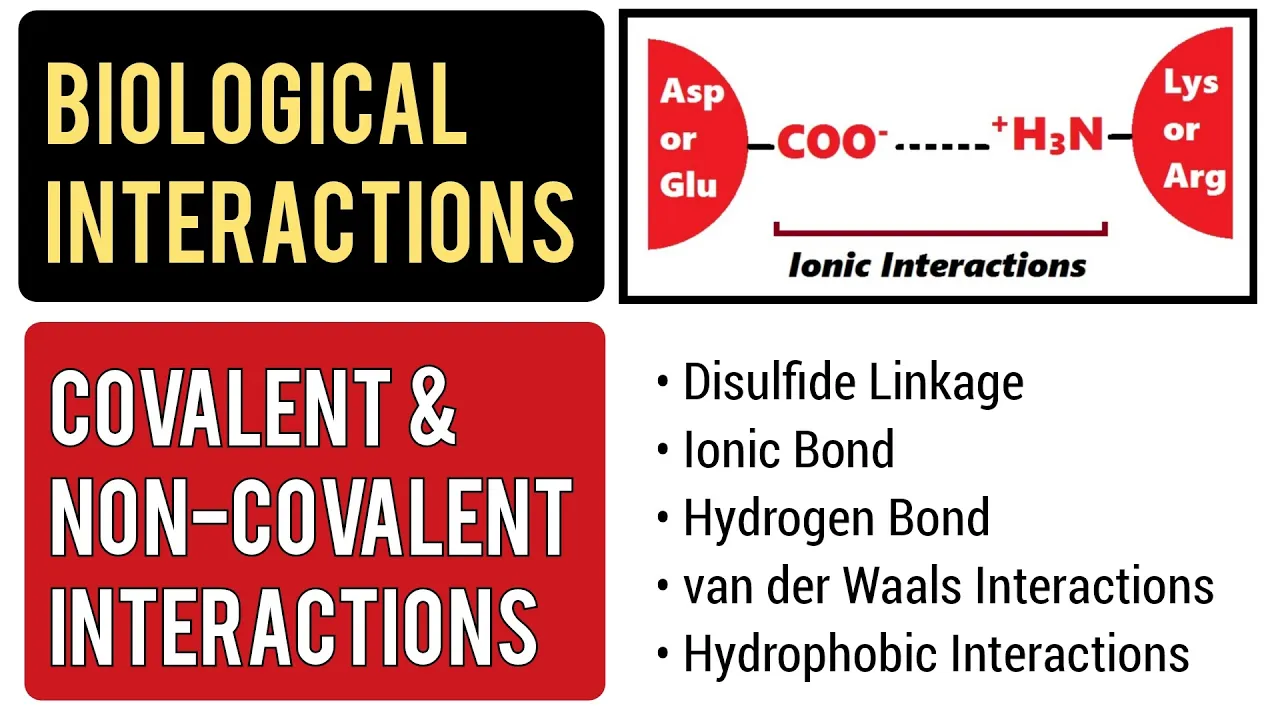
If we're talking about ionic bonds, we often call these like salt bridges because if you have something positive and something negative that cancel each other out, we call that a salt. And so this is an example of a salt bridge.
We'll see these a lot when we talk about the charged amino acids. And so these salt bridges can form. This would be an ionic bond.
But we could also have these partial charge partial charge attractions. And we have different names for these depending on whether they're like permanent or non-permanent, whether they're induced, this sort of thing. And so collectively we can call all these non-coovvealent interactions intermolecular forces. So remember that when you have inter inter means between.
So we're talking about interactions between molecules something that is a molecule is made up only of coalent bonds. But if you have interactions between those molecules then those are going to be non-coovvealent interactions. And so with ion ion we talked about this would be our ionic bonds and we're talking about side chains and things. We often call these salt bridges. We're talking in the contents of like proteins, amino acids. We can have a permanent dipole, permanent dipole. So an example of this would be our hydrogen bonds that we just talked about. So those water molecules are always going to have that dipole and so they're always going to be able to form these interactions.
We also said that water can form interactions to full charges. So what you can get is you can get an ion permanent dipole interaction where say if you dissolved a salt in water, well now those water molecules are going to hang out with that salt ion. Now we'll see too that this can kind of take the water out of condition in terms of binding to other things. So this can lead to an increase in the importance of Vanderwal's interactions and things like this. So let's talk about those.
Vanderwalls, our dispersion forces, our London dispersion forces. Lots of different names for these interactions, but what they have in common is that they are going to involve interactions between molecules that don't normally have a charge or even a partial charge.
That is a dipole. Instead, these are molecules that are induced to have a dipole, like a temporary dipole, either because something ionic, so something fully charged comes by, something with a dipole comes by, or the electrons just happen to be whizzing over in one place more than another, and then the ones next to them have to react to that because now you have this random instantaneous dipole that's inducing another dipole in the thing next to it, which induces a dipole in the thing next to it. and you get these powerful chain reactions that individually are weak but collectively are strong. Those are all going to be kind of classified under this idea of these Vanderwalls. So if we talk about those interactions between things that don't normally have a dipole, well, you can refer to them with any of these terms. You'll see these terms used interchangeably. They have some slight technical differences, but for the context of our class, we're just going to consider all of those terms to be kind of equivalent. And remember that even if you have molecules that don't have a charge, they can randomly get that instantaneous dipole because remember randomness is not evenness.
Randomness is randomness. If I said just spread yourselves randomly about the room, you probably spun yourselves out evenly around the room. But true randomness is going to involve those clumps. It's going to involve those hot streaks where you get 10 heads in a row when you're flipping a coin. Similarly, the electrons can hang out in one place more than another just randomly. And this will set off that chain reaction.
You have these interactions that individually are weak but collectively are strong. These are kind of referring to these interactions in their singularity but we often are dealing with these interactions collectively.
If however we want to deal with just the strength of one individual interaction.
If we consider all of these interactions to be purely electrostatically based so purely based on charge which is a major oper simplification especially in the case of the hydrogen bonds if however we consider that well now we can use Kulum's law to help us understand it Kulum's law looks pretty scary not so bad for F is just the force of the attraction or the repulsion of K is just a constant q's are the charges that you're trying to measure the attraction or the repulsion between we're considering them as kind of like point charges keep that in mind for later.
We're not dealing with the complicated big old messy molecules. Instead, we're just like, we'll just pretend it's just a point charge. And so those are our Q's. If you imagine these Q's as kind of Romeo and Juliet yelling to each other that they love each other. The bigger the Q's, the louder they're screaming, the higher the charge strength. So if you've got an ion, that's better than just like a dipole, just like a partial charge. A full charge is better. And if you've got like two full charges, that's even better than a charge of like one.
So higher charge, higher attraction or higher repulsion.
What about our distance? Well, distance we have our R on the bottom. We see it's R squared. So as the distance increases, you rapidly lose the force of the attraction. So as Romeo and Juliet start walking across the football field away from one another. Well, now they're going to feel each other's love less.
And now the dialectric. This is the tricky one. The dialectric. So sometimes it's called the relative permitivity. We represent it with this epsilon symbol.
This is talking about the solvent that is surrounding these charges that is intervening these charges. So it's talking about the polarity of the solution of the solvent of the things around the charges not the charges themselves. Remember we're just considering these as being point charges. There's a simplification. So the polarity we're talking about is in the thing in between them. So if we're in an aquous solvent we're going to have a high polarity. we're going to have a high dialectric of about 80. This could be like on the surface of a protein. If you're dealing with something where you have a organic solvent, maybe you're in a solvent like benzene. Well, here you've got a dialectric of 2.3, way, way, way lower. And that's similar to what you see in the non-polar protein interior.
If we look at how this is going to impact the force, well, this is on the bottom. And so if the dialectric gets bigger, then the force is going to get smaller. The more polar the solution that's in between these things, the weaker the force is going to be. You can think of Romeo and Juliet on opposite sides of the football field. And there's a bunch of quarterbacks running in between them. It's going to make it harder for them to feel one another's love. This is much more detailed than you need to know for this class. I thought I would just tell you the general basis of where this comes from.
But basically, what can happen is you can think of it like this. The dialectric is kind of going to tell you about the solvent, remember?
And you can imagine that you have two charge plates on either side. And the dialectric is kind of telling you about how well those charges can feel one another or how much the solvent is going to be blocking them. The force is going to be dampened. It's going to be counteracted by the polarity of the solvent lining up because they want to orient themselves in a way that's going to feel that attraction, too. But this takes away from the attraction that the two main things are going to feel.
If however you've got that non-polar solvent, you've got that non-polar environment of a protein interior, well now you're not going to have that polarity of your solvent. And this is not going to counterbalance the force.
The key things to remember is that the polarity of the solvent, not the polarity of the molecules that the charges are being measured between. And the higher the polarity of the solvent, the more distraction things there are, the harder it is for the charges you care about to feel one another. Because these charges that you don't care about, the polar solvent is getting in the way.
Another analogy that might help you is it's kind of like if you have a non-polar solvent with a low dialectric, you got nice mint condition velcro. But in a more polar environment with a higher dialectric, now you've got fuzz in your Velcro and that's weakening the ability for those Velcro strands to stick together. And this makes it so that that salt bridge in the interior of a protein is going to be much more powerful than the salt bridge at the surface of a protein. And in fact, the salt bridges at the surface of the protein, even though you might look at your order of the attractive forces and say ionic bonds strongest. Well, if they're on the surface of the protein, they can actually be pretty weak and be broken up because they're going to be surrounded by a watery, salty environment where there's lots of good things for them to kind of juice instead of bonding to another part of the protein. But one of the bottom lines is that the environment matters, the context matters. So, we have that water can form those hydrogen bonds. Water can form interactions with ions. Water can form interactions with temporary dipoles. So water can make lots and lots of these interactions, but in order to make interactions to things other than water, well, it has to break off its interactions with the water molecules.
And so whether something dissolves depends not only on whether water likes making interactions with it, whether it can make interactions with it, but it also depends on whether it's worth it to swap its water interactions for those solutes interactions. And so if it is, then the thing will dissolve. And if it isn't, then the thing won't dissolve. So what determines this is going to be at its heart. We can think about this in terms of thermodynamics. And so when we're talking about thermodynamics, we're talking about our delta G, our change in free energy. And so remember, we want that delta G to be negative for things to be favorable. And the way that something would be favorable is the products had a lower enalpy. So if they had more stable bonds, if they had like more or more stable bonds. So remember enaly we're thinking about bonds and then with entropy we're talking about randomness or disorder. So what happens when something binds is you have to take into account okay so we broke off those water water bonds and now we're forming new water solute bonds. Are those bonds more stable than the water water bonds?
And if so then you're going to get a negative enalpy and that's going to be favorable. But if not you're going to have a positive enalpy.
But even if you have that positive enalpy, not all hope is lost because you still have entropy.
And whether or not you have entropy is going to depend on how free those water molecules are and how free the solute molecules are compared to what they were before. And so to illustrate this, let's talk about something called the hydrophobic effect.
And so basically, if you think about water and it's just hanging out, if there is something non-polar that comes in, what's going to happen is those water molecules are going to have to give up their water water interactions and they're going to have to kind of form interactions with this thing that they don't want to form interactions with. the only thing that they could form with something non-polar would be those instantaneous dipole those like dispersion forces those Vanderwal's forces and so instead the water wants to maximize the better forces that it can form it and wants to maximize its water water interactions and so although before we talked about when we had like bulk water it's moving all around and it's forming all those interactions with water in this case the water molecule is kind of going to cinch around the non-polar thing it's going to maximize its water water interactions and minimize the interactions with that non-polar thing. So, this non-polar thing is going to be excluded. What this is doing is it's taking these water molecules though that were all happy.
They were all roaming around and now it's kind of locking them in place. So, what you're getting is a lower entropy.
But what would happen if those molecules were now joined together? if those molecules were joined together, it takes fewer of the water molecules to surround them. And so in this way, by kind of combining those non-polar things, clumping them all together, less of the water is taken out of commission. So you have more of the water molecules that are going to be free. And this is going to make it so that you have an increase in entropy. So you get more of the freed water when you group the hydrophobes together. And this is the basis for something called the hydrophobic effect.
And so this is also called the water exclusion effect because water is excluding those things.
And so when we talk about phobic, phobic stands for fear.
But I think that's misleading because it's not that these things are afraid of water and it's not even that they're avoiding water. It's that the water is avoiding them and it's this water avoiding them. This water excluding them that is going to force them together.
This is important consequences though because once they're forced together, they're actually going to be able to form some interactions and we often call these like hydrophobic interactions.
This is the same sorts of interactions that we can see before. And in this case, the only thing those non-polar molecules can do is that they're going to be able to form those instantaneous dipoles. You're going to get those dispersion forces and stuff like this.
So, this would be the basis of say your quote unquote hydrophobic bonds, but there's really not a hydrophobic bond.
Instead, we're talking about water excluding these things, these things getting clumped together, and then if one of them happens to randomly depolarize, then you're going to get these chain effects. And so you can get these individually weak but collectively strong interactions of these non-polar molecules inside of the water network.
These forces, this is not an intrinsic desire.
Instead, it's just forced together and because of the circumstances and then you can have these random forces kind of have an impact.
For these other things where you have this permanent charge or this permanent partial charge, these can actually be kind of like an intrinsic desire because they always have that charge that they're going to be attracted to other charged things. But remember that non-polar doesn't attract non-polar.
It's only when you get those temporary dipoles in a non-polar molecule that it's then able to respond to another thing such as another molecule that has another instantaneous dipole. So, it's not an intrinsic desire, but we can still talk about these as kind of like hydrophobic interactions. That's what we're talking about. We're talking about water excluding them. And why does water exclude them? Because of that entropy.
So, we have the hydrophobic effect that's driven by entropy. This pushes those things together, makes it so that those dispersion forces have a bigger impact and can be drawn in numbers.
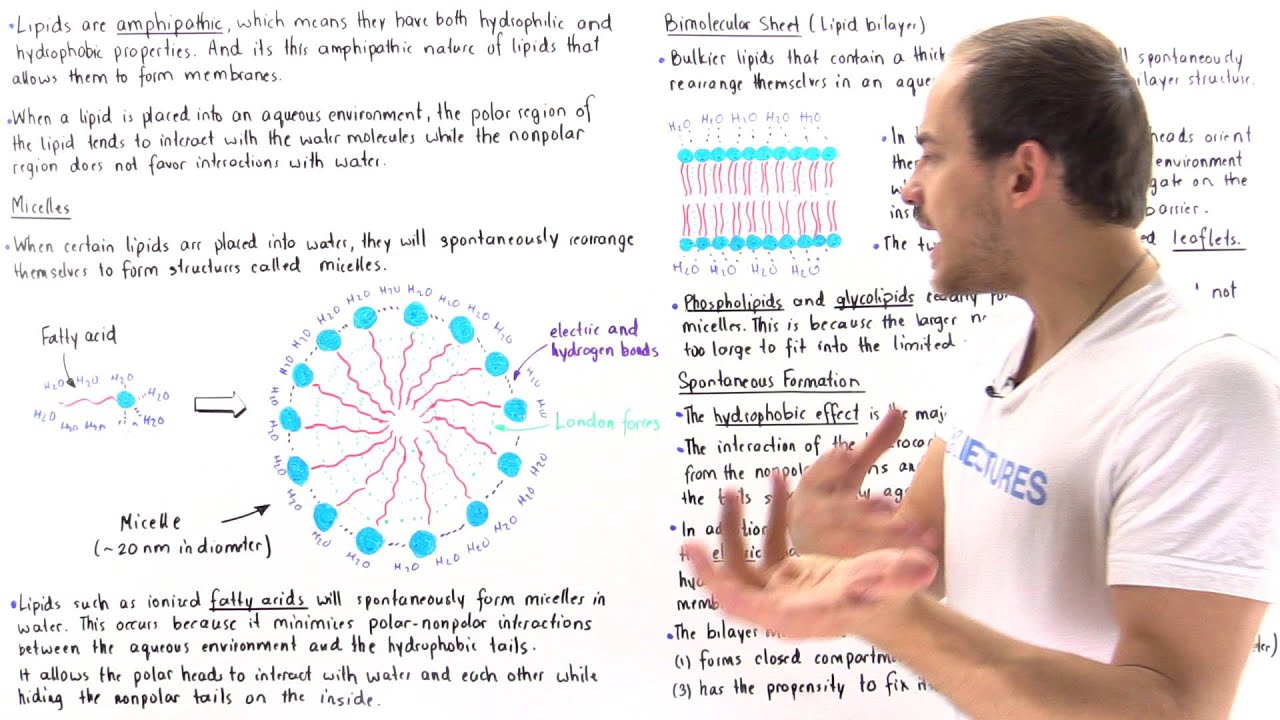
Typically, you don't just have a fully non-polar molecule. You're going to have something that has non-polar and polar parts. So, something that's like amphopilic molecules are going to line themselves up so that their polar parts are going to hang out with the water and their non-polar parts are going to hang out away from the water. And so it's most easy to see this in the case of like a soap where you have a positive head um or you have some sort of hydrophilic head and a hydrophobic tail and those are going to be in the water and so you get something called like a mal and some cases where you get something like a bubble. All of those things are going to be optimizing those water water interactions and minimizing the water non-polar thing interactions.
It's not always quite as obvious as this, but in the case of something like a protein, you do still have non-polar and polar parts. And so in a protein, it's going to arrange itself so that the polar parts on the outside and the non-polar parts are on the inside.
And we're going to see this a lot more, but this is a key force to protein folding is that you have these different amino acids. Some of them are very hydrophobic, so water is going to exclude them. Some of them are hydrophilic, so water is going to let them into its network. And this is going to be the main driving force of protein folding. And we'll get more into that later in the course. But it's just this is all coming from that water exclusion effect, from that hydrophobic effect that remember is caused by the water kind of trying to maximize its own entropy and its own favorable interactions.
When you're thinking about the hydrophobic effect, I want you to think entropy because remember those new it's forming less favorable interactions, but you have this increase in the entropy of that solvent. So, this can get kind of confusing if you're thinking about say a drug binding. So, you might be thinking, okay, well, if something's binding, you're going to get a decrease in the entropy, right? Because things are going to be held down more. You have less mo to move, less freedom for movement.
But it's those solvent molecules that you need to take into account when you're deciding whether something is actually going to be entropically favorable in this case. So what we're actually going to see is that in a lot of cases you'll have some sort of drug molecule that typ of often one of the biggest hurdles for drug manufacturing is that the drugs are not very water soluble. So it's hard to get them into cells. And the reason why it these drugs are often not very water- soluble is because they often bind to fairly hydrophobic patches on a protein or on some other molecule.
And so that when they bind to those hydrophobic patches, it's like taking something like this where you have all these water molecules that are taken out of commission by surrounding that hydrophobic patch. And now if you kind of replace that with something else, then you're able to free up those water molecules. and maybe the hydrophilic parts like the polar parts of those molecules can then form interactions with the water. So you're kind of able to exchange out some non-favorable interactions for more favorable ones and free the water. We'll also talk about when in the context of enzymes, these are often proteins, sometimes proteins and nucleic acids that are going to help speed up reactions in various ways. And we'll talk a lot about different mechanisms enzyme can use, but one of them is that they can like desolvate active sites. So basically sometimes you can get a salvation shell. So like what we talked about before, how the water is kind of clenched around something and hiding it. This can hide important active sites on enzymes making it difficult or impossible for reactions to occur.
What enzymes can do is one thing that they can do is they can help remove that water coat but keep the sub substrate soluble by kind of like replacing bonds to water with bonds to the enzyme. So there are different places that we'll see kind of salvation come into account and swapping interactions with water to interactions with other molecules.
And finally we need to talk a little bit about water is not just water or it's not just H2O. It also autoionizes to give you a hydroxide ion and a proton.
Oh, that that proton basically because remember we have that 55.5 molar water.
That proton isn't just going to hang around. It's going to latch onto a water molecule to give you this hydrronium ion. So in water you're going to have this mix of water, hydrronium ion, and hydroxide ion. But almost all of it is actually just going to be water. But there are very very few ions in water.
So by doing some calculations with from the pH and the marity of water, you can figure out that only about two in a billion molecules of neutral water are ionized at any point. But this ionization and proton swapping is happening all the time. So it's super duper fast. We're talking on the order of trillions of seconds. And so this is why we can have ions of water acting in all sorts of reactions to catalyze things in acid and base mechanisms. And so we'll see this when we more when we talk about things like enzymes, but we can think about there kind of being protons all over the place, being hydroxide ions all over the place, and these these protons kind of jumping from molecule to molecule even faster than diffusion. So it's actually pretty cool and we'll see more about this later in the course, but for now know the basics.
know that we have a lot a lot of water that this water is highly polar that this allows it to form all sorts of partial charge partial charge attractions. It has a permanent dipole so it can form those permanent dipole, permanent dipole, permanent dipole ion, permanent dipole, induced dipole. All of those good things we can form with these water molecules. Although one of the most common things we're talking about with water molecules is actually going to be our hydrogen bond. But this doesn't just happen between water molecules. It can also happen between the bases of DNA, between the backbone of a protein, all sorts of different places. And the precise geometry and length of these bonds makes it so that we can get distinctive structures. We'll talk more about how the individual amino acids like their unique parts, their side chains or R groupoups can influence exactly the angles that can take and so influence whether they can be in an alpha helis or an al or in a beta strand. But it's really that hydrogen bonding from that distinctly distributed combination of donors and acceptors that's going to make it so that all these different proteins can form similar secondary structures. And we'll so we'll get much more into this but know that this is happening because of these hydrogen bonding interactions where you have a lone pair on something electrogative. You have some a hydrogen attached to something electrogative. You get this partial charge partial charge attraction and they're going to be strongest if they're in line and they're strongest at the shorter distances and they're typically on the order of about three angstrom.
Remember that individually these are fairly weak. They're going to be stronger than your other types of like Vanderwal's forces and things like this, but and collectively they're very very strong, but they're very short-lived because the strength of each one of them is only going to be on the order of magnitude of the of the molecules, just like random energy.
So, if you have just bulk water, it's all these water molecules are going to be moving around. And if these water molecules are tied up, well, this is going to decrease the entropy. we can increase the entropy again by forcing the hydrophobic things together and freeing up more solvent molecules. So this is the basis of the hydrophobic effect this entropy driving it. And remember that there are some ions in water and you can think about there kind of always going to be some ions around to help you catalyze your reaction.
But these they're very few in terms of their absolute numbers, which is probably good because then they'd be causing things to happen all over the cells that we didn't want. So those are the basics of water. And throughout the course, you'll hopefully gain more of an intuition about how water is going to affect or not affect biochemical processes.
Up Next

The Chelate Effect: Stability in Metal Complexes Explained
@CatalystUniversity
81.4K views•2017-02-06
Biocatalysis and Catalysis in Islatravir Synthesis | Merck Webinar
@SCIwheresciencemeetsbusiness
675 views•2020-10-08
1H NMR: Determining Number of Peaks from Structure
@MSJChem
59.2K views•2017-04-06
Edible Water Bottles: A DIY Guide to Sodium Alginate Spherification
@ryan
10.5M views•2019-06-21
Related Study Plans & Knowledge Roadmaps
Structured learning paths in Chemistry