







![[1] Thermodynamic & Kinetic Aspect of Metal Complexes | Inorganic chemistry | BSc 3rd year](https://i.ytimg.com/vi/JYqT6Bx7wkg/hqdefault.jpg?v=607d6f37)

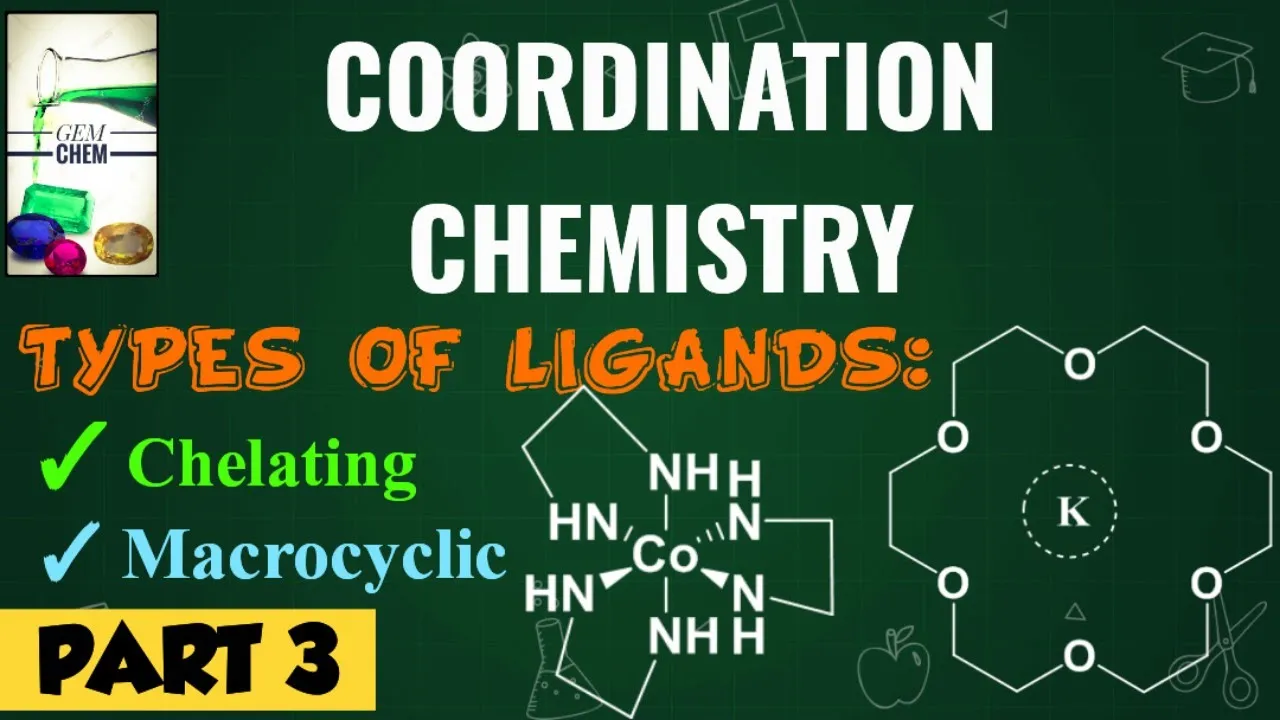
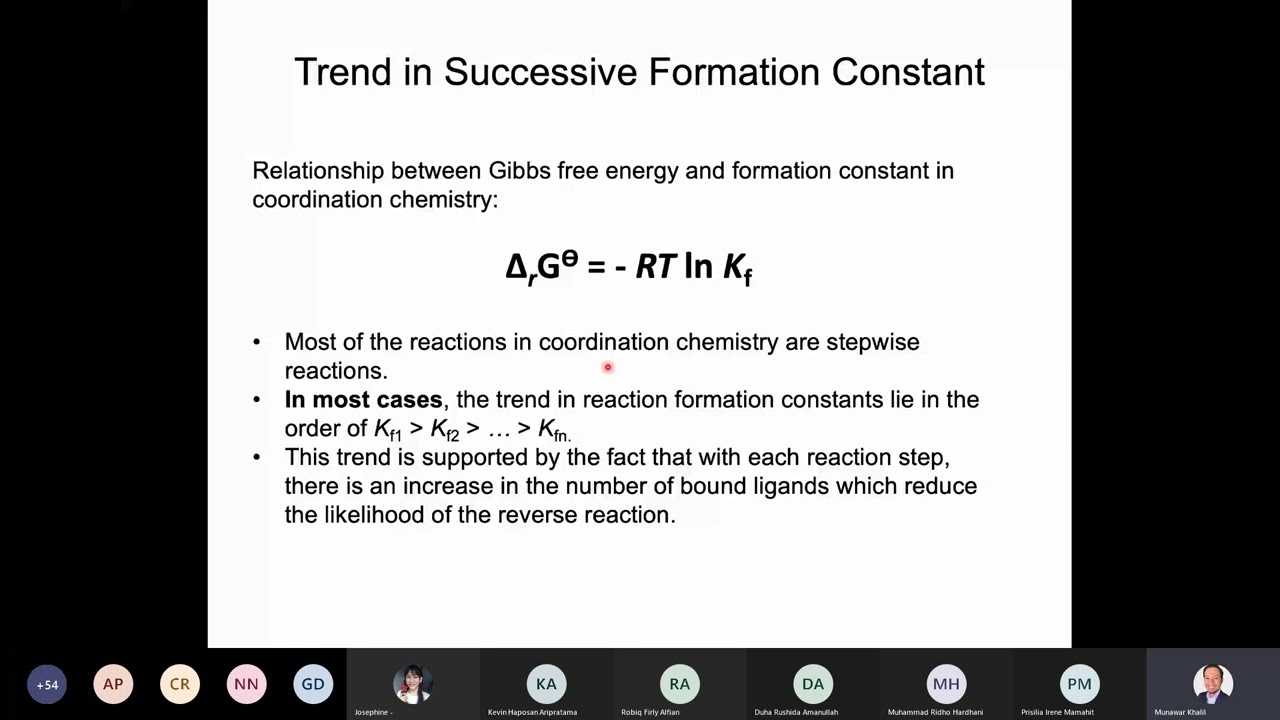










The chelate effect is a phenomenon in coordination chemistry where a polydentate ligand (such as ethylene diamine or EDTA) forms a significantly more stable complex with a metal ion compared to multiple monodentate ligands, due to the ligand's ability to bind through multiple donor atoms simultaneously; this increased stability arises because the ligand's multiple binding sites make dissociation less likely and is primarily driven by entropy as the ligand displaces water molecules from the metal's hydration sphere.
The Chelate Effect: Stability in Metal Complexes Explained
Added:Basic coordination chemistry, including metal-ligand coordination covalent bonding and coordination numbers.
The classification of ligands based on denticity (monodentate vs. polydentate ligands).
Fundamental thermodynamics, particularly the Gibbs free energy equation and the concept of entropy (S).
Chemical equilibrium principles and stability/formation constants (Kf) for metal complexes.
The Macrocyclic Effect, exploring how cyclic ligands (like crown ethers and porphyrins) offer even greater stability than open-chain chelates.
Clinical applications of chelating agents, such as chelation therapy for heavy metal poisoning (e.g., using EDTA).
The biochemical significance of natural chelates, including the structure and function of hemoglobin, chlorophyll, and cytochromes.
Factors influencing complex stability beyond entropy, such as the Irving-Williams series and crystal field stabilization energy (CFSE).
Analytical applications of chelation, specifically complexometric titrations used to determine water hardness.
81.4K views1.1Klikes8:31Original Release: 2017-02-06
hi welcome back to electronic structure and bonding in inorganic chemistry my name is Kevin Toof make sure to like this video And subscribe to the channel for future videos and notifications all right so I want you to look over here on the far left all right so I have a metal here designated by m it has a li attached to it that has two donor atoms this this liand as you might recognize this is ethylene ethyl diamine sometimes you'll see it abbreviated in parenthesis as all right ethylene diamine has a property that um there and there's many there's many different lians that have this it has the property called B denticity and we usually call it B dentate it's a bidentate liant denticity is the is the property of lians by which they have multiple atoms to which donate electron density to a metal okay in this case there's two atoms that have this ability all right the two atoms are this nitrogen right there and this nitrogen right there both of those atoms have the capacity to donate electron density to the metal and that makes this Lian ethylene diamine by dentate all right the topic of this video and I'm not going to take too long on this because it's a relative relatively simple topic it's called the keyate effect the keyate effect is an increase in stab ability for a complex when you have the metal Bound by a li that has multiple um multiple sites of electron donation clearly this ethylene diamine has that okay in other words what I'm saying is this complex right here if this was all there was to the complex it is more stable than if I had the metal simply bound to to two ammonia all right this complex down here is significantly less stable than this all right and the increase stability of having both of those donor atoms come from the same liand a bidentate Lian is called the keyate effect all right there are even some lians that have even higher degrees of denticity an example of that is EDTA so what is Eda well Eda looks like like this let me finish drawing this it does take a minute to draw and if some of you have taken any kind of biochemistry course or any kind of biology lab you've probably used EDTA with they realize or not this is Eda it stands for ethylene diamine Tetra AIC acid Ed D usually it's abbreviated in lowercase when you're talking about it in terms of a complex in the naming all right it's tetradentate it has four Eda there's Eda in a lot of foods because it picks up um ions so that bacteria can't use them and increases the shelf life okay and if all four of these from ethylene diamine will dissociate from the metal as shown in this state right here there's always a probability of that but there's also a greater probability that if it dissociates it will reassociate back to where you'll end up back in the initial State like this all right so the keyate effect does several things number one because there's added stability from multiple sites of interaction from one Li all right it it basically makes it less likely for one of the donor atoms to dissociate it's also the keyate effect makes it very unlikely that all the donor atoms will dissociate at the same time all right one of those atoms might dissociate but both of them are probably not going to dissociate at the same time the only way the ligan can fully dissociate from that metal is if they both dissociate at the same time and that's very unlikely and when one of them dissociates it's a lot more likely for it to reassociate all right and this keyate effect is primarily driven by entropy okay A lot of times the metal is solvated and so whenever this the both of these um donor atoms from ethylene diam interact with the metal you basically have water being dispersed from the metal its hydration sphere is eliminated and that is an increase in entropy that drives this reaction and or this interaction and makes it spontaneous and so we say the key light effect is largely driven by entropy okay technically the state has a lower has a has a is lower entropy but when you disperse the hydration sphere or whatever it is away from the middle that's an overall increase in entropy that drives this interaction and and ultimately makes it very very stable okay the keelight effect has a lot of applications there's a lot of biological applications as well in the next video we're going to cover something called the macrocyclic effect which is actually a form of the keyate effect but it is much more specific and we'll see why um in the next video but just to just to to summarize the keyate effect it's a drastically stabilizing effect when you have one Li that can bind to the same metal with multiple donation sites in this case for ethylene diamine it's these two nitrogens if it were Eda binding all these Li all these sites I should say to one ion the sites would be these four carboxy negative charges okay and what the kelite effect does is it it basically causes it to be relatively unlikely that one of these donor atoms will dissociate but it makes it very likely that it will reassociate the other thing it really does is it makes it very very very unlikely that all the donor atoms from that one Lian will dissociate at the same time so in other words keate effect really binds that metal keate is binding you know also in Biochemistry some enzyme active sites let me come down here do this this is a practical example some enzyme active sites particularly ones that bind phosphates they have aspartate residues all right they have aspartate residues like this now technically if this is one enzyme these even though the enzyme is massive it's a massive molecule these aspartate residues come from this same molecule and sometimes a magnesium ion not a typical it's not a transition metal but it certainly works here it likes to interact with these aspartate residues okay an example of an enzyme that does this is DNA polymerase we would say the Magnesium is chelated by the aspartate residues it's chelated it's bound very tightly in there and these magnesium ions are very difficult to remove as a result okay so that's an example and an enzyme that does that is DNA polymerase RNA polymerase does the same thing with magnesium but it does it additionally with zinc ions also another enzyme that does this with zinc is carbonic and hydrates in fact I have a video of that on my channel in an enzyme mechanism playlist so go watch that if you want to see kelation in action okay so in short that's the keyate effect in the next video we're going to go over something called the macrocyclic effect make sure to join us then like the video and subscribe to the channel for future videos and notifications thank you
Up Next

50:27
Water, Acids, Bases, and Buffers Explained | Biochemistry Lecture
@bftinylectures4362
46.3K views•2020-08-24
83:56
Biocatalysis and Catalysis in Islatravir Synthesis | Merck Webinar
@SCIwheresciencemeetsbusiness
675 views•2020-10-08
6:58
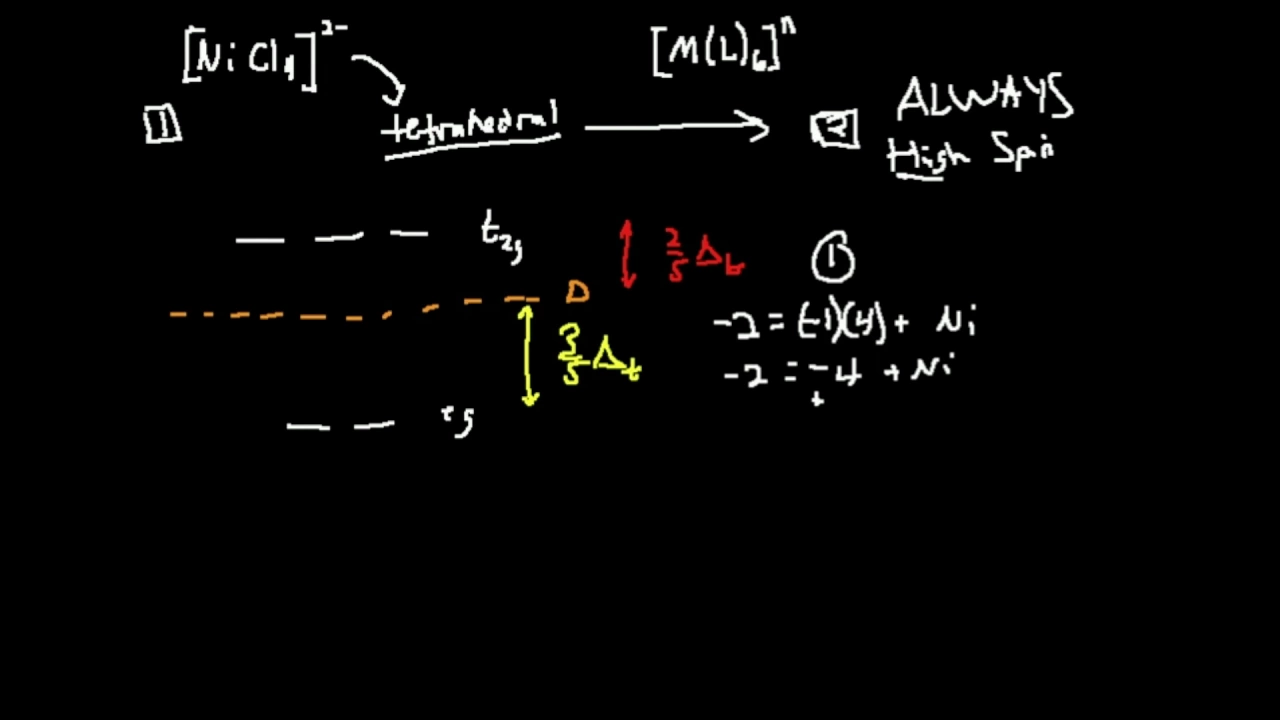
CFSE for Tetrahedral High-Spin Complexes | Crystal Field Theory
@CatalystUniversity
14.2K views•2017-02-06

17:31
Edible Water Bottles: A DIY Guide to Sodium Alginate Spherification
@ryan
10.5M views•2019-06-21
Related Study Plans & Knowledge Roadmaps
Structured learning paths in Chemistry
chemistry
Nuclear Chemistry: Decay, Meds & Fuel Cycle
01Introduction to Nuclear Structure and Radioactivity
02Decay Dynamics and Kinetics
03Radiation Interaction and Detection
+ 2 more learning modules
24h5 modules
Explore Roadmap
chemistry
Supramolecular Chemistry: Forces & Machines
01Foundations of Chemical Bonding and Intermolecular Forces
02Introduction to Host-Guest Chemistry
03Thermodynamics and Dynamics of Self-Assembly
+ 2 more learning modules
16h5 modules
Explore Roadmap
chemistry
Photochemistry: Excited States & Reactions
01Foundations of Light-Matter Interactions
02Molecular Orbitals and Electronic States
03Photophysical Processes and Jablonski Diagrams
+ 2 more learning modules
18h5 modules
Explore Roadmap
chemistry
Coordination Chemistry: Bonding & Properties
01Introduction to Transition Metals and Ligands
02Crystal Field Theory (CFT) and Geometry
03Magnetic Behavior and Spin States
+ 2 more learning modules
14h5 modules
Explore Roadmap