












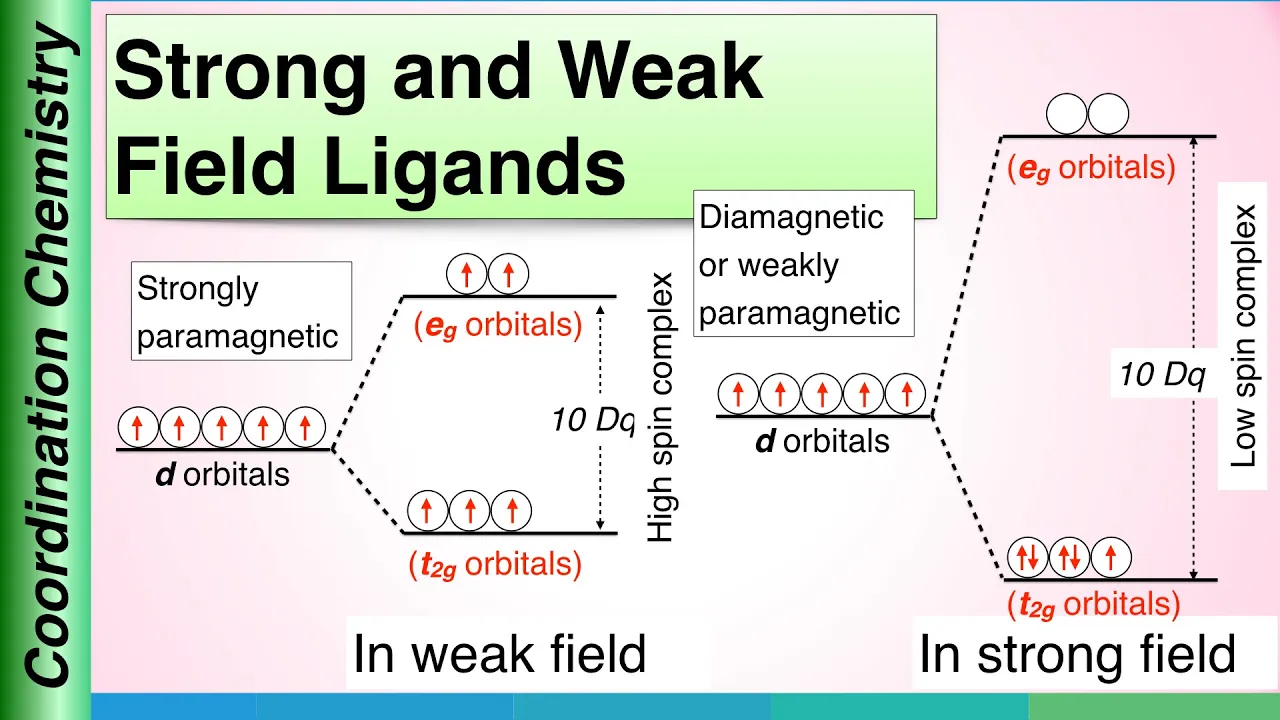



















In tetrahedral high-spin complexes, the crystal field splitting diagram is inverted compared to octahedral complexes (T2g orbitals are higher in energy and eg orbitals are lower), and since all tetrahedral complexes are inherently high-spin, electrons fill orbitals without pairing; the crystal field stabilization energy (CFSE) is calculated as (3/5Δtetrahedral × electrons in T2g) - (2/5Δtetrahedral × electrons in eg), and Δtetrahedral is approximately 4/9 of Δoctahedral.
CFSE for Tetrahedral High-Spin Complexes | Crystal Field Theory
Added:Fundamentals of Crystal Field Theory (CFT), including d-orbital shapes and their spatial orientations.
The concept of d-orbital splitting in coordination complexes, particularly comparing octahedral and tetrahedral geometries.
Basic electron configuration rules, specifically Hund's rule, the Aufbau principle, and the Pauli exclusion principle for filling d-orbitals.
The distinction between weak-field (high-spin) and strong-field (low-spin) ligands.
Quantifying the relationship between tetrahedral and octahedral splitting parameters (the Delta_t = 4/9 Delta_o relationship).
Applying CFSE values to explain thermodynamic properties like lattice energies, hydration enthalpies, and ionic radii trends.
Determining the magnetic properties and calculating spin-only magnetic moments for tetrahedral complexes.
Interpreting electronic absorption spectra (UV-Vis) and understanding d-d transitions in tetrahedral coordination compounds.
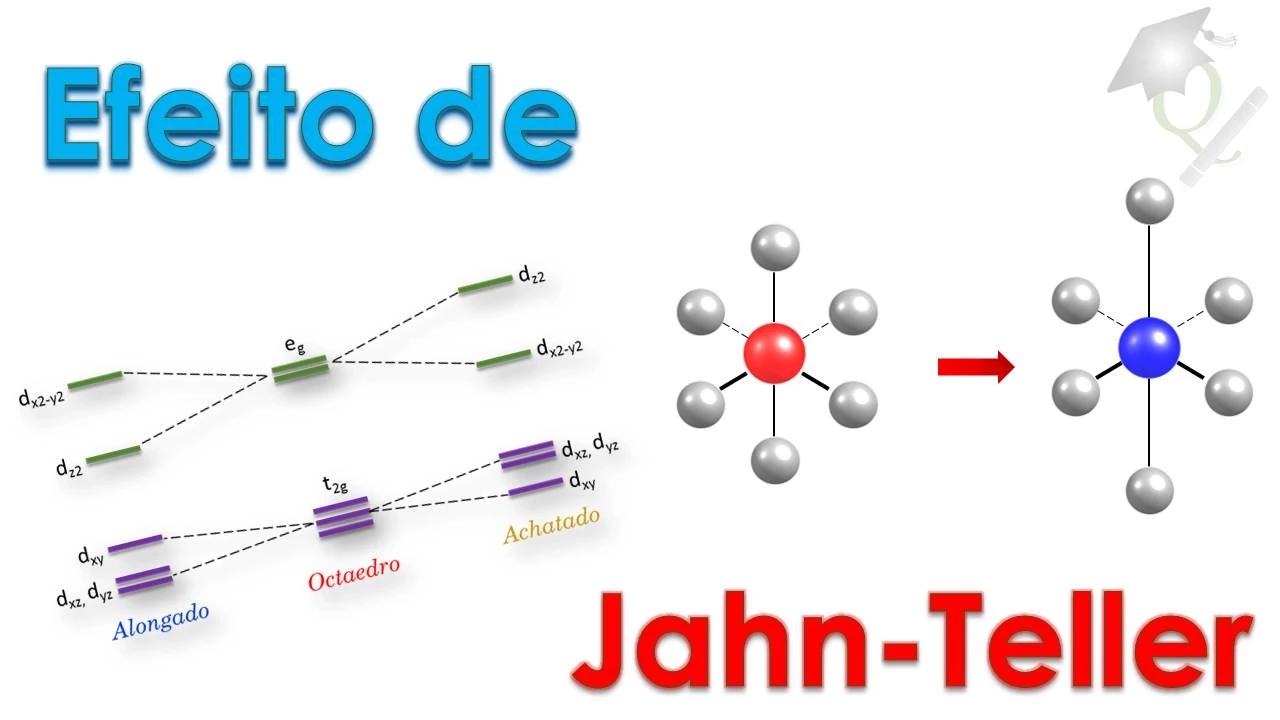
Exploring the Jahn-Teller effect and its structural and spectroscopic manifestations in tetrahedral geometries.
14.2K views142likes6:58Original Release: 2017-02-06
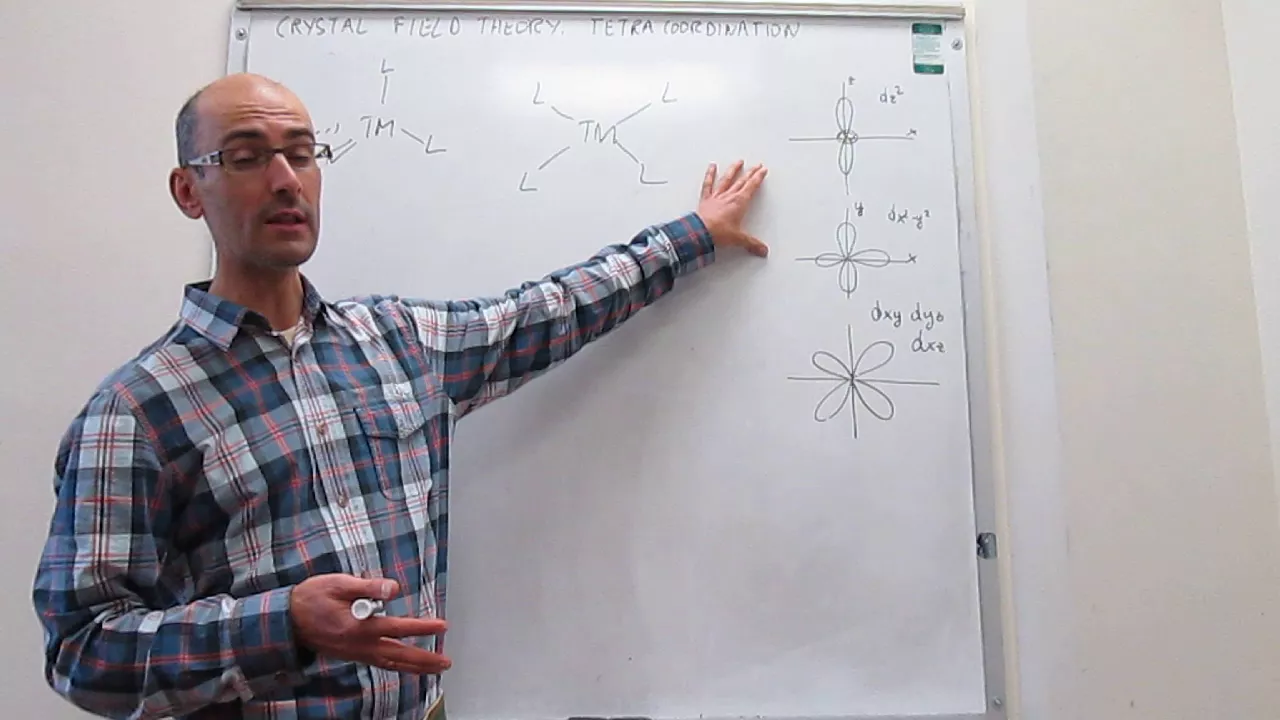
hi welcome back to electronic structure and bonding my name is Kevin toke off make sure to like this video and subscribe to the channel for future videos and notifications alright so in the last few videos we've been calculating crystal field stabilization energy however we've been doing it for octahedral complexes and we know hopefully that octahedral complexes have the general form of a metal and then we have some ligand and there's going to be six of them and then some charge okay look at this one this one only has four ligands and we are going to assume it's tetrahedral could be because generally when we calculate crystal field stabilization energies we're either doing it for octahedral or tetrahedral at this level so we are going to assume this is a tetrahedral this is a tetrahedral complex now several things to remember about tetrahedral situations of calculating crystal field stabilization energy whenever I did before whenever I was doing octahedral I always had the e sub G on the top and T 2g on the bottom like this it turns out that for tetrahedral its flipped okay the T 2g is on the top and the e sub G is on the bottom okay it also turns up pretty much everything is flipped this right here is the degeneracy level okay degenerate energy level this difference in energy right here this is three-fifths the three-fifths was on the top last time because e sub G was on the top but now it's not Delta octahedral its Delta tetrahedral okay and just like it was two-fifths on the bottom in octahedral now this difference in energy is two-fifths but again it's Delta tetrahedral all right so hopefully that makes sense that's that's basically the first thing to remember about tetrahedral complexes the second thing which makes it a little bit easier to be perfectly honest is the fact that you don't have to determine if something high spin or low spin because for tetrahedral they are always always high spin and when we do the example will again go into what that means particularly the high so that flowchart we've been using in the past few videos we don't need that for this they're always high spin now what we do have to do is again step one what we did in the last video and the last few to be vertically honest is we have to calculate the charge on the metal okay this one's a little bit more challenging because overall the charge is minus 2 and our ligand has charged so what I do is I set the overall charge of the complex equal to the sum of the individual charges chloride always has a minus 1 charge okay and then there are 4 of them plus the charge on the nickel alright which is going to be negative 2 is equal to negative 4 troops to many of those negative 4 plus nickel so I add for add for this cancel so nickel is going to be having a plus 2 charge or I can write this as nickel 2 plus alright nickel 2 plus my next step is I need to calculate the number of the electrons alright go to nickel nickel is right here if it loses two electrons how do I know it loses two because it has a two plus charge if nickel loses two it's going to preferentially lose these two first so it's just going to have 1 2 3 4 5 6 7 8 D electrons ok 8 D electrons now I have to remember I'm going to I'm going to now fill in the electrons it's high spin so number one we there are is know pairing energy but I'm going to do high spin so what does that mean 1 2 instead of staying down here for 3 & 4 I'm going to go up high because it's high stead 3 4 5 and then I'm going to come down 6 7 and then 8 ok so that's high spin alright now I need to calculate the crystal field stabilization energy so what am I going to do well my crystal field stabilization energy is going to be I'm going to use this first 3/5 Delta tetrahedral times the number of electron in that area which is going to be for those orbitals for electrons minus two-fifths Delta tetrahedral times the number of electrons in that area and those or goals that is for alright so what is this equal to I don't have to worry about the pairing energy this is going to be 12 over 5 Delta tetrahedral minus 8 over 5 Delta tetrahedral so overall it looks like that is going to be 4 over 5 or four-fifths Delta tetrahedral all right so that is going to be right there my crystal field stabilization energy for this tetrahedral complex alright here's an interesting thing suppose it's tetrahedral but I want to calculate the Delta octahedral for this or at least I want to compare it to that well I have a general rule of thumb and it's that Delta tetrahedral is approximately four ninths of Delta octahedral all right so how do I convert this into a Delta octahedral for a comparison well I'm going to take 4/5 and I'm going to substitute this expression for Delta octahedral this right here I'm going to plug in this because it's equal to Delta octahedral so this is going to be 4/9 Delta octahedral so I'm getting that this is at least relationship wise is going to be 16 over 45 Delta octahedral and that's the same thing as 4/5 Delta tetrahedral all right so that's going to be a direct comparison of them the key here and the point is just that Delta tetrahedral the difference in energy that you see in this tetrahedral complex is going to be less approximately half of that of Delta octahedral okay so just to make that clear all right and that's all there is to the tetrahedral complex it's always high spin and then you just have to remember the crystal field splitting diagram is flipped upside down to where eg and the 3 v is on the bottom and T 2 G and the two fifths is on the top and then instead of Delta octahedral you are specifically dealing with the Delta tetrahedral and then you calculate crystal field stabilization energy in a similar way and it's in terms of Delta tetrahedral not directly octahedral all right so hopefully that made a little bit of sense make sure to LIKE this video and subscribe to the channel for future videos and notifications thank you very much
Up Next
6:54
Crystal Field Theory: Tetrahedral & Square Planar Complexes
@diegotroya3497
23.9K views•2018-04-29

83:56
Biocatalysis and Catalysis in Islatravir Synthesis | Merck Webinar
@SCIwheresciencemeetsbusiness
675 views•2020-10-08

8:31
The Chelate Effect: Stability in Metal Complexes Explained
@CatalystUniversity
81.4K views•2017-02-06

17:31
Edible Water Bottles: A DIY Guide to Sodium Alginate Spherification
@ryan
10.5M views•2019-06-21
Related Study Plans & Knowledge Roadmaps
Structured learning paths in Chemistry
chemistry
Nuclear Chemistry: Decay, Meds & Fuel Cycle
01Introduction to Nuclear Structure and Radioactivity
02Decay Dynamics and Kinetics
03Radiation Interaction and Detection
+ 2 more learning modules
24h5 modules
Explore Roadmap
chemistry
Supramolecular Chemistry: Forces & Machines
01Foundations of Chemical Bonding and Intermolecular Forces
02Introduction to Host-Guest Chemistry
03Thermodynamics and Dynamics of Self-Assembly
+ 2 more learning modules
16h5 modules
Explore Roadmap
chemistry
Photochemistry: Excited States & Reactions
01Foundations of Light-Matter Interactions
02Molecular Orbitals and Electronic States
03Photophysical Processes and Jablonski Diagrams
+ 2 more learning modules
18h5 modules
Explore Roadmap
chemistry
Coordination Chemistry: Bonding & Properties
01Introduction to Transition Metals and Ligands
02Crystal Field Theory (CFT) and Geometry
03Magnetic Behavior and Spin States
+ 2 more learning modules
14h5 modules
Explore Roadmap