












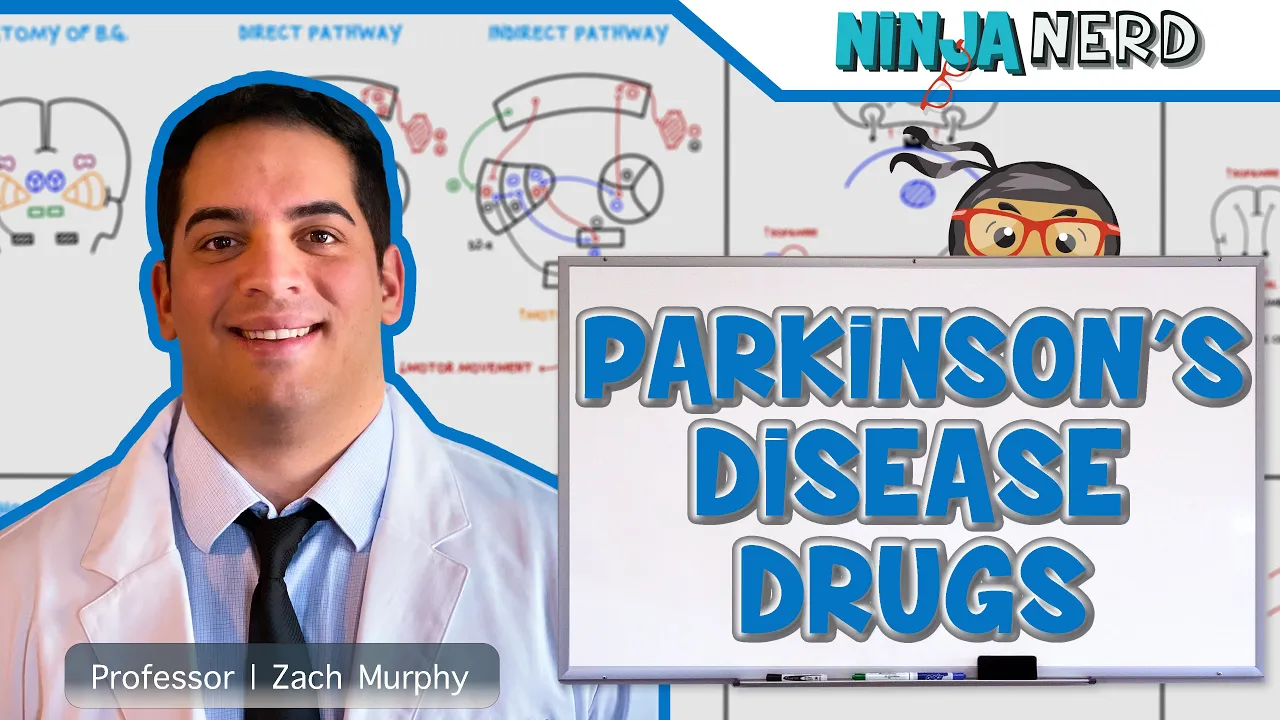





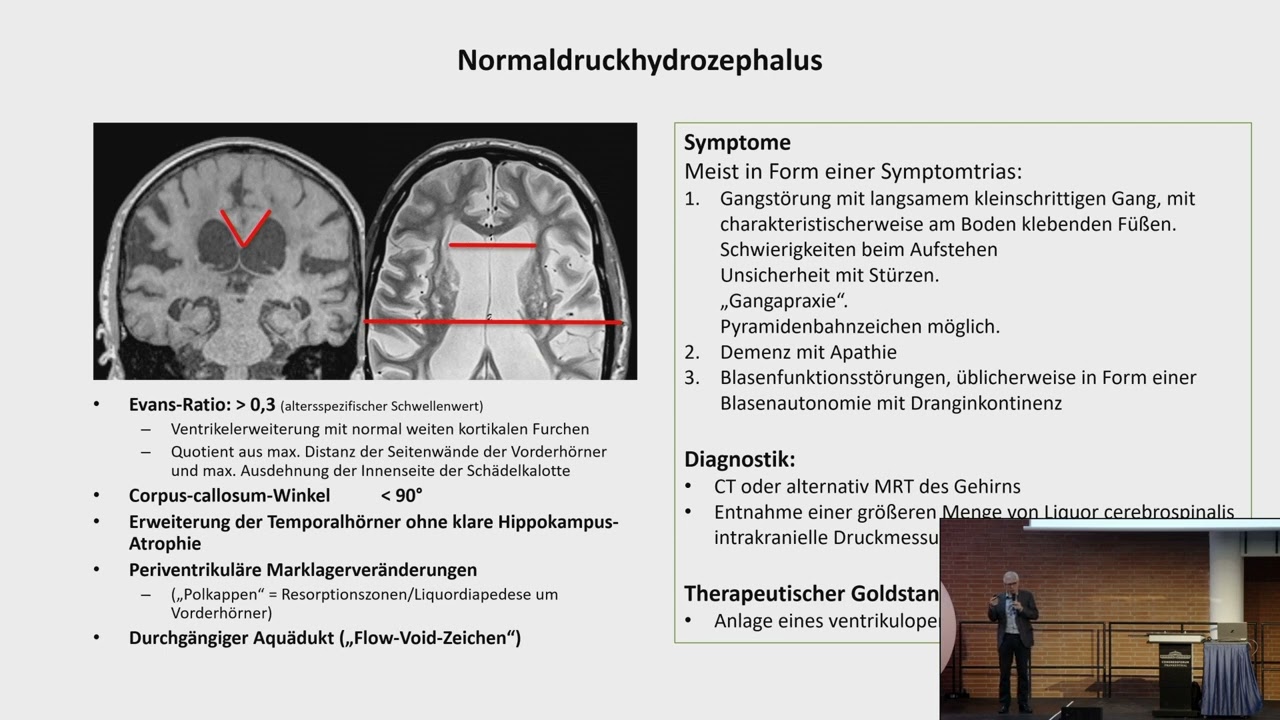

Parkinson's disease causes movement problems like bradykinesia and rigidity when approximately 80% of dopamine neurons in the substantia nigra die, disrupting the nigrostriatal pathway that projects to the striatum; this loss impairs both the direct pathway (which normally loosens the thalamic 'leash' to enable movement) and the indirect pathway (which normally tightens the leash to reduce movement), resulting in reduced motor control.
Parkinson's Disease Pathophysiology: Dopamine Pathways Explained
Added:Basic neuroanatomy of the brain, particularly the structure and general functions of the basal ganglia.
The fundamentals of neurotransmission, specifically how dopamine acts as a chemical messenger in the central nervous system.
The concept of excitatory and inhibitory neural pathways, including the roles of glutamate and GABA.
Basic physiology of voluntary motor control and how the cerebral cortex coordinates movement.
Pharmacological interventions for Parkinson's disease, including the mechanisms of L-DOPA, carbidopa, and dopamine agonists.
Advanced surgical treatments such as Deep Brain Stimulation (DBS) and how it modulates disrupted basal ganglia circuitry.
The cellular and molecular pathology of Parkinson's disease, focusing on alpha-synuclein aggregation and Lewy bodies.
Differential diagnosis of atypical Parkinsonian syndromes (Parkinson-plus syndromes) versus idiopathic Parkinson's disease.
155.1K views955likes5:59Original Release: 2015-02-24
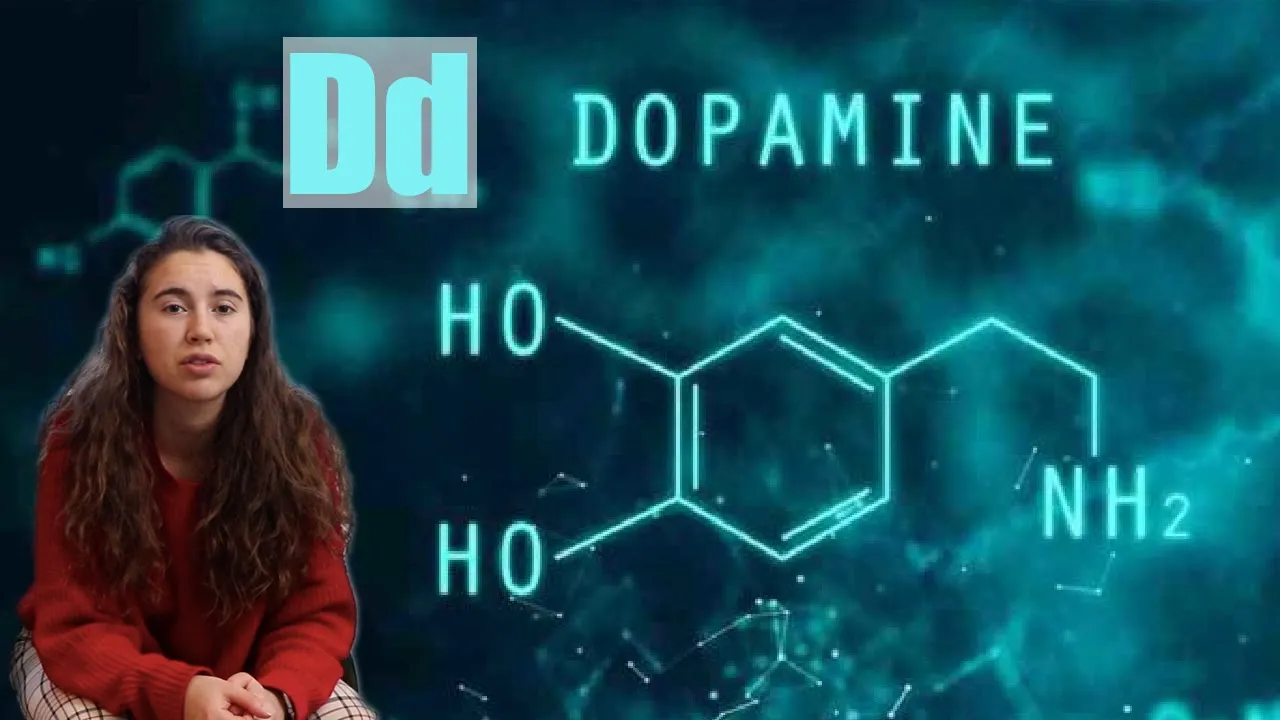
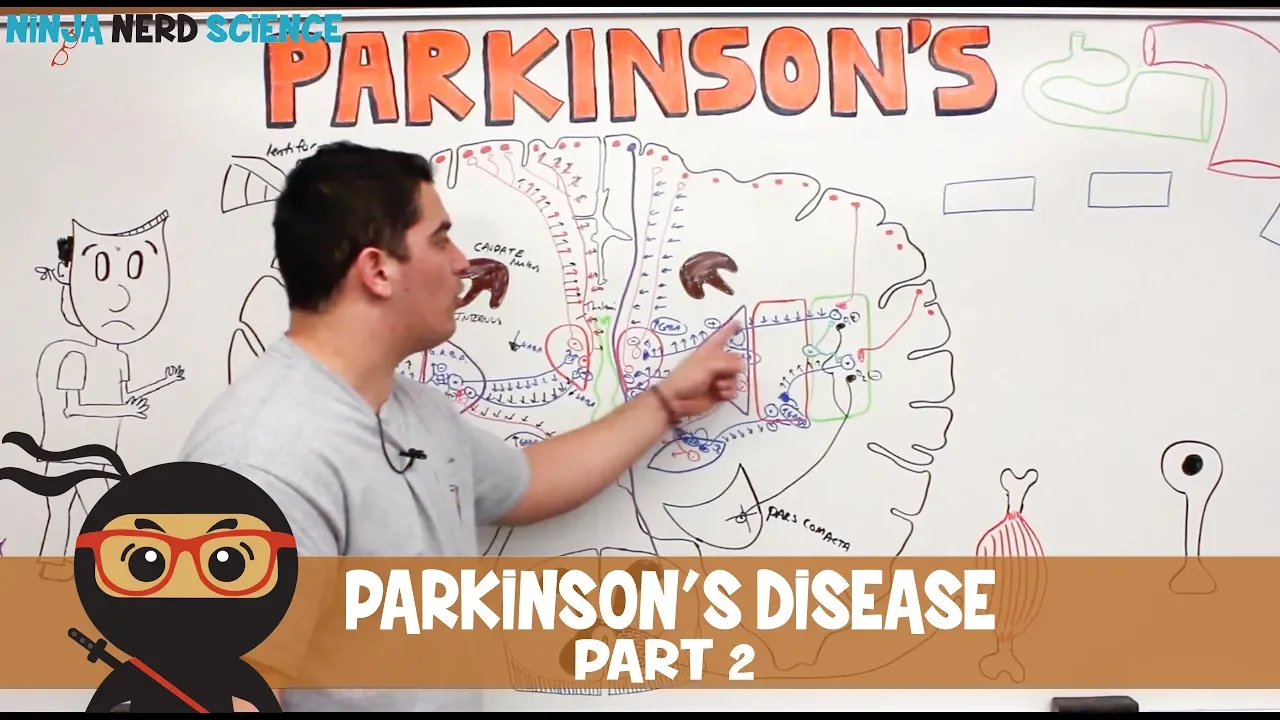
so we know that Parkinson's disease causes problems with movements right and and what we see in people with Parkinson's disease is a reduction a a loss A slowing down of movements and and this happens largely because of a loss of dopamine neurons in the brain but you might be wondering what is so special about these dopamine neurons how do they actually cause these problems with movements what's what's going on here and that's actually a really great question so let's have a look at how that all happens so let's start off by jumping over here to the substantia and you might remember this that the substantia is the main area in the brain where we see this big loss of dopamine neurons right so we have these dopamine neurons here in the substan so they they head over they project to the striatum so let's let's draw some of these so here's some dopamine neurons here in the substan and they go over here to the strium so they send their axons over here and they go and they talk to neurons in the strium and we actually have a name for this little bundle of dopamine neurons this little Highway that goes from the substantia to the strium and we call it the Nigro striatal pathway Nigro because they head from the substantia and striatal because they head over to the striatum so during Parkinson's disease these neurons they they start to die off right we start to lose some of these neurons and and actually this is really interesting so so as these neurons are starting to die as we're starting to lose these neurons in Parkinson's disease what we also see at the at the same time is this formation of these little clumps of proteins in a lot of these neurons and these are called louisi bodies and these Louis bodies start to form and and we're not going to go into the the kind of the pathological diagnosis of Parkinson's disease at this point but in in what we call a postmortem exam so after the person has died and we're looking at their brain these Louis bodies are actually the main thing that we see in the brains of people with Parkinson disease and the really interesting part is that we we actually don't know at this point what role Louis bodies play in the disease we don't know if they're maybe involved in the loss of these dopamine neurons or maybe if they're actually like a protective mechanism to kind of try to prevent more loss of dopamine neurons or maybe something that we haven't even thought about yet we just we don't know at this point and so that's kind of an interesting bit of research that's currently going on so anyway so so back to our Nigro stal pathway here so more and more of these dopamine neurons die we lose more of them and when we've lost about about 80% of them so so quite a bit right 80% that's when we start to see Brady kinesia and rigidity and some problems with movements the things that are actually the physical signs of Parkinson's disease so in order to figure out how this loss of dopamine neurons actually leads to the movement problems that we see we have to kind of think back to the direct and the indirect Pathways that the basil ganglia in our brains use to control our movements so I like to think of the thalamus as a dog a dog on a leash and it needs to be on a leash because we don't want it getting all excited because when the thalamus gets all excited it causes our motor cortex to get too excited and this causes our muscles to move too much too much movement because remember our motor cortex is what talks to our muscles to get them to move so we keep our Thalamus on a tight leash right so this is what we do and we do this so it can't OV excite the motor cortex and the basil ganglia their job is to adjust the length of our leash and this adjusts how active the thalamus can be and they do this by talking to each other in the direct and the indirect Pathways so the aim of the direct pathway is to loosen our leash on the thalamus to let our Thalamus be a bit more active and chat with our motor cortex more so that we can move around a bit more so let's say maybe you're crossing the street and the light is about to change and you know you're a good person you don't want to hold up traffic so you need to go from walking to running in order to make sure that you get to the other side in time right so here is when your direct pathway would kind of kick in so your substantia would send off these dopamine signals to make the thalamus more active and and this would make you move a bit more allow you to go from walking to running to get across the street but when we lose these dopamine neurons in the substantial the substantial can't send much dopamine to the strium so this means that it can't amplify the direct pathway it can't excite our muscles even more so we can't get that extra muscle movement to get our friend here across the street faster and on the flip side remember that the aim of the indirect pathway is to tighten that leash on our Thalamus and that's to reduce muscle movements so maybe you made it to the other side and now you want to go from running to walking so you want to slow down the muscle activity in your legs right so that you can slow down your steps and start to walk so in this pathway the substantial uses it dopamine to kind of fine-tune this and make sure that we don't turn our muscle activity down too much so that you're you know you want to walk at a good Pace you don't want to walk too slow so the substantial helps get you at that perfect pace and it does this by loosening our leash on the thalamus and it causes more movement when we lose these dopamine neurons in Parkinson's disease the substantia it can't send as much dopamine to the strium to loosen the leash on the thalamus right so our leash it gets too tight and our muscle movements are turned down too much so overall with a loss of dopamine neurons in the the Nigro strial pathway the substan it just can't initiate more movement in the direct pathway and it can't prevent a an excessive reduction in movement in the indirect pathway and that's why this loss of dopamine neurons in the substantial causes the slowing down and loss of movements that we see in someone with Parkinson's disease
Up Next

12:33
FDA-Approved Alzheimer’s Drug: Aducanumab & the Amyloid Hypothesis
@SciShow
287.5K views•2022-03-23

48:47
Graphic Medicine: Comics for Collaborative Healthcare Communication
@nationalpatientadvocate
189 views•2023-12-04

10:28
Neuroanatomy: Central and Peripheral Nervous System Divisions Explained
@AKLECTURES
136.2K views•2014-09-20
3:05
Stages of Labor and Vaginal Birth | Childbirth Animation
@nucleusmedicalmedia
52.1M views•2017-08-18
Related Study Plans & Knowledge Roadmaps
Structured learning paths in Medicine
medicine
Abnormal LFTs: Diagnostic Workup & Pathology
01Liver Anatomy and Basic Physiology
02Introduction to Liver Function Tests (LFTs)
03Hepatocellular vs. Cholestatic Patterns
+ 3 more learning modules
12h6 modules
Explore Roadmap
medicine
Analyzing Blood Smears: RBC, WBC & Platelets
01Introduction to Blood Components & Smear Preparation
02Normal Morphology of Blood Cells
03Erythrocyte Pathologies & Morphological Variants
+ 2 more learning modules
12h5 modules
Explore Roadmap
medicine
Mechanical Ventilation: Waveforms & Alarms
01Anatomy and Physiology of Breathing
02Introduction to Mechanical Ventilation & Core Modes
03Ventilator Settings and Waveform Interpretation
+ 2 more learning modules
12h5 modules
Explore Roadmap
medicine
Neuro Exam: Localization & Stroke Syndromes
01Foundations of Neuroanatomy and Vascular Supply
02The Neurological Examination: Step-by-Step
03Principles of Neurological Localization
+ 3 more learning modules
18h6 modules
Explore Roadmap