


















Philosophers have developed frameworks to understand how we can make meaningful assertions about nonexistent objects: Bertrand Russell argued that statements about non-existent entities are false because they imply existence, while Alexius Meinong proposed a three-tiered ontology (absistence, subsistence, and existence) allowing non-existent objects to have some form of being; additionally, the concept of a 'universe of discourse' provides a solution by establishing that truth-values depend on the context or framework within which statements are made, enabling us to discuss fictional worlds like Harry Potter's as internally consistent systems even when they don't correspond to reality.
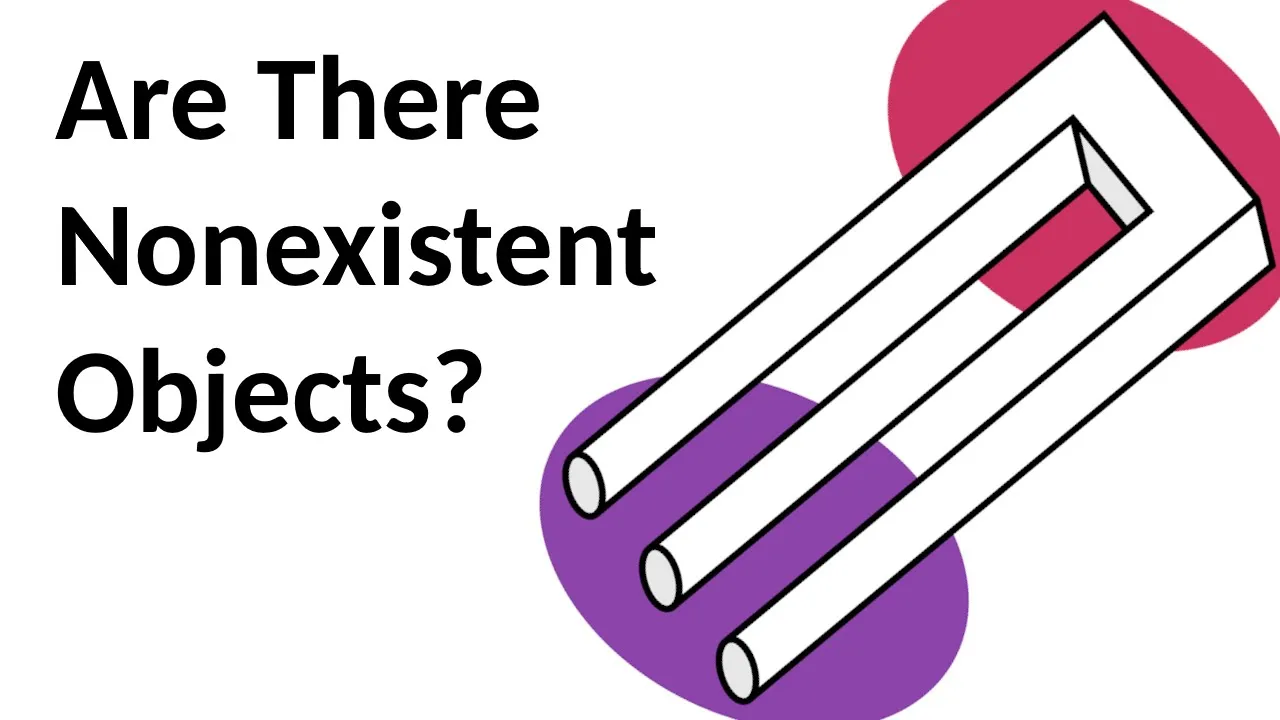
How Can We Talk About Nonexistent Objects? | Philosophy
Added:Introduction to the Philosophy of Language, specifically how words refer to objects in the real world (Theory of Reference).
Basic ontological concepts, particularly the distinction between realism (what exists independently) and nominalism or anti-realism.
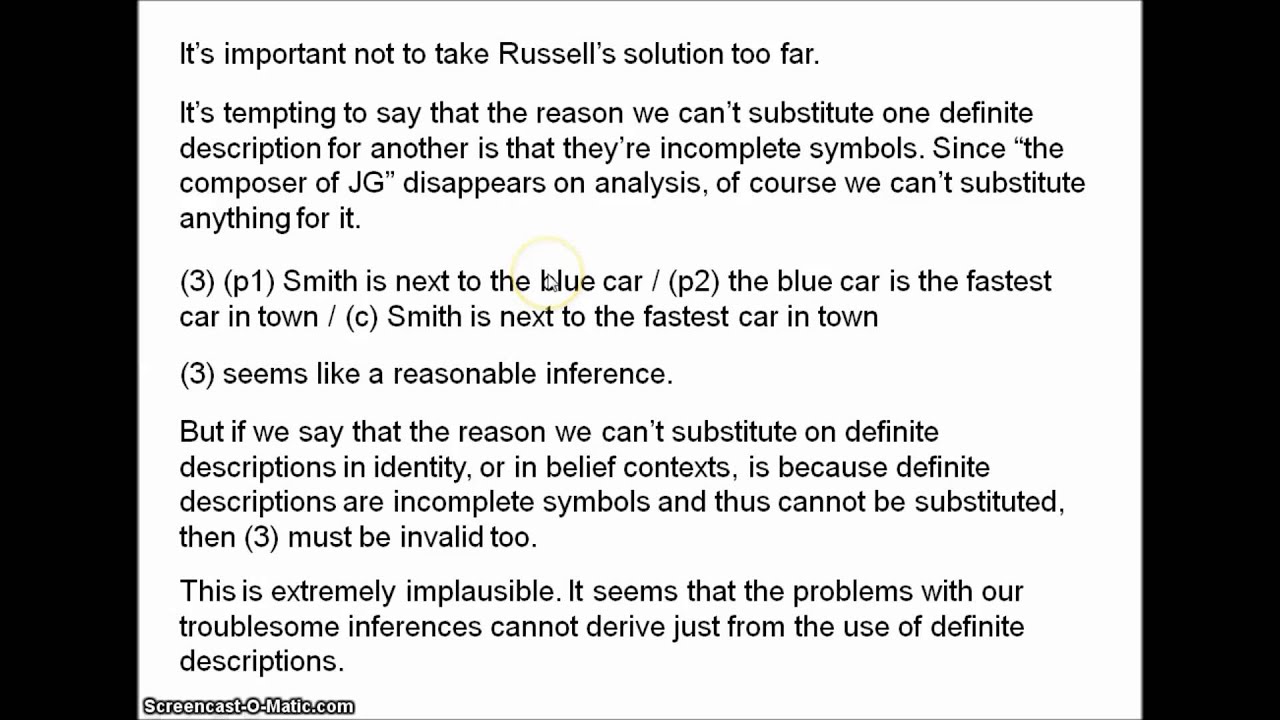
Bertrand Russell's Theory of Definite Descriptions, which serves as a primary historical counter-argument to Meinongian ontology.
Fundamental concepts in formal logic, such as existential quantification (asserting that something exists) and truth values.
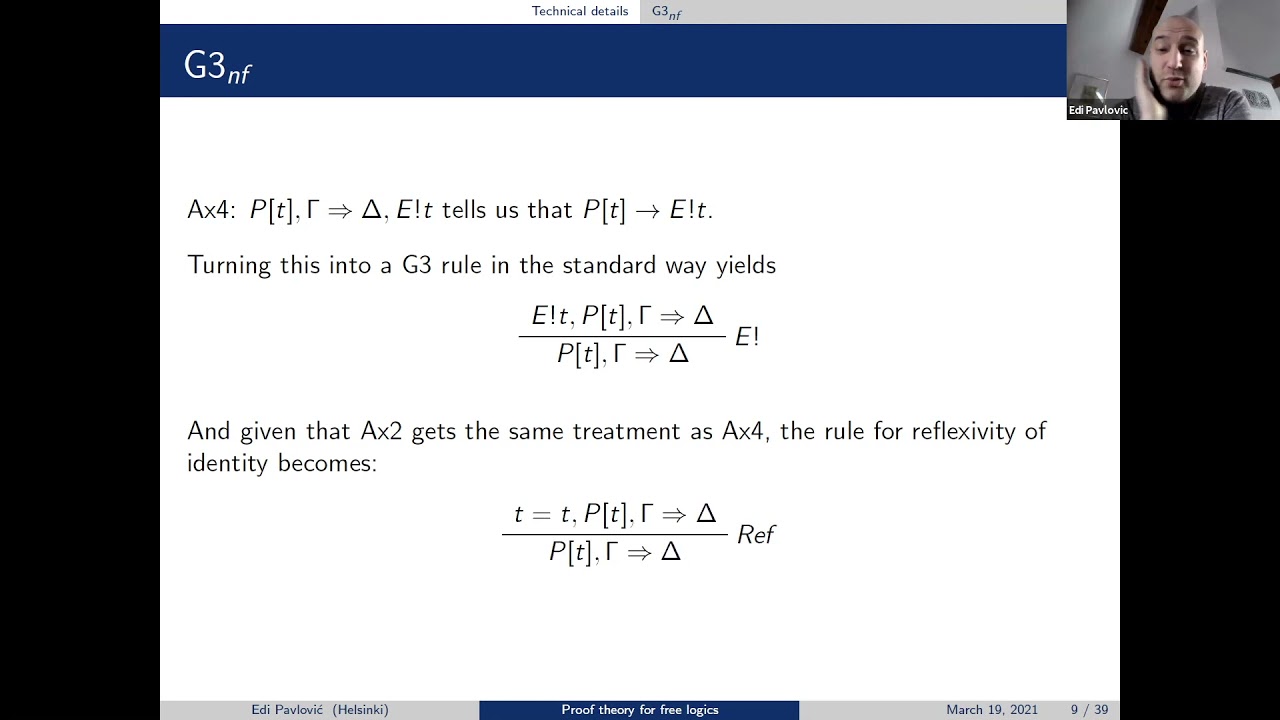
Free Logic, a system of formal logic that allows for terms that do not denote any existing object.
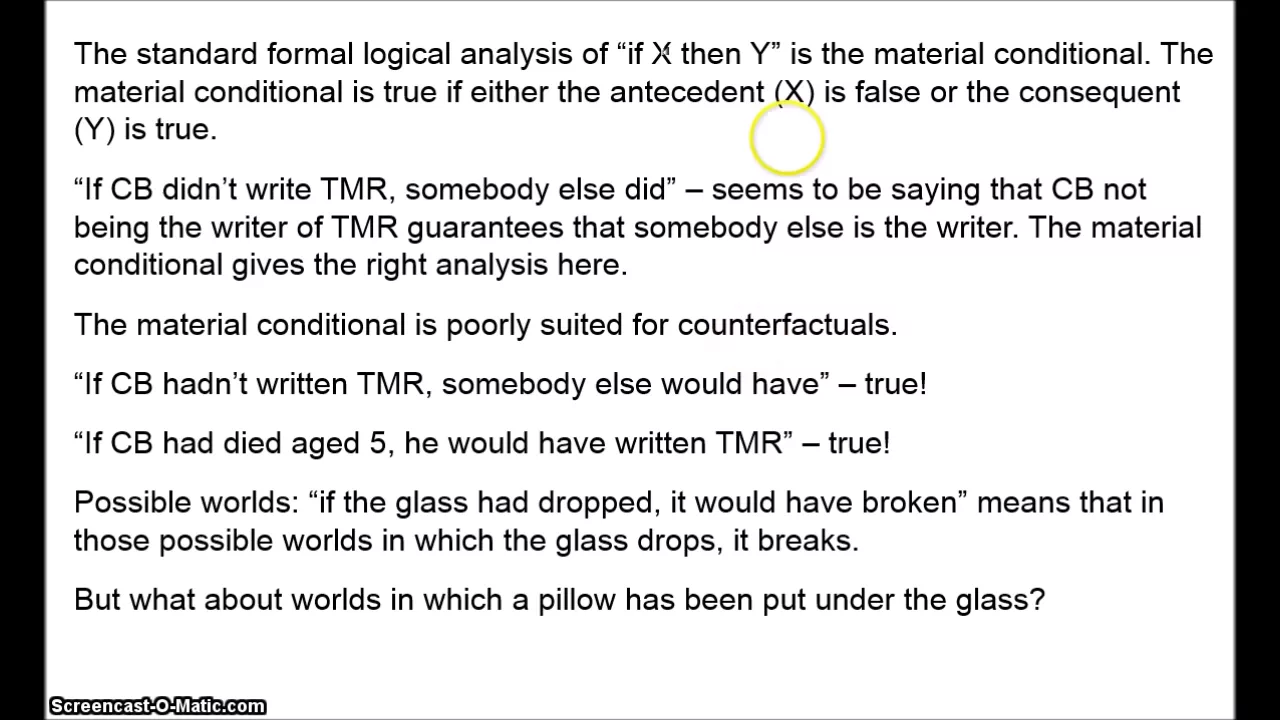
Possible Worlds Semantics and Modal Logic, exploring how we evaluate statements about counterfactual or alternative realities.
Fictionalism in metaphysics, the view that statements about fictional entities or mathematical objects are useful falsehoods.
Abstract Object Theory, which formalizes the properties and relationships of non-existent, intentional, and abstract entities.
872.8K views19.3Klikes9:20Original Release: 2016-09-27
Sherlock Holmes lives at 221C Baker Street.
Santa Claus has eight reindeer.
Harry Potter’s best friend is Draco Malfoy.
If a zombie touches your skin, you’ll become a zombie.
I just made a series of assertions.
They all make sense, generally speaking.
They contain subjects and verbs and are grammatically legit.
But what is their truth-value?
I’m sure you had some immediate reactions to some of them. Like, Harry and Draco? No.
But how can an assertion be true or false, if it’s about beings that are nonexistent?
How are we supposed to think about things that don’t exist in the real world, yet somehow seem to exist in our minds?
Part of why we can think about, and talk about, and even picture in our imaginations, things that have never existed, is because of language.
Without language, the only stuff we’d really be able to communicate about would be physical objects – because communicating would mostly consist of pointing...maybe a little bit of grunting.
But words allow us track to concepts – ideas we hold in our heads – even if they don’t correspond with anything in real life.
And here, we find ourselves in a new realm: where the philosophy of language bumps up against aesthetics, the philosophy of art.
Because when we talk about nonexistent objects, we soon find ourselves talking about imaginary worlds – worlds that don’t exist, but which language has allowed us to conceptualize in our minds.
And when it comes to discussing things like meaning and existence in these worlds, we need a slightly different set of philosophical tools, because in these worlds, different rules often apply.
And that’s because we make up those rules.
In the worlds that we imagine, there might be life on other planets.
Or the past as we know it might never have happened.
Or maybe there are no laws of physics.
It turns out, we can create entire universes just with our minds.
[Theme Music] When we first started to unpack the big ol’ steamer trunk that is language, we talked about the idea of reference.
The referent of a word is the object in the world that the word tracks, or keys into.
So, a referent of the word ‘cat’ is this guy.
But what happens when there is no referent?
Like, what’s the referent of the word ‘jabberwock’?
And how can I determine the truth-value of such a word – or the object it refers to?
Is it even possible?
I suppose it could be that, when we refer to non-existent objects, we’re just speaking nonsense.
But I’m almost positive that I really do know a lot about things that aren’t real.
And I think of that information as facts – facts that are true.
Like, I know that Snow White hangs out with seven dwarves, and if you told me that there were eight, and that one of them was named Sloppy, I would know you were just wrong.
But where are those dwarves in the real world?
And how do I know how many there are?
And how could you be wrong about something that doesn’t exist?
To parse this question some more, let’s head over to the Thought Bubble for some Flash Philosophy: Here’s another assertion for you: “The present king of France is bald.” True or false?
Bertrand Russell said it’s false.
And it’s false even though this sentence actually has a couple of statements packed into it: One, it asserts that there is a present king of France and two, that he is bald.
But, there is no present king of France – France has a president, not a king.
So the whole proposition ends up being false.
Since there’s no present king of France, Russell said, we can’t attribute any true statements to him.
It would be just as false to say that the present king of France has a ponytail, and a nice, bushy hipster beard, as to say he’s bald.
So this French king is a non-existent entity that’s falsely been ascribed an existence, simply through an error in our understanding of language.
And if you’ll recall, this is similar to what we encountered with the cats-and-tails conundrum, back when we were discussing the nature of reality.
If you say that “Every cat has one more tail than no cat,” that can be interpreted to mean that there’s such a thing as No-Cat.
So, just like with the present King of France, a weirdness in our language makes no-thing look like some-thing.
Thanks, Thought Bubble!
Now, Russell was sure that we can’t make any meaningful assertions about something that doesn’t exist.
But 20th century Austrian philosopher Alexius Meinong had a different view.
Meinong was convinced that we can have meaningful thoughts about objects that don’t exist in reality.
But, he said, in order to be able to speak meaningfully about something, it must, in some sense, have being.
So Meinong came up with an ontology – that is, a system of being – that was divided into three classes: absistence, subsistence, and existence.
And he posited that even non-existent things could fit into this system.
First, he said, every possible object that you can think of absists.
If you can think about it, it has absistence.
This includes stuff that could never exist in real life – like unicorns, or the mythical Lost Island that our old monk friend Guanilo said would be the best place on Earth, if it were possible.
And inside the group of things that absist is the smaller subset of subsistent objects.
These are things like numbers and theorems, that don’t manifest a physical existence, but they also don’t contain any sort of impossibility.
They’re just not physical things, so they can’t be found anywhere in the world.
They’re just concepts.
And finally, existent objects are those that are actually here in the physical world, like cats and smart phones and current French presidents.
So, existent objects have all three levels of being – they exist, they can be conceptualized, and they can be imagined.
Now, I should probably point out that many of Meinong’s contemporaries viewed him as something of a nutter.
He was trolled pretty hard by some of his contemporaries, who referred to his supposed realm of non-existent objects as Meinong’s Jungle – a place where round squares wander around with the present king of France, hippogriffs, and never-ending gobstoppers.
And maybe you think Meinong’s Jungle is a bunch of baloney too.
But you might also say there’s a difference between something like a round square, and something like Harry Potter.
Because, you might think that Harry Potter is real, in some sense.
Like, you get that he’s fictional, but to you he feels real.
So what about that? Is that nonsense too?
Not necessarily.
Here’s one way that some aestheticians, or philosophers of art, make sense of what’s going on when we talk about fictional objects.
They begin by pointing out where, metaphorically speaking, we talk about them.
The domain in which we have a conversation, is known as a universe of discourse.
And inside this universe, assertions can be either true or false.
Our default universe of discourse is the actual world.
So in regular conversation, “Harry Potter is a wizard,” is a false assertion, just like “The present king of France is bald,” because there is no Harry Potter, so he can’t be a wizard.
There’s also no wizards.
But when we’re having a conversation about the world of Harry Potter, we’ve entered a different universe of discourse.
When our universe of discourse is the world of Harry Potter, “Harry Potter is a wizard” is a true statement, even though it’s false in the real-world universe of discourse.
And whether we know it or not, we use different universes of discourse all the time – not just when we’re talking fandoms.
Like, in the universe of discourse that is basketball, taking a few steps with a ball in your hand is called traveling, and is illegal.
But in the universe of discourse called football, taking steps with a ball in your hand is not called traveling and is perfectly legal.
So one way to solve the puzzle about the existence, and truth, of imaginary objects is to say that – in the case of Harry Potter – J.K. Rowling created a universe of discourse that is Harry’s world.
And that universe shares some things in common with our world, but it has differences too.
In the real world, it is false that Harry Potter has a lightning scar on his head, because there is no Harry Potter.
But in the universe of discourse that is the world of Harry Potter, it’s true, because both Harry and his lightning scar exist.
So when we talk about fiction, we’re speaking within a particular universe of discourse, and our interlocutors know this – even if it’s not explicitly stated.
This lets us say things that end up being true, even though the truth doesn’t track to this actual world.
Now, things get a little weird when our universe of discourse is a fictional world that’s set inside of our real world, like House of Cards.
Frank Underwood is the president of the United States, but, well, so is Barack Obama.
They both live in the White House and have the same executive powers.
Unlike the universe of discourse to which Harry Potter belongs, the universe of House of Cards adheres to all of the rules of our world.
Thankfully, much to our credit as a species, we are great at distinguishing between universes of discourse.
We can distinguish between what’s canon and what’s not.
We can fight passionately and knowledgeably about what might happen within fictional universes of discourse – like who would win in a foot race, Superman or the Flash?
And when you think about fictional realities where different universes of discourse meet – like DC/Marvel crossovers – you’re actually engaging in some pretty serious ontological ponderings.
You’re holding in your mind an incredible number of propositions that are specific to different universes, and figuring out exactly what would be true, if those universes were combined.
For instance, in a world where both ghosts and zombies exist, would it be possible for one person to become both, at death?
Our ability to understand – and play around with – fictional realities helps us think about other hypothetical realities too.
Like what will happen in the future, and what the implications might be of the different choices that we make.
So, treating nonexistent things as if they’re real?
“Nonsense” probably isn’t the right word for it.
Being able to create and conceptualize a universe is a pretty amazing skill.
Today we talked about nonexistent and imaginary objects, and whether it’s possible to make true assertions about them.
We learned about Meinong’s Jungle and the concept of a universe of discourse.
Bananas are chom choms.
Next time we’ll talk about objects of aesthetic appreciation.
Crash Course Philosophy is produced in association with PBS Digital Studios.
You can head over to their channel and check out a playlist of the latest episodes from shows like: Braincraft, Coma Niddy, and Deep Look.
This episode of Crash Course was filmed in the Doctor Cheryl C. Kinney Crash Course Studio with the help of all of these awesome people and our equally fantastic graphics team is Thought Cafe.
Up Next
61:25
Wittgenstein's Language Games Explained | A.C. Grayling
@DarwinCollegeLectureSeries
90K views•2020-02-16

164:01
John of Damascus on Holy Images: A Theological Defense
@BannedBooks
139 views•2026-04-25
9:31
Philosophy of Language: Sense, Reference & Wittgenstein
@crashcourse
1.3M views•2016-08-29
4:57
The Myth of Sisyphus: A Greek Legend of Eternal Punishment
@TEDEd
8.6M views•2018-11-13
Related Study Plans & Knowledge Roadmaps
Structured learning paths in Philosophy
philosophy
Frankfurt School: Critical Theory & Culture
01Foundations of the Frankfurt School and Critical Theory
02Horkheimer & Adorno: The Critique of Instrumental Reason
03The Culture Industry and Mass Deception
+ 2 more learning modules
12h5 modules
Explore Roadmap
philosophy
Philosophy of Language: From Frege to Austin
01The Linguistic Turn: An Introduction to Language in Philosophy
02Gottlob Frege: Sense and Reference
03Early Wittgenstein: The Picture Theory of Meaning
+ 3 more learning modules
15h6 modules
Explore Roadmap
philosophy
Feminist Epistemology: Standpoint & Injustice
01Introduction to Epistemology and Feminist Critiques
02Sandra Harding and Standpoint Theory
03Donna Haraway and Situated Knowledges
+ 2 more learning modules
12h5 modules
Explore Roadmap
philosophy
Environmental Philosophy: Ethics & Deep Ecology
01Foundations of Environmental Ethics & Anthropocentrism
02Biocentric Individualism and Animal Liberation
03Ecocentric Holism and Deep Ecology
+ 1 more learning modules
10h4 modules
Explore Roadmap