











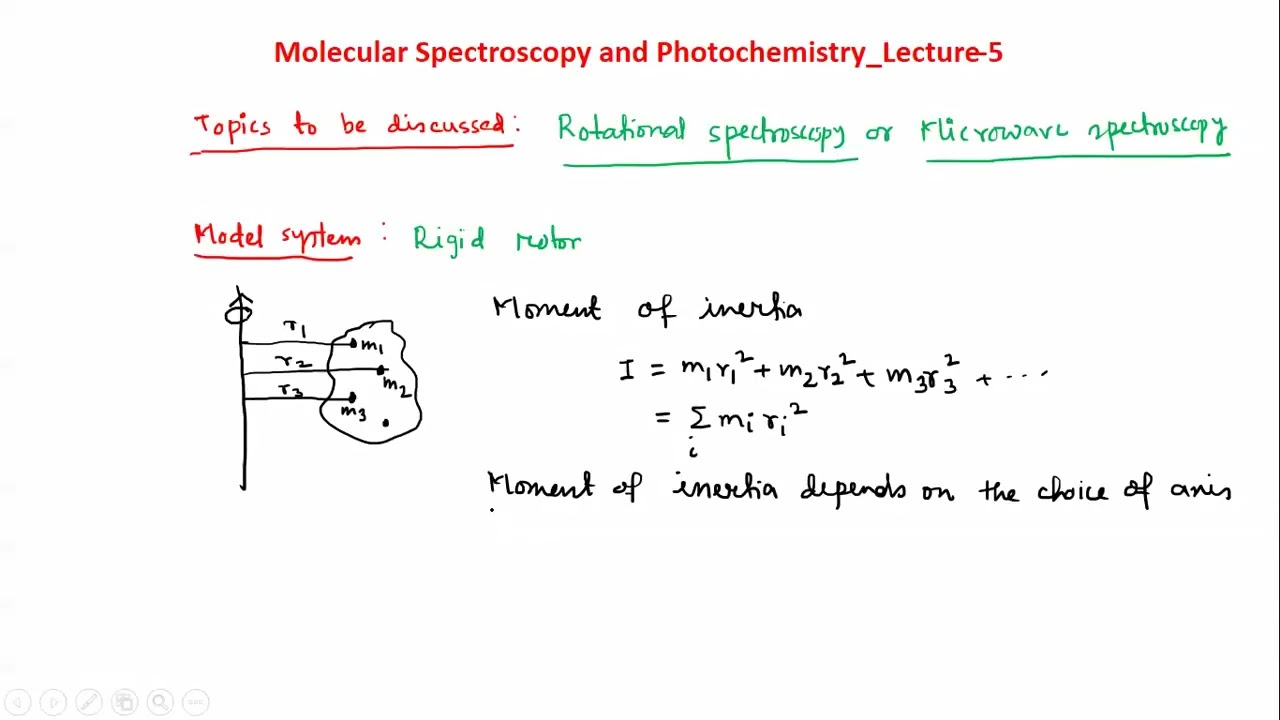









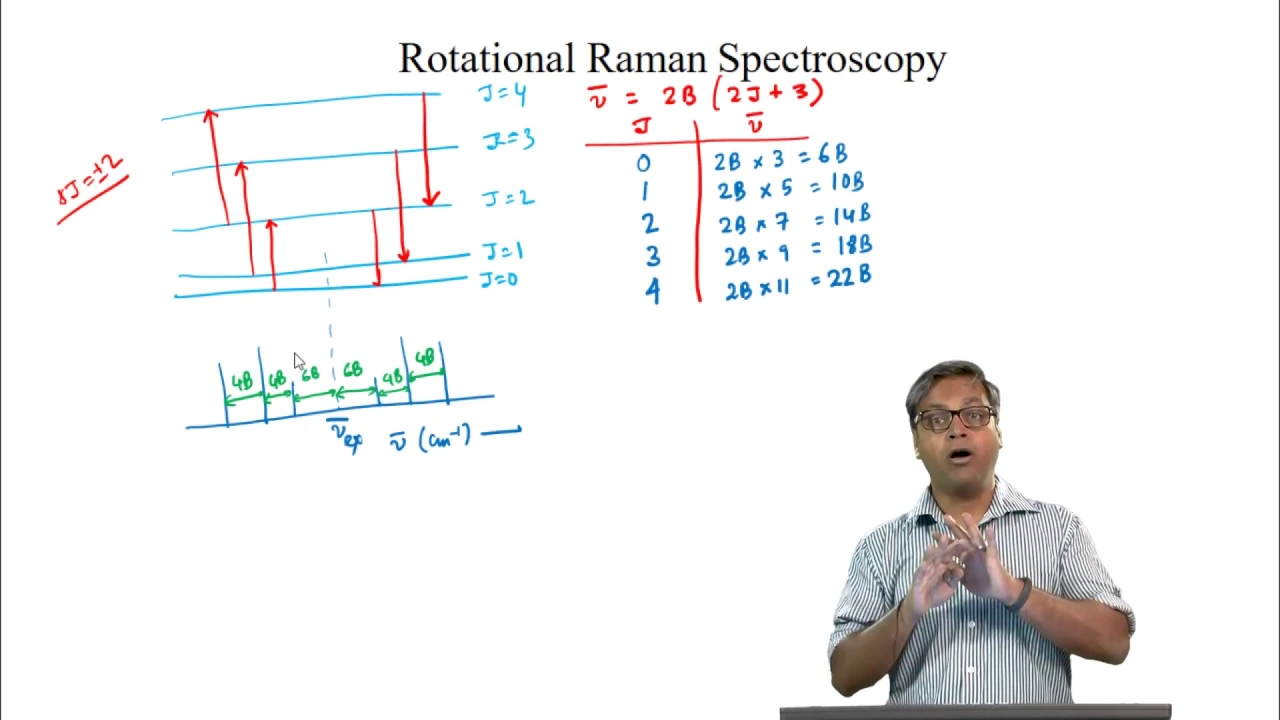






Rotational (microwave) spectroscopy studies transitions between quantized rotational energy levels in molecules, producing spectra only for molecules with permanent dipole moments (microwave-active), such as HCl and CO, while homonuclear diatomic molecules like H2 and Cl2 are microwave-inactive; the technique requires gaseous samples and follows the selection rule ΔJ = ±1, yielding equally spaced spectral lines at intervals of 2B cm⁻¹, where B is the rotational constant calculated from the moment of inertia I = μR₀² using the reduced mass μ and bond length R₀, with applications in industrial process monitoring, moisture determination, and astrophysical analysis.
Rotational Microwave Spectroscopy Theory and Applications
Added:Fundamental concepts of electromagnetic radiation, specifically the energy, frequency, and wavelength characteristics of the microwave region.
Classical mechanics of rotating bodies, including the concepts of moment of inertia and angular momentum.
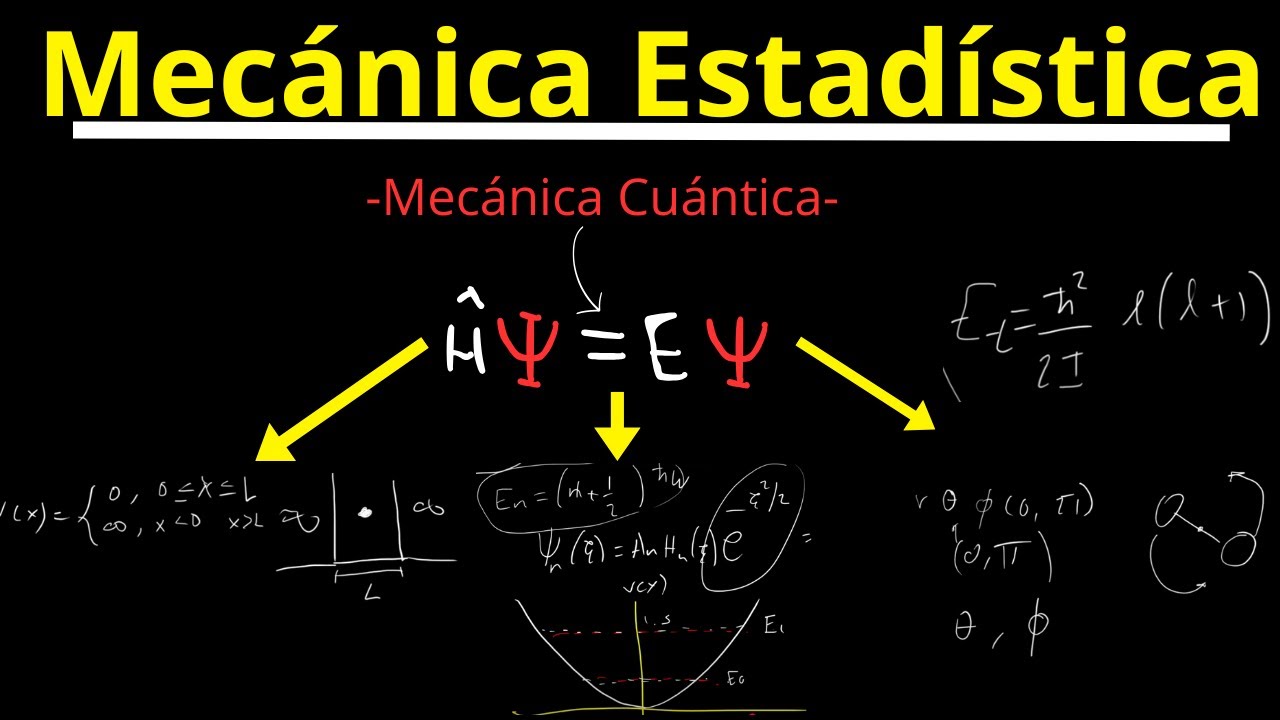
Basic quantum mechanics, particularly energy quantization and the quantum mechanical rigid rotor model.
Molecular structure and polarity, specifically understanding chemical bonds and why a permanent dipole moment is required for microwave interaction.
The non-rigid rotor model, including centrifugal distortion and how molecular bonds stretch at high rotational speeds.
Vibrational-rotational spectroscopy (Infrared spectroscopy) and how rotational transitions couple with vibrational transitions.
Quantitative determination of precise molecular geometry, such as calculating exact bond lengths and bond angles from rotational constants.
Isotope effects in rotational spectra and how isotopic substitution is used to determine molecular structures.
Real-world applications in astrochemistry, such as using radio telescopes to detect complex organic molecules in interstellar clouds via their rotational signatures.
27K views516likes35:58Original Release: 2019-09-04
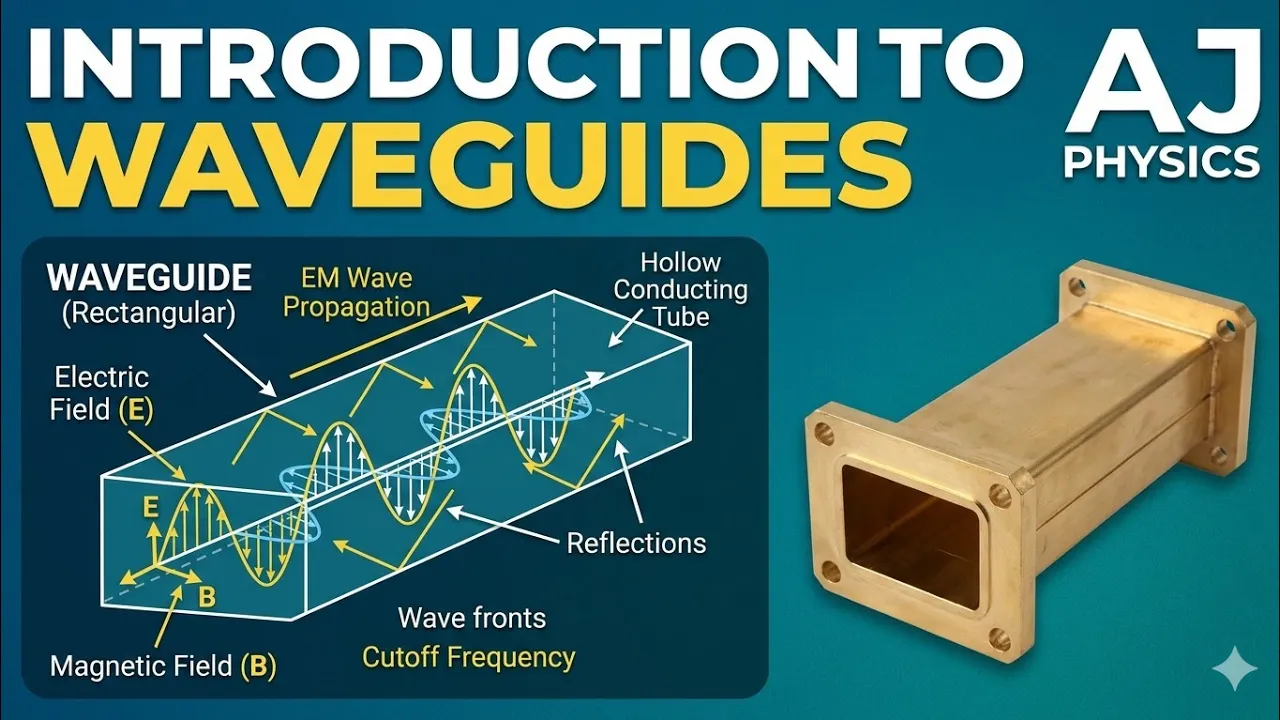
[Music] [Music] [Music] welcome you all I am dr. Smith already in previous lectures we studied about the IR spectroscopy Raman spectroscopy this is the another type of spectroscopy which we are going to study it's about the rotational microwave spectroscopy in this lecture or session we are going to discuss some topics like theory of microwave or rotational spectroscopy rotational energy levels transition and rotational spectrum we discuss selection rule of rotational spectroscopy instrumentation and application part of the microwave spectroscopy now first of all what does microwave spectroscopy material spectroscopy is concerned with transition between rotational energy level transition between rotational energy levels in the molecule and the molecules give a rotational spectrum only if it has permanent dipole movement it means microwave spectroscopy are shown by only those compound which have permanent dipole movement for example this is HCl and Co both have permanent dipole movement so they are called as microwave active they give the rotational spectrum another one is example is h2 and cl2 they don't give rotational spectrum and they are called as microwave inactive molecules rotational spectroscopy is only the second and the most important point is this rotational spectroscopy is really ethically in the gas phase only it is possible for gas phase not for solid and liquid where the rotational motion is quantized in solids or liquids the rotational motion is not quantized due to collision between their molecules not quantized due to collision between their molecules absorption of electromagnetic radiation the coupling mechanism an electromagnetic wave is an oscillating electric field and interacts only with molecules that can undergo a change in dipole movement and the oscillating dipole can be provided by the rotation of permanent dipole like for example HCl and this type of interaction leads to the microwave spectra this is the direction of rotation of and this is the direction of dipole you see in this figure now come to the theory part or the principle of microwave spectroscopy as the earlier discussed in my previous slide microwave spectroscopy is deal.this Veda pure rotational motion of the molecules and I are both vibrations and rotations are observed in Raman spectroscopy whose vibration and rotational levels are observed but in this spectroscopy only rotational motions are observed so it is the pure rotational spectroscopy and the condition for absorbing resonance in this reason is that molecule must possess permanent dipole movement when a molecule having dipole moment rotates it generates an electric field which can interact with the electronic component of microwave radiation during interaction energy can be absorbed or in emitted and does the rotation of molecules give rise to a spectrum energy can be absorbed or can be emitted in a two ways that means transfer of energy can takes place in two ways first is absorption microwave spectra and other is emission microwave spectrum in the case of first of all this is your absorption microwave spectra when there is a jump from lower rotational energy level to higher rotational energy level that is transfer of energy from the incident microwave radiation to the molecule then it is called absorption microwaves spectrum while the second type is emission microwave spectrum when there is a reversion from the higher energy level to the lower energy level that is transfer of energy from the molecule to the incident microwave radiation a molecule can have three different movement of inertia ia IB and IC along the axis or according to their axis of rotation along the X Y n Z moment of inertia it is also called the mass moment of inertia which is a measure of an object's resistance to changes in its rotation rate and it is the rotational and a log of mass this is the case of HCl where women this is IA along the x-axis moment of inertia along the XS is represented by the I a moment of inertia along the y axis is represented by the IC and the moment of inertia along the z axis is represented by the IB in case of HCl we seen that along x axis along I a moment of inertia is zero while moment of inertia along the y and z axes are equal according to their moment of inertia rigid rotors are classified into four groups rigid rotors means it have all it has only rotation not vibration linear rotors there are four types linear rotors such as diatomic or linear molecules such as axial osseous acetylene and co2 which have women of inertia along X X is zero and along the y and z it means IB is equals to I IC along Z and Y axis moment of inertia is equal second type is spherical top rotors for example methane sf6 have three equal moment of inertia it means along x y and z their moment of inertia are equal third one is symmetric top rotors for example ammonia methyl cyanide and methyl chloride have to equal moments of inertia along x axis and along z extras moment of inertia oz are equal but along Z and along Y axis moment of inertia are not equal in case of symmetric top rotors fourth one is a symmetric top rotors for example water methanol chloride and formaldehyde have three different movement of inertia it means along X along Y and along z-axis moment of all moment of inertia are different are not equal they are not equal on the basis of moment of inertia they are the four main groups of molecules as the earlier discussed in our slide this is the case of linear molecule and this is the case of spherical top where moment of inertia along the three axes are equal this is the case of symmetric top we will discuss in the previous lecture in the previous slide and this is the asymmetric top where all the moments of inertia are equal and along this is along z-axis moment of inertia is small in comparison to along Y axis and in comparison to along x axis important part this is homonuclear diatomic molecules such as hydrogen oxygen nitrogen it means H - o - n - o CL - have zero dipole movement that is they are nonpolar compounds and have zero change of dipole moment during rotation hands no interaction with radiation and hence homonuclear diatomic molecules are microwave inactive they are microwave inactive molecules while had - nuclear diatomic molecules such as HCl HF and Co which have permanent dipole movement that is they are polar compounds and the change of dipole occurs during the rotation and hence interaction with radiation takes place therefore heteronuclear diatomic molecules are microwave active molecules now come for a we are going to discuss how to calculate the moment of inertia of diatomic rigid diatomic molecules a diatomic molecule can rotate around the vertical axis and their rotational energy is quantized assume a rigid it means non elastic bond these are two atoms these are center of gravity distance between M 1 and center of gravity is r1 and distance of the other atoms M 2 between the centre of gravity is r2 and total distance is R naught for rotation assume a rigid or non elastic born where R naught is equal to R 1 plus R 2 for rotation about center of gravity see m1 r1 is equal to m2 r2 or m1 r1 is equal to M 2 or not - Arvin in the same way we can also calculate M 2 r2 is equal to M 1 or not - like this or M two R 2 is equal to M one R naught minus R with the help of these with the help of these we can calculate the value of we can calculate the value of R 1 and R 2 R 1 is equals to M 2 R naught upon M 1 plus M 2 and R 2 is equals to M were R naught upon M 1 plus M 2 now moment of inertia about the C is M 1 R 1 square plus M 2 R 2 square put the value of R 1 and R 2 from Equation 3 which we have calculated in the first previous slide we can get the value of moment of inertia M 1 M 2 upon M one plus M two R naught square or it is I is equals to well this is the radio where this mu is your reduced mass now a diatomic molecule can rotate around a vertical axis the rotational energy is quantized by using the Schrodinger wave equation the rotational energy levels allowed to the rigid diatomic molecules and are given by this equation rotational energy levels is equal to the H Square where H is Planck's constant thanks constant is moment of inertia and J is the rotational quantum number you know this is your reduced mass M 1 and M 2 other masses of the atom and R is your in the nuclear distance with the help of this we can calculate the moment of inertia I now we are going to discuss the energy levels of a rigid diatomic rotor or molecules rotational energy for a rigid diatomic molecule rotor is quantized and II J is equal to X square upon 8 PI square J into J plus 1 in joules while this is the rotational energy formula and it is calculated in terms of Jews while rotational energy is normally expressed in per centimeter so we have to convert from jewel to centimeter with the help of simple you know YZ equals to H nu or XC into wave number so wave number of absorption you can calculate like this with the help of this we can divide this EJ upon HC to get the rotational energy in per centimeter with the salt by solving we get the simple formula so EJ is equals to H upon 8 pi square IC into J into J plus 1 in centimeter inverse this is and where B and and B is equals to H square and means equals to h upon these equals to H upon 8 PI square I see and this B is your rotational constant rotational constant now we are going to discuss the transition observed in rotational spectrum for the transition from J is equals to 0 to J 2 1 since we have no this is the formula for rotational energy EJ is equals to h upon 8 pi square IC into J into J plus 1 where in this transition we can calculate far from final to initial in the next slide we are going to how we calculate the value of J rotational energy level with the help of this simple formula EJ is equals to be J into J plus 1 for J is equals to 0 to J is equals to 1 we have formula V J into J plus 1 now with the help of this simple formula we can calculate the transitions between the energy level so Delta ej is equals to e j is equals to 1 minus e j is equals to 0 so B into 0 so so B into 1 1 plus 1 minus D into 0 0 plus 1 it means to be minus 0 so Delta eg from 0 to 1 is equals to 2 B or vibrational frequency is 0 to 1 for transition J is equal to 1 2 J is equal to 2 likewise in the same way we can calculate Delta e J is equals to e J is equals to 2 minus Z equals to 1 likewise B into 2 2 plus 1 minus B into 1 and 1 plus 1 is equal to 6 B minus 2 B or it comes to 4 B for Delta e J 1 to 2 is equal to 4 B or this is 1 to 2 we get 4 B like this way we can calculate the transitions and the various rotational energy levels for another level since the allowed rotational energies are given by the formula H upon 8 pi square I see J into J plus 1 so we get this relation the wave numbers of different rotational levels will be 0 to b6 b12 e 20 B and so on and for 2 adjacent rotational States the energy difference is given by 2 B hence the wave number of the lines observed in the rotational spectrum will be 2 B 4 B 6 b 8 B and so on and the various line in the rotational spectra will be equally spaced now come to the selection rule of rotational microwave spectroscopy the molecule the cement selection rule is Delta J is equals to plus minus 1 this is the gross selection rule but the molecule should have permanent dipole movement or electric dipole movement and the homonuclear molecules do not have pure rotational spectrum because they don't have dipole movement only heteronuclear diode diatomic molecules do have rotational spectra Delta J plus 1 means for absorption spectra Delta J is equal to minus 1 for emission spectra these are the allowed transition it means transition takes place from 0 to 1 1 to 0 to 1 1 to 2 2 to 3 but they are not from 0 to 2 or 2 to 4 these are not possible these are the allowed transition it must be in unity changes only these are not allowed these are allowed separation between the adjacent level is we already discussed is to be and we can be obtained from the spacing between rotational lines in the spectra of molecule this is the rotational spectra of rigid diatomic molecules here from J - J plus 1 the selection rule is like + - rotational number these are the allowed rotational energy levels of a diatomic molecules and these are the transitions we are calculate in the previous slide and this is simple rotational energy this is the simple rotational energy is the J J plus 1 by simple putting if for for J is equals to 0 EJ is equals to 1 on the basis of this equation for J is equals 4 for J for J is equals to 1 with the help of this formula e J is equals to B into 1 1 plus 1 it means it comes to be and for J is equals to 2 each is equals to B in to 2 2 plus 1 it means 6 B so rotation energy is like this 0 2 b6 b12 be 20 be firm but the allowed transition is from 2 B 4 B 6 b 8b 10 B 12 B respectively example of rotational of rigid diatomic molecule this is the rotational spectra of HCl molecule where value of B is 10 to the power of point 10 point 6 the line separation you already know in you have line separation is to be in HK each case if it is given 21 point two centimeters it means the line separation you V is equals to ten point six centimeter inverse with the help of this with the help of the formula of moment of inertia with the help of rotational constant we can calculate the moment of inertia and rotational constant of a molecule these are the examples you can easily solve by going through the formula which I I was discussed in my lecture in this length in this example you have to calculate the from the rotational spectra of SCL value of B is this this is the masses and it you can easily determine the bond length of the HCL molecule by simply putting in this four so please try to solve with yourself this is another example of calculation you have to calculate the value of I and moment of inertia and inter-atomic distance of carbon monoxide where rotational constant is given by applying the formula of I moment of inertia you can easily calculate the value of I n R this is another example you have to calculate the bond length of carbon monoxide using value rotational constant in this and reduce mass is this by putting the formula you can easily calculate the inter atomic distance now come to the instrumentation part monochromatic radiation of wavelength in the microwave region are allowed to pass through the sample instrumentation parts first of all this is the microwave radiation source this is the waveguide in which through which the sample is passed this is the sample cell this is the modulator and this is the detector monochromatic radiation of wavelength in the microwave region are allowed to pass through the sample space containing the sample in gaseous form now the radiation are made to pass through the waveguide what after this there is a quartz crystal detector which receives the radiation from the waveguide after receiving the radiation from waveguide detector vibrates and produce electrical signal which is amplified by the amplifier after amplification signal is displayed either as a recording on a chart or as a pattern on screen lastly frequency or the range of frequencies of the detected radiation is determined by the pattern obtained on the chart or a oscillograph moment of inertia and nuclear distance up to this point 0 plus minus point zero triple zero to Armstrong can be calculated by changing frequency of oscillator and observing the intensity of transmitted beam now come to the application part of microwave spectroscopy microwave spectroscopy has been used for monitoring and control of industrial process and it is the ideal process analyzer because of some qualities it is non-invasive it means the measurements can be made outside of the reaction chamber eliminates the need of sampling or physical removal of the sample any we can do the measurement outside the champion chamber it can be used for dark colored samples they analyze large sample volumes as microwaves diffuse out from the transmitter through the entire sample becomes lower microwave spectroscopy has been used in monitoring and control of industrial processes such as material with low dielectric constants such as plastic glass ceramics and composite materials can be easily determined with the help of microwave spectroscopy determination of moisture in various tobacco types can be done with the help of microwave spectroscopy monitoring of bad acidification reaction as in the certification of butanol by the acetic acid monitoring of the drying process in industry as it is one that is hard to monitor for example huge cakes of wet materials when dried in big vessels can be monitored with the help of microwave spectroscopy other application Astrophysical applications red radio as Tanabe can be done with the help of microwave spectroscopy now come to the difference between the microwave and IR spectroscopy microwave spectroscopy it is the characteristic of the absorbing molecule as a whole while the resolution of the line is more in microwave and the substance under investigation must be in gaseous state it is the most important the spectra observed are nearly always absorption spectra while in case of IR the spectra IR spectrum is the characteristic of functional group present in absorbing molecule the resolution of the line is less in case of IR the substance must be in solid liquid or gaseous state in case of IR and the spectra observed may be either absorption or emission while in this case only maximum time or absorption spectra appear now in summarize form microwave spectroscopy is concerned with transition between rotational energy levels in the molecule and this that microwave spectra or rotational spectroscopy yeah a rotational spectra obtained only for those compound which have permanent dipole moment and microwave spectroscopy it is a property of the molecule as a whole and it is not possible to relate certain parts of spectrum to certain parts of the molecule it is the property of molecule as a whole it is not in the form of fragments we cannot study the fragment and fragments of molecule with the help of microwave spectroscopy the substance to be studied must be in gaseous state and microwave spectroscopy is fundamental fundamental not suitable for characterizing new compounds it is the one of the limitation of microwave spectroscopy these are the assignments you can able to solve when you are going through my lecture if in this problem if you face any difficulty or if you have any queries then you can contact me at my email id thank you [Music] you
Up Next

79:58
Interstellar PAH Discovery: Cold Clouds to the Solar System - Brett McGuire
@CaltechAstroSeminars
105 views•2025-10-30

83:56
Biocatalysis and Catalysis in Islatravir Synthesis | Merck Webinar
@SCIwheresciencemeetsbusiness
675 views•2020-10-08
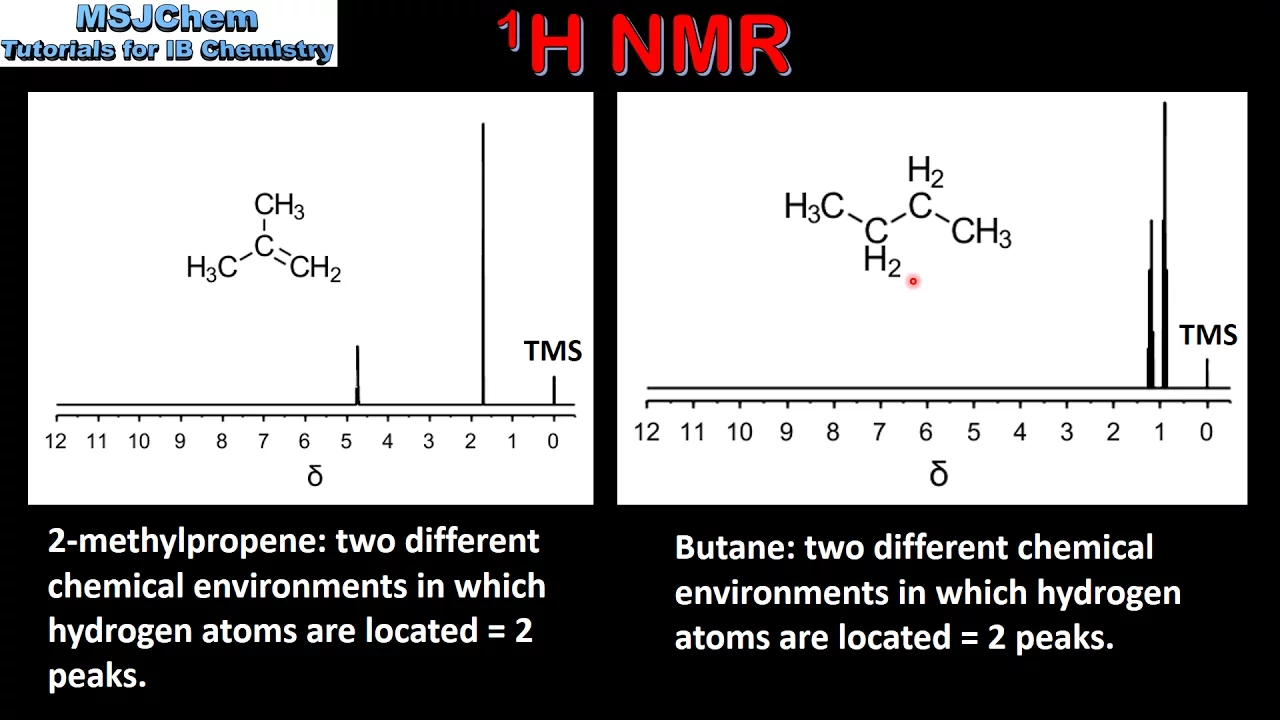
10:06
1H NMR: Determining Number of Peaks from Structure
@MSJChem
59.2K views•2017-04-06

17:31
Edible Water Bottles: A DIY Guide to Sodium Alginate Spherification
@ryan
10.5M views•2019-06-21
Related Study Plans & Knowledge Roadmaps
Structured learning paths in Chemistry
chemistry
Nuclear Chemistry: Decay, Meds & Fuel Cycle
01Introduction to Nuclear Structure and Radioactivity
02Decay Dynamics and Kinetics
03Radiation Interaction and Detection
+ 2 more learning modules
24h5 modules
Explore Roadmap
chemistry
Supramolecular Chemistry: Forces & Machines
01Foundations of Chemical Bonding and Intermolecular Forces
02Introduction to Host-Guest Chemistry
03Thermodynamics and Dynamics of Self-Assembly
+ 2 more learning modules
16h5 modules
Explore Roadmap
chemistry
Photochemistry: Excited States & Reactions
01Foundations of Light-Matter Interactions
02Molecular Orbitals and Electronic States
03Photophysical Processes and Jablonski Diagrams
+ 2 more learning modules
18h5 modules
Explore Roadmap
chemistry
Coordination Chemistry: Bonding & Properties
01Introduction to Transition Metals and Ligands
02Crystal Field Theory (CFT) and Geometry
03Magnetic Behavior and Spin States
+ 2 more learning modules
14h5 modules
Explore Roadmap