

















![[QUÍMICA VERDE] DISCUSSÃO DOS EXPERIMENTOS (TURMA 2022)](https://i.ytimg.com/vi/tBAD497icmM/maxresdefault.jpg)


![Lec-01: রাসায়নিক পরিবর্তন [গ্রিন কেমিস্ট্রি, E-Factor, Atom Economy, Question Bank Solve]](https://i.ytimg.com/vi/OHZD7V-rqBA/maxresdefault.jpg)
Aspirin (acetylsalicylic acid) is synthesized from salicylic acid through acetylation using acetic anhydride and concentrated sulfuric acid as a catalyst, followed by crystallization and recrystallization purification, with product verification achieved through iron(III) chloride testing that distinguishes aspirin (no color change) from salicylic acid (turns purple).
How to Synthesize Aspirin: Organic Chemistry Lab Procedure
Added:Understanding of organic functional groups, specifically phenols, esters, and carboxylic acids.
The reaction mechanism of nucleophilic acyl substitution, particularly acetylation using acetic anhydride and an acid catalyst.
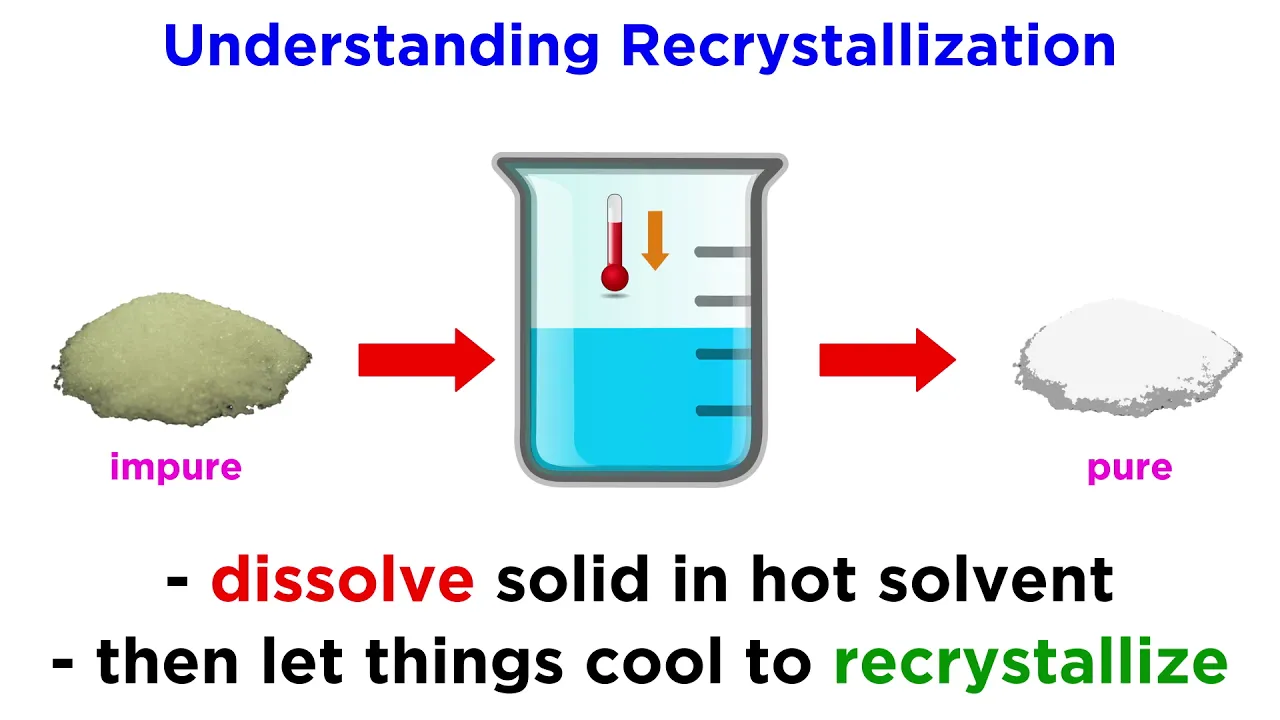
The thermodynamic principles behind recrystallization, including temperature-dependent solubility and solvent selection.
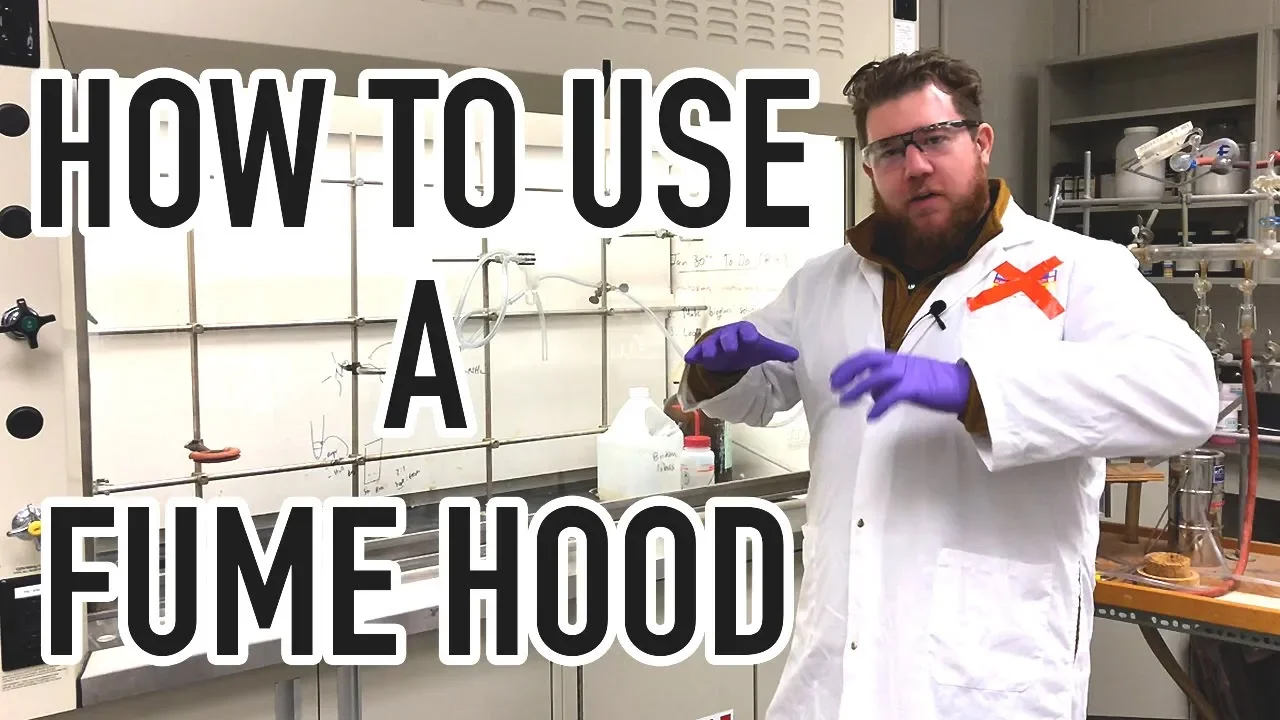
Standard organic laboratory safety procedures and equipment, such as vacuum filtration setups and chemical fume hood usage.
Characterization of the synthesized aspirin using analytical techniques like Infrared (IR) Spectroscopy and Proton NMR.
Quantitative analysis of the reaction's success, including calculating theoretical/percent yield and determining melting point to assess purity.
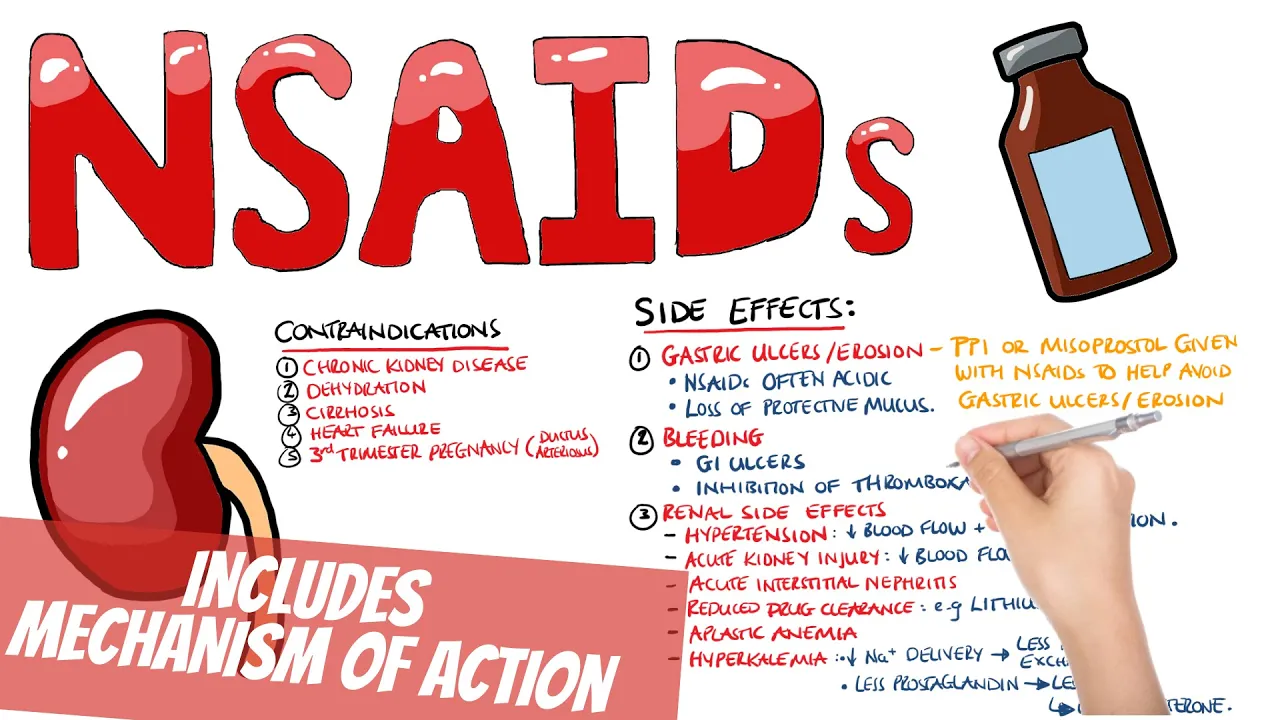
The biochemical mechanism of action of aspirin (acetylsalicylic acid) as a non-steroidal anti-inflammatory drug (NSAID) inhibiting COX enzymes.
Alternative synthetic pathways and green chemistry principles applied to esterification reactions to reduce hazardous waste.
117.8K views2.6Klikes7:54Original Release: 2023-04-12
We’ve gone over a number of laboratory techniques in this series.
But now it’s time to do something different.
We are going to do an actual organic synthesis.
We are going to build an organic molecule.
As we have discussed in the lecture series, a big part of organic chemistry involves pathways that scientists have used over the years to synthesize specific organic molecules.
These are used to synthesize everything from biomolecules to industrial materials to drugs.
Today we will synthesize aspirin.
Aspirin is a drug used to reduce pain and inflammation, which we covered in detail over in the pharmacology series.
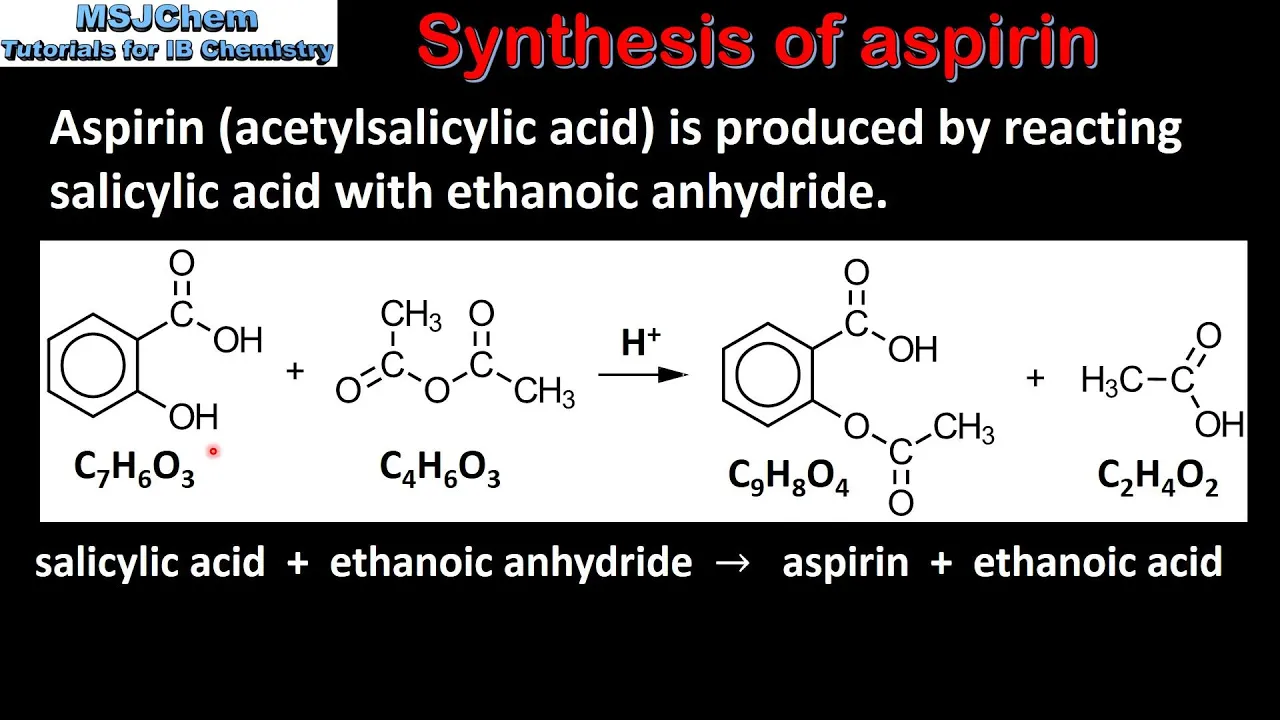
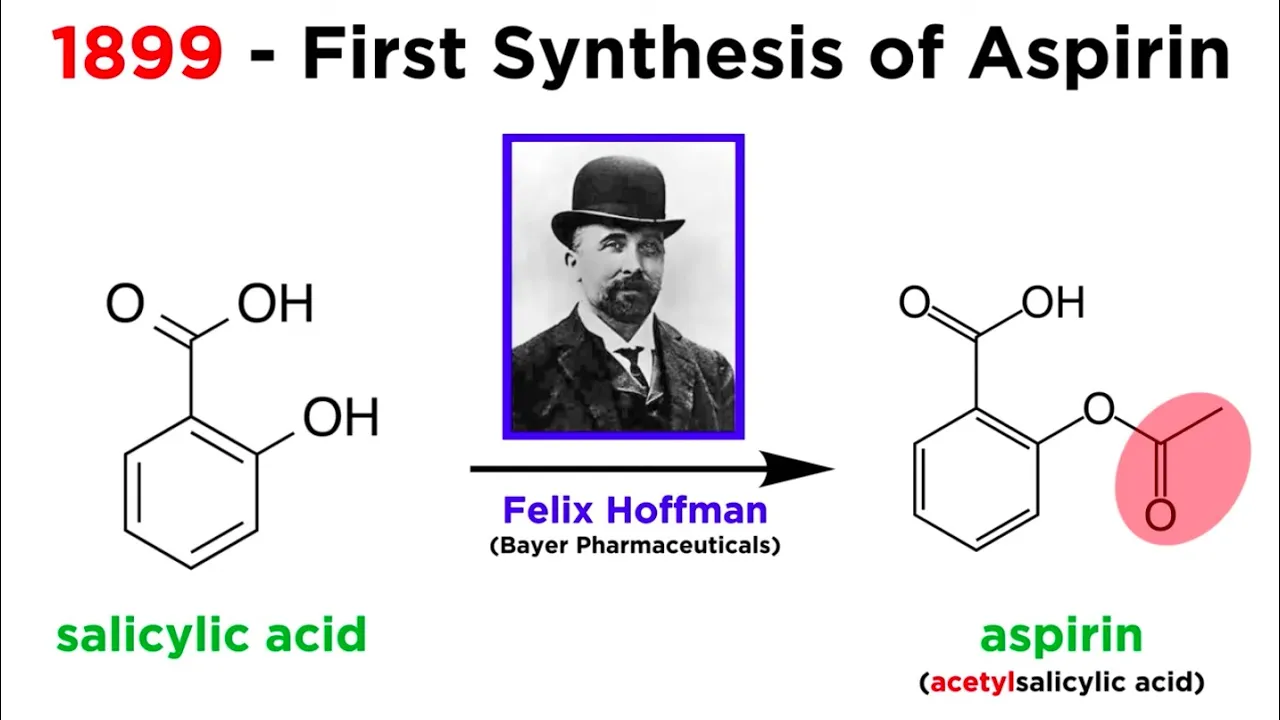
Aspirin’s chemical name is acetylsalicylic acid, and it is synthesized quite easily in one step from salicylic acid.
As you can see in this scheme, we can convert salicylic acid to acetylsalicylic acid by reacting with acetic anhydride to introduce the acetyl group.
The hydroxyl group on salicylic acid attacks protonated acetic anhydride to pick up the acetyl group.
This is what we’re doing in the lab.
We’ll add the anhydride to salicylic acid, use a strong acid as a catalyst, and heat the reaction to completion.
We’ll then perform crystallization steps to isolate and purify our aspirin.
To finish, we’ll use a simple qualitative test to see whether or not we have made and purified aspirin.
Reagents will include ethyl acetate, an irritant, and sulfuric acid, an extremely strong acid, so make sure you are using all the appropriate safety gear and precautions.
To start, let’s set up a hot water bath.
We’ll put water in a 500 milliliter beaker and start heating it on a hot plate.
While that heats, let’s prepare our reaction.
We’ll put about 2 grams of salicylic acid in a 125 milliliter Erlenmeyer flask, making sure to record the precise mass on our datasheet.
Let’s add 5 milliliters of acetic anhydride to the powder.
Let’s also add 5 drops of concentrated sulfuric acid.
Swirl the mixture to make sure that everything is well mixed.
We’re now ready to heat our reaction vessel.
To get even heating, we’ll dip our flask in the hot water beaker, instead of putting it directly on a hot plate.
To do this, let’s use a ring stand and a clamp to secure our flask.
Heat the water until it reaches around 80 or 90 degrees Celsius, and then leave the reaction flask partially submerged in the hot water for about 10 minutes.
With our reaction complete, let’s take it out of the hot water.
We’ll then let our solution cool down to room temperature.
Aspirin crystals should start to form as the solution cools down.
As we covered in the recrystallization tutorial, you can use a glass rod to scratch the sides of the beaker to initiate crystallization if necessary.
The glass particles scratched off will provide a surface for crystals to start forming.
If you still do not see crystals, add about 10 milliliters of cold water to the reaction mixture.
This will halt the reaction.
To make sure all the crystals have been formed, let’s dip our beaker in an ice water bath.
Leave it there for 10 minutes.
That should be enough for all the crystals to form.
After we’ve formed aspirin crystals, let’s collect them by vacuum filtration.
Place some filter paper in the Büchner funnel, and then add the solution.
Be sure to rinse the flask with cold water to get all of the product out, and also to wash with water to remove impurities.
Let’s run the vacuum for a few minutes to make sure that everything is dry.
Let’s then collect our product in another vessel.
We’ll make sure to save all our product by rinsing the filter paper with ethanol into our beaker.
Even though we’ve collected our product, it is not totally pure.
This is because it still has trace amounts of the starting materials.
We’ll have to perform recrystallization to purify our product.
Let’s start by dissolving the impure aspirin in 5 milliliters of ethanol.
While we do that, let’s heat up some water on our hot plate.
We’ll then add 50 milliliters of hot water to the crude sample.
This will start to dissolve.
Let’s then add the vessel to the hot plate and start adding more solvent.
After everything has dissolved, it is time to recrystallize.
Let’s take our vessel off of the hot plate and place it at room temperature.
Over time, we’ll start to see crystals of aspirin form.
Give it time for all the crystals to form, and we can also scratch the sides to initiate crystallization.
Finally, put the vessel in an ice bath as before to make sure we’ve crystallized all of our product.
Let’s bring in the vacuum system again to dry our product one last time.
Before we do that, we’ll weigh our filter paper and watch glass, as this will be used to measure the mass of our product.
Now, let’s add the same filter paper to the vacuum system and start filtering.
Let this go for a few minutes to make sure it’s dry.
We can then put our filter paper with our product on the watch glass and leave it at room temperature to air dry, or use the oven at 65 degrees Celsius for 20 minutes.
After you get a dry product, let’s place it on a scale to weigh it.
The mass of your purified sample is calculated by taking this number and subtracting the mass of the watch glass plus the filter paper that you measured earlier.
Once you’re done with a synthesis, you have to make sure that the product you’ve made is the correct product.
In a typical chemistry lab, we use melting point analysis, IR, NMR, TLC, and more.
But today, we’ll use a simple qualitative assay to confirm the presence and purity of our product.
To do that, we’ll use iron(III) chloride.
This compound changes color from brownish-red to purple in the presence of a phenol ring.
Now, let’s look at our starting material, salicylic acid, and our product, acetylsalicylic acid.
Which one has a phenol ring?
As you can see, salicylic acid has a phenol ring and aspirin doesn’t.
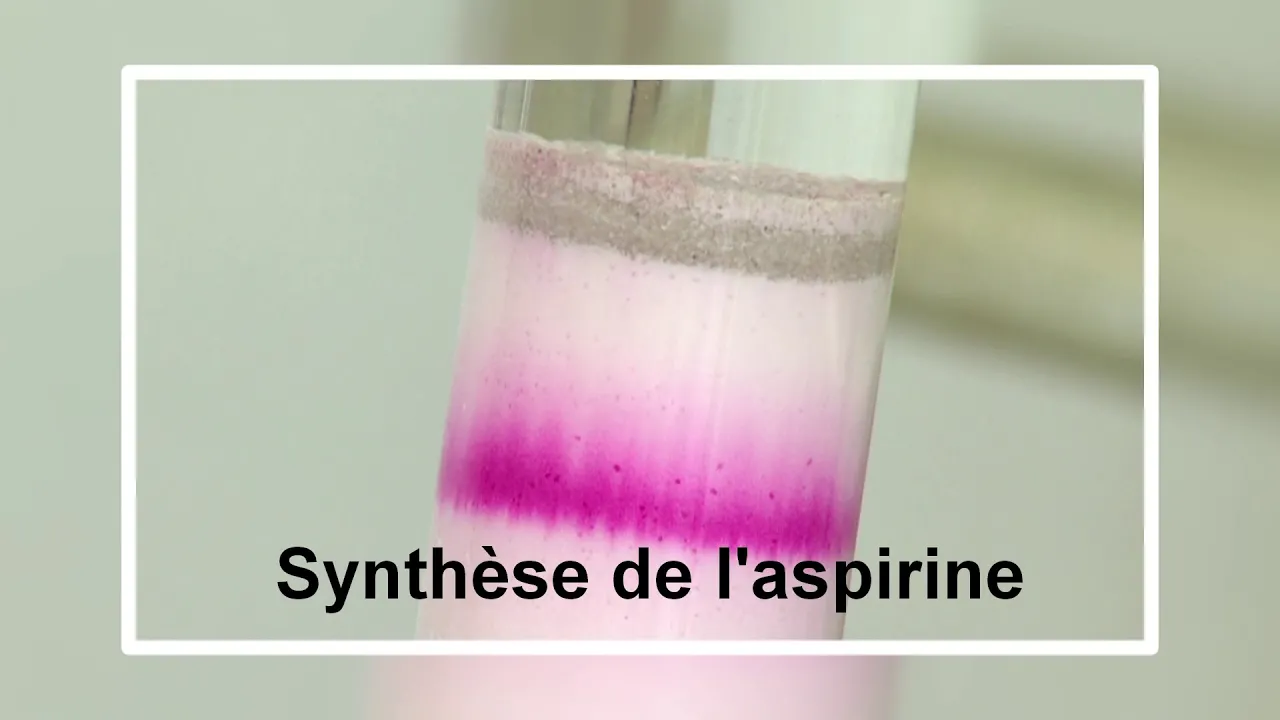
So, if we add both the starting material and our product to tubes and introduce iron(III) chloride, the salicylic acid should turn purple and aspirin should remain brown.
So if we have made and purified our aspirin, it shouldn’t change color.
If it does, either we didn’t make any aspirin, or we’ve made it but didn’t correctly separate it from the starting material.
So let’s test our products.
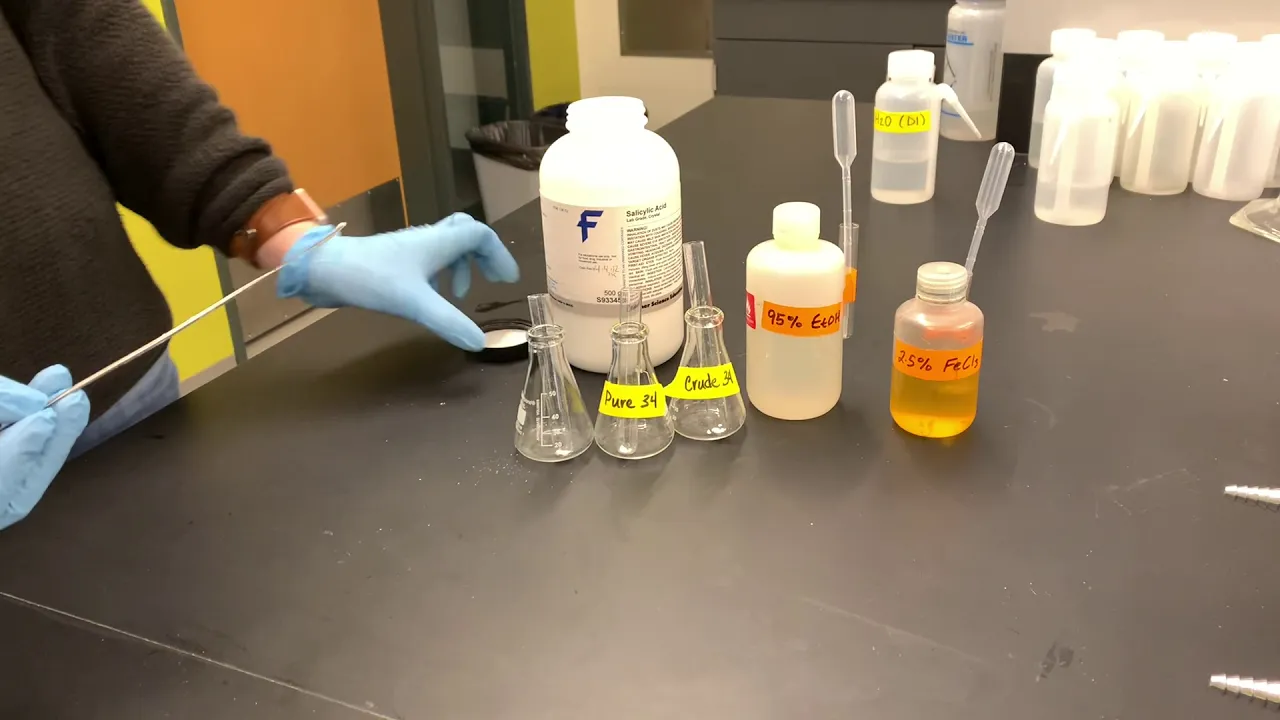
Here we have a tube of our starting material, a tube of our crude product after the first crystallization, and a tube of our final product.
We’ve also added a tube of pure water as our control to make sure that our test works correctly.
Now, after adding FeCl3 to each of our samples, let’s look at the results.
The starting material turned purple as expected.
Then the crude product may turn purple, which would mean that there is still some starting material in there.
But it may not, if the product was cleaned enough that no significant impurities reside even within the crude product.
The pure product, as you can see, is brown, which is good news.
That means that we have successfully made aspirin and adequately purified it from the starting material.
The control here is also brown, meaning that our test works as expected.
And with that you have now completed your first organic synthesis.
This is about as simple as it gets for synthesis, so hopefully we can look at much more complicated synthetic techniques in the future.
Up Next
1:25
Reverse Osmosis Process Explained: How Desalination Works
@SAWaterCorp
914.7K views•2017-05-10
83:56
Biocatalysis and Catalysis in Islatravir Synthesis | Merck Webinar
@SCIwheresciencemeetsbusiness
675 views•2020-10-08
10:54
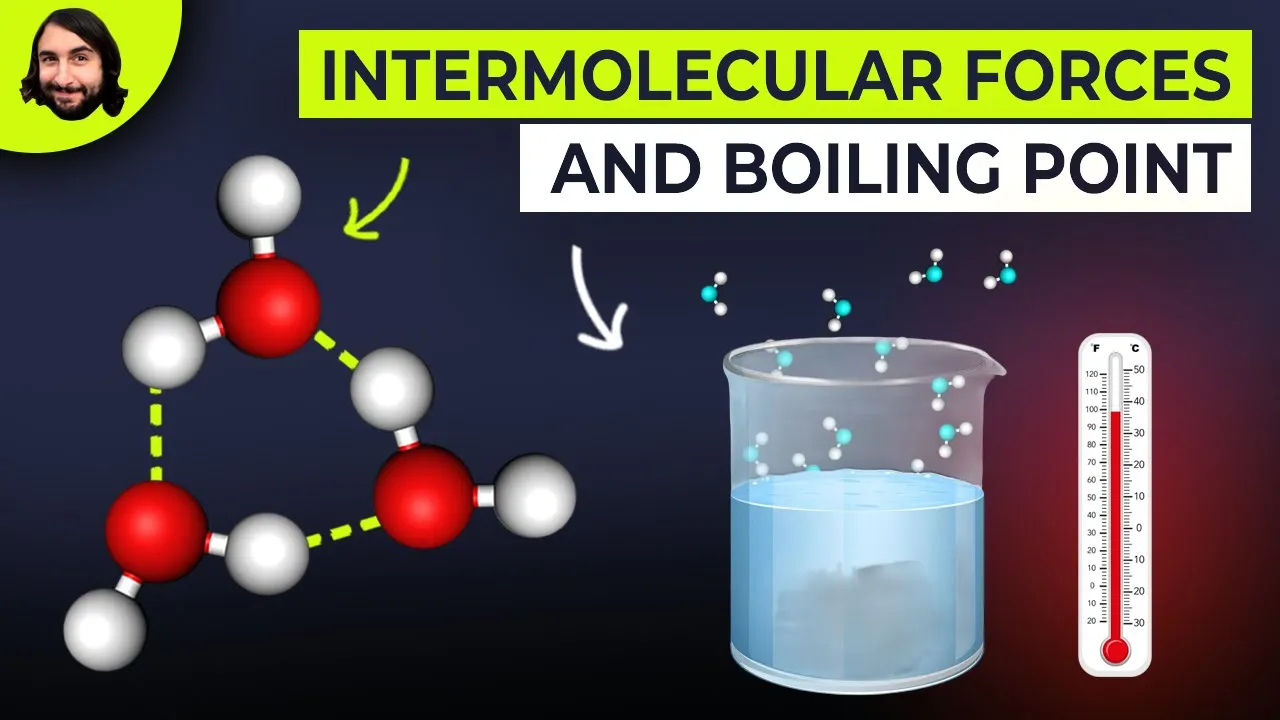
Intermolecular Forces and Boiling Points Explained | Chemistry
@ProfessorDaveExplains
2.7M views•2015-11-05

17:31
Edible Water Bottles: A DIY Guide to Sodium Alginate Spherification
@ryan
10.5M views•2019-06-21
Related Study Plans & Knowledge Roadmaps
Structured learning paths in Chemistry
chemistry
Nuclear Chemistry: Decay, Meds & Fuel Cycle
01Introduction to Nuclear Structure and Radioactivity
02Decay Dynamics and Kinetics
03Radiation Interaction and Detection
+ 2 more learning modules
24h5 modules
Explore Roadmap
chemistry
Supramolecular Chemistry: Forces & Machines
01Foundations of Chemical Bonding and Intermolecular Forces
02Introduction to Host-Guest Chemistry
03Thermodynamics and Dynamics of Self-Assembly
+ 2 more learning modules
16h5 modules
Explore Roadmap
chemistry
Photochemistry: Excited States & Reactions
01Foundations of Light-Matter Interactions
02Molecular Orbitals and Electronic States
03Photophysical Processes and Jablonski Diagrams
+ 2 more learning modules
18h5 modules
Explore Roadmap
chemistry
Coordination Chemistry: Bonding & Properties
01Introduction to Transition Metals and Ligands
02Crystal Field Theory (CFT) and Geometry
03Magnetic Behavior and Spin States
+ 2 more learning modules
14h5 modules
Explore Roadmap