









![[난제] 리만가설 / [Eng sub] Riemann hypothesis](https://i.ytimg.com/vi/Xslgz1nNcTQ/hqdefault.jpg)


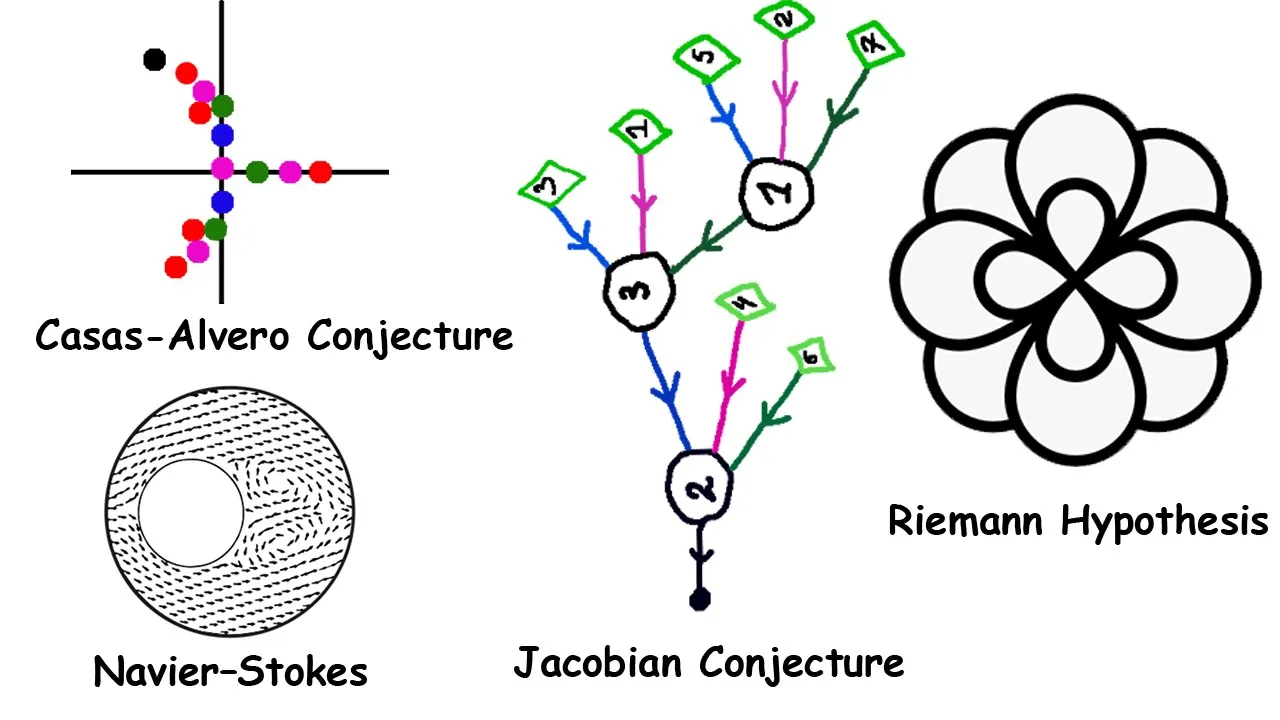

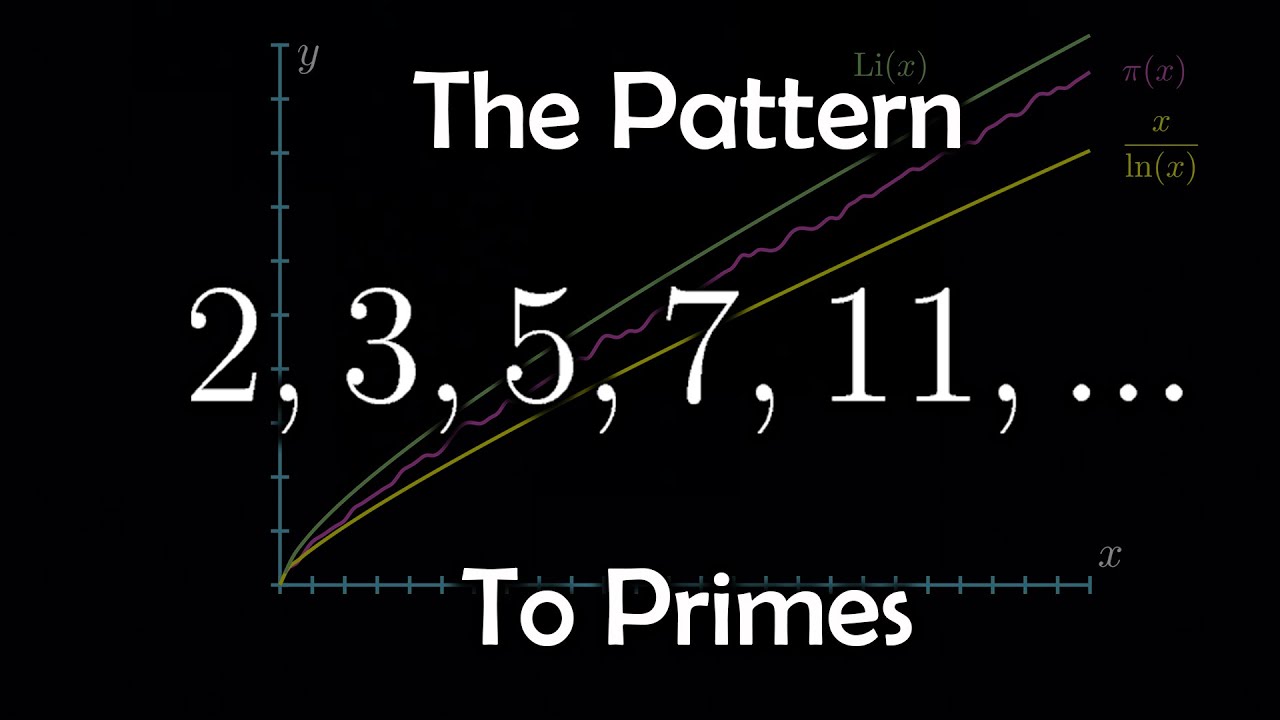





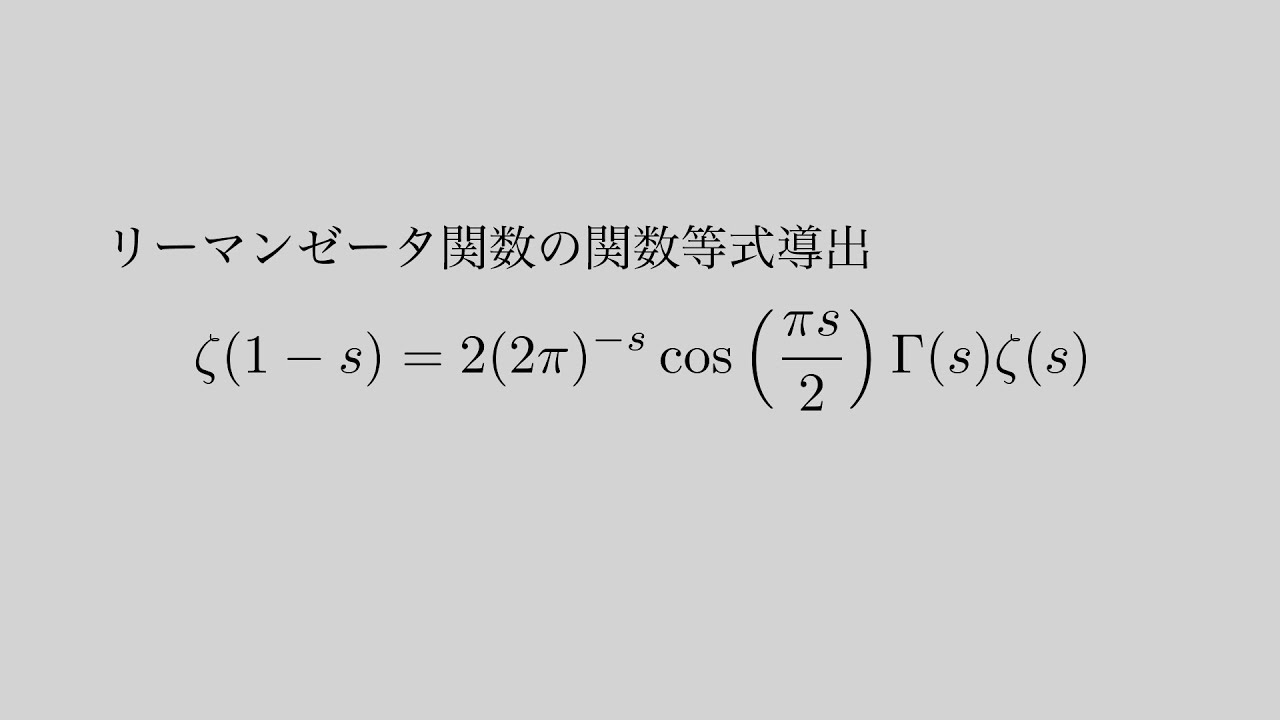


The Riemann zeta function ζ(s) = ∑(n=1 to ∞) 1/n^s converges absolutely when the real part of s is greater than 1, which can be proven using the comparison test and integral test by comparing the series to the integral ∫(1 to ∞) 1/t^x dt, where x represents the real part of the complex variable s.
Riemann Zeta Function: Convergence (Part 1) | Complex Analysis Tutorial
Added:Basic complex variables, specifically representing complex numbers and understanding the real part, Re(s).
The theory of infinite series from real analysis, including the concepts of convergence, absolute convergence, and the comparison test.
The Cauchy Integral Test, which is a key mathematical tool used to determine the convergence of infinite series.
Familiarity with the definition of the Riemann zeta function as an infinite Dirichlet series of the form sum of 1/(n^s).
Analytic continuation of the Riemann zeta function to extend its domain to the complex plane except for the pole at s=1.
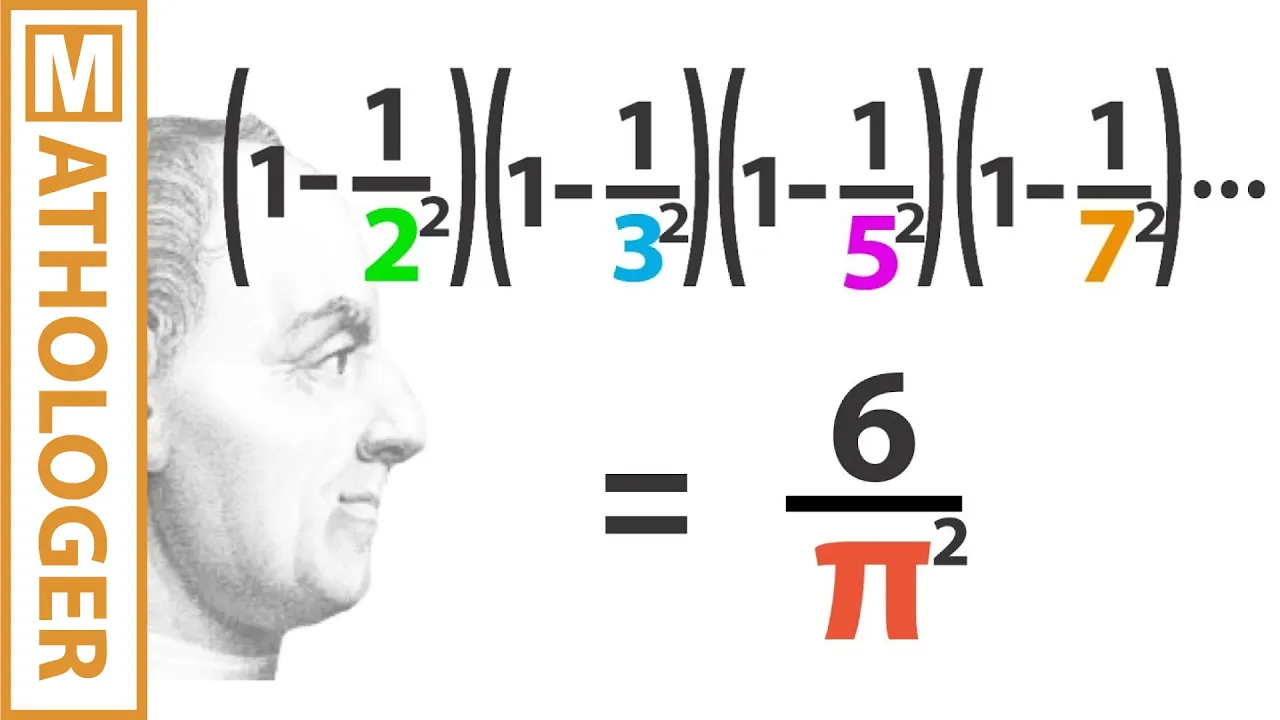
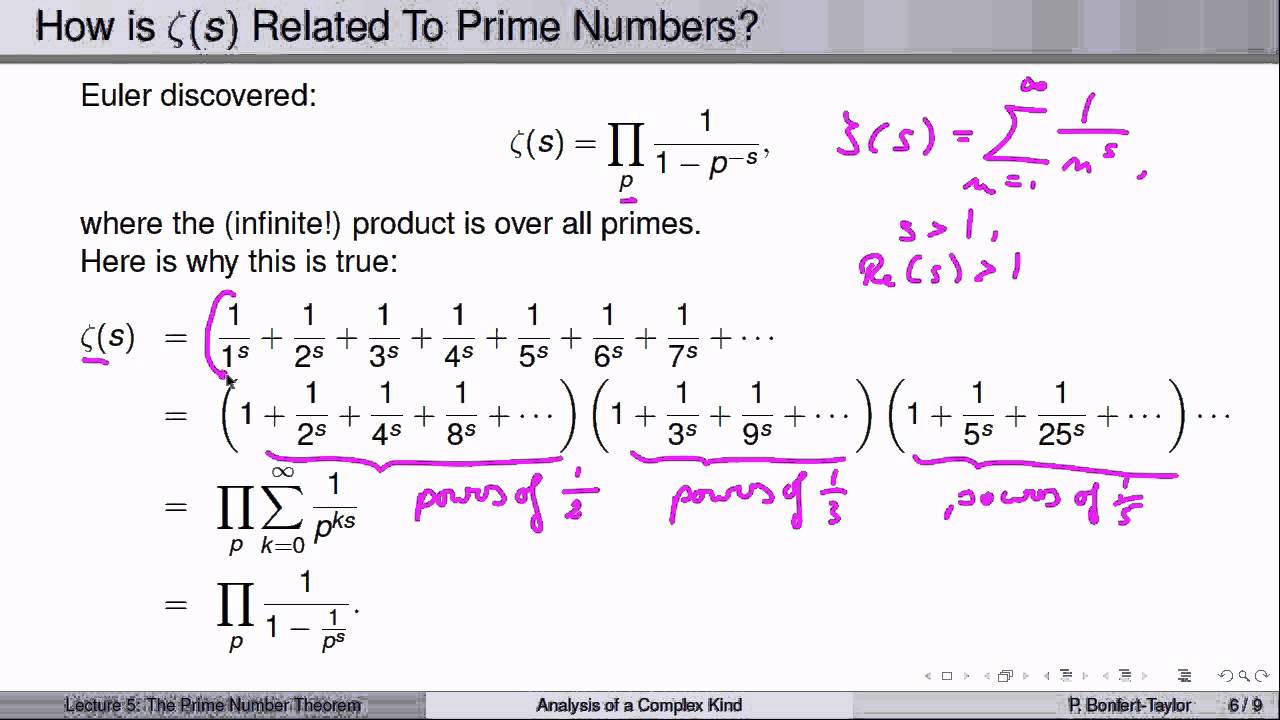
The Euler Product Formula, which establishes a deep connection between the zeta function and prime numbers.
The functional equation of the Riemann zeta function, relating its values at s and 1-s.
The Riemann Hypothesis, which concerns the location of the non-trivial zeros of the zeta function along the critical line Re(s) = 1/2.
87.9K views842likes10:52Original Release: 2012-03-08
hello and welcome to the first video in the series about the zeta function what is the zeta function the zeta function is a very important function in numerical analysis okay if you want to know more about numbers then you have to know a lot about the reman zeta function actually the most important part is about the distribution of the prime numbers okay it actually gives you a an litical way to count how many prime numbers exist until special big large number okay in order to understand this big deal question the reman hypothesis um you can actually win $1 million with that okay you can become millionaire with just using your brains and solving this 150 years old problem and um I thought about doing this uh video because I didn't found anything similar to that on YouTube so this is the reason why I will also start from the very basic stuff like convergence then we go step forward we will derive the oiler product representation and then we will jump uh until we derive the relationship between the zeta function and the uh prime number zeta function we will actually show also that the uh in the reciprocal sum of the prime numbers is infinitely large and uh results like this we will actually also calculate some values of the zeta function for odd uh not odd numbers but even numbers odd numbers are something like a big problem until today and no one knows how to calculate them and we will do a lot of stuff and um maybe at the end we will end up having the remon hypothesis and you will understand where it came from and what it actually means why it arises from this strange looking function but now I talked so much but let's just have a look at the zeta function okay the zeta function is was first defined like this okay there are many many representations for the zeta function and this was the first representation that was known it's it's a result from Oiler Oiler really work a lot on this function he tried he actually was the one who found the zeta function values for even numbers then he tried to solve for odd numbers but this is a big problem and not solve until today okay maybe you will be able to solve this but no mathematician is able to solve it um yeah actually this is the function and we want to know what is the region of convergence of this function um you might ask why is it doing such a lame thing in this first video I'll just show you how to work with the zeta function how to work with infinite sums and then you will get a feel on what we will do later on okay so let's just have a look at what I'm doing I'm taking the first step that I'm doing is I'm taking the absolute value of this okay and taking the absolute value of something and um like a sum okay if you take the absolute value of a sum then this is always smaller or equal to taking the sum over these factors and their absolute value okay this is uh called the Triangular inequality because it's coming from the sides of a triangle two sides are always longer than one side okay so this is the the origin of that now in the next step what I'm doing is I'm taking the absolute value of one giving me only one so this didn't change and now I only have in the uh denominator I have n to the S and the absolute value of that so let's just go ahead and write down what we found out we know this stuff now we want to evaluate the absolute value of n to the S but it's it's hard to take the absolute value of n to the S if you don't know what s is so I'll uh break up S this is a complex number maybe I didn't mention that this is a complex number Oiler only defined this for real numbers and now uh we will jump off or ahead and try to do this with complex numbers it was actually reman who did this this is the reason why it's called oer reman zeta function now every complex number can be written as X Plus i y okay n to the X Plus i y and I take the absolute value now these are just power course we have n to the X multiplied with n to the i y so you can separate them this is just power law and then you have the absolute value and take the absolute value of a product is equal to taking the absolute value of the factors okay this is just a formula that I'm using you can just check this out with minus1 multipli with minus one this gives you one absolute value of one and you could get it the same way by just multiplying this and actually this is the the way to prove it with minus one and so for now we have this written down here okay now this is uh the first part is pretty simple if you have a natural number and you take it to some real number what will happen is you will always end up having a real number again so this is just an exponential function which only takes positive real numbers the right hand side is a little bit harder to understand but we will do a little step in order to understand better better so this is what we had before and I'm just writing this n to the iy as an exponential okay e to the iy logarithm of n so uh actually this iy i y was on this n was the power of Z and this is just if you take uh the if you exponentiate something and then take the logarithm or the reverse order this is an identical operation okay the only problem that we would have here is that n to the iy is a complex number and uh the logarithm is not very well defined on that problems it's it's defined but we have uh problems of periodicity but actually we would only get a factor of I of something and it would not change our problem a lot so what we see here is the absolute value of e to the iy logarithm of n actually this is a complex number on the unit circle and the unit circle has an absolute value of one so this is one and we end up having found out that the zeta function has actually a smaller or equal value than the infinite sum for n = 1 to Infinity 1 / n to the X okay now you might say wow wasn't that the definition of the zeta function itself no we had here for the X we had a complex variable s so so we reduced it to the case with a real variable X now we can slam all the formulas and all the theorems that we know about real sums okay now uh this is our first result now I'm using a very very important theorem out of map it's it's called the kosi integral or I don't know how he's spelled out in American English I think uh some I heard that someone called him CI but I don't think this is right I think it's kosi because he was a Frenchman so what we are doing is actually we are using the kosi Kushi integral theor what it states is if you want to find out if a sum is converging or diverging what you have to look at is its corresponding integral okay and corresponding integral means you take the integral or instead of using uh sum you take the integral sign and you replace the N by let's say t Okay because if you plug in N equal uh so for T if you plug in the N value you will end up having all the same values okay actually this is just an approximation of the sum and if the one is converging then the other is converging and if the one is diverging the other is diverging now integrating this function is pretty easy it's 1/ 1 - x to the T 1 - x so just you can you could just differentiate and see sorry that this is true now we have this stuff and this is a little bit problematic first of all what you should should see is that X is not a or it's not allowed that X is equal to one the case that X was equal to 1 we would have the logarithm because it's 1 / tdt we would have the logarithm of T and this is diverging so we know in the xal 1 case we have Divergence now let's look at the other cases if we plug in in so if we plug in one it doesn't give us any problem we get 1 over 1 - x so this is a value that we can calculate but uh calculating in Infinity gives us a little problem okay if you have Infinity to a positive number what what will happen is that it will become infinitely large okay this will would diverge so we have to look that this part is not positive we have to make it negative and in order to have this negative if you write it down it's 1 - x shall be smaller than zero if you just rearrange then you get X should be greater than one and actually remember that X was the real part of s so we derive this equation okay the real part of s has to be greater than 1 and actually this concludes this lecture this was the first lecture and if you want to see my new videos coming up soon then please um subscribe my videos so you can see the new videos on the zeta function okay I hope you like this video and hope to see you next okay see you guys
Up Next

55:24
Analytic Number Theory: Factorials, Primes, and the Riemann Hypothesis
@zetamath
183.9K views•2020-05-28

4:43
Elliptic Curve Cryptography Explained: ECC, ECDSA, ECDH
@PracticalNetworking
28.5K views•2024-10-21
10:44
Fourier Series Introduction: The Big Idea Explained
@DrTrefor
387K views•2021-05-03

6:00
The Mathematical Impossibility of Accurate World Maps
@Vox
23.3M views•2016-12-02
Related Study Plans & Knowledge Roadmaps
Structured learning paths in Mathematics
mathematics
Tensor Calculus: Vectors to Riemann Curvature
01Mathematical Foundations: Linear Algebra & Calculus
02Covectors, Dual Spaces, and Tensor Basics
03The Metric Tensor and Index Gymnastics
+ 2 more learning modules
40h5 modules
Explore Roadmap
mathematics
Gödel's Incompleteness: Logic, Proofs & Limits
01Introduction to Formal Systems & Hilbert's Dream
02Set Theory, Cardinality, and Cantor's Diagonal Argument
03Arithmetization and Gödel Numbering
+ 2 more learning modules
14h5 modules
Explore Roadmap
mathematics
Galois Theory: Fields, Groups & Solvability
01Foundations of Abstract Algebra: Groups & Fields
02Polynomials & Field Extensions
03Splitting Fields & Symmetries
+ 2 more learning modules
24h5 modules
Explore Roadmap
mathematics
Non-Euclidean Geometry: Models & Geodesics
01Euclid's Fifth Postulate and the Birth of New Geometries
02Hyperbolic Space and the Poincaré Disk Model
03Geodesics: Defining Straight Lines in Curved Spaces
+ 2 more learning modules
15h5 modules
Explore Roadmap