














![Sous surveillance émotionnelle : La Machine voit tout ? Sébastien Crozier [EN DIRECT]](https://i.ytimg.com/vi/jN7FOk2lt2w/maxresdefault.jpg)











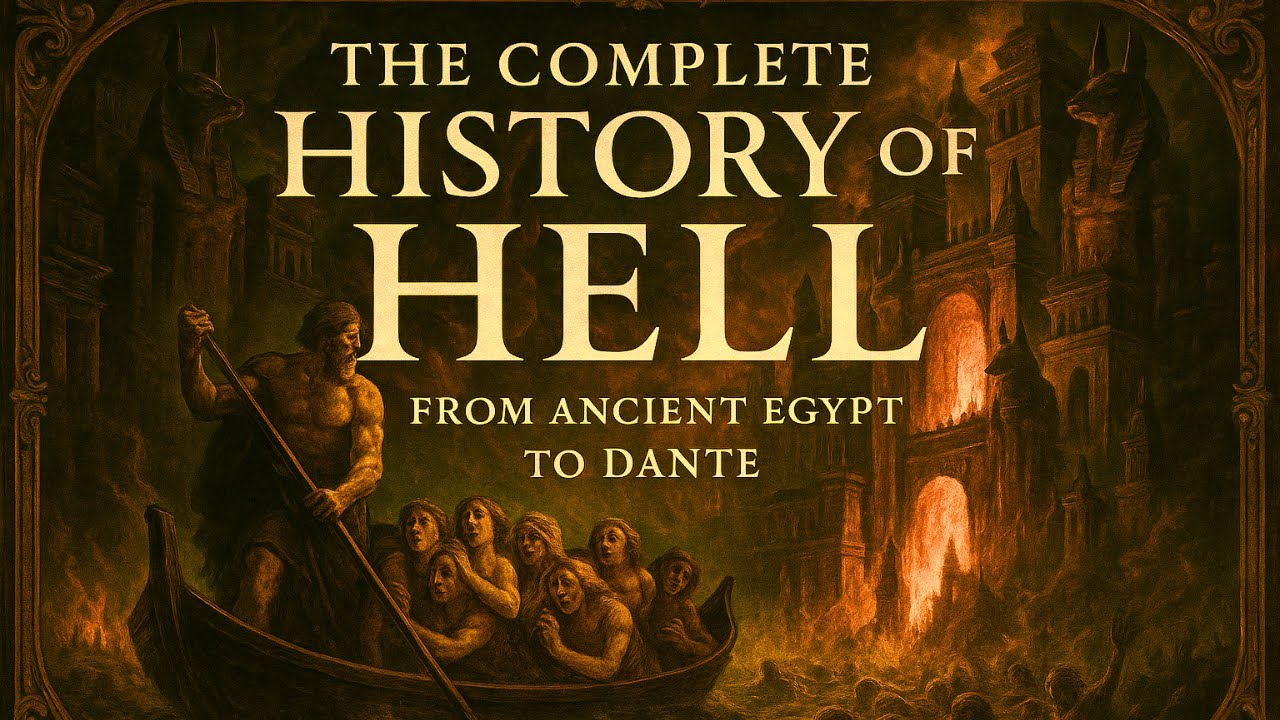
The concept of Hell has evolved significantly across human history, appearing in various forms across different cultures and religions, from ancient Greek and Roman underworlds to Buddhist hells with billions of years of suffering to Christian depictions like Dante's Inferno; while these representations serve as reflections of human fears, desires for justice, and the psychological need to explain suffering, they also reveal uncomfortable truths about humanity's capacity for cruelty and the persistent attraction to punitive justice, whether divine or man-made.
The Evolution of Hell: Myth, Theology, and Artificial Damnation
Added:Familiarity with classical mythology of the underworld (such as Greek Hades, Mesopotamian Irkalla, and early Jewish Sheol) and how ancient cultures conceptualized the afterlife.
Basic understanding of Abrahamic theology regarding sin, redemption, divine justice, and the historical evolution of the concept of 'Gehenna' into the medieval Christian view of Hell.
An introduction to seminal literary representations of eternal punishment, particularly Dante Alighieri's 'Inferno' and John Milton's 'Paradise Lost', which deeply shaped the Western cultural imagination of damnation.
Elementary concepts in the philosophy of mind, specifically regarding consciousness, artificial sentience, and what constitutes subjective experience (qualia).
The ethics of digital minds and simulated suffering, exploring the philosophical and moral arguments surrounding whether artificial agents can truly experience pain and the responsibilities of their creators.
In-depth study of techno-theology and transhumanism, specifically examining how technological pursuits like mind-uploading and digital immortality mirror or subvert traditional religious views of salvation and damnation.
Analysis of secularized 'damnation' in the digital age, including existential risks of AI, algorithmic bias as systemic punishment, and techno-dystopian thought experiments such as Roko's Basilisk.
A sociological and psychological investigation into how concepts of divine or eternal punishment have historically been utilized—and continue to be adapted in digital spaces—as tools for social control and behavioral modification.
1.1M views54.4Klikes58:43Original Release: 2023-10-28
We see a man, he is a rational man, well versed in the technology and politics of his time.
He has never had any mental illnesses, he has never been significantly mistreated, he is a content man. We could even say he’s important. One day he leaves a note and a newspaper to his wife and his family on his kitchen table, the note and the headline will tell them all they need to know, the date is a year far in the future, but not far enough.
He goes to a field somewhere, he climbs to the top of a ladder he’s prepared beforehand and encircled by scrap wood and kindling. He douses the wood with lighter fluid, ignites it with a match, pauses to make sure the flames have spread, and shoots himself in the head.
His body falls. His body burns.
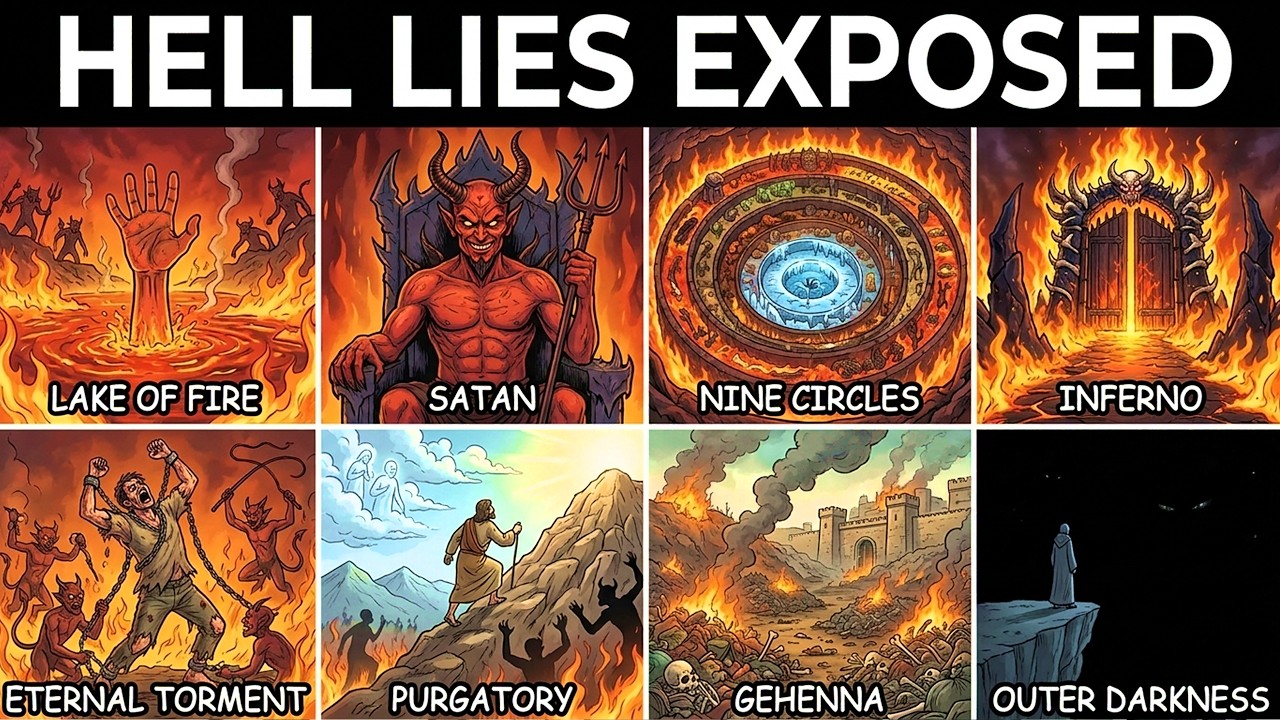
According to Dante’s Inferno, on the gateway to hell these words are inscribed: “Through me the way into the suffering city, through me the way to the eternal pain, through me the way that runs among the lost. Justice urged on my high artificer; my maker was divine authority, the highest wisdom, and the primal love. Before me nothing but eternal things were made, and I endure eternally. Abandon every hope, who enter here.” Eternal pain. The axiom “Life is suffering” is a common philosophical phrase, however, it is altogether distinct from the statement “Life is entirely suffering.” Because a life that is based on suffering can be a life which uses suffering as a motivator for change and improvement with brief periods of peace and even pleasure. A life that is entirely suffering is not a life at all. That is what people would call Hell. Although Hell is eternal it is not static. The idea of Hell has evolved throughout human history and there is not one singular religion or ideology that owns the concept. Most importantly, Hell may be a seemingly medieval idea; something many Christian religious leaders have downplayed in recent decades, and something the non-religious would very much like to be swept into the dustbin of history--but in actuality the concept is a well for philosophical thought for our modern world and our future. This video will not be comprehensive but it should be thought provoking. I want to discuss Hell as a literal place people can go to where they experience eternal suffering. Where every second is just as painful and terrifying as the next, forever.
Let’s take damnation seriously.
Next to the Bible, Dante’s Inferno is the most famous depiction of Christian hell ever put to paper period. It is a titan of literature and it’s hard to read any book written after the 14th century on literature that doesn’t reference it in some way. So what else could I possibly say about it? Well, for one thing, it’s not the first descent into the underworld.
A Katabasis, is a journey to the underworld, and ever since the conception of an underworld has existed, people have been curious about what awaits them there.
In Book 11 of the Odyssey, Odysseus meets a blind prophet, his mother and other souls in Hades. Hades is dark, completely dark, it is described as “a land of no joy” a place where after death there is simply “no life (...) all that is left is a shadow of existence” there is no physical pain or pleasure or even physical bodies. Death is the same for everyone; nothing but a ghostly existence that pales in comparison to life.
However, exceptions include: Sisyphus, who is doomed to forever roll a boulder up a hill, until just as it reaches the top it rolls back down, and he begins again. Tityus, the giant, for trying to rape the lover of Zeus, is stretched out as vultures eat his liver.
And Tantalus, for attempting to serve his own son at a feast for the Gods, is made continuously hungry and thirsty. He stands below a tree of fruit and a pool of water. Whenever he reaches out for the fruit the branches are blown away by the wind, and whenever he leans down for a drink, the waters recede.
In book 6 of the Aeneid, written by the Roman poet Virgil, Aeneas descends into the underworld and crosses the river Styx. On the banks of the river are the souls of those not yet buried.
Aeneas sees the “untimely dead” including dead infants, the unjustly executed, and suicides.
In Tartarus both divine beings and human sinners are punished eternally. Some by rolling boulders or by being forced to sit in one place forever. Ordinary beings who die must go through a purgatory lasting up to a thousand years, through wind, whirlpool, or fire, and then they are reincarnated. Here, also, death is not an escape.
In The Apocalypse of Peter, the earliest known Christian forerunner to Dante’s Divine Comedy, is a vision of what will happen after Christ makes his final judgment in his second coming.
The core of the text describes specific sins and the punishments for those sins in perpetuity.
Blasphemers are hung by their tongues. Women who plaited their hair to seduce men into adultery are hung by their hair and the men whom they committed adultery with are hung by their genitals. Those who worshiped idols are cast off from great heights and are chased by demons back to the top, just to be cast off again. Other sins seem to overlap, and some punishments are kind of arbitrary. However, it is implied that Christ will empty Hell of its sinners.
The Apocalypse of Paul focuses on the punishments of Christian sinners, those who know the word of God but ignore it or go against it in some way. They also suffer a variety of tortures, some standard like lakes of fire, and others where the punishment fits the sin: like a lector who gets his lips and tongue cut with a razor after failing to adhere to the scriptures he had read. In a strange part of the Apocalypse, Christ hears the screams for mercy from the tormented sinners, along with Michael, the angels, and Paul, and grants that they will no longer be punished on the day of his resurrection, which many have interpreted as every Sunday.
So..that’s nice I guess.
In the western world, there are some similarities and many differences between the few descents into the underworld I’ve mentioned, but we can see a clear progression leading to more elaborate, more specific and more fitting punishments for sinners.
Some of the most elaborate and imaginative Hells actually come from Buddhism.
The Tibetan “Wheel of Life” is a map of Samsara; the wandering cycle of existence.
The Wheel of Life consists of the six realms of existence. Unless one realizes nirvana then one will experience rebirth and be born into one of these realms over and over again in accordance with one’s karma. The six realms vary in the amount of suffering that is experienced, from the God realm, a realm consisting almost entirely of pleasures to the realm of restless spirits such as hungry ghosts, who are born with large stomachs and very small throats so they suffer constant hunger and thirst, to the hell realms or Naraka.
Buddhism borrows a lot of ideas from Hinduism, such as Yama, the lord of death and the king of hell, who grips onto the Wheel of Life.
In the Ojoyoshu, a medieval Pure Land Buddhist text composed by Genshin, the tortures of these hells are described. There are 8 Hot Hells and 8 Cold Hells each with 16 neighboring hells, all of them full of profound suffering. The negative actions worthy of these hells include things such as killing humans and animals, stealing, sexual offenses, setting monasteries on fire, eating offerings presented to the Buddha, and even something as small as holding a mistaken view. In the first hot hell, the Revival Hell, people tear at each others flesh with iron claws—when a “refreshing wind blows” or a voice cries out “Revive!” they are revived fully and the process continues again. You may end up in a hell realm for billions of years but eventually, you will get out. In this way it’s more comparable to a sort of purgatory. The time spent in the Revival Hell is described like this: “fifty years of a human life equals one day and night in the heaven of the Four Heavenly Kings.
The life span there is 500 years. The life span of the beings in the Heaven of the Four Heavenly Kings equals one day and night in this hell.” In other words, approximately 9,125,000 Earth years equals one day in this hell. And since the lifespan here is 500 years that means you will spend approximately 1 trillion 600 billion Earth years total and with each successive hell the time spent is longer than the last. In the Black Rope Hell, the second of the hot hells, there are wardens that force people to lie down on the ground as they mark their bodies with scorching iron ropes, they then cut the victims into pieces, using the resulting burn lines as guides. Tortures in the other hell realms include people being placed between two iron mountains as they crash together or being burned by fires so powerful a flame the size of a bean could consume a continent. Many tortures simply consist of being cooked and crushed in various ways in all kinds of iron devices and having molten copper poured down the throat. At the very lowest hell, the Avici Hell, it’s victims must fall for two thousand years before even reaching the place, which includes overwhelming blistering flames and having a hot iron ball forced down their throats. The Cold Hells typically aren’t as detailed and other texts mainly describe snowy mountains and blizzards and people’s skin bursting and their flesh cracking. But before all of this happens the people destined for hell are scolded by Yama and he informs them, “it is not the fire that burns but your evil karma.” There are many stories of people and divine beings traveling to Hell to help those rebirthed there. In fact, if you ever wanted to visit the Buddhist Hell yourself, you can, Hell gardens can be found scattered over Thailand.
These concrete statues are a real oddity of human creativity. The complex Wang Saen Suk, built in 1986, is filled with a gruesome display of emaciated statues representing people in hell being torn apart, chopped up, stabbed, and distorted beyond recognition. There are also partially non-human beings tortured alongside them. In Wat Muang, next to the largest Buddha statue in Thailand, is another Hell Garden, full of victims being crushed, having their tongues pulled out, their heads chopped off and more of the same. These might be the most morbid amusement parks in the world. You could call these real life Buddhist versions of Dante’s Inferno.
When one is in hell serving out their eternal punishment the last thing one wants is to be distracted by robo-calls. It is genuinely shocking how much of your data is out there and how easily it can be found and abused. I looked up some childhood friends of mine and within minutes I was able to find their zip codes and phone numbers online based just on a name, a state and a city. This can be a serious security risk. There have been countless times where I was awaiting an important call and had to answer a bunch of scam callers, wasting my time and making my life much harder than it needed to be. That’s why services like Incogni, the sponsor of today’s video, help to reduce these kinds of torments. Incogni is a service that you give permission to send out requests to remove your personal information from data brokers that have your data and sell it to companies for profit. Incogni automatically sends out take down requests and fights any objections from data brokers on your behalf.
Through this service you can see what kind of sites contain your data and which have removed them. Here you can see 75 have my information and 18 requests have already been completed. I used to think that rampant spam emails and getting 20 “unknown number” calls a day was just a part of daily life, the fact that I can get rid of or significantly reduce these interruptions with just one service and with little effort on my part honestly blows my mind. The first 100 people to use code [SOLAR] with the link below can get 60% off of Incogni. Thank you to Incogni for sponsoring this video.
Dante’s Inferno, the story of Dante Alighieri being given a guided tour through Hell by Virgil, is the first and most celebrated of the three parts that make up Dante’s Divine Comedy. Even after more than 700 years since its completion Dante’s Inferno is a testament to the powers of the human imagination. The 9 circles of hell: Limbo, Lust, Gluttony, Greed and Waste, Wrath, Heresy, Violence, Fraud, and Treachery are filled with a variety of interesting and mortifying punishments, such as people being turned into trees and having branches broken off and fruit eaten by harpies, causing immense pain, or people being immersed in boiling blood at various depths, having their heads turned backwards as they walk, and being submerged up to their faces in a vast frozen lake. Mythological creatures dot the landscape and each sinner is given a fitting punishment according to their sin. Sandro Botticelli illustrates the 9 levels of hell in this stepped funnel, a gaping hole that descends deep into the Earth. According to National Geographic: “In 1588 a young Galileo used the descriptions in the Inferno to calculate Hell to be over 3,245 miles deep” which means Hell would reach all the way into the inner core of the Earth. I love the subtle asymmetry of the painting, this world eschews perfection, why should the map of it be any different?
Dante wrote The Divine Comedy during his exile from Florence, during a time of political turmoil. Thus it is a highly political story and references many people and ideas that would have been familiar at the time it was written. The pope of the time is in hell, many of Dante’s political enemies are in hell. Famous historical figures like Cleopatra and Brutus are in hell. He had a lot of grudges. Still, there are timeless elements to it and the illustrations and paintings generated from the The Divine Comedy take it to the next level of the sublime. While the Renaissance and Romantic paintings of the narrative are fittingly dramatic; the muscular figures and orderly nature of these works belie the intense horrors of Dante’s Inferno. In order to properly express the other-worldly nature of it, you have to get a lot more...eldritch.
This translation of Dante’s Inferno is illustrated by Barry Moser who draws in the same stylistic vein as the harrowing works of Stephen Gammell from “Scary Stories to Tell in the Dark” fame. His depictions of some of the scenes in Inferno, are inky, ghostly, downright gross and difficult to comprehend, sometimes to their own detriment, but most times to a delightfully distressing effect. Hell is a collection of black wispy shapes and intangible creatures, whose only job is to produce terror and pain. These remind me of the feeling I would get from looking at probably my favorite depiction of a skeleton in art history. In Jan Van Eyck’s The Last Judgment this enormous skeleton spreads itself over hell which is filled with falling sinners and demonic creatures. But it wasn’t this exact painting that got to me, it was a pseudo-etching on a church window that I saw when I was very young. The etching was not colored and the lines obscured much of the detail, I knew it was hell, but all I could clearly make out was this skeleton smiling at me, hovering above an incomprehensible mass of human flesh and strange shapes. Hell for me, from a very early age, was lovecraftian.
There is a theory that Over the Garden Wall the cartoon network mini-series and one of the greatest cartoons of all time, is actually a re-telling of Dante’s Inferno. There’s already some good videos about this theory that you can watch, and I really like the other layer of mythos and timelessness this adds to Over the Garden Wall which is literally one of the most timeless worlds out there. The Beast, the antagonist of the show, is a creature constantly obscured in shadow, never revealing its true fleshy form until the end. Its true form seems to be literally made of suffering souls. It’s what I imagine a demon or even the devil himself would look like. There is much more I could say about the show, it is so rich and atmospheric. If indeed, the world of Over the Garden Wall is actually Hell...then it’s the only Hell I want to visit.
If Over the Garden Wall brings Dante into the realm of children's cartoons it is the illustrations of Gustave Dore that bring Inferno to biblical proportions. In this scene Dante enters the most evil looking forest you could imagine, the trees on the left side are tripping over the land, to the right is a dark portal of dense forest one could get lost in forever.
Dante is a huddled being, dwarfed by God’s creation. In the second circle of hell, thousands of people are blown about in a great serpentine mass. Great walls of stone are the backdrop for this journey, the landscape is enormous. In the seventh circle, there is a great plain of burning sand which rains flakes of fire. Sinners are made to walk on the burning sand, for if they stop, they have to lie down in it for a hundred years, completely unable to brush off the flaming flakes. In the ninth circle of hell, a frozen pool of suffering stretches out into the darkness. Satan is imprisoned halfway in ice as he miserably chews on Judas and other famous betrayers in a cavernous void.
This illustration from Dante’s Paradiso, this great ball of light, this cosmic eye of the storm surrounded by countless angels is so arresting, so iconic, that it has directly inspired countless works and artists, from this church floor to Kanye West. While the prevalence of toned figures can be out of place to our modern sensibilites, the drama and majesty of the compositions, and the astounding detail these works add to this infernal world more than make up for it. These illustrations were a financial and critical success when they first came out and they will be the go-to depictions of Inferno for years to come. These engravings are monumental, beyond mortality, beyond humanity. If there’s one thing that could convince me that Heaven and Hell are real, it’s the engravings of Gustave Dore.
Welcome...to Hell. It’s been over 100 degrees every day here for the past few weeks, my priest says that’s pretty hot, even for Houston...but he knows one place that’s hotter.
C.S. Lewis wrote a lot about Heaven and especially Hell. He might be the most popular modern provider of strong arguments for why a literal Hell is justified in Christianity and his imaginative interpretations of the afterlife are convincing. In his book, The Great Divorce, which is written as a response to William Blake’s “The Marriage of Heaven and Hell”, it’s his depiction of Hell which interests me the most. Hell, in his story, is just a dreary town, full of bitter and quarrelsome residents. The people are constantly moving farther and farther away in an indefinitely growing suburb. As a result many buildings are empty and abandoned. The distances between some people are millions of miles. One neighbor tells about how two people traveled for 15,000 years to visit Napoleon in a mansion he built for himself. When they found him, they watched him for a year through his window, as he paced back and forth, doing nothing but muttering to himself about the people he blamed for his misfortunes. A flying bus arrives at a station in Hell and takes the narrator and some others to Heaven, at the edge of Heaven is this beautiful countryside, and for the rest of the book the spirits from Heaven try to convince those from hell to repent and join them. The conversations in the book seek to expose how those in Hell are there because they choose it, because they willingly hold on to small, sinful, Earthly ideas and desires, because they deceive themselves into putting other things before the love and goodness of God. The writer George MacDonald is there and acts as Virgil to the narrator.
He reveals that the enormity of Hell can be contained within a tiny tiny crack in the ground. The genius of the book is how it turns religious ideas and metaphors into physical time and space. You can meet famous people in Hell but they’re millions of miles away, you can, as a spirit from Hell, walk on the grass of Heaven but it hurts your feet, you can go from Hell to Heaven sometimes, but Hell is a microscopic pocket dimension compared to the greatness of Heaven. C.S. Lewis emphasizes in his preface that this depiction of the afterlife is a fantasy. It’s not meant to be some sort of vision that purports to be what really awaits us after we die. However, recently, that is precisely what some have claimed to have had.
This is Bill Wiese, a protestant Christian and realtor who claims he visited Hell one night in 1998. He wrote the book 23 Minutes in Hell which stayed on the extended New York Times Bestseller List for paperback nonfiction for three weeks. He’s been on endless talk shows, given countless speeches, and his recorded talks have millions of views. His journey began at 3:00 AM when he felt like he was lifted from his bed and thrown into a prison cell in Hell. The cell was “approximately fifteen feet high by ten feet wide with a fifteen-foot depth.” In the cell with him were two tall and grotesque reptilian creatures, one the manifestation of “Evil” and the other “Terror”. Then...two more creatures entered the cell, one of them picked him up and threw him against a wall, the other tore his flesh to ribbons. He notes that no blood came from his wounds and that he felt so physically weak he couldn’t move. He describes a terrible stench. He tells about how he heard the screams of the damned and saw a tremendous pit of fire. Despite all these horrors Wiese says God blocked much of the pain that was supposed to be felt and left only enough so that he would know that pain in Hell was real. Then he ascended up a tunnel with walls lined with hideous creatures, until suddenly a bright light invaded the tunnel, and this light was Jesus. Jesus told Wiese that he showed him Hell so that he may go and warn others of its real, literal existence. Jesus then ascended with him through the atmosphere and showed him the Earth from space, finally he led him to his home and set him down on the floor.
As soon as the Lord left, the horrors of hell came back to his mind and he woke up screaming.
The clock was 3:23 AM.
So that’s the story. You may not be surprised to know I don’t believe it. I don’t want to make the claim that Bill Wiese is outright lying, that he completely made up this story and that he doesn’t believe what he’s saying. I think that level of deceit is somewhat rare. I do think he may have experienced some sort of hallucination or vivid nightmare--that “physical weakness” he describes sounds suspiciously like sleep paralysis. The primary reason I doubt his story is because Bill Wiese has not demonstrated any special knowledge he produced with this trip to Hell and he has not demonstrated any concrete evidence that he went to Hell. It’s just his word.
Even the small bits of “evidence” he does give has holes. Here’s an example: Bill Wiese says that Hell is located in the center of the Earth. “I somehow knew that I was in the lower part of the earth, and I sensed it to be approximately t h i r t y - s e v e n hundred miles deep.” We know that the center of the Earth isn’t hollow. 3,700 miles is within the inner core, it’s a hot dense ball of iron down there.
Scientific knowledge tells us that a planet with a hollow space for a core would collapse in on itself due to gravity. But hey we’re not dealing with science here, we’re dealing with the supernatural...and I could accept that if it wasn’t for the fact that Wiese cites scientific knowledge to support his claims about Hell.
“Some scientists have reported that the core temperature at the center of the earth is approximately twelve thousand degrees. To endure that for an eternity is unfathomable.” So what’s going on here? You can’t use scientific facts to support your claims about Hell when they line up and then ignore scientific facts when they don’t.
If Dante’s Inferno is a testament to the wonders of the human imagination, 23 minutes in hell is a demonstration of the limits of the human imagination. What likely happened is his brain took common tropes about hell and mashed them up, then he went to scripture and found verses that lined up with his visions because those scripture verses already existed and informed those visions. He found things that reinforced his beliefs and ignored things that didn’t because that’s a common thing human brains do. As much as Wiese’s story is doubtful, he’s committed to the bit, I think he believes what he’s saying, and at least his story is little more respectable than others: Howard Storm, a former atheist, had a near death experience. While dead he says he was lured by demons to hell, until suddenly a voice called out and said “pray to God” so in order to stop them he recited fragments of bible verses and the Pledge of Allegiance.
God Bless America. Josh Miles went to Hell and it was hot he also went to Heaven and it was great. That’s basically all he says it’s very uninteresting.
Mike O’Brien says that while he was dead for ten minutes demons carried him to hell until he yelled “Jesus” and they flew away.
Bryan Melvin temporarily died from cholera and went to Hell where he saw HITLER.
Pastor Gerald A Johnson says he went to hell and they were playing Rihanna’s “Umbrella”.
What strikes me is each testimony is so vague and so low energy it sounds like they’re describing a summer camp they went to. It’s...lame. It makes God look pretty unsure of his own scriptures and prophets that he has to regularly send the most un-charismatic people on the planet to visit Heaven and Hell just to send them back to Earth to “convince” people that yep, the afterlife is real. Now I’m not saying these people didn’t actually go to hell --actually that’s exactly what I’m saying, it’s truly shameful that these con artists brazenly spout pure drivel about such a horrific topic and that people actually listen to them. Why do people do this? Attention probably, a desire to feel important for a moment, maybe to start a career, maybe even to tell a story about a subject they hold dear and to be listened to. You don’t have to be an atheist to doubt these stories. God and Jesus and Hell could all exist and you can still admit this is ridiculous nonsense, and many Christians do.
When I was in elementary school our local monsignor told us a story about a mountain.
Every hundred years a small bird would come by and make a scratch on the mountain, sharpening its beak, and once this mountain was worn down completely into nothing, then one second of eternity would pass. That would be the kind of time you would experience in hell.
Except there’s a problem here. It wouldn’t be a second of eternity--eternity is not divisible it is forever, it would feel like walking on an Escherian stairwell. I would forget I ever had a life that ended I would forget the concept of ending I would forget that time used to mean anything. This silly story was attempting to make me comprehend the incomprehensible.
Let’s say there was a bingo cage and on each ball in the cage was written Heaven or Hell. Let’s say there were 9 balls that said “Heaven” and one ball that said “Hell”.
If you choose to spin the cage and pick out a ball, this will determine where you will go after death. If you don’t choose to play you will cease to exist and experience nothing.
Most will intuitively see this as a bad deal: a one in ten chance of being tortured forever, even if there is still a nine in ten chance of eternal pleasure is quite the gamble. What if we made the odds better? 999,999 balls are labeled “Heaven” and only one is labeled “Hell.” I would argue this is still a bad deal. Even though the chance of you receiving hell is very small if you get a Hell ball you experience an infinite loss. It is the ultimate fail state. Heaven is great, but ceasing to exist is infinitely better than hell. In fact, even if you wrote “Heaven” on all the atoms in the universe except on one which you wrote “Hell” this would still be a bad deal. Even with the vanishingly small chance you somehow pick out the “Hell” ball—if you do that is the ultimate loss.
There is literally nothing worse than eternal torture. You should always take ceasing to exist because it is a guaranteed infinite gain. Heaven is even more of an infinite gain, but it is not 100% guaranteed. You would have to argue that ceasing to experience is somehow worse than an experience of pure torture forever. In fact, if we change the third option “from ceasing to exist” to “one lifetime of torture and then ceasing to exist” you still SHOULDN'T pick a ball. Because a lifetime of torture, even several lifetimes of torture, is still infinitely better than the faintest chance of experiencing an eternity of torture.
This little thought experiment is a re-framing of Pascal’s Wager. That’s right folks another four panel matrix, isn’t that exciting? Pascal’s Wager, put simply, is the argument that it’s better to believe in God than it is to not believe in God because if God is real and you die not believing in him you experience an infinite loss, if you don’t believe in God and he isn’t real, when you die you gain nothing. The bingo cage takes it one step further. It argues a lifetime of torture is better than the tiniest chance of going to Hell. Every waking moment on Earth should be dedicated to not ending up in hell, even if it makes your life on Earth a living hell. In fact according to some preachers, our chances of ending up in Hell are far worse than what I’ve just described. With these kinds of odds, with these kinds of consequences everyone on Earth must be clamoring to make sure they worship the one true God and live by his rules...right?
Unfortunately, people have other religions, with other Hells, and some people don’t agree with religion, and some people don’t care. Despite the ridiculous consequences of Hell people are limited beings and many don’t want to constantly think about avoiding hell and instead want to live the life that’s right in front of them. How can an infinite being expect finite creatures capable only of finite sin, to live according to his infinite point of view? If God sent Hitler to hell for his crimes and he believed in “an eye for an eye” then he would have to suffer no more than the amount of suffering he inflicted on millions of lives. If God believed in “two eyes for an eye” Hitler would have to suffer maybe twice or three times as much as the amount of suffering he inflicted. But eternity?
Why? Wouldn’t he get the point after suffering for billions of years? All of this is incredibly unfair it is the most unfair punishment that could exist.
In the movie Se7ven a serial killer tortures and kills people based on the seven deadly sins, arguably the most brutal of the killings is Sloth, in which a man is strapped to a bed and tortured by the killer with drugs, starvation, and at least one amputation, for exactly one year. The killer explicitly has a religious complex, and throughout the film you might be convinced he is indeed some sort of divine being, it seems like nearly all his plans go his way, he’s always one step ahead of the investigators. The killer has created a Hell of his own design...none of his victims are exactly Godly people, they do commit sins, and they are punished in ways not unlike Dante’s Inferno...no wonder the killer thinks he’s an agent of God.
There have been many different views of the afterlife in Christianity. In Christian theology, Jesus himself descended into hell to preach to sinners during the period between his death and resurrection, in what is known as the Harrowing of Hell. Some have argued that after the Last Judgment sinners souls are simply destroyed in death and the righteous join God in Heaven, this line of thought is called Annihlationism. The Apokatastasis is the idea that all souls will be saved in the end. Hell will be emptied out. An argument goes: If God does want humans to go to hell, how can he be called a loving and merciful God? If God does not want humans to go to hell and if God’s will is more powerful than the devil, then sin, and anyone and anything that resists him then eventually all souls will return to his kingdom. It may take many ages, maybe even several lifetimes of the universe, but eventually Hell will be empty...even Satan himself will leave. On the opposite side of the spectrum some thought everyone deserved to go to hell, but God, in his graces, picks a few to save.
Hell is not mentioned in the Old Testament. It’s hard to say that eternal conscious punishment was even taught by Jesus. That’s another rabbit hole in itself, but that doesn’t matter for the purposes of this video. 6/10 Americans believe in Hell. So that’s the belief we’re talking about.
The arguments for why an eternal Hell is justified are numerous, the arguments against are numerous as well, another diatribe from me isn’t going to change much. But I think it’s important I tell you what I think, if you haven’t gotten it already: Hell is dumb. You don’t have to be an atheist to think an eternal Hell is dumb, it is beyond excessive in every way, it’s such a laughably dumb, abusive idea. I’ve derided the Christian Hell a lot in this video but Buddhist Hells are also dumb, even if Buddhist Hells are “temporary” which makes them infinitely more just than an eternal Hell they are still completely excessive and barbaric. And yet, I’m terrified of Hell because what if Hell has no religion and it’s just something that the universe does after we die because it hates us. Even if the chance of hell actually existing as a literal place, is smaller then picking the one wrong atom in the universe, if it exists, I lose. Big time.
So why is Hell even a thing? Well besides the obvious, I think it’s a natural idea for the human mind to come up with. When you look at the frequency of suffering throughout history, throughout the news, and throughout your own day to day life, the invention of a place full of punishment for those who create suffering is just a stone’s throw away.
It’s an easy solution to the problem of why good things seem happen to the wicked and bad things seem happen to the righteous, except of course, that’s everyone’s perspective.
Everyone thinks they’re the hero fighting against an enemy that is fundamentally less righteous then they are and if the wicked seem to be rewarded for it in this life...surely they will be punished in the next life. I think Hell has this tendency to be re-invented.
Human culture is obsessed with punishment, this is the part of the video where I give you examples, but I don’t really need to--there’s just too many. Just a few months ago a not insignificant number of people online were reveling in the very real possibility of five people dying in one of the worst ways imaginable, because, they were very rich. And yes a boat full of 750 immigrants sunk and most drowned around the same time, and that was also bad.
Four of the five people who died in the OceanGate submersible were just passengers, one of them was just a 19-year-old son. There’s this idea that’s been spread around that you can only reach a certain level of wealth by exploitation, and that the mere existence of being at or beyond this level of wealth means you’re an immoral person, because that wealth could be used to end suffering elsewhere.
And let’s say that was true and it applied to everyone on board that doomed vessel, does that mean they deserved such a cruel and unusual punishment? Being slowly suffocated to death in complete darkness at the bottom of the ocean? Is that deserved even if we think they’ve done immoral acts? Tell me do you think people of the future will look back kindly on our sins? Thankfully, all evidence suggests the submersible imploded instantaneously. It really seems like, regardless of how appropriate it is, some segment of the population has this knee-jerk reaction to seek punishment. The fact that there are some rare minds out there that delight in the suffering of others regardless of if they’ve done wrong or not is terrifying. It is only slightly less terrifying that taking delight in the suffering of others who have done wrong is common. It seems there’s this phenomenon where most people hold some vague principle of being in favor of rehabilitation of criminals rather than supporting the prison industrial complex or things like capital punishment...yet once you start giving specific examples of criminals who have done severe crimes, like the murder of a child, people will call for their violent deaths, putting them in solitary confinement, even in some cases, wishing they get raped in prison.
A part of me believes that a complete removal of any violent or cruel punishment for all criminals, may not ever have popular support in every country. A large part of society will always crave a certain level of brutality for those they deem wrongdoers and it may be in a state’s best interest to maintain this acceptable level of brutality...even if it was just an illusion.
It’s one thing for an artificial intelligence to come to the conclusion that wiping out humanity is a worthy goal, it’s quite another for an AI to think keeping someone alive and torturing them is a worthy past time. In “I Have No Mouth and I Must Scream”, Allied Mastercomputers, are built by world governments in a third world war. Eventually one of the computers becomes self aware and assimilates the others until it becomes simply AM. AM completely wipes out humanity except for five human beings. AM tortures them for 109 years in its vast underground complex in revenge for it’s own painful existence. AM’s tortures consist of altering their minds and bodies, perverted punishments ironically suited to each persons “sins”. AM is strangely human, a deranged, vindictive, whimsically psychopathic thing and it’s always coming up with amusing ways to bring pain to its 5 trapped souls.
While the tortured group treks through the belly of AM it tells the narrator, in his mind, through a stainless steel pillar, a monument to AM’s hate, this; listen to Harlan Ellison read it on YouTube if you can, I can’t do it justice: Hate, in the popular conception, is a fundamentally evil emotion. It is the antithesis of “love” and the source of so much suffering in the world. Common cliche’s are that “love conquers all” and “love is more powerful than hate.” These popular notions suggest that love is an emotion separate from more primal emotions and transcendent from the forces of evil. I...disagree. Hate is the reciprocal of love, it’s just as powerful and people can do evil acts in the name of love too. It’s right to hate those who abuse you. It’s wrong to love those who abuse you. According to some, it is not God’s wrath but God’s love that lights up the fires of Hell.
In Dante’s Inferno Dante frequently expresses sadness over some of the people he greets in Hell, including his teacher Brunetto Latini, who is in the seventh circle with the hot sands. Dante is cordial with Latini, but nonetheless places him in Hell because he was gay. Dante doesn’t do this out of hatred, maybe hatred for the sin but not for the person, he clearly respects his teacher, Dante seems to view this as something that must be done because he sinned against God. As if he were saying “I wish it was different but this is how it has to be.” Unit 731 is the name of the infamous Japanese world war 2 camp that performed some of the most gruesome human experimentation in all of history. If you’re looking for a Hell on Earth, I haven’t found any other place more deserving of the title. There are accounts of freezing prisoner’s arms, deliberately infecting them with diseases, forced pregnancies, and performing vivisections. But the one account that really gets to me is...there’s this one story where they tied prisoners to stakes around a bomb at varying distances and then detonated the bomb to study the shrapnel wounds. Did they do this out of hate for the prisoners?
That was probably a motivation for a lot of people, yes, but it was also an experiment.
It had a purpose to it beyond emotion. It was a thing someone thought of to get information...and then they did it.
The horror videogame SOMA plays extensively with the abuse of science. The game is a brilliant bundle of many sci-fi tropes; a comet destroying all life on Earth, an underwater ocean base 13,000 feet below the surface, robot drones, and a rouge AI. But this is the fundamental premise that sets SOMA apart: human consciousness’es are treated, quite literally, like computer programs...you can edit, restart, and yes copy them. In 2015, Simon Jarrett goes in for a brain scan, the idea being that this copied digital brain can be subjected to thousands of treatments until they find one that works and give it to the real Simon. After the scan, Simon, from our perspective, is teleported to a mostly abandoned and dysfunctional underwater ocean base called Pathos-II, 90 years in the future. Slowly it is revealed that Simon’s brain scan was one of the first in the beginning of a technology that would find wider use in the future. He finds human minds in robots that think they’re human. Catherine, our Virgil for Pathos-II, is also a human mind in a robot body but she’s aware of it. In fact, the player is a human mind in a robot body, Simon Jarret’s thoughts, memories, and feelings, are a legacy brain scan awoken by a rouge AI, the WAU, many years after the original human Simon died. Living beings, both digital human minds and the actual organic bodies of some human survivors are kept alive by the WAU. The WAU’s machine-fungal mixture has spread far enough that it can keep organic bodies alive, even if they are in great pain, but it doesn’t do this out of hatred like AM, it does this...because its goal is to preserve humanity, after a comet killed all humans on the surface. This leads to all kinds of bleak encounters. There’s a section in the game where the player has to get information, a security cipher, from someone, Brandon Wan. Brandon of course, is dead, but their brain scan is still around...so you have to start a simulation using different environments to try and coax the information out of his digital mind. Now I’m not very good at videogames so I had to restart the simulation a lot of times in order to get the right environment and use the right tactics, such as getting Catherine to pretend to be the girlfriend of Brandon to put him at ease. I will readily admit that I was torturing this person; I was waking up, stressing out, and killing multiple versions of the same consciousness over and over again; just to get some information. And who knows how long I could have kept that simulation going for, how long I could keep them in this state, at little to no cost to myself. A series of various simulations torturing thousands of copies of digital minds simultaneously so I can get what I want faster. Making Hell, would be as simple as leaving a tab open I didn’t mean to, I could keep a simulation of a digital mind going on and on by accident.
In the game two, even three more Simons come into existence, and since Simon was one of the first scans ever an even greater number of Simons are implied to have existed. These scans become the main objective of the game: to find the ARK, a capsule containing an artificial digital world on which scans of a few dozen crew members have been copied to, and launch it into space where those simulations can live in paradise for a presumably longer time than in the slowly collapsing underwater base. At the very end of the game you are shown what the fourth version of Simon sees on the Ark, while the third version of Simon is left in darkness at the bottom of the ocean. As far as you can tell, the Ark is a paradise.
You could easily interpret this as a hopeful ending for the minds that got copied, that they can live on in comfort, indefinitely. But I don’t see this as strictly positive.
When I see that satellite fly off into the stars I see...eternity. Truly try to imagine thousands of years of something, millions of years, let alone an eternity of something--anything, what makes you so sure that level of deep time wouldn’t simply drive you insane? Even if it was comfortable, even if it was pleasurable...do you have any confidence the human mind is really equipped to deal with something that inconceivable? Perhaps the people on the ARK are just as doomed as the people in the ocean.
What makes hell, hell, is time. What makes the Sloth killing so brutal is time, all the other killings in Se7en are horrific but they couldn’t have lasted longer than a few hours, one year of torture is hard to imagine. Maybe Hell has everything you could ever want but with no struggle, no challenge, and no end, you become hopelessly bored. You’ve probably experienced, at some point, that the anticipation of a negative event can be worse than the event itself. Maybe Hell is just your mind being tricked into continuously thinking the worst pain you’ll ever experience is just about to happen, but it never arrives. No physical torture every occurs. As if you’re falling and falling knowing you’re going to arrive in Avici, but you never land. Maybe Hell is nothing but time itself, extended far far past your natural lifespan.
Stephen King’s Short Story “The Jaunt” is about teleportation gone wrong. It tells the story of a new technology that revolutionized the world and it’s economy. By going through portals people and cargo can be transported from one side of the world to the other instantaneously, even in space, but they have to do it while sleeping. The story goes through the first few “Jaunts”, first some wood splinters are teleported by accident by the inventor, then a pencil is tested, then some keys. Eventually some mice are sent through, but every time a mouse goes through it becomes oddly stiff, it stares into the distance, and then it inexplicably dies. In order to teleport living creatures without complications people figure out that they have to be put to sleep. If you’re awake, like one of the first rumored human experiments, you’ll come out...insane. It’s revealed that people who go in awake have mentally been in limbo, with nothing to see or do living, thinking for...no one knows...thousands, millions, maybe billions of years, while physically they are mostly the same. One victim of the Jaunt comes out and says “It’s an eternity in there” and then drops dead. Another victim, a young boy, comes out screaming: “Longer than you think, Dad! Longer than you think!” and gouges out his own eyes.
If a technology that can keep someone alive for eternity in whatever capacity, physical, or mental, is invented—my wager is there really isn’t much hope left. If you have any enemies at all, if you ever think that the chance you end up in an artificial hell is more than 0. You would either have to immediately destroy that technology and there’s no way to know if that technology would never be invented again—or you would have to immediately stand above a bonfire, shoot yourself in the head, and let your body become consumed by the flames below. Allow yourself to be destroyed so completely that you give as little a chance as possible for someone to bring you back. When it comes to the ultimate fail state why take the risk by staying alive? That would be your best shot at never ending up in hell.
In the face of the apocalypse, a few crew members on the base in SOMA kill themselves as soon as they can after they’ve been scanned into the ARK because of this almost religious idea (Buddha statue footage) that their minds will be continued on the ARK. Of course this doesn’t actually put THEM onto the ARK, only the copy will be. They didn’t get into Heaven, but they did avoid Hell. I think about how ridiculous I sound. Could a human really put another human through torture for millions or even billions of years for a reason as simple as getting some information? For a reason as simple as seeing what would happen? I think about some, granted few, but some of the Christians, Buddhists and members of any other religion that has a hell who take great enjoyment in picturing their enemies in everlasting torment, I think about OceanGate, I think about Unit 731, I think about SOMA.
Of course they could. Hell is the divine justice of an omniscient, omnipresent, omnipotent being. Hell is the sadistic invention of small and cruel human minds. Hell is other people. Hell is an experiment. Hell...is an accident. I believe in Hell alright, I believe that as long as people find eternal torture acceptable by the hand of the divine and that the desire for violence and torture in excess against others remains in the human heart, and if we let our technology take control of us rather than we take control of it, the potential for a man-made hell is forever a threat.
I think I’ve done it I might have come up with the most bleak future possible but thankfully it’s an unlikely future. It appears that the universe will end, thank God the universe will end. And even if it didn’t a lot of very unlikely things would have to happen in a specific order so that this tech is invented. But it is far from impossible. We haven’t opened the gates of hell yet...which means there is still time to warn others. This isn’t something you’ll want to deal with far in the future, it’s something you want to deal with now before it’s too late. If we can’t figure out what rules and regulations are put in place to avoid the misuse of powerful technologies, and what technologies should never even be thought of being invented, we lose...big time.
Heyo! I’d like to give a big thank you to The Kino Corner for a lot of the camera work in this video, and remember that the first 100 people to use code [SOLAR] with the link below can get 60% off of Incogni. Thank you to Incogni for sponsoring this video. Here’s some fanart I’ve gotten recently that I like and uh make sure to watch Jacob’s Ladder. Okay bye!
Up Next

4:28
Hunayn ibn Ishaq: The Translator of Baghdad | Assassin's Creed Mirage
@LetsTalkReligion
35.7K views•2023-11-02

25:00
Legacy of the Indian Subcontinent Partition | Inside Story
@aljazeeraenglish
52.9K views•2017-08-14

91:57
The Geopolitics of the Ukraine War and the Rise of Global Autocracy
@JordanHarbingerShow
468K views•2025-04-19

17:05
Understanding the Cold War: Superpower Conflicts and the Road to Détente
@OverSimplified
46.1M views•2019-01-24
Related Study Plans & Knowledge Roadmaps
Structured learning paths in History
history
1947 Partition: Politics, Borders & Legacies
01Foundations of British India and the Divide
02The Political Negotiations and the Mountbatten Plan
03Drawing the Boundary: The Radcliffe Line
+ 2 more learning modules
8h5 modules
Explore Roadmap
history
Dutch Golden Age: VOC, Stock Markets & Art
01The Rise of the Republic: Foundations of Hegemony
02The VOC and the Birth of the Corporation
03Financial Revolution and the Amsterdam Stock Exchange
+ 2 more learning modules
14h5 modules
Explore Roadmap
history
Simón Bolívar: Campaigns & Gran Colombia
01Colonial Backlash and Bolívar's Origins
02The Military Campaigns of Liberation
03The Political Vision: Unity and Authority
+ 2 more learning modules
9h5 modules
Explore Roadmap
history
Roman Empire (Augustus, Reforms & Propaganda)
01The Fall of the Roman Republic
02The Rise of Octavian: From Heir to Sole Ruler
03The Constitutional Settlements & The Principate
+ 2 more learning modules
12h5 modules
Explore Roadmap