

















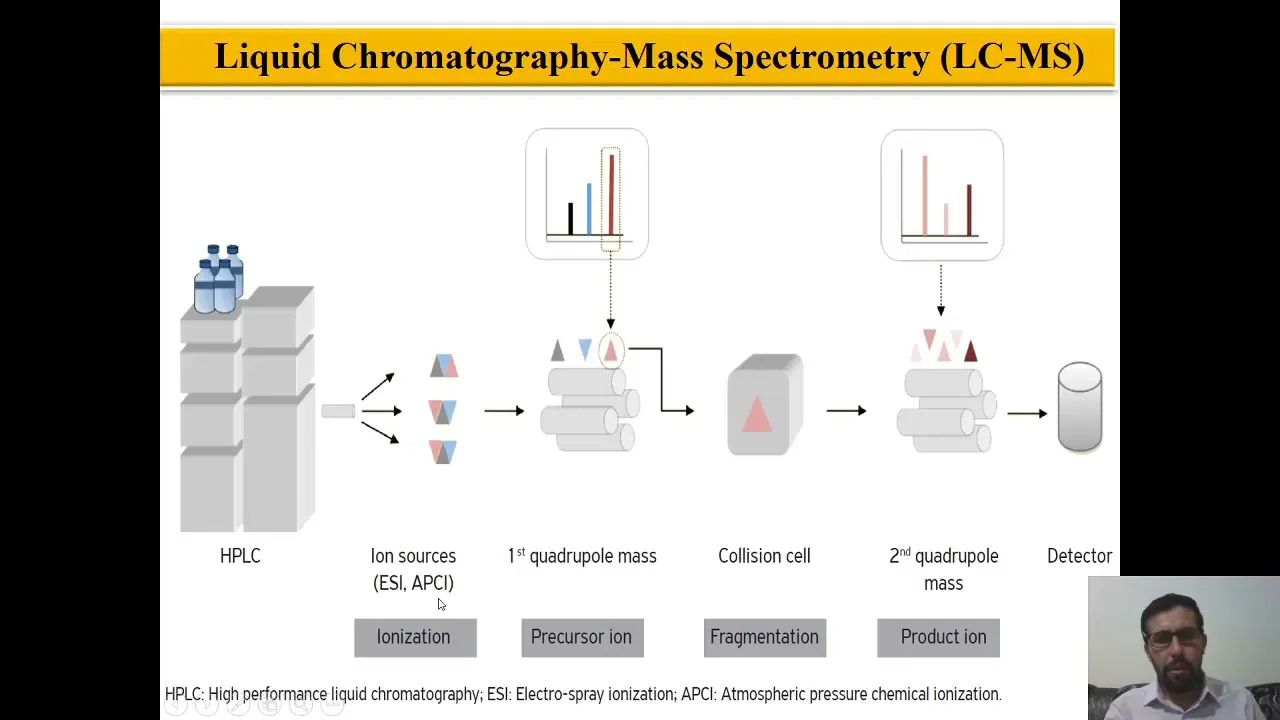
LC-MS is a hyphenation technique that combines the physical separation capability of liquid chromatography with the mass analysis capability of mass spectrometry, enabling simultaneous separation and identification of complex mixtures; the interface is crucial because LC operates in liquid phase under atmospheric pressure while MS requires vacuum conditions, necessitating specialized ionization sources like electrospray ionization (ESI) or atmospheric pressure photoionization (APPI) to convert liquid samples into gaseous ions before mass analysis, with applications spanning pharmaceuticals, biochemistry, clinical diagnostics, environmental monitoring, and forensic science.
LC-MS Interface Explained: Principles, Types, and Applications
Added:Fundamental principles of Liquid Chromatography (LC), including mobile/stationary phases, retention mechanisms, and liquid-phase elution.
Basic operations of Mass Spectrometry (MS), specifically the requirement of high vacuum environments and gas-phase ion detection.
The physical and chemical incompatibility between high-pressure liquid flows (LC) and high-vacuum gas systems (MS).
Core chemical concepts of ionization, molecular polarity, and phase transitions (liquid-to-gas vaporization).
Advanced study of specific interface types such as Electrospray Ionization (ESI), Atmospheric Pressure Chemical Ionization (APCI), and Atmospheric Pressure Photoionization (APPI).
Interface parameter optimization (e.g., desolvation temperature, gas flow rates, capillary voltage) for analytical method development.
Understanding, identifying, and mitigating matrix effects, specifically ion suppression and ion enhancement in complex biological samples.
Real-world applications of LC-MS hyphenated systems in fields like proteomics, metabolomics, forensic toxicology, and environmental analysis.
64.3K views874likes18:45Original Release: 2020-12-04
so welcome back friends today we are going to cover a very important technique analytical technique called as a lcms that is liquid chromatography Mass spectroscopy now this technique has been called as a hyphenation technique okay what do you mean by the hyphenation so hyphenation in literal terms means joining okay joining or connecting now joining means these two analytically different techniques that is liquid chromatography and mass spectroscopy have been joined by hyphen to make it a more synergistic effect because as we all know each technique that is whether it is liquid chromatography or a mass spectroscopy both have their own distinction and own jurisdiction of working and they excel in it as we all know LC that is liquid chromatography is famous for its physical separation okay so that chromatographic technique is very useful for the separation of a mixture of components and mass analysis is important to identify to identify the components of the separating mixture nistic analytical effect on a determination of unknown compounds separation as well as its structure determination so lcms is a technique that combines physical separation capabilities of liquid chromatography with mass analysis capability of mass spectrometry it is a method that combines the separation that means separation from from hlc with the detection capability of mass spectroscopy okay so that means the two capabilities of two distinct in instruments separation and detection separation of LC that is liquid chromatography and detection is of a mass will be combinely used to gain a synergistic analytical effect in lcms we remove the detector now what exactly they have done they remove the detector of a liquid chromatography okay so the liquid chromatography detector has been removed from the column and fit the column to the interface to the interface through which it is connected to the MS okay so the arrangement is like this LC liquid chromatography consist of its own detector now you just remove that detector from the column and attach a interface this is a important term interface is important because these two instruments these two analytical instruments are very distinct in their operation as well as the requirements of analytical practicals and that's why to make them compatible with each other you need a certain instruments which has a capacity to make sure that these two instruments run smoothly and simultaneously and that is the column to that interface and that interface again gets uh entered into the mass analyzer okay so this is how the instruments looks like it's simple okay in most of the cases interface used in lcms is ionization source so the ionization source which we have studied in case of mass spectroscopy are majorly used for uh interface purpose okay now what is the theory behind it we already dealt it actually hlc okay hplc is method for separation we all know separating a complex mixture into its components High sensitivity of mass spectroscopy provides the information for identification of the compounds of structural elucidation of the compound what does it means hlc is Master in separation and while Mass spectroscopy with its highest amount of sensitivity is useful for identification of compounds or structural elucidation means hlc will separate out the components of a mixture and they gets transferred to the MS that is mass spectroscopy through interface and Ms has excellent capacity or highest sensitivity to determine the structure or to identify the compound this is what the theory is all about the combination of these two technique is called as lcms at the metabolites as the metabolites appear from the ground end of the column they enter the mass detector where the solvent is removed now what is exactly the uh procedure is that as we all know liquid chromatography consist of a solvent so and mass spectroscopy do not will dealt with any amount of solvent techniques okay so you need to con this is the primary and foremost important technique in case of lcms if you want to efficient analysis by lcms you need to make sure that the total amount of solvent gets evaporated either removed and the remaining metabolites or analy needs to be ionized okay this component system looks like now when this ionized these ionized molecules enters into the mass spectrometer the ionizing molecules then sorted out and identified according to their M by Z that is Mass to charge ratio on which the whole Mass spectoscopy works we all know this so depending upon the mass to charge ratio these socalled as ionized components of the analyte or a molecule get separate out this is what the procedure looks like the instrument is look like this okay now it's not so simple that we can use hlc and Ms in tandem by just attaching themselves into the interface okay so why we need interface if anyone ask you why we need interface in case of hlc Ms or lcms so there are two distinct analytical techniques remember these two are distinct LC and Ms devices are fundamentally incompatible now why they are incompatible because the operation of hlc is in liquid phase we all know this but Ms it is of vacuum origin you need to maintain the vacuum so there are fundamental differences or fundamental incompatibilities it works at a lower temperature 25 to 50° C you need to ionize the molecules in case of mass spectroscopy so the temperature is higher around 200 to 300 or any uh dalon range of uh molecules but in case of Ms we have the distinction or a limitation that up to 4,000 dton for Quadra Mass analyzer and even for other analyzers we have studied it that uh bulky molecules or heavy molecules will not be ionized in case of mass spectroscopy inorganic buffers are required it requires volatile buffers because Ms is dealing with the gaseous components okay so you need to maintain gaseous component as well as the vacuum outside the instrument so the V volatile buffers are the requirements in case of mass spectroscopy but in case of hlc inorganic buffers are required now the next difference is 1 ml per minute is what the elant flow standard elant flow we have studied it in the hlc is equivalent to 500 ml per minute of the gas now suppose if you maintain the normal flow rate of the hlc also that is equivalent to 500 ml per minute of the gas but that is not acceptable in case of gas chromatograph sorry mass spectoscopy mass spectroscopy accepts only 10 mL 10 ml per minute and you are providing 500 ml per minute so this is the huge difference in case of hlc's output and Ms Inlet okay so these are some of the technical advantages sorry disad advantages by linking hlc and Ms and that's why interface becomes important now what what is interface now so we will have a discussion on interface lcms systems include a device for introducing sample such as hlc an interface for connecting such a device an interface is required in case of introducing the sample into the msst electrostatic lens that efficiently introduces the generat ions a mass analyzer unit that separates ions based upon their Mass to charge a ratio and a detector unit that detects the separated ions so this is what the instrumental characteristics of lcms it requires interface ion Source electrostatic lens Mass analyzer and detector unit in an lcms system however if the LC unit is simply connected directly to the MS unit the liquid mobile phase would vaporize resulting in large amount of gas being introduced into the MS unit now suppose if you directly uh attach LC with the MS without introducing interface so as we all know even in case of last topic here it is if you introduce the 1 m ml 1 ml per per minute element flow into the MS it results into 500 ml per minute of the gas and what is the actual requirement for the MS is only 10 ml per minute and you are introducing 500 ml per minute so the excessive amount of gas will be get introduced and that is not the efficient way for carrying out the operation under Mass spectroscopy okay this would decrease the vacuum level because the excessive amount of gas will leads to the fluctuation in the vacuum level and prevent the target ions from reaching the detector because vacuum is required to maintain that uh speed or the way in which that ions travel through the M analyzer and reach to the detectors and if there is a decrease or fluctuation in the vacuum level because of increase in the inlet of the gas it results in and you will not get the appropriate results okay now what are the different types of interfaces now interfaces we already covered actually these are the ion sources specifically electrospray ionization thermospray ionization atmospheric pressure ionization and atmospheric pressure photo ionization these have been dealt in the mass spectroscopy itself so we will have have a short discussion on this so the first electr spray ionization as the world suggest there is something electrons getting sprayed to generate the ionization okay so that is what the ESI what exactly the theoretical aspects of it ESI draws the sample solution to the T of capillary tube there is a capillary tube we will have a diagram also first we will let the theory part to be covered where it is applies to the high voltage remember capillary tube applies to the high voltage is the first criteria a nebulizer gas flows you need to maintain the nebular flow of the gas nebular flow is such a type of flow which results into spring spring of the sample so small droplets gas sorry solvent spray this creates a fine mist of charg droplets charge dropline m NE gas flow maintain now as the charge particles move the solvent continues to evaporate okay now the charge particle is moving uh inside the capillary tube and and that results into the evaporation of the solvent thereby increasing the electric field on the droplets on the surface when the mutual repulsive force of the charges exceeds the inside the capillary tube it results into increasing electric field of the droplets now increasing electric field means increasing charges on the droplets now as soon as the force or Mutual repulsive force on the charge exceeds the liquid surface tension as we all know spray or droplet can be intact by using the excessive amount of surface tension now if any uh Force inside the droplets get exceeds the surface tension this results into continuous breakdown of the droplets into even smaller droplets this process is called as a friction okay as this EV operation and fishion cycle is repeated droplets eventually become small enough that the sample ions are liberated into the gas space so the first evaporation then Fusion cycle then again evaporation then the fusion cycle this cycle goes on continuously resulting into a very small drop plates such that the sample is converted into the ions and liberated into the gas phase so this is how the ESI works okay this is the gas capillary where it is attached to a high power supply solvent is coming from the LC okay N2 is a carrier gas okay so these are getting nebulized nebulized means small droplet evation process start and then these so-called generated ions are generated into the inlet of a mass spectrometer gets into it now the second one is atmospheric atmospheric soal as atmospheric pressure and photo means a light okay to generate the ions the LC elent is vaporized using a heater now here the vaporization is carried out by using the heater at the atmospheric pressure as the word itself suggest it is atmospheric pressure photo ionization so heater is used at the atmospheric pressure the resulting gas is made to pass now the resulting gas the gas is generated by using heater at the atmospheric pressure now this gas is generated and this pass through a beam of photons generated by the discharge of U lamp which ionizes the gas molecules okay now what they have done they have heated heated the solvent the solvent resultant Heating in the atmospheric pressure results into a gas okay okay now this gas travels and which then again interacted with the photons of the UV lamp and then these photons generate the charge molecules which are again pass into the mass spectroscopy okay so this is what the atmospheric pressure photo ionization so the application part of the lcms uh lcms consist of a variety of domains of applications not only limited to the pharmaceutical applications it also has a biochem application some of the short uh applications I have listed it over here so the pharmaceutical applications includes a rapid chromatography of benzoin identification of bile acid metabolites in case of biochemical applications rapid protein identification using capillary lcmsms msms in Tandem and database searching clinical application High sensitivity detection of identification of aflatoxins you are must be knowing that this is a toxin generated in the food so the identification can be possible by using lcms determination of vitamin D3 in the poultry field supplements environmental applications are there detection of phal Ura herbicides detection of low levels of car carbar in the food forensic applications illegal substances toxic agents and explosives so these are some of the applications of lcms remember this technique is called as a tandom technique or hyphenation technique because LC and Ms are fundamentally different from one another and they have been attach or join by using the tandem techniques or hyphenation technique using interface hence this technique is called as lcms then there are multiple variations of this gcms is there which is also widely used use then there is msms in tandem spectroscopic method so this is all about the hyphenation technique I hope you enjoyed this video uh do like share and subscribe the channel thank you we will meet again in the next video
Up Next

21:59
LC-MS/MS Fundamentals: QqQ Technology and Method Development
@chromatographyonline
60K views•2023-01-28
83:56
Biocatalysis and Catalysis in Islatravir Synthesis | Merck Webinar
@SCIwheresciencemeetsbusiness
675 views•2020-10-08
10:06
1H NMR: Determining Number of Peaks from Structure
@MSJChem
59.2K views•2017-04-06

17:31
Edible Water Bottles: A DIY Guide to Sodium Alginate Spherification
@ryan
10.5M views•2019-06-21
Related Study Plans & Knowledge Roadmaps
Structured learning paths in Chemistry
chemistry
Nuclear Chemistry: Decay, Meds & Fuel Cycle
01Introduction to Nuclear Structure and Radioactivity
02Decay Dynamics and Kinetics
03Radiation Interaction and Detection
+ 2 more learning modules
24h5 modules
Explore Roadmap
chemistry
Supramolecular Chemistry: Forces & Machines
01Foundations of Chemical Bonding and Intermolecular Forces
02Introduction to Host-Guest Chemistry
03Thermodynamics and Dynamics of Self-Assembly
+ 2 more learning modules
16h5 modules
Explore Roadmap
chemistry
Photochemistry: Excited States & Reactions
01Foundations of Light-Matter Interactions
02Molecular Orbitals and Electronic States
03Photophysical Processes and Jablonski Diagrams
+ 2 more learning modules
18h5 modules
Explore Roadmap
chemistry
Coordination Chemistry: Bonding & Properties
01Introduction to Transition Metals and Ligands
02Crystal Field Theory (CFT) and Geometry
03Magnetic Behavior and Spin States
+ 2 more learning modules
14h5 modules
Explore Roadmap