























Consumer surplus is the total excess of marginal benefit above the price paid, calculated by summing the differences between what consumers are willing to pay (marginal benefit) and what they actually pay for each unit purchased; when a single price is set for all consumers, those who purchase earlier units receive surplus value because they were willing to pay more than the market price, while those at the margin receive no surplus as their marginal benefit equals the price.
Consumer Surplus Explained with Microeconomics Principles
Added:The Law of Demand and how to interpret a standard Demand Curve.
The concept of Marginal Benefit and the principle of Diminishing Marginal Utility.
How market price is determined through market equilibrium of supply and demand.
Basic graphical analysis in microeconomics, specifically identifying areas under and over curves.
Producer Surplus and calculating Total Economic Surplus (Social Welfare).
The concept of Deadweight Loss resulting from market interventions like taxes, subsidies, and price controls.
Price Discrimination strategies, where firms attempt to capture consumer surplus by charging different prices.
Welfare Economics and using surplus analysis to evaluate the efficiency of different market structures, such as monopolies.
588K views1.8Klikes5:01Original Release: 2012-01-05
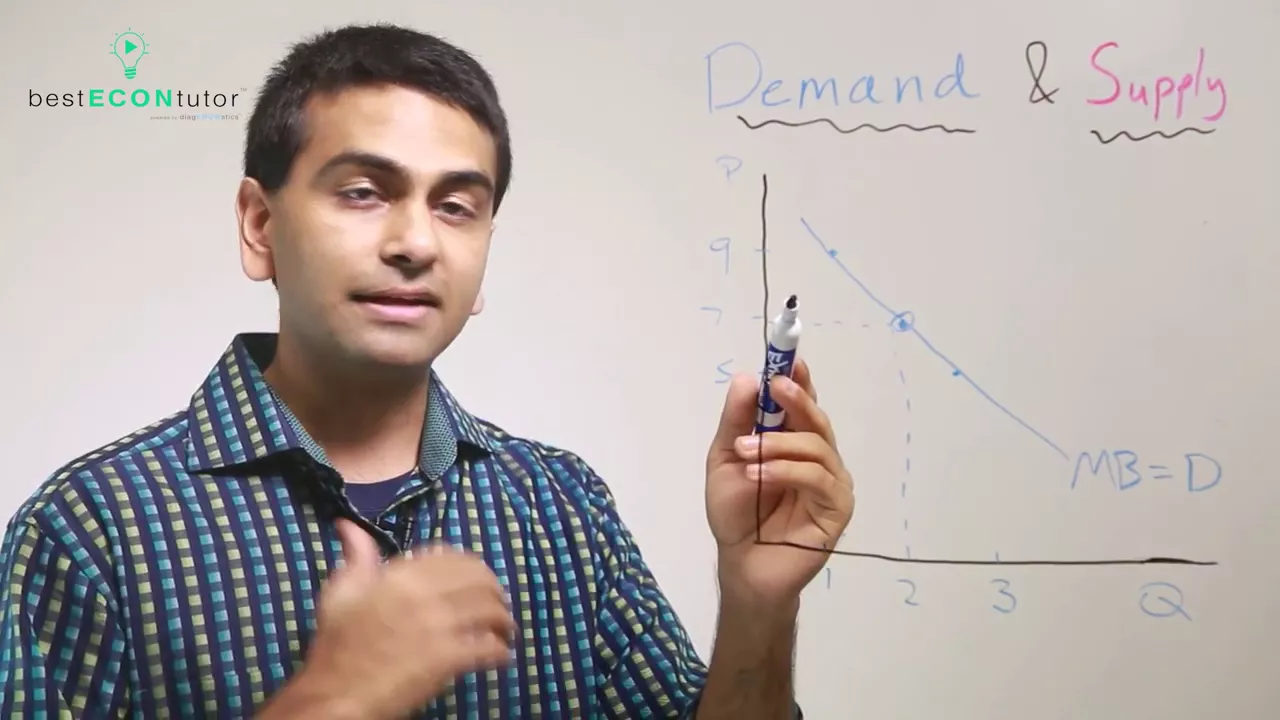
In the last video, we saw how you can actually view a demand curve as actually a marginal benefit curve.
That for any given the quantity of the good you're selling, that that point on the curve is actually showing the marginal benefit for that incremental unit.
So this is a marginal benefit for that first unit.
This is the marginal benefit for that second unit.
And there's multiple ways that you could view this, assuming that we're talking about this new car here.
Maybe if you're going to only sell one unit, someone really wants it really bad, the benefit for them, the marginal benefit for that first unit for them, is going to be $60,000.
Now, let's say if you want to sell two units, that second unit might be bought by that same person.
And they might say, well, I already have one car.
The benefit of getting that second one's only $50,000.
That's the point at which I am neutral.
That's the point at which I'm right on the fence of willing to buy that car.
Or it might be another person, another person who's just not as enamored as the first person, who says, OK, for $50,000 I do like that car.
And then for the third, the third person there, once again, they're not as enamored as the first two, they would be willing to buy it for $40,000.
And what we saw is at some point you could say, look, let's say that we decide that the price ends up being-- for whatever reason-- $30,000.
And so when the price is $30,000-- and this is kind of viewing it in the traditional notion of, at a price, what quantity were you selling it.
But when you think about that reality, what's actually happening is that this fourth person is right on the fence.
Their marginal benefit is exactly $30,000.
So in their mind, they're saying, I am giving away $30,000.
And in exchange for that I'm getting something that is worth $30,000.
So it's kind of like, hey, will you be willing to trade this dollar for a dollar?
Well, you probably would be kind of on the fence about that.
You're very close to going either way.
You feel like it's a good deal if you could get it for maybe a penny less.
It's a bad deal if you're getting it for a penny more.
So right on the fence, but you're going to just barely get this fourth person to transact at this price.
But what we hinted at is if you do have one price for everybody-- in the future we'll talk about not having one price for everybody-- but if you did have one price for everyone, these first units were kind of sold below where they could have been sold.
They were sold below their marginal benefit.
So remember, we're viewing this same demand curve we're now viewing as a marginal benefit curve.
So this first unit right over here, it could have been sold at $60,000.
But now, we're selling it for $30,000.
So this right over here, this was $30,000.
I'll just write 30 for $30,000.
The marginal benefit is $30,000 higher than the actual price.
The marginal benefit of that unit, the benefit that the market got out of it is $30,000 higher than the price.
The marginal benefit for the second unit is $20,000 higher than the price at which the product is being sold.
The marginal benefit for this third unit, assuming this is $40,000, is $10,000.
Or another way to think about it is, the consumer surplus for this first unit was $30,000.
The consumer's got $30,000 more in benefit, marginal benefit for them and value for themselves, than they had to pay for it.
Here, the consumer surplus was $20,000.
The consumer got $20,000 more in value than that second consumer was willing to pay for it.
And here is $10,000.
And then this fourth consumer is neutral.
The marginal benefit is what they paid for it.
And so when you think about this, you can say, well, what's the total consumer surplus here?
Let me write this down.
What is the total consumer surplus?
And another way of thinking about it is, what is the total excess of marginal benefit above and beyond the price paid?
So how much surplus marginal benefit did they get, if you take out the price paid?
And over here, the total consumer surplus is going to be the $30,000 for that first unit, plus the $20,000 for that second unit, plus the $10,000 for that third unit.
And so the total consumer surplus in this scenario when we sold four units at $30,000 is-- And we're assuming we're selling cars here.
So we can't sell parts of cars here.
We can't sell 1.1 cars.
I guess if we're talking about averages, maybe we could.
But let's just say we're selling just whole numbers of cars here.
The total consumer surplus in this situation was 30 plus 20 plus 10, which is $60,000.
Everything's in thousands.
So this is $60,000.
So in this scenario, in that week, the consumers would get $60,000 more in benefit for them, in perceived benefit for them, than what they actually had to pay for it.
And if you think about it, it's a little unideal for the seller, because they were selling something at a lower price than maybe what they could have gotten from at least these first few consumers here.
And that was because they, just really based on the model that we have here, they just had to set one price.
Up Next

5:03
Tax Incidence and Elasticity: Who Really Pays? | Economics Explained
@ageconjon
4.7K views•2020-09-22

21:53
Tiebout Model & Club Theory: Local Public Goods | Public Finance
@Vidyamitra
12.6K views•2016-04-14

10:27
Keynesian Cross & Multiplier: Fiscal Policy Effects
@khanacademy
218.5K views•2012-04-05

113:18
The Age of Easy Money: Fed & Inflation | Full Documentary
@frontline
21.2M views•2023-03-15
Related Study Plans & Knowledge Roadmaps
Structured learning paths in Economics
economics
Intellectual Property: Innovation vs Monopoly
01Foundations of Market Power: Monopolies & Deadweight Loss
02The Economic Trade-Off of Intellectual Property
03Patents: R&D Incentives vs. Market Monopolization
+ 3 more learning modules
12h6 modules
Explore Roadmap
economics
Sovereign Debt: Defaults, IMF & Restructuring
01Introduction to Sovereign Debt & Government Bonds
02Debt Sustainability & Credit Ratings
03Anatomy and History of Debt Crises
+ 2 more learning modules
12h5 modules
Explore Roadmap
economics
Market Design: Matching Theory & Gale-Shapley
01Introduction to Market Design and Price-Free Markets
02Two-Sided Matching & The Gale-Shapley Algorithm
03School Choice Systems and Mechanism Design
+ 2 more learning modules
10h5 modules
Explore Roadmap
economics
Impossible Trinity: Forex, Capital & Policy
01Introduction to Monetary Policy and Central Banking
02Exchange Rates and International Capital Flows
03The Mundell-Fleming Model
+ 2 more learning modules
8h5 modules
Explore Roadmap