![The Indian Constitution: Class 8 Civics Chapter 1 [Full Chapter]](https://i.ytimg.com/vi_webp/jZLxG-gCOco/maxresdefault.webp)











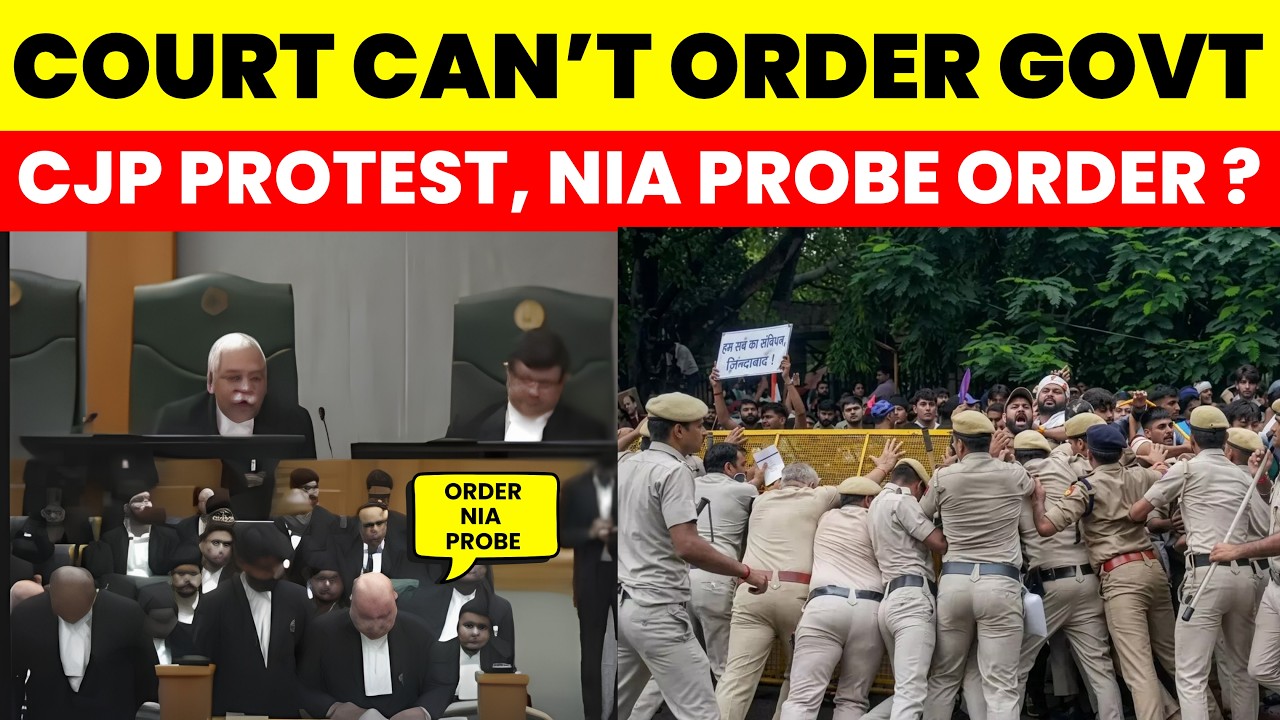





The Supreme Court's expansion into investigative powers through court-monitored investigations has created a dangerous precedent where judges gain political influence they should not possess, undermining the separation of powers and potentially creating a parallel government; judges should focus on interpreting law rather than conducting investigations, as this risks compromising judicial impartiality and the rule of law.
Judicial Overreach in India: Harish Salve on Court Power Limits
Added:The principle of Separation of Powers as outlined in the Indian Constitution, defining the distinct roles and boundaries of the Legislature, Executive, and Judiciary.
The fundamental distinction between 'Judicial Activism' (the proactive protection of citizen rights) and 'Judicial Overreach' (the perceived encroachment of courts into policy-making domains).
The origin and evolution of Public Interest Litigation (PIL) in India, which historically expanded the standing (locus standi) of citizens to approach courts on behalf of the public good.
The concept of Judicial Review (primarily under Articles 13, 32, and 226 of the Indian Constitution), which empowers the higher judiciary to evaluate the constitutionality of legislative and executive actions.
Analyzing specific case studies of controversial Supreme Court interventions, such as the national highway liquor ban or court-mandated reforms in sports administration (BCCI).
Investigating the mechanism, legality, and practical outcomes of 'court-monitored probes' by agencies like the CBI or special investigation teams (SITs) under judicial supervision.
Evaluating the systemic debate over judicial appointments in India, specifically comparing the judiciary-led 'Collegium System' with the struck-down National Judicial Appointments Commission (NJAC).
Conducting a comparative constitutional analysis of judicial power, comparing India's judicial supremacy trends with the doctrine of parliamentary sovereignty in the United Kingdom and judicial restraint in the United States.
137.4K views0likes11:54Original Release: 2025-10-25
Shall we speak freely?
>> Yes, of course.
>> Totally freely.
>> Absolutely.
>> Bindas sir today.
>> Absolutely.
>> Mumbai style bindas. I was in a bookshop. It was crossword in Mumbai.
And I remember the case. We' fought many cases of corruption in this country. And I always say that when we fought corruption, we fought corruption. There was no BJP. There was no Maadi party.
Sorry for BJP supporters. The reality is this that there was no BJP. There was no Ahmed Bi party. We fought the cases. Six or seven scams 2010 2011. And then there was a case filed against me. is a frivolous case sir. I won't go into details because then they'll reopen the case against me but the yeah they do that sir but >> but I got a call from a politician then in the ruling party who said you back off and we'll pull back this and that case against you. If you don't pull back that case against you anyway your employers will sack you.
This is reality. So I've always I'm not naming the people. What I'm saying is if we all want to be naive and think there is no link between the judiciary, exjudiciary, politicians, ex- politicians, ruling party, oppositions, it's nonsense. It's all a system of nepotism. It's operating right before our eyes. It's a system, isn't it, sir?
Speak your mind. Mr. Salv, my next subject is on judicial interference and transgression.
There is an elected government and in there is a growing belief unfortunately in our country that there is also an unelected government.
You have probably been the lone star who has been very vocal about judicial transgression. You've often said that the Supreme Court should be questioned.
Now that's very rare. Very rare. And there are people in this country I still remember and I'll say it directly in the context of former chief justice Chandraur who found and hoped that former Chief Justice Chundra Chur would be an oral parallel center of power and who used the phrase lone star or something to that effect that you are the lone star against this elected government only you can save us. There are enough people in Delhi who want the Supreme Court and there are enough people within your own legal fraternity sir who would like to see judicial overreach who would like to see the courts run a parallel government. So let me start by asking you sir your overall thoughts. You've often said Supreme Court has a misplaced position as the moral guardian and the public disappointment is often linked to its judgment. But we've seen this new phenomenon of judges speaking outside their judgments.
Judges making comments which I feel sometimes they want to be quoted. They want those in the front pages.
So shall I get your opening remarks on this?
>> Yes, absolutely. Uh if I can just take a step back. See the expansion of [snorts] judicial review was on a very intellectually robust basis affirmative justice brought in by Krishnaization of the judiciary where you open the doors of what is called locust standai or ability to move the court. Any citizen could move the court if there was a violation of citizen's rights. So that's how it went and it was very targeted to those sections of society who did not have access to justice.
That is where all this came from. When we challenged the bearer bonds law, nobody asked who is this person who's challenging the bearer bonds law. It was issues which were brought to court and issues which could be resolved by judicially manageable standards. Whether a law is constitutional or not is squarely for the court to decide. Those were the kind of issues which came.
Environmental issues. What was the big forest case which we fought? It was all for enforcement and honest enforcement of the forest conservation act.
Something which was totally within judicially manageable standards. The turn came with the giant Havala case.
The Supreme Court stepping into order investigations. The first time a court monitored investigation was held was in the giant Havala case and political heads started rolling. That gave a kind of political power to Supreme Court which had never had before.
What did it result in? 100% acquittital this has gone on again >> that because the prosecution did do a good job >> because there was no case >> I remember I was a reporter we used to stand at the sazari courts and we used to quote unquote you know find a lot of fun when kalpanat ray at that point of time even madavra sinda Mr. Adwani biggest of names would come to the court we would stand with Mike outside and there was a fervor among the people that the most powerful have been brought before the court. So wasn't that the other side of it? Wasn't it actually?
>> That's that was that's the danger.
>> What's the danger?
>> The danger is the court creating moccracy.
The Supreme Court should never try and humble people. That's not their job.
>> You think that was their intent?
>> Yeah. whether or not it gives gave them a sense of power which they have never relinquished a court monitored investigation gave rise to a whole breed of lawyers and I don't want to start naming them who then made it their business to blackmail who then made it their business to bring these issues to court and today even as we speak what is a politician most worried Not you make a set of allegations court says get a CBI inquiry. They won't say so when it's one of their own in whose house they find cash burning there. There's no CB.
>> That's the secondary issue. The the primary issue is that if a allegation is made against a politician, he should be as vulnerable as Anil Amani.
>> Correct. He should be as vulnerable as Anil Amani. For Anil Amani, have they ordered a court monitoring investigation? No. For hundreds of people, have they ordered a court on monitored investigation? No, because the law must take its course. If the Supreme Court has to work, it has to work to strengthen the working of the law, not take over these powers.
>> But isn't democracy an extreme word?
>> It is. I'm sorry. It No, that feeling that people feel that the rich and mighty have been brought to heal. There was a different reason why people felt that because the kind of politicians who had come to hold office had become arrogant. the trouble it creates and this is what I've always said you do justice on the facts of a case a crack develops in the body of the law look at then what happened next in the 2G wholesale investigations 100% equitital why because when you have a court monitored investigation the investigator feels if he tells the court look you've asked me to investigate but you know what honestly there's nothing you say oh really you've not found anything maybe you're also corrupt so he says I cover my skin I come and give you some sort of a report I know it's going to fall apart and I'll give you one stinging example now it's a matter of court sticking example >> the case against sunil mittal >> correct >> against >> sunil mittal and pramm mahajan the allegation was for the second branch pmod mahajan had given the second branch without charging a increase in the hr The record showed he had only said when the second branch is to be given a committee should be constituted. That's all that he said.
>> They went to Arun Sh and Arun Sh's credentials nobody has ever doubted and asked him were you influenced by the fact that your predecessor had said he said nothing of the sort. I examined it on merits and I thought this should be done. I have done it. He was not charged. They suppressed his witness statement >> and they brought a charge against Sunil Mit.
>> They suppressed it. Finally it got exposed in the court. That's why Sunil Mittal was let off even by the Supreme Court. So these kind of things happen in the investigation because you have to come up and say so and so has done something wrong. Why? Because the Supreme Court has ordered you to do it.
You will see this pattern in every court ordered investigation except for a few cases of coal and I don't want to commend because they're all pending in appeal in the entire 2G 100% equititals. in the entire gi 100% equals as lawyers we knew this is going to happen but in the process today if a judge today what is the politician most scared of your political career is under a cloud if a investigation is ordered who cares if after 3 years nothing is found so this has upset the balance of power and this has created a problem and we need to address this problem the justice delivery system must work the court. I can understand if it tightens up the way you appoint public prosecutors, the way you appoint independent judiciary. We were working on it. I was paying in a PIL s for reform in the police. We forget all that and you go case by case.
>> Yeah. Shall we speak freely?
>> Yes, of course.
>> Totally freely.
>> Absolutely.
>> Bindas today.
>> Absolutely.
>> Mumbai style bindas. I was in a bookshop. It was crossword in Mumbai and I remember the case. We fought many cases of corruption in this country and I always say that when we fought corruption, we fought corruption. There was no BJP. There was no Maadan Bi party. Sorry for BJP supporters. The reality is this that there was no BJP, there was no Amad Bi party. We fought the cases six or seven scams 2010 2011 and then there was a case filed against me some frivolous case sir. I won't go into details because then they'll reopen the case against me.
The yeah they do that sir but >> but I got a call from a politician then in the ruling party who said you back off and we'll pull back this and that case against you. If you don't pull back that case against you anyway your employers will sack you.
This is reality. So I've always I'm not naming the people. What I'm saying is if we all want to be naive and think there is no link between the judiciary, exjudiciary, politicians, ex- politicians, ruling party, oppositions, it's nonsense. It's all a system of nepotism. It's operating right before our eyes. It's a system, isn't it, sir?
And there are enough people in the legal fraternity who do not argue or win or lose cases on the basis of their intellect, but on other considerations. Well, if if you're saying that and that's the public perception of the court, you must remember the Supreme Court commands neither the sword nor the purse.
>> Neither the sword >> nor the purse. It has no armies. It has no treasury. The Supreme Court has only one source of its strength. Public opinion.
>> Is that so?
>> The only source.
>> Are the courts in this country comfortable with public opinion >> today? That is what worries me the most because why was it when a strong leader like Mrs. Gandhi and others strong leaders dared not disobey the court?
Why the maximum the court could do is tell tell the police saying go arrest so and
Up Next

46:29
Constitution Types: Legal vs Political Explained
@uclpoliticalscience
101 views•2026-03-05

4:27
US Secondary Sanctions Impact on EU Businesses and Blocking Legislation
@Bureauvandijk
1.6K views•2019-03-20
5:27
Forensic Phonetics: Speaker Identification in Legal Cases
@nptel-nociitm9240
539 views•2025-03-19

24:42
Police Interrogation Tactics: False Confessions & Legal Reform
@LastWeekTonight
7M views•2022-04-18
Related Study Plans & Knowledge Roadmaps
Structured learning paths in Law
law
Self-Defense Law: Imminence & Castle Doctrine
01Foundations of Self-Defense Law
02Imminent Threat & Reasonable Belief
03The Principle of Proportionality
+ 3 more learning modules
12h6 modules
Explore Roadmap
law
Defamation Law: First Amendment & Actual Malice
01Introduction to civil torts and the First Amendment
02Elements of Defamation: Libel and Slander
03Public Figures vs. Private Individuals
+ 2 more learning modules
8h5 modules
Explore Roadmap
law
Hearsay Rule: Trial Evidence & Exceptions
01Introduction to Trial Evidence & Courtroom Basics
02Demystifying Hearsay: The Core Definition
03Non-Hearsay: Exclusions Under FRE 801(d)
+ 3 more learning modules
14h6 modules
Explore Roadmap
law
Medical Malpractice: Law, Liability & Care
01Foundations of Tort Law and Civil Liability
02The Four Elements of Medical Malpractice
03Defining and Proving the Standard of Care
+ 2 more learning modules
12h5 modules
Explore Roadmap