

























The Bohr model, proposed by Niels Bohr in 1913, revolutionized our understanding of atomic structure by introducing the concept of quantized electron orbits, where electrons occupy specific energy levels around a central nucleus without radiating energy, thereby explaining both the stability of atoms and their characteristic emission spectra.
Bohr Model of Atom: Quantum Mechanics Explained | Physics
Added:Rutherford's planetary model of the atom and its stability limitations under classical electrodynamics.
Planck's quantum hypothesis and the relationship between a photon's energy and its frequency (E = hf).
The phenomenon of atomic line spectra, specifically the empirical Balmer formula for hydrogen emission.
Fundamental classical mechanics concepts, including Coulomb's Law of electrostatic attraction and centripetal force.
The limitations of the Bohr model, such as its inability to predict spectra for multi-electron atoms or explain the Zeeman effect.
De Broglie's hypothesis of matter waves, which explains Bohr's quantized orbits as standing waves of electrons.
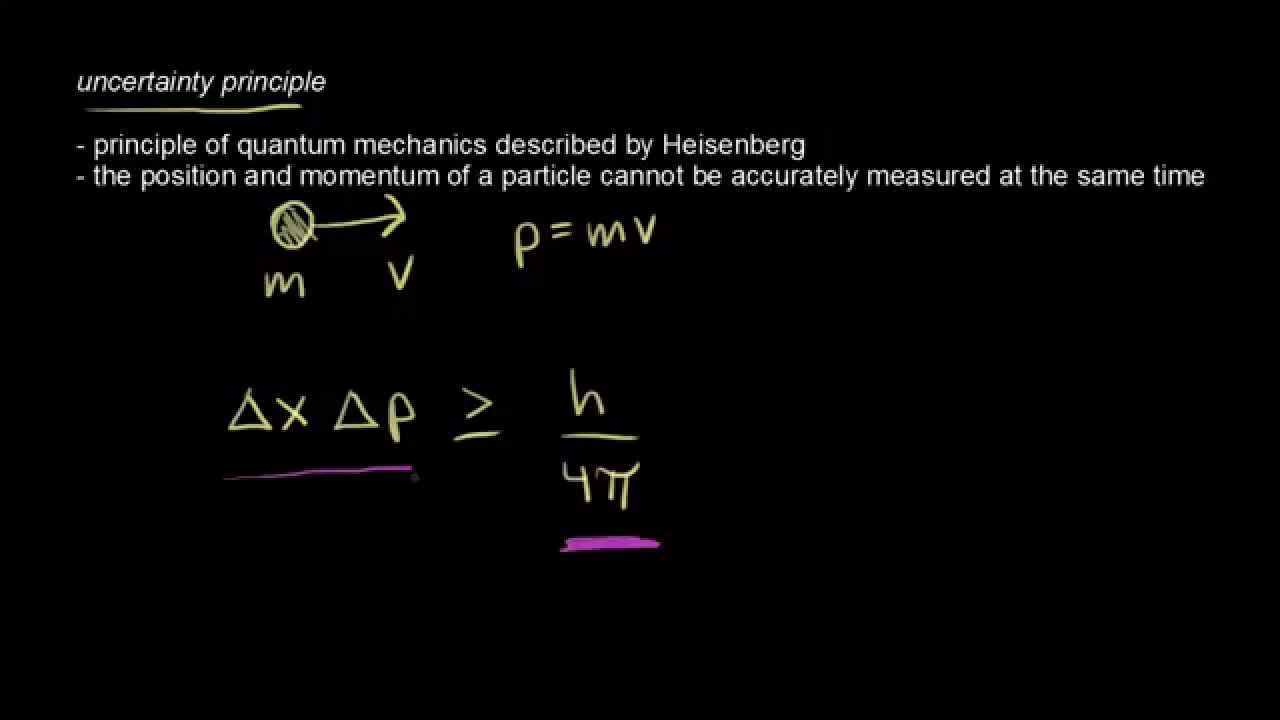
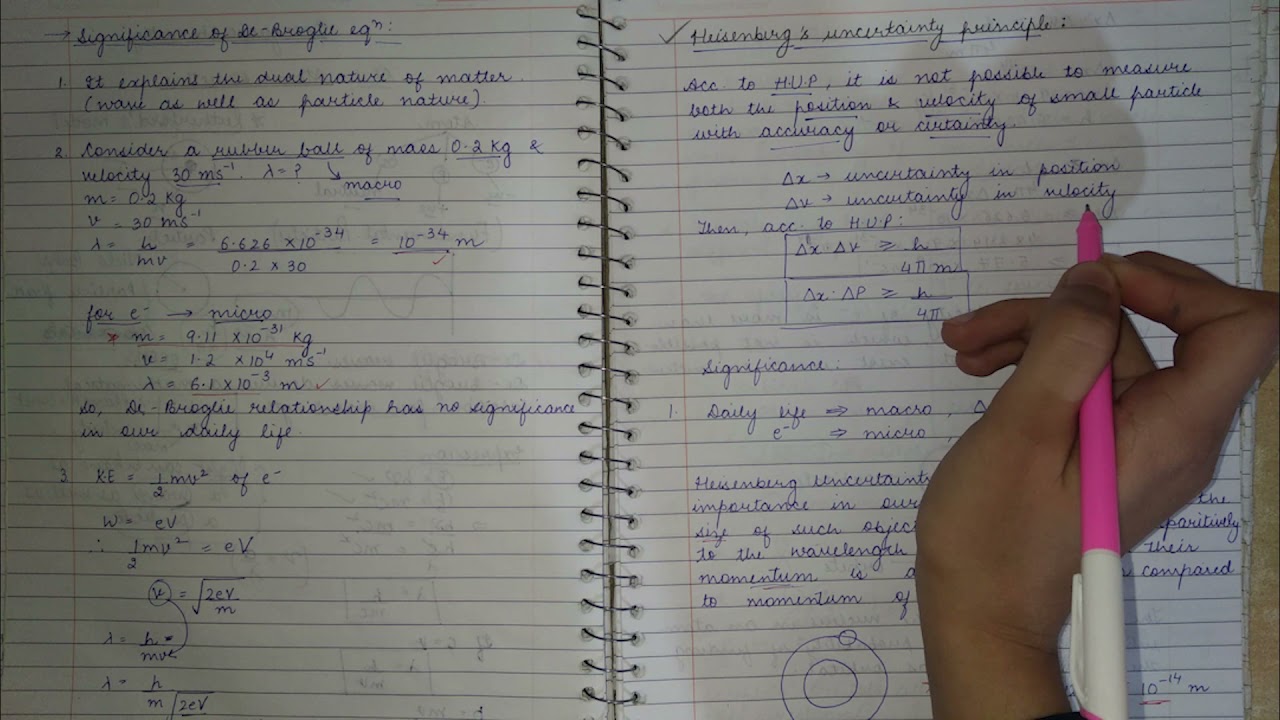
Heisenberg's Uncertainty Principle and why it replaces Bohr's precise electron trajectories with probability distributions.
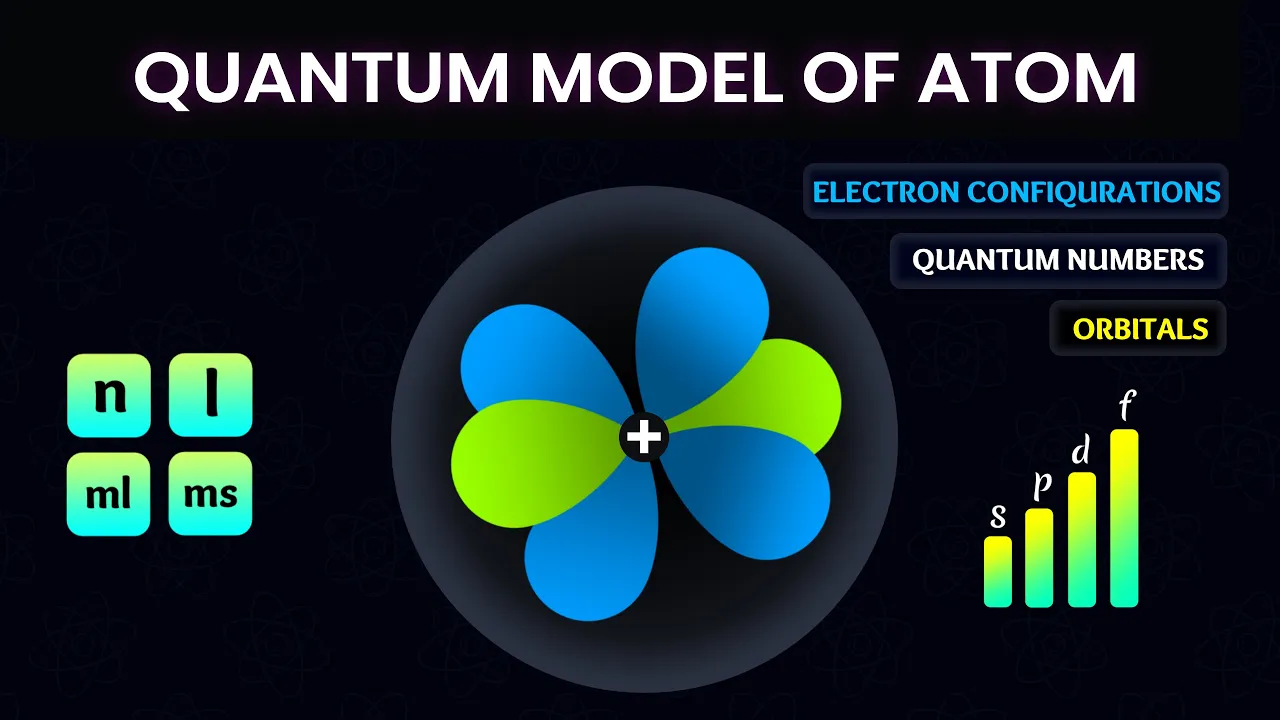
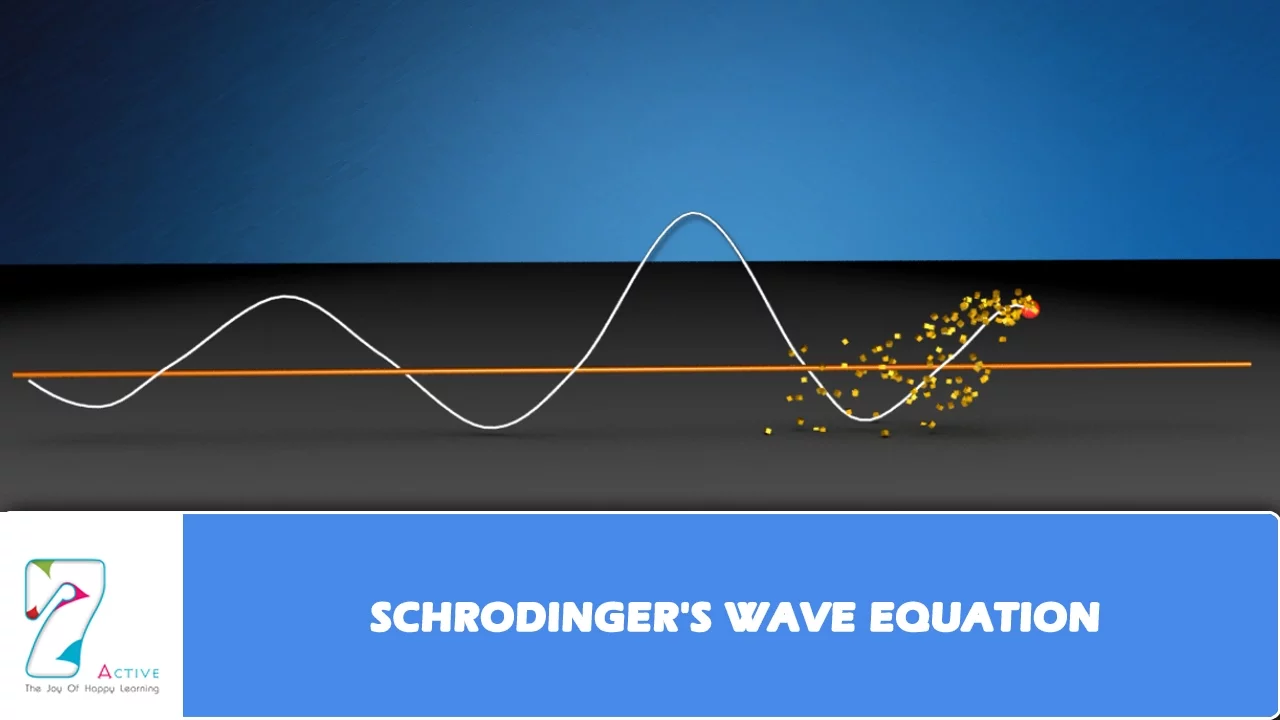
The Schrödinger Wave Equation and the transition from 2D circular orbits to 3D quantum mechanical atomic orbitals.
480.9K views12.3Klikes27:12Original Release: 2020-04-17
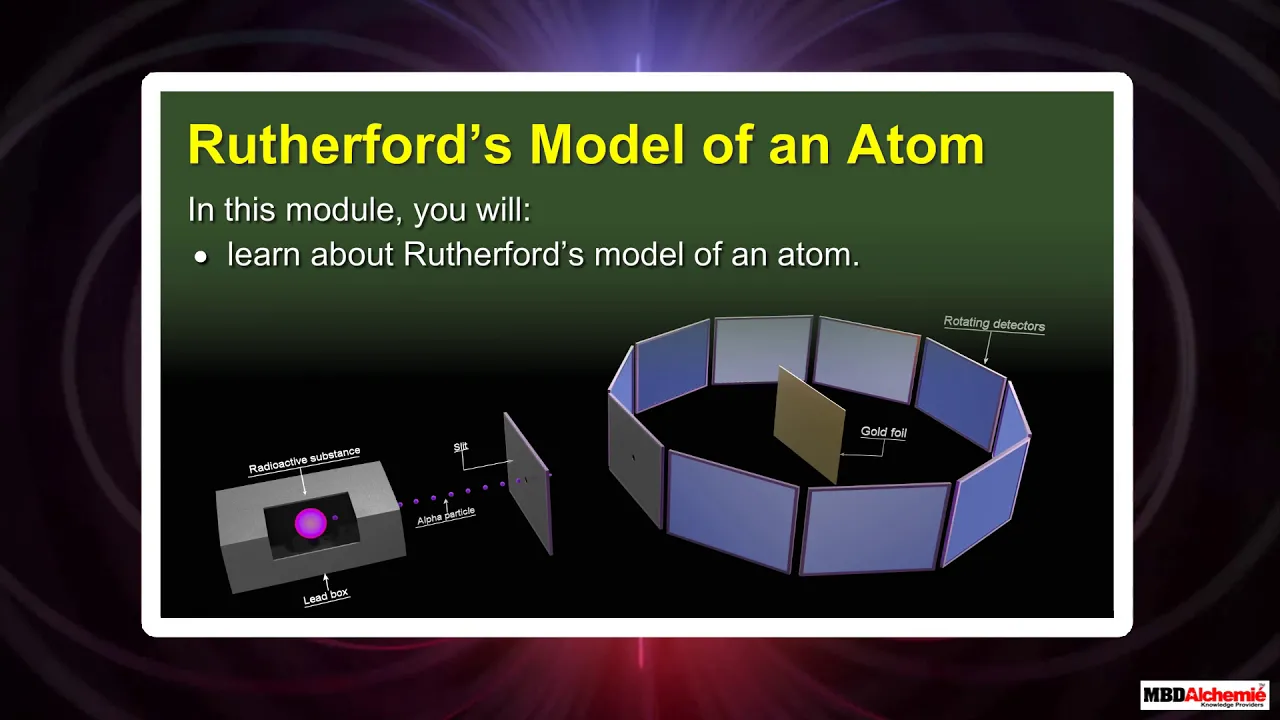
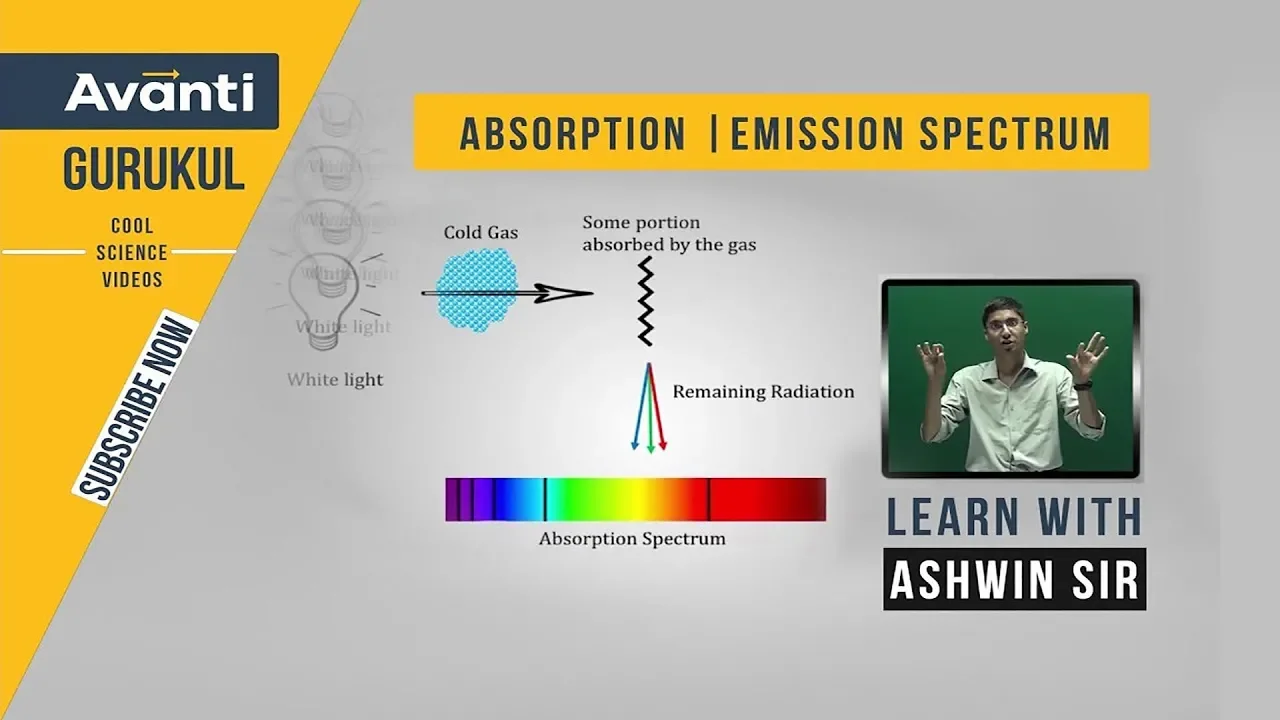
it is amazing to think that as recently as the beginning of the 20th century there was still a great deal of debate surrounding the existence of atoms those who doubted their existence cited the simple fact that they could not be directly observed and therefore how could we possibly conclude that they exist whereas those who supported the atomic hypothesis referred to the remarkable success of the kinetic theory of gases which was able to account for the macroscopic properties of gases by assuming that they were comprised of trillions upon trillions of tiny atoms in random motion the reason we couldn't see the atoms was simply because they were too small however the debate was short-lived a series of remarkable experimental observations at the beginning of the 20th century could only be explained using the atomic theory and furthermore it was realized that the structure of the hypothesized atoms could be used to explain the incredible diversity of the properties of material objects in the natural world when in 1897 JJ Thompson proved by experiment that tiny negatively charged particles called electrons can be extracted from atoms leaving behind positively charged ions it became clear that atoms are not as the Greek meaning of their name implies indivisible constituents of matter but rather complex systems formed by positively and negatively charged parts in 1904 Thompson proposed a model of the atom in which he visualized the atom is being formed by some positively charged substance uniformly distributed throughout the atom with negatively charged electrons embedded like plums inside a pudding however the model was not without its problems whilst it was possible to derive some stable configurations of motionless electrons embedded in the positively charged medium he suspected that it was the motion of electrons inside atoms that was responsible for the properties of magnetic materials however his model was incapable of accounting for the motion of electrons within the atom the experiment that ultimately caused the death blow to the plum pudding model was the famous alpha scattering experiment of Geiger and Marsden in 1909 which involved firing a stream of stiffly charged alpha particles as a thin piece of gold and measuring the angles of deflection according to Thompson's model if you fire a high-energy alpha particles of a thin gold leaf then you should find that practically no alpha particles are reflected by the gold this is because the diffuse positive charge filling Thompson's atom would provide minimal repulsive force and therefore be unable to deflect alpha particles back towards the source however when Geiger and Marsden performed the Alpha scattering experiment they found that roughly one in every 8,000 alpha particles were deflected back towards the source in direct conflict with Thompson's prediction in March 1911 Ernest Rutherford proposed a radical new model of the atom in order to account for the experimental results of Geiger and Marsden according to Rutherford's model the atom consists of a tiny positively charged nucleus surrounded by even tiny and negatively charged electrons which occupy the vast regions of space around the nucleus this explained why most alpha particles pass through the gold leaf since they are simply passing through the vast regions of empty space with inside the atoms of gold however in those rare cases where an alpha particle collides head-on with the gold nucleus the concentration of positive charge within the nucleus is sufficient to push the alpha particle backwards and this accounts for the 1 in 8,000 alpha particles that were scattered back towards the source although Rutherford's model was a significant improvement over Thompson's it was plagued with problems of its own if the electrons are believed to exist in the space surrounding the nucleus then what exactly are they doing they can't just be standing still because the electrostatic force of attraction between the positively charged nucleus and the negatively charged electrons would surely cause the electrons to be pulled into the nucleus and this would imply that all atoms are inherently unstable and therefore should collapse the obvious solution to this problem is to propose that the electrons are in fact orbiting the positively charged nucleus much like the Earth orbits the Sun and that it's the orbital motion that prevents the electrons from falling into the nucleus just as the motion of the earth stops our planet from falling into the Sun however the orbiting electron model doesn't work either to see why we need to refer to Maxwell's theory of electromagnetism which had been developed in the second half of the 19th century according to electromagnetism surrounding every charged particle there exists an electric field and if you change the position of a charged particle then the field will also change now according to electromagnetic theory if a charged particle moves in a circular orbit then the acceleration of the particle will cause a ripple in the surrounding electromagnetic field corresponding to the emission of electromagnetic radiation if we apply this to an electron orbiting the nucleus then we see that as the electron orbits the nucleus it will radiate energy and therefore as it loses energy it will slow down and spiral into the nucleus an electromagnetic theory predicts that this would occur in less than a trillionth of a second so it appears that the electron cannot be standing still and it cannot be orbiting the nucleus like a planet orbits the Sun so what exactly is it doing the answer to this question would require a union of the old classical ideas of electromagnetism with the newly developed ideas of energy quantization as put forward by Max Planck and Albert Einstein and it would require the remarkable vision of one man Niels Bohr who had become one of the founding fathers of quantum mechanics in 1911 after completing his PhD at the University of Copenhagen a 25 year old Niels Bohr joined JJ Thompson at the Cavendish laboratory in Cambridge with the hope of working with Thompson on the structure of the atom however folklore suggests that JJ Thompson and Bohr's relationship did not get off to the best of starts when during their first meeting Bohr apparently entered Thompson's office with a copy of one of Thompson's books on atomic structure pointed to a particular section and declared this is wrong it is hardly surprising therefore that Thompson did not immediately warm to him a number of disagreements between the two men forced Bohr to abandon Cambridge and head for Manchester where he had been invited by Rutherford himself like Einstein and Planck before Bal realized that attempting to resolve the problems of the atom using purely classical physics was probably doomed to failure instead he should take seriously the idea that energy has only ever transferred discreetly in chunks or quanta rather than in the continuous fashion predicted by classical physics furthermore Einsteins explanation of the photoelectric effect in 1905 had demonstrated that light should be considered a stream of particles called photons each consisting of a discrete amount of energy faced with the challenge of the stability of the atom ball took a leap of faith and simply hypothesized that in order for atoms to be stable there must exist stable configurations of the electrons orbiting the central nucleus and that these stable orbits should depend in sum as yet unspecified way on Planck's constant furthermore he suggested that the transitions between these stable States would cause the emission of photons of discrete energy young enthusiastic and unhampered by the limitations of classical physics ball launched into a period of intense productivity resulting in the publication of three papers in 1913 that would change the landscape of atomic physics forever Bohr's groundbreaking work focused on the simplest atom hydrogen and was based on four postulates that combined elements of classical and quantum physics the first was based on Coulomb's law from classical electrodynamics according to this postulate the electron is held in orbits around the nucleus by the Coulomb force of attraction between the positively charged nucleus and the negatively charged electrons the second postulate is the assertion that contrary to predictions of electromagnetic Theory the electron does not radiate energy despite the electrons acceleration the second postulate removes the problem of the stability of an electron by simply postulating that this particular feature of the classical theory is not valid for the case of an atomic electron this postulate was based on the fact that atoms are observed by experiment to be stable even though this is not predicted by the classical theory this may seem like a rather bold assertion but Baal was hopeful that the exact mechanism explaining how this is possible would emerge later the postulate introduced the idea that the angular momentum of the electron is quantized in units of Planck's constant divided by 2 pi and the final postulate suggested that photons of light are emitted by atoms whenever an electron moves from a higher energy orbit to a lower energy orbit the justification of Bohr's postulates or of any set of postulates can only be found by comparing the predictions that can be derived from the postulates with the results of experiment so we will now consider these ideas in a bit more detail we will begin by looking at the quantization of angular momentum according to classical physics the angular momentum of an orbiting electron is found by multiplying the mass of the electron by the vector cross product of the radius and velocity vectors furthermore the magnitude of the vector cross product of any two vectors is given by multiplying together the magnitudes of the individual vectors and the sine of the angle between them in the case of an electron in a circular orbit this angle is always 90 degrees and therefore sine of 90 equals 1 and we see that the angular momentum is equal to the mass of the electron times the velocity times the radius now we see from this expression that according to classical physics because the radius and velocity can vary continuously and take any value so too can the angular momentum however ball propose that the angular momentum of the orbiting electron is quantized in integer multiples of Planck's constant divided by 2 pi if we combine the classical and quantum expressions for the angular momentum and rearrange for the radius of the electron orbit we find the following expression before we can fully appreciate what this equation is saying we need to find a way of describing the motion of the electron in its orbit around the nucleus Bohr assumed that the electron was held in its orbit around the nucleus by the Coulomb force of attraction between the electron and the proton Coulomb's law states that the magnitude of the force acting between two charges Q 1 and Q 2 is proportional to the product of the charges and inversely proportional to the square of the distance between them applying this to the example of a single electron of charge e orbiting a single proton of charge e the electrostatic forces given by the following expression next we assume that the electron is orbiting in a circular path of radius R with speed V because the direction of the electron is constantly changing the electron must be accelerating and therefore according to Newton's second law there must be a resultant force directed towards the center of the circle that is causing this acceleration in the case of circular motion the centripetal acceleration is given by the expression a equals V squared over R and if we combine this with Newton's second law we find the following expression for the centripetal force acting on the electron Bohr assumed that the centripetal force was provided by the Coulomb force of attraction and therefore he equated these two mathematical expressions to arrive at an equation for V squared next he used the expression derived for the radius using the angular momentum quantum condition if we square this expression and substitute the blue equation for V squared we arrive at the following equation which tells us the radius of the allowed electron orbits let's take a closer look at this equation we see that the electron is only allowed to orbit the nucleus at certain distances depending on the value of n if we substitute the appropriate values for Planck's constant the permittivity of free space epsilon naught the mass of the electron and the charge of the electron into this equation we find that for N equals 1 the so-called Bohr radius is calculated to be naught point 5 3 times 10 to the minus 10 meters and this provides a rough estimate for the atomic dimension of the hydrogen atom when Bohr calculated this value he was reassured that the value he found on the basis of angular momentum quantization was in line with other known estimates for the size of the atom if we next calculate the radius of the N equals 2 and N equals 3 orbits then we see that the distance between adjacent orbits grows as n increases another thing that ball was able to calculate was the orbital speed of the electrons recall that we were able to derive an expression for the speed of the electrons using Coulomb's law if we then substitute R into this equation we find the following Express which can be used to calculate the speed of the electron in different orbits corresponding to N equals 1 N equals 2 and so forth clearly the fastest possible speed will correspond to the innermost orbit when N equals 1 in that case we find a speed of two point one eight times 10 to the 6 meters per second which is reassuringly less than the speed of light and so ball was pleased to see that his model of the atom did not appear to violate Einstein's theory of special relativity once Bohr had determined the radii of the allowed electron orbits his next task was to determine the energy of each of these orbits in order to do this he realized that the total energy of the electron will simply be the sum of its kinetic energy and potential energy the kinetic energy is due to the motion of the electron whereas the potential energy is due to the electrostatic force of attraction between the electron and the positively charged nucleus now the kinetic energy is easy to calculate as I'm sure you remember from school it's simply given by 1/2 times the mass times the velocity squared the electric potential energy is derived from Coulomb's law and for the hydrogen atom is equal to minus e squared over 4 PI epsilon nought R Y the minus sign well the minus sign is there because the convention in physics is to define the potential energy at infinity to be zero and since the potential energy of the electron increases as it moves further away from the nucleus it must be negative for finite separations so if we add these two equations together and substitute the following expressions for V squared and R which we derived earlier then we find the following yellow expression which simplifies in the following way note that all of the terms inside the bracket are constants if we substitute the experimentally determined values for each of these constants we find that the combination of terms inside the bracket corresponds to a numerical value of 2.18 times 10 to the minus 18 joules and so we can write the total energy of the electron as minus 2.18 times sends the minus 18 joules / N squared this equation tells us the energy of the electron in each of the allowed orbits corresponding to N equals 1 N equals 2 N equals 3 etc as you can see from this equation the orbital energies are very small and therefore physicists often write the energy using a different system of units called electron volts rather than joules an electron volt is defined as the energy transferred to an electron when it is accelerated through a potential difference of one volt so for example imagine you had two parallel conducting plates connected to a 1 volt battery if you placed a single electron at the negative plate it would clearly experience a force and accelerate towards the positive plate and the amount of kinetic energy it gained moving between the plates is what we define as an electron volts worth of energy in order to calculate how much energy in joules an electron volt corresponds to we can make use of the definition of potential difference which is defined as the energy transferred per unit charge if we rearrange this equation we find the energy transferred is equal to V Q so in the case of an electron with charge E moving through a potential difference of one volt we see that the energy transferred equals one point six times 10 to the minus 19 joules and this is what we call one electron volt so one electron volt is equivalent to one point six times ten to the minus 19 joules if we now rewrite the total electron energy in electron volts we find the following famous equation e equals minus thirteen point six over N squared electron volts and this equation tells us the energy of the nth electron orbit now if we calculate the energies of the first six orbits then we find the following values we see that the energy difference between adjacent orbits decreases as n increases we can picture these orbits in a number of ways but it is often convenient and conventional to represent the energy levels as a series of parallel lines with the lowest energy also known as the ground state energy at the bottom as the electron moves away from the ground state its energy increases and an infinite from the nucleus the energy is defined as zero ball realized that in order for an electron in the ground state to move to a higher energy state it would need to absorb just the right amount of energy corresponding to the exact difference between two energy levels when an electron moves from a lower to a higher energy level it is said to be excited so for example imagine that an electron is excited from the ground state to the N equals four energy level the questioned ball then asked was how does the electron lose energy such that it can return to the ground state it was at this stage that Bohr delivered his masterstroke he realized that the electron loses energy by emitting a photon and that the energy of the emitted photon is equal to the difference in energy between the higher and lower energy level the greater the energy difference the greater the energy of the photon ball also realized that there were often more than one route that an excited electron could take in order to return to the ground state in our example we see that the electron could hop between every level on its route to the ground state or it could move from the N equals four to the N equals three then the N equal one level or it could move from the N equals four to the N equals two and then from the N equals two to the N equals one or it could go straight from the N equals four to the N equals one and each of these different transitions would correspond to the emission of a photon with a particular amount of energy let's now look at this in a bit more detail imagine that an electron in the ground state is excited to the N equals two energy level when it D excites and drops back down to the ground state it will emit a photon and as we know the energy of a photon is given by the equation equals HF or equals HC over lambda where H is Planck's constant C is the speed of light and lambda is the wavelength we can work out the energy of the emitted photon by calculating the difference in energy between the N equals 2 and N equals 1 level if we put in the numbers we see that the energy difference is equal to thirteen point six minus three for which is 10.2 electron volts and if we convert this into joules we find that the energy difference is 1.6 3 times 10 to minus 18 joules so this is going to be the energy of the emitted photon we can work out the wavelength of the emitted photon by using the equation lambda equals HC over Delta e and we find that the wavelength turns out to be 122 nanometers so what kind of photon is this well the wavelength of the photon tells us about the type of radiation emitted visible light has a wavelength of between roughly 350 and 750 nanometers with violet light being at the short wavelength end and red light being at the long wavelength end wavelength slightly longer than 750 nanometers take us into the infrared region and wavelength slightly shorter than 350 nanometers take us into the ultraviolet region and therefore we see that the hundred and twenty-two nanometer photon is an ultraviolet photon in other words photons emitted as a result of this particular transition are not directly visible likewise electron transitions from the N equals three four five and six energy levels down to the ground state will all cause the emission of ultraviolet photons this series of wavelengths is referred to as the Lyman series named after Theodore Lyman who first discovered them the natural question to ask at this stage is whether any electron transitions correspond to the emission of visible photons and the answer is yes we are going to consider electron transitions from the N equals three four five and six energy levels down to the N equals two energy level let's see what we get firstly if we calculate the wavelength of the photon emitted when an electron moves from the N equals 3 to N equals 2 level we find a value of 654 nanometers and we see that this corresponds to a reddish color in the visible spectrum next if we consider a transition from the N equals 4 to N equals two levels we find a photon of wavelength 488 nanometers and this corresponds to a light blue green color the N equals 5 to N equals 2 transition corresponds to a wavelength of 435 nanometers which is a deep blue color and finally the N equals six the N equals two transition corresponds to a wavelength of 412 nanometers which is a purple violet color and in terms of visible photons this is it you can try calculating the photon wavelengths for all other possible transitions within the hydrogen atom and you will see that these are the only four transitions that cause the emission of visible photons and so rather than having a continuous spectrum of colors we actually have what is known as a line spectrum consisting of four lines of color and the wavelengths corresponding to these four lines are unique to hydrogen a bit like an atomic barcode these four visible lines are named the bomber lines after Johann bomber who discovered an empirical equation to predict the bomber series in 1885 it had long been known that if he passed the white light emitted from a hot object such as the Sun or a filament lamp through a triangular prism then the light will disperse and a continuous spectrum of colors will be observed however detailed experimental investigations in the 19th century revealed that the light emitted from a glowing gas of a particular element does not form a continuous spectrum so how do you make a gas glow well that simply involves taking a rarefied gas and passing an electric current through it collisions between the electrons flowing through the gas and the atoms of the gas cause the gas to emit light if you then pass that light through a triangular prism what do you get well in the case of hydrogen gas you observe the following pattern and if we overlay the colors predicted by Bohr's model of the atom we find remarkable agreements between the colours and wavelengths of light note that the purple violet line cannot be seen in this picture and this is simply because this particular emission line has a very low intensity which was not picked up in this particular photograph one of the remarkable successes of Bohr's model of the atom was its ability to explain the hydrogen emission spectrum we see that these unique lines are simply a result of electron transitions between discrete energy levels inside the hydrogen atom and that the discrete energy levels are a consequence of the angular momentum quantum condition so we see that introducing the quantum into the atom not only help to stabilize the atom but also help to explain the emission spectrum of the hydrogen atom but it wasn't only the hydrogen atom that could be explained using the Bohr model the basic idea of energy levels and electron transitions would ultimately account for the emission spectra of all the known elements in the periodic table and Bohr's model would be hailed as a triumph for which he would be awarded the Nobel Prize in 1922 as is often the case in physics the solution to one set of questions naturally gives rise to a new set of questions Paul wrote to Rutherford on the 6th of March 1913 in closing with his letter and manuscript with the title on the constitution of atoms and molecules in his reply Rutherford reacted favorably but raised some difficult questions he was particularly puzzled by the fact that in Bohr's model an electron in a high energy orbit would somehow need to know beforehand the energy of the final destination in order to emit radiation of just the right wavelength in this simple statement Rutherford was raising the alarm about the implications of the new quantum theory for our understanding of cause and effect and this alarm would continue to sound for the remainder of the century and well into the next the success of the Bohr model as measured by its agreement with experiment was certainly very striking but it only accentuated the mysterious nature of the postulates on which the model was based where did the angular momentum quantum condition come from and what was the mechanism behind electron transitions between energy levels the answers to these questions would have to wait nearly a decade until the beginning of the 1920s when the pioneering work of de Blois Schrodinger Heisenberg and Dirac would lay the foundations for the most successful theory ever create on earth quantum mechanics our vision of reality would never be the same again reflecting on this fact Bohr said we must be clear that when it comes to atoms language can be used only as in poetry the poet too is not nearly so concerned with describing facts as with creating images and establishing mental connections physics is not about what the world is it is about what we can say about the world
Up Next

13:59
Quantum Mechanics Explained: Wave-Particle Duality, Uncertainty, and Entanglement
@ArvinAsh
287.3K views•2023-02-18

12:53
21cm Hyperfine Transition in Neutral Hydrogen: Radio Astronomy Basics
@AaronRobertParsons
12.4K views•2011-10-13

30:58
Neutron Star Physics: Limits of Neutron Accumulation and Stellar Collapse
@PhysicsExplainedVideos
1.4M views•2025-07-05

27:14
Entropy and the Second Law of Thermodynamics Explained
@veritasium
27.5M views•2023-07-01
Related Study Plans & Knowledge Roadmaps
Structured learning paths in Physics
physics
Nuclear Physics (Decay, Fission & Reactors)
01Atomic Structure and the Binding Force
02Radioactive Decay and Half-Life
03Nuclear Fission Mechanics and Chain Reactions
+ 2 more learning modules
12h5 modules
Explore Roadmap
physics
Soft Matter (Polymers, Colloids & Rheology)
01Foundations of Soft Matter & Thermal Forces
02Polymer Physics and Macromolecules
03Colloids, Surfactants, and Self-Assembly
+ 2 more learning modules
38h5 modules
Explore Roadmap
physics
Analytical Mechanics: Lagrangian & Hamiltonian
01Mathematical Foundations: Calculus of Variations
02From Newtonian Mechanics to Constraint Dynamics
03The Principle of Least Action & Lagrangian Mechanics
+ 3 more learning modules
28h6 modules
Explore Roadmap
physics
General Relativity (Spacetime & Cosmology)
01Foundations of Relativity: Special Relativity
02The Geometry of Spacetime: Equivalence Principle & Curvature
03Einstein's Field Equations: The Mathematics of Gravity
+ 2 more learning modules
55h5 modules
Explore Roadmap