
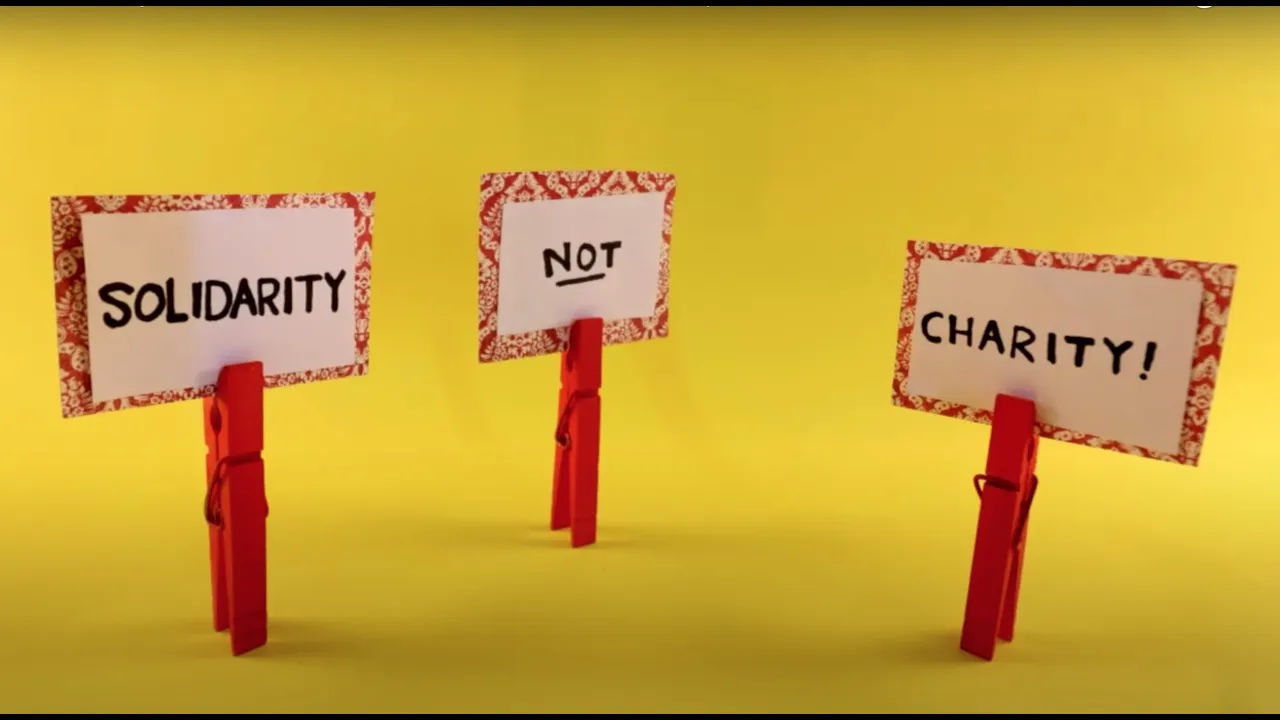
















Mutual Aid is a community-based approach to survival and liberation that distinguishes itself from charity by focusing on systemic root causes rather than individual blame, emphasizing collective action and solidarity over charitable giving, and prioritizing the dignity and self-determination of people in crisis. Effective Mutual Aid work requires creating supportive group cultures that embrace imperfection, practice direct communication and feedback, welcome new members, and cultivate joy in collaborative labor. The approach recognizes that government welfare systems are fundamentally designed for social control rather than genuine care, and that meaningful social change emerges from ordinary people organizing collectively rather than waiting for elite intervention.
Mutual Aid 101: A Primer on Community Solidarity
Added:I would like to pass it over to our presenter today Dean Spade thank you so much hi it's so amazing to be here and see all the places you all are coming from Singapore Switzerland here in Washington state where I am people from all over Canada it's so cool all over so many places really excited to be in this conversation so grateful to share aable for this series for making it free for inviting me to be part of it grateful to the inter reters and um everyone who's making this happen okay I'm just going to Dive Right In um I've got a bunch of content I want to share and the session will be interactive there'll be times when I invite you to share things in the chat I'm not going to read the chat the whole time I present because there's too much going on but at times I will read parts of the chat out loud once I've given people a prompt sometimes I'll be reading what I see there I'll be reading what's on my slides so if you would rather just listen to this session and not look that's great and the slides are available to everyone so you can look at it later there's nothing on there that I'm not ready to have you have so if you want to just listen at any point you'll be hearing a lot of what's going on I think it's so great that this is being recorded and people can watch later some Concepts I'm hoping to get through during our time together what is mutual Aid what are some common problems for groups doing Mutual Aid work and what helps principles for Mutual Aid work avoiding charity Tendencies we'll talk about the differences between charity and mutual Aid creating group Culture intentionally dealing with procrastination and perfectionism and finding joy in working together for Liberation so I'm just starting with a few images that bring to mind like what people think of when they see or consider discuss Mutual Aid this is an image from 2020 of people doing a big food distribution project another food distribution image people in some kind of community space with boxes of groceries and a sign about volunteering these are these gorgeous free fridges that were around New York City that had been painted in very beautiful ways this is an image of Street Medics supporting people at a protest it's really important form of mutual Aid like people doing direct support to Folks at protests giving out masks giving out water helping people you'll see in the lower image who've been attacked by tear gas by police really beautiful kind of mutual Aid work this is an image from maybe you remember in 2020 during the uprising against police violence and anti-black racism there was a pretty big fight with the cops here in SE Seattle and a police free zone occurred the cops left the precinct here in my neighborhood and this police free zone became a place where people were gathering talking about things sharing skills and what it looked like was a bunch of mutual Aid tables it's very typical of spaces that people occupy in defiance of the police is that the actual infrastructure is people giving each other food people handing out clothing people offer ing at that cop free zone people were offering free haircuts Nails mental health support hot food cold food there was just it's really useful to know that our movement spaces that we claim tend to be visually like Spa like defined by Mutual Aid these are images from when the campfire happened in Northern California and a lot of people were displaced and living in the Walmart parking lot and people were supporting each other with mutual Aid giving out blankets clothing tents you can see how Smoky the air was maybe you'll recall that eventually the cops criminalized this encampment and kicked people out we'll be talking about criminalization of mutual Aid this is an image I think from Hurricane H Hugo another example of mutual a that we see in every disaster people coming to each other's rescue really noticeably the government doesn't come and rescue people certainly not in a timely way certainly not in a way that's just just or um evenly distributed across poor and Rich um white people and people of color so it's often up to us a few things about what Mutual Aid is from my perspective like any term it's used by lots of people in lots of ways but I'll share what it means to me and how I'll be talking about it today so mutual Aid is the part of our ecosystem of Liberation work where we're giving each other material support to survive existing systems our movements also do other things like Drop banners block pipelines we do so many things but one thing we do that's Mutual Aid is when we materially support each other trying to survive existing systems it's only Mutual Aid in my opinion if it's based in a shared analysis about the root causes of the crisis it's the systems that are to blame for the crisis not the people in crisis this is a distinction from charity that I'll be talking about in a moment and to me it's only Mutual Aid if it also includes an invitation to Collective action because if we know that it's the system that's the problem and not people in crisis then we know that to solve it we have to get together and fight right and so it doesn't mean that you have to join our group to get a tent from us right now or get this food but we're always like asking you to join the fight hey we think what's happening to you is unfair and do you want to join us and fighting for justice for everyone so those to me are the three elements that Define mutual Aid and I want to distinguish it from charity this is like a really important part of how we Define it charity celebrates rich people's generosity it's its Origins the the origins of the charity system we have here in the United States and I think in Canada in Europe come from the invention of poor relief in a period where new forms of capitalism were displacing huge numbers of people from their land and then the rich people and the government sometimes the church establish like these little crumbs they give out to some people that legitimize and justify the system that say it's fair and part of the way that works is that charity is about blaming and controlling people in crisis while Mutual Aid would say people are unhoused because of a racist Colonial capitalist housing market charity systems are like you're on house CU there's something wrong with you you need to take these pills you need to become sober you need to go to these trainings you know like this kind of thing like you're not housing ready all this kind of idea of blaming people in crisis for the crisis charity always divides people into deserving and undeserving there's strict eligibility criteria IA to receive support like undocumented people can't get anything here or people with felony records can't get anything here or you have to have children or not have children or be sober their idea that it's okay for some people to be left in poverty and crisis but we'll give something out to the few people Mutual Aid is like everything for everyone we don't distinguish we don't judge people for being in crisis and say that some deserve support ultimately charity justifies legitimizes and sustains the existing systems of extraction Mutual Aid wants to destroy those systems so that we don't have to live under these crises that are created by them a background idea for me that I want to put in the mix with us the we live under a myth that social change comes from governments corporations media and Elites and that the way it happens is that charismatic leaders appeal to Elites and change their minds to win change and in that story Ordinary People don't really have a big role all we can do is like Vote or donate or post on social media or go to an occasional March this is a very disempowering mythology about how change works that also doesn't track with the history of social movements in reality social change happens when huge numbers of Ordinary People organized to fight back back and to make it impossible for the extraction and violence to continue ordinary people are at the center of change and Injustice is not a result of misunderstanding it's not like oh the elites just don't know that genocide kills people or that fossil fuels are destroying life on Earth or that poverty shortens your life they know you know it's a result of domination so we so if we organize ourselves as if our only goal is to convince Elites we will never win and they would love for us to just stay there begging for them to change things and take care of us instead we're going to take care of ourselves and force change the final part of this reality is that our movements are only made of our relationships our opponents have all the money in the guns the only thing we have is like all the people on Earth who are not winning out and who are actually really endangered and dying from these conditions so if we can't figure out how to stick together and stand up for each other and do solidarity then they win it it really matters how we treat each other because that's all we have is like whether we build trust know how to share make decisions together have generative conflict so we'll be talking about things related to that you can't do Mutual Aid work and ignore Human Relationships just falls apart okay so these myths about social change that I mentioned mention are very demobilizing they encourage us to limit our resistance to passive and symbolic acts and we're supposed to expect somebody else to save us like elected officials nonprofits Tech billionaires whatever they discourage us from taking bold Collective action I want to just give you an example these are images from the Montgomery Bus Boycott a lot of us are taught a little bit about this in like Elementary school that Rosa Parks refused to give up her seat and then Martin Luther King made important speeches and then the laws changed through courts and legislators the real story is that the Montgomery Bus Boycott was a giant Mutual Aid project made and done by mostly working-class black women to transport tens of thousands of people everywhere they needed to go for a year and a half without the bus system so people they did all these huge cooking projects like you see on the left hand side to sell food to buy cars to drive people around and then people also coordinated to walk together in groups because it was quite dangerous white supremacists were very like upset and violent about the boycott this is an example of how Ordinary People and mutual Aid are written out of the stories that we hear about powerful social change and instead the stories are are told as stories about Elites so we want to look at history differently and notice the core role we all have in mobilizing and transforming conditions couple other images probably the most famous Mutual Aid programs in American history were the Black Panther Pary survival programs including their free breakfast programs um that happened in cities around the United States that at the time the head of the FBI Jay Edgar Hoover said was like the biggest threat to the United States was that the Black Panthers were serving breakfast such sweet pictures of these kids together couple more final pieces on this when we think about Mutual Aid we want to think about the history of poor relief like welfare Social Security these kinds of programs we have in the United States but there's versions of them in many places around the world and disaster relief like when does the government come in or not when the hurricane or the flood or the fire comes through a lot of people in our culture have a fantasy of a caregiving state that will you know deal appropriately with pandemics or fires or floods that will someday provide Health Care to everyone the reality of the United States is that it's a government designed and created to to cultivate white settler life it's gotten better better better over the whole course of its existence at extracting wealth from poor people in the planet and concentrating it with a few rich people and whenever it gives out care it's just to like stabilize briefly stabilize when things get too unstable with this fundamentally unstable arrangement of taking from everyone for just a few it's not it's by Nature not caring it's by Nature Colonial and violent and racist and the sooner we let go of that fantasy the more effective our actions can be whenever they give us relief poor relief disaster relief it's always conditional oh sorry undocumented people can't get the covid checks oh sorry you don't have an address you can't Etc it's always exclusive it's mainly most of the relief will go to rich people to white people to businesses not to people of color to poor people and they can just revoke it whenever things stabilize oh two covid checks is enough to get you guys not to Rebel or the history of the US poverty welfare programs they expand a little bit when there's big uprisings like in the 60s and 70s and in the 1930s and then they contract them soon thereafter because they are just using them for social control not to actually keep people alive people often ask about Mutual aid but isn't it all so small how could it ever be to scale that's probably the most common question I get we have to change our idea about scale the scale of the nation state is actually a very violent brutal scale that's about extracting from most people and then giving crumbs back and it's also like really ineffective to deal with disaster in that way the most effective disaster relief happens at the local level the people on your block know oh hey people on this block speak farsy speak Spanish or there's Elders on this block who won't be able to get down from their Apartments if the lights go out and there's no elevator the scale of response for disaster is best at the local level and the way you get a a scaling up of that is not through centralization it's not oh groups that are National groups that have an office in DC are the most important ones that's a story we're told instead you scale it up through collaboration and networking so this group is experimenting with doing this in a community that has more elders and this group over here in this part of the neighborhood is is really doing this with people who um have a lot more sickle cell disease and people in this part of the neighborhood are really working on this with the part of the neighborhood that floods the most and each of those has a wisdom and a specific way of doing it and these people do it in community that celebrates Eid and that needs to look different and then they share their best wisdom but they don't become one big thing that tries to standardize as if we're all the same and as if the same answers happen everywhere so it's about shifting from thinking of scale as Central ization of authority and bureaucracy to thinking of scale as coordinating connecting sharing wisdom sharing resources it just comes up a lot so I wanted to mention it when we do effective resistance including Mutual Aid sometimes the government will copy it and offer some concessions they'll then give something like that out great let's celebrate that we that's a sign of our power let's not then start to rely on them for it because they will take it back as soon as we're not really well organized and threatening the stability of their regimes so we can celebrate concessions but we shouldn't demobilize when they give something out or when they even sometimes we demobilize just because they like said that our thing was a problem but then they didn't go on to do anything about it the stakes of this work are extremely high as you all know we're in an ecological crisis we're under a like terrifying fascist government we going to be encountering mounting disasters for the rest of our lives the best way to prepare for disaster is to do Mutual Aid work right now to build all those connections those skills the awareness of who's vulnerable in our communities the ability to coordinate well I forgot to say at the beginning and I want to say now I have a lot more workshops that go into deeper detail about some of the skills based stuff for groups that I'm not going to get to today there's a ser video series called building capacity for Mutual Aid groups that I did that's got a bunch of videos that go into more detail with these skills and it's all free online and they'll share a link that links to my website where you can find all of those and the slides and you can then do the workshops yourself for your group the idea is to make this stuff really easy to get okay so some common problems that come up in mutual Aid work one is that people take funding and then there's strings attached to it really can make groups falter suddenly there's a lot of reporting requirements or there's you're not allowed to serve certain communities with it or groups get bogged down in the bureaucracy of the grant process so that's a really common dilemma like we want more money for this but when we get it from certain sources there's a lot of strings attached another problem is that a lot of people do Mutual Aid work that's focused primarily on giving and receiving money I want to really name right now that we will never have enough money to beat the odds with money so it's good for us to give and receive money but we really need to build Mutual Aid work that has additional elements in it where we're giving each other child care Elder Care visiting people in the hospital like we need sometime in 2020 a lot of groups started that just gave money to people online and the whole thing was online and it was it's meaningful and useful but we want to build thicker relationships more skills beyond that cuz we will never have enough money to to meet meet all the needs of the problems that they're creating for us so a lot of groups end up being like we raised $50,000 amazing or $20,000 but there's somebody who needs a new trailer and there's somebody who needs a new wheelchair like some really high ticket things and there's actually 20 people who are consistently unhoused or can't pay their rent and won't be able to because of the conditions that they're living under and these aren't one-time problems for people this can be a problem for groups when they start to fight with each other about what to do about the fact that there's not enough money or who to prioritize right this is just these are just the conditions it's not because these groups are doing anything wrong another common problem how to choose who gets help in general Mutual Aid groups choose to try to give the help to the people who are the most vulnerable which is the ethically right thing but even inside that do we pay three People's rent or buy one person this wheelchair it's just this is an impossible situation people are tend to be in longterm need and crisis and sometimes chaotically and I think some mutual Aid groups get overwhelmed when it's oh my God it might take five people just to support this one person to get through dayto day because of the levels of Crisis the system creates in people's lives people really struggle of course in the face of this with how to have boundaries like it's life and death work and yet it's lifelong work so how do we be loving and generous and also try to do this work for our whole lifetimes which means not not burn out our group in the first few months and this is a real challenge we're going to talk about solutions to these things and some of these pressures can create conflict in groups and a lot of groups that I work with blame themselves for the pressures it's the conditions it's not us of course this work is hard so how can we hold that these conditions didn't come from our group doing anything wrong so what helps remembering that we can't do it perfectly we talk about this work as imperfect people doing imperf work we're all learning how to think and feel together we're learning new solidarities we all come into the work not knowing everything we could about all the systems we live under so we might show up and not have not interrogated our transphobia yet or have a lot to learn about ableism or are noticing the ways that racism is impacting how we behave how can we let ourselves be imperfect and be Learners together really hard but really important like getting rid of perfectionist standards which in my opinion are white supremacist and capitalist standards usually the conditions are the problem not us so can we not blame each other for things that are the conditions it really helps to listen to each other carefully and not need to get our own way this is a new skill for most of us because we live in a system where at work and at school we're usually Tau Tau to try to be right get our own way dominate others or just folds others authority to get by so we're trying something different which is to really care what everyone in this group thinks find the best wisdom together be able to be like I could live with that let's do that if it's going to bring the group forward instead of getting hung up on my one idea and needing it to be just so trusting the wisdom of the group this is really important because we are all pretty afraid of giving and receiving feedback in this culture because it's a society defined by imprisonment and we're afraid of being thrown away and we're afraid if we give someone feedback they'll be defensive and most of us are pretty defensive and we mostly are in really hierarchical environments like schools and jobs and families where the feedback only goes one way we're not very good at feedback and so then we don't tell people when something they're doing is hard for us and then we talk behind their back or we get so mad we blow up eventually but we never told them along the way or we just disappear from the group so how can we learn more about direct feedback so that we don't gossip or blow up or disappear and I have some workshops about this at that same link on my website Deans spade.net building capacities for Mutual Aid groups so I want to talk about a few Mutual Aid principles that really um guide us I'm keeping my eye on the time one is like I mentioned this is the Cornerstone of mutual Aid the system not the people suffering under it creates poverty crisis and vulnerability two and part of that is a commitment to the dignity and self-determination of people in need or crisis charity treats people in crisis like need to be fixed by the charity there's this kind of real top down paternalistic usually racist kind of framework Mutual Aid is like people know what they need we're going to listen to people and assume they know what they need and it doesn't mean we of course still have to have a group process around what we're prioritizing and people in need differ on their opinions about that but there's a fundamental respect that people in crisis have dignity and don't need to be fixed or bossed around Mutual a is about making a long-term commitment in our culture in charity culture there's an idea like maybe if you wanted to be a good person you'd go to a soup kitchen on Thanksgiving and help out for one night and maybe you would take a selfie about it right like you'd have a c a pet cause that you do something about once in a while Mutual Aid is about deciding that our lives are dedicated to Liberation and that we're going to go go deep in a project that can really support people in crisis and an example I often use is after the murder of Freddy gray in Baltimore there was a big Uprising and some people started a jail support project they were seeing how people are released from jail and often get arrested right away so they set up a project to wait outside the jail and when people came out offer them do you need a ride do you need warm clothes do you need to make some phone calls so they wouldn't just get picked up again trying to get home or get their basic needs met a project like that you do it and you keep learning more about how to do it better oh we need to have a Spanish speaker with us oh we should come here earlier on Tuesdays because they let people out at this time whatever you learn more as you go about what it means to do this well and you keep deepening you know if you're doing eviction defense if you're doing support to help people who've had their wages stolen like everything you do you learn more like oh what does this community really need who were we accidentally leaving out what does it mean to have deeper solidarity be more effective respond to new conditions so it's about a long-term commitment not just a flash in the pan Mutual Aid projects work best when they have open meetings and Pathways for new people to join most people join social movements through mutual Aid we need to have much bigger movements in order to survive much less win our society is very demobilized and we need tens of millions of people hundreds of millions of people involved in our movements in order to fight back so we need a lot of people to join and most people join through mutual Aid either because they need something and they go to the only people offering it and those people are like yeah it's messed up that you don't have that do you want to join the fight or they're like I'm so upset that this thing is happening in my community I want to help people maybe it happened to me before maybe I heard about it on the news and then they join there a really big entry point for people into movements who then sometimes go deeper into mutual Aid some of them will go deeper into direct action and be blocking pipelines soon or whatever but it's a really important entry point and also many Mutual Aid projects if they don't think about incorporating new people will get really small cuz like a few people will have to leave or get sick or move or have a kid or whatever and then soon the project is four people and they can't possibly you know they're burning out whatever so it's really important to have ways to let new people in and to have new people take on real roles like really deeply oriented to how decision- making Works to how they can really be heard and participate not just like accidentally have like the founders of the project really be the bosses that doesn't work it leads to burnout and also people aren't going to hang out and do unpaid work to be bossed around they need to really get to participate the exception I would give to this is that some mutual Aid projects of course have different security needs if you're giving out medical procedures or medicines that are illegal where you live you might like not be open to every brand new person who might be a cop you know so there's but most Mutual Aid projects that are doing food Child Care disaster prep ideally are open to new people and good at bringing new people in mutual Aid projects tend to engage in political education with members so when I enter the project I might be like I'm so upset about what's happening to Immigrant children at the border and then I get into the migrant Justice group and I learn oh I also care about adults and then I find out wow the immigration system is like brutal for people with disabilities and it's super anti-black and my solidarities grow through doing the work and that'll happen both inally through meeting the other people in the project and while we're putting all these sandwiches into bags we start talking about what we know about things and what's making us frustrated and we teach each other things organically and a lot of groups also do political education sessions like we're going to have a disability Justice training for our group something like that I mentioned this to do this work we have to all learn a lot more about how to give and receive feedback how to have humility and learn in public it's rough skill set in this Society but it's it's the difference between whether we can have useful conflict and learn from each other or just fall apart as part of that a lot of mutual Aid groups put some time into building conflict resolution skills and processes with members and I have a lot more information about that in those other workshops that I mentioned most of us don't know anything about how to have conflict in generative ways people in our society are taught to like ignore conflict and avoid it or burn Bridges and ditch people and so how do we learn how to have a useful conflict and learn things and become better able to care for each other and um expand our thinking Mutual Aid projects tend to Value transparency this is a real distinction from charity and like nonprofits where you're like who's getting paid what where did that money come from Mutual Aid projects you'll see people posting on social media we took in $2,000 we bought 30 sleeping bags and 400 bottles of water and you know that kind of transparency is really good for Community Trust and for making sure the group itself is operating according to its principles there's been a big Trend over many decades in the US I think a difference between the 1960s '70s moment of revolutionary work and now is more groups use consensus-based decision-making because people realize it doesn't work when you have bosses when you have bosses one it's easier for law enforcement to pick them off or infiltrate and become the boss two people don't stick around to be bossed around doing unpaid work like I said and also voting having it be like a majority rule thing really doesn't work because then we have a vote and people who lost the vote and they're going to leave the group if now the work is happening a way that they don't like so consensus based decision- making which I have a whole training on in one of those videos which may be useful if that's a New Concept is where you're just like let's figure out something that works for everyone including it doesn't have to be everyone's favorite thing so part of this is building this skill that I noted in the slide the skill Desiring other people's participation so I bring a proposal and I actually want people in the group to tell me what they don't like about it what they what it's missing so that it gets more and more support to be as good as it can possibly be for this group so that we all support it and we all implement it I don't want to just get my proposal voted for if a bunch of people don't like it because then it probably won't really happen cuz not we're all doing this work un paid I want to hear what others think could be better that's really vital it's a skill that we don't really have living in a society where we're usually at work or at school either being dominated or um trying to dominate I wanted us to look at this chart someone's going to put it in the chat the link to this chart and in the chat have spend a little moment having a look at the chart and in the chat talk about what stands out to you or what you recognize in groups that you've been part of the chart is linked self-determination yeah I'm just curious what are people seeing people are questioning hierarchies giving things away without expectations somebody mentions that depr professionalized right like we're trying to have it Mutual Aid work is not doesn't need to be professionalized it's not siloed yeah thank you decentralized yep members aren't people who donate they're people who actually participate that's very different between charity and mutual Aid yeah people being willing to beg borrow and steal to get what we need like long histories of people doing Mutual Aid projects entirely based on Stolen medical supplies from their jobs a passion issue rather than a job exactly charity is more about control great yeah someone mentions the charity side seems very 501c3 yeah most nonprofits operating on a charity model almost all of them great someone mentions disconnected from other issues yeah like a lot of times in Charities it's this charity is about homeless people but it's completely disconnected from anything that's about refugees or gender and sexual based violence these things are all like these little silos often determined by philanthropists yeah conflict not being good at conflict great everyone is a volunteer in most Mutual Aid projects so we have to resolve conflict yeah charity is seen as a top- down Grace yep thank you yeah and someone asked are we saying that all nonprofits are bad I am not saying that I've been part of lots of nonprofits but the nonprofit system and there's a really amazing book about this called the revolution will not be funded it's edited by in and I also have a series of videos on my website called nonprofit Blues which might be useful to some people queer dreams and nonprofit Blues but the nonprofit system emerged actually as a result like the kind of growth in that sector emerged as a result of the kind of backlash to the 1960s and 70s movements there was this shift from in those movements there was an enormous amount of mutual Aid and Grassroots work happening and then there was a kind of professionalization of charity work and the idea that social justice is like a career track and that everybody else who doesn't have that job just Waits and does nothing or sends a donation it's part of this bigger picture and I think most people who work in nonprofits and I know it's been my experience can see how the funding system actually controls what nonprofits do right like nonprofits are funded by our opponents mostly like they're mostly funded by wealthy people and the government so that really limits what they can do there are some nonprofits that do something I would call Mutual aid but mostly nonprofits don't get to do Mutual Aid there's limits on who they can serve and their agenda is defined by philanthropy it's people call it philanthropic control anyway there's a lot more out there about that I also did a a talk maybe someone could find a link to it and put in the chat called should should social movement work be paid and I think it's a it's gotten a little bit more about that history and like some of the problems that do happen when we try to be paid for all of our social movement work so I want to talk about group Culture it's so important when we're creating Mutual Aid groups to create a group Culture that we can sustain where we treat each other well where we work together in ways that are effective where we respond to changing conditions so groups have cultures all groups of cultures they include the signals we give out to people when they first come in like how does it feel here like is it warm or cold does it feel like a space that's multi-racial or it's just for white people is it a space that has a certain age Dynamic is it a space where we have fun and celebrate or a place where people are very serious are we punctual or late do we gossip or give direct feedback is there a sense of scarcity that drives the whole thing and rushing or is there kind of faith in abundance these are just cultural norms these cultural norms are usually created by the people who started the group but they can also change as new people come in and they can change when we intentionally try to change them it's really useful and I just want to name that trauma overwhelming Community need urgency a real lack of resources these things do influence the culture of our resistance groups and they impact the people working in them we didn't invent these problems right yet we can work on trying to change the group Culture and one thing I noticed is that the reason I'm giving you a series of charts like this to look at in this workshop and these charts are also in the book Mutual Aid which you can find free online at the anarchist Library the point of these charts is if we look at them together in the group we can be like huh what's this like what are we noticing instead of having a fight with each other where I'm like you make us all late or you rush us all right like could we see these things as Norms so I want you all I'm asking the folks at shable to put the group Culture chart into the chat and let's say in the chat to each other what stands out in the chart what Tendencies do you witness in groups that you are part of or work with and this could include friend groups family groups sharing work well great flaky people are flaky in in this person's group yeah people are flexible or experimental insular and clicky I hear a lot of complaints about that I think that's really something for us all to work on that can drive new people away conflict avoidant people being not Dependable that's really hard on groups a few people doing most of the work savior complex people being welcoming and easeful the founder as the boss that's a really common thing it's not good for that person it's not good for anyone else it's normal and not about judgment but we got to move away from it martyrdom overworking we're going to talk more about that later in this session virtue signaling confusion and gatekeeping yeah some groups people like how does anything get done here how these decisions get made how do we make this more transparent great so just even noticing what's in the Tendencies and being like huh and just with with the group being yeah we do have a tendency of this kind or that kind what would it be like for us to try to shift that instead of being blamey to each other what helps us move towards the aspirational qualities in the chart when you look at the chart and see things I'm so sorry someone's asking if we can show the chart on the screen unfortunately it's too many words that would be really hard to see on the screen and also these links will be in the uh followup email and everything that um sherel sends out yeah what helps us so people say direct communication from understanding of compassion yeah can we be kind to people and be like ah what if we tried to change this to build more trust listening can really help change the stuff open communication being able to hold conflict and repair uh someone says being the one to initiate change yeah like not being afraid to say hey guys I think that the way we are moving is driving new people away or is like keeping us from um trusting each other or whatever yeah this is really great I this chat is so wonderful thank you all for all that you're sharing yeah creating and welcoming multiple points of Entry that's so great I think some groups I've been in we have like a monthly orientation for new members or a quarterly orientation for new members and then we also have a dinner once a month and then maybe once in a while we have a party related to a holiday that's relevant to us like giving people lots of ways in or maybe we're tabling at something in the community someone says potluck love it okay there's so much here I'm going to keep going even though I like just want to do this with you forever it's like the things you're saying are so genius something I just have to put in this presentation it's so important to me is that Mutual Aid includes rule breaking and law breaking and there's this image of this graffiti that I really love here that says stop believing in Authority start believing in each other and I really wanted to put this in because I actually just saw my friend Peter gelder Los who's a author of many beautiful books one of his most recent books which is called they'll beat the memory out of us he says something like any effective political tactic we do they will eventually criminalize and that is so true you see this you see the criminalization of handing out food in Parks you see the criminalization of blocking the highway you see the criminalization of wearing a mask at a protest all of these things and so we should know especially now when they're criminalizing the kinds of health care we need whether that's trans health care or abortion when they're criminalizing people being in public like in I live in Seattle where they've passed new kind of drug war style laws that are like you know creating these sex work free zones and these Drug Free Zones they're doing so much to close public space to stigmatize our communities and to make our resistance illegal we are going to have to break laws and rules everyone doesn't have to choose to do that but the more of us who back up those who do and the more of us who learn how to keep a good secret especially for people like nurses teachers social workers people who are on the front lines of enforcing the worst rules coming from the government we need to learn how to do a clandestine thing together keep a secret and connect with somebody who maybe you wouldn't have known had your values and be like like form that relationship I told you earlier in about the kind of myth of social change I would consider that like a liberal myth that tells us that all of our resistance work should be through official channels like we should appeal to the government and we should have a permited March they want us to do everything above ground we need a vibrant underground we need to hide people from Ice we need to hide people from the cops we need to break the law together that's part of how we're going to get through this if to the extent that we are so I wanted to put that in the center and I wanted to show some pictures to inspire us this is 2020 the city of Los Angeles was going to come and clear and encampment of unhoused people out of Echo Park and housing Justice activists learned about the dates at which the sanitation trucks were going to come throw everybody's homes away who are living in Echo Park and they went and blocked the trucks with their bodies I love these images gives me goosebumps people are like no [ __ ] no you cannot clear people out of this park who are barely trying to survive so then there was like a a period where Los Angeles stopped clearing out that park for months and months during the early part of the pandemic and there became a Vibrant Community of unhoused people and so much Mutual Aid in the park people had set up solar showers all was like really beautiful Mutual Aid practice happening there and then the city decided to clear it they spent Millions literally millions of dollars that could be spent on housing with this huge armed raid of the park thousands of people showed up to try to defend the encampment the city managed to clear the encampment and put a 16 M fence all the way around Echo Park that stayed up until pretty recently so just again us remembering what's at stake here they are terrified of us taking up public space helping each other survive the stakes are very high the work is very important another example I think this is from 2017 Nashville Tennessee this guy comes home he's in his van ice has come to arrest him his neighbors surrounded his van held hands and stayed for hours until ice left maybe some of you are part of rapid response networks where you live that are forming people trying to learn how to coordinate to block Ice arrest this is so moving to me so beautiful we can actually defend our neighbors another example maybe some of you followed moms for housing in Oakland these black moms moved their families into empty foreclosed housing in Oakland and then their Community rallied around them and stood outside all night every night to protect them from police raids they stayed there for a while ultimately these are the cops that were sent to clear them out look at how militarized this is it's so disgusting but it tells us what the stakes of this work are it it always makes me ask the question how many of us would have to be there to stop these raids and there's a book I really love called in defense of looting by This brilliant trans author Vicky uster she has all these stories about resistance that are really inspiring for this moment and one of them it's about how in the 1930s the height of the Great Depression there's massive amounts of eviction happening all over the country and there were these eviction riots where that's what they were sometimes called or they were also called Flying squadrons and basically groups of people would know an eviction was happening and gather hundreds sometimes thousands of people to go to that apartment or house and refuse to let the eviction happen sit on all the furniture fill up the space and not let the cops or Marshals go forward with the eviction it was like so beautiful it happened in Detroit New York City all these places the research shows that 77,000 families had their evictions prevented this way in the early 1930s a third of New York City evictions 77,000 in New York City in the early 30s so just thinking about that's not like a drop in the pan that's not like a little tiny like if we were coordinated to take these risks together we could actually stop the violence of these systems that's what I'm imagining how many people how how do we need to get together get more people to participate and to be brave and be willing to break rules and it's so much safer when we do it together if just a few people try to do it yeah they'll get arrested but if a thousand people do it together you could just actually stop the cops okay I'm GNA move us on just because trying to get through a few pieces before we have our Q&A so I want to talk about perfectionism and procrastination cuz there's such big op obstacles in mutual Aid work and most of us live with I would say both of them maybe some people here think they're not a perfectionist I used to think I was not a perfectionist because I was like I do everything terribly that's a perfectionist thinking I'm like I'm such a mess because I'm a perfectionist so most of us live with both and perfectionism and rigid judgment in our movements is really common we're so afraid that if we make one mistake or say the wrong thing people will leave us judge us talk about us behind our backs never speak to us again living with that is really bad for the culture of groups we want people to be able to ask questions raise concerns we don't want to silence ourselves then we won't create authentic relationships talk about the really complex issues that are actually in the room it can also impede our boldness if we're so afraid of making a mistake we might not try something really intense and really important right we need the boldest tactics possible cuz literally everything we're fighting is life and death for the individuals in our community who are in crisis and also for the Earth right like it is it's time it is time to take the risks but if we're afraid of making a mistake we might never get around to building the trust to take really bold action perfectionism and procrastinations show up differently for different people some of us it's that we never join a group cuz we are like endlessly researching some of us never complete our task because we're afraid you know we sign up for a task in the group and then we're like judging ourselves and putting it off and watching TV or doing some other task and we never finish our task and it's and then we feel guilty like we're bad people and it feeds a cycle of Shame there's so many ways it shows up but it's like it can also create a lot of conflict like I said I would do these tasks and I didn't do them and so then I don't come to the next meeting like it's just really hard on us and for some people it's coming from a feeling of impostor syndrome like like everyone else here knows things I don't know they're all going to find out I don't belong here stuff like that and the pressures of being in in leadership just being part of a group can make people kind of like afraid to act and one way that it looks for a lot of people is difficulty prioritizing tasks oh my God there's so much going on in life and I don't know what to do next one thing I recommend that everyone try that I learned in the 12ep program Workaholics Anonymous which I really also recommend reading the literature or joining that program if you have any kind of problem with overworking or avoiding work but one tool is creating a prioritized list for yourself it can be so exhausting to every time you sit down to work on stuff be like what do I work on now and then you end up working on the thing that wasn't that important and you never did the thing that was really important so just creating a prioritized list for me is like creating a little love note to myself tomorrow morning and the next time I sit down so that I actually work on the thing that I need to work on instead of having avoidance and procrastination and shame drive this like chaotic relationship to my tasks I want to say to you all I think that one of the dominant emotional states in today's society is the feeling of avoidance the feeling like I don't want to call my grandmother I don't want to work on the spreadsheet for the group I don't want to go to work I don't want to go out with my friends I don't want to have sex with my partner like everyone feels just like oh my God I can't I can't possibly that's the feeling of an overwhelming in society and a society based on coercion where you haven't gotten to choose very often in your life what you wanted to do it's been like we must do this for work or school or family and if we don't we'll be like left in the gutter there's like this high stakes forced work and it can be really hard when you get stuck in that feeling when you practice that all the time then you join a mutual Aid group and they're like here will you help us with this spreadsheet to make sure everybody all the people in the local prison get the letters we were supposed to send them and you're like spreadsheets you know instead of feeling like yes I'm doing what I really believe in I'm helping people in crisis right now I'm part of a group you you just default right we all just default to that avoidant feeling so I want to talk about that avoidant feeling as an internal habit that can drive procrastination so in the chat I'm curious if people will write about this think about a task or a type of of work you avoid or procrastinate how does the avoidance feel in your body like for me it Feels Like H like I want to back off from it I've heard people say they feel tired someone says dry eyes anxiety heartburn dread pit in my stomach anxious back pain heavy pinch stomach ache cloudy head tired spiraling despair panicked sleepy a lot of people get fatigued when they feel avoidant sharp pains irritable shameful exhausted tightness yeah need to lie down some people are like I just want to go watch media we live in a time when the world's literally ending and they've given us the best TV and video games ever it's not a coincidence and it's really bad right so like uh oh I just lost all my time and didn't do what I meant to do okay so the alternative to this is I let people writing the very funniest things in the in the chat the alternative to this is feeling on purpose like knowing why I want to move forward for me it's like oh yeah like I care about people having housing I care about everybody who's locked up I care about everybody who's being put through this kind of poverty maybe I'm connecting to my own memories and experiences of being in jail or being poor all things that have happened right being alone like not having support So for me it's like that question what's that feeling inside what's it like when you feel on purpose for me it's like my spine feels upright I feel forward let's go and I will tell you I have a lot of avoidance when it's time to write and I write a lot and so I have to be like I have to bring in on purpose right so people are saying fired up energized inspired expansion joyful ready for flight someone says on purpose is like the transition into labor that's cool buzzing clear on fire peaceful but energetic itic yeah centered giddy I can think more clearly confident expansive in the zone my belief is that we can cultivate the feeling of on purpose even to do a spreadsheet even to visit an elder in the neighborhood who you actually don't really like but you love you know what I mean like even to go do child care when you're like right now I'm annoyed by three-year-olds I believe we can cultivate this feeling and that we have to unshakable I love the word unshakable thank you for writing that in it's like a matter of being like I refuse to be organized by this distraction Society I am going to choose to be organized by my true desire Mutual Aid work and all social movement work includes a lot of boring or laborious or tedious task it's like a lot of diaper changing it's a lot of delivering the food it's a lot of um talking to someone who other people find difficult whatever and so how do I cultivate the on-purpose feeling I do it before I start a task you can do it together before a meeting are we going to read a poem aloud are we going to do a go round of why we're here one word check in what are we going to do by myself or with others to cultivate that to cultivate that feeling of on purpose to know why I am doing this and to have that fuel me if I have to do something alone like at the computer can I imagine the people from my group with me or my ancestors or the trees or can I tap into the resistance of all the people who've ever been locked down or all the people who've ever fought the colonizer what do how can I remember that I'm part of something I'm not alone the last thing which is very related to this is this other chart I want us to look at this chart is directly from the program Workaholics Anonymous it is about working compulsively versus working joyfully and in the chat I'd love to hear from people what stands out in the chart what can you relate to and anything about what helps you move toward working more joyfully it's very hard we have to cultivate The Joy it's not going to happen for us right false deadlines someone says being playfully responsive to others being tightly scheduled can make us be compulsive setting boundaries can move us towards joyful working yeah a lot of us feel a lot of impatience it's like work the word work I wish we had another work I'm writing a book that's a sequel to my curent book uh love in a [ __ ] up world and it's called getting [ __ ] done in a [ __ ] up world because I don't want to use the word work because work reminds us of like homework and working a wage job these things are not we're trying to go for this other feeling like how do we feel someone said mentally how do we feel collected and forward towards what we believe in even when we're doing stuff that's hard for me even just reading the chart helps me just reread the chart Dean yeah going slow someone says that helps them yep taking breaks for treats nice I mean often I I light a candle before I do a task that I'm stressed out about sometimes I'll get on a phone with a friend or I'll be like I'm texting you at the start at the end or I'll be like Friday morning will you meet me and we'll both do the thing that we both are avoiding we'll do it together from 9: to 10: a.m. and we'll text during it something like that setting a timer setting boundaries breathing people are so smart I love all this being aware of our moods coor working calling someone you love praying dancing I really heavily rely on this poem it's called life Chant by Diane de Prima I really find that poem helps me Orient to what I care about this is my final image I love this image by Seth tachman people pulling themselves out of the water we M we the people must help each other the government does not care that is the truth it's not going to become a caring government certainly not right now and let me tell you it doesn't matter who's elected next time it's a it's a deportation machine it's a wealth concentration machine it's a racism machine and our job is to take care of each other especially the people who are getting the least care and fight back excellent thank you that was quite the Whirlwind we currently have 50 open questions in the chat or in the Q&A we're not going to get to all of these I will say that we're saving all of these questions we're going to be posting um a a a discussion thread on the on canvas and we'll post every single one of these questions in that discussion thread and so what we know is that the thousand people that have shown up to this thing live and over 2,000 that have registered for this between the group as you can see in the chat um we have most of the answer that that Dean would answer as a as an individual we have is the collective and so we're going to um need to lean on the collective after this session is over as we just have 15 minutes left so again um we'll post a link to Canvas to be able to to sign in there and we'll we'll make sure all of these questions that got posted today get added to Canvas tomorrow I'll also say that we do have three more straight kind of education sessions and we will be covering a lot of the topics that people are asking questions about in more depth in those sessions so definitely encourage folks to sign up for those as well please bear with us as I mentioned we now have 60 Questions in the chat it's loading up we're not going to get to all of them and thank you for putting them all in there but we will make sure we add them to Canvas I'm going to start with with one which is a pretty weighted question that I I think a number of groups have have struggled with and this specific question is focused on infighting within groups the person who asked the question uses the example of the genocide in Gaza which has torn apart their uh every community that they've been in and there's many this is one example but there's many polarized things that come up that can tear apart groups and so they're wondering how do we address this level of really intense conflict when we're trying to work together yeah my life in the movement for palestin solidarity and also in the movement for Trans Liberation and also for police and prison abolition and each of these three things are things that are very polarizing or have been in groups I've been part of where a lot of people are coming to the group or to our movements not knowing a lot about those conversations especially like before 2020 most people hadn't heard about abolition and so I think part of it is just being willing to spend our whole lives encountering the new people sharing what we think hearing their push back especially when people are learning new ideas sometimes they have to have these like spasms of no it doesn't mean they're not listening or engaging and I'm still going to hold my I'm still going to hold my position so we want to become people who are permeable to others ideas like also when I'm the Newbie to the idea I want to be permeable right like most of us have so much to learn about covid and disability Justice in a society that denies chronic illness and and denies like the pandemic itself right like I want to be open to learning and I also want to hold firm I don't need to let go of a position just because someone disagrees sometimes in groups conflict does lead to group splitting and that's not necessarily a bad thing like when we over need consensus that can be a problem like it could be that we need to have two groups that try it two different ways right or the other people of it is can we make sure we're not undermining other groups there's a long history of a non- abolitionist group working on an issue and an abolitionist group working on an issue and then the non abolitionists undermining the abolitionists and going and working with the cops no so we we do need to stand up to our fellow movement members when it's about undermining people who are taking the more bold position we want to always Orient towards caring for people doing the Bolder work instead of undermining one another and if you find yourself saying other people are not pragmatic enough and they're they should work as insiders more you're probably undermining people doing Bolder work most people in the United States have been fed a lot of pro cop pro-israel pro-military nonsense our whole lives and a lot of transphobic nonsense and homophobic nonsense and we really need to both be patient with new people and hold firm and this is really complicated and that's why none of us can do it alone and if we're primarily arguing like on the internet with strangers no we need groups of people who are like us one thing I say to everybody is if you're the most radical person you know you got to expand your friend circles and find some people who challenge you because otherwise you're just being pulled in the wrong direction by the people you're connecting with like we all need to find some support expanding our solidarities and not get stuck I do a lot of work around Palestine and I'm Jewish and it's like important for me not to spend all my time arguing with liberal zionists they would love to have just argue with me forever nope I got to also have some people to work with who share my connection to Palestine solidarity work and then make calculate decisions am I wasting my time with this liberal Zionist group or institution or actually are we moving them and that's a hard thing to know I got to talk to my fellows and be like huh is this movable right now or am I beating my head against the wall and I got to check out my own energy levels how does it feel how's my on purpose doing with this fight conflict is part of our movements because we're in a permanent struggle against like colonialism and capitalism and racism and stuff one other thing I'll say about this figuring out am I arguing with someone who's actually a Target like they need to move and shift and I want to use tactics that might include like you know naming it publicly or am I arguing with someone close in my community who I want to move I want to organize towards the right thing so my this question I always think are you going to DM them or are you going to post about them don't post about people when you should be dming them right like like sometimes we treat our close inside people who could actually be moved like they're a Target like they're the University president or the mayor no am I doing this to to humiliate someone else I think it's completely fine to want to humiliate the mayor about his bad politics but it's not really ideal to start humiliating people who are movable people in my immediate genre of resistance these are very subtle complex questions that we need each other to figure out and make sure am I not just reacting and trying to get attention or trying to make others feel bad or operating on some internalized Vengeance stuff from our society very complicated that's why I need friends I need to make sure I have people I trust politically to work out these really hard questions with and sometimes we're going to get it wrong yep and Adrien Marie Brown wrote a great book we will not cancel us which goes into greater depth about that and explores the the Nuance of of how to engage rather than to push people away I have a follow-up question for you there was a lot of people that were asking about consensus building and you mentioned earlier about the the potential for when when you bring new people into a group that the purpose or the the radical nature of the group can get diluted you you use the exam example around abolitionist organizing can you speak to utilizing consensus and the balance between consensus between everyone in a group that you've brought in and the original meaning or purpose of a group yeah I think one thing that's really useful is in order to keep your group like tied to its radical purposes like having that like writing down your principles I've been in groups and we at the very beginning wrote down we're not going to accept funding for this group because we could see how that we were working on something where a lot of groups institutionalized or this group will always be committed to disability Justice and that's what this means to us or this group is abolitionist so then people can join and they don't have to be abolitionists but the group is and that we've been transparent about that maybe they're joining the group because they also have had this certain experience in the hospital or whatever the thing is we're working on right that's one piece of it and then the other piece is what does it really mean to support people's political development in the group like when you when new people come in one thing that really helps is to make sure people have a chance to say what they're upset about that made them come like you can't just fold people into a meeting and just go with the agenda people need to be heard when they're entering political life so that's why it's good to have an orientation meeting that's once a month or quarterly so that new people get to have a go around that lets them show who they are more let's them show what they're connected to when people have gotten to make that emotional and kind of political spiritual connection with others they they're going to be more open to hearing the next level of solidarity that they might not have encountered before and we want to make sure that's tied in like we want to be like in the orientation we want to orient you to some key principles of solidarity and why and there's plenty of room to ask questions and these are our principles of solidarity here and you don't have to fully believe in them yet but we want to have a conversation with you because this is how the group rols right and this could change like anything the group already believes could change through a consensus process somebody would have to propose that you change the principles of the group and there'd have to be an actual process instead of the group not really having clear principles and then it being like it just changed because there was new people here and now suddenly everyone's like no drug users or something really not cool could creep in that's very common Society so I think I don't I'm not saying we have to have a lot of bureaucracy but it's useful for groups if they know they've got a few principles that might be pretty bold and important solidarity things to say it explicitly to each other and make sure to orient the new people to it have another question here about how to engage with mutual Aid when having ongoing mental health or other issues or other disabilities and wonder if you can speak to that at all that's a great question honestly communities of people with disabilities are some of the places where the most Mutual Aid happens because people with disabilities are like abandoned by our society and have to do so much to get basic needs met so many of the most brilliant Mutual Aid races can be seen in in those communities I think part of it is like stuff that affects everyone having boundaries remembering that we can ask for help from our fellows one of the things I think is a benefit of doing Mutual Aid work is actually having more people in our lives to support us so many people in our society are isolated live alone don't have friends who would visit them in the hospital or bring them soup or talk to them when things are really hard building those relationships through communities where we have the same passionate interest in Liberal ation can make our whole lives richer and more supported and then we need to build Mutual Aid groups that are not ableist so that we can actually care about people who come in understand when people are like I can't do this or I can't do that or in order to do this I need this support actually teach each other and learn about ableism so that it's not hard for people who are currently having a mental health crisis or disability stuff come up to participate we all need to commit to that I'm wondering if you can speak to Mutual Aid organizing in rural communities or small towns there's a few different questions that have been framed around rur or hey I'm in a really small place it's hard to find people where do I how do I get started you know from that perspective yeah one thing I think is really useful is like disaster prep Mutual Aid is something people can start anywhere I have a friend in his area he just like put out some flyers was like does every does anybody want to come we'll all talk about how to turn off our utilities in in the event of these certain disasters so it wasn't like you had to have a certain politics or anything it was just like let's meet each other and they made the flyers in English and Spanish because that was relevant to that spot and then people showed up and then they started to figure out what other connections do we have oh some people here want to also do Outreach to folks living in RVs in this parking lot some folks want to do some work related to family members in the local prison or the the prison that's 600 miles away whatever the case may be right and so that's one way another way is to figure out if there's anything nearby like if somewhere nearby there's a radical bookstore or an anarchist space or a food notot bombs happening in a park or or start something that becomes a hub like where will people meet each other but just go where there is any action even if it's two counties over they might know somebody who lives where you live or if there is some project that hasn't a a presence on the internet somehow but it's in another part of the state they still might know people where you are so I found that kind of like doing that kind of networking maybe they're not working on the thing you most want to work on but they're just going to know more people in the middle of you like people who are doing this kind of work tend to know other people doing it even on different issues so you just got to get in somehow and our communities our work we don't have big advertisements we are harder to find and so you got to be a little bit sleuthy but it's absolutely happening in rural places it's often happening around trailer parks it's happening around people being released from prisons and jails into those communities it's happening around battles about like land and pollution like any there's so many pieces to around farming around food distribution like you can find some people who care about some part of what you care about and then like how are we going to collaborate together all right I'm gonna ask one final question and then do a a quick wrap up before to make sure we get done on time this person wrote that they have found in many if not most organizing spaces that organizing itself is narrowly defined as appeals to to the state via protest public comment Etc and they find convincing people around doiing ourselves to be incredibly difficult it's like a mental block what ways have you found useful in helping people make this mental shift I think actually doing stuff I think so many people right now are angry and scared because of the Trump Administration and newly interested in doing something but then they're like am I supposed to just donate to the ACLU I don't think it's going to work suing them you know like so how do we get people we have to invite people and we have to invite people a lot of times like we're having a film screening about this cool political history and we're also having a barbecue on the Block and we're also having a how to make your own go bag party like just we just need to invite the [ __ ] out of everyone and that because it is a huge hump to leave that kind of isolation and join others and so we just need to make it irresistible and I just want to acknowledge that's hard and yet it is what movements have always done all right thank you so much for answering all these questions thank you everyone for for showing up there's number of links that are being added in the chat right now want to encourage folks to sign up for our next session which will be focused on building and sustaining Mutual Aid groups the one after that is Legal Financial and security Basics there was also a number of questions in the Q&A they're asking around security specifically so we'll be going into that and then the final session is mutual Aid in action which will be a series of short presentations uh from Metro Atlanta Mutual Aid Fund mutual Aid disaster relief Mutual a easty Vicky Oster who was Dean mentioned earlier in defense of looting and the Mississippi reproductive Freedom fund and so we'll be having short presentations from them and then breakouts to go deeper into all those different topics that they're covering I want to make sure that again to encourage people to sign up for canvas and to keep this conversation going the chat was so alive here for security reasons we said at the beginning we would not be sharing the chat we will be going through and grabbing links from the chat and po ing them into canvas and we encourage people to continue the conversation answer questions that other people are asking take the First Leap and ask questions that's how we get conversations going we have to be vulnerable in those spaces uh in the spaces where it's safe to be so also we have two bonus SE uh sessions that have been added on we'll be doing an office hour which will be open on this exact same time on Wednesday March 19th and then we'll be running an offers and needs Market to be able to connect everybody to be share resources back and forth and you'll be able to see what that process looks like also if you want to go deeper into mutual Aid and Disaster Response encourage you to check out the response podcast which we produce at sharable and to check in on sharable also we've been around for about 15 years we've published over 4,500 stories about the ways that people are sharing resources around the world several how-to guides related to Mutual Aid we collaborate with organizers and allies to imagine Resource Network and scale Cooperative projects we envision a just connected and joyful World where're sharing is daily practice and communities flourish so invite you to go deeper into those resources at shareable.on
Up Next
Understanding Section 8 Housing Choice Vouchers: A Guide
@CEDAMvideo
160.3K views•2014-02-18

Hollywood Fantasy Orchestrator RPG Expansion Pack Tutorial Walkthrough
@HighResolutionJapan
1.1K views•2024-03-08

FastAPI vs Flask vs Django: Choosing the Right Python Web Framework
@TechWithTim
302.5K views•2024-05-26

Game of Thrones Opening Credits: A Cinematic Analysis
@gameofthrones
46.3M views•2011-04-18
Related Study Plans & Knowledge Roadmaps
Structured learning paths in General & Interdisciplinary Studies