

















Partial molar properties are thermodynamic quantities assigned to individual components in a mixture, representing how the total property (volume, enthalpy, entropy, etc.) changes per mole of that component added while keeping temperature, pressure, and the number of moles of all other components constant; the total molar property of a mixture equals the sum of each component's mole fraction multiplied by its partial molar property, and these values depend on the mixture composition and are generally different from the pure-component molar properties.
Partial Molar Properties in Thermodynamics | Chemical Engineering
Added:Understanding of extensive vs. intensive thermodynamic properties (e.g., total volume vs. molar volume).
Familiarity with mixture composition terminology, specifically mole fractions and total moles.
Basic knowledge of multivariable calculus, particularly partial derivatives and their physical interpretation.
Fundamental laws of thermodynamics and the concepts of state functions like Gibbs free energy, enthalpy, and entropy.
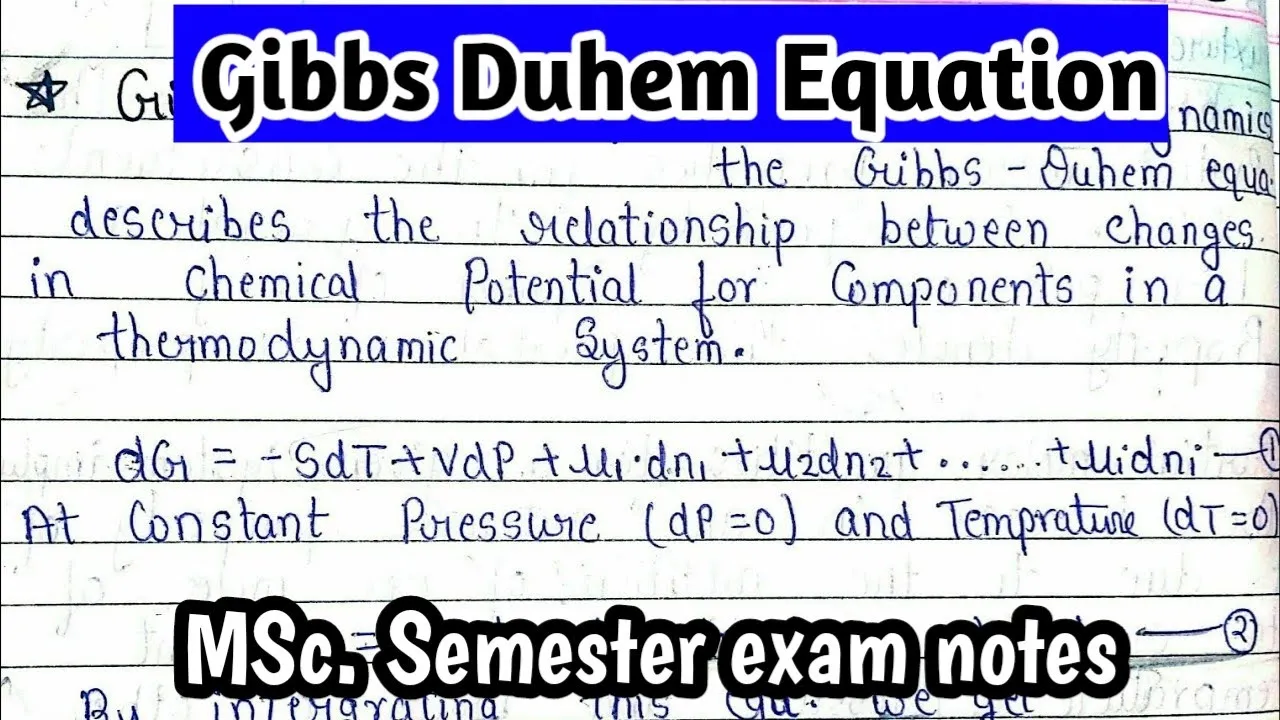
Derivation and application of the Gibbs-Duhem equation to relate changes in partial molar properties.
Introduction to ideal and non-ideal mixtures, including excess properties and activity coefficients.
Analysis of phase equilibria (e.g., vapor-liquid equilibrium) using chemical potential, which is the partial molar Gibbs free energy.
Practical methods for determining partial molar properties from experimental data, such as the tangent-intercept method.
45.8K views225likes3:27Original Release: 2012-02-23
Here we'll discuss partial molar properties.
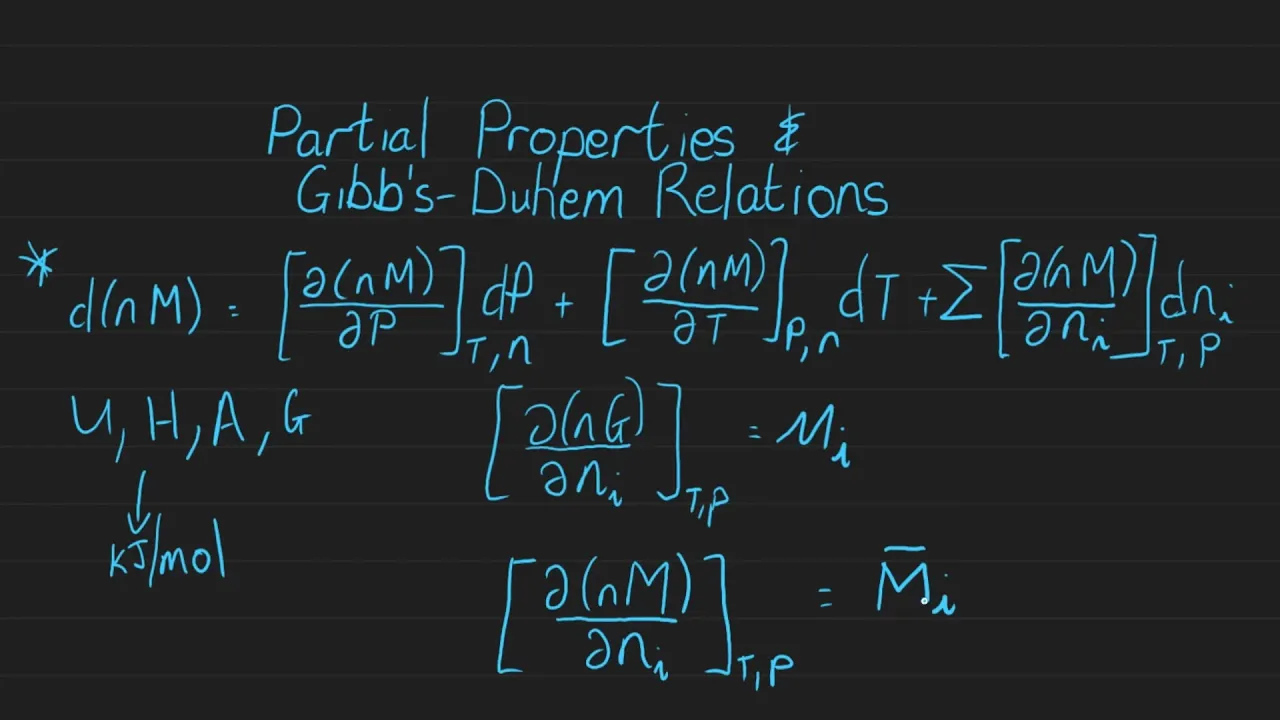
Essentially what these are is properties we assign to individual compounds or components in a mixture even though these are mixed on a molecular level, we can still try and assign properties, and the way we do that, is by assigning partial molar properties.
And the partial molar properties are such that if we have a binary system and X1 is the mole fraction of component one and let's look at partial molar volume.
So the line over the top, this is the partial molar volume of component one.
And mole fraction of component two, the partial molar of component two.
So essentially, we sum up the partial molar properties times the mole fractions, we get the molar property.
So this is the volume and it's all molar quantities.
So this is the volume of the mixture per mole of mixture and this is the partial molar volume for component two.
So V1 bar and V2 bar are functions of the composition of the mixture.
in general, they're not equal to the molar volume of component one or the molar volumes of component two.
So we can envision if we had a system where the mole fraction of component one was 0.6 and component two was 0.4, since liquid phase total volume is one liter.
We add a very small amount of component one and we observe that the volume increases by a small amount.
The mole fractions change slightly so I've indicated they are approximately equal to these values but obviously they're slightly different.
Well the partial molar volume is the change in the volume for the change in the number moles of component one where we're keeping constant temperature, pressure, and number of moles of component two.
Notice in this problem we've added component one, the number moles of component two is the same before and after.
So an approximation since we added a small amount, you'd take the final volume minus the initial volume - that's in liters - and divide by the number of moles of component one that we added, and this is going to be a reasonable approximation to the partial molar quantity for component one.
This is an estimate of V1.
Obviously it gets better the smaller the amount that we add.
And as we change the composition of this liquid mixture, then this value for partial molar quantity is going to change.
So if our starting mole fraction is X1 equals 0.1, we'd get a quite different value.
And then the same idea applies for partial molar enthalpies, internal energy, entropies, Gibbs free energy, they're all defined partial molar quantities as the change in this case of the enthalpy per mole, change in component one, temperature, pressure.
And if we're looking at a system with five components, that would be n2, n3, n4, n5 are kept constant while we vary our moles of n1.
And analogous for the other species.
And again, the same idea, H the enthalpy for the mixture per mole is the sum of the mole fractions times the partial molar quantities of the species.
Up Next

96:03
Chemical Potential & Introduction to Phase Equilibria | Thermodynamics
@fredrickmwazighe2132
344 views•2024-11-06
83:56
Biocatalysis and Catalysis in Islatravir Synthesis | Merck Webinar
@SCIwheresciencemeetsbusiness
675 views•2020-10-08

12:59
Langmuir-Hinshelwood Kinetics: Derivation and Model Verification
@LearnChemE
59.4K views•2011-11-28

17:31
Edible Water Bottles: A DIY Guide to Sodium Alginate Spherification
@ryan
10.5M views•2019-06-21
Related Study Plans & Knowledge Roadmaps
Structured learning paths in Chemistry
chemistry
Nuclear Chemistry: Decay, Meds & Fuel Cycle
01Introduction to Nuclear Structure and Radioactivity
02Decay Dynamics and Kinetics
03Radiation Interaction and Detection
+ 2 more learning modules
24h5 modules
Explore Roadmap
chemistry
Supramolecular Chemistry: Forces & Machines
01Foundations of Chemical Bonding and Intermolecular Forces
02Introduction to Host-Guest Chemistry
03Thermodynamics and Dynamics of Self-Assembly
+ 2 more learning modules
16h5 modules
Explore Roadmap
chemistry
Photochemistry: Excited States & Reactions
01Foundations of Light-Matter Interactions
02Molecular Orbitals and Electronic States
03Photophysical Processes and Jablonski Diagrams
+ 2 more learning modules
18h5 modules
Explore Roadmap
chemistry
Coordination Chemistry: Bonding & Properties
01Introduction to Transition Metals and Ligands
02Crystal Field Theory (CFT) and Geometry
03Magnetic Behavior and Spin States
+ 2 more learning modules
14h5 modules
Explore Roadmap