






![SACANI RESPONDE [TERRA] - Ciência Sem Fim #189](https://i.ytimg.com/vi/EtqFKF9AtGY/maxresdefault.jpg)









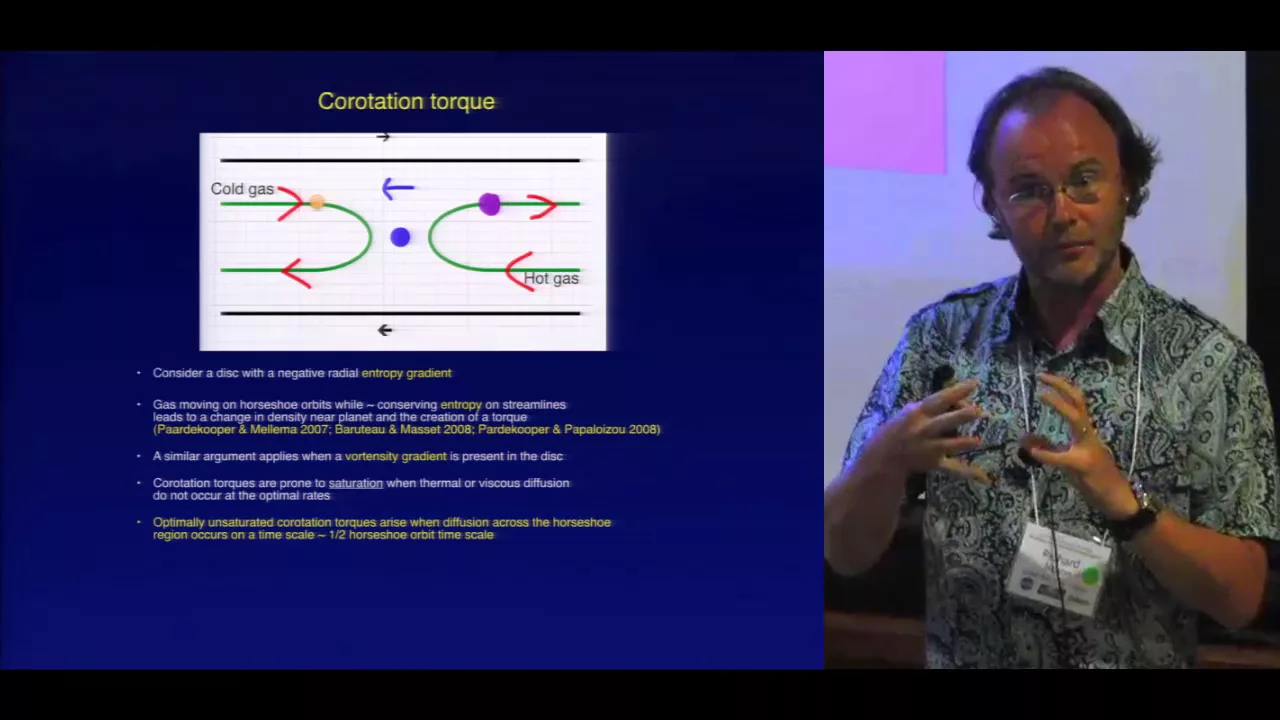
James Clerk Maxwell's 1856 Adams Prize essay on Saturn's rings demonstrated that uniform solid rings are gravitationally unstable and cannot exist, while systems of many small particles can remain stable through gravitational interactions; this work established foundational principles of gravitational instability that later proved essential for understanding planet formation in protoplanetary discs, where similar gravitational instabilities can cause particles to clump together and form planets.
Maxwell's Saturn Rings & Planet Formation | Astrophysics Lecture
Added:Newtonian gravitation and orbital mechanics, specifically Keplerian shear and tidal forces (the Roche limit).
The historical scientific consensus on Saturn's rings prior to Maxwell, specifically the debate between solid, fluid, or particulate compositions.
Basic principles of fluid dynamics and perturbation theory, which are essential for understanding stability analyses.
The general concept of protoplanetary disks and the nebular hypothesis of solar system formation.
The Toomre stability criterion for self-gravitating accretion disks and its role in planetesimal formation.
Modern observational evidence of protoplanetary disks and dust gaps using instruments like ALMA (Atacama Large Millimeter/submillimeter Array).
Advanced computational astrophysics techniques, specifically N-body simulations and hydrodynamical models of planetary rings and accretion disks.
The physics of disk-planet interactions, including orbital migration (Type I and Type II migration) of protoplanets.
308 views7likes42:31Original Release: 2025-05-22
Thank you very much. And I'm delighted to talk to you today about Maxwell's work on Saturn's rings and to try to make some connections with ideas of gravitational instability and the formation of planets um in our solar system and beyond.
So as others have mentioned uh Maxwell was motivated to work on Saturn's rings uh because of the Adams Prize essay competition for 1856 which was announced in this way and the emphasis was on the stability of the rings. Uh it wasn't known at the time whether they were solid or fluid and various possibilities were to be investigated.
Well, the Adams Prize had been established a few years before to honor John Cooch Adams, the mathematical astronomer from Cornwall, who had graduated in 1843 and become a fellow of St. John's College. and he'd worked um analyzing uh the discrepancies in the orbit of Uranus and used that to predict uh the existence and the location of another planet which would be Neptune uh except uh as is well known um the um the British astronomers at the time failed to capitalize on the opportunity and uh instead it was the Neptune was discovered following Levaro's parallel and independent uh calculations. Anyway, um the Adams Prize was to be awarded every two years to a Cambridge graduate in those days uh for the best essay on some topic in pure mathematics, astronomy or another branch of natural philosophy.
And the first topic for the Adams Prize was a very Adams like uh topic and was won by Robert Pearson from St. John's. U but then after that well the next one uh wasn't awarded at all and then a couple of years after that actually there were no candidates for the essay competition.
So when it came to 1856 well perhaps the topic was more inviting. Um, Maxwell won the essay of course the essay competition this year of course but his was the only entrance entry in the comp.
Now, two of the examiners for the Adams Prize for 1856 were uh James Chalice who was Plumeian Professor of astronomy, director of the observatory at Cambridge and uh had was one of the people that famously failed to uh follow up on Adam's calculations and missed the opportunity to discover Neptune. Um and then William Thompson later Lord Kelvin who a few years older than Maxwell uh but was already uh professor in Glasgow. And how did this fit into Maxwell's own timeline? He'd recently graduated in mathematics as we've heard coming second in the tripod and had uh received a fellowship at Trinity College. he uh was uh reading his paper on Faraday's lines of force to this society uh in the year 1855 when the essay topic was announced. Um now the following year he had to return to Scotland uh and his father passed away and also at this time he was being considered for the chair in natural philosophy at Marshall College Aberdine which he took up at the end of 1856. So it's during this period that he was working on Saturn's rings and he had to complete the essay by the end of that year and then he received the prize the following summer. But actually the published version of the essay contains some additional work and some corrections which uh involves some correspondence with Thompson.
Well, in 1856, Saturn's rings had already been known for 200 years or more. Well, when Galileo turned his telescope, his new telescope to Saturn, he recorded his discovery in this anagram, uh, which was later revealed to be this Latin phrase, uh, meaning that I have observed the most distant planet to have a triple form. Um but as as the diagram suggests, Galileo thought that the planet had ears or arms, something like that. Uh it was only really Hygens. Um exactly, well, yes, exactly 200 years before the essay competition, um Hygens had a better observation, but he wasn't so good at composing anagrams, it seems. Um so this one turned out to be this Latin phrase um which revealed that it was a thin flat ring nowhere touching the planet. Okay. And then not long after that Cassini noted the division of the main rings into two parts. Um the inner one being wider and uh darker. Okay. So um by the time of uh the essay well this is what um uh contemporary illustration of Saturn Saturn and its rings was in 1856. Um now by this time the fainter inner sea ring had been discovered and indeed there had been a revival of interest it seems in Saturn and its rings around about 1850 particularly in America. So the bonds discovered the the C-ring and there were discussions of the dynamics of the rings. Uh pos some possible evidence that Struver had found of some evolution in the inner part of the rings which was I think controversial. Um oh and here's the diagram of Saturn in Maxwell's essay.
So um in those days it's clear from the language in Maxwell's essay and indeed the uh essay title itself though I mean the competition uh abstract um that mass Saturn was regarded as a masculine object. Um but Maxwell also commented on how useless Saturn was. He was not aware of any practical use in astronomy or navigation of the rings and didn't have any effect on anything else in the solar system. Um however there was uh most remarkable from the scientific point of view. Um actually he also says here that uh there's something even less useful than Saturn's rings. That's uh the spiral nebula. In other words, spiral galaxies which had recently been uh identified. But I I sort of think uh maybe that Saturn itself, the planet was thought of as a sort of ivory ball like like one of these in the mechanical model that's been on display here. Um uh okay. Now in Maxwell's essay he he pays homage to Llas the great mathematician and refers to his great work uh that being the the treaties on celestial mechanics um uh published from 18 so 1798 uh or the year seven as it was known in revolutionary France. So um here are a couple of pages from mechanic celeste Lelass's uh discussion of Saturn. So uh the first result of Lelasses that Maxwell refers to is the um the the fact that Lelass argued that Saturn's rings couldn't be a uniform solid ring because it would be unstable.
So this is our first example of a gravitational instability. U a uniform solid ring would be in equilibrium. Uh the gravitational attraction between the planet and the ring can be balanced in this configuration whether or not the ring rotates. Um uh but it's unstable and uh it's not immediately obvious um that if we move the ring sideways well parts of it will come closer to the planet, other parts will go further away. It's not obvious whether the energy is lowered or increased if you want to think about it that way. Um, we can look at this actually using Lelass's equation. If I'm allowed an equation here, perhaps Lelass's equation will be okay. Um, so this describes the variation of the gravitational potential in regions of space away from where the ring is. This is the potential of the ring. Now, first of all, I should say that uh we're allowed to replace Saturn uh as a spherical object with a point mass at its center. We know that from Newton. Uh the gravitational properties of the planet can be reduced to that of a point mass at its center. And so the question then is whether this point is sitting at a local minimum of the gravitational potential that would make it stable. But Lelass's equation is telling us really that um at this point the potential due to the ring can be neither a maximum nor a minimum. Um and uh in a sense it has to be a minimum with respect to z the vertical coordinate because if we move the point above the plane of the rings it'll certainly be attracted back downwards.
uh so it's sort of stable or a minimum in that dimension and then correspondingly it would have to be a maximum with respect to the horizontal coordinates and so it's unstable and uh Lelass argued it slightly differently actually what I just described is more based on Maxwell's own kind of reasoning in his essay uh but Maxwell sorry Lelass concluded that the the ring would be unstable to lateral displacements would then collide with the planet so it couldn't be that um now how how else in astronomy can we consider a gravitational equilibrium because the thing about gravity is everything attracts everything else. So how can you have an equilibrium of the forces the the uniform circular solid ring is a bit special in that regard. Um but uh another way we can achieve it is by having things orbit around each other.
So if we consider a particle or it could be a moon of Saturn going around the planet in a circular orbit uh that's a kind of equilibrium although it's moving we could look at it in a rotating frame that rotates with that circular orbit and then it's just stationary at this point and that's a kind of gravitational equilibrium. Um now if we displace the particle towards the planet we think that's releasing potential energy that it's potentially unstable but of course it doesn't because as we know from Kepler and Newton it'll just go into um a slightly elliptical orbit which in the rotating frame of reference uh means that the the particle or moon does a little epicycle around its original location. This epicycle is strictly an ellipse rather than the circle that the Greeks thought of a circle on top of another circle or indeed in Maxwell's model I think it's a circle on top of another circle. Um but the point is that the energy can't be released because well either we can think of it as because of the rotation of the frame here the motion is diverted from towards the planet into this loop or we can think of it in terms of the conservation of angular momentum that blocks the release of energy in this configuration. Um another result of lelasses that Maxwell refers to in his essay is another aspect of equilibrium.
This is really for a fluid ring around the planet. Uh so let's think of this as a cross-section of a sort of elliptical tube that goes all the way around the planet. And the question is whether we can balance the forces at some distance from so Saturn's way over here to the left. Let's say now if the center of this ring is it's a ring that's narrow and also thin. uh if the center of this ring is rotating at the appropriate speed for a circular orbit around the planet at this distance and if the whole ring is actually uniformly rotating around Saturn then the gravitational attraction of the planet on this part will be too great and on this part will be too small. So there there'll be a tidal force trying to shred the ring to pull it apart that could be resisted by the the gravity of the ring itself pulling in towards uh the center here.
Um and it's possible as Llas showed to balance these forces together with a a pressure gradient. Um but only if the ring is not too close to the planet. Um we could express it by saying uh a certain D is greater than 4.6. Well, what do I mean by D? Um it's a convenient way of describing either the density of the material of which the ring is made. That's why I called it D.
Uh but it's also a measure of the distance of the ring from the center of Saturn. Actually, the cube at the distance.
Um so if that's sufficiently large then it will be able to hold itself together against tidal forces. Uh now Maxwell would go on in his essay to discuss various stability conditions which could be converted into uh critical numbers for this uh parameter d. And in a sense they were to do with comparing uh properties to do with mass with properties to do with the rotation which is the omega here.
Now, interestingly, at around the time of uh Maxwell's essay, uh some related work was done in France, but it wasn't apparently known to Maxwell or the British community. That's the work of Edoir Rash around about 1850. Um now, this differs from Lelass's work. Rush was thinking of an ellypoid, the sort of rugby ball-shaped three-dimensional figure, which we could think of as maybe one of the moons of Saturn, which had uh drifted uh too close to the planet and was also being potentially torn apart by the same tidal forces, but in a three-dimensional way.
And uh Ross showed that uh you could you could sustain such a fluid body uh but it had to be even further away from the planet in order for the tidal forces not to be too strong. And indeed Rash proposed this is a a way to form the rings that a satellite that was too close uh would be torn apart and in into rings.
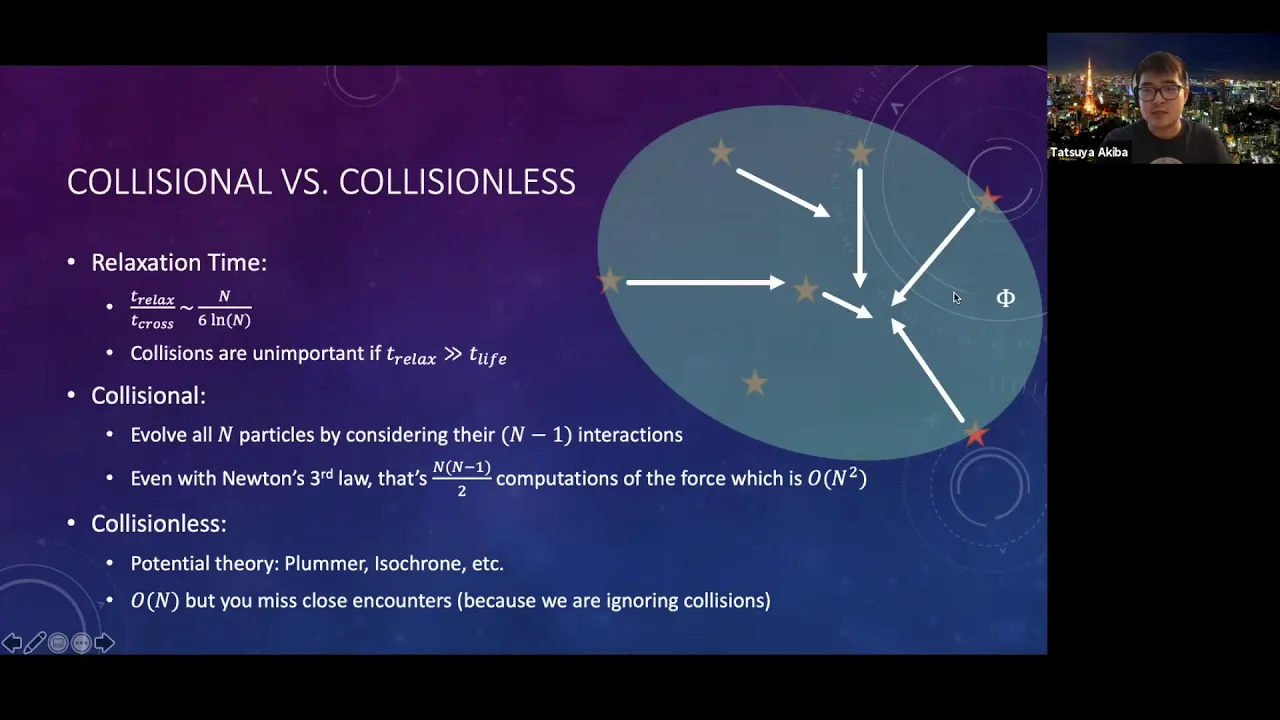
Now if we place these uh try to place these distances on uh this beautiful image of the Saturnian system as we have today a montage of Cassini images. Um well if we assume that the ring is made of water or water ice something of that density which is greater than that of Saturn um then rush's ellipsoids could exist outside uh a critical distance which roughly roughly here. Um so that'd be consistent with the idea that you could form the rings by breaking up objects at about this distance. uh Llass's uniformly rotating ring, the sort of elliptical tube could exist outside uh this distance which as as it happens is close to the inner edge of the the B-ring. I mean there are other ways to think about this competition between gravitational attraction of the ring material and tidal forces. For example, if you had strong solid spherical particles, you can ask if they can stick together through their own gravitational attraction. uh which they can do outside a critical radius or whether little particles can stick to big particles and so on. These are other ways of thinking about this uh criterion. Um so actually the first problem that Maxwell solved in his essay was um building on Llass's theory about the uniform solid ring which had been ruled out. What about a non-uniform ring? Now this is uh a really difficult problem um which I I guess the wranglers of the day uh would be be good at doing but it's actually I I find it quite difficult to reproduce this calculation I must admit. Um but uh Maxwell set it up in a very clever way and used Furia analysis which uh as I think Malcolm mentioned he'd uh read about uh in his youth um to describe the angular variation of the density of the non-uniform ring and then uh derived conditions on the stability of this uh configuration. In particular he considered uh an extreme kind of non-uniformity. So Llass's uniform solid ring mounted with a uh a heavy particle at one point and Maxwell concluded after lengthy mathematics that even this would all to be unstable unless the ratio of the mass of the particle to the uniform part of the ring uh was in this very narrow interval which seemed highly improbable and so that basically ruled out the theory of the solid ring.
uh perhaps the most uh well-known aspect of Max Maxwell's essay was about the stability of coorting particles or satellites. So this is quite a good way to set up an equilibrium configuration whose stability can then be tested. So we have a number of identical uh particles or satellites following the same circular orbit around Saturn and then we ask whether that is stable or unstable. So as was uh uh suggested in the previous talk this was done by linear stability analysis introducing small perturbations from the equilibrium simplifying the equations in that way and using furer analysis to describe the various undulatory modes of the system as I beautifully illustrated with the mechanical model and he had to consider radial tangential and vertical displacement. So in this direction away or towards from the planet uh in the direction away towards from the neighboring satellites and vertically out of the plane. Um and the complication of the problem is that the radial and the tangential ones the ones in the plane of the ring are coupled together by the rotation which was we noted in the uh discussion of epicycles.
And so here are some illustrations of uh different fur modes, different numbers of oscillations in the configuration. Uh and Maxwell showed that the most dangerous ones, the ones most likely to be unstable were ones in which the neighboring ring particles uh would undergo equal and opposite displacements. And indeed he showed that um that the ring would be unstable if this criterion was satisfied. Now this can be interpreted as saying either that the ring so I should say MP is the mass of a single particle n is the number of particles uh this is a condition that the ring uh be sufficiently massive or alternatively that the number of particles be sufficiently large so if there are too many particles in a way if their spacing is insufficient then uh the system will be unstable um I'll come back to that one uh as for the outcome of the instability Maxwell described in detail the the growth of the uh unstable modes in the linear theory that he had. Uh but he could only speculate about the eventual nonlinear outcome. Uh but he was quite right that it causes the particles to collide with each other and then they can stick together and form fewer more massive uh satellites.
So uh I mean this illustrates the sort of spiraling trajectories of the unstable motions of neighboring particles in in an example of this unstable mode leading to a collision between particles. And then Maxwell tried to relate this at least qualitatively to theories dating back to Kant and Llass uh in the 18th century about the formation of planetary systems. the uh origin of the solar system. Um so yeah, a few years ago we actually did a simple numerical simulation of this instability to show that the particles do indeed uh collide through this instability and they stick together um uh or if they're allowed to stick they can form uh fewer more massive objects. Okay. Okay. Now, the modern view of Saturn's rings, thanks to the Voyager and Cassini missions and other uh groundbased uh investigations, is that they are indeed composed of um very large numbers of uh particles of almost pure water ice. So, trillions of particles uh which are orbiting the planet at like 10 kilometers/s or so.
And relative to that circular motion, they have very small random motions on the order of millimeters/s. Those are the characteristic speeds at which the particles are gently colliding. Uh and in indeed there is a tendency for them to clump uh through their own self-gravity. So uh well we have both computer simulations and oil paintings describing this uh situation.
um we don't uh even Cassini isn't able to image the individual ring particles but we do do know something about their size distribution. Um so this is uh uh provides some structure in the rings uh not necessarily forming bound objects but uh contributes to their activity and dynamics. Sorry for the spelling mistake and also pro provides a transport process within the rings.
Um now Maxwell did uh somewhat briefly consider the possibility of fluid rings.
Um and uh well uh his calculations in this area have been noted to be flawed. In fact he he was aware of this himself I think. Uh but he did conclude uh qualitatively that the uh gravitational attraction of different parts of the ring would cause it to break up into beads as he described it.
Um so the I mean the modern theory of gravitational instability in fluid uh discs and rings which might be gaseous rather than the watery discs that he was thinking of um do indeed provide a a condition on the the ring to or disc to break up into uh clumps or fragments. Um so I mean this work was done in the 1960s uh particularly associated with the name of tumeric uh but also by goldrike and lynenbell here in Cambridge. And um I suppose that what's going on here is that we're finding a way of rearranging the material so as to bring things closer together. So releasing gravitational energy but respecting all of the constraints which here are to do with the conservation of angular momentum or to incorporating the fact this is all a rotating fluid and uh applied to Saturn's rings at least in the sort of watery models that Maxwell was working with that would occur at quite a close uh distance to the planet. So uh from somewhere about here onwards uh a watery disc would tend to uh be gravitationally unstable. And indeed we know that gravitational instability of the icy rings is active um in the outer part of the ring system increasingly so as we get to the outer edges.
So uh Max among Maxwell's conclusions to the essay were that the um the only system of rings which can exist is composed of an indefinite number of unconnected particles revolving around the planet with different velocities according to their respective distances.
He expressed it more poetically in this letter to Thompson. What should we say to a great stratum of rubbish jostling and jumbling around Saturn without hope of rest or agreement in itself till it falls peacemeal and grinds a fiery ring round Saturn's equator? Yes. So um the the main thing neglected in uh Maxwell's analysis of gravitational instability was the orbital shear uh because he was thinking in a way of lelass's uniformly rotating rings but they can only really be narrow not the broad rings he wanted to think about and um also in the same letter to Thompson he expresses his concerns about orbital shear in this way that he wouldn't recommend anyone to few a building stance on any of the rings uh because the parallelograms would be spun out into spirals in a few hours. And indeed, the way we analyze gravitational instability in discs which are subject to orbital shear, that's the inner parts are rotating more rapidly than the outer parts because of Kepler's laws. Um is very much built it builds in that sort of deformation uh that shearing into the wave analysis.
Now I was very interested reading Maxwell's essay to uh see what he says about uh the viscous spreading and evolution of the rings which is not quite the same thing as stability. Um because I think when the essay topic was set on stability the idea was well Saturn's rings have been around for at least 200 years. They are stable clearly in a in a dynamical sense. It's much longer than the orbital time scale. But here we're looking at how they might evolve over very long time scales. Um and he was thinking both about particles which would collide with each other because of interactions and resonances between differently rotating parts of the system and uh or of a fluid ring where there be a viscosity u which would either of these things collisions or viscosity would tend to dissipate energy while conserving the angular momentum which in those days had to be capitalized um uh of the system.
Uh so uh in particular for the the fluid ring he derived this equation for the rate of change of the energy of the ring which is essentially orbital energy um as a result of viscous dissipation working on the orbital shear in the ring and using Stokes's value for the viscosity of water for the purposes of illustration he concluded that the energy of the ring would change on well on a time scale this number of years uh which was inconceivably longer than the age of anything as considered in the mid-9th century well and even now a longer than the age of the universe um but Maxwell noted that the this process would cause the ring to spread so the inner part would the inner radius would go inwards and the outer one go outwards so this could be seen as foreshadowing the theory of accretion disc which is really a a 20th century uh development with wide applications in astrophysics Um, now we can actually measure the viscosities in Saturn's rings by looking at the waves excited by the moons. So moons out here at various resonant locations in the rings excite waves and those waves travel some distance and then they're damped out by the viscosity of the rings and uh estimates of the viscosity something like 100 to a thousand times that of water which Maxwell was considering um depending on which part of the rings you're looking at and uh that actually would give you evolution time scales similar to the age of the solar system. Um, that isn't necessarily uh helpful because most people think that Saturn's rings are much younger than that, perhaps only hundreds of millions of years old because of their purity. So, there's still there are still puzzles there about the evolution of the rings. So, um, Saturn's rings can now be seen in the context of other astrophysical discs around stars, black holes, and so on. Um, of course there are extremely beautiful example, one where we can uh resolve in amazing detail things like the interaction between uh objects like this moon Daphnus in the outer part of the A-ring, how it interacts with the rings by opening up an annular gap through the exitation of these edge waves. And um a closely analogous process happens when planets are born in gas discs around young stars. um if they're sufficiently massive, they can open a gap. And the ways that they excite in the surrounding gas disc carry away energy and angular momentum. These processes are fundamental in understanding how planets attain their final mass and their final orbital configuration around our star and other stars. Um so what about the outcomes of gravitational instability? Well indeed it's possible to form um objects by uh elomerating material as Maxwell uh suppose but another possibility is as we've seen forming structure and transport within rings and discs.
Now um looking at the Saturnian system with a wider uh scope and there are many rings the many moons outside the ring system and some have speculated that uh actually uh instead of the rings being formed by disrupting moons here could work the other way that the outward expansion of the rings could lead to formation of moons at the rash limit and then they get pushed away. I mean the boldest version of this theory which I would say is not widely accepted is that all the moons in the solar system uh could be could have been formed from tidal discs like this around planets and produce different numbers of moons uh depending on the uh properties of each planet. Um now going back to the uh planet formation in discs around young stars. Gravitational instability is seen as being important in the early phases the first few million years when the discs are massive massive enough to satisfy that instability criterion. And depending on the thermal properties how rapidly the gas can cool. This is thought either to produce bound objects which might be very massive planets or alternatively to produce structure spiral structure a recurring set of density waves. Um and uh so the first process could plausibly explain some of the most massive and distant planets. So I mean this is a distribution of exoplanets have been discovered in recent years. Uh the ones of many Jupiter masses that are far from their stars. Some of them might have been produced by gravitational instability. Otherwise gravitational instability uh can play a role in the formation of other planets for example in helping uh things to uh form planet decimals uh within the gas discs. Um but the second possibility uh this one here which here is seen in the context of protolanetary discs that theory was developed uh in the 1960 to to explain the spiral structure of galaxies. So that's uh an outcome of gravitational instability in another type of astrophysical disc. Now I'll try to draw some other connections with Maxwell's ideas.
um because looking at some of the correspondence um or some of the documents coming uh shortly after Maxwell's essay, it's clear that he was trying to develop a kinetic theory uh of the rings there. So considering these very large numbers of colliding particles um but this kinetic theory is much more difficult than the kinetic theory of gases he would go on to develop where the particles just go in straight lines between collisions. here between collisions the particles are in going in Kepleran orbits around the planet and there might only be a few collisions per orbit. Um also the collisions of the particles might be quite inelastic. They don't just bounce off each other uh in an elastic way as in the standard kinetic theory of gases that he would develop. So Maxwell I think uh aborted this uh plan. It really it was only carried out in the 1970s and beyond. um this kinetic theory of colliding inelastic particles in the context of an orbital sheer flow uh as in an astrophysical disc. Um and that can be that sort of theory can be roughly matched with the computer simulations of very large numbers of colliding particles in local models of such discs including Saturn's rings.
Um now uh other types of astrophysical discs that we study include the high energy plasma discs around black holes um which are also dominated by orbital motion around a central point mass. Uh but the physics is rather different. I mean here this material is it's very hot. It's highly conducting fully ionized and the magnetic field plays an important role in the dynamics. the subject of magneto hydrodnamics a sort of fusion of uh fluid mechanics and electromagnetism and uh I think Maxwell would really have enjoyed uh magneto hydrodnamics it has appealing mechanical pictures the magnetic field lines or the lines of force as he would have called them move with the plasma that's a a famous result due to Alvain who won the Nobel Prize for his work on MHD um and also So the magnetic field affects the motion of the plasma through magnetic tension and magnetic pressure.
I mean putting those ideas together we get this mechanical picture that the magnetic field imparts an elasticity to the fluid or the plasma. And indeed um those ideas of tension and pressure the way the magnetic field influences uh for us the fluid flow is described nicely by the Maxwell stress. He describes in this uh in in his textbook the um the the tension and pressure due to the magnetic field um which we now think of as a stress tensor. Uh but we can also link this to Maxwell's work on visco elasticity. There's something called the Maxwell derivative which derives from his work on uh the time dependent relation between stress and strain in what we now call a visco elastic medium and uh I mean nowadays we can express this in in a tensor language which Maxwell didn't have but it turns out in MHD um the Maxwell stress evolves in time through what we would call a Maxwell derivative. So that's a nice connection. Um now uh coming back to the exoplanets there's a an interesting variant on one of Maxwell's problems. We could consider uh uh equally equal mass satellites uh equally spaced in a certain sense orbiting uh well it could be a star in this case. We the these might be planetary embryos on the way to becoming planets. They formed in a gas disc and they're competing in some sense for for with each other.
Um now the question is whether this is stable or unstable. Well that turns out to be an unfair question because it's not really an equilibrium to begin with.
Uh these planetary embryos want to orbit the star at different rates faster on the inside slower on the outside and so they will have close encounters at at various times. And uh these close encounters cause uh random kicks or semi-random kicks in their orbital properties in particular their eccentricity which can undergo a sort of random walk process leading eventually to a collision and and a merger between these objects. So it's not as clean as Maxwell's problem. There's no clean um uh separation between stability and instability. It's more about the time scale which depends exponentially on the separation of the particles expressed in a certain set of units. If we convert Maxwell's problem which was for uh satellites on the same circular orbit but separated uh in the tangential direction um then uh well basically where they would be unstable in Maxwell's problem uh the this planetary protolanetary system will uh will lead to a collision on a quite a short time scale uh otherwise it could last for millions of years. So this kind of consideration is very relevant in understanding the architecture of planetary systems including the solar system. How full is it? Is there room to put in another planet or would it just lead to instability in this in the sense that we've described? But also there are many interesting exoplanet systems have been discovered with multiple planets like seven or eight planets such as Kepler 90 uh Trappist one and so on. And this kind of consideration about the dynamical uh spacing and the fullness of planetary systems is very relevant for understanding uh how these can be formed and uh how they are stable and uh uh a further connection which has been uh already discussed in uh uh in the previous talk is about uh stability uh polomials and so on. uh because at several points in Maxwell's essay he uh determines the stability of a certain mechanical system through the linearization of the equations and then uh well he as he says here let us write n instead of the symbol d by dt. So he's expressing the time variation in terms of a parameter n which is equivalent to saying that the small pertubations are assumed to depend in an exponential way on time through uh and this number n might be a complex number or an impossible number perhaps we should say.
um and he then determines algebraically whether or not the roots of this polomial equation uh imply uh growing disturbances or not.
So this was later to be uh more systematized uh through his own work which as we've seen led to the field of cybernetics but also through uh Ralph's work and uh as as the previous speaker described the Adams prize much later in 1876 uh for which Maxwell was one of the examiners was on this topic where Ralph was able to uh uh solve this problem quite completely also. So the fury analysis this way of analyzing disturbances well for Maxwell's ring system uh that was taken forward by Thompson and as linear stability analysis of sheer flows in fluids. Okay. So to to bring this to a conclusion um we can certainly agree with Ary uh that this uh Maxwell's essay is a remarkable contribution to mechanical astronomy but arguably it's quite a lot more than that. Um it's inspiring I think because it's both a broad investigation but also a deep one in several places. Um and Maxwell shows quite a pragmatic use of simplifications and approximations to make the problems tractable. Um and he remarkably is able to extract or extrapolate the physical conclusions correctly from u these carefully chosen model problems. And I found that very inspiring. And uh as we've seen in many ways, Maxwell's essay anticipates a number of developments that were to come even a century later. And there are plausible connections with his remarkable developments later in other fields such as kinetic theory, uh stability and control. And uh I think also this work um and and the correspondence surrounding it reveals a very human uh genius. uh perhaps more Beethoven than Mozart. He clearly struggled with early uh calculations in this essay and yet produced a remarkable work as a result of it. Thank you.
Up Next
127:36
Uranus: The Extreme Physics of a Tilted Ice Giant
@CalmSpaceToSleep
4.3K views•2026-08-19
61:17
First Billion Years of the Universe with the Square Kilometre Array
@iaaudc
121 views•2022-05-26

6:25
Kepler's Laws of Planetary Motion Explained (Educational Astronomy Video)
@Peekaboo_Kidz
404.9K views•2023-02-17
6:10
Gamma-Ray Bursts: Cosmic Snipers Explained | Astronomy
@kurzgesagt
15M views•2016-07-31
Related Study Plans & Knowledge Roadmaps
Structured learning paths in Astronomy
astronomy
Reionization: Pop III Stars, IGM & 21cm Line
01Foundations of Cosmology & the Early Universe
02Population III Stars & Cosmic Dawn
03Physical Mechanisms of Reionization
+ 2 more learning modules
17h5 modules
Explore Roadmap
astronomy
Planetary Rings: Dynamics, Roche & Resonances
01Foundations of Gravity and Orbital Mechanics
02Tidal Forces and the Roche Limit
03Structure, Composition, and Collisions
+ 2 more learning modules
10h5 modules
Explore Roadmap
astronomy
Asteroseismology: Stellar Waves, Ages & Cores
01Foundations of Stellar Astrophysics & Wave Mechanics
02Stellar Oscillation Modes: P-modes and G-modes
03Mathematical Framework of Asteroseismology
+ 2 more learning modules
35h5 modules
Explore Roadmap
astronomy
Adaptive Optics: Physics, Engineering & Control
01Foundations of Wave Optics and Wavefronts
02Atmospheric Turbulence & Optical Distortion
03Wavefront Sensing Technologies
+ 3 more learning modules
35h6 modules
Explore Roadmap