


















Superconductivity occurs when electrons form Cooper pairs at temperatures below a critical point, causing them to behave as bosons and occupy the same lowest energy state, resulting in zero electrical resistance and the Meissner effect that allows magnets to levitate above superconductors; however, this conventional theory only explains superconductors up to about 30 Kelvin, while high-temperature superconductors discovered in 1986 remain unexplained by current physics.
How BCS Theory Explains Superconductivity
Added:Basic understanding of superconductivity, including the concept of critical temperature (Tc) and zero electrical resistance.
Fundamentals of quantum mechanics, specifically the distinction between fermions and bosons, and the Pauli Exclusion Principle.
The concept of crystal lattices and phonons (quantized lattice vibrations) in solid-state physics.
Classical electromagnetism, particularly Ohm's law, magnetic fields, and electromagnetic induction.
In-depth study of High-Temperature (Type-II) and unconventional superconductivity, which cannot be fully explained by standard BCS theory.
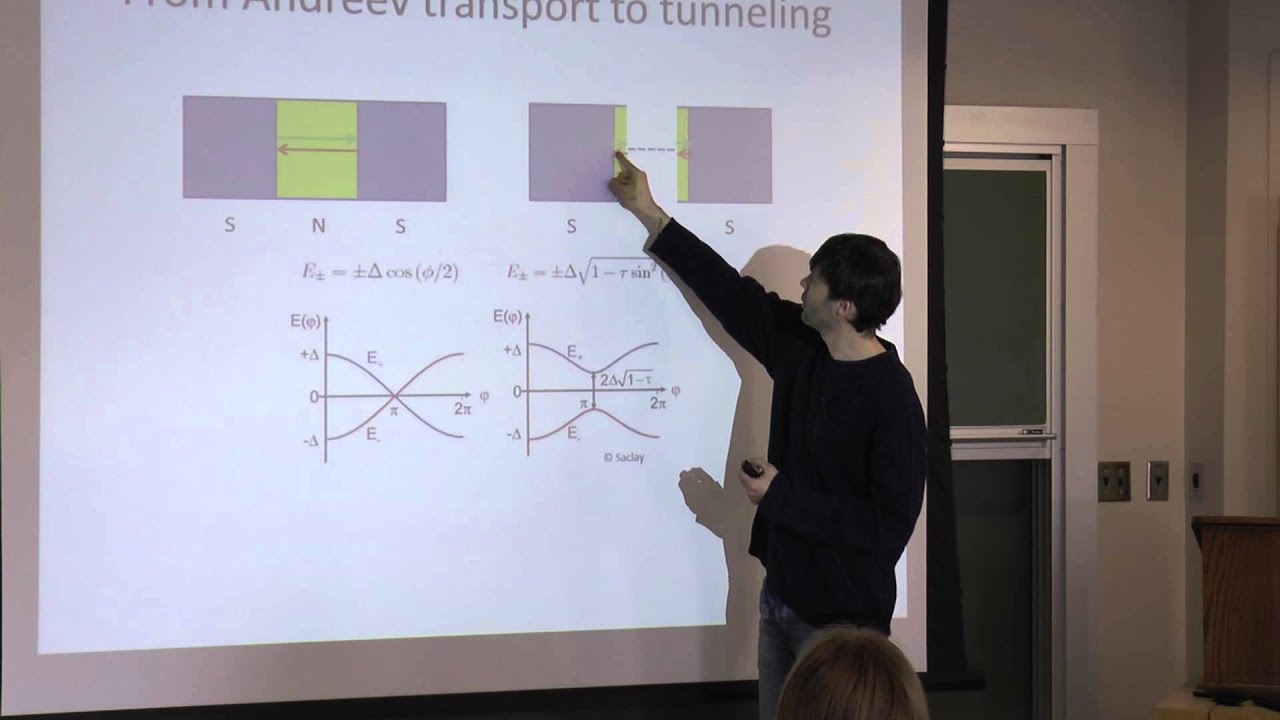
The Josephson Effect and its application in Josephson junctions, which are fundamental to superconducting qubits in quantum computing.
Ginzburg-Landau Theory, a phenomenological macroscopic theory used to describe superconductivity and phase transitions.
Practical engineering applications of superconductors, such as SQUIDs (Superconducting Quantum Interference Devices), MRI machines, and Maglev trains.
75.2K views2.7Klikes8:29Original Release: 2022-12-29
we will see how two electrons that usually repel each other can actually come together to form pairs leading to absolutely zero losses and making this magnet right here levitate to understand and appreciate what's really going on we first need to understand how electrons normally behave let's take this piece of aluminum right here if we zoom in we can reveal its microscopic structure and what we find is a periodic arrangement of positively charged aluminum ions with electrons flowing through it it is this flow of electrons that is what's causing electricity to flow allowing you to charge your phone but this flow isn't perfect occasionally the electrons will bump into one of the atoms transitioning the electron from a higher energy state to a lower one and transferring some of its kinetic energy to the atom making the atom vibrate a bit harder these vibrations are what we call heat and it is the source of resistance in metals sometimes you can even feel this heat when your charger is getting hot so how do we get from this messy picture of electrons just bouncing around to a levitating magnet well first we need to cool down way down close to absolute zero we have now cooled down so far that the aluminum atoms hardly vibrate at all it is at these extremely low temperatures that something interesting happens as we cool down below the critical temperature of 1.2 Kelvin the aluminum suddenly transitions from a normal metal to a superconductor a superconductor is a material that has zero resistance below its critical temperature a sudden drop first observed by cameling Honest in 1911. as a result currents can flow without a single loss meaning that inside a superconductor electrons never ever bounce off of atoms but how can this be because the atoms certainly didn't disappear and neither did the electrons so how can there now be zero collisions we'll get to it but first there is one other effect that classifies a superconductor and that is that inside a superconductor there is no magnetic field superconductors expel all magnetic fields forcing the magnetic field to go around the superconductor an effect known as the meissner effect so now we know what a superconductor is it has zero resistance and it expels all magnetic fields but we still do not know how it works on a microscopic level 46 years after Ana's first discovered superconductivity bardeen Cooper and Shriver discovered how it worked what they suggested is the following as we cool down the atoms hardly vibrate at all and are mostly stuck in place as an electron then moves through the atoms it pulls on them due to their opposite charges and this pull slightly displaces the ions pulling a region of them closer together we now have a small area that's slightly more positively charged than the area surrounding it another electron flowing by will be attracted by this positive charge effectively making the electrons attract each shutter allowing them to form pairs so-called Cooper Pairs and it turns out that forming these pairs is actually energetically favorable so as we cool down below the critical temperature the electrons will all pair up and this is where something interesting happens electrons which are spin one-half particles are fermions which means that only one electron can occupy one energy State at the same time but if you take two spin one-half particles and you put them together they will actually start acting as a boson and bosons can all occupy the same energy state so what we find is that now a new lowest energy State appears below all the other energy states and it is this new Quantum state that all the pairs fall into so this explains why it is now impossible for the electrons to scatter they are already in the lowest energy State there is no lower energy state for them to transition to to make things worse there's even an energy gap between the ground state and the next closest States now we still need to understand why there's no magnetic field inside our superconductor one simple way of looking at it is to follow it I should bring a magnet close to a metal this will induce Eddy currents that oppose the change in magnetic field in normal Metals these Decay rapidly but in perfect conductors these currents will keep increasing in strength until they match the external field perfectly canceling it and never decaying however in superconductors this is not the full picture because this only works in changing magnetic field but a superconductor will expel any magnetic field even if it does not change the London Brothers show that a magnetic field in a superconductor generates super currents and these super currents generate their own magnetic field canceling the exterior field only very close to the surface part of the magnetic field can actually penetrate since we cannot generate infinite screening currents but this field decays exponentially so what ends up happening when we put a magnet above a superconductor is that the magnetic field lines are bent around the superconductor and this banding of lines generates a force and when this force is stronger than gravity we can have a magnet levitate so magnet levitates because the magnetic field cannot penetrate the superconductor which results in an upward force and this is caused by electrons coming together in pairs so-called Cooper Pairs and here they act as bosons which allows all of them to occupy the lowest energy state and then these bosons these scuba Bears start forming screening currents when an external magnetic field is applied and that is why pairing electrons can levitate a magnet so now you know how superconductors work or do you the theory I told you is currently accepted however it only works for some superconductors with this Theory you can reach critical temperatures up to around 30 Kelvin so imagine the shock of the scientific Community when in 1986 a high temperature superconductor at 35 Kelvin was discovered and just a year later in 1987 a critical temperature of 93 Kelvin was achieved something that seemed clearly impossible from the theory we just learned so how is it possible well it seems that there may be other pairing mechanism however right now 36 years after their Discovery their pairing mechanism is still unknown the highest critical temperature we have gotten so far is 138 Kelvin however it is still minus 135 degrees Celsius or minus 211 degrees Fahrenheit so it's still very far off that magical goal of room temperature superconductivity which if discovered would literally transform the world and save billions of dollars on energy understanding how electrons pair in these unconventional superconductors could really pave the way for a room temperature superconductor it would most likely lead to a Nobel Prize as well now just two months ago at the time of recording one group from the University of Oxford claimed to have found definitive evidence for what binds these electrons together they suggest that super exchange interactions closely related to anti-ferromagnetism are responsible for the pairing but the jury is still out so far it is a 36 year old unresolved mystery however it does seem like we are getting closer and when we do figure it out it could really revolutionize the world we live in thank you for watching and I hope you enjoyed and I would really appreciate it if you hit that subscribe button and if you want to see how you can actually make superconductors go check out this video by now red where he does precisely that I will put a link to his video in the description below see you next time
Up Next

14:00
BCS Theory of Superconductivity Explained | HSC Physics
@Letslearnscience
57.9K views•2012-05-23

12:53
21cm Hyperfine Transition in Neutral Hydrogen: Radio Astronomy Basics
@AaronRobertParsons
12.4K views•2011-10-13

32:32
NMR Spin Physics I: Zeeman Effect, Resonance Condition & Larmor Frequency
@nptel-indianinstituteofsci8064
2.3K views•2024-01-17

27:14
Entropy and the Second Law of Thermodynamics Explained
@veritasium
27.5M views•2023-07-01
Related Study Plans & Knowledge Roadmaps
Structured learning paths in Physics
physics
Nuclear Physics (Decay, Fission & Reactors)
01Atomic Structure and the Binding Force
02Radioactive Decay and Half-Life
03Nuclear Fission Mechanics and Chain Reactions
+ 2 more learning modules
12h5 modules
Explore Roadmap
physics
Soft Matter (Polymers, Colloids & Rheology)
01Foundations of Soft Matter & Thermal Forces
02Polymer Physics and Macromolecules
03Colloids, Surfactants, and Self-Assembly
+ 2 more learning modules
38h5 modules
Explore Roadmap
physics
Analytical Mechanics: Lagrangian & Hamiltonian
01Mathematical Foundations: Calculus of Variations
02From Newtonian Mechanics to Constraint Dynamics
03The Principle of Least Action & Lagrangian Mechanics
+ 3 more learning modules
28h6 modules
Explore Roadmap
physics
General Relativity (Spacetime & Cosmology)
01Foundations of Relativity: Special Relativity
02The Geometry of Spacetime: Equivalence Principle & Curvature
03Einstein's Field Equations: The Mathematics of Gravity
+ 2 more learning modules
55h5 modules
Explore Roadmap