












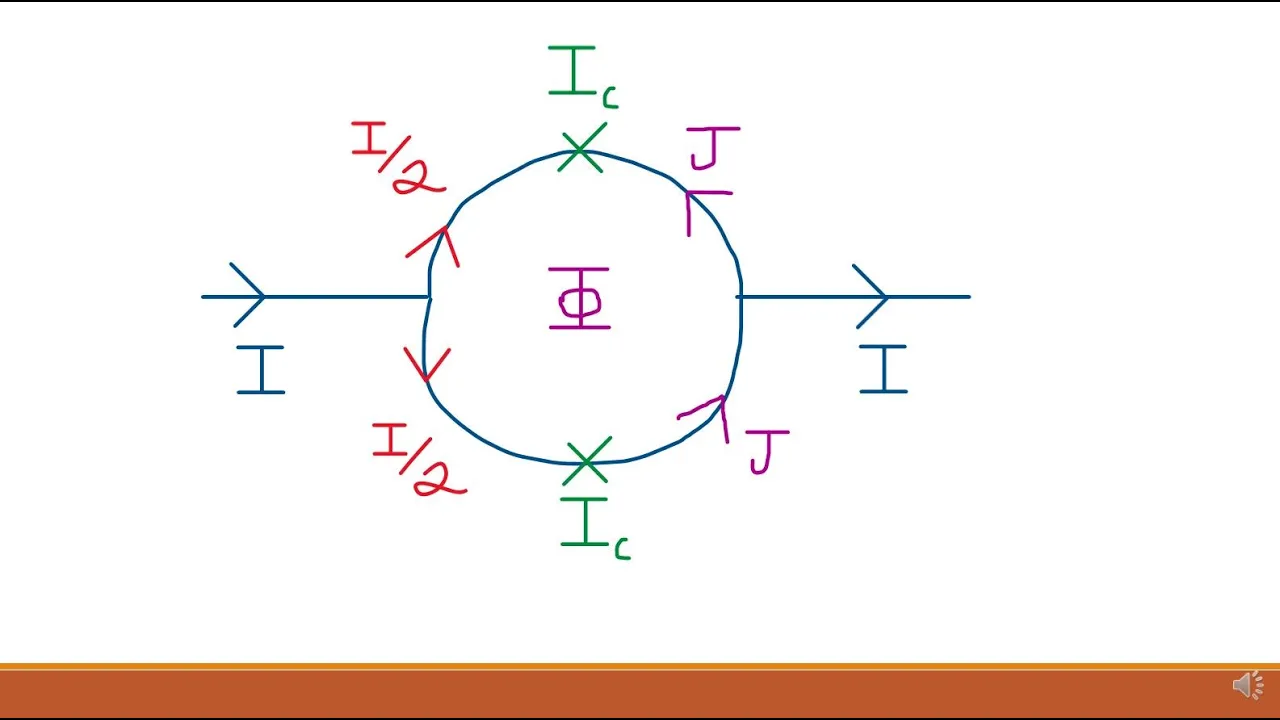











Josephson effects describe supercurrent flow between two superconductors separated by a thin barrier, where Cooper pairs tunnel through the barrier without dissipation; this phenomenon is explained by Andreev bound states—quantum states formed when electrons reflect off the superconducting interface as holes, creating electron-hole pairs that carry supercurrent and exhibit a sinusoidal current-phase relationship I = I_c sin(φ), where φ is the phase difference between the superconductors.
Quantum Transport Lecture 14: Josephson Effects & Supercurrent
Added:Fundamental concepts of BCS (Bardeen-Cooper-Schrieffer) theory, including Cooper pairing, the superconducting energy gap, and macroscopic phase coherence.
Quantum mechanics of tunneling, specifically how wavefunctions penetrate potential barriers and the concept of transmission coefficients.
Basic principles of quantum transport, such as scattering theory, Fermi-Dirac statistics, and the Landauer-Büttiker formalism.
The phenomenon of Andreev reflection, where an electron incident on a normal metal-superconductor interface is reflected as a hole, retroreflecting a Cooper pair into the superconductor.
Superconducting Quantum Interference Devices (SQUIDs) and their real-world applications in highly sensitive magnetometry.
Superconducting qubits (such as Transmon, Flux, and Charge qubits) and how the Josephson junction acts as a non-linear, dissipationless inductor in quantum computing.
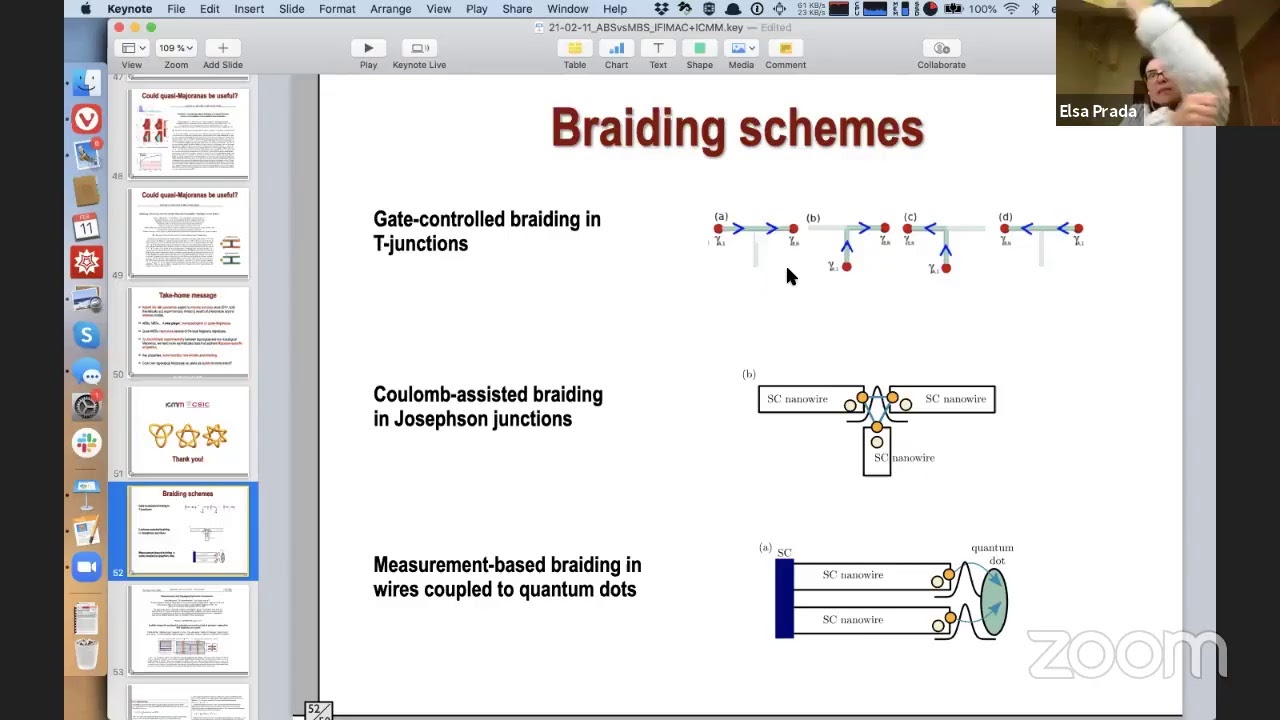
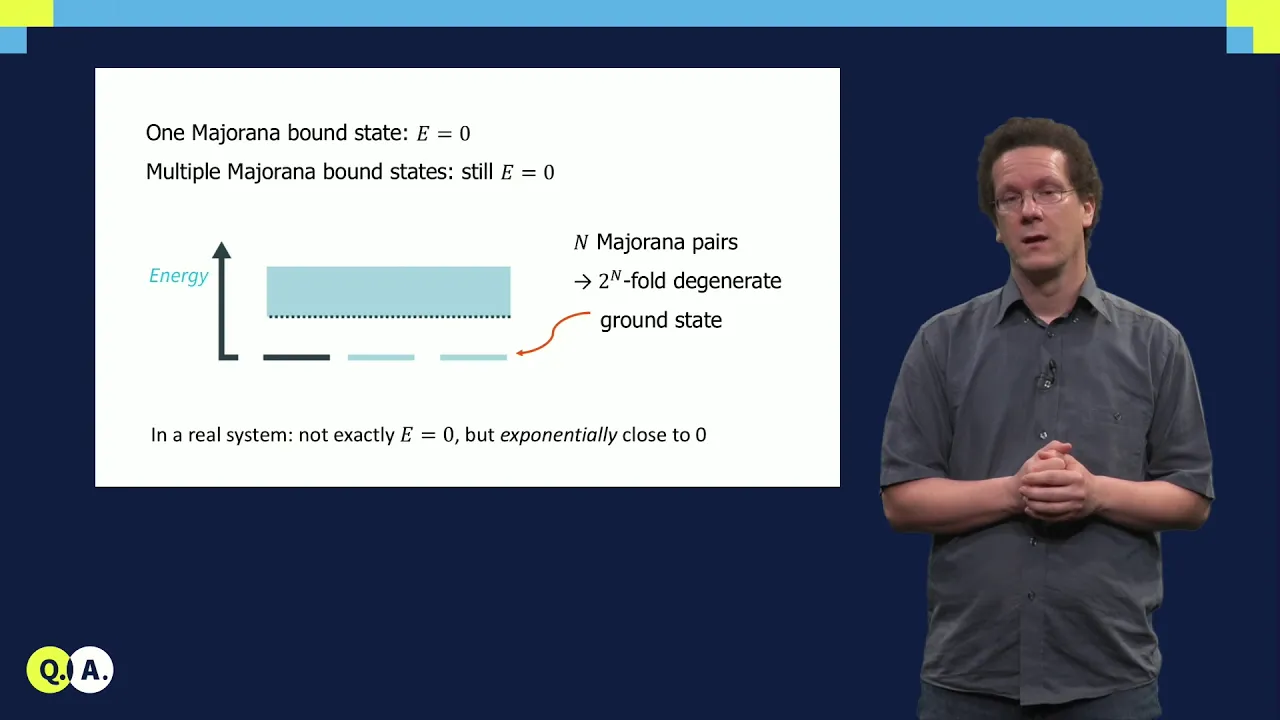
Topological superconductivity and the search for Majorana bound states in hybrid semiconductor-superconductor nanostructures.
The AC Josephson effect and its application in metrology for defining the international standard of the Volt.
58.5K views750likes1:18:12Original Release: 2013-03-07
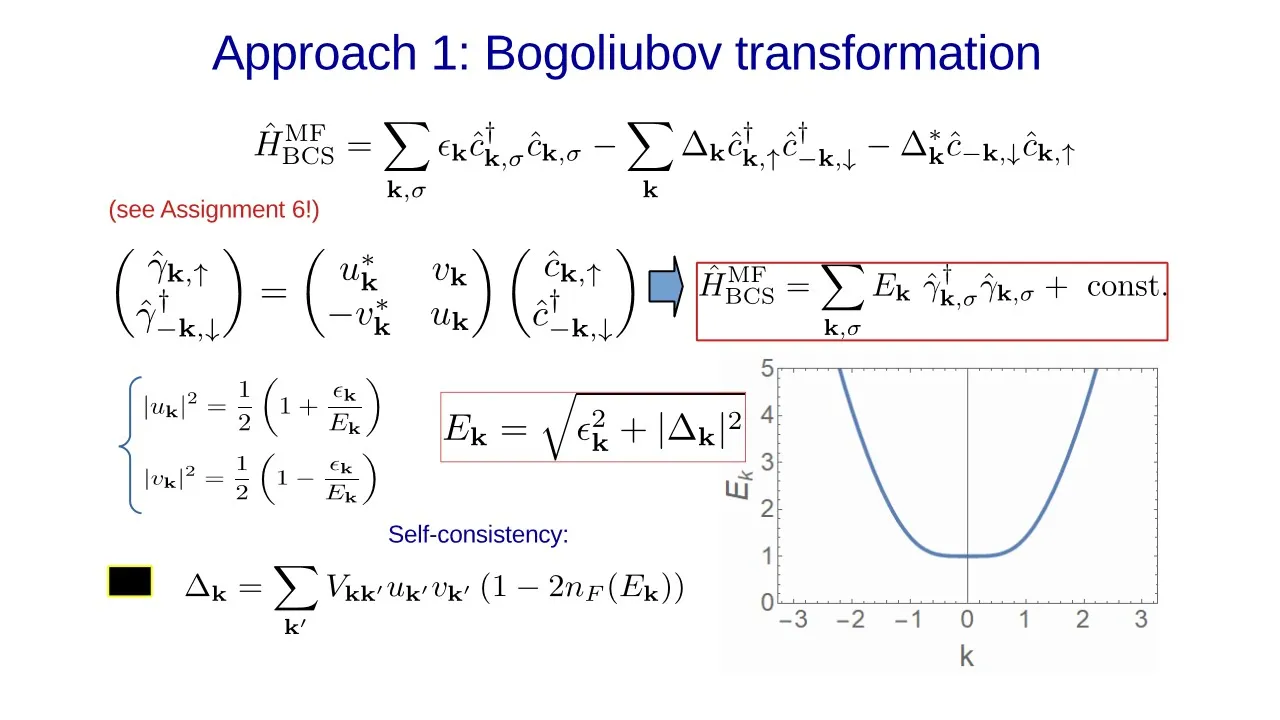
today we continue uh in the field of super conductivity uh focusing on uh this uh family of effects uh proposed theoretically by Josephson um and uh these are not just physical phenomena it is a very natural for our course to study this because um it all happens in a device the the building block is a Josephson Junction Junction between two superconductors and pretty much any effect you can imagine related to this concept is uh another device so many interesting uh effects and uh um in subsequent lectures we will see more devices based on superconductors and Joseph in effect including uh Quantum bits um at the end so um last uh week we uh focused on uh a piece of superconductor and uh I asked you to think about a superconductor in a very simple way as a wave function this one piece of superconductor uh all the Cooper pairs uh is a complicated many body state but they are all condensed in a b Einstein condensate in a ground state protected by the superconducting Gap from excitations and all of those Cooper pairs are in exactly the same state described by one complex number with an amplitude which is proportional uh to the square root of density uh and uh a phase so in principle a whole piece of superconductor would be determined by this one complex number and today we are going to study uh systems where two pieces of superconductor are in close proximity to each other very close proximity with a little gap which is called a barrier um and this barrier can be vacuum can be an dialectric insulator can be a metal can be a semiconductor and pretty much in all these situations the barrier is small enough you can see the josephan effects the Josan effect is a flow of super current between two distinct disconnected pieces of superconductor that's what Joseph and effect is if you think about it it's quite remarkable because um in this region in between there is no conditions for superconductivity there's no attractive interaction between the two electrons there are no there is no condensate uh none of that is there uh yet somehow um through this uh piece of dialectric or metal current can flow without dissipation the super current can flow so even though it's a if you T put this piece of uh let's say let's stick a piece of copper in between put a piece of copper and measure it separately on your table it will always have resistance no matter the temperature at the lowest temperature it will still have finite resistance put it in between two super conductors and you can pass a current without any resistance so that is very remarkable and uh that's called the Jos effect and uh the notion behind this effect why this works is because um you can think of this wave function on the left uh overlapping with the wave function on the right because they are close so like a wave functions of simple electrons not Cooper pairs overlapping over a tunneling barrier and allowing electrons to go from one side to the other same way wave functions of Cooper pairs overlap and uh form of a single wave function over the barrier something like this um here I show superconductor on the left superconductor on the right uh a tunneling barrier in between a constant wave function here and a constant wave function here inside the superconductor and outside the superconductor I allow them to uh slowly Decay or maybe they Decay fast it depends on the materials uh I motivated it to you in the last lecture when I mentioned to you the proximity effect right so this this is possible uh if you imagine that this barrier is a metal electrons can just fly into here and for a while they will remember each other's phases so so they will think they're a coer pair for an evanescent time also works with a dialectric or vacuum actually the quantum mechanical wave function can go in in under the barrier and if the two are close enough there will be an overlap and in the dash line I plot the sum of the two-way function nothing more well approximately so going from left to right this wave function also called the order parameter exhibits a a kind of a weak spot the amplitude is reduced but if it's not reduced to zero Cooper pairs can go from left to right and they can carry super current so J and effect can be thought of as a tunneling of Cooper pairs one thing is not plotted here in this graph is Phase well or you could say the phase of the left super conductor is the same as the phase of the right superconductor but um as the two pieces are distinct disconnected in principle the two phases don't have to be the same in general they can be different and the phase difference across the junction is a key parameter to everything we're going to talk about today it determines all the properties of Josephson Junction so the phase drop across the tunnel barrier f 1 minus 5 2 Delta F and uh for a large fraction of the talk I will just forget to write this Delta I will just write fi just phase and I will call it phase because of course phase is additive I can just subtract a constant uh from somewhere in a phase and uh but it's the phase difference I want you to keep in mind that whenever I I'll be talking about phase it will always be the phase difference between the two pieces of superconductor that matters that affects the physical properties and why that uh quantity matters it's because this microscopically Quantum coherent State and this microscopically Quantum coherent State form one coupled State and uh in order for supercurrent to flow we have to maintain phase coherence if we lose phase coherence and this quantity does not matter then Cooper pairs cannot travel from one superconductor to the other over a piece of copper and still create no dissipation still remain in a condensed state so phase coherence is important if you ever get to measure a Jos ofon Junction um you would get an IV characteristic which may look like this uh in this case uh what they uh well this is a cartoon but what you would have to do to measure this kind of characteristic is you have to sweep the current and up to some critical current there will be no voltage across the junction so after the critical current The Junction often rapidly switches as a jump into the finite voltage state after which it behaves kind of like a resistor the line that goes through here extrapolates to zero so this region is often called a normal state of a Josephson Junction and this is the supercurrent state you can see um that this is by no means a linear IV uh especially clearly not down here so if you put make a circuit that includes the joson junction as an element uh this will not be a linear Circle circuit it will be distinctly different from circuits that have resistors capacitors inductors uh those circuits we understand very well but this will be uh nonlinear and so you would have to uh apply its own logic it has its own logic there other examples of nonlinear elements are tunnel Junctions diodes transistors Etc they also come with the their own logic so uh when Josephson uh theoretically envisioned this effect um everyone said that he was crazy uh actually turned out to be true later on but for a different reason but um the reason why they said he was crazy was because uh to think about this tunneling uh people broke it down into tunneling of single electrons and uh the probability of two electrons tunneling and being a Cooper pair here and then forming a Cooper pair again here was thought to be very small and then so Joseph understood that that amplitude is actually not small if you think about Cooper pairs uh tunneling and when he uh derived his original equations uh he uh um came up with this formula which connects the super current flowing uh in the junction so not the critical current but the super current at a given moment of time uh to the phase drop across the junction so the critical current then is just a constant and uh very simple formula super current with an amplitude of the critical current is proportional to sign of the phase difference and that is often called the first joson relation and uh he he came up with two so we will talk about the second one later so coming back to this experiment if we slowly ramp up the current and we are still in the super current state right we increase the current and uh according to this equation we are winding the phase we are creating a phase across the junction cuz the two are connected right so what would be the phase difference at the critical point point at the critical current value yeah so just sign becomes one right we would be at the phase difference of Pi / 2 so as we go from here to here we will be going from zero right for zero current phase difference is zero or 2 pi or 4 pi and as we increase we will be going from 0o to Pi / 2 over a sinusoidal curve and then we exceed the critical current and uh something else happens which we will discuss later in a talk okay couple words about uh the most important example of joseon Junctions at least for this course um these are on technology you already seen this method before when I talked about tunnel Junctions uh this is this Shadow technique where uh you uh create a uh suspended mask over your substrate and then uh you put it in the evaporator and atoms in the ultra high vacuum Electron Beam evaporator come down in straight lines so you can deposit them at one angle then at another angle and uh so you will form overlaps between the two layers and in between the two layers if you put a bunch of oxygen in this chamber you will oxidize the surface of the bottom layer and therefore here you will create a tunnel Junction well if you oxidize for a kind of a long time this tunnel barrier will be quite thick and it will be a very good tunnel Junction uh and then there will be no super current because the tunneling barrier is too high so if you oxidize a little bit less and the two super conductors in this case this works most uh often with aluminum the two layers of aluminum are a little bit closer then Cooper pairs can tunnel and so with the same technique you can create good tunnel Junctions also excellent Josephson super conductor insulator superconductor Junctions this all relies on the fact that this aluminum oxide is an excellent oxide it grows very uniformly without any holes and uh with a very thin layer that it can be very well controlled what the thickness of that layer is so these Junctions are very often used in Quantum transport experiments and uh for most of the superconducting cubits for example here's an example of a of a cubit uh I think uh this is uh a sample that was fabricated in Germany in the group of Alex Ustinov um here uh he made a a little loop with the three overlap areas which are these tiny joseon Junctions of aluminum aluminum oxide so this is how it might look this scale bar is one micron so these are much smaller than a micron um and uh you have to use Electron Beam lithography to Define these patterns and uh you also see shadows in this picture so because you first deposited at this angle and then at that angle everything is doubled uh so you can see this shape and then offset from it another shape and uh it's the overlap of the doubled shapes that they control with angles of deposition and create these Junctions so this is a prototype of a something that is called a three Jon Junction flux cubid we will discuss it in uh next week I think uh the next uh yeah this is another technology that is uh very mature also very reliable uh and it is called the niobium trayer Junctions uh the the a bunch of layers but the important ones are they deposit a layer of niobium which is a a much stronger superconductor than aluminum then they cover it with aluminum then they oxidize like in the previous step they oxidize and then they put a layer of niobium on top so they make a sandwich of niobium aluminum aluminum oxide niobium and then they chop this sandwich up and uh make circuits out of it so uh this uh whole bunch of layer is a is a process which is a factory uh quality process developed by this company hypress uh and they call it niobium IC if you see at the top there niobium integrated circuit process this is from their website you can download the manual for how to design circuits uh for rules for all these layers and submit it to them and they will give you chips with your circuits and this is used by uh several research groups uh around the world uh for uh magnetic sensors um and things like that based on uh joseon Junctions uh also by this company d-wave uh I believe in in Canada I think at least at some point they purchased their chips from uh from hypress maybe not anymore but uh they used to so they would order a circuit um and it will come uh also by um a community which uh tried to create computers based on uh Jason Junction so not on based on Silicon semiconductors but on something called rapid single flux Quantum rsfq logic this is an example of such circuits here the analogy to integrated circuits is uh quite applicable because this is also a Computing circuit where uh classical not Quantum logic operations are done with magnetic fields created in the loops of Josephson Junctions and um so here are a bunch of different Jos and Junctions some are uh bigger some are smaller uh other elements include inductors um and the reason why you have so many layers in addition to this important one is because you want to connect different Junctions with uh with superc conducting interconnects and also maybe create shunt resistors Etc so some of these are shunt resistor layers some are interconnects and some are dialectric to separate different layers so this is a uh a very highly controlled technology niobium Joseph injunctions there's something you should be able to relate to cuz I've been talking about uh these materials uh for a large fraction of the course um Joseph injunctions based on semiconductor nanoes carbon nanot tubes graphine Etc also many new materials like topological insulators um uh oxide tegs Etc um call them hybrid uh Junctions because uh uh they came a little bit after uh the development of those other types of Junctions like uh aluminum and niobium and they uh couple semiconductors to superconductors so this uh was a long challenge um for technical reasons uh and therefore when when all of this became possible with high quality in in these new materials you see the papers uh got very a lot of attention and got into big journals uh but actually the physics that they study goes back to the 1960s to the original work of Josephson um after the fact uh the uh devices appear to be very simple you take for example a semiconductor nanowire and you put two aluminum electrodes on it and so the the contact is good enough then the current flows from one electrode to the other without dissipation so it's a super current here's a current on this axis and they sweep the current and they get no voltage until at some point it switches to this other state in this case the junction is actually hysteretic so the red Trace is going in this direction and then when they sweep it back it stays in the resistive state for longer and it switches back to superc conducting State at a different point so at I it's called a retrapping current critical current and retrapping current so it Junction is retrapped back into the Super conducting state uh we will uh discuss why that happens in later slides but this shows you that uh uh this is not simply a um Jun an element where up to some parameter it's a zero resistor and after another parameter when its parameter is exceeded it's a finite resistor it's much more than that it's it's there's something strange nonlinear going on in this J function here for a carbon nanot tube um a little bit hard to see the beautiful fabri pero data you should uh look at this paper uh if you want to study it but um what the data shows is um a critical current now which is uh tunable by gate so these uh values are for different settings of a of a back gate VG underneath and Nan tube so it seems that in a semiconductor you can affect the value of the critical current by sweeping a gate just like you could affect conductance in a quantum dot or a Quantum Point contact by a gate you can also affect the super current you can do all these same experiments in graphine now with those uh hybrid semiconductor systems in mind um let's go back to Andrea reflection and try to understand uh from this uh perspective what gives rise to supercurrent um what gives rise to supercurrent is something called Andre of bound States first let's look at at one side of this Junction and uh remind ourselves what Andrea reflection is Andrea reflection is a mechanism through which uh electrons can enter the superconductor right electron comes to the superconductor and uh it is reflected as a whole with the opposite energy so a Cooper then goes this way into the superconductor and charge is conserved because we gave one electron and we extracted a hole so we transfer the charge of 2e per Andre reflection into the Super conductor um and the energy works because this one is plus e this one is minus E and Cooper pair has zero so energy is conserved um charge is conserved so this is allowed and it does happen uh now let's think what happens if uh there is another superconductor on this side well so if you come with an electron you do this Andre reflection here you go back you do another Andre reflection and uh you send a Cooper pair this way maybe and then uh you can go back so you can kind of go in a loop in this process so this is now at zero bi so different from multiple Andre reflection where at each bounce the two um electrons were gaining energy from bias at zero bias uh this will just go in an infinite Loop and actually it is not so different from a quantum dot if you think about it because this electron hole particle which goes as an electron comes back as a hole and and does does this Loop this particle is bound in between the two superconductors it is not bound exactly like an electron in a box because at every reflection a Cooper pair is uh kind of nucleates and goes into the superconductor but that's okay because the number of Cooper pairs in the superc conductor is not conserved it's bosons so you can throw as many of them as you like in um but it is like a quantum dot because um um these uh States form a discrete Spectrum due to the confinement between the two superconductors so the condition for them to form the spectrum is very simple it's like wave matching uh solution like like in a particle in a box or in interferometer uh you have to uh make sure that as electron goes and comes back the phase accumulated in this entire process is uh equal to 2 pi all like a like a Bor zomerfeld model in an atom right you have to fit a number of wavelengths inside a trajectory on a on an orbital the same way very simple um and uh just that simple condition would give you a spectrum of these Andre of bound States for each Junction here are some extremely simple calculations um the phase uh difference can come from just the phase difference between the two superconductors 51 minus 52 that's the quantity we discussed in the first slide uh then there could be a phase difference accumulated between electron and ho if uh there is no perfect symmetry between them um and that that would scale with length of the junction and then there's this term uh that comes from uh the uh confinement energy scale the Gap because the the height of the potential barrier is the gap so if we are in a fairly short Junction and this term is irrelevant or if we have perfect particle whole symmetry uh we can also put this to zero and uh extract energy from here we will get that the energies of the Andre of bound States in this uh kind of simplified situation are proportional to the cosine of phase / two and again remember this fi this phase it's a phase difference between the two superconductors a phase drop across the junction so once again this phase drop plays a role in the energy spectrum of Andrea bound States in uh in this superconductor normal metal superconductor Junction if it's a very long Junction and uh this term dominates then we actually get a something that's very simple uh energy evolves linearly with phase and then another important thing about these states is that they always come in pairs that's due to particle whole symmetry uh but uh the reason uh the easy way to understand this plus minus sign is the following uh remember I'm showing you that uh electron starts from here and becomes a whole there is another state where a hole starts from here and becomes an electron so the the state that goes in the opposite direction and that will have the kind of like the opposite energy so then we talk about ho like Andre of bound States and electron-like Andre of bound States and they will always be symmetric with respect to Zero Energy D bound states have been measured directly and indirectly many times uh I want to show you a recent uh beautiful experiment from France uh where Singo Andre bound states were detected in a carbon nanot tube uh this is their device um it is um a carbon nanot tube I don't know if you can see it but it's this hair in the picture over here um and um they've made an aluminum device around it using the same Shadow technique uh like for tunnel Junctions but um they they didn't really uh oxidize anything but uh the reason why they use this Shadow technique is to um create this um different electrode in the middle so the Jon Junction is between the green and the green and this guy is a tunneling Probe on top it's on top of the nbe so what they uh the difference between them is that when they before putting the Green Layer they they cleaned a bit I think the nanot tube so they made a very good contact here um and for this one they didn't so it works as a tunneling probe so it's a it's a higher potential barrier to get in so what they have is a a way to do spectroscopy on this joseon Junction from a tunneling probe um and uh what they also introduced here is this Loop we will talk about loops uh in the next lecture but um just to motivate it for you for now this Loop allows them to uh adjust the pH difference between the fork between the two green green electrodes the way that works is they put magnetic flux into this Loop and uh this flux creates a phase difference between the two superconductors similar to uh Aon of bom interferometers any other interferometers uh so I realized I did not touch on this in this course uh but uh just um for now I want you to think about loop as a phase control mechanism create a phase difference so then when they uh sweep the phase they just sweep actually current through some coil to change a flux in this Loop um they see uh in their uh tunneling characteristics uh these lines that that wiggle around so the measurement is send the voltage Bice from here to the superconductor so current goes here into the n tube splits around and goes goes out but from the red to the nanot tube it has to tunnel and so we are doing a a tunneling spectroscopy experiment like scanning tunneling microscope or tunneling from a normal lead onto a quantum dot so if we have a Quantum level aligned with the voltage bias that we apply uh we will observe a resonance in transmission so it's a similar concept as uh in uh quantum dot lectures so they identified these resonances as Andrea bound States because they had this characteristic dependence on phase this is a line cut uh one of the states is a uh superconducting Gap they they uh assign it to Delta so remember from last lecture at the edge of the superc conducting Gap we have have an anomaly so that will show up as a resonance in transmission if you tunnel from a normal metal to the superconductor there will be a resonance at the Gap and below the Gap these phase dependent resonances are in dra bound States and it looks uh I guess I think you will all agree that uh it looks like they have some kind of a sinusoidal or Coos soidal dependence on the phase and that is very typical and remember the Joseph Sun equation was a SFI term so pretty much in most of the Junctions that we study it will be a SFI or a cosine fi one way or another what they also could do in this device is of course sweep a gate the the gate in this case is a back gate it's a layer underneath the substrate this one and they saw that these resonances also change as a function of gate voltage uh there is some periodicity related to the period of colum Peaks when they add another electron on a quantum dot on a nanot tuube um so this is also in agreement with what uh they found earlier when they saw that the super current depends on the gate so then uh if uh Spectrum of Andre of bound states which carry super current from left to right depends on the gate and also the super current will depend on the gate okay so once again in a superconductor normal metal superconductor Junction uh confined by the superconducting gap on two sides electrons will form Andra bound states which go like this electron goes into a hole and in one cycle of this a Cooper pair is transferred from left to right and because phase coherence is maintained energy of these states is even dependent on phase that is why the two condensates on the left and on the right are coupled uh and the current can flow without dissipation this is like one way function going through this andreev stage and it's perfectly fine to also think about this process as just the overlap of the wave functions on the left and on the right uh Andre method is uh uh very powerful uh gives uh uh very good predictions as I will show you in the later slides and uh uh very useful for many of the new experiments uh to think about it in terms of Andrea States now let's um think about what happens if you have not a superconductor normal metal where electrons can fly uh but a superconductor insulator structures while if you just have two wave functions here and here they will just have to overlap through the insulator and allow for the tunneling process to occur uh you can go continuously from one regime to the other keeping in mind the notion of Andre of bound States so I want to to show you this as an example uh let's start here and let's make a a little break here like a little mirror that reflects these states with some small probability um then it turns out that the formula for Andre of bound States from this converts into this so the difference is this tow is a transmission of an Andre of bound state so if an Andre of bound state has a finite transmission from here to here you have to add this Tow and I'm not deriving the formulas here because they're fairly basic and I want to go forward so if you are curious how it's derived uh look it up now if um we increase this Gap more and more we can think about uh two sets of Andrea bound States one is on the left side and one is on the right side we can even infinitely shrink this this guy um and then what uh you have to think about is Cooper pairs undergo Andre reflection here then electrons tunnel another Andre reflection here and they get out so this is how you could continuously go in your mind from Andre states to tunneling you just have to introduce tunneling between two uh pairs of Andre bound States now what happens in the spectrum is that um when you introduce this uh tunneling between Andra bound States you hybridize the whole like and the electron like branches of this process because on one side you start with an electron like State and it has to Tunnel into the whole like State on the other side so instead of this crossing here you will get an anticrossing level repulsion which is proportional to the uh transmission of this barrier and an interesting thing happens that um these lines these Andra states are 4 Pi periodic because it's a cosine 5/ 2 and these due to this hybridization become 2 pi periodic in practice also in this Junction uh what will happen if you sweep the phase for example is that you will always stay in the ground state so your all your current and voltage characteristics energies will be 2 pi periodic because you will go from here to the ground state here unless these are completely decoupled and you have no way of going from one to the other okay I told you SFI SFI SFI yes it is the case in most Junctions if you put two superconductors together most likely it'll be uh something like SFI in between them but there are many important examples where it's not the case um and there you have to take into account what happens in the barrier uh first of all over here we have a case of a point contact uh Quantum Point contact or just a classical Point contact a very clean narrow constriction it turns out in that case the current phase relation if transmission is very high it is almost linear remember like those Andrea bound States um had a linear term KF * L well if that dominates the current phase relation will be linear so current or energy versus phase will be linear but then if you uh lower the transmission and the Andre bound States will couple it goes into something that looks like a sign at low transmission so from ballistic regime to tunneling regime you go from linear to transmission and now this function up here um you can think about it as a straight line or you could also decompose it into harmonics of a sign function if sign function function is your base uh this these skewed functions will just simply have higher harmonics in addition to sign and these higher harmonics have an interesting interpretation uh you can interpret them as a higher order processes of uh coer pair tunneling if a single coer pair tunneling gives you s f term s two F term is like two Cooper pairs tunneling and uh you can make those processes is dominate in clean structure so you can observe higher order Josephson effects in in specially designed experiments here's a curious example that I spent several years of my life studying um it is a sinusoidal current phase relation but it's flipped you can see that a sign function goes down as we increase the phase so um it is as if uh the sign function is shifted by pi or if you can also say a critical current is negative what what whatever concept you are more more happy with you can also say that the minimum energy of this Junction is at Pi but we did not introduce this energy yet and the the connection of the two um so I think we will return to this maybe in the next lecture uh but this is just another example of what can happen in Joseph injunction um and then very recently um theoreticians have proposed that you just take these Andra bound States and if it's really forbidden to go uh from uh the lower Branch to the upper Branch over this point you will just stay on this line then from two Pi periodic current phase relation you can go to four Pi periodic current phase relation and what protects this transition position is a myana fermion so very often you will read in Mayana papers that a Smoking Gun evidence for myanus is this 4 Pi period in the in the Jose effect and um I think the recent uh uh understanding in this a little bit of a red herring because if you start on this lower uh andreev State and then go up here it's an excited state and so the the phase particle remember this is a phase difference it can fall down to this state and so you will never see the 4 Pi period in a real experiment but um this has been proposed as a very exotic this probably the most exotic of these all of these effects now we come to the second josephan relation and uh this one is a has to do with a very important area what happens above the critical current and also with a Time dependent uh property of J conjunctions so again without deriving it I will postulate for this lecture that if you apply voltage bias to a joseon junction a phase difference across the junction will change in a linear fashion with that voltage it will just start winding in time so at the time zero when you turn on the voltage a face difference will start going linear with the slope which is 2 e over H only fundamental constants it's kind of amazing you can take a aluminum Junction a nanot tube junction graphine junction always the same evolution of the phase so it's a very fun mental relation and uh it also tells you that even above the critical current it is not just a resistor I already mentioned it to you from the hesis but also from this you can see uh we are in a finite voltage state so we have some voltage on the junction um and um it could even be that up here ohms law applies pretty well it's linear change but we know that underneath this there is something happening to the phase what is happening to the phase it's changing all the time so apply two voltage between the two superconductors and the phase starts going running away from you the phase difference between the two so one very simple exercise just plug this in to here this is the first Joseph Sun relation the sinusoidal one you will get at a finite voltage bias a constantly changing phase and this s function will oscillate so this coupled to this dictates to us that at the finite voltage we actually have an AC super current flowing through the junction at the frequency determined by the voltage and AC current actually leads to radiation so people have detected joseon radiation by uh detectors that were hooked up to Jon Junctions this effect is real does not show up here because this is a Time average measurement it's a DC characteristic so at each point we average for many seconds uh so if we could see in real time what's going on at this point there will be some oscillating current creating radiation so this Dynamics is what gives rise to at least in part to this normal State resistance but it is very hard to see this radiation it is fairly small in amplitude and if you do any DC measurement it time averages so people have to do sophisticated measurements to see it uh but uh it is um actually very easy to see the manifestations of this uh second relation but you have to do the reverse experiment you have to apply microwave frequency apply high frequency and the current voltage characteristics change very dramatically so under microwave excitation current voltage characteristic from this becomes a staircase of very sharp step St so current versus voltage becomes a bunch of steps these are several curves at different uh amplitude of exitation at a certain frequency uh about a megahertz in this case I think and the highest one going all the way up here and switching uh has no steps that's because uh the exitation was at zero so this is the critical current of this Junction now we apply uh AC exitation at high frequency and the critical current suppresses and these steps appear so these are called Shapiro steps and the reason why they appear I'll tell you uh in a couple of minutes uh but what's remarkable about them is that you can always predict the frequency uh uh the voltage at which they appear because it's it's related to frequency that you excite with by uh this relation and you can track this relation back to there so this coefficient here is a joseon frequency coefficient and the frequency is just given by the voltage so it's a rate of change of the phase so when you match the voltage bias across the junction this is the voltage bias across the junction which creates this phase Dynamics with an external excitation at the same frequency you get some kind of resonances yeah so once again phase Across The Junction at finite voltage evolves according to this so it has a certain frequency which is this Jos frequency you plug it into the sinusoidal function uh and if we match that frequency with an external exitation we get these dramatic resonances which are called Shapiro steps and that is very easy to see in an experiment so now let's introduce uh the Josephson energy um there is an energy scale associated with the Josephson Junction it's called the Josephson energy and the way you derive it is like any other energy it's a free energy stored inside the junction so we have to take I * V * DT in order to ramp up the current we have to uh apply voltage um for a given time but V * DT according to what I just said in the last slide is D which is the phase difference so energy is related to Super current as an uh integral over phase or in other words super current is a derivative of energy by phase so that's really easy to remember because if your supercurrent is a sign function energy will be a cosine function so for a s function energy will be a cosine function this cosine function is a particular shape which is 1 minus cosine that's what you get from uh uh S 5 and uh um that tells you that the energy difference prefers to be at zero in this Junction that is the lowest energy State and now the coefficient in this formula this is the Josephson energy so the the scale of energy maximum energy is given by the critical current with some again some fundamental constants so critical current of of the junction is proportional to this energy scale of the joseon junction which is called EJ now let's uh think a little bit more about realistic uh joseon Junctions I just explained to you that uh it would be characterized by a certain energy EJ free energy stored inside the junction from um the phase evolution of the wave function of the overlap of the two wave functions into superconductors uh but if the junction is small enough this uh familiar energy scale will also play a role the charging energy because if the capacitance is small this can be quite large so if we just put these two terms together we can write a hamiltonian for a Jon Junction which includes the capacity term with the number of Cooper pairs hence a four here the charge is two and the energy term which is proportional to cosine fi is the integral over sin fi for the super current so in such Junctions like I showed you for small aluminum circuits with very small Junctions this charging energy can actually play a big role in uh in the properties of the Junctions and that leads us to a very um simple and intuitive way to think about this uh phase difference um I will uh go through these equations they're very simple uh but um basically what we're doing here is uh uh trying to calculate the total current that flows through the junction including all of its properties the Joseph Sun current and the capacitance and the finite resistance um but what we will arrive to is an is a very intuitive picture for how to think about Joseph and Junctions so if we want to calculate uh the current uh armed with not the um shenar equation but with the circuit elements uh with these parameters like the Joseph and energy and the capacitance and a normal State resistance we use this model which is called the rsj model resistively shunted Junction model and sometimes RS CJ model where C is the capacitive uh and it is literally this model current can flow um rather than thinking that it's flows from one superconductor to the other we think that it flows through a parallel connection of a josen element resistive element and a capacitor and a joseon element is characterized by this joseon relation or you have to plug in something else here if you have a nonsinusoidal element uh but um this is a nonlinear part because uh this current def depends on some parameter phase so it's not an ohms law element this guy is related to uh what happens at a finite voltage right uh so it's related to the second Josan relation and instead of writing V equal to some constants over phase derivative we write I * R and this R is a normal State resistance it's a constant characterizing The Junction and then this is the display bement current so this current is uh uh this one and so we know that V is uh proportional to D DT so DV DT for the displacement current is proportional to the second derivative of phase and we have all these pre factors critical current resistance and capacitance of the Josephson Junction which we just plug into this model uh now let's put it all together the total current is the sum of the three and it turns out that it's uh proportional to second derivative of phase first derivative of phase and the sinusoidal term now does this equation look familiar W equation wave equation wave equation um previous semester of physics LCR or even even an earlier semester yeah I would say it's a pendulum except what is what is swinging phase difference is swinging phase difference is swinging on a pendulum so uh we started with something very obscure phase difference that determines all the properties of this Junction now all we need to think about is a ball in this kind of a periodic sinusoidal potential yeah because we have this sin fi term which gives us the sinusoidal potential and this slope turns out to be an external bias a current bias so if we if we sit it becomes a pendulum if we only consider this region down here or a harmonic oscillator right if we want to consider this entire landscape uh the proper words to say are that it is a mechanical ball inside a washboard potential or Tilted washboard potential the washboard is this thing where you can wash your clothes if you don't have a a laundry machine um very good device but uh maybe they have to come up with a new analogy because uh in modern times people probably don't use that anymore uh but we use it in the Josephson physics so uh it's still useful now let's look more closely at this um equation I wrote it again up there so this equation describes the evolution of a phase particle which is remember the phase difference between the two superconductors across the joseon junction but just going to call it the particle from now on in a washboard potential and so the term which is uh in front of the second derivative of the coordinate acceleration that's the acceleration what's in front it's Mass so mass is capacitance this is the analogy capacitance of a conjunction is like Mass first derivative that's friction friction is resistance except you get more friction if resistance is lower I have to remember that it's it's not like you get more resistance and you get more friction it's the other way around so it's an analogy never forget you are in an analogy it's not a it's not intuitive it's just simple it's just simple to remember and then a force is an external bias so individual well uh and its curvature is related to a a plasma frequency uh that would be the self oscillations of the ball inside here so this is a Formula you would get if you treat it as a pendulum okay so uh armed with that analogy we can understand a little bit the um evolution of the IV curve remember in the IV curve we increase the bias and there is no current flowing or sorry there is no voltage flowing uh developing we increase uh uh current bias and voltage remains zero what is voltage voltage is dy DT yeah so voltage would mean that a phase which is now just simply called X the coordinate has to change but so at low IAS we are in this tilt and the ball is in one of these traps and so we are tilting it a bit but it's not coming out it's staying here so phase does not change therefore voltage is zero so when does the voltage develop when we tilted so much that these uh confinements are no longer there when the the curve became uh flat on these parts and the ball it was sitting here and it started to go bo bo boink starts to go and uh as it goes we get voltage we get D5 DT in our equation so this is right at the critical point and then uh as we keep increasing the force we increase the Tilt even more and then the ball just goes faster and faster and faster so this is simply considering the confinement in this potential but remember we also have friction resistance and we also have capacitance the mass the inertia so let's first talk about uh the uh regime where capacitance is small uh and um resistance is large uh small also small so resistance is small uh we have a very viscous uh medium friction is large resistance is small friction is large uh that's when we get this uh simplest IV curve because um I am tilting this potential and at some point the ball starts to roll and so I am just past the critical point and the ball is rolling and I tilt it back and as soon as that force is gone as soon as the little traps appear again the ball is stuck again because it has so much friction and so little inertia has small capacitance and small resistance um so then uh the IV curve is very simple uh supercurrent State that's when we are trapped in inside one trap then it starts to roll but as soon as I trap it again it goes back into the supercurrent state so this is called the over damped Junction as opposed to the underdamped junction the under Dam Junction is when you have a lot of inertia or you have a a large resistance so very little friction then what happens is you tilt this washboard potential and you let the ball roll and the ball is heavy and it doesn't care about friction it's just starts to go and it actually is hard to stop it you tilt it back you already develop the traps but it just goes over the traps because it has all this momentum so this is what's shown here you start and you don't go until you escape from the trap you switch into the finite voltage state but if you want to go back it will take you some effort to stop the ball so you have to reduce the bias way down and you get this hysteretic Behavior so that's called underdamped as it has a lot of enertia and you cannot stop the ball so the this analogy uh helps you explain very very easily uh the hysteresis that people often see in Joseph in Junctions so from the retrapping current you can estimate the uh capacitances and uh parameters of the junction You can predict where this will occur from the from our rsj model sometimes this part is rounded here so that is like premature Escape escape from the trap maybe there's a thermal excitation so you still have a uh washboard still has Maxima and Minima but they are pretty shallow and then thermal energy can kick you out but remember once you're out the next minimum is lower so you just start to go so that's why there will be some switching before you reach the critical current if the critical current is determined by the point where there is no minimum anymore in a trap so we are still here we still have Minima but we can escape okay now let's um think again about Shapiro steps I promised you an explanation uh this will get again a hand waving explanation I wish I brought a washboard with me uh you will have to use a little bit your imagination here but uh once again Shapiro steps are under the influence of uh external radiation uh we develop these resonances and what are these resonances it it is that uh we keep increasing the voltage or we keep increasing the current but the voltage doesn't change it is a finite voltage but it Remains the Same so what is voltage voltage is a rate at which this particle moves so you keep increasing the Tilt but the particle moves at the same rate the rate does not increase that's what happens on a Shapiro step so this is a data from uh this paper without uh excitation they have this black curve which is a little bit hysteretic by the way so this really does happen in experiments but it doesn't have these other steps and under um radiation in in the range of gigahertz they start having these steps so radiation can be modeled as you have to add a force which is time dependent and it's sinos soidal it's periodic to this potential and what that does is it rocks it like that it tilts it like that so then there is a actually a classical phenomenon which is called phase locking which tells you that um the the the force is a certain phase then as you try to go over the well if the force always pushes you back you slow down a bit and uh it leads to a phase locking between the motion of this ball and this potential such that uh over each period of this Force you are only allowed to jump over one bump that's because as you roll here with all your uh momentum that you gained the potential rocks backwards and pushes you back so this this classical phase locking phenomenon uh leads to the fact that even though you increase the Tilt the the rate at which you go is independent of that it's dependent on um how fast the force is going so uh the force is going a little bit faster then you uh phase lock at a different frequency but every every period of this drive you overcome one bump then what are these other steps well that is also very simple in one period you shoot over two bumps so there's a higher order phase locking processes two bumps three bumps Etc so this is a way to think about uh these Shapiro steps okay this dramatic picture is uh 3,20 Josephson Junctions in a in a long chain and what they do with these Junctions is they apply microwave radiation like in the last slide but uh they have three th Junctions for more accuracy uh and what they do is they measure the voltages of Shapiro steps and this happens to be how our society sets the standard for electric volt for one volt because if you know the frequency with which you excite this system then the voltage difference between Shapiro steps is determined by that frequency with fundamental constants like 2 e over H so this is the most accurate way we have to determine voltage knowing just the fundamental constants because we can very accurately measure and create different frequencies we can use our ability to create frequencies to uh very accurately measure volts so they do it at the nist National Institute of Standards using jesen devices and using Shapiro steps actually to measure the standard of volt now the last couple minutes uh I would like to play with this um analogy a little bit longer and I think this is a very uh beautiful result and uh this is what's Driven uh the field of superc conducting Cubit for the last two decades so what do we have we have a a ball with a mass and this ball has is described by coordinate in one dimensional space which is Phase so if we um make the mass of this ball smaller and smaller and lower the temperature we might go into a Quantum regime right where it should be described by the uncertainty principle between the momentum and the coordinate and I already substituted Delta f for the coordinate because we know what that is what is momentum momentum is M the mass times x dot which is f dot which is this which is this which is this this is the charge so the uncertainty principle is actually between the charge and the phase or between the number of Cooper Pairs and the phase difference across the junction so if you know the charge very well you completely don't know the phase or if you know the phase very well like you set it from a flux Loop charge is completely unknown so you can uh you know I introduced it to you as a kind of a mental exercise let's play with the rsj model and derive this uncertainty principle but it happens to be a very fundamental property uh these two quantities really are connected by this uncertainty principle and you can measure it in experiments you can measure the quantum mechanical behavior of a phase particle you can also make a connection between the the quantum me mechanical properties of the phase and the fluctuating charges but today I will just show you this part and then in the next lecture we will talk about the the other Quantum experiments so this is what I just described uh uh you can uh you can fix the phase or you can fix the charge and what determines that is the ratio between the joseon energy and the charging energy so if you have a very large Jes energy and the charging energy is negligible that means that uh the charge is fixed there's no uncertainty there so you get uh uh superpositions of phase states superpositions of phase particle in this washboard potential and uh if Jos energy do uh is dominated by a charging energy you can see superpositions of charges over the joseon junction but the phase will be fixed and there are also a continuous spectrum of devices from this extreme to this extreme the experiment I will talk about today is called microscopic Quantum tunneling and it is uh treating this washboard potential as a potential barrier and trying to see the particle going from here to here Quantum mechanically by tunneling not by jumping over so the way they actually do it is they bias The joseon Junction close to the Tipping Point and so after the particle has tunneled it just goes it runs it goes into the running state so what they had to measure is simply a voltage uh developing across the junction so switch into the finite voltage state so this is a a um very beautiful and to me very important paper that maybe one of the first demonstrated Quantum properties in the joseon junction related to the phase Dynamics and what they've measured is uh the distribution of switching voltages for joseon junction as a function of temperature and the the width of that distribution so they measure a thousand times at which bias did the junction switch um and uh that dis that width of that distribution closely followed temperature for high temperatures so escape from this well to the running state was just temperature broadened events so you get energy from temperature and jump out and starts to run but then they started lowering the temperature more and more the temperature kept dropping but the Escape rate the distribution of those Escape rates saturated so you even though it should be harder and harder to escape if you don't have energy to jump over it happen to be equally easy below certain temperature and they've attributed it to macroscopic Quantum tunneling processes I encourage you to read this paper it's very easily written especially if you know the washboard potential idea and uh to me uh you know the washboard itself is created by Quantum mechanic processes the josen effect is a fundamentally quantum mechanical effect tunneling of wave functions from one superconductor to the other but now what we have done is we have defined a new degree of Freedom this Quantum particle which is a phase difference and we observe the quantum mechanical behavior of that degree of Freedom so we have layered layers of quantum on top of each other and uh much of the modern condensed matter physics has to do with layering Quantum on of quantum what was considered Quantum in the 1960s We Now call it classical the Jos effect itself and Quantum is the superpositions of phase particle and we will dedicate another lecture to that but for now I will stop
Up Next

23:20
DC and AC Josephson Effect in Superconductors Explained
@PhysicsByLaxmikantaSir
802 views•2021-01-06

12:53
21cm Hyperfine Transition in Neutral Hydrogen: Radio Astronomy Basics
@AaronRobertParsons
12.4K views•2011-10-13

32:32
NMR Spin Physics I: Zeeman Effect, Resonance Condition & Larmor Frequency
@nptel-indianinstituteofsci8064
2.3K views•2024-01-17

27:14
Entropy and the Second Law of Thermodynamics Explained
@veritasium
27.5M views•2023-07-01
Related Study Plans & Knowledge Roadmaps
Structured learning paths in Physics
physics
Nuclear Physics (Decay, Fission & Reactors)
01Atomic Structure and the Binding Force
02Radioactive Decay and Half-Life
03Nuclear Fission Mechanics and Chain Reactions
+ 2 more learning modules
12h5 modules
Explore Roadmap
physics
Soft Matter (Polymers, Colloids & Rheology)
01Foundations of Soft Matter & Thermal Forces
02Polymer Physics and Macromolecules
03Colloids, Surfactants, and Self-Assembly
+ 2 more learning modules
38h5 modules
Explore Roadmap
physics
Analytical Mechanics: Lagrangian & Hamiltonian
01Mathematical Foundations: Calculus of Variations
02From Newtonian Mechanics to Constraint Dynamics
03The Principle of Least Action & Lagrangian Mechanics
+ 3 more learning modules
28h6 modules
Explore Roadmap
physics
General Relativity (Spacetime & Cosmology)
01Foundations of Relativity: Special Relativity
02The Geometry of Spacetime: Equivalence Principle & Curvature
03Einstein's Field Equations: The Mathematics of Gravity
+ 2 more learning modules
55h5 modules
Explore Roadmap