















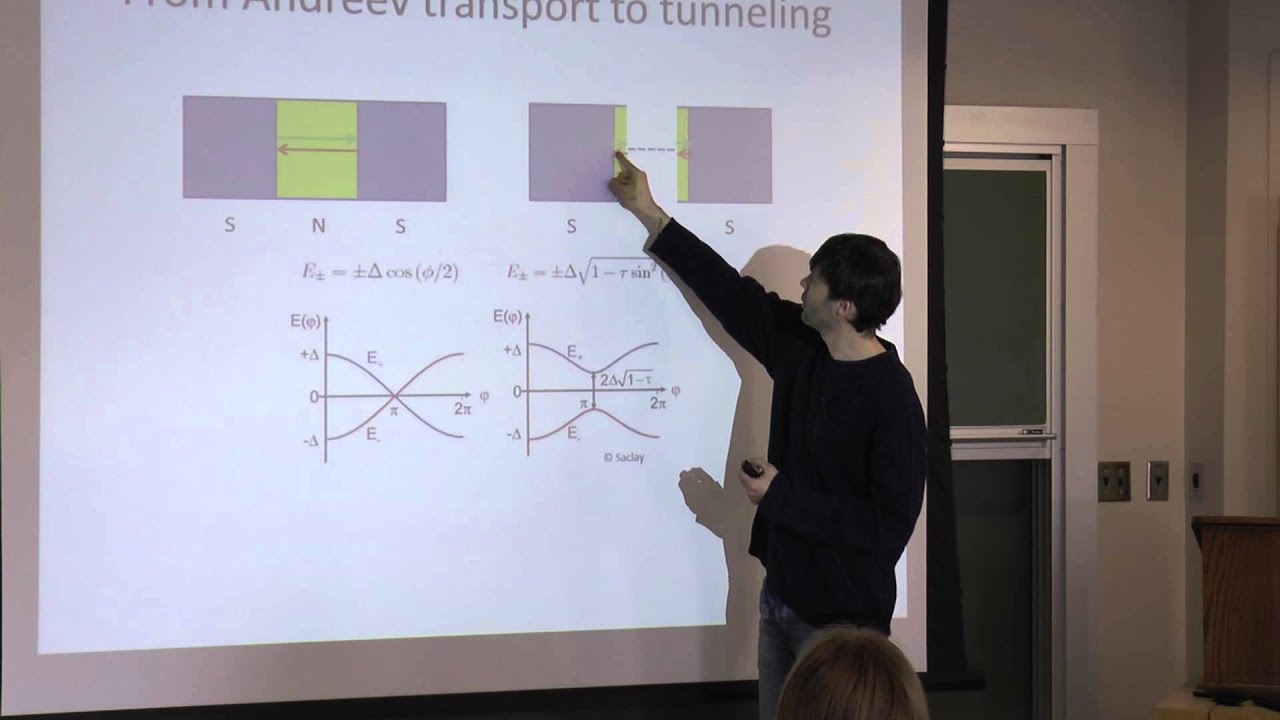

![K.Pomorski [QHS+SGGW]: Strategy of integrated classical-quantum chips development in Poland](https://i.ytimg.com/vi/JXX0T9dr3zE/maxresdefault.jpg)


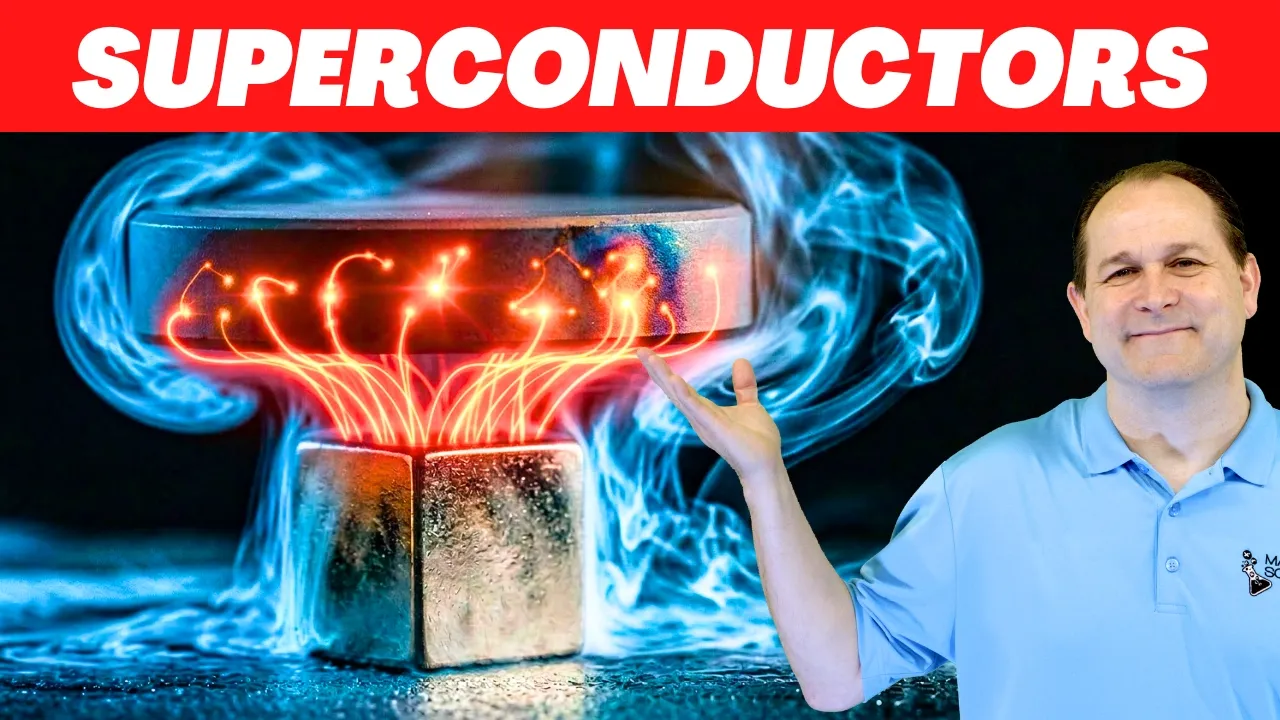
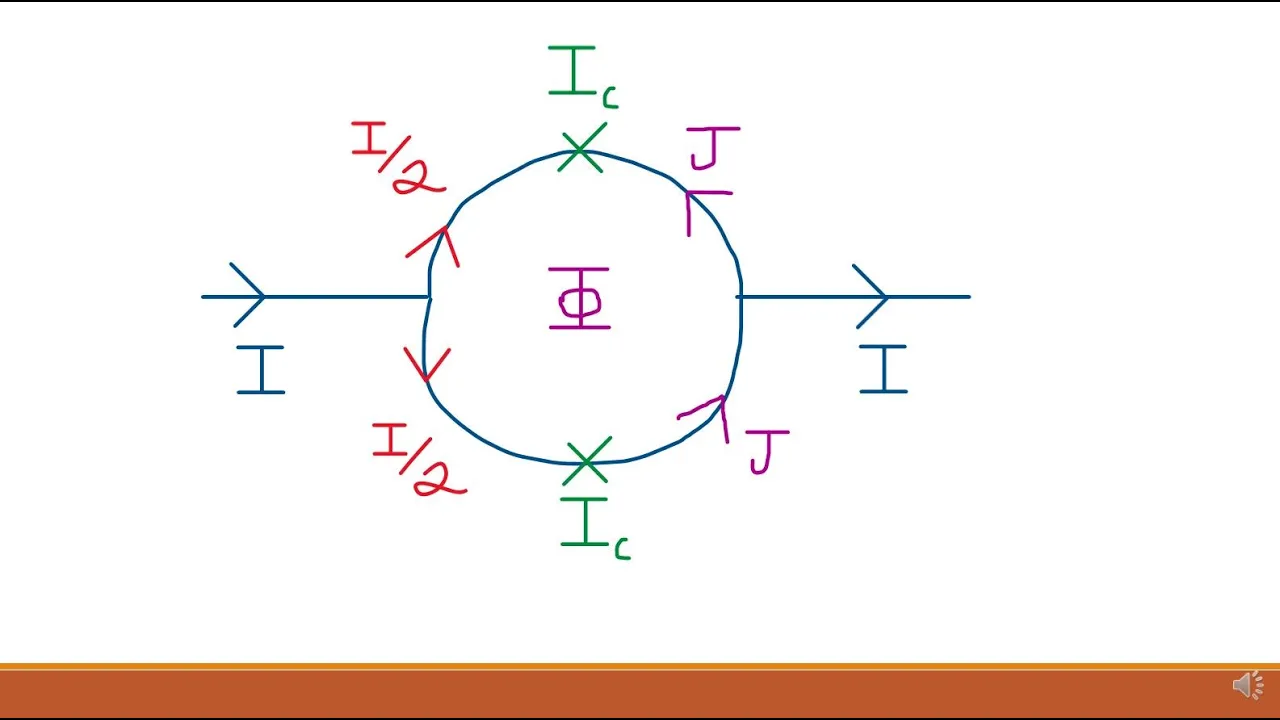
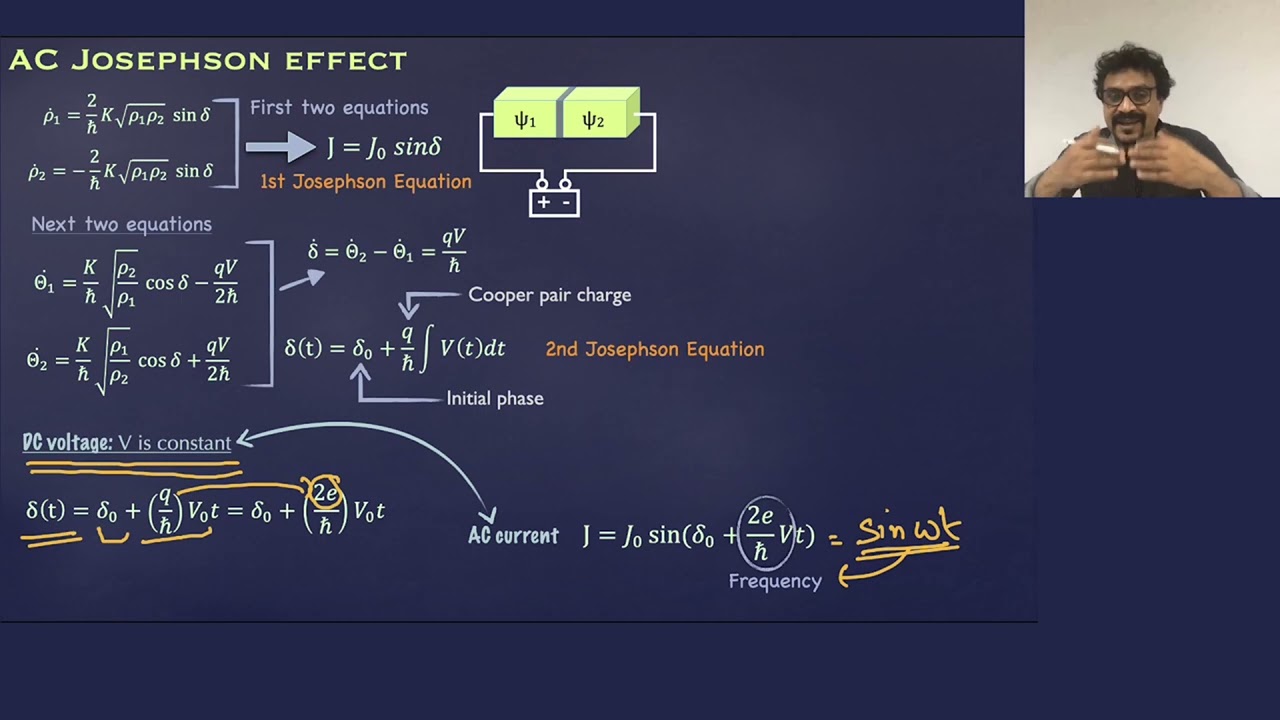
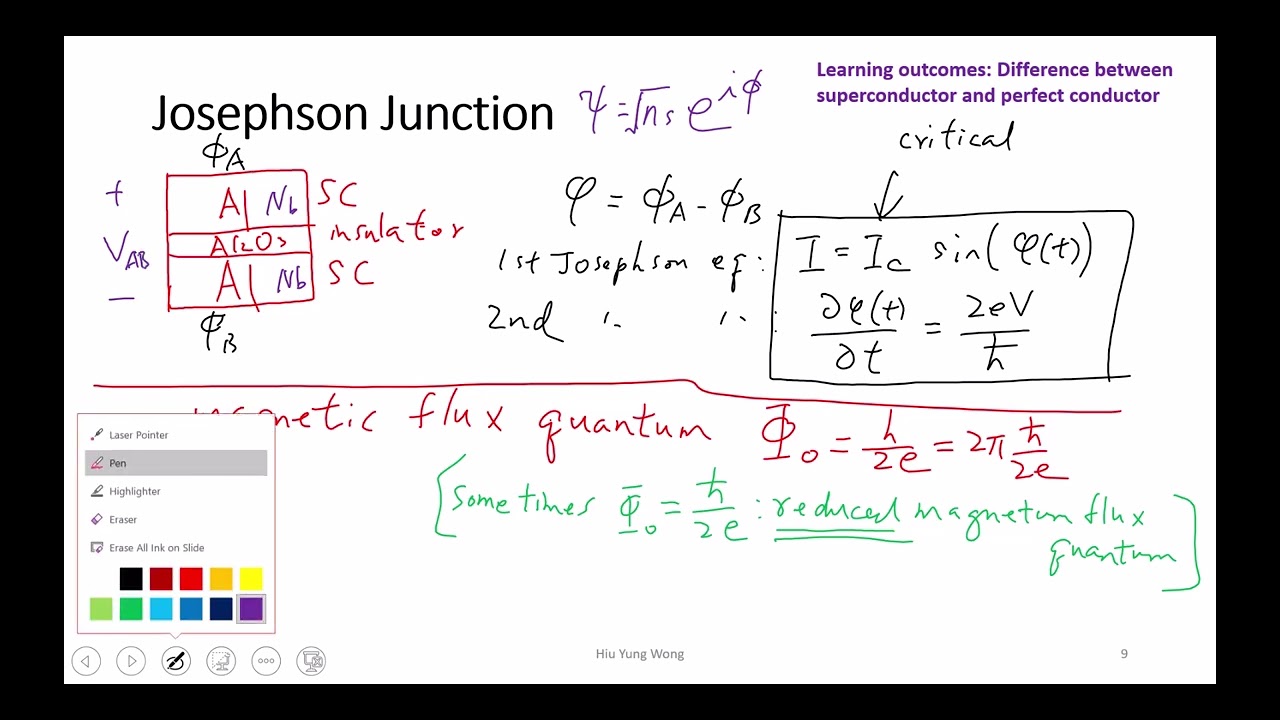
The Josephson effect describes quantum tunneling of Cooper pairs across a junction between two superconductors separated by a thin insulating barrier (approximately 0.5 nanometers). In the D.C. Josephson effect, when no external voltage is applied, a constant supercurrent flows between the superconductors given by I = I₀ sin(Δ), where Δ is the phase difference between the Cooper pair wave functions. In the A.C. Josephson effect, when a DC voltage V is applied, the current oscillates at a frequency f = 2eV/h, where e is the electron charge and h is Planck's constant, due to the time-varying phase difference Δ = Δ₀ - (2eV/ℏ)t.
DC and AC Josephson Effect in Superconductors Explained
Added:The fundamentals of BCS Theory of superconductivity, specifically the formation and behavior of Cooper pairs.
Quantum mechanical tunneling, where particles penetrate potential energy barriers that would be classical obstacles.
The concept of a macroscopic quantum wavefunction and the physical significance of its phase factor in superconductors.
Basic electrodynamics in superconductors, including the Meissner effect and London equations.
Superconducting Quantum Interference Devices (SQUIDs) and their application in highly sensitive magnetometry.
Superconducting qubits (such as the Transmon qubit) and their foundational role in quantum computing architectures.
The Josephson voltage standard, which utilizes the AC Josephson effect to define the international standard for the volt.
Rapid Single Flux Quantum (RSFQ) logic circuits used in ultra-fast, low-power digital superconductor electronics.
802 views12likes23:20Original Release: 2021-01-06
everyone welcome to this video in this video want to want to discuss about the D and AC Josephson effect this is the part of the super conductivity you know the super conductivity is a state of the metal at which the current flow is very large that is the resistivity tends to zero below a certain temperature called critical temperature at first 1911 it was observed by commlink owns for the metal HG and after the very research obtained for different material to obtain the high temp high TC that is the critical temperature superc conducting for use in the Daily Life Application there is various application okay so in this super conductor there is a special effect this is called deception effect we want to uh know about this effect in this video okay so start if if there is a super super conductor suppose this is a super conductor this is a p of a superconductor this is a super conductor and you connect a external voltage source if I connect a external voltage source with the super conductor right and to measure the current and voltage connect a ameter and parallel with the voltmeter okay so this is a super conductor connect external voltage source with an ammeter and the uh voltmeter okay what will be the happen of the value of the voltmeter because there is a current flow is TS to Infinity total current flow goes through here and the resistivity tends to zero so from V equals to I since R is equals to zero that's why the voltage reading of this voltmeter will be zero so this reading will be zero reading clear in this case now if we break this super conductor in two part or if we collect uh contact to Super conductor like this is the super conductor super conductor one and another Super conductor this is another Super conductor super conductor 2 in the Gap this Gap is nearly 1 cm if this Gap is only cm and the situation are the same and the other situation are the same that is the there is a voltage source and there is a MM and connect the voltmeter to measure the voltage okay so you can see that there is no current flow and the voltmeter gives you the voltage which is measur in the so this is the maximum value okay maximum value okay this is no problem but if we uh close this two nearly to 1 to5 nanometer if we close these two super conductor super conductor one and super conductor 2 in the Gap nearly to5 nanometer then what happen then you can see that the this is a EMF applied EMF this is the ammeter and connect with the external voltmeter okay so the value of this volmeter again tends to zero why this there is a gap present but the current will be voltage will be zero that mean there there are flowing the current flow the flow the current right flow the current so the flow current flow is happening due to tunneling okay so this current flow is happening due to single electron teling or the quantum tunneling Quantum Quantum tunneling effect or you can say this is a johon Josephson tunneling this is also called as the Josephson tunneling Josephson Josephson tunneling this effect also known as Josephson channeling okay so this is known as jpon channeling because there is a Gap but also the teling was happen that is called J this is a quantum mechanical tunneling you all know that and this effect is known as the Joseph son Josephson effect and the Gap is known as or this Junction is known as the Josephson Junction this jungon is know as Josephson jungon right J Jon Junction this is the Jon effect okay so there is a gap between two superc conductor bar also the flow current this is the jpon current and the effect is Jon effect and the junction is known as J Junction and the tunneling is known as J tunneling okay there are three types of Josephson Junction are available types of jph Joseph Sun Junction there are three types of Joseph Sun Junction are available number one s i s that is super conductor insulator super conductor this is super conductor this is insulator super conductor super conductor I want to write in the middle this is the difference insulator insulator number two is s s s the Middle s is the super conductor super [Music] conductor the other property and number three is a s n s n for nons superconducting metal non superconducting metal super conducting metal in these three cases or in this three Junction joseon effect or Josephson effect observed now if we interest about this Junction this Junction is nearly to5 nanometer about this Junction if we we interest about the junction there are two types of just effect are happening types of deception effect jcep effect there are two type of jion effect happening number one DC jpon DC jpon and AC jpon AC Josephson okay what is the basic difference in DC Josephson that is when we apply there is a gap when we apply a voltage the current flow originate and if we connect the voltage or remove the voltage remove remove external Source external Source then there is a flow of current in between this this current is constant current the current flow within this which is constant current which is constant s Delta which is constant we will be derived this expression in this case there is no no external no external Source no external Source but there is a DC current flow DC current current flow okay this is the DC deception effect in the other site if there is a there is a apply a DC voltage if there is a apply a DC voltage apply if there is DC voltage apply then there is a oscillation occur the I = to i0 sin Delta this is Delta 0 minus Omega T so there is a Omega T that is the frequency this is the uh AC Josephson frequency that is that there is a oscillation oscillating current oscillating current flow okay this is the AC just apply DC voltage and there is a oscillation that is oscillating current flow that that's why call this is a AC jpon I think clear in case of dcep there is no Source external Source apply but there is a flow of constant current between these two superconductor super conductor one super conductor 2 but when we apply a DC voltage source in external then there is a oscillating current flow between these two super conductor this is the AC reception effect clear now we try to derive this two expression Quantum mechanically okay at first comes into DC jcep effect when two two super conductor S1 and S2 taking this two super conductor and in between this is a uh insulator so the wave function of the wave function of the Cooper pair actually this current flow due to coer pair the current flow due to current flow due to Cooper pair in the super conductor current flow due to Cooper pair current flow due to Cooper pair uh through super conductor through super conductor super conductor okay and the wave function of this current flow is written as this there n is the number density of the carrier and this is called the phas this portion is face portion this is the number density this this is for Semiconductor one sorry super conductor one and this is for super conductor two so if we want to write this surer equation of this two so you can say that is I cross a deli delt s your equation is H SI right H H is nothing but the energy term energy energy term okay so if we multiply this t with this energy term gives you this is the transfer coefficient coefficient means the transfer per unit time there is a par unit time right per unit time per unit time means the unit will be second inverse per unit time means there is second inverse second inverse or heart so this is the heart so if we multiply the H cross with this t if we multiply the H cross and this is the frequency and this is the H H into frequency you know this is the equivalent to energy clear dimensionally you can say this is a energy that's why we replace the H by H cross T clear and the transfer toward towards the S 2 that's why this written as this so H cross T is a energy term and this I will be I2 because is transferred to another side clear so if we just I taken as in right hand side you can see here similarly for Semiconductor 2 you can write this H cross t s 1 this is S 2 this is s 1 and this is also written as this this is a true equation and since I equals to this so if we derivative of this s this is partial derivative you can do that easily and put in this derivative in those three equation three and four so if we using five and 5 into three if you use 5 into three you just put this value you got this expression Delta where Delta is the phase difference the phase difference phase difference right the Delta is the phase difference between the uh coer pair of two between coer pair Cooper pair uh transmission transmission of two superconductor of two superconductor super conductor okay just after that if we compare the real and imaginary part the real part will be this so this will equal to that and the imaginary part will be that so the number density and phase be for in the superconductor one the site one similarly just use this five in four in this equation you and then compare the real and imaginary you also get this two equation you can see this is like to similar and N1 dot is equals to minus N2 DOT number one and number two will be D N1 by DT equal to minus d n uh sorry this can be written as like that this is the persistent persistent current this signify percentage now if there is same type or The Identical same type sem super semiconductor sorry this is not semiconductor this is super conductor this is super conductor super conductor or you can call identical identical send the number density will be nearly equal so just equation 8 you can say Theta 1 and Theta 2 this is identical N1 N2 are same so this cancel out minus t cos Lambda and in case of this is also minus t k Lambda so these two are identical so you can say this is nothing but this is nothing but delt of theta 2 - Theta 1 = 0 so Theta 2us Theta 1 or you can say this is Theta 1 - Theta 2 Theta 1- thet 2 will be zero so Theta 1us 2 Theta 2 will be constant okay since this Theta 1 minus Theta 2 is constant that's mean you can say the current flow the current flow you can say the current flow that is the current flow current flow current flow I is proportional to Del n DT or n dot right and n do is nothing but the proportional to sin Delta for N1 dot or N2 dot you can see this is proportional to sin Delta since Delta is constant so this will be also constant so I is nothing but i0 sin Delta since Delta is constant since Delta is constant so I can say constant that's mean there is flow of the DC current flow flow of DC current okay so there is flow of DC current that's why this is called the DC deception effect DC Joon effect this is called DC jpon effect in which the current flow within the material or the superconductor will be constant since there is no external voltage source there is no external voltage s we do not apply any voltage term in this equation the voltage ter will be zero in this surer equation okay so no external voltage source there are only uh without any external voltage so there is a flow of the DC current direct current that's why this is called the DC jion effect and this current will be constant by using this quantum mechanical function we can prove this one goes to the AC josep effect in the ation we will apply a DC voltage source in if we apply external DC voltage source what happen the total energy will be minus 2 e because there is a q v total energy will be QV and Q is 2 e why twice e because there is a CER pair always two electron are uh along with Cooper pair because of coer pair Q will be minus TC okay so that why that's why the voltage for two uh total difference is minus 2 EV so we can take minus EV and plus e just that the difference will be minus 2 EV okay so at that point minus EV and that point plus EV so final minus initial will be the difference from that side to that side will be minus 2B so if you put the in the Sol your equation in the same manner uh this is nothing but the in the previous that is the this term is actually energy term right this is energy term and this is the potential energy term so if we put this one for in S one side that is a superc conductor one and for superconductor 2 okay and this derivation taken from the deception effect and put this value in this equation one you got the relation like that this two are relation was obtained and you can see this relation is nothing but identical with the additional term this term was add it this is the additional term additional term compared to DC compared to DCP effect compared to DC jpon effect clear and the similar manner in the second case that is the superconductor two you can just put the same manner just go through this calculation you can get the same expression like super decision Josephson effect with the additional term this is the additional term additional term additional term uh compared to compared to DCP effect clear now from three and four we can say there is a n One Prime sorry N1 dot with nothing but the N2 minus N2 Dot just like a this is there is a minus okay so N1 dot is nothing but minus N2 dot that is nothing but this this is the current flow one side to another side these are the same okay and from the difference of these two you can write this is nothing but just put this value Theta one dot and put the value of theta 2 dot you can see there there is a change in if I H cross and the difference will be like that so this if we integrate this Delta D equal to Delta 0 minus 2 e into T this is wred as this is wred as Omega Omega is nothing but angular frequency so the frequency of oscillation will be f is 2 Omega by 2 pi so this is the value of angular frequency of the AC jpan effect AC jpon effect this is the angular frequency okay so since you know the current flow the current flow s Jo Josephson Josephson since AC current flow is nothing but uh current is nothing but proportional to deln Del T N1 or N2 will be like that and you can see the N1 and N2 both are proportional to both are proportional to sh Delta so this can be written as Sin Delta so I is nothing but i0 i0 sin Delta and Delta is nothing but Delta is nothing but Delta 0 Delta 0 Delta 0 Delta is nothing but delta0 discon Delta 0 minus Omega T this is a oscillating part oscillating oscillating part not a constant so this can be say this is a AC current flow or the RF current flow oscillating current flow oscillating current flow through the through super conductor super conductor sorry through superconductor super conductor okay that's why uh this is called a AC jcep effect because uh with the apply of the with applying the DC voltage within this Josephson Junction uh you can get the AC current flow within this super conductor in between two I think clear if there is any query always go through the comment box and comment in the comment okay there is a problem you can solve this uh just go through this question a DC battery of this this is a DC battery applied across it through a AC joseon since this there is apply a DC battery that why occur the AC josep find the frequency ofation just put the relation f is nothing but 2 e YH and you got the value like that very simple okay so thank you we'll meet in the next video as soon as possible
Up Next

112:15
Superconducting Qubits Explained by Andreas Wallraff - QCHS 2021
@qchs-quantumcomputinghard-6609
9.7K views•2021-07-16

12:53
21cm Hyperfine Transition in Neutral Hydrogen: Radio Astronomy Basics
@AaronRobertParsons
12.4K views•2011-10-13

32:32
NMR Spin Physics I: Zeeman Effect, Resonance Condition & Larmor Frequency
@nptel-indianinstituteofsci8064
2.3K views•2024-01-17

27:14
Entropy and the Second Law of Thermodynamics Explained
@veritasium
27.5M views•2023-07-01
Related Study Plans & Knowledge Roadmaps
Structured learning paths in Physics
physics
Nuclear Physics (Decay, Fission & Reactors)
01Atomic Structure and the Binding Force
02Radioactive Decay and Half-Life
03Nuclear Fission Mechanics and Chain Reactions
+ 2 more learning modules
12h5 modules
Explore Roadmap
physics
Soft Matter (Polymers, Colloids & Rheology)
01Foundations of Soft Matter & Thermal Forces
02Polymer Physics and Macromolecules
03Colloids, Surfactants, and Self-Assembly
+ 2 more learning modules
38h5 modules
Explore Roadmap
physics
Analytical Mechanics: Lagrangian & Hamiltonian
01Mathematical Foundations: Calculus of Variations
02From Newtonian Mechanics to Constraint Dynamics
03The Principle of Least Action & Lagrangian Mechanics
+ 3 more learning modules
28h6 modules
Explore Roadmap
physics
General Relativity (Spacetime & Cosmology)
01Foundations of Relativity: Special Relativity
02The Geometry of Spacetime: Equivalence Principle & Curvature
03Einstein's Field Equations: The Mathematics of Gravity
+ 2 more learning modules
55h5 modules
Explore Roadmap