
















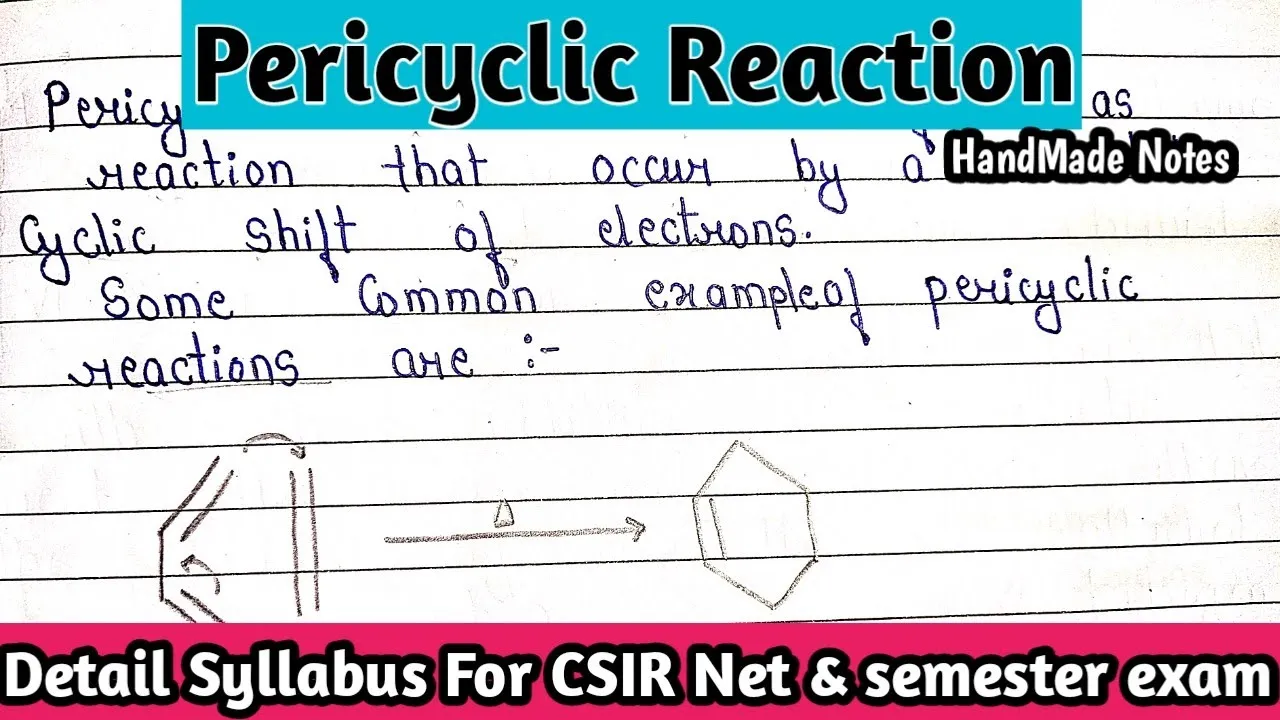


The Diels-Alder reaction is a concerted [4+2] cycloaddition between a diene (a molecule with two conjugated pi bonds) and a dienophile (an electron-deficient alkene), forming a six-membered ring with one pi bond and two new sigma bonds; the reaction exhibits stereospecificity where cis dienophiles add syn-fashion and trans dienophiles add anti-fashion, and requires proper orbital symmetry with the diene's HOMO overlapping with the dienophile's LUMO, with the diene approaching the dienophile in either exo (substituents away from the ring) or endo (substituents projecting under the ring) fashion.
Diels-Alder Cycloaddition: Mechanism and Stereochemistry
Added:Understanding of conjugated pi systems and the difference between s-cis and s-trans conformations in dienes.
Fundamental concepts of Molecular Orbital (MO) Theory, specifically the definitions of HOMO (Highest Occupied Molecular Orbital) and LUMO (Lowest Unoccupied Molecular Orbital).
Basic stereochemistry concepts, including chirality, enantiomers, diastereomers, and the terms 'cis' and 'trans' in alkenes.
The electronic effects of substituents, specifically distinguishing between Electron-Donating Groups (EDGs) and Electron-Withdrawing Groups (EWGs).
The Alder Endo Rule, which explains the kinetic preference for 'endo' product formation over 'exo' products under thermal conditions.
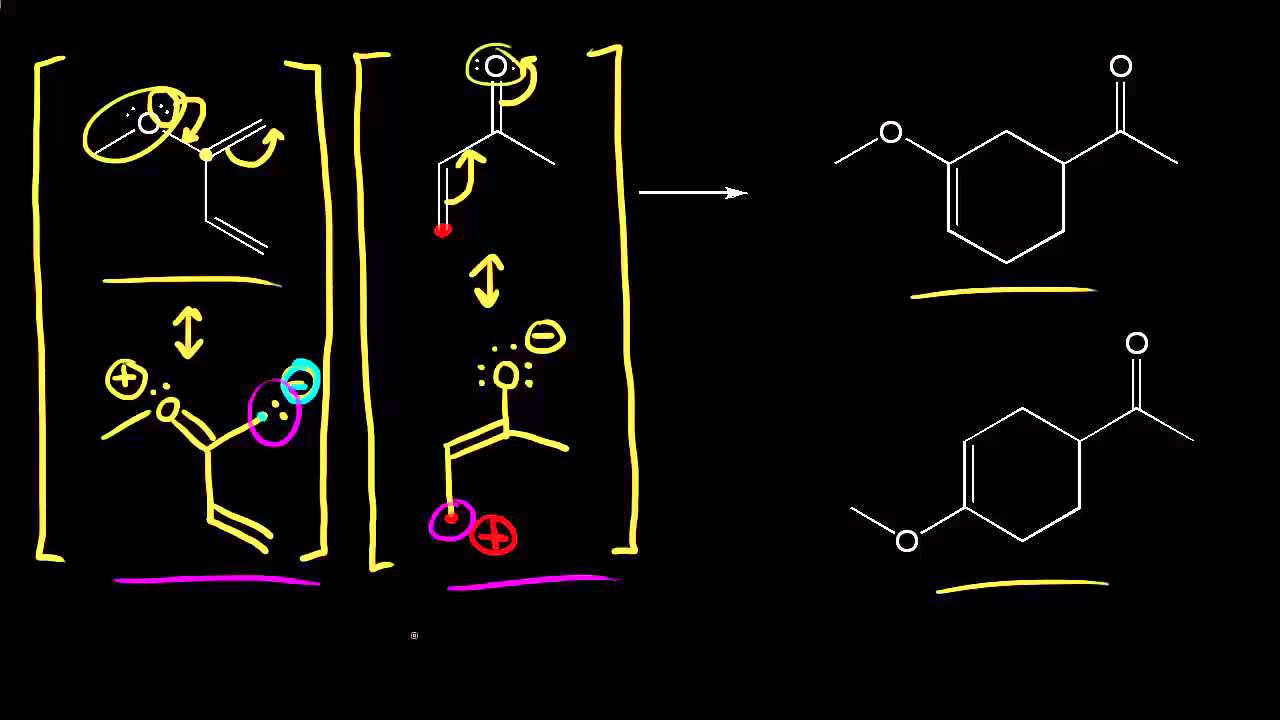
Regiochemical outcomes in unsymmetrical Diels-Alder reactions, utilizing resonance structures to predict ortho- and para-like major products.
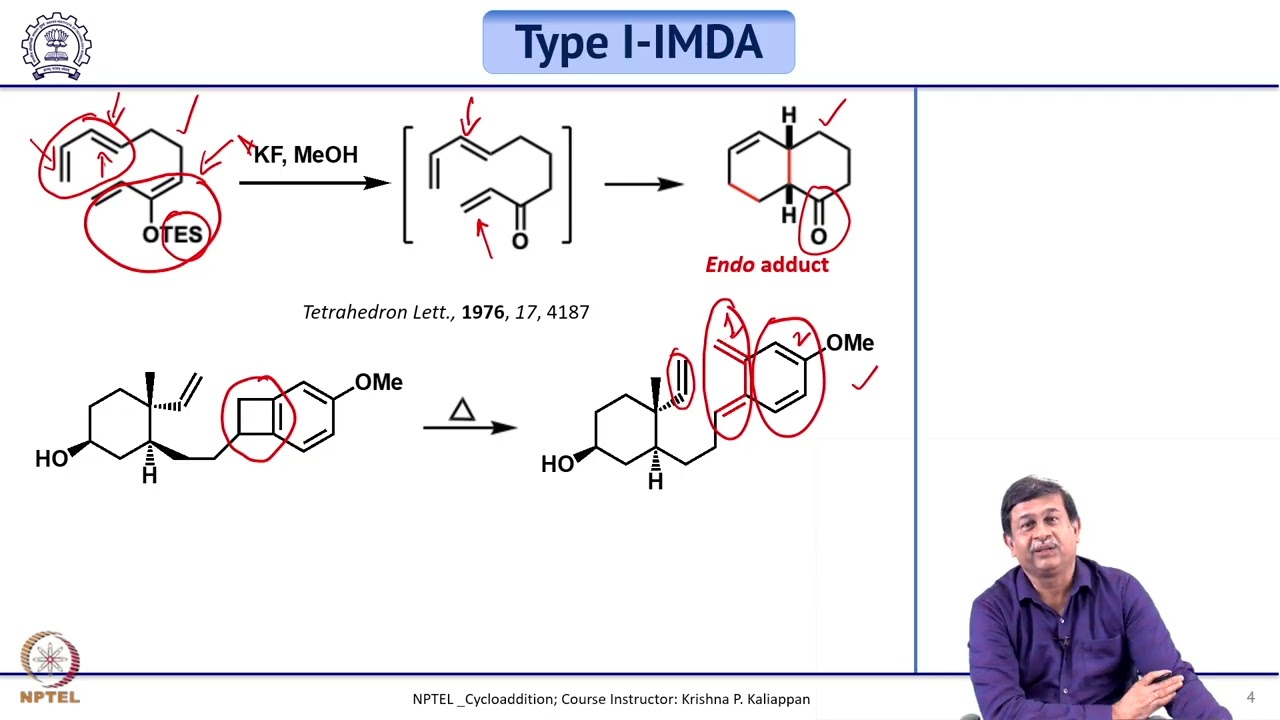
Intramolecular Diels-Alder (IMDA) reactions and their application in synthesizing complex, polycyclic natural products.
The Retro-Diels-Alder reaction, its thermodynamic driving forces, and its utility in organic synthesis as a protecting group strategy.
Broadening to other pericyclic reactions governed by orbital symmetry, such as electrocyclic reactions, sigmatropic rearrangements, and [2+2] cycloadditions.
181.9K views3.3Klikes9:32Original Release: 2015-01-05
hey everyone, it's professor Dave. I want to tell you some things about the Diels-Alder reaction.
every Diels-Alder reaction is going to have two key players here.
there's going to be a diene and a dienophile.
a diene, as you might expect, is an alkene with two pi bonds, so this is the diene there's a pi bond there and a pi bond there and the dienophile is the thing that reacts with the diene.
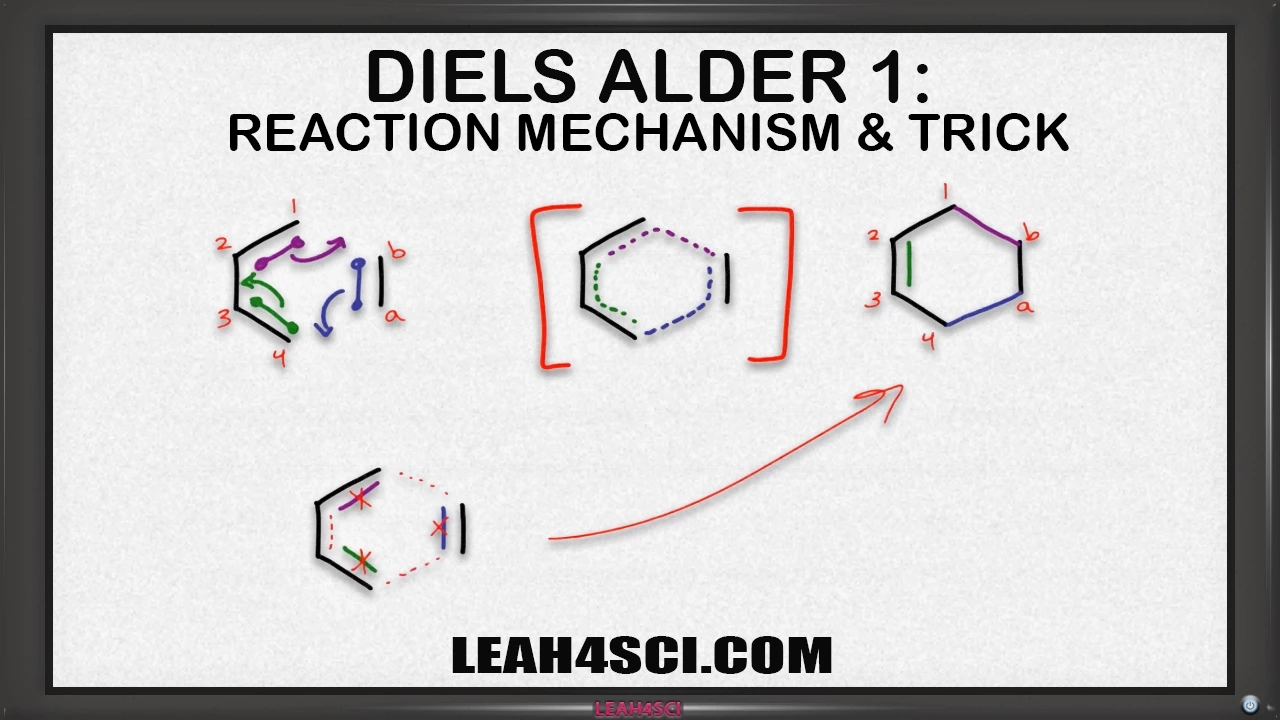
what is common of every Diels-Alder reaction is that we're going to be forming a six-membered ring this is very useful in synthetic chemistry because there a lot of naturally occurring compounds that we wish to synthesize that have six-membered rings. this is a very stable ring it is utilized a lot in nature so what happens is, this is a concerted reaction where the pi electron density is shuffled around this is how we're gonna draw these arrows it is arbitrary which direction around the ring we draw the arrows because this is a concerted reaction it's not the case that these pi bonds are moving one at a time, what ends up happening whereas we had three pi bonds to begin with, shuffling around, what we're going to get is one pi bond remaining and two new sigma bonds, that's these here.
so if we look at the transition state we basically have a six-membered ring of partial pi electron density that's illustrating how all of this is shuffling around at once, but what we end up with is always going to be a six-membered ring with one pi bond and here are our two new sigma bonds so there's an element of stereospecificity to examine here, let's say we are looking at a cis dienophile, a cis dienophile will add in syn fashion to the diene, and that will result in these R groups being cis to one another on the product whereas if we have a trans dienophile, that is going to add in anti fashion to the diene and so that is going to give us the groups trans to one another in the product however, whereas this is certainly stereospecific, because cis on this side or the other would yield the same product, here there is still an element of variability, depending on which face of the alkene is approached, we could have a wedge and a dash here or a dash and a wedge and those would in fact be two different molecules once again, cis alkenes add syn, trans alkenes add anti.
the situation with butadiene and ethene was a simplified situation, let's take a look at a more complicated one where both the diene and the dienophile are already rings themselves.
the way to draw the correct product is to always recall that we are forming a six-membered ring between the four carbons that are doubly bound carbons in the diene and the two carbons in the dienophile.
let's number these just to be sure what's going on always be aware that we are forming a six-membered ring between these six carbons and then everything else is just sort of where it already is. so this is what we're going to get the reason this looks a little funny is that we have these carbons participating both in this five-membered ring and the new six-membered ring so if we go ahead and draw these arrows we can see where that new six-membered ring is going to be.
let's draw them in, but the point is that this carbon here that was in the five-membered ring that carbon is not participating in the new six-membered ring, but it didn't go anywhere, it's still there.
basically we have this situation where we have an additional carbon jutting up, out of the board a little bit and so that's going to still be there, and the rest of the maleic anhydride will be projecting downwards so every Diels-Alder product will have a six-membered ring, and it will be formed from specifically those six carbons that we just discussed.
that's the easy part, the hard part is trying to figure out where all the other stuff is.
so we want to always make sure that we are not adding or subtracting any carbons or any material we want to make sure that all of the bonds are where they're supposed to be.
it is the case that we are always just going to be moving these three pi bonds, one of them will remain a pi bond but then the other two will go to form these new sigma bonds, so those are the new bonds there and that's the new six-membered ring.
let's take a look at it from a different viewpoint imagine that we are looking at these molecules edge-on this is the case with the Diels-Alder reaction, in order for the orbitals to line up, remember that these are p orbitals extending perpendicular from the plane of the molecule the diene must be lowered onto the dienophile so that's how the chemistry occurs. once again, this is the same product from a side view here's that bridge head carbon, that's the 5th carbon on the diene that was not participating in the reaction and then here are these two new bonds, that are forming the new six-membered ring let's go ahead and number this one those are the carbons that correspond to these, which are the ones that correspond to these.
in any given reaction, it is always the case that one molecule is dumping electron density from its highest occupied molecular orbital into the lowest unoccupied molecular orbital of some other molecule. with the Diels-Alder that's very important to look at because it may or may not be the case that a Diels-Alder reaction is possible depending on the configuration of the molecular orbitals let's take a look at butadiene here, if you look at the orbital diagram, there are four pi electrons that need to be accounted for. two fit in each orbital so here are the first two in the first orbital, and the second orbital contains one node so that is what is going to put us in this configuration with the lobes oriented as they are so that's the highest occupied molecular orbital for butadiene, and then the dienophile electron density is being dumped into those so we need to examine the lowest unoccupied molecular orbital that the electron density is going to go into so over here we have one orbital full with the two pi electrons, and then the lowest unoccupied one is this one with one node, we can see here that everything is in phase and ready to undergo the Diels-Alder reaction, these are going to overlap nicely and these are going to overlap nicely however, if there were more pi electrons or this molecule was different in some way such that these were not in phase, then the Diels-Alder would not be able to occur so that's something to keep in mind, we always have to check the orbital diagram to make sure that a Diels-Alder reaction is possible.
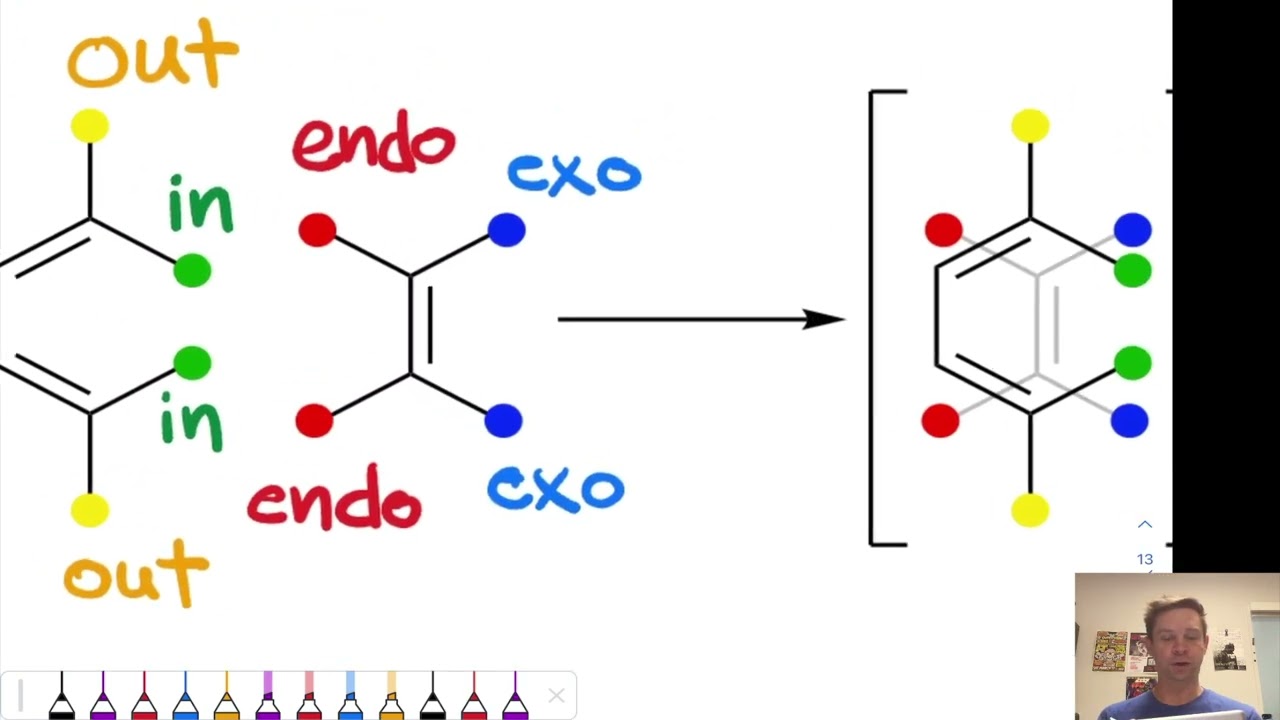
there's one other point that we want to discuss the diene can approach the dienophile in either exo or endo fashion, that's not necessarily implying exothermic or endothermic, they're just terms that are describing the geometry of what's going on.
it is an exo Diels-Alder reaction if the groups projecting from the dienophile are extending away from the diene, so this is going to lower down, and this is more probably more sterically favorable there's not as much steric hindrance associated with an exo Diels-Alder reaction with the endo, see how the R groups are projecting directly under the plane of the diene as it approaches this can have something to do with the transition state of the Diels-Alder reaction if there are functional groups present such that some kind of an interaction can occur a slight stabilizing effect between maybe some electron deficient groups where the pi electrons can interact with those groups in the transition state of the molecule depending on what's going on, exo or endo may be favored for varying kinetic or thermodynamic reasons thanks for watching, guys. subscribe to my channel for more tutorials and as always feel free to email me with questions
Up Next

18:31
How to Design a Total Synthesis: Retrosynthetic Analysis
@chemistryunleashed4348
44.2K views•2013-06-19
83:56
Biocatalysis and Catalysis in Islatravir Synthesis | Merck Webinar
@SCIwheresciencemeetsbusiness
675 views•2020-10-08
10:54
Intermolecular Forces and Boiling Points Explained | Chemistry
@ProfessorDaveExplains
2.7M views•2015-11-05

17:31
Edible Water Bottles: A DIY Guide to Sodium Alginate Spherification
@ryan
10.5M views•2019-06-21
Related Study Plans & Knowledge Roadmaps
Structured learning paths in Chemistry
chemistry
Nuclear Chemistry: Decay, Meds & Fuel Cycle
01Introduction to Nuclear Structure and Radioactivity
02Decay Dynamics and Kinetics
03Radiation Interaction and Detection
+ 2 more learning modules
24h5 modules
Explore Roadmap
chemistry
Supramolecular Chemistry: Forces & Machines
01Foundations of Chemical Bonding and Intermolecular Forces
02Introduction to Host-Guest Chemistry
03Thermodynamics and Dynamics of Self-Assembly
+ 2 more learning modules
16h5 modules
Explore Roadmap
chemistry
Photochemistry: Excited States & Reactions
01Foundations of Light-Matter Interactions
02Molecular Orbitals and Electronic States
03Photophysical Processes and Jablonski Diagrams
+ 2 more learning modules
18h5 modules
Explore Roadmap
chemistry
Coordination Chemistry: Bonding & Properties
01Introduction to Transition Metals and Ligands
02Crystal Field Theory (CFT) and Geometry
03Magnetic Behavior and Spin States
+ 2 more learning modules
14h5 modules
Explore Roadmap