















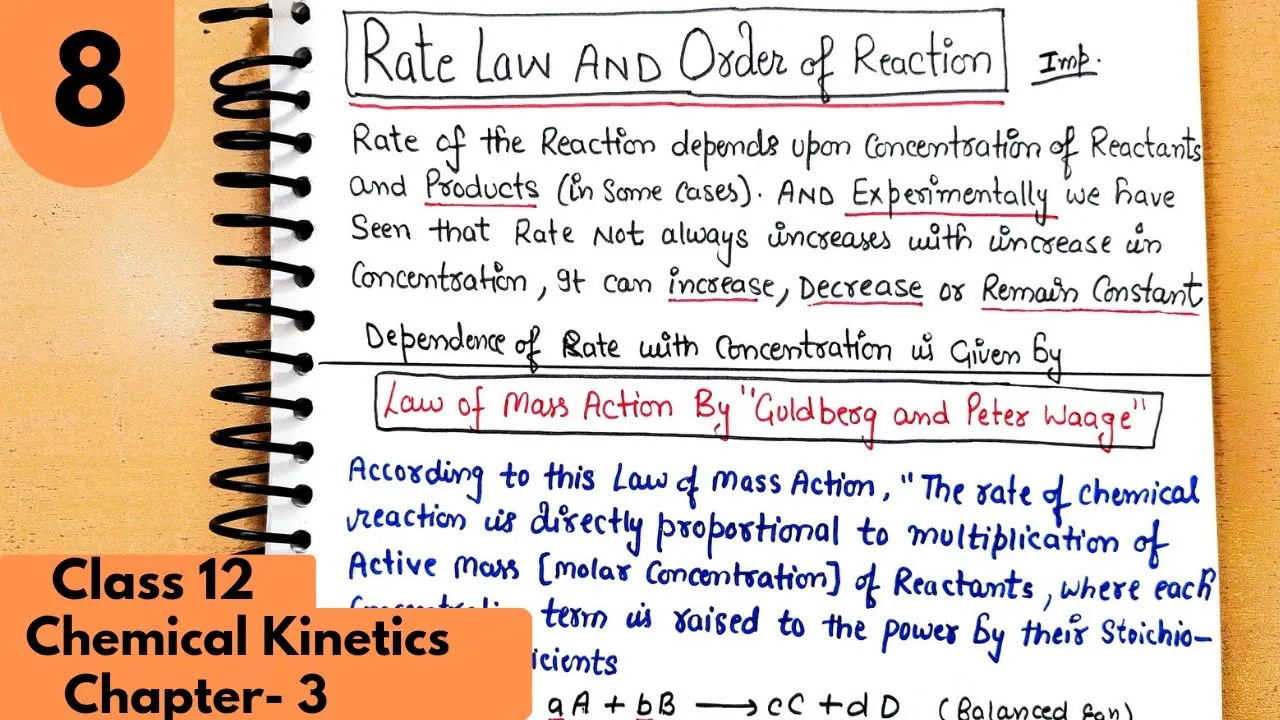


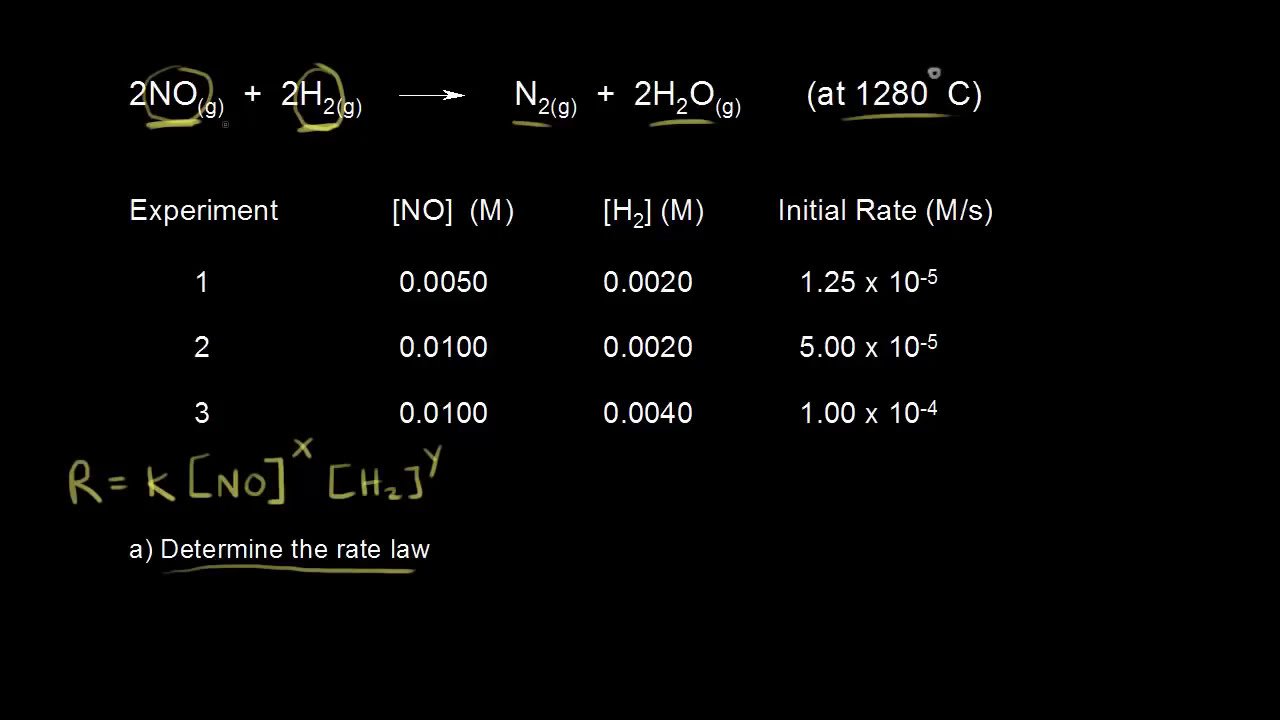



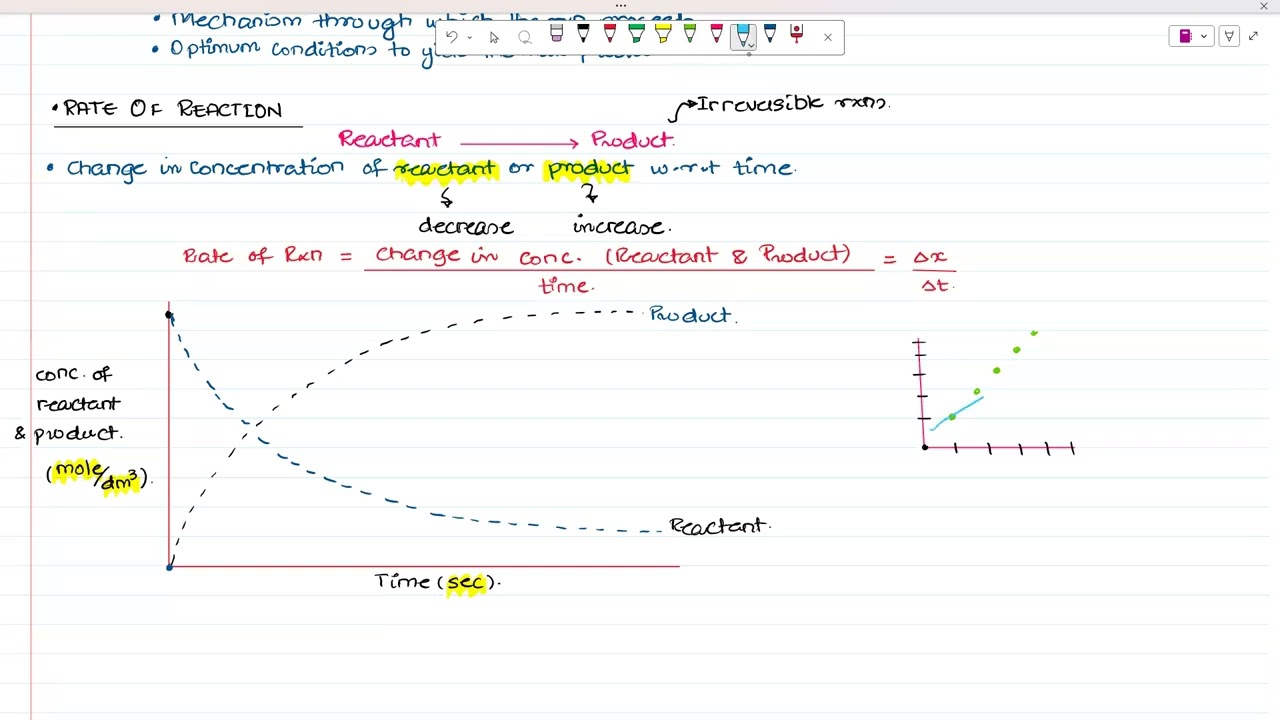










In chemical kinetics, the rate of a reaction can be measured at two levels: the average rate, which is the change in concentration of reactants or products over a specific time interval (calculated as Δ[concentration]/Δtime), and the instantaneous rate, which is the rate at any given moment determined by taking the derivative of concentration with respect to time (d[concentration]/dt). The negative sign is used for reactants because their concentration decreases during the reaction, while positive signs are used for products as their concentration increases.
Chemical Kinetics 12: Average & Instantaneous Rate of Reaction
Added:Basic understanding of chemical reactions, stoichiometry, and how to write and balance chemical equations.
The concept of concentration (molarity) and how the amounts of reactants and products change over time.
Fundamental mathematical concepts of graphing, specifically calculating the slope of a line (secant vs. tangent lines).
An introductory conceptual understanding of calculus, particularly the difference between an average rate of change and an instantaneous rate of change (derivative).
Formulating rate laws and determining the rate constant (k) for different chemical reactions.
Understanding the order of a reaction (zero, first, and second-order) and the concept of molecularity.
Deriving and applying integrated rate equations to determine reactant concentration over time and half-life.
Exploring reaction mechanisms, elementary reactions, and identifying the rate-determining step.
Investigating the temperature dependence of reaction rates using the Arrhenius equation and activation energy concepts.
87.5K views363likes15:51Original Release: 2013-12-28
Hello friends this video on chemical kinetics part two is brought to you by exam.com no more Fe from exam correct so let's see a reaction from macroscopic Level I mean I have a reaction I'm concerned only about the rate rate is the only thing that is in my mind now right so if at the macroscopic level I'm not going in the molecular level at a very bird IU level you can see bird IU only from distance I am seeing it there is a container and something is happening right I'm just seeing the quantity of reactants quantity of product those things I'm seeing then I call it a macroscopic level I'm not even concerned about which molecules are reacting why they are reacting I'm concerned only the macroscopic level right I'm only interested in the amounts of the reactant reacted and the amount of product form right amount of this amount of this that's what I'm interested and that is what you call macroscopic level but when you talk about the microscop molecular level where you actually want to see the molecules how it is taking part how they're reacting right so if you see for a given reaction if you go inside any reactant has will have atoms and molecules correct so you want to see what is happening what is actually happening inside why a plus b is becoming C and D so if you see the molecule of a are in blue b in red C in green and D in red you you see they are reacting right they they are bumping each other and they're forming new products this is something at very very microscopic level or molecular level we call because here in this level we are concerned about the reaction mechanism how it is reacting right their orientation the energy of these molecules and how they are getting uh undergoing collisions and what is the effective Collision which is non-effective Collision how the product is getting formed all those kind of things role of catalyst also how the how the catalyst is helping to increase the reaction rate so this is all molecular level so in in chemical K kinetics we'll discuss the reactions both at macroscopic level and molecular level correct so in this whole chapter we'll we'll first start with macroscopic level we'll talk about the change in the product or change in the reactant concentration and once we understand the concepts why the products are how the rate of change of product is uh linked with other parameters then we'll start at molecular level about how the molecules interact and the product is getting formed correct so molecules at the molecular level I will assume the molecules as car and the bumping of molecules which you see here is similar to bumping of cars correct so if you see these are my cars and if the car bump each other at a very high speed and they almost ramp each other right they break um one another then I'll call a reaction happen right for example in this case you see the two car in the first case in the first case if you see these two cars s ramed and the reaction happened but in the second case if you see the cars didn't even touch each other there was no reaction here so there was no reaction here and there was a reaction here so in the whole chapter we'll consider molecules as car and we'll try to understand how the reaction is happening right we talk about the visibility of the reaction in this case here reaction was visible here it didn't happen we talk about the extent of the reaction then we'll talk about the number of cars we have right the blue cars and the red cars and that will depend that will Define the extent of the reaction we talk about the speed of reaction then also we'll talk about a lot of factors just be with me we'll uh try to visualize molecules as car in the whole chapter and the way the molecules bump each other there nothing about the bumping of two different cars and the final broken car is my product we'll assume in that way we'll see the whole chapter right the bumping of car this becomes a new product so since I told that uh we'll talk about molecules as car in the whole chapter let's see in a car what is there car runs right there's the speed of the car for example this is a car and this is my distance time graph I have made and there's a car which will move from here to here and if you see as the time goes car can move from point A to point B so this is my point a and this is my point B actually so if you see the car is moving from point A to point B and it's going up and now it's stopped but the time is getting stopped and then again it going up the higher speed and it paus for some time and then again it goes up and it stops this is the distance time graph you you see this is the distance covered let me repeat once again the car starts the car accelerates and then it stops it stops for certain time time goes on and then car again starts again goes off stop for some time again the car starts and then it stops so if this is if you plot the distance time graph this is how it look right now if you see in this whole journey if you talk about the average speed of the car that will nothing but total distance covered by car that is AB by total time this is my point here B if you plot the XY Point here this x will be T and Y will be point B correct here T will be 0 and point8 so if you see the total distance covered is AB and total time is T so if you talk about the average speed average speed total distance covered by total time and that is nothing but AB by T hope it took two t seconds to come from there to there that will be the average speed correct from point A to B but now if you want to find the instantaneous speed and you must have studed this in the phys chapter the instantaneous speed at any point instantaneous speed at any point is nothing but you from that point you draw a tangent and the slope of this tangent will give you instantaneous speed that is DX by right that is speed instantane okay this is a very simple concept we have learned in physics average speed and instantaneous speed if you have not SED and if you're not understanding from the slide you can watch the physics video where we explain the instantaneous speed and average speed so here we have this instantaneous speed for at any given point for example here also I can find the instantaneous speed I just will draw a tangent here and the slope of this will give you a inant speed at this point if you see the tangent will be in this direction and the speed will be zero at this point the in speed will be different right so if you see here it is accelerating it has more speed here it has almost zero speed so at any given point time you can just draw a tangent and you'll get the instantaneous speed at this point of time similarly in the reaction also we'll find the average rate of the reaction and instantaneous rate of reaction as I told the molecules are nothing but car it just comparing car has average speed instantaneous speed so the reaction will also have average straight and instantaneous state so you see this is a typical reaction we have so if you see a typical reaction I have a reactant on my left hand side product on my right hand side over a period of time the reactant will diminish and you'll get more product so if you see this graph the concentration of reactant goes down as the time increase and the concentration of product in the red one increase as the time increase the green one is reactant and the right one is my product that's my typical concentration time graph for a given uh reaction so if you see for the any kind of reaction if you define the rate of a reaction rate of a reaction will be nothing but change in change in amount of chemical species it can be species can be anything uh react into a product right during a reaction reaction the whole thing divide by time in which change was cost for example you mix hyro and oxygen get water the reaction took only 2 seconds but you're observing it for maybe 30 minutes but the reaction time will be 2 minutes because at the two sorry 2 seconds because at 2 seconds only actually the reaction happened right for example you have hydrogen and oxygen it gives water and this took only 2 second correct and after that it was just water and you just observing it so it is not the time you observing it is the time when the reaction is happening actually so that is the time you to divide and this is the change in amount of chemical species during a reaction for example you talk about the decrease in the concentration of hydrogen or decrease in the concentration of oxygen or or increase in the concentration of water so as we have told a chemical rate of reaction we have average rate of reaction and we have again instantaneous rate of reaction similar to car average speed in speed so let's talk about the average rate of reaction right so average rate of reaction nothing but the rate of decrease in concentration of any of the reactant because the concentration of reactant will decrease or the rate of increase of concentration of product okay either rate of decrease in concentration of any one reactant let's suppose you have a plus Bal C plus d or so let's suppose you have a plus b here and you have C plus d here so we talk about the average rate there is nothing but the rate of decrease in concentration of any one of the reactant for example A or B correct so if you say if I want to write average rate is nothing but minus Delta n because the number of I'm talking about of reactant by Delta or you can say Delta n of product by Delta please note there's a negative sign here and there is no sign here there a positive sign here why there's a negative shine because if you see the reactant will decrease for example at T is equal to0 it was let's suppose 10 mole and it was uh 2 mole at T isal to T this will become let's suppose 5 Mo and let's suppose this is increase it becomes 6 Mo so if we see the change in the reactant is what 5 - 10 there is minus 5 so since there's a minus here to remove that minus we are putting a sign but you talk about the change in product final minus initial 6 - 2 that is 4 already a positive quantity it beat once again the change in react final minus initial that is 5 - 10 that is minus 5 so to get rid of minus sign we'll put a minus sign here change in products final minus initial is 6 - 2 that is four that's a positive number so we don't put a negative sign here correct so both are nothing but average you can just either take the rate of decrease of the reactant or rate of increase of the product both are nothing but the rate of reaction let's talk about the instantaneous state of the reaction see again instantaneous of reaction as I told it is nothing but at any given point of time for example if I want to know here here I can find minus Dr by D so d by will be this much you put a minus you'll get this much this slow this is my instantaneous of reaction or if you find for the product it will be plus DP by why plus and minus the same rule which we just explained see this is if this is my Dr by this line but the moment you put minus the sign changes right it becomes something in this direction if you see both are in the same direction at any given point of time so rate instantaneous is nothing but either minus d by DT or plus DP by DT both are my instantaneous rate of the reaction one thing to note here is when you talk about the average of reaction it doesn't mean that you have to talk uh about the average rate from here to here I can also talk about the average rate from here to here this point is example this point is a this point of B I can also talk about the average rate between A and B so in that case I'll find the concentration at B and find the concentration of a for example in this case average rate from A to B beward concentration that this be r at B minus concentration at a by delta T how much time it took from here here to here that is it took this much time correct and since uh you see RB will be less than ra there has to be negative sign because it's nothing but for the reactants for reactant it was minus of Delta react by T so this is my average rate between these two points A and B correct so you talk about average you have to talk about the average rate of reaction between two points when you talk about instantaneous you will talk about instantaneous rate of reaction at any given point of time right 2 point average 1 Point instantaneous thank you visit exam.com to watch more videos attemp free online test get pre study materials find tutors and mentors and much more thanks once again
Up Next

48:46
Integrated Rate Laws Explained: Zero, First, & Second Order Chemical Kinetics
@TheOrganicChemistryTutor
1.4M views•2021-04-04
83:56
Biocatalysis and Catalysis in Islatravir Synthesis | Merck Webinar
@SCIwheresciencemeetsbusiness
675 views•2020-10-08
7:13
Nylon: Properties, Preparation & Uses | Class 8 Chemistry
@LearnoHubClass1112
26.4K views•2015-11-17

17:31
Edible Water Bottles: A DIY Guide to Sodium Alginate Spherification
@ryan
10.5M views•2019-06-21
Related Study Plans & Knowledge Roadmaps
Structured learning paths in Chemistry
chemistry
Nuclear Chemistry: Decay, Meds & Fuel Cycle
01Introduction to Nuclear Structure and Radioactivity
02Decay Dynamics and Kinetics
03Radiation Interaction and Detection
+ 2 more learning modules
24h5 modules
Explore Roadmap
chemistry
Supramolecular Chemistry: Forces & Machines
01Foundations of Chemical Bonding and Intermolecular Forces
02Introduction to Host-Guest Chemistry
03Thermodynamics and Dynamics of Self-Assembly
+ 2 more learning modules
16h5 modules
Explore Roadmap
chemistry
Photochemistry: Excited States & Reactions
01Foundations of Light-Matter Interactions
02Molecular Orbitals and Electronic States
03Photophysical Processes and Jablonski Diagrams
+ 2 more learning modules
18h5 modules
Explore Roadmap
chemistry
Coordination Chemistry: Bonding & Properties
01Introduction to Transition Metals and Ligands
02Crystal Field Theory (CFT) and Geometry
03Magnetic Behavior and Spin States
+ 2 more learning modules
14h5 modules
Explore Roadmap