







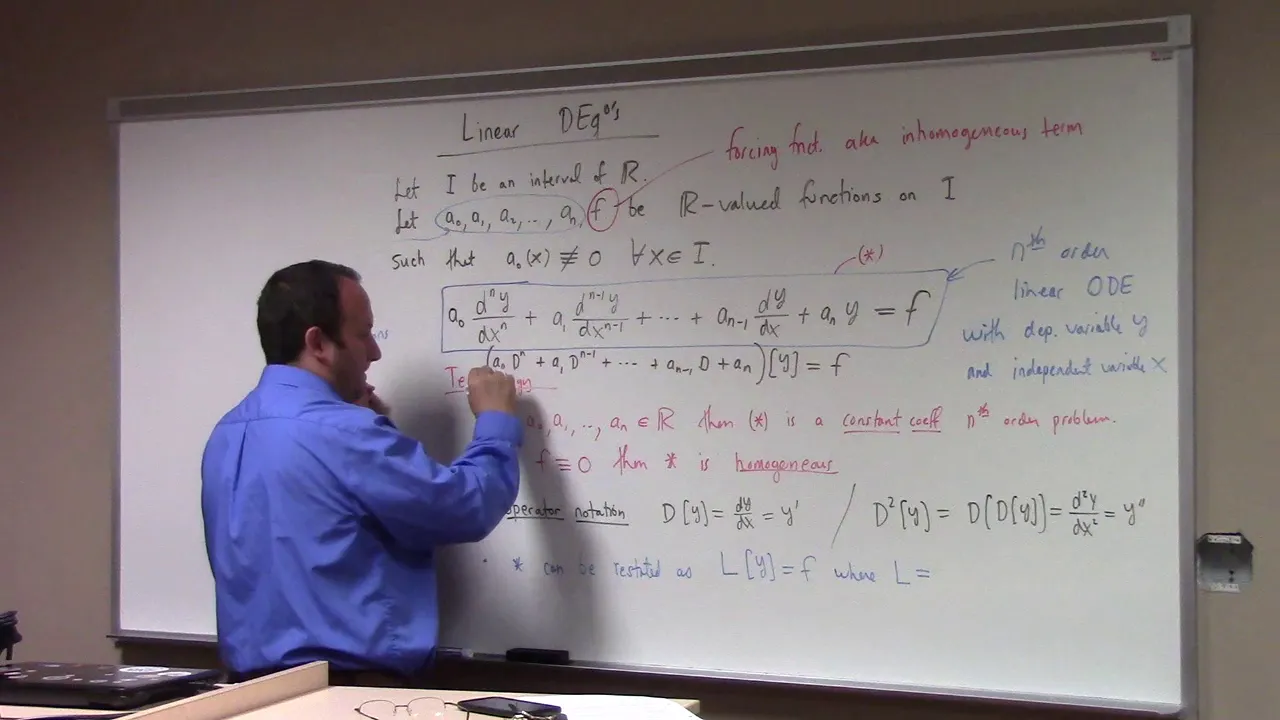


















A differential equation is linear if it can be written in the form where coefficients are pure functions of the independent variable (x) and the dependent variable (y) and all its derivatives appear only to the first power; otherwise, it is nonlinear. For example, y'' + e^x*y' + y = sin(x) is linear because coefficients are pure functions of x and all terms are first-degree, while y''' + 3y*y'' + y = e^x is nonlinear because y is multiplied by its derivative, violating the linearity condition.
Linear vs Nonlinear Differential Equations Explained
Added:Basic concepts of single-variable calculus, specifically the definition of a derivative and standard differentiation rules.
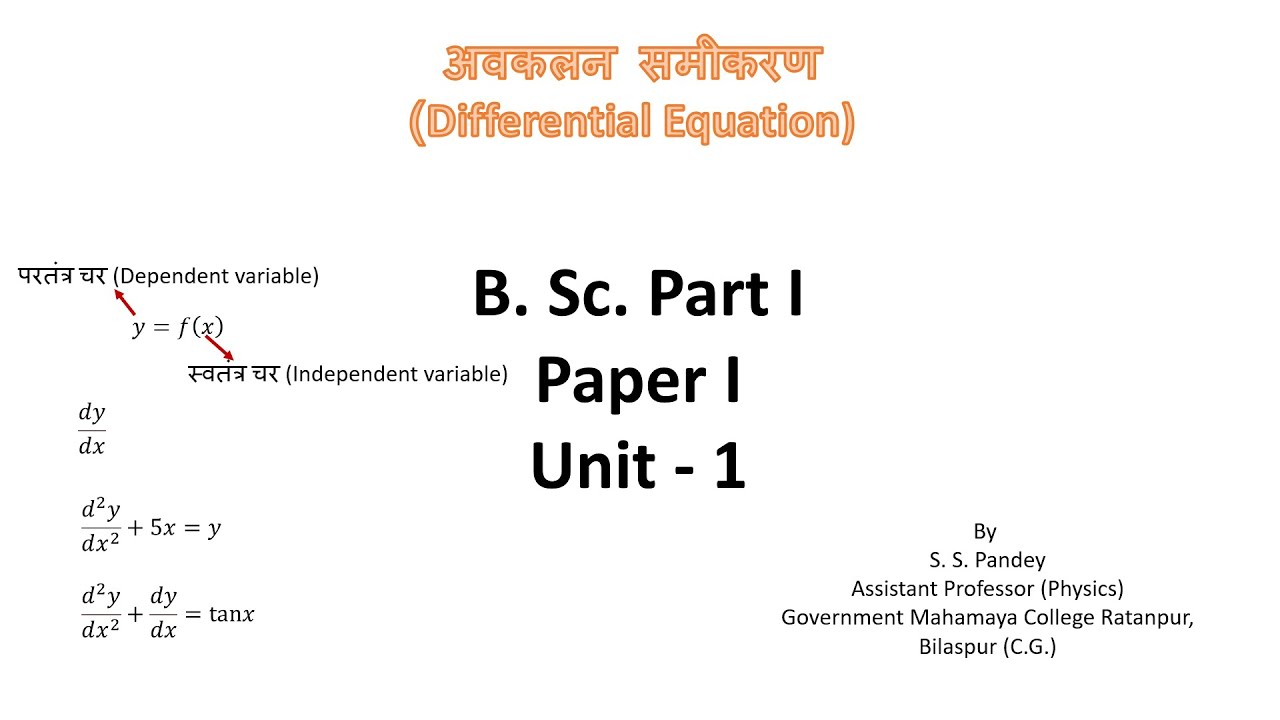
The fundamental definition of a differential equation, including the distinction between dependent and independent variables.
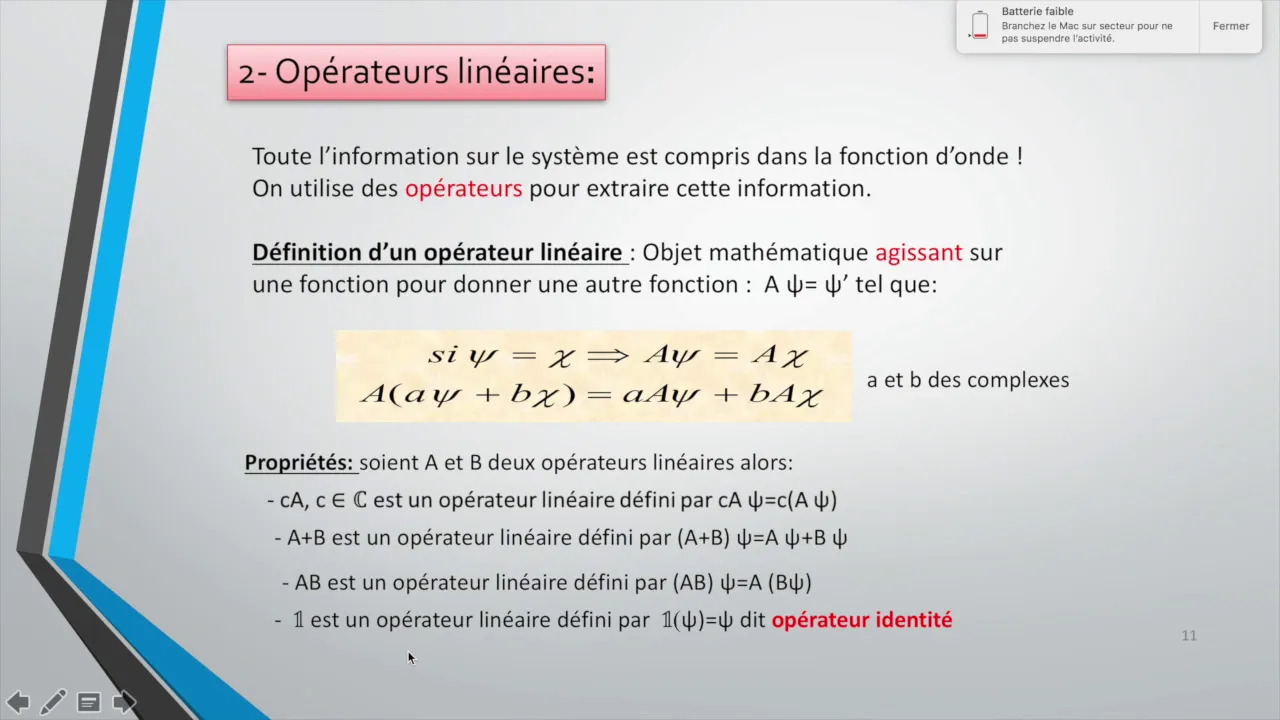
The algebraic concept of linearity, particularly how linear operators and linear combinations function.
How to identify the 'order' of a differential equation based on its highest derivative.
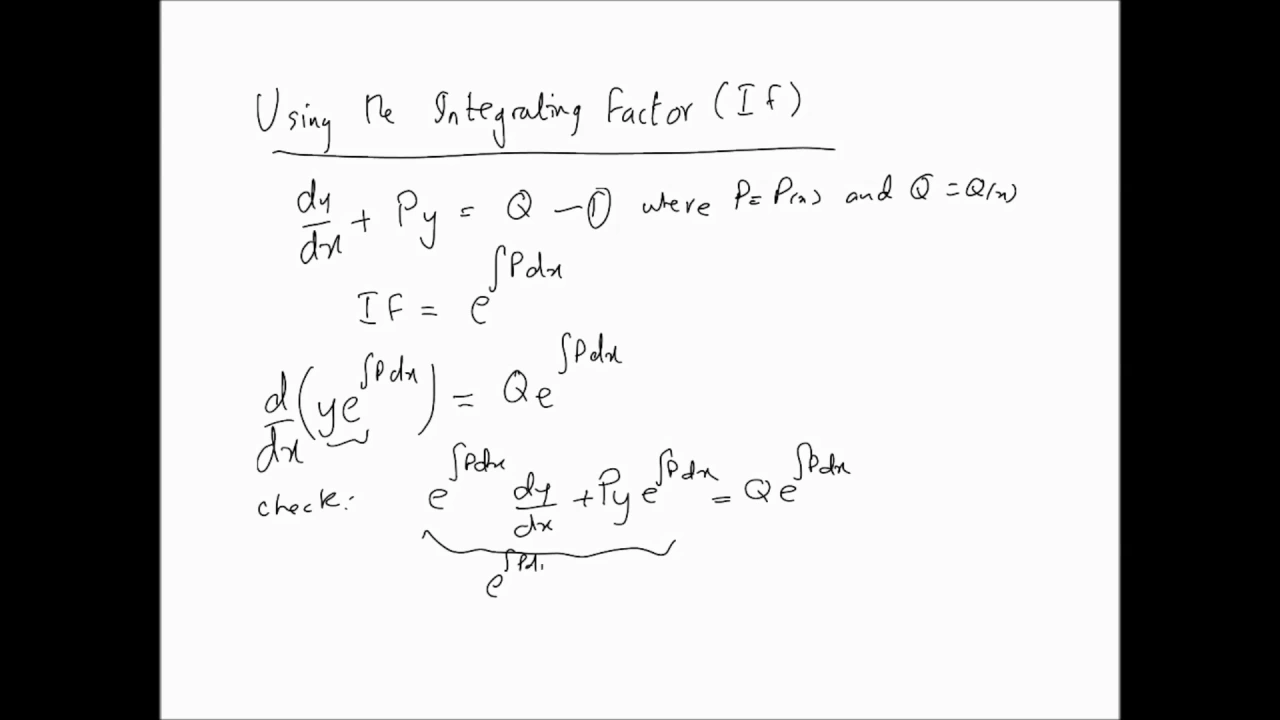
Analytical methods for solving first-order linear differential equations, such as the integrating factor method.
Techniques for solving higher-order linear differential equations, including homogeneous equations and the method of undetermined coefficients.
Qualitative analysis of nonlinear differential equations, including finding equilibrium points and performing linearization.
Numerical methods (such as Euler's method or Runge-Kutta methods) used to approximate solutions for complex nonlinear equations.
Real-world mathematical modeling, contrasting linear phenomena (like simple harmonic motion) with nonlinear systems (like chaotic pendulums or population dynamics).
332.9K views6.4Klikes7:18Original Release: 2018-05-15
hey everyone welcome back in this video we're going to talk about the difference between what's called linear differential equations versus nonlinear okay linear versus nonlinear this topic is a little bit harder for some people so we'll do a lot of examples so a de so a differential equation is linear in Y you can also say linear in X or any other variable we're gonna focus on linear and Y if we can write it so if we can write it in the form so first I'm going to show you like the mathematical definition and then I'm gonna explain it in words because that's how I think of it I'll actually don't think of it this way I mean I guess I do let me just go ahead and write it so basically you have a coefficient so I'll call that a sub n of X so a pure function of x times say the nth derivative of X plus and then you would have a sub n minus 1 but I'll skip that one all the way down to say the first derivative so a sub 1 of X dy/dx again a pure function of X and then plus a sub 0 of x times the 0 with derivative so the zero of derivative of a function is the original function and that should be equal to G of X so basically in front of Y and all of its derivatives so here's Y and all of its derivatives you only have pure functions of X that's the first condition so again in front of Y in all of its derivatives you only have pure functions of X and the second condition is that Y and all of its derivatives are all to the first power so maybe I should write that down so one so in front of Y and its derivatives you have only pure functions of Acts so pure funks of X also here you have two only X here right can't have a Y here but in front of Y in all of its derivatives you have pure functions of X and then also Y and its derivatives are all to the first power so are all to the first power okay let's do some examples right away and we're gonna do a bunch of these until hopefully it makes sense so question it says linear or nonlinear so linear and why we're only concerned if it's linear or nonlinear and why or is it nonlinear okay a how about let's see us have to make these up how about y double prime plus each of the x times y prime plus y equals sine X so this is a differential equation if you watch the first video you'll know that the order is two because the order is the order of the highest derivative and there's a second derivative and this problem we want to figure out if it's linear or non-linear so here we have a 1 here we have an e to the X here we have a 1 so in front of Y and all of its derivatives we have pure functions of X that that's the first condition check and Y and all of its derivatives are all to the first power so that's the second condition check and then here we have a pure function of X so check so in this case the answer would be linear Aylin you know let's do another one be how about this one y triple prime plus 3y y double prime plus y equals e to the X in this case the order is three just easy to talk about because the order is the order of the highest derivative and this one would be nonlinear because of this piece right here right this is a function of Y and it's being multiplied by the second derivative you cannot have that right you have to have only pure functions of X in front of Y and its derivatives so in this case the answer would be nonlinear nonlinear let's do another one see how about something like this x squared dy DX plus y equals seven okay so in this case the order is one because the order is the order of the highest derivative so we have the first derivative and this one would be linear because this is a pure function of X there's a one here it's a pure function of x and y and all of its derivatives are to the first power so that would be linear so keep going D how about something like this square root dy/dx plus 3y equals sine X in this case the order is one because this is the first derivative and this one is nonlinear and the reason is you can think of this dy/dx this piece here rather as dy/dx to the one-half power right because you can write the square root as a one-half so that's not to the first power so this is nonlinear right Y and all of its derivatives all have to be to the first power otherwise it's nonlinear e Y double prime plus sine Y times y equals e to the X this would be order 2 right because the order is the order of the highest derivative and it would be nonlinear because you have this function of Y here in front of the Y so you can't have that right no good at all so this is nonlinear you can only have pure functions of X in front of Y and all of its derivatives one more F see if I have any ideas I can't really think of anything that we haven't really done too much well how about this y double prime plus cosine of X plus y equals e to the X so kind of a weird problem here but this is a differential equation and it's order two because the order is the order of the highest derivative and that's a second derivative it's been nonlinear right nonlinear you cannot have cosine of X plus y doesn't make any sense in this context right Y and all of its derivatives have to be to the first power it's inside a cosine function so it's not good that would be nonlinear so hopefully this video a video made sense and just keep in mind it's linear if Y and all of its derivatives appear to the first power and in front of Y and all of its derivatives you have to have pure functions of X on the right hand side you always have a pure function of X I hope that helped
Up Next
20:00
Sketching Phase Portraits for Linear Systems of Differential Equations
@ellieblair7322
542.8K views•2015-03-12

4:43
Elliptic Curve Cryptography Explained: ECC, ECDSA, ECDH
@PracticalNetworking
28.5K views•2024-10-21
12:13
Riemann Integral Formal Construction and Definite Integrals
@TheMathSorcerer
2K views•2019-09-08

6:00
The Mathematical Impossibility of Accurate World Maps
@Vox
23.3M views•2016-12-02
Related Study Plans & Knowledge Roadmaps
Structured learning paths in Mathematics
mathematics
Tensor Calculus: Vectors to Riemann Curvature
01Mathematical Foundations: Linear Algebra & Calculus
02Covectors, Dual Spaces, and Tensor Basics
03The Metric Tensor and Index Gymnastics
+ 2 more learning modules
40h5 modules
Explore Roadmap
mathematics
Gödel's Incompleteness: Logic, Proofs & Limits
01Introduction to Formal Systems & Hilbert's Dream
02Set Theory, Cardinality, and Cantor's Diagonal Argument
03Arithmetization and Gödel Numbering
+ 2 more learning modules
14h5 modules
Explore Roadmap
mathematics
Galois Theory: Fields, Groups & Solvability
01Foundations of Abstract Algebra: Groups & Fields
02Polynomials & Field Extensions
03Splitting Fields & Symmetries
+ 2 more learning modules
24h5 modules
Explore Roadmap
mathematics
Non-Euclidean Geometry: Models & Geodesics
01Euclid's Fifth Postulate and the Birth of New Geometries
02Hyperbolic Space and the Poincaré Disk Model
03Geodesics: Defining Straight Lines in Curved Spaces
+ 2 more learning modules
15h5 modules
Explore Roadmap