

















Clay soil is not a problem but rather the richest natural nutrient vault, containing negatively charged particles that can hold up to 40 times more nutrients than sandy soil; the key to unlocking this potential is maintaining glomalin-producing fungi through organic matter, cover crops, and mulching, which creates stable soil aggregates that improve water infiltration, nutrient availability, and fertility without synthetic fertilizers.
Soil Vault Method: Clay Soil Fertility Without Synthetic Fertilizers
Added:Understanding soil texture and composition, specifically the physical properties and challenges associated with clay soils such as compaction, low aeration, and water retention.
The fundamentals of the soil food web, particularly how organic matter is decomposed and cycled by soil microorganisms.
The basic symbiotic relationship between plant roots and mycorrhizal fungi, including how plants trade carbon for nutrients.
The distinction between synthetic fertilizers (which feed the plant directly) and organic soil amendments (which feed the soil biology).
Advanced cover cropping strategies, including multi-species seed cocktails, nutrient accumulation profiles, and biological termination methods.
Methods for testing and monitoring soil biological health, such as measuring soil respiration, assessing fungal-to-bacterial ratios, and observing aggregate stability.
Permaculture and no-till farming systems that scale these biological principles to market-gardening or broadacre agricultural operations.
Techniques for cultivating and inoculating soils with indigenous microorganisms (IMOs) and fungal-dominated compost to accelerate soil transformation.
132 views4likes26:50Original Release: 2026-05-06
Every expert on the internet gives you the same advice about clay soil. Add sand to loosen it. Till it every spring.
Buy bags of amendment. Dump fertilizer on it. And when that does not work, buy more. It sounds scientific. It sounds logical. Millions of gardeners follow it every single year. And it is destroying their soil. Published research shows that plants only absorb about half the synthetic nitrogen you apply. The rest washes into ground water or locks up where roots cannot reach it. You are paying full price for a product that delivers half its promise. and you will need to buy it again next spring because the soil never actually improved. Every year, American gardeners spend roughly $ 8.5 billion on lawn and garden products and the clay underneath their yards just keeps getting worse. But there is a method that costs $0 and makes clay soil more fertile every single year instead of less. We call it the soil vault method because your clay is not broken ground. It is the richest nutrient vault in the natural world. and every bag of fertilizer you have ever purchased was a payment to access nutrients that were already there. This method has been tested on 5,000 acres of North Dakota clay by a farmer who nearly went bankrupt before he stumbled onto it. It has been validated by USDA research that sat buried in academic journals for decades. And the only reason you have never heard of it is because there is nothing to sell. A method that turns free materials into permanent fertility is not a product. It is a threat to every business model in the garden industry. This is the story of the soil vault method and why the people selling you soil amendments have a financial reason to make sure you never learn it.
But before we reveal the system, if you are sick of paying for toxic fertilizers, we have put together a free 0 harvest blueprint for you. It reveals seven zerocost fertilizers that actually outperform everything you know and the lazy no dig method that eliminates weeding permanently. One of our readers used the fertilizer trick inside and his garden grew double the size of his neighbors. To get instant access to the blueprint in a weekly forgotten gardening hack, click the first link in the description below or scan the QR code on the screen right now if you are watching on TV. Just open your camera app on your phone and then hold it against the screen. A yellow button should pop out. In 1991, a farmer in North Dakota took over 1,760 acres of heavy clay that could barely absorb rain. 20 years later, that same clay was absorbing more water in a single hour than the state receives in an entire year of rainfall. What happened in between is the reason you have never needed to buy a bag of fertilizer. Gabe Brown took over his in-laws farm just east of Bismar, North Dakota. The soil was heavy clay, the kind that sticks to your boots and cracks open in summer like a dried riverbed. He farmed it the way everyone did, the way his in-laws had since the 1950s. tillage every spring to break up the clouds. Synthetic fertilizer spread by the taunt. Pesticides, fungicides, herbicides, the full chemical playbook approved by every agricultural extension office in the state. Nobody questioned it. It was just how farming worked. Then nature decided to run an experiment of its own.
In 1995, a hail storm destroyed his crop. He replanted. In 1996, hail came again and wiped out the replanting. In 1997, a late spring blizzard killed what the hail had not. In 1998, drought finished the job. Four consecutive years of catastrophic crop failure. His cattle were dying, his bank account was empty, and the debt was crushing. Gabe Brown was one bad season away from losing everything his family had spent decades building. His neighbors watched from their own struggling fields and waited for the auction notice. So he made a decision that was born entirely from desperation, not from philosophy. He could not afford to till, so he left the crops double standing in the field over winter. He could not afford to buy fertilizer, so he planted without it. He could not afford herbicides, so the weeds grew alongside the crops. Every aronomist in the county told him he was committing agricultural suicide. Every neighbor thought he had lost his mind.
But something happened that nobody predicted. When soil scientists ran tests on his clay a few years later, the results contradicted everything conventional agriculture had taught for 50 years. The soil was not declining. It was actively improving. The organic matter, which sat at a lifeless 1.9% when he took over the farm, had started climbing for the first time in recorded history on that land. Water infiltration, which had been measured at half an inch per hour in 1991, meaning thunderstorm rain simply sheated off the sealed clay surface and carried top soil with it, began to increase. Brown did not stop. He could not afford to go back to the old way. And by now, he did not want to. He started planting diverse cover crop mixes, sometimes 20 or more species in a single blend. He stopped killing weeds with chemicals and started suppressing them with living ground cover. He integrated cattle into the system using carefully managed grazing to mimic the way wild bison once moved across the great plains. Grazing an area intensely for a short period and then moving on giving the land a full year to recover. By 2007, he had eliminated all synthetic fertilizer from his operation, not reduced it, eliminated it. By 2010, the fungicides and pesticides were gone, too. Today, Brown's ranch spans over 5,000 acres of North Dakota clay. His organic matter has risen from 1.9% to over 6% with one field hitting 11.1%, a number that made visiting soil scientists double check their instruments. His water infiltration rate went from half an inch per hour to over 8 in per hour. That is a 16-fold improvement in the clay's ability to absorb and hold rain. His crop yields now run 20 to 25% above the county average and his input costs are a fraction of his neighbors because he buys no fertilizer, no fungicides, and no pesticides. He won the Hines Award for the environment. He was named one of the 25 most influential agricultural leaders in America. His book Dirt to Soil became the foundational text of the regenerative agriculture movement. NBC called him a regenerative no-till pioneer. And here's the detail that should stop every gardener mid scroll.
Brown did not fix his clay soil. He stopped breaking it. The clay was never the problem. The treatments were and the treatments were making the garden center money every single spring. But to understand why, we need to go deeper than any gardening video has ever taken you. We need to look at what clay actually is because the science is genuinely staggering and it explains everything. Clay particles are less than 2,000 of a millimeter across. You would need an electron microscope to see one clearly. A sand grain next to a clay particle is like setting a basketball next to the head of a pin. And they are not round like sand. Clay particles are flat shaped like microscopic sheets of paper stacked in layers. That tiny size and flat shape creates something remarkable. Surface area. A single gram of smctite clay about the weight of a paperclip has a surface area between 700 and 800 square me. That is the size of two full basketball courts packed into something you could hold on your fingertip. Even common kalinite clays carry 50 to 100 square meters per gram.
Sand has about one square meter. We are talking about a thousandfold difference.
Every one of those surfaces carries a negative electrical charge built into the mineral structure itself. Those negative charges attract and hold positively charged nutrient ions like a magnet. Grabs iron filings, calcium, magnesium, potassium, ammonia, iron, zinc, copper. The exact nutrients your plants need to grow, flower, and fruit.
Soil scientists call this holding power cation exchange capacity CEC. Think of it as your soil savings account. Sandy soils have a CEC between 0ero and 8.
Nutrients wash through them like water through a civ. Clay soils routinely exceed 25 and some reach 40 or higher.
Your clay is not dead dirt. It is the richest nutrient vault in the natural world. And it does more than just hold nutrients. Clay holds water in a way that sandy soils simply cannot match.
During a drought, clay soil can be the difference between a harvest and a funeral for your tomato plants. The moisture clings to those vast surfaces and stays available in the root zone for weeks after the last rain. Sandy soil drains in hours. But here is where the story connects back to Gabe Brown because this is exactly what his soil test data proved. When researchers measured the carbon stored in Brown's clay, they found 96 tons per acre in the top 48. in the regional average on conventional farms using the standard fertilizer and till program was 10 to 30 tons. His clay was storing three to 10 times more carbon than his neighbors despite sharing the same county, the same weather patterns, and the exact same clay type. The only difference was what he stopped doing to it. The great farmlands of the American Midwest, the black earth of Ukraine, the flood plains of the Nile, these are all clay dominant soils that have fed civilizations for millennia. But here's the catch that explains why your garden feels like a construction site. While Ukrainian wheat fields produce bumper crops, a fault is useless if you cannot open the door. And the key to that door is not a bag of fertilizer. It is a living organism that we have been accidentally killing for decades. And this is where the story takes a turn that the fertilizer industry really does not want you to hear. In 1996, a USDA soil scientist named Sarah Wright made a discovery that should have changed gardening forever.
She was studying microisal fungi, the ancient organisms that form symbiotic partnerships with plant roots. Plants send sugars down through their roots to feed these fungi. In return, the fungi extend microscopic filaments called hi far beyond the root zone, mining water and nutrients from places roots cannot reach. A plant with healthy fungal partners can access nutrients from soil 10 times farther away than its roots extend. Wright discovered that these fungi were producing a sticky glyoprotein she named glolin after glales, the taxonomic order of the fungi. To extract it, she had to heat soil samples to 121 degrees C for a full hour. Nothing else in soil required that kind of force to dislodge. When she measured how much glomalin was in healthy soil, the numbers stunned the research community. Glolin accounts for up to 27% of all carbon stored in soil.
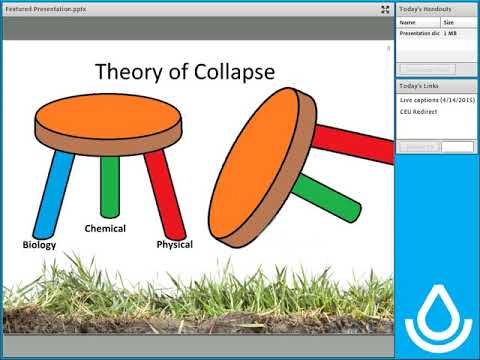
It persists for 7 to 42 years. And it does something no synthetic product can replicate. It literally glues individual clay particles together into larger clumps called aggregates. Those aggregates create spaces between the channels where water drains, air flows, and roots push through. That is the difference between clay that crumbles in your hand and clay that smears like wet concrete. When glomalin is present, clay has excellent structure. When glomalin is gone, clay particles collapse flat against each other. Drainage fails, compaction sets in and the surface crusts over into a sealed layer that repels water. Sound familiar? And this is where Brown's data gets almost unbelievable. In 1991, when his farm followed the conventional playbook, the clay could only absorb half an inch of rain per hour. North Dakota thunderstorms routinely dump an inch or two in 30 minutes. That means every storm was sheeting across his fields, carrying his top soil with it. The soil could not drink fast enough. After he stopped tilling and let the biology rebuild, the infiltration climbed to over 8 in per hour. But his neighbor Jay Furer at the Natural Resources Conservation Service ran a later test and found the infiltration had exceeded 30 in per hour. 30 in that is more water than North Dakota receives in an entire year absorbed in a single hour. The same clay, the same field. The only change was that the glomalin producing fungi came back to life. This is exactly what gave brown soil was doing in 1991. Years of annual tillage had been shredding the fungal networks that produce glomalin.
The synthetic fertilizer was shortcircuiting the sugar trade between plants and fungi. The ancient partnership that had been building soil for 400 million years. Why would a plant invest energy feeding its fungal partners when a flood of free nitrogen appears at the root surface every spring? The plant stopped paying the fungi and without that sugar supply, the fungi starved. The glomolin stopped being produced and without glomalin, the clay aggregates fell apart and collapsed into a sealed airless mass. And every expert told brown to buy more fertilizer until harder, which was exactly the prescription that had caused the problem in the first place. Follow the money and the cycle becomes obvious. In year one, you buy fertilizer. It works beautifully. But underground, the plants stop producing the sugars that feed their fungal partners. Why pay rent when someone is handing you free food. In year two, the fungal networks have weakened. The glomal in production has slowed. The aggregate structure starts degrading. You notice the plants are not quite as vigorous, so you buy more fertilizer. The garden center recommends a bigger bag this time. By year four, you are spending twice what you started with, and the soil is visibly worse. The clay is stickier, harder, drains slower.
You are watering more because the soil's capacity has declined along with its structure. The garden center is delighted because you are now a lifetime subscriber to their product line. The IPCC has estimated nitrogen leeching rates between 9 and 30% for synthetic fertilizers depending on conditions.
That is money literally washing into groundwater. But the hidden cost dwarfs the wasted product. Every dollar you spend on synthetic fertilizer accelerates the collapse. It destroys the biological system that would have delivered those same nutrients for free.
The more you use, the more you need. The more you need, the more you spend. Three myths keep gardeners trapped in this cycle. And we need to destroy all of them. The sand myth. When you mix sand into clay, you do not get lom, you get concrete. Sand grains are large and round while clay particles are flat and microscopic. And the clay fills every gap between the sand grains until the mass locks together denser than either material alone. This is literally how bricks are manufactured. The tilling myth. Every tiller pass shreds the microisal hy that produce glomalin destroying months of fungal growth in minutes. Worse repeated tillillage creates a hard pan, a dense sealed layer below tilling depth that traps water above it. You are building a bathtub under your garden. The lime myth. Lime adds calcium and raises pH, which is fine if your soil is actually acidic, but gardeners who dump lime every spring without testing. Push pH above 6.5, locking up iron, manganese, zinc, and boron. A $15 soil test would prevent years of frustration. This is the part you came for. The soil vault method step by step. Six components, one system, $0, and the three mistakes that will sabotage you if you do not avoid them.
Step one, stop tilling and stop buying synthetic fertilizer. This is the foundation of the entire soil vault method. You are going to let the fungal networks rebuild. Every till pass and every synthetic application delays recovery. Gabe Brown's turnaround started the day he could not afford to do either. Step two, armor the surface.
Spread 2 to 4 in of organic matter on top of your clay. Compost, leaf mold, aged manure, grass clippings, shredded autumn leaves. Do not dig it in. This is critical and it goes against everything you have been told. Nature does not rode to till the forest floor. Leaves fall on top. Earthworms pull material downward through their burrows. Fungi grow upward into the decomposing layer. Rain washes dissolved organic compounds into the pore spaces below. Within a single growing season, you will see the color of the soil changing underneath the compost layer as carbon migrates downward through biological activity. If you want to accelerate this process, worm castings are the single best amendment available. The microbial diversity and quality vermic compost is extraordinary and published research consistently shows that worm castings speed up aggregate formation in clay compared to compost alone. You can produce worm castings at home for free with a bin the size of a storage tote and your kitchen scraps. That bin produces the highest quality soil amendment that money literally cannot buy at a garden center because the living organisms die on the shelf. Step three, plant cover crops as biological tillers. Dicon radish pushes a tap routt 2 to 4 ft deep into compacted clay and some varieties reach 6 ft. The word daikon means big root in Japanese and these plants live up to it. Research at the University of Maryland found twice as many corn roots penetrating compacted subs soil after a daon cover crop compared to cereal rye. When the radish dies over winter, that massive root decomposes and leaves behind an open biopore that future roots, water, and air can follow. You're getting deep tillage without touching a tool and adding organic matter at the same time.
Crimson clover fixes free nitrogen from the atmosphere through symbiotic bacteria in its root nodules, essentially manufacturing fertilizer from thin air. When the clover decomposes, that nitrogen becomes available to whatever you plant next. A fall blend of daicon radish, crimson clover, and cereal rye is one of the best free investments in gardening. The radish drills deep. The clover fertilizes. The rye holds the soil and adds root mass. All three decompose into organic matter that feeds the fungal networks underneath. Some gardeners save seed from year to year, making the cover crop completely free after the first purchase. If you are finding the soil vault method useful, like and subscribe.
We cover forgotten growing techniques every week that the garden industry will never put on a shelf. Step four, mulch year round and do not be stingy about it. two to three inches of wood chips, straw, or shredded leaves on every exposed surface. This is one of the highest leverage-free practices in all of gardening. And the science behind it explains why. When rain hits bare clay, each raindrop lands with enough force to shatter surface aggregates and disperse the clay particles into a thin slurry.
As that slurry dries, it forms a crust that is nearly impervious to water. Soil scientists call this surface crusting, and on bare clay gardens, it is responsible for enormous amounts of rainfall being wasted as runoff instead of soaking into the root zone. You stand there with a hose because the rain that fell for free could not get in. Mulch absorbs the impact. Rain filters through the mulch layer gently, reaching the clay surface without the destructive force that causes crusting. The difference is dramatic. Mulched clay soil can absorb several times more rainfall than bare clay in the same storm event. Beyond that, mulch maintains consistent moisture so the fungal network stay active through dry spells. It moderates soil temperature, keeping things cooler during mid-summer heat waves and warmer into the fall, extending the window where biology is working underground. And as the mulch decomposes over months, it becomes the organic matter that feeds the fungal networks from the top down, exactly the way a forest floor has operated for 300 million years. Freewood chips from local tree services are available in nearly every city if you call and ask. [music] Many arborists are desperate to find drop off locations because they pay tipping fees at the dump. You are solving their problem while building your garden. Fallen leaves in autumn are available in virtually unlimited quantities. Straw from a local farm costs almost nothing. We are past the halfway mark and what comes next is the part that separates gardeners who get results from gardeners who stay stuck for years. Two more components of the soil vault method and then the three mistakes that destroy everything. Step five, test your calcium to magnesium ratio. This is the advanced move that almost nobody talks about. Calcium promotes fauculation which means clay particles clump into good aggregates.
Magnesium when it dominates promotes dispersion where particles repel each other and seal into a dense mass. The ideal ratio is roughly 6:1 calcium to magnesium. If your soil test shows magnesium domination, adding gypsum, which is calcium sulfate, shifts the ratio without changing pH. Gypsum is often free from drywall recycling operations, but you need that soil test first. Do not guess. Step six, never work wet clay. This is the free habit that prevents the most damage. When clay is saturated, those flat particles are floating. Step on them and they align flat against each other like a deck of cards being pressed. That is compaction at the particle level. The ribbon test takes 5 seconds. Squeeze a handful of soil. If it holds a ribbon or stays in a tight ball, walk away. If it crumbles when you poke it, you are safe. After heavy rain, wait 48 hours. Build permanent beds with defined walkways so growing areas never get foot traffic.
Here are the three mistakes that will wreck your progress and we see these constantly in gardening forms from people who tried the right method but made one critical error that set them back by years. Mistake one, adding sand.
We covered the science on why this creates concrete rather than lom, but people still do it because the advice is everywhere. A gardener in a clay heavy suburb of Atlanta dumped six wheelbarrows of construction sand into her vegetable beds on the advice of a YouTube video. The beds became so hard after drying that she could not push a triel into the surface. She had to remove the entire bed and start over. Do not add sand under any circumstances.
Mistake two, skipping the soil test before adding mineral amendments. This is the most expensive free mistake in gardening. A $15 test from your county extension office tells you exactly what your soils exchange complex looks like, what your pH is, and whether you need calcium, magnesium, or neither. Without that data, you are guessing. And guessing with lime on clay that is already above, pH 6.5 locks up iron, zinc, manganese, and boron. For years, we have seen gardens where unexplained yellowing and poor fruitruing turned out to be mineral lockup caused entirely by unnecessary lying. The fix took multiple growing seasons. $15 would have prevented all of it. Mistake three.
getting impatient and tilling in year one because the surface looks rough. The biology needs time. The fungal networks that produce glomal and grow slowly.
Every time you reach for the tiller because the garden does not look pretty yet, you are resetting the biological clock to zero. Gabe Brown soil did not transform in one season either. It took consistent practice over years. The improvement was permanent, compounding, and free. Now, here's what happens inside your soil year by year. Because this progression is what makes the soil vault method genuinely astonishing. Year one. The surface still looks rough and the clay underneath is still dense, but small changes are already happening beneath the surface. Water begins soaking in slightly faster after rain instead of pooling on the surface the way it used to. The compost you laid on the surface starts disappearing as earthworms and fungi pull it downward through biological activity you cannot see. The soil smell shifts from sour wet clay towards something richer and darker. Cover crop roots are punching channels into the compacted layers below. Channels that will persist long after the roots decompose. You might not see dramatic results above ground yet.
Be patient. The real construction is happening underground. Year two. This is when the first visible payoff arrives.
Earthworm populations begin to increase noticeably. Their arrival is a biological signal that experienced soil scientists specifically look for because earthworms will not colonize soil that lacks adequate organic matter and decent structure. When they show up in numbers, the recovery is confirmed. Every worm tunnel becomes a permanent channel for air and water. Watering needs drop because the fungal networks are beginning to store and distribute moisture through the root zone. Your mulch layer from last fall has vanished into the soil surface. Plants start performing better and you notice fewer disease problems. This is the first real payoff above ground. Year three. This is the turning point. The soil crumbles in your hand instead of smearing. The color is visibly darker as organic carbon accumulates. You can push a finger into the surface without effort. When you dig, you find old root channels and earthworm burrows running through what used to be a solid, airless mass. Plant health improves significantly because the microisal networks are now extensive enough to deliver nutrients through the underground exchange system. Neighbors start asking what you changed. Tell them you stopped buying fertilizer and started feeding the fungi instead. Watch their faces. This is the turning point.
Year four and beyond. This is where the transformation accelerates in ways that seem almost unfair compared to garden still on the synthetic treadmill. The glomalin produced by the rebuilt fungal networks is binding clay particles into stable aggregates that drain, breathe, and hold nutrients simultaneously. Soil tests at this stage show increasing nitrogen and phosphorus availability even though you added zero purchased fertilizer. Disease resistance improves because the fungal networks help plants share chemical defense signals. The same mechanism Suzanne Samar discovered in her woodwide web research on forest microisal networks. The soil has become a self-sustaining biological engine. It is not just maintaining fertility. It is building fertility year after year on its own. Building fertility. Let's put the cost comparison on the table so you can see how absurd the difference really is. Once you see these numbers side by side, you will never look at a bag of fertilizer the same way again. The average gardener working clay soil spends between $200 and $400 per year on synthetic fertilizer, soil amendments, lime, and conditioners. Over 10 years, that is $2,000 to $4,000. Add in the irrigation cost from watering compacted soil that cannot absorb rain properly, and the number climbs higher. Some gardeners spend another $100 to $200 per year on potting soil to top off beds that keep sinking as organic matter depletes. After a full decade of the spending, the soil is no better than it was when they started. Often, it is measurably worse because the fungal networks have been suppressed, the aggregate structure has degraded, and the clay has sealed tighter each year.
The Z method over the same 10 years cost nothing for materials you can source free. Compost from kitchen scraps and yard waste. Cover crop seeds saved from the previous season or bought once for a few dollars. Mulch from tree services who would otherwise pay to dump it.
Gypsum from drywall recycling if your soil test calls for it. At the end of that decade, the soil is darker, crumblier, more fertile, better draining, and actively improving on its own without any purchased input. You stopped spending money on your soil years ago because the biology took over the job. One path costs thousands and creates dependency. The other costs nothing and creates compounding abundance. The garden industry builds its revenue on the first path. The second path makes every product on their shelves unnecessary. And that is why you will never see it advertised at the checkout counter. You do not garden for the garden industry. You garden for your family, your table, and the ground under your feet. In 2021, Gabe Brown stood on a stage in Pittsburgh and received the Hines Award for the Environment, one of the most prestigious conservation honors in America. His son Paul now runs Brown's ranch dayto-day. The same heavy North Dakota clay that nearly destroyed the family in the 1990s now supports 5,000 acres with yields above every neighbors. Zero purchased fertility and soil that independent labs confirm is still getting richer and more alive with each passing season. The organic matter is still climbing. The water infiltration is still increasing. The earthworm counts are still going up.
Brown told an audience of farmers something that applies to every gardener watching this right now. He said, "We do not have a moisture problem. We have an infiltration problem." His clay proved him right. The water was always falling.
The soil just needed to be alive enough to let it in. The nutrients were always locked in those negatively charged clay surfaces. The soil just needed the fungal networks to unlock them. When Brown's father-in-law retired from that farm in 1991, the soil could absorb half an inch of rain per hour. Today, after three decades of feeding the biology instead of fighting the clay, that same soil absorbs over 8 in per hour. The same soil, the same clay, the same plates shaped particles carrying the same negative charge. The only thing that changed was what lived inside it.
Every handful of clay in your backyard holds that same potential. Not because we say so, but because the particle physics, the glomalin research, the microisal science, and 30 years of documented field results on 5,000 acres of North Dakota clay all point to the same conclusion. The nutrients are already in your soil. The water holding capacity is already built into the mineral structure. The only thing missing is the biology, and biology runs on compost and fungi, not bags from the garden setter. Now, the soil vault method handles the soil side. There is one more piece that completes the system. It is the single most expensive mistake in any garden. Fertilizer. We made a video that breaks down seven free fertilizers hiding in plain sight, including one that a university study showed doubled plant growth compared to the bestselling synthetic nitrogen on the market. A retired professor used number three on his clay beds, and his neighbors accused him of cheating. Watch that video now before you spend another single dollar at the garden center.
Up Next

31:10
Regenerative Agriculture: Building Soil Fertility with Soilkee
@FarmLearningTim
79.9K views•2024-11-01

15:54
Life in Biosphere 2: Sustainable Ecosystems & Human Survival
@TED
334.9K views•2009-06-16
14:30
Microplastics Everywhere: How Plastic Impacts Our Lives
@TEDx
100.9K views•2018-05-08
10:28
Ice Stupa Artificial Glaciers: Solving Ladakh's Water Crisis
@SonamWangchuk66
3.2M views•2015-05-03
Related Study Plans & Knowledge Roadmaps
Structured learning paths in Environmental Science
environmental-science
Ocean Noise: Cetacean Impacts & Mitigation
01Fundamentals of Underwater Acoustics
02Marine Mammal Bioacoustics
03Anthropogenic Noise: Shipping & Seismic Surveying
+ 2 more learning modules
16h5 modules
Explore Roadmap
environmental-science
Road Ecology: Corridors, Overpasses & Fencing
01Foundations of Habitat Fragmentation and Carnivore Ecology
02The Road Barrier: Ecological Impacts of Transport Infrastructure
03Principles of Ecological Corridors and Connectivity Mapping
+ 3 more learning modules
14h6 modules
Explore Roadmap
environmental-science
Ocean Acidification: Kelp Buffering & Shellfish
01Fundamentals of Ocean Chemistry & pH
02Chemical Pathways of Coastal Acidification
03Bivalve Physiology & Calcification Under Stress
+ 2 more learning modules
18h5 modules
Explore Roadmap
environmental-science
Ice Stupas: Glacial Retreat & Water Security
01Foundations of Glaciology & Mountain Hydrology
02Climate Change and Glacial Retreat Dynamics
03The Science of Ice Stupas & Artificial Glaciers
+ 2 more learning modules
14h5 modules
Explore Roadmap