A study by MIT economists suggests that a modest robot tax of 1-3.7% of robot value could help combat automation's effects on income inequality in the U.S., with similar modest trade taxes (0.03-0.11%) also recommended to reduce job displacement from imports.
Taxing Robots to Address Automation and Income Inequality
Added:Deep Dive
The economic concept of 'capital-labor substitution' and how automation replaces human workers in the production process.

Роботизация и ее последствия для рынка труда
410
This section presents the economic theory underlying robotization. The speaker explains that robotization is essentially a private case of replacing labor with capital, governed by the Coase-Douglas production function. The theory shows that capital and labor are both substitutable and complementary. Robotization occurs when investors find it profitable to invest in capital that can replace human labor, weighing investment costs against wage savings. The section introduces the concept that different types of work have different profitability thresholds for automation, creating natural limits to robotization. The key insight is that economic theory provides a framework for understanding why and when robotization occurs.
Click to watch →

Нова економіка: великий бізнес з'їсть усіх?
1.5K
Large companies are increasingly substituting capital (robots, AI, automation) for labor, which explains why sales concentration in big firms has grown over 120 years while employment concentration has remained nearly unchanged since the 1920s; this shift creates economic inequality as most workers are concentrated in hard-to-automate sectors with lower incomes, while fewer people control the capital and technology that generate most economic value.
Click to watch →

Bertie Benegas Lynch: "Hay que cerrar el CONICET"
148.6K
Capital substitutes for labor in production processes. The example of using a tractor instead of a horse for farming demonstrates how capital investment reduces the need for human labor while increasing productivity. This substitution is a fundamental mechanism of economic development.
Click to watch →

Экономика AGI: как изменится ваша работа и что с этим делать
1.1K
This section explains how AI changes the relationship between capital and labor from multiplicative to additive. Previously, both capital and labor were needed together to produce output; now, capital (AI) can substitute for labor. This means entities with more capital can produce more output with less human labor, potentially concentrating value in capital-rich entities. The speaker also discusses value migration in the AI industry, currently moving from infrastructure (75% of value) to platforms to business applications. This creates opportunities for those who can build valuable applications on top of AI infrastructure.
Click to watch →

Ask Prof Wolff: Capitalism and Racism
26.3K
Automation represents a key strategy capitalists use to reduce labor costs by replacing human workers with machines. When the purchase price of a machine over its useful life (typically five to ten years) proves cheaper than hiring living laborers to perform the same work, capitalists have strong financial incentives to implement automation. The system provides little accountability for compensating displaced workers or communities affected by unemployment resulting from this technological substitution.
Click to watch →
Deep Dive
Basic principles of public finance and taxation, including how taxes alter economic incentives and market outcomes.
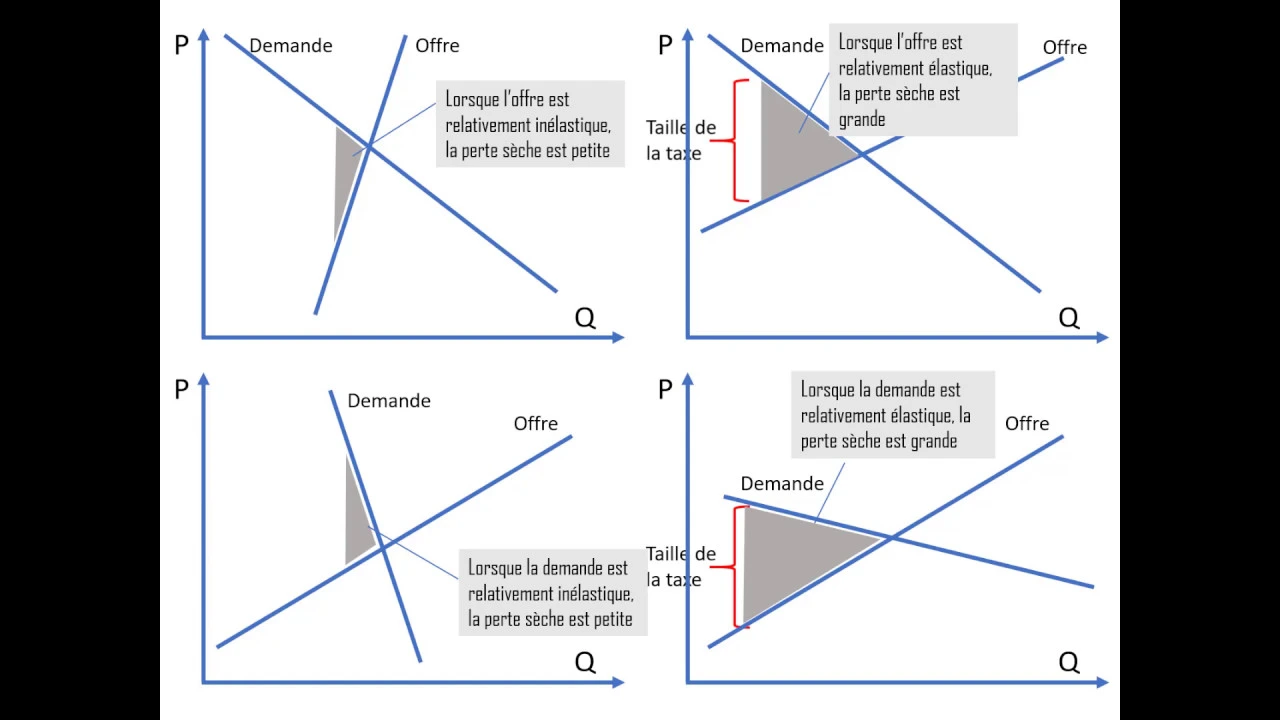
Fiscalité 6 : le coût de la fiscalité (1/2) La perte sèche
6.3K
Taxation modifies the incentives of economic agents (consumers and producers) by altering the price system. In a market economy, agents respond to price signals. When taxation reduces the net return for producers (through higher taxes on income or profits), their incentive to work and produce decreases. Similarly, when consumers face higher prices due to taxes, their incentive to purchase goods decreases. The fundamental principle is that taxation reduces the quantities exchanged in markets.
Click to watch →

Public Finance MCQ || Economics MCQ public Finance // लोक वित्त अथवा लोक राजस्व के महत्वपूर्ण प्रश्न
5K
This section covers core public finance concepts including the Increasing State Activity theory (Schumpeter) linking economic growth to public sector expansion, proportional tax systems with constant rates, the Benefit Principle (Adam Smith/Lindahl) tying taxes to services received, Expenditure Tax introduced by T.T. Krishnamachari, and Merit Goods (Musgrave) providing positive externalities like education. These foundational principles establish how governments finance public services and distribute tax burdens fairly.
Click to watch →

(Lesson: 11) 12th Economics | நிதிப் பொருளியல் | 94 Line by line Questions | Best Revision Video |
24.5K
Public Finance (பொதுநிதி) originates from the Greek word 'Bisqal' meaning 'basket,' representing the government's treasury. It is defined as the study of government revenue and expenditure, serving as a boundary between Political Science and Economics. Adam Smith defined it as the study of government revenue and expenditure nature and policies. Modern Public Finance encompasses five sub-disciplines: Public Revenue, Public Expenditure, Public Debt, Public Finance Policy, and Public Finance Management. Tax is defined as a compulsory payment without expecting specific benefits. Adam Smith's four principles of taxation are: Principle of Ability to Pay, Principle of Certainty, Principle of Convenience, and Principle of Economy. Direct taxes (like Income Tax) are based on ability to pay with progressive rates. Indirect taxes (like Excise Duty, Sales Tax) are based on equality at uniform rates. GST (Goods and Services Tax) is an indirect tax implemented on July 1, 2017, with three types: CGST, SGST, and IGST.
Click to watch →

TTAADC || Fiscal policy || Marathon class || By Susmita ma'am || #ttaadc #tripurajob
4.8K
Taxation principles include ability-to-pay (progressive taxation based on income/wealth), horizontal equity (equal treatment of equals), and vertical equity (unequal treatment of unequals). Direct taxes like income tax cannot be shifted and are borne entirely by taxpayers, while indirect taxes like sales tax can be shifted through market mechanisms. The incidence of tax refers to who ultimately bears the burden, distinguishing from impact (who initially pays). Diffusion theory explains how taxes shift through economic chains. Peacock and Wiseman's step-like hypothesis suggests public expenditure increases in discrete jumps rather than smoothly. The critical limit hypothesis suggests diminishing returns to public expenditure beyond certain thresholds. Public debt categorizes into productive debt (infrastructure financing) and unproductive debt (war financing).
Click to watch →

Hora da Verdade Receita Federal: Finanças Públicas - Prof. Celso Natale
11.1K
Taxation principles include equity (fair distribution of tax burden), neutrality (minimal distortion of economic decisions), and efficiency (maximizing revenue with minimal administrative costs). Equity encompasses horizontal equity (similar situations treated similarly) and vertical equity (different situations treated differently). Tax incidence determines who ultimately bears the burden based on relative elasticities of supply and demand. Taxes on consumers shift demand curves, while taxes on producers shift supply curves, with the burden shared based on elasticities.
Click to watch →
Deep Dive
An understanding of income inequality dynamics, specifically the distinction between labor income (wages) and capital income (profits).
STICERD Morishima Lecture | Daniel Markovits | The Meritocracy Trap
1.8K
The conceptual distinction between labor income and capital income is between income that has its roots in the earner's own effort and skill (labor income) and income that has its roots elsewhere (capital income, most characteristically inherited wealth). For example, an entrepreneur who founds a company and sells it for money has labor income, even though the income comes most immediately from selling founder shares. A hedge fund manager managing assets they do not own has labor income, even though their income is taxed as capital gains.
Click to watch →

EPOG seminar #180: Gérard DUMÉNIL – Managerial capitalism or Macroeconomic Financial frontier
803
The researchers distinguish between wage income and capital income when analyzing inequality. Wage income includes all supplements to wages, while capital income includes interest, dividends, and capital gains. The key finding is that the concentration of wage income at the top has increased dramatically, while the concentration of capital income has remained relatively flat after World War II. This distinction is crucial because it reveals that the rise of inequality is primarily driven by wage inequality rather than capital income inequality. The researchers argue that this has important implications for understanding the causes of inequality and for developing policies to address it.
Click to watch →

The Hindu Newspaper Analysis | 11 November 2025 | Current Affairs for UPSC CSE | Drishti IAS
29.8K
Global income inequality is characterized by the widening gap between capital owners and laborers. Capital owners earn from profits, rent, and dividends, while laborers earn from wages and salaries. Data shows capital income share is increasing rapidly while labor income share is growing minimally. In 1980, labor share was 65-70% and capital share was 60%, but these proportions have shifted significantly. The Gini coefficient measures inequality, with 0 representing perfect equality and 1 representing perfect inequality. Countries with Gini above 0.4 are classified as having high inequality. 83% of countries experience high income inequality, affecting 90% of the world's population.
Click to watch →

Connecting income to capital growth and potential inequality | Macroeconomics | Khan Academy
23.5K
National income can be divided between two main groups: labor income (wages paid to workers) and capital income (returns on wealth such as buildings, real estate, and resources owned by capital holders). When capital income grows faster than labor income, a larger percentage of national income flows to capital owners. Since capital ownership is itself highly concentrated among the wealthy, this dynamic drives increasing income inequality. The concentration of both capital and income among the upper decile creates a self-reinforcing cycle where those with existing wealth generate more income, further concentrating economic resources.
Click to watch →

PART I: MASTERING THE UNIVERSE BY ROB LARSON
250
While wage inequality (labor income) is often discussed, the real inequality rests in ownership of capital. The disparity in capital ownership creates a flow of passive income that makes money for those who own it. For the very richest families, capital income dominates their earnings, and their money makes money for them. This creates a self-reinforcing cycle where wealth begets more wealth through passive income streams.
Click to watch →
Deep Dive
The concept of 'technological unemployment' and its historical impacts on the workforce and wage stagnation.

Technological Unemployment: Skills, Place, & Identity | Daniel Susskind
1.4K
John Maynard Keynes coined 'technological unemployment' in 1931, describing job loss from labor-saving innovations outpacing new job creation. Despite periodic automation anxieties throughout economic history, technological progress has historically created more jobs than it destroyed. New technologies exert two opposing forces on labor markets: substitution (machines replacing human workers) and complementarity (machines creating new human tasks). The complementarity force has historically won, making 'structural technological unemployment' rare. However, current generative AI systems are expanding into domains previously thought exclusively human, raising questions about whether this historical pattern will continue. Frictional technological unemployment describes situations where work exists but people cannot access it, named after Tantalus who stood beside water and fruit he could never reach. Three barriers cause frictional unemployment: skills mismatch (workers lack required abilities), place mismatch (workers live where jobs aren't created), and identity mismatch (workers refuse jobs conflicting with self-conception).
Click to watch →

Technological Unemployment
660
Technological unemployment—job loss from technological advancement—has shaped human history since Aristotle first speculated on machines replacing labor. Ancient civilizations responded through relief programs, public works, and religious support. The Black Death caused medieval European unemployment, triggering resistance against labor-saving technologies. Classical economists developed compensation theories arguing machinery shifts workers to different sectors, while Marx challenged these views pessimistically. The 20th century saw debates shift to the US, with major concerns in the 1930s and 1960s. The 2013 surge in concerns came from studies projecting significant job losses despite rising output. Research reveals automation threatens electronics manufacturing across Asia (74-81% vulnerability in Thailand, Vietnam, Philippines), with the developing world facing 75% job risk. U.S. Council of Economic Advisors found low-wage jobs ($<20/hour) face 83% risk. Policy responses span working hours reduction, public works programs, basic income pilots in Finland, Netherlands, and Canada, educational strategies emphasizing STEM disciplines, and market-based approaches requiring companies to employ humans. The Zeitgeist Movement and Venus Project envision a post-scarcity economy transforming traditional jobs into opportunities for automation enhancement, freeing time for creative pursuits.
Click to watch →

Praca bez sensu | David Graeber
10.1K
Technological unemployment is an economic phenomenon where rapid technological advancement makes human labor unnecessary or reduced in quantity. Historical examples include the Industrial Revolution's automated looms displacing manual textile workers, and modern self-service kiosks threatening cashier positions. Automation now threatens all work categories, including creative fields like writing, as AI demonstrates capability to generate coherent literary text. The fundamental contradiction emerges: fewer workers are needed to produce sufficient goods, yet humans require employment for survival. This creates a systemic challenge where meaningful work may disappear before solutions emerge.
Click to watch →

Tecnologías Enabling y Replacing, Skill Bias y Mercado del Trabajo
217
Technology affects labor markets differently across time periods. In the 1960s-1970s, technology generally improved conditions for all workers and created employment, described as 'raising the tide and lifting all boats.' However, starting in the 1990s, a fundamental change occurred where some wages began to decrease. Technology can be categorized into two types: enabling technologies that enhance workers' capabilities by building on existing skills, and replacing technologies that substitute human workers with machines at lower cost.
Click to watch →

123 | Épisode spécial Q&A
2.2K
The concern about technological unemployment is largely a myth because historical patterns show that technological changes create new sectors and jobs rather than eliminating employment. When productivity increases in certain sectors, wages rise relative to others, workers transition to new sectors, and new industries emerge. The adjustment period can be difficult and costly, but the long-term trend is toward full employment. Technological change primarily affects two groups most severely: workers with highly specific human capital whose skills are only valuable in one company or industry, and workers with low levels of general education. The Luddite movement (1811-1812) represents a recurring pattern of resistance to technological change, where workers destroyed machines because they believed machines were stealing their jobs. The underlying emotions are fear and lack of confidence in one's ability to adapt. The socialist movement is described as the most effective form of technological regression because it systematically destroys innovation by removing profit incentives for technological advancement.
Click to watch →
Prerequisite Knowledge
- Concept 01The economic concept of 'capital-labor substitution' and how automation replaces human workers in the production process.
- Concept 02Basic principles of public finance and taxation, including how taxes alter economic incentives and market outcomes.
- Concept 03An understanding of income inequality dynamics, specifically the distinction between labor income (wages) and capital income (profits).
- Concept 04The concept of 'technological unemployment' and its historical impacts on the workforce and wage stagnation.
Subsequent Learning
- Step 01The practical and legal challenges of defining a 'robot' or 'automation technology' for tax policy implementation.
- Step 02Alternative or complementary policy solutions to automation-driven disruption, such as Universal Basic Income (UBI) and wealth taxes.
- Step 03The macroeconomic trade-offs of a robot tax, particularly its potential to slow down technological innovation, productivity growth, and international competitiveness.
- Step 04Advanced welfare economics models that calculate optimal tax rates on capital versus labor in highly automated societies.
Robot Tax Study
Concept Discussed
Tax Justification
Global Precedents
MIT Findings
Trade Tax Parallel
Rate Recommendations
Specific Tax Rates
Robot Tax Study
0:00Playing Section
- 1
A study proposes a modest robot levy to offset automation's impact on inequality.
- 2
The tax aims to counter income disparity caused by job-replacing automation.
Stifling Innovation and Global Competitiveness
Opponents of a robot tax, including prominent economists and industry leaders, argue that taxing automation is counterproductive. First, defining what constitutes a "robot" is highly arbitrary, making such a tax difficult to administer. Second, by increasing the cost of adopting new technologies, a robot tax stifles innovation and slows down productivity growth, which is the primary driver of long-term economic prosperity and rising living standards. Lastly, in a globalized economy, imposing a robot tax would severely damage a nation's international competitiveness, incentivizing companies to relocate manufacturing and research to countries with more favorable tax regimes. Critics argue that instead of penalizing technological progress, governments should focus on alternative mechanisms to address inequality, such as broad-based tax reforms, stronger social safety nets, and robust worker retraining programs.
Deep Dive
The practical and legal challenges of defining a 'robot' or 'automation technology' for tax policy implementation.
![[이럿타 178회 2부] 빅데이터세!!!](https://i.ytimg.com/vi/afHR1XNj9jY/maxresdefault.jpg)
[이럿타 178회 2부] 빅데이터세!!!
131
Robots are defined by four criteria: autonomy through sensor data exchange, self-learning capability, physical form, and ability to take spontaneous action. The physical form is the key distinction between robots and software. Korea's 2016 Robot Development and Promotion Act defines robots as systems that autonomously perform perception, judgment, and action functions. Robot taxes serve two purposes: addressing negative externalities of automation like job displacement, and redistributing automation benefits to society. Implementation challenges include determining which systems qualify as robots, defining appropriate tax rates, and ensuring the tax base is broad enough to be effective. The European Parliament's 2017 proposal to grant robots legal personhood was rejected. Robot taxes can be implemented by measuring work hour reductions due to automation and calculating tax rates based on employed workers.
Click to watch →

Tributação da Economia Digital e Tecnologia
442
Taxing robots presents fundamental conceptual challenges. The first challenge is defining what constitutes a 'robot' - whether it refers to physical machines, automated systems, or AI-driven software. The second challenge is determining whether taxation should apply to general automation or only to automation that actually substitutes human labor. These definitional issues complicate the creation of effective tax policies for automated systems.
Click to watch →

Taxing Artificial Intelligence & Robots
813
Current proposals for taxing AI and robots conflict with fundamental tax policy principles including neutrality, simplicity, uncertainty, efficiency, effectiveness, fairness, and flexibility. The core challenge is defining what constitutes AI and robots, which is difficult given rapid technological development where definitions can become obsolete within months. Additionally, AI/robots are not comparable to human workers since they cannot independently seek alternative employment if displaced, unlike humans who can switch jobs.
Click to watch →
![세금 얘긴 왜 은근슬쩍 빼는 거죠? [YTN라디오 이슈&피플]#세금 #세제개혁 #대선공약](https://i.ytimg.com/vi/wbzvBY9vTcU/maxresdefault.jpg)
세금 얘긴 왜 은근슬쩍 빼는 거죠? [YTN라디오 이슈&피플]#세금 #세제개혁 #대선공약
647
Taxing robots or automation technology presents unique challenges because there is no clear definition of what constitutes a 'robot' for tax purposes. Without a clear definition, it is difficult to determine what should be taxed and what should receive tax incentives. This creates policy confusion and potential unfairness in the tax system.
Click to watch →
Taxing Robots: Background, Pitfalls, and a Possible Solution
131
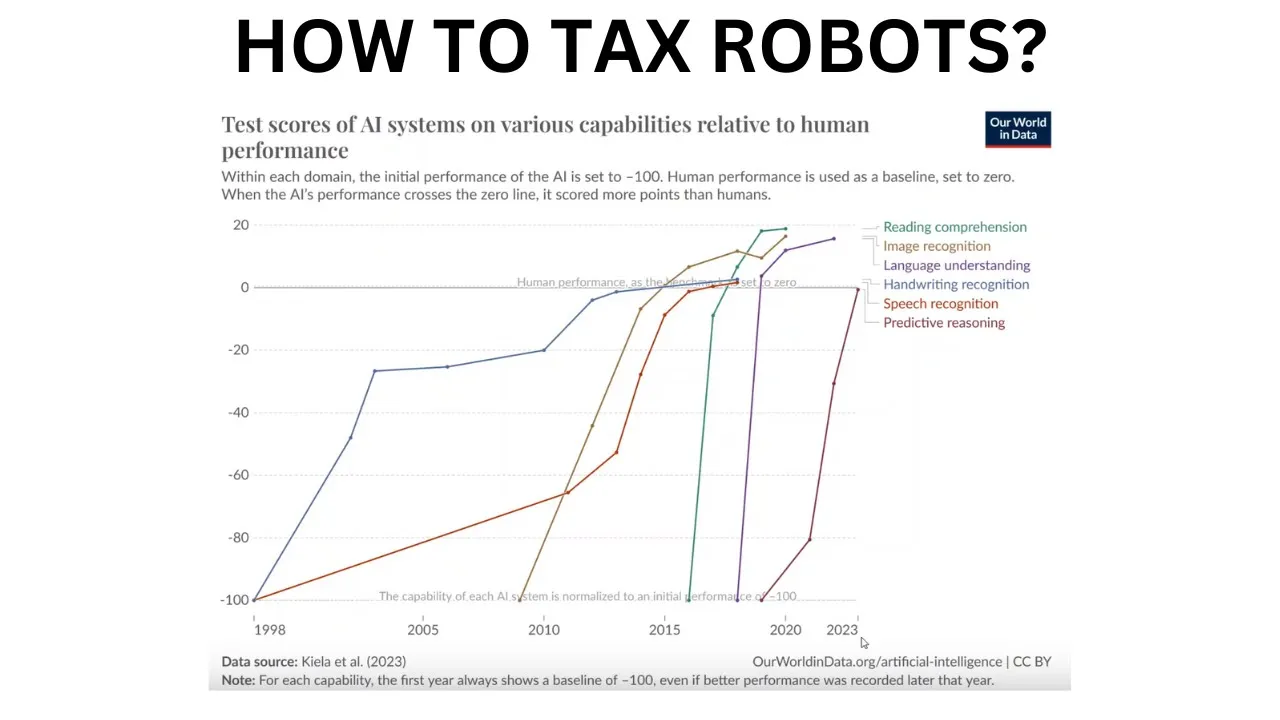
This section analyzes why robot taxes face fundamental obstacles and presents electricity taxes as superior alternatives. Robot taxes face four critical problems: (1) Definitional challenges—robots must be movable along three axes and reprogrammable, but this definition allows circumvention; (2) Other automation technologies like 3D printers and self-driving cars may not qualify, and AI systems present particular challenges since they lack physical entities to tax; (3) Research demonstrates that robot taxes discourage innovation and automation adoption, making workers worse off even when proceeds help affected workers; (4) Countries implementing robot taxes face offshoring risks, as firms relocate to nations without such taxes, undermining policy effectiveness. A production function model shows that when automation capital is more electricity-intensive than traditional capital (true for industrial robots and likely for AI), electricity taxes can replicate robot tax effects on capital accumulation and labor use. This approach offers critical advantages: electricity taxes are already widely implemented and straightforward to apply; they avoid definitional problems by not requiring robot definitions; they create no legal issues by treating all electricity users equally; and they can foster cleaner production if electricity generation relies on fossil fuels. By applying electricity or CO2 taxes on automation, policies can address environmental concerns while managing automation's distributional effects more effectively than direct robot taxation.
Click to watch →
Deep Dive
Alternative or complementary policy solutions to automation-driven disruption, such as Universal Basic Income (UBI) and wealth taxes.

GDY MASZYNY ODBIORĄ NAM PRACĘ..
163.5K
Bill Gates proposes Universal Basic Income (UBI) as a necessary complement to automation. His argument: robots should be taxed like human workers since they displace human labor. The state would guarantee basic income to displaced workers, funded by robot taxation covering energy, maintenance, and repair costs. This approach addresses the economic disruption caused by automation while maintaining social stability.
Click to watch →

I Was Totally Unprepared For This Conversation
91.3K
Platforms evolve over time as users discover new ways to use them. The personal computer was initially inferior to mainframes but eventually dominated because users discovered ways to make it more useful. Universal Basic Income (UBI) could provide a foundation for people to pursue meaningful work rather than survival employment. Pigovian taxes are taxes on activities that create negative externalities, such as pollution or non-biodegradable plastic, which can be used to fund UBI. Automation and artificial intelligence will change the nature of work, potentially making traditional social security systems unsustainable.
Click to watch →

Universal Basic Income--For or Against? A Debate
95.5K
UBI addresses two key challenges from automation and technological change. First, it creates incentives where employers must offer good wages and working conditions to attract workers, addressing the current problem where companies capture automation benefits without sharing them. Second, UBI cushions workers displaced by creative destruction—when industries decline, workers can transition without falling into poverty. Without UBI, displaced workers often cannot find comparable employment and may become permanently dependent on disability programs. UBI provides a safety net that allows people to search for better opportunities while maintaining dignity and independence.
Click to watch →

PODCAST #01: Zukunftsthemen, Wissenschaft, Wirtschaft & mehr! - Chatisfying
53.6K
Universal Basic Income (UBI) is a proposed solution to economic disruption from automation. In a highly automated society where robots perform most work, robots could pay taxes that fund UBI for all citizens. This would ensure that everyone has access to basic resources regardless of their ability to work.
Click to watch →

Renda Basica Universal
1.6K
UBI implementation scenarios include: (1) Model A - full universal payment (800-1500 euros/month in rich countries, 600-1000 reais/month in emerging countries), funded by taxes on automation, wealth, data, and natural resources; (2) Model B - partial universal payment with additional benefits for those in need; (3) Model C - guaranteed income where high earners pay more taxes to fund benefits for those who lost jobs to automation. The most likely scenario is partial and digital UBI implemented through Central Bank Digital Currencies (CBDC), with government control over eligibility.
Click to watch →
Deep Dive
The macroeconomic trade-offs of a robot tax, particularly its potential to slow down technological innovation, productivity growth, and international competitiveness.

Los sindicatos contra la IA: quieren condenar a España a la mediocridad
40K
When a tax is imposed on robots (machines that perform complex automated operations), companies face increased costs for automation. This creates a strong economic incentive for companies to invest less in robots and automation technologies. The result is reduced productivity improvements across the economy, as companies delay or avoid adopting technologies that could increase output per worker. This demonstrates how taxation policies targeting automation can inadvertently slow economic progress and productivity growth.
Click to watch →

Crisis demográfica, decrecimiento económico y transición energética
40.9K
Taxing robots could undermine a country's economic competitiveness by making it more expensive to adopt automation. Countries that impose taxes on robots may be at a disadvantage compared to countries that do not, as they will be slower to adopt productivity-enhancing technologies. This creates a potential race to the bottom where countries compete to have the most favorable regulatory environment for automation adoption. The challenge is balancing social protection with maintaining economic competitiveness in an automated economy.
Click to watch →
![[Intelligence-High School Debate] Ep.4 - This house would implement a robot tax _ Full Episode](https://i.ytimg.com/vi_webp/mJtLg3mrHx0/maxresdefault.webp)
[Intelligence-High School Debate] Ep.4 - This house would implement a robot tax _ Full Episode
30.3K
Robot taxation prevents innovations and causes losses of social benefits. It is hard to define exact robots, making it difficult to impose taxes efficiently. In the long term, robot taxation could lower the productivity and efficiency of the nation, potentially reducing the nation's competitiveness in the global economy.
Click to watch →

Debata Paweł Nowak vs Marcin Kumięga w formacie 1vs1
189
Implementing robot taxation involves complex policy trade-offs: (1) Supporting robotization for competitiveness requires lower taxes on automation, (2) Protecting workers requires higher taxes on robots, (3) These objectives conflict directly. The proposition argues that minimal symbolic taxation would not solve the fundamental problem, while significant taxation would undermine the competitiveness benefits that justify robotization investments.
Click to watch →
R&D-Based Growth and Automation Part 2: Results
751
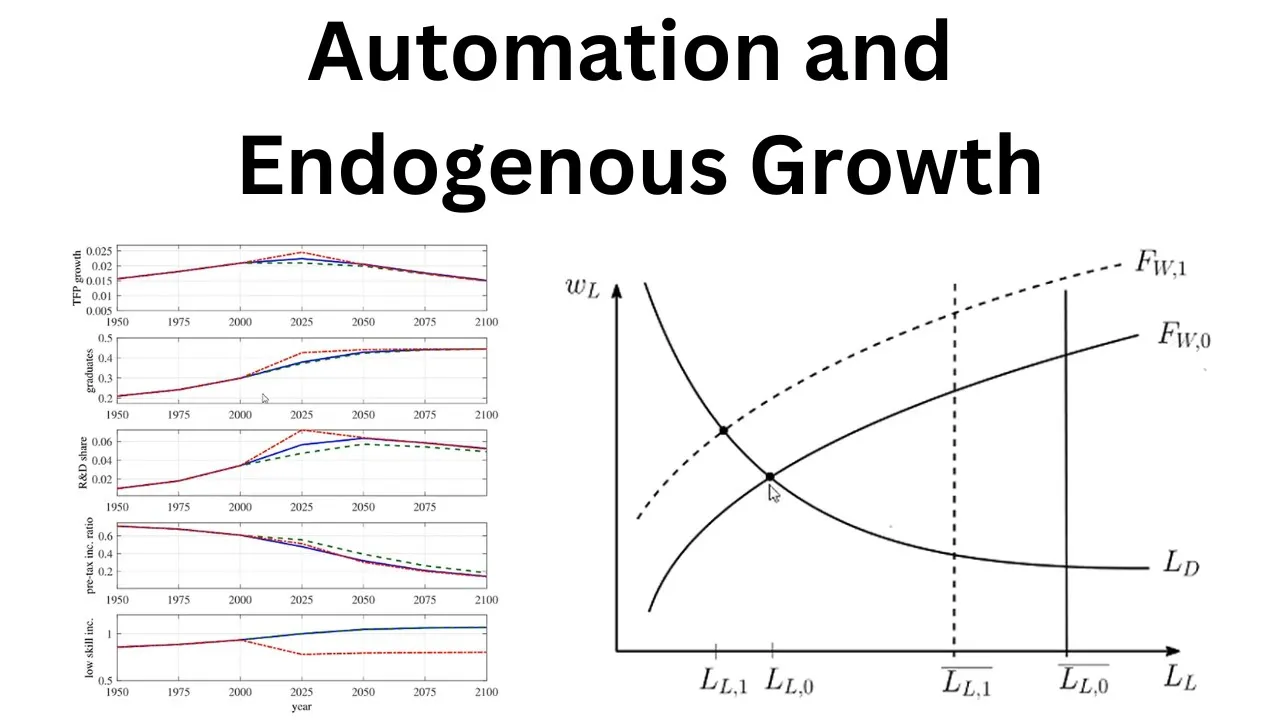
Implementing a robot tax to redistribute income to those harmed by automation creates an equity-efficiency trade-off. Redistribution reduces the incentive for low-skilled workers to invest in education, lowering the share of graduates and reducing R&D investment, which slows TFP growth. However, it provides income support to affected workers. A robot tax produces a stronger reduction in growth but also a smaller reduction in income inequality compared to a wage tax. The trade-off shows that policies aimed at reducing inequality must accept reduced economic growth as a consequence.
Click to watch →
Deep Dive
Advanced welfare economics models that calculate optimal tax rates on capital versus labor in highly automated societies.
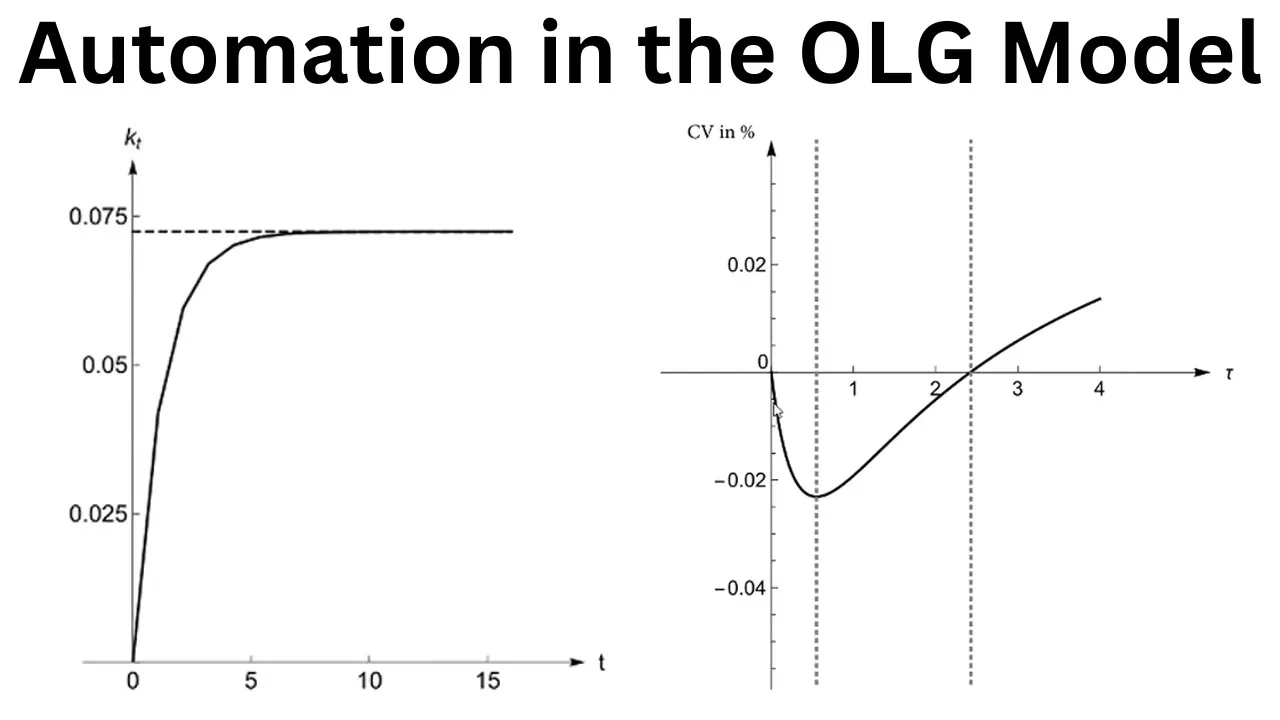
The Overlapping Generations Model With Automation
1.4K
This section analyzes whether policy intervention can address automation-induced stagnation. A robot tax τ levied on firms and redistributed lump-sum to households shows complex welfare effects. Moderate taxes (around 50%) are welfare-increasing because young individuals benefit from automation-induced wage increases and receive redistributed proceeds, enabling savings and investment. However, very high taxes eventually reduce welfare by lowering returns to traditional capital. The optimal tax rate exceeds 200%. This demonstrates that the Chamley-Judd result—that capital taxation always reduces welfare—breaks down in automation contexts. The key insight is that automation creates conditions where capital taxation can be welfare-improving, challenging standard public finance conclusions.
Click to watch →

👉 Keine Steuern mehr bis 50.000 €? Wie dieses Modell das Amt überflüssig macht!
109
This segment details how to restructure taxation and welfare systems for an automated economy. A negative income tax provides payments to those earning below a threshold (e.g., 50,000 euros), replacing the entire social welfare apparatus including unemployment insurance and job centers. Rather than taxing machines or robots (which would punish technological progress), society should tax the increased productivity and cost savings that automation generates. A fundamental unfairness exists where capital income is taxed at lower rates than labor income—someone earning 200,000 euros from employment pays nearly 50% in taxes while the same amount from investments pays only 25%. This disparity should be corrected by taxing capital income more heavily and labor income less, recognizing that earned income requires effort while investment income does not.
Click to watch →

Artificial Intelligence and Economic Growth | Hoover Institution
7.5K
The task-based model assumes symmetric tasks where capital and labor are perfect substitutes on automated tasks but complements across all tasks. As automation expands (β increases), capital spreads thinly across more tasks (dilution effect), reducing capital-augmenting effects while increasing labor-augmenting effects. This creates a twist in technological change that is neither purely capital-augmenting nor labor-augmenting. The law of motion β̇ = θ(1 - β) implies β approaches 1 asymptotically. Despite near-complete automation, labor share converges to approximately two-thirds because labor remains the scarce factor concentrated on essential tasks. The weak link constraint means even with infinite capital, bottlenecks preserve high wages.
Click to watch →

KOLLABIERT durch Künstliche Intelligenz der JOBMARKT? - VisualEconomik DE
70.7K
Of course, a worker in Germany earns more than one in Bangladesh through this. But the lives of people in Bangladesh are also improved by the innovations and creativity of German workers. Simply by higher productivity benefiting all of humanity. How this distribution question is to be solved in the case of extremely high automation is a rather political and social problem that we should address in a separate video.
Click to watch →

Topic 4: Optimal Taxation Part 1 | Economics 2450A: Public Economics
40.7K
Applying Ramsey logic to savings reveals the Chamley-Judd result: optimal capital income tax rates converge to zero in infinite-horizon models. With capital income tax θ, the post-tax price of period-t consumption is [1/(1+(1-θ)r)]^t. For any θ > 0, this ratio approaches infinity as t → ∞, implying infinitely large distortions on future consumption. Since optimal tax rates cannot approach infinity, θ must converge to zero asymptotically. This suggests labor income taxation may be preferable to capital income taxation.
Click to watch →
Robot Tax Study
Concept Discussed
Tax Justification
Global Precedents
MIT Findings
Trade Tax Parallel
Rate Recommendations
Specific Tax Rates
Robot Tax Study
0:00- 1
A study proposes a modest robot levy to offset automation's impact on inequality.
- 2
The tax aims to counter income disparity caused by job-replacing automation.
Stifling Innovation and Global Competitiveness
Opponents of a robot tax, including prominent economists and industry leaders, argue that taxing automation is counterproductive. First, defining what constitutes a "robot" is highly arbitrary, making such a tax difficult to administer. Second, by increasing the cost of adopting new technologies, a robot tax stifles innovation and slows down productivity growth, which is the primary driver of long-term economic prosperity and rising living standards. Lastly, in a globalized economy, imposing a robot tax would severely damage a nation's international competitiveness, incentivizing companies to relocate manufacturing and research to countries with more favorable tax regimes. Critics argue that instead of penalizing technological progress, governments should focus on alternative mechanisms to address inequality, such as broad-based tax reforms, stronger social safety nets, and robust worker retraining programs.
The economic concept of 'capital-labor substitution' and how automation replaces human workers in the production process.
Basic principles of public finance and taxation, including how taxes alter economic incentives and market outcomes.
An understanding of income inequality dynamics, specifically the distinction between labor income (wages) and capital income (profits).
The concept of 'technological unemployment' and its historical impacts on the workforce and wage stagnation.
The practical and legal challenges of defining a 'robot' or 'automation technology' for tax policy implementation.
Alternative or complementary policy solutions to automation-driven disruption, such as Universal Basic Income (UBI) and wealth taxes.
The macroeconomic trade-offs of a robot tax, particularly its potential to slow down technological innovation, productivity growth, and international competitiveness.
Advanced welfare economics models that calculate optimal tax rates on capital versus labor in highly automated societies.
120 views3likes1:33@QPTOriginal Release: 2022-12-21
A study suggests a robot levy — but only a modest one — could help combat the effects of automation on income inequality in the U.S.
What if the U.S. placed a tax on robots?
The concept has been publicly discussed by policy analysts, scholars, and Bill Gates.
Because robots can replace jobs, the idea goes, a stiff tax on them would give firms incentive to help retain workers, while also compensating for a dropoff in payroll taxes when robots are used.
Thus far, South Korea has reduced incentives for firms to deploy robots; European Union policymakers, on the other hand, considered a robot tax but did not enact it.
Now a study by MIT economists scrutinizes the existing evidence and suggests the optimal policy in this situation would indeed include a tax on robots, but only a modest one.
The same applies to taxes on foreign trade that would also reduce U.S. jobs, the research finds.
The researcher says that their finding suggests that taxes on either robots or imported goods should be pretty small.
Specifically, the study finds that a tax on robots should range from 1 percent to 3.7 percent of their value, while trade taxes would be from 0.03 percent to 0.11 percent, given current U.S. income taxes.
Up Next

9:25
Network Effects Explained: Direct and Indirect Dynamics
@andreasmunzel9360
5.2K views•2021-04-26

5:07
Impact of Yuan in Indo-Russian Trade Amid Sanctions
@WION
261.9K views•2022-07-01
10:33
Behavioral Economics Explained: Rationality, Nudges, and Risk
@crashcourse
1.1M views•2016-03-12

113:18
The Age of Easy Money: Fed & Inflation | Full Documentary
@frontline
21.2M views•2023-03-15
Related Study Plans & Knowledge Roadmaps
Structured learning paths in Economics
economics
Sovereign Debt: Defaults, IMF & Restructuring
01Introduction to Sovereign Debt & Government Bonds
02Debt Sustainability & Credit Ratings
03Anatomy and History of Debt Crises
+ 2 more learning modules
12h5 modules
Explore Roadmap
economics
Market Design: Matching Theory & Gale-Shapley
01Introduction to Market Design and Price-Free Markets
02Two-Sided Matching & The Gale-Shapley Algorithm
03School Choice Systems and Mechanism Design
+ 2 more learning modules
10h5 modules
Explore Roadmap
economics
Impossible Trinity: Forex, Capital & Policy
01Introduction to Monetary Policy and Central Banking
02Exchange Rates and International Capital Flows
03The Mundell-Fleming Model
+ 2 more learning modules
8h5 modules
Explore Roadmap
economics
Healthcare Economics: Market Failures & Systems
01Introduction to Healthcare Markets and Market Failure
02Asymmetric Information and Adverse Selection
03Moral Hazard and Insurance Design
+ 2 more learning modules
12h5 modules
Explore Roadmap